
Judge, 1923-12-15 · page 11 of 36
Judge — December 15, 1923 — page 11: what you’re looking at
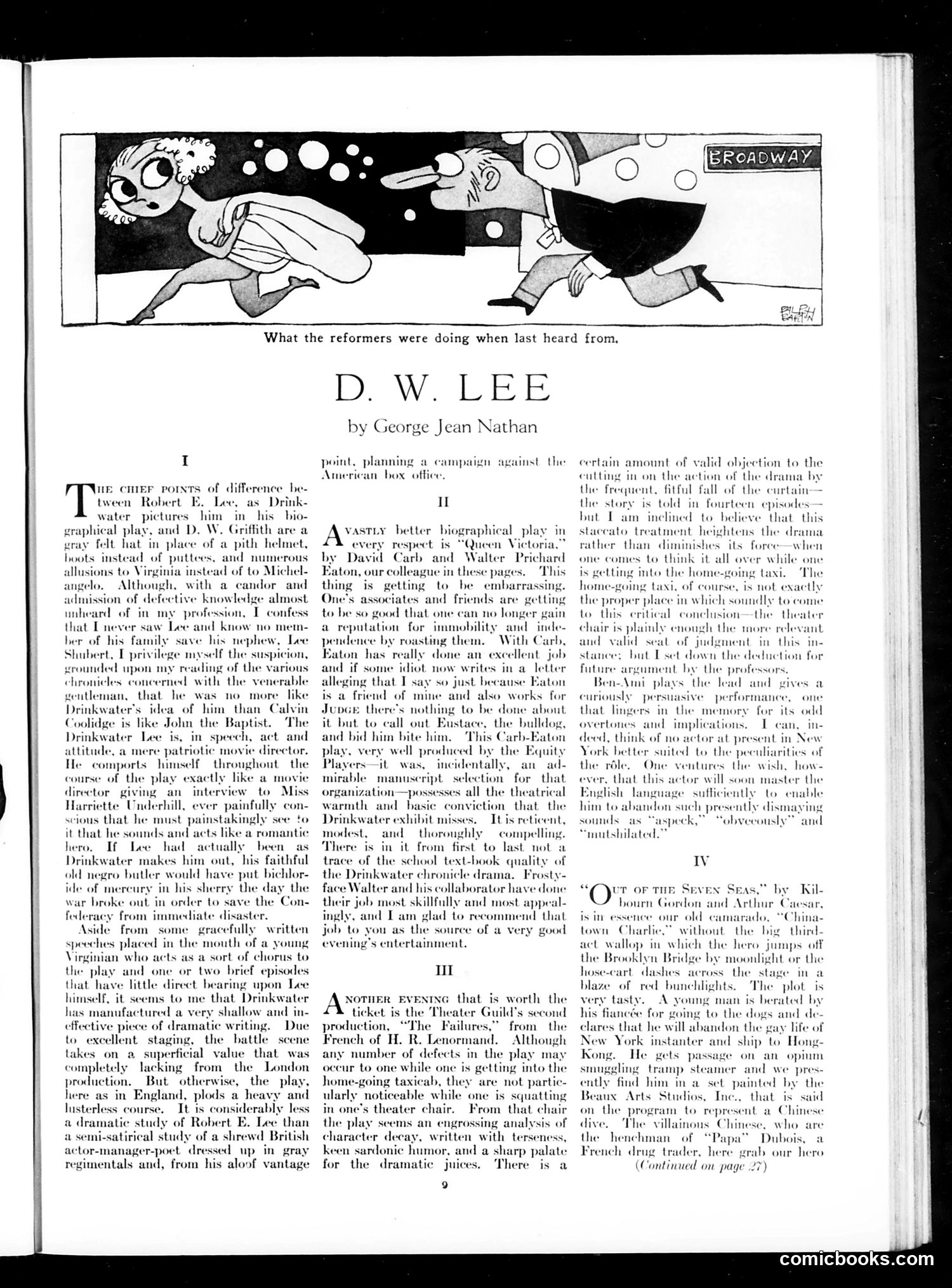
A restored page from Judge, 1923-12-15. Page through the whole issue in the reader above.
📄 Transcribed text from this page (OCR, searchable)
Machine-transcribed from the original scan — historical spelling and the odd misread are preserved.
WAY. What the reformers were doing when last hea I HE CHIEF points of difference be- tween Robert Lee, as Drink- water pictures him in his. bio- phical play, and D. W. Griffith are a vray felt hat in place of a pith helmet, boots instead of puttees, and numerous allusions to Virginia instead of to Michel- angelo. Although, with a candor and admission of defective knowledge almost unheard of in- my profession, [confess that [never saw Lee and know no mem- her of his family save his nephew, Lee .T privilege myself the suspicion, (J upon my reading of the various chronicles concerned with the venerable gentleman, t he more like Drinkwater’s a oof him than Calvin Coolidge is like John the Baptist. The Drinkwater Lee is, in speech, act and attitude, a mere patriotic movie director. He comports himself throughout the course of the play exactly like a movie director giving an interview to Miss Harriette Underhill, ever painfully con- scious that he must painstakingly see to it that he sounds and acts like a romantic been as Was no old negro butler would have put bichlor- ide of mercury in his sherry the day the war broke out in order to save the Con- federacy from immediate disaster. Aside from some gracefully written speeches placed in the mouth of a young Virginian who acts as a sort of chorus to the play and one or two brief episodes that have little direct bearing upon Lee himself, it seems to me that Drinkwater has manufactured a very shallow and in- » piece of dramatic writing. Due to excellent. staging, the battle scene takes on a superficial value that was complet lacking from the London productiot But otherwise, the play, here as in England, plods a heavy and lusterless course. It is considerably less a dramatic study of Robert E. Lee than a semi-satirical study of a shrewd British actor-manager-poet dressed up in. gray regimentals and, from his aloof vantage D. W. LEE by George Jean Nathan point, planning a campaign against: the American box office. II Assis better biographical play: in every respect is “Queen Victo by David Carb and Walter’ Pricl Eaton, our colleague in these p; Thi thing is getting to be embarrassing. One's associates and friends are getting to be so good that one can no longer gain a reputation for immobility and in pendence by roasting them. > With Carb, Eaton has really done an excellent job and if some idiot now writes in a | alleging that I say so just because E is a friend of mine and also works for Juvce there's nothing to be done about it but to call out Eustace, the bulldog, and bid him bite him. This Carb- “very well produced by the it’ was, incidentally, manuscript. selection for that organiz: I the theatrical warmth and basic conviction t the Drinkwater exhibit misses. It is reticent, modest, and thoroughly — compelling. There is in it from first to last not a trace of the school text-book quality of the Drinkwater chronicle drama. Frosty- face Walter and his collaborator have done their job most skillfully and most appe ingly, and Lam glad to recommend that job ‘to you as the source of a very good evening’s entertainment. jon—possesse: III NOTHER EVENING that is worth the ticket is the Theater Guild’s second production, “The Failures,” from the French of H. R. Lenormand. Although any number of defects in the play may occur to one while one is getting into the home-going taxicab, they are not partic- ularly noticeable while one is squatting in one’s theater chair. From that chair the play seems an engrossing analysis of character decay, written with terseness, keen sardonic humor, and a sharp palate for the dramatic juices. ‘There is a 9 certain amount of valid objection to the cutting in on th the frequent, fi ction of the drama by ul fall of the curtain— the story is told in fourteen episodes but Tam inclined to believe that) this staceato treatment heightens the drama rather than diminishes its force—when one comes to think it all o while one is getting into the home-going taxi. ‘The home-going taxi, of Course, is not exactly the proper place in which soundly to come to this critical conclusion—the theater chair is plainly enough the more relevant and valid seat of judgment. in stance; but Lset down the deduction for future argument by the 7 Ben-Ami_ plays the | curiously this in- ndand formance, one that lingers in the memory for its odd overtones and implications. I can, in- deed, think of no actor at present in New York better suited to the peculiarities of the rdle. One ventures the wish, how- ever, that this actor will soon master the English language sufficiently to enable him to abandon such presentiy dismaying week,” “obvecously” and gives a rsuasive sounds as * “mutshila IV x@) T OF THE SEVEN Seas,” by bourn Gordon and Arthur ¢ is in essence our old camarado, “Chin town Charlie,” without the big thire t wallop in which the hero jumps off the Brooklyn Bri by moonlight or the hose-cart dashes across the ce ina blaze of red bunchlights. The plot is very tasty. A young man is berated by his fiancée for going to the dogs and de- clares that he will abandon the gay life of w York instanter and ship to Hong- ong. He gets passage on an opium smuggling tramp steamer and we pres- ently find him ina set painted by the Beaux Arts Studios, Inc., that is said on the program to represent. a Chine dive. The villainous Chinese, who are the henchman of “Papa” Dubois, a French drug trader, here grab our hero (Continued on page 27) kil- sar, comicbooks.com