
A complete issue · 36 pages · 1923
Judge — September 22, 1923
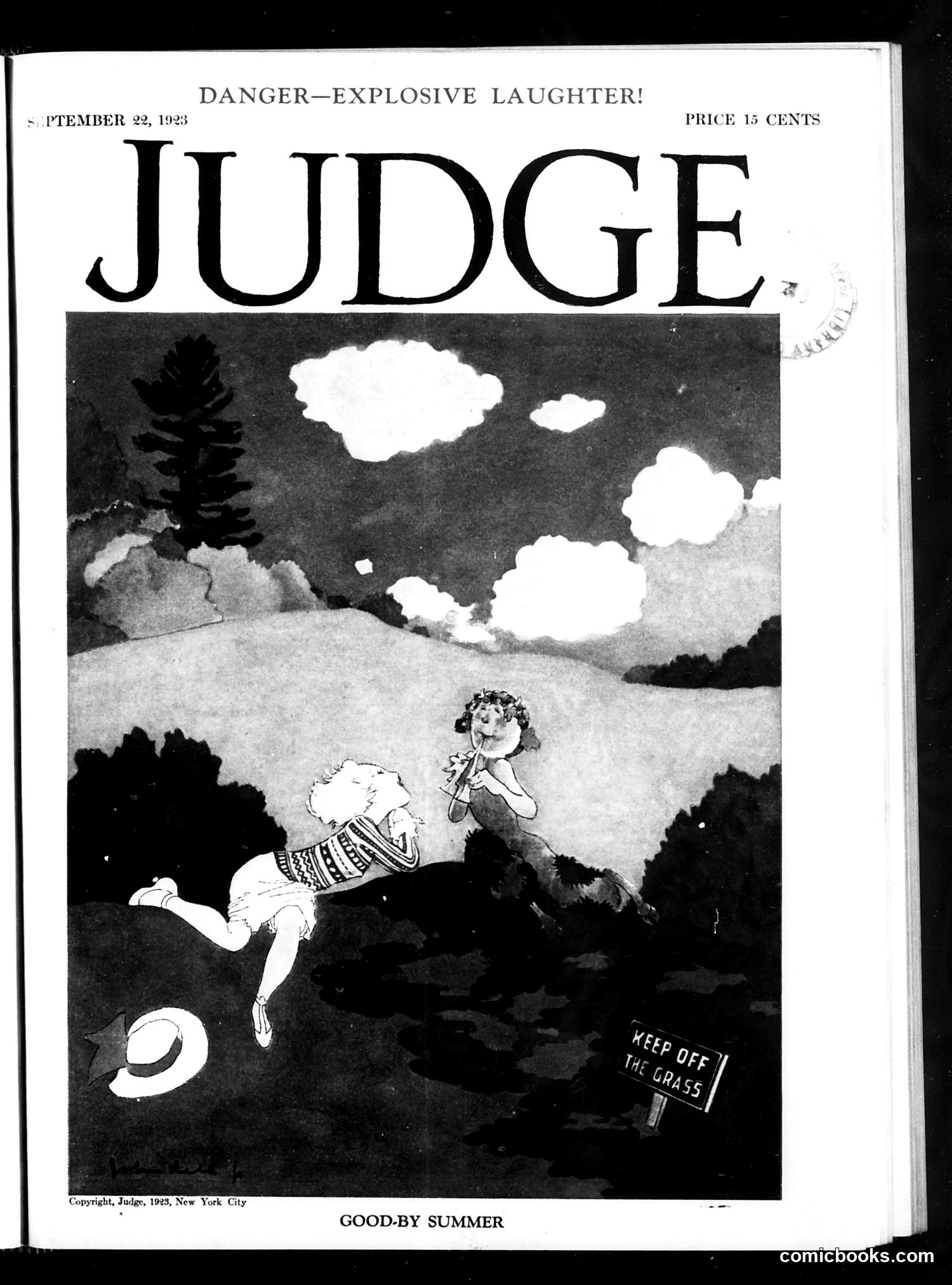
This cover cartoon depicts a young woman fleeing a pastoral summer landscape, her hat flying off as she runs. The "Keep Off the Grass" sign suggests she's escaping from a manicured, restrictive environment. The satire likely comments on the end of summer leisure and the return to social constraints. The woman's dynamic pose and lost hat convey liberation interrupted—she's breaking free from the formal restrictions of summer recreation (symbolized by "Keep Off the Grass") as the season ends. The subtitle "Danger—Explosive Laughter!" promises comedic content throughout the issue. Without additional context, the specific social critique remains somewhat ambiguous, though it appears to mock the tension between freedom and propriety in 1920s leisure culture.
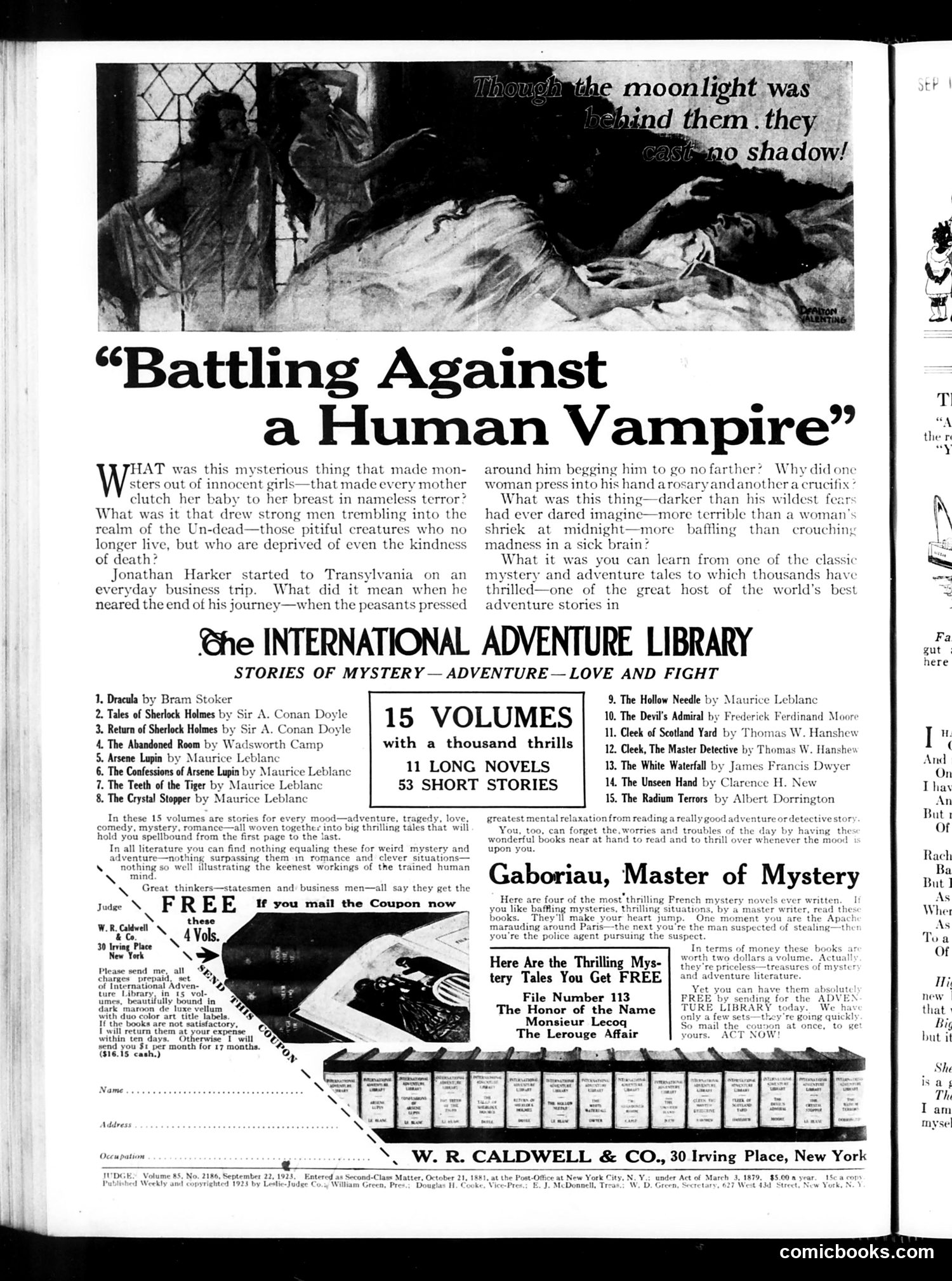
This page is **primarily an advertisement** for "The International Adventure Library," a 15-volume book collection marketed by W.R. Caldwell & Co. The ad emphasizes mystery, adventure, and romance stories. The small illustration at the top titled **"Battling Against a Human Vampire"** appears to be promotional artwork for one of the collection's stories, depicting dramatic gothic/horror imagery consistent with early 20th-century adventure fiction. The accompanying text introduces Jonathan Harker's journey to Transylvania, clearly referencing **Bram Stoker's "Dracula"** (listed as volume 1 of the collection). The "vampire" reference is literal—promoting classic horror literature rather than making political satire. The page contains no discernible political commentary; it is a straightforward commercial promotion for adventure and mystery novels.
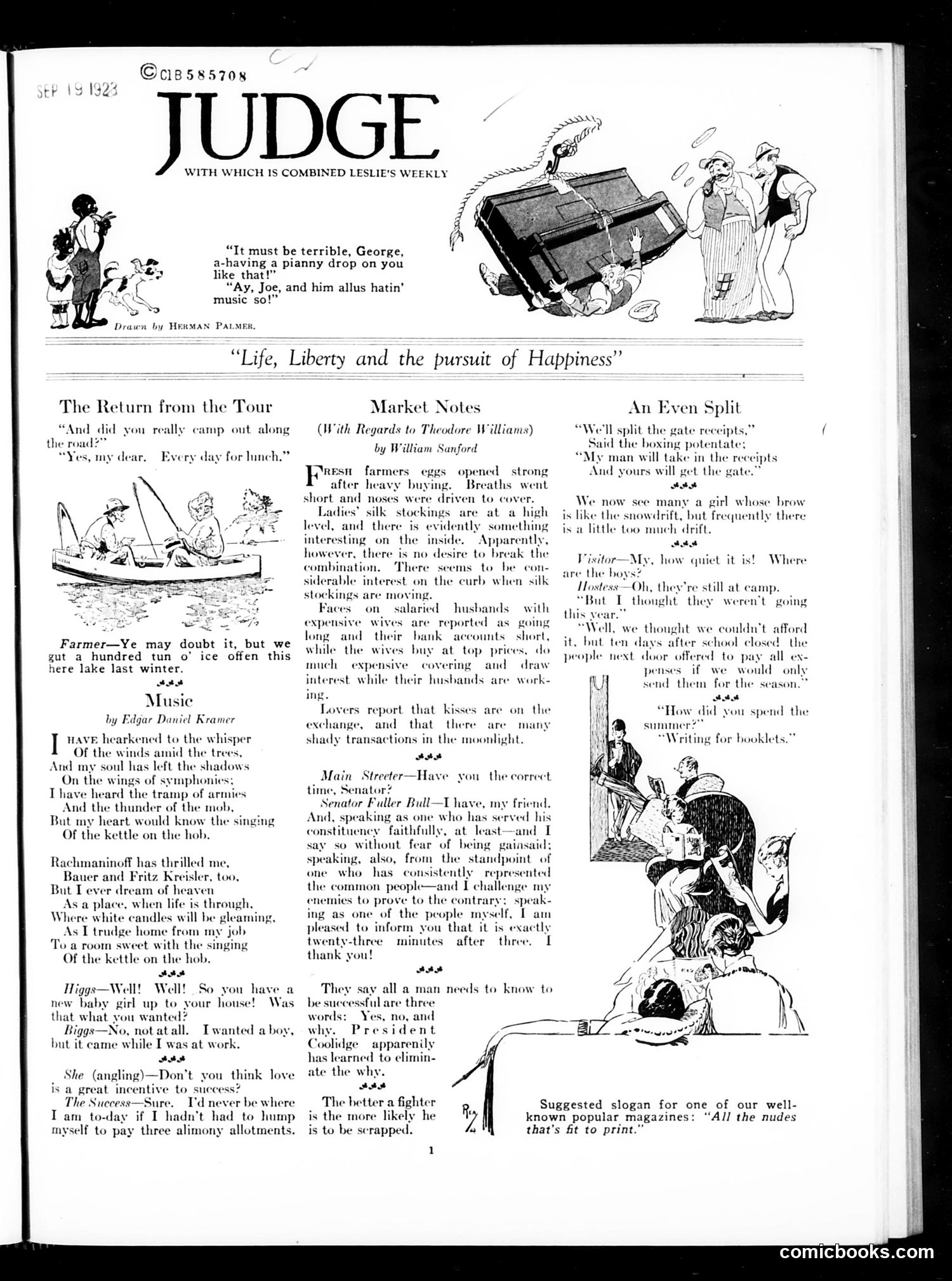
This page from Judge (dated September 19, 1923) contains satirical commentary and humorous pieces rather than political cartoons. The "Market Notes" section mocks post-WWI economic conditions: farmers struggling after heavy buying, women's silk stockings at inflated prices, and husbands trying to manage household finances while wives spend freely. The satire targets the economic inflation and gender dynamics of the 1920s. "An Even Split" jokes about boxing match gate receipts being divided between couple members. The "Music" poem references Rachmaninoff, Bauer, and Kreisler—famous classical composers—suggesting nostalgic longing for pre-war cultural stability amid post-war economic chaos. Overall, the page reflects 1920s concerns: inflation, changing gender roles in spending, and cultural displacement after World War I.
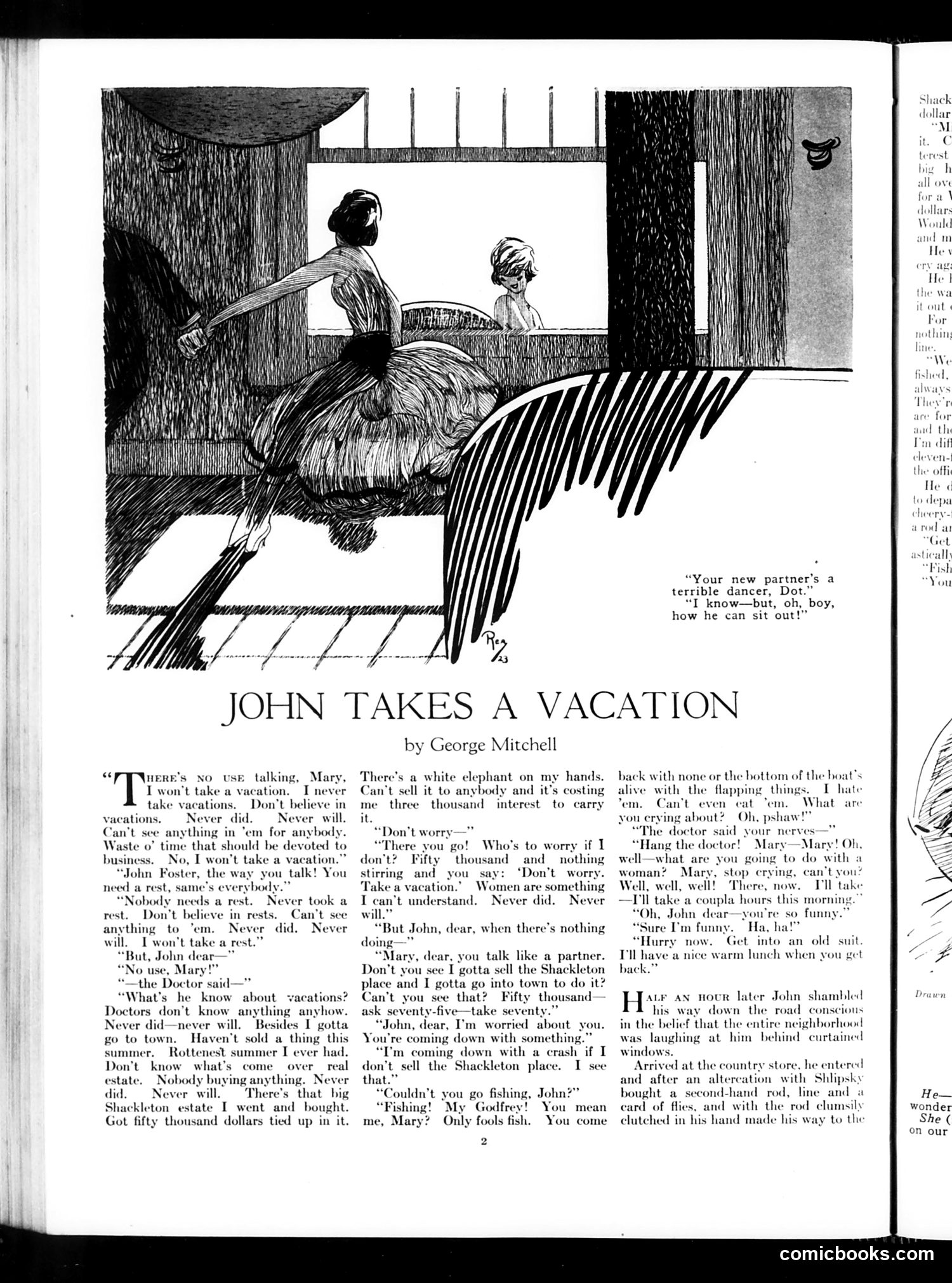
This story satirizes the conflict between a man's desire for rest and his wife's anxieties. John announces he won't take a vacation, claiming business demands his presence. Mary counters with increasingly absurd worries: he's stuck with a "white elephant" (unsellable property), the Shackleton estate will collapse without him, fishing is dangerous. The cartoon illustration shows a couple where the man appears exhausted while the woman gestures animatedly—capturing the domestic dynamic of the story. The satire mocks how spouses use exaggerated concerns to manipulate each other's leisure plans, and how vacations become sources of marital friction rather than rest. The humor lies in recognizing these relatable domestic power struggles.
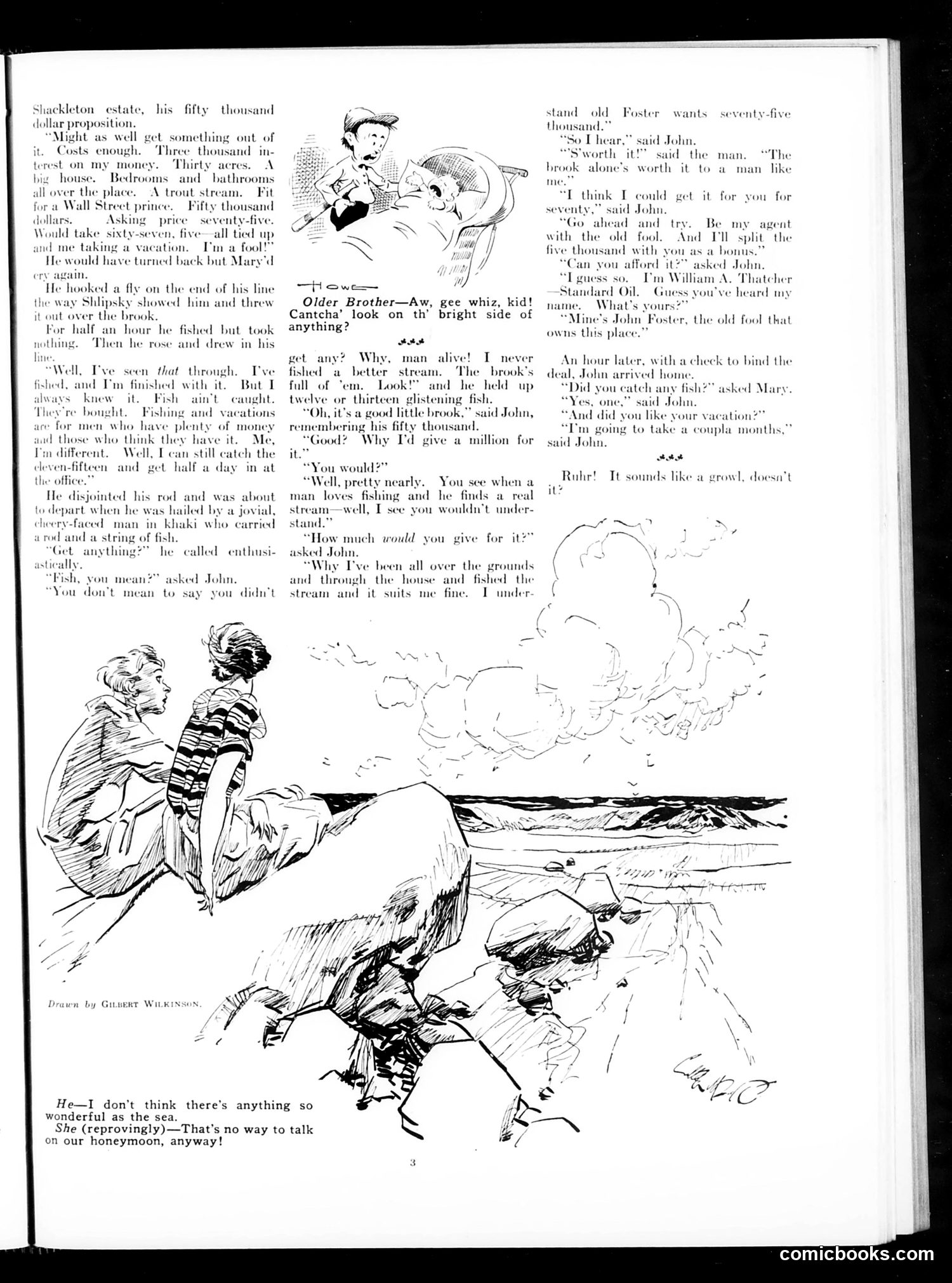
This page contains a humorous short story about two men negotiating over property and fishing rights. The narrative involves "old Foster" owning a valuable fifty-thousand-dollar estate with a brook, and John attempting to purchase fishing rights to it. The main joke centers on a misunderstanding: John believes he's found an untouched "letter stream" (likely a pun on "better stream"), unaware that Foster has already fished it extensively. The satire mocks both parties—Foster's greed in overvaluing his property and John's naïveté in believing he's discovered something genuinely valuable. The accompanying illustrations by Gilbert Wilkinson show two figures by a brook, depicting the comedic negotiation. This represents typical Judge magazine fare: gentle social satire about business dealings and rural life.
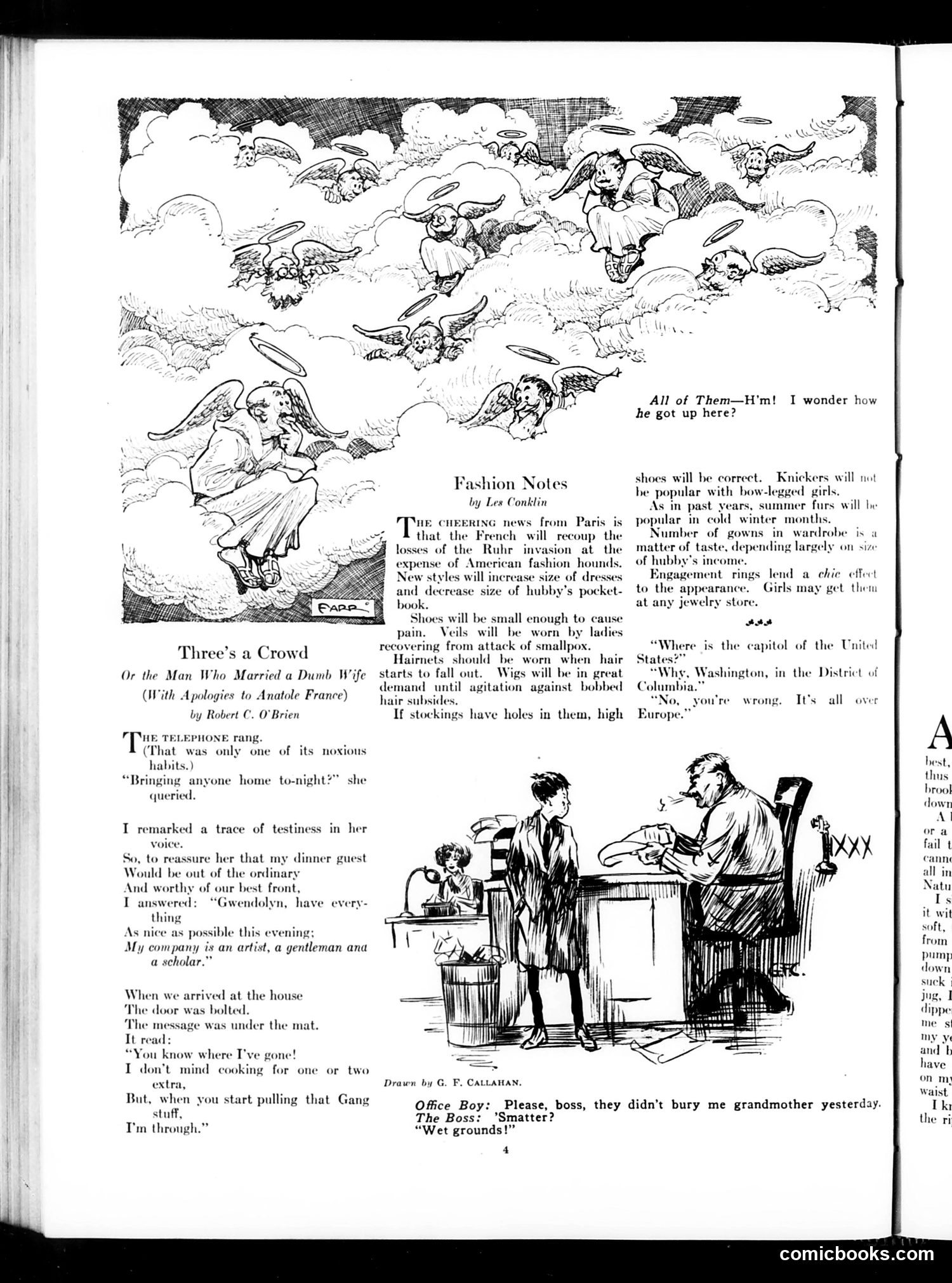
This page contains three distinct pieces: 1. **"All of Them—H'm! I wonder how he got up here?"** – A whimsical illustration of cherubs and angels in clouds, likely a humorous heaven scene with no clear political intent. 2. **"Fashion Notes by Lee Conklin"** – Commentary on post-WWI fashion trends, predicting smaller shoes, veils for smallpox recovery, and wigs due to bobbed hair styles. References "the Ruhr invasion" (French-German tensions) affecting American fashion economics. 3. **"Three's a Crowd"** – A poem by Robert C. O'Brien about marital discord when a dinner guest arrives. The accompanying G.F. Callahan illustration shows domestic tension, with a brief office joke below about wet grounds and a grandmother's burial. The content reflects 1920s American culture: post-war fashion anxiety, European conflicts' economic impact, and domestic humor.
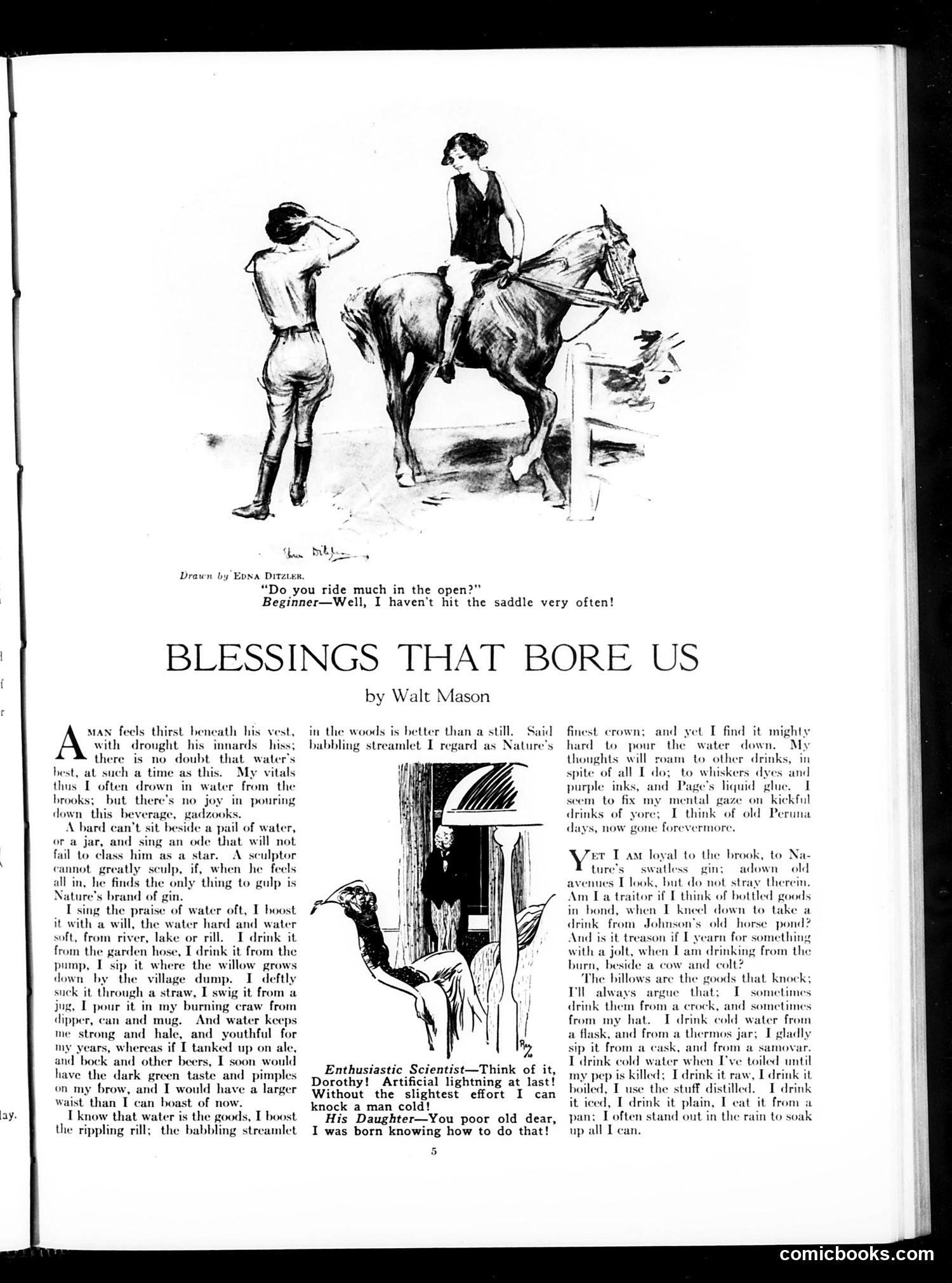
**The Cartoon:** The top sketch by Ena Ditzler depicts a beginner horseback rider who hasn't yet learned proper riding technique—the humor is visual wordplay on "hit the saddle" (meaning to ride frequently) versus literally striking the saddle from falling off. **The Main Article:** Walt Mason's poem "Blessings That Bore Us" satirizes the contradiction between what people *should* want and what they actually desire. Mason praises water's health benefits while admitting he'd rather drink alcohol—whiskey, ale, beer, and patent medicines like Peruna (a popular tonic). The irony is that water is objectively good for you, yet boring compared to intoxicating alternatives. The lower cartoon mocks pseudo-intellectual boasting: a scientist brags about creating artificial lightning, only for his daughter to casually reveal she's been doing the same thing all her life (a dated reference suggesting she's capable of "stunning" men into unconsciousness, likely through flirtation or social manipulation). Both pieces mock self-deception and pretension through humor.
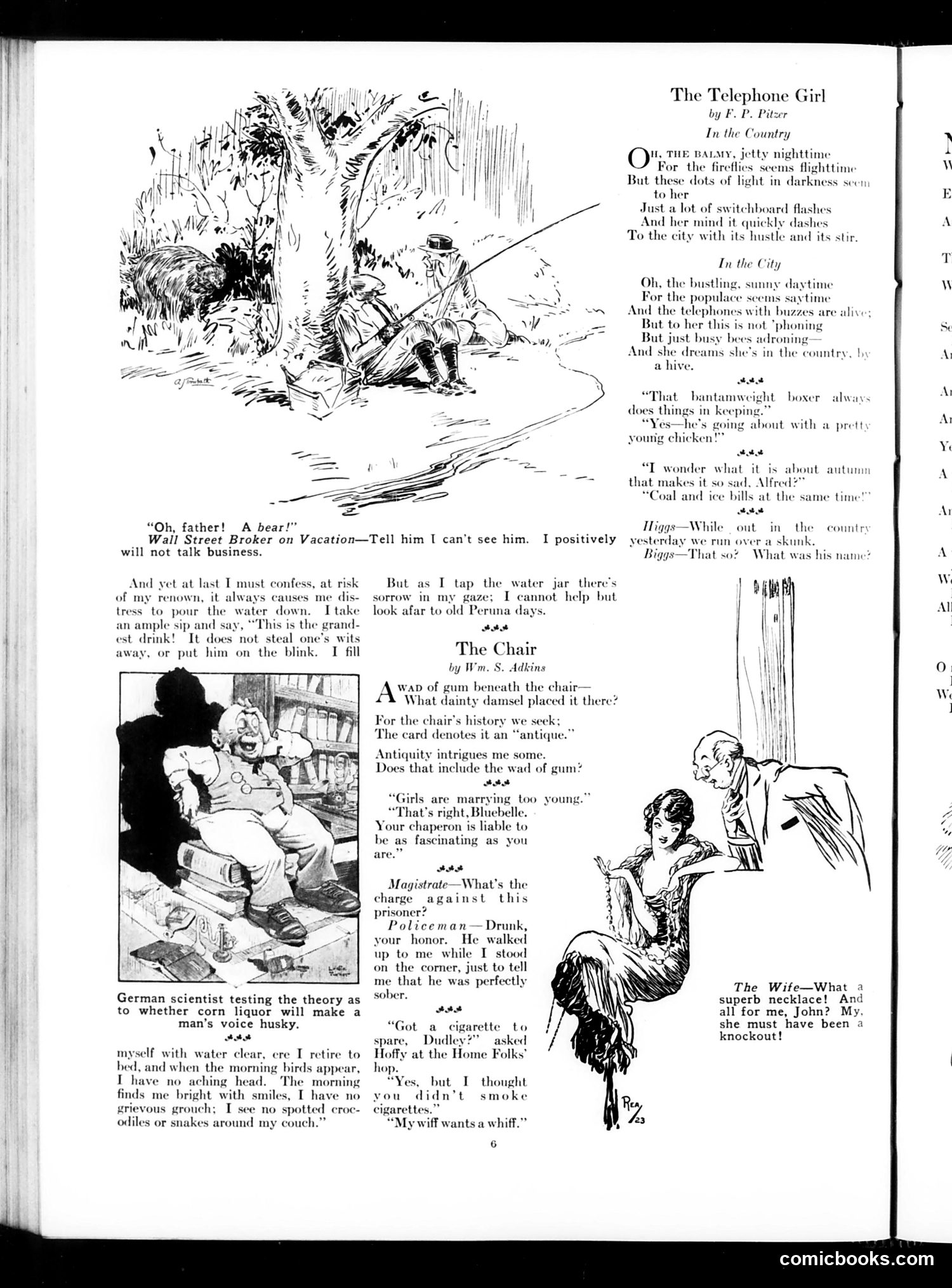
This page contains several satirical vignettes typical of early-20th-century American humor: **"Wall Street Broker on Vacation"**: A wealthy businessman encounters a bear while vacationing but refuses to discuss business—satirizing Wall Street financiers' obsession with work and their attempt to escape it. **"German scientist testing corn liquor"**: Mock-scientific humor about Prohibition-era concerns regarding alcohol's effects, particularly whether corn whiskey affects voice quality. **"The Telephone Girl"**: A young female telephone operator daydreams about rural life while managing city switchboards, contrasting pastoral simplicity with urban bustle—reflecting rural-to-urban migration tensions of the era. **"The Chair"**: Absurdist humor about an antique chair with gum stuck underneath, questioning what "antique" truly means. The remaining items are brief social jokes about dating, marriage, and courtship conventions. The illustrations use exaggerated caricature typical of the period's satirical style.
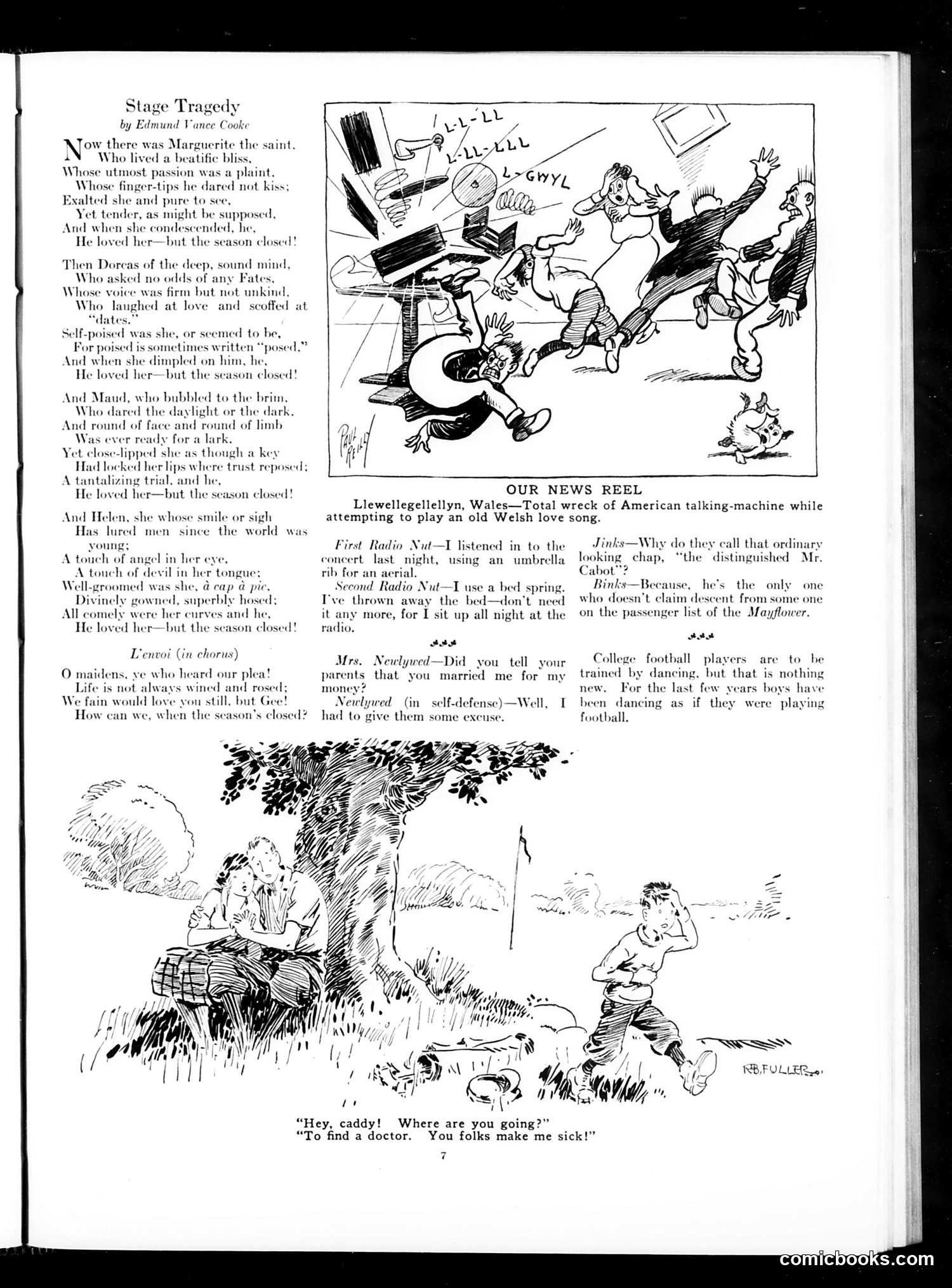
This page from *Judge* magazine contains satirical commentary on early 20th-century American life. The main poem "Stage Tragedy" by Edmund Vance Cooke mocks romantic theater conventions—specifically the melodramatic "stage lover" who falls passionately for different women (Marguerite, Dorcas, Maud, Helen) but whose affections end when "the season closed." It's satire of overwrought theatrical romance and male inconstancy. The "News Reel" section offers brief humorous social commentary: radio enthusiasts improvising aerials from household items; jokes about ancestry-obsessed Americans; newlyweds marrying for money; and college football players dancing so poorly they "make me sick." The golf cartoon shows a sick golfer telling his caddy to fetch a doctor, satirizing golf's appeal even when one feels unwell. These items collectively mock contemporary fads (radio, genealogy-consciousness), courtship rituals, and American social pretensions through light humor typical of *Judge's* satirical approach.
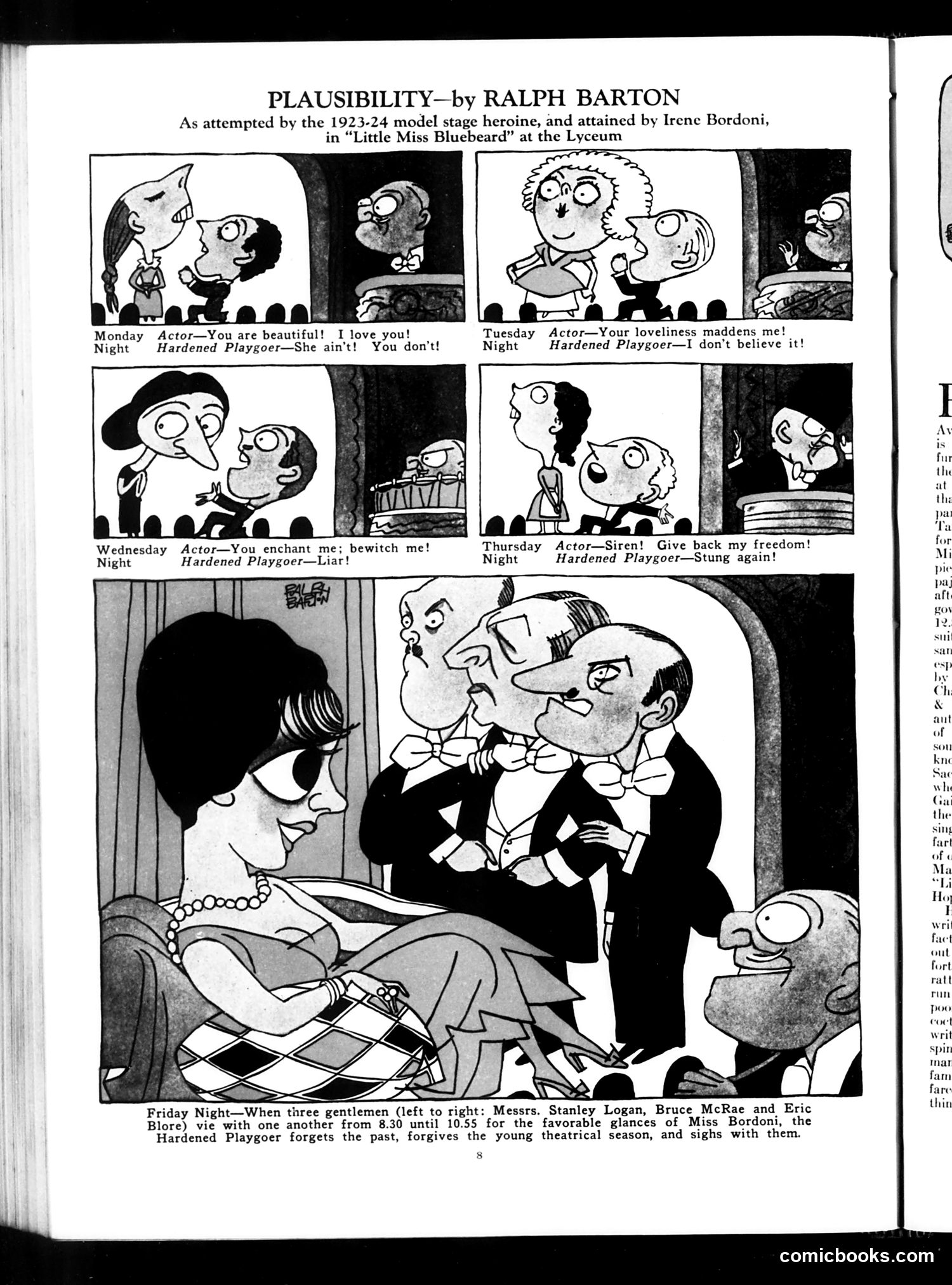
This satirical cartoon mocks theatrical conventions of the 1920s stage. The comic tracks a "hardened playgoer's" (cynical theatergoer's) reactions across the week to the same romantic scenes in the play "Little Miss Bluebeard" featuring actress Irene Bordoni at the Lyceum Theatre. Monday-Thursday show the playgoer dismissing the actor's declarations of love and passion as implausible and overwrought—"I don't believe it!", "She ain't!", "Liar!" The joke's punch comes Friday: when three male actors (Stanley Logan, Bruce McRae, Eric Blore) compete for Bordoni's affections simultaneously, the cynic finally finds it *convincing*—he "forgets the past" and sighs along with them. Barton satirizes both overwrought stage melodrama and the female star's actual power to make artificial emotion feel genuine through sheer charisma.
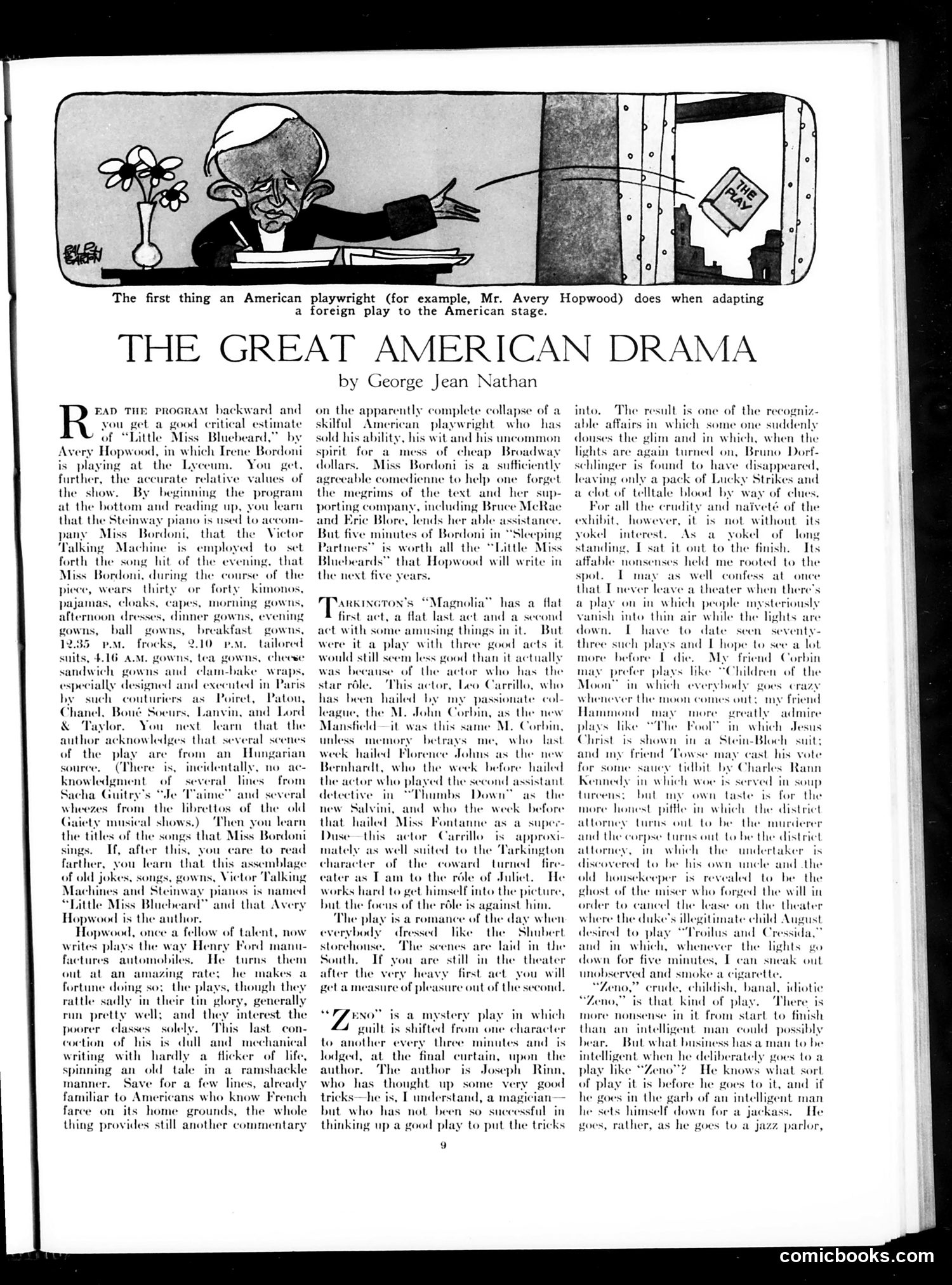
**The cartoon** (top left) depicts a caricatured playwright gesticulating at his desk—likely Avery Hopwood, whom the article criticizes. The image satirizes his mechanical, assembly-line approach to playwriting. **The satire's point:** Critic George Jean Nathan argues that Hopwood, once talented, now manufactures plays like Henry Ford produces automobiles—prioritizing profit over artistry. Nathan dissects "Little Miss Bluebeard" by reading the program backward, revealing the show is merely a collection of borrowed elements: French couture, a borrowed Hungarian plot, recycled jokes, piano music, and Victor phonograph songs—all assembled around actress Irene Bordoni. **The key critique:** American playwrights have abandoned wit and originality for cheap Broadway dollars. Hopwood's work lacks genuine dramatic structure, relying instead on spectacle and star power to draw "poorer classes" audiences. **Context:** This reflects 1920s theater criticism targeting commercialization of Broadway and the decline of American dramatic art.
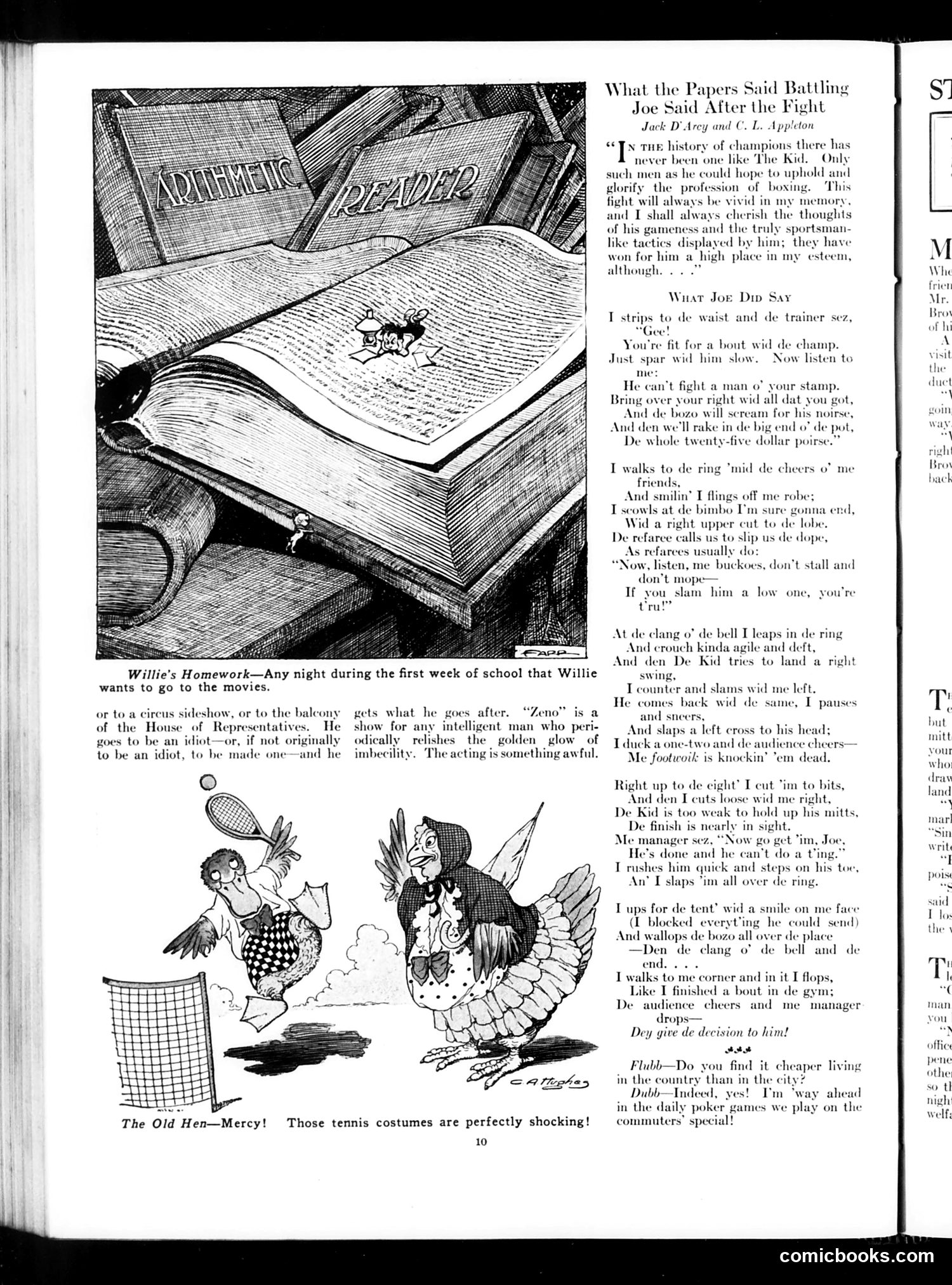
This page contains two distinct pieces of satirical content: **"Willie's Homework"** (top): A brief joke about a schoolboy named Willie who skips homework to attend movies or circuses. The reference to "House of Representatives" suggests politicians are similarly negligent—choosing entertainment over their duties. The joke mocks both the boy's idleness and, by extension, Congress members who prioritize leisure over governance. **"Battling Joe Said After the Fight"** (center/right): This is the main satirical piece. It contrasts what boxing papers *reported* Joe said (flowery, dignified praise of sportsmanship) versus what Joe *actually* said in thick working-class dialect. Joe's real account describes crude fighting tactics, bribery ("rake in de big end"), and referee corruption—revealing the brutal, dishonest reality beneath boxing's pretense of noble sport. The satire exposes the gap between boxing's public image and its actual corruption. **"The Old Hen"** (bottom left): A separate cartoon mocking prudish elderly women scandalized by modern (1920s) women's tennis clothing.
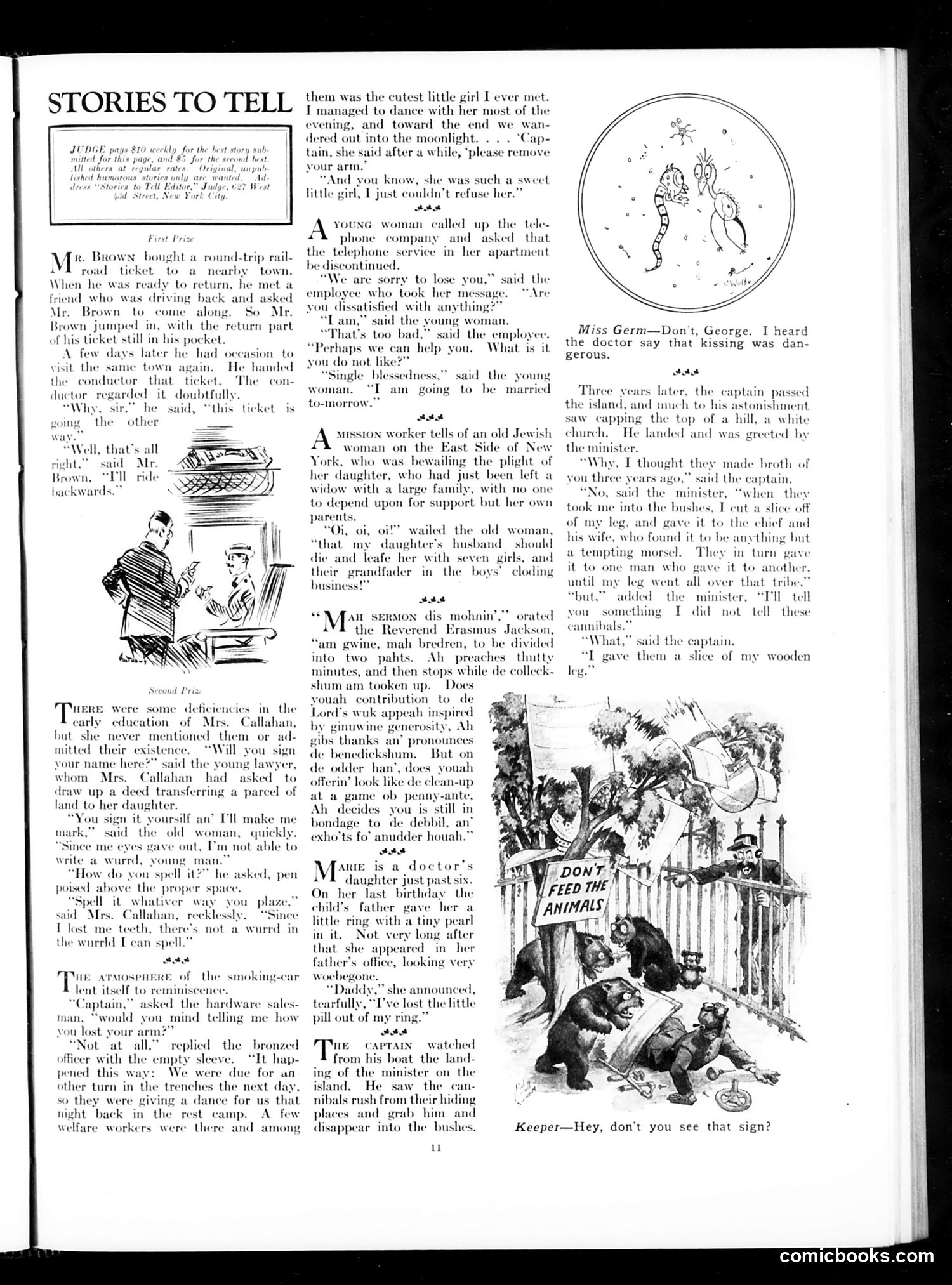
This page from *Judge* magazine contains several short humorous stories that satirize early 20th-century American life and character types: **"The Round-Trip Ticket"**: Mocks a man's obtuseness by having him attempt to use a return train ticket traveling backward. **"The Deed"**: Lampoons Irish immigrant illiteracy through an elderly Mrs. Callahan, who cannot sign her name and cavalierly dismisses the request. **"The Missing Arm"**: A sentimental war story where a WWI officer sacrificed his arm by complying with a young woman's flirtatious request—satire of romantic wartime narratives. **"Single Blessedness"**: A woman wants her telephone disconnected because marriage makes her happy. **"The Sermon"**: Uses dialect humor and stereotyping of Black church culture, mocking both the preacher's self-serving collection tactics and his parishioners' stinginess. **"The Ring"**: A child's innocent misunderstanding of "pearl" as "pill" provides gentle humor. The cartoons employ period stereotypes—Irish working-class, Black vernacular, immigrant characters—common in early 20th-century American comedy.
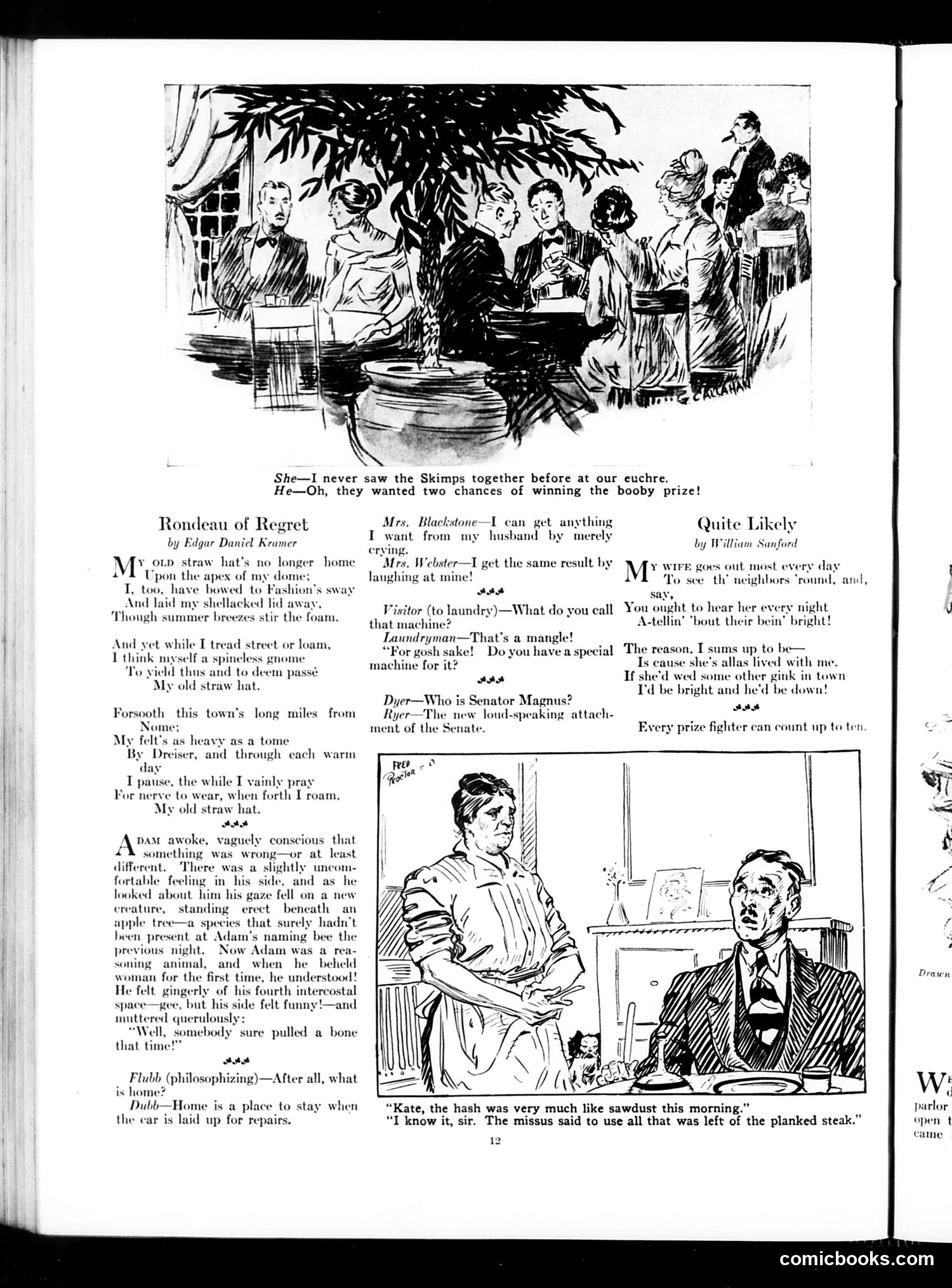
This Judge magazine page contains several satirical pieces mocking early 20th-century domestic life and social pretension: **Top cartoon**: A joke about the "Skimps" (a recurring character family, likely representing nouveau riche or lower-class pretenders) wanting "two chances of winning the booby prize" at a euchre party—suggesting they're so socially awkward they need extra odds just to lose respectably. **Poems and humor**: Light satire on fashion conformity ("Rondeau of Regret" mocks men abandoning straw hats for felt), marital dynamics (wives manipulating husbands through tears), and domestic incompetence (the hash "like sawdust" made from leftover planks). **Bottom illustration**: A servant explaining to an employer that the hash uses "all that was left of the planked steak"—satirizing both servant resourcefulness and employer obliviousness to food waste. The humor assumes readers share anxieties about social status, changing fashion, and domestic hierarchies typical of the period. Senator Magnus's "loud-speaking attachment" jokes about senators' verbosity.
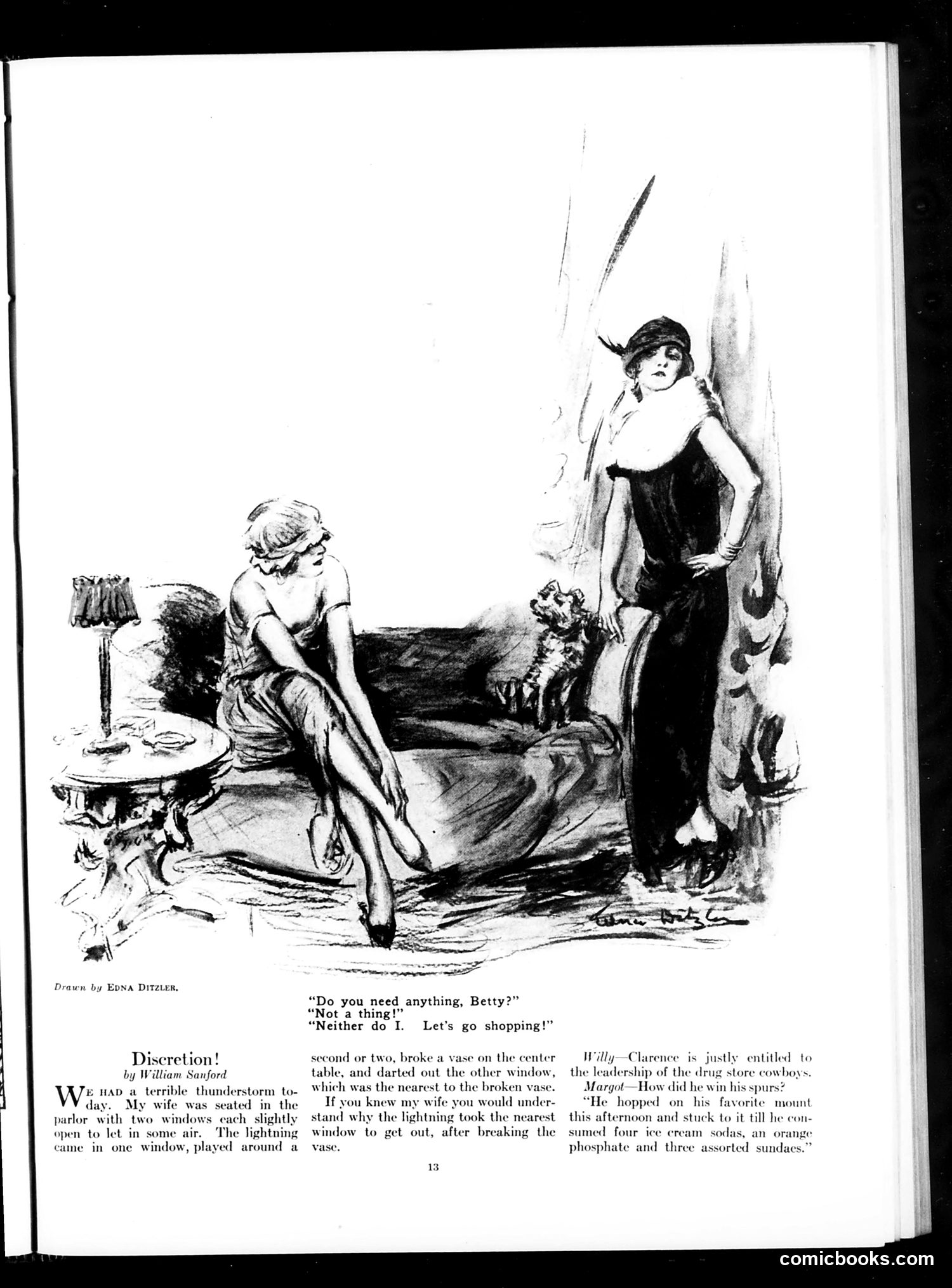
This page contains two separate humorous pieces from Judge magazine: **"Discretion!" (main cartoon)**: A joke about a wife's priorities during a lightning storm. The humor relies on a stereotype about wives being materialistic—the punchline suggests the wife's concern for shopping is so strong that even lightning "intelligently" exits through the nearest window to escape her. The illustration by Edna Ditzler shows two women in an interior scene, reinforcing the domestic setting. **"Willy" (bottom text)**: A brief joke about young men ("drug store cowboys"—loiterers who hung around drugstores as social gathering spots). The humor comes from the absurd notion that consuming multiple ice cream sodas in one sitting constitutes impressive leadership or achievement worthy of respect. Both pieces reflect early 20th-century social attitudes: satirizing women's shopping habits and mocking idle youth culture. The jokes are gentle, relying on exaggeration rather than sharp political commentary.
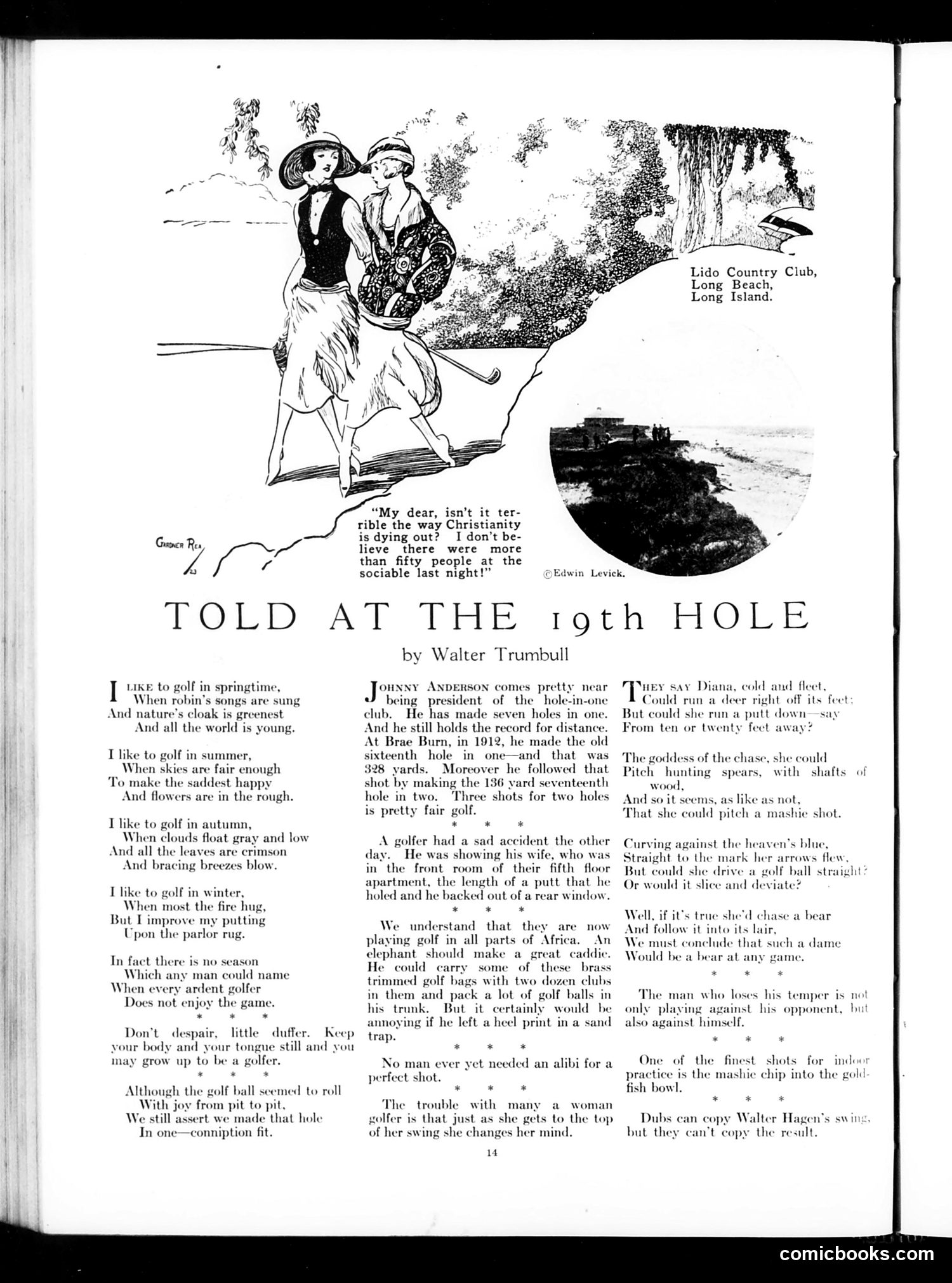
This is a humorous article by Walter Trumbull about golf culture, featuring verses celebrating golf across seasons and anecdotes about golfers' mishaps and foibles. The cartoon at top shows two fashionable women at the Lido Country Club gossiping about Christianity's decline, evidenced by sparse attendance at a church "sociable"—a gentle satire of wealthy society's superficial religiosity and distraction with leisure activities like golf. The article's humor targets golf obsession and amateur golfers' delusions. Stories include a golfer backing out a fifth-floor window while demonstrating a putt, and jokes about women golfers who second-guess their swing mid-stroke. References to Johnny Anderson's hole-in-one record and Walter Hagen (a famous pro golfer) ground the humor in actual golf culture. The "19th hole" (the bar/clubhouse where golfers gather after finishing 18 holes) was traditional golf lingo, making this the perfect venue for gossipy anecdotes about the game and its players.
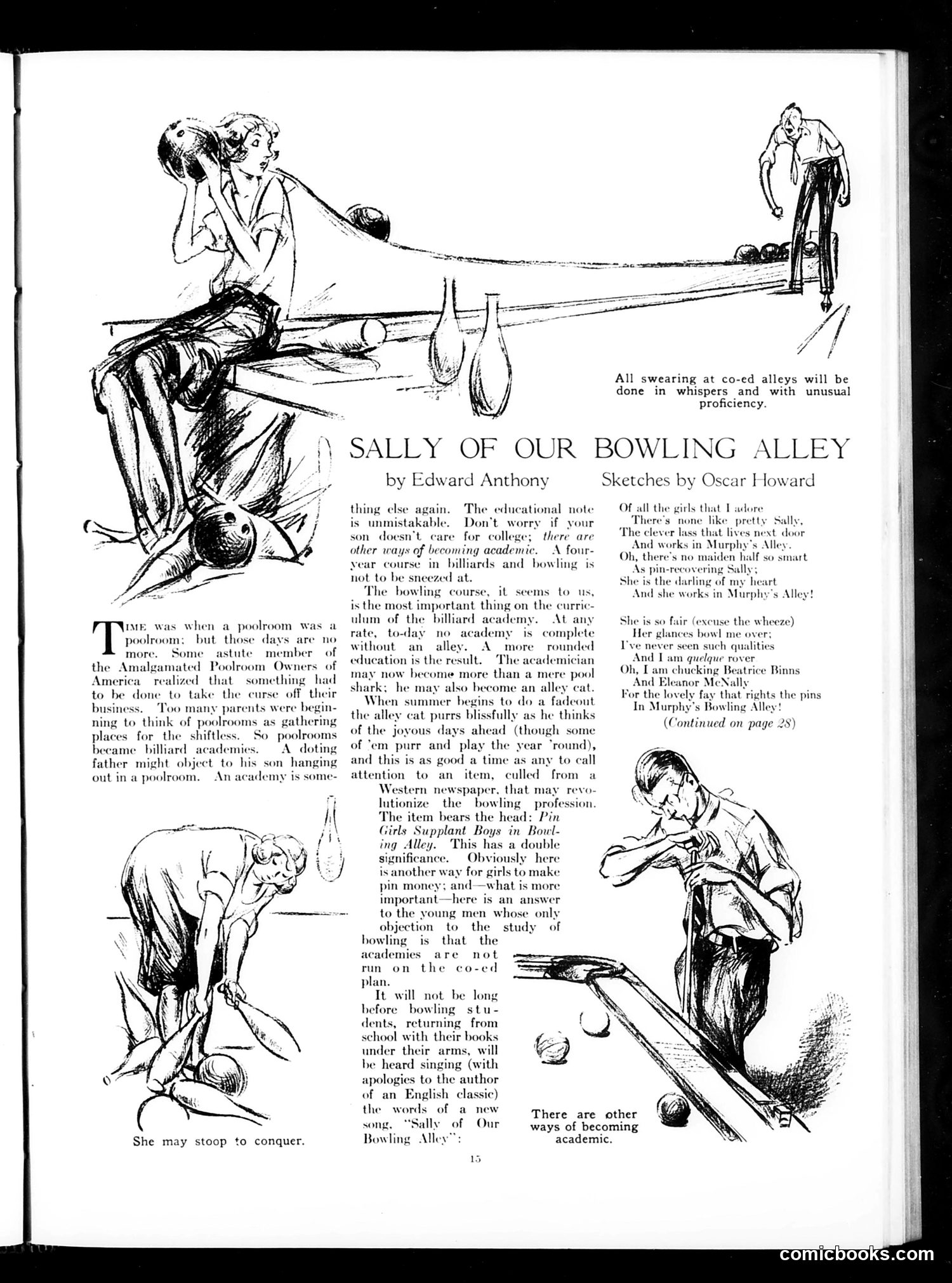
This article satirizes the rebranding of poolrooms as respectable "billiard academies" to improve their reputation—a transparent marketing trick targeting worried parents. The satire centers on bowling alleys, where the real innovation is employing young women as "pin girls" to set pins (a job previously held by boys). The piece mocks how this development suddenly makes bowling "academically acceptable" while simultaneously providing an excuse for young men to frequent these establishments. The accompanying verse celebrates "Sally," a pin girl at Murphy's Alley, treating the whole enterprise as transparently designed to attract male students under the guise of education. The humor lies in exposing the hypocrisy: poolrooms remain poolrooms regardless of their name, and bowling alleys become fashionable only when staffed by attractive young women—hardly an educational innovation.
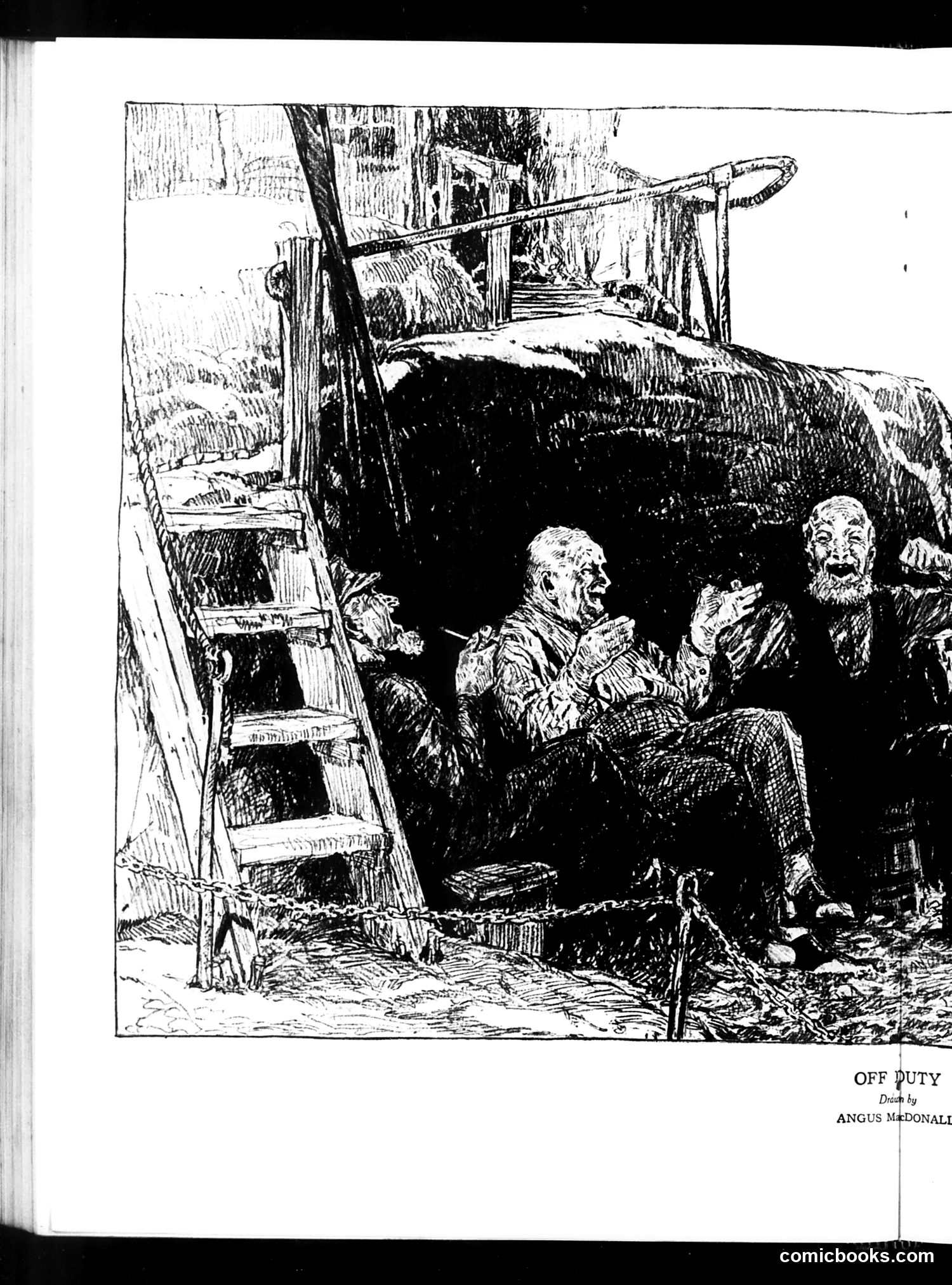
This sketch depicts three men relaxing inside what appears to be a cave, bunker, or underground shelter. A ladder leans against the entrance. The title "Off Duty" suggests these are soldiers or workers taking a break from their responsibilities. The cartoon likely satirizes military or wartime conditions—possibly commenting on soldiers' leisure time during WWI (given Judge magazine's era) or their living conditions in trenches/dugouts. The cramped, dark underground setting contrasts humorously with the men's casual relaxation. Without additional context or visible identifying features, I cannot definitively determine which specific military campaign or historical moment this references, though the wartime leisure theme is clear.
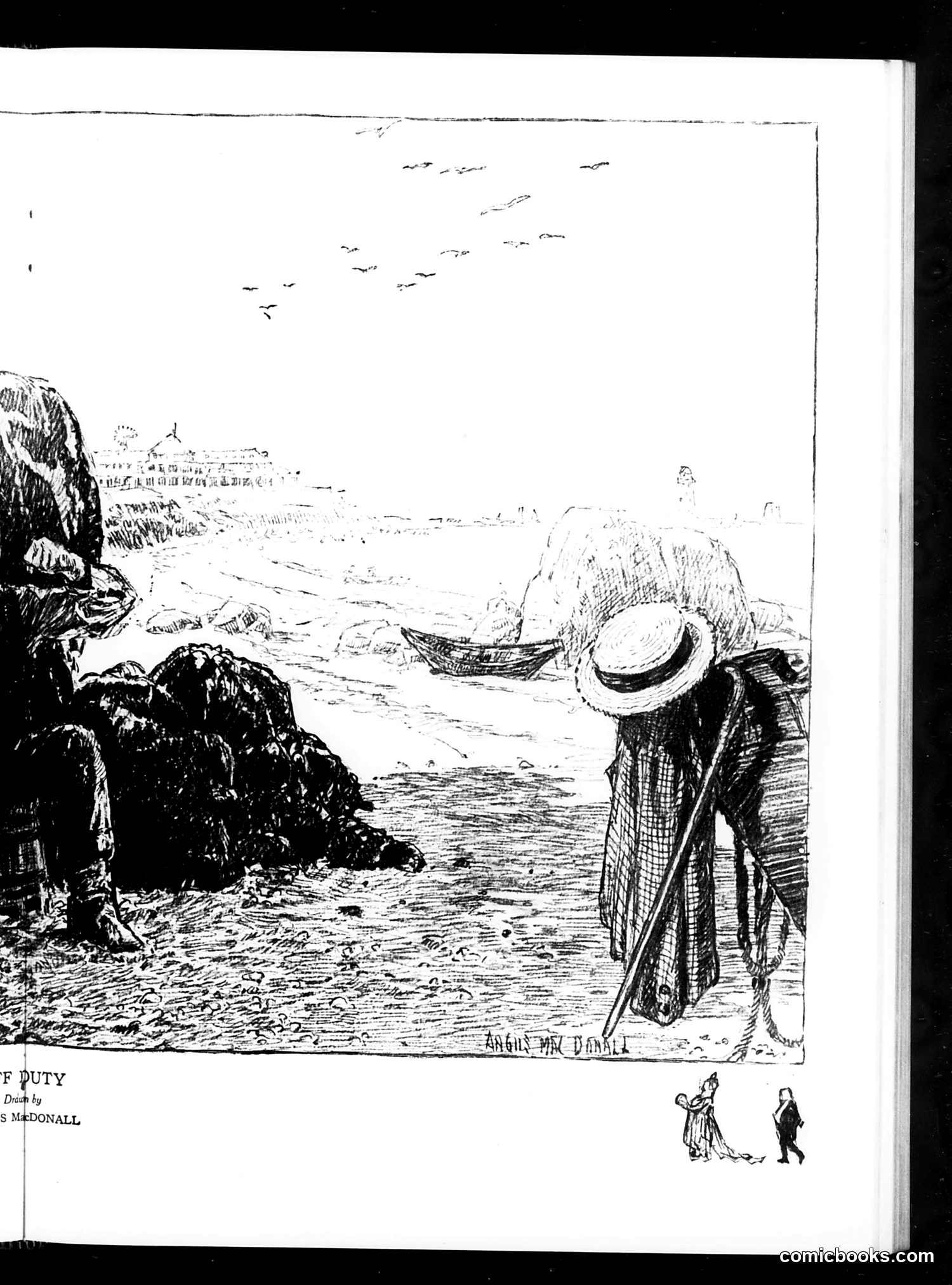
This sketch by S. MacDonall depicts two figures in Victorian dress on a beach, relaxing by boats with a distant seaside resort visible. The title "Off Duty" suggests these are officials or workers—likely customs officials or harbor authorities—taking leisure time. The satire appears to target the contrast between public responsibility and private leisure, or possibly corruption: these duty-bound officials are absent from their posts while enjoying themselves. The detailed rendering of their relaxation, set against the working harbor scene, implies criticism of negligence or dereliction during working hours. Without additional context from Judge magazine's date, the specific political target remains unclear, though the cartoon critiques irresponsible public servants.
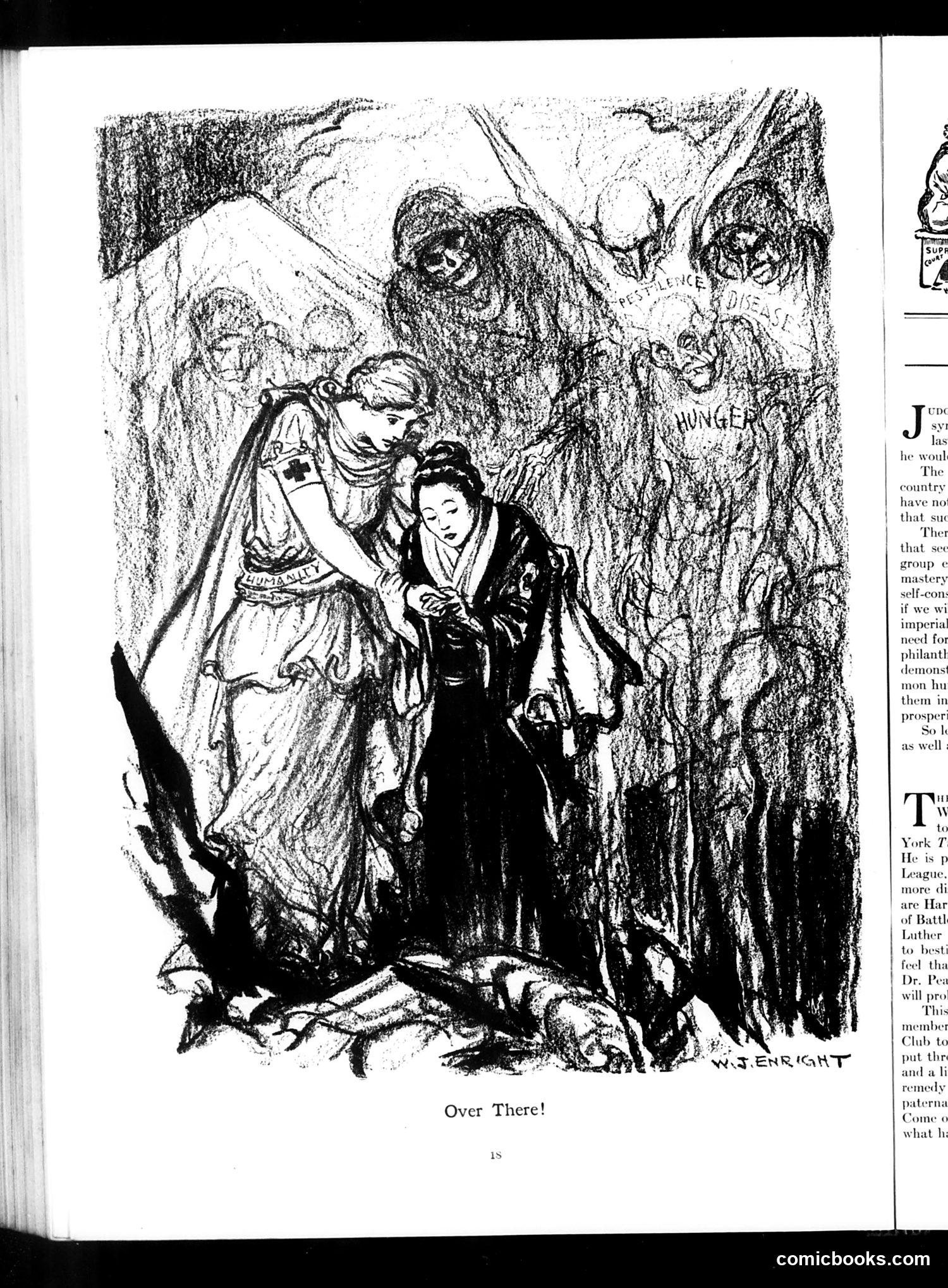
This cartoon depicts an allegorical scene of American intervention in World War I. The central figure appears to be **Lady Liberty or Columbia** (representing America), gesturing toward figures in the background labeled with words like "HUNGER" and "JUSTICE." Shadowy, demonic figures loom above, likely representing the evils of war or enemy forces. The title **"Over There!"** references the famous 1917 George M. Cohan song that became a rallying cry for American soldiers being sent to Europe. The cartoon satirizes American philanthropic and humanitarian justifications for entering the war—the "imperial need" mentioned in the OCR'd text. It suggests America is being called upon to rescue suffering peoples abroad, with Liberty leading the charge. The work appears to advocate for American intervention while simultaneously questioning whether such moral arguments adequately justify military involvement.
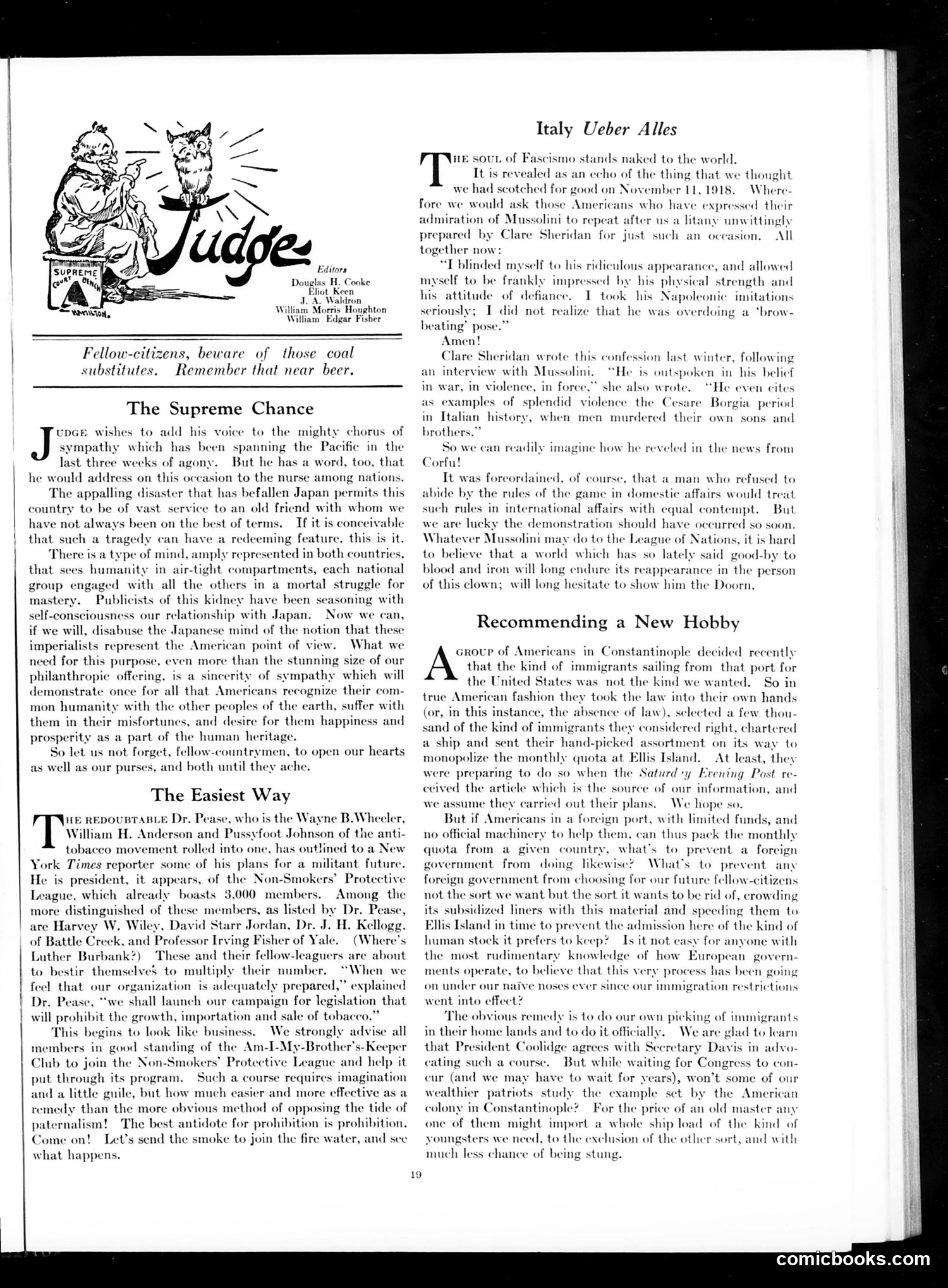
This Judge magazine page contains three distinct editorials with satirical cartoons: **"Italy Ueber Alles"** (top right): Judge criticizes Americans admiring Mussolini, linking Fascism to pre-WWI militarism ("scotched for good on November 11, 1918"). The piece quotes Clare Sheridan's confession that she was seduced by Mussolini's physical strength and "Napoleonic imitations" while overlooking his "browbeating pose"—mocking celebrity fascination with strongmen. **"The Supreme Chance"** (middle): Following Japan's earthquake disaster, Judge urges Americans to demonstrate genuine sympathy, arguing this proves Americans aren't imperialists despite their government's policies. **"The Easiest Way"** (bottom left): A satirical attack on anti-tobacco crusaders like Dr. Pease. Judge mocks prohibition advocates, suggesting the "best antidote for prohibition is prohibition"—ironically endorsing their own logic to undermine them. The cartoon (top left) shows "Judge" magazine's mascot character addressing readers about "coal substitutes" and "near beer," referencing Prohibition-era alcohol bans.
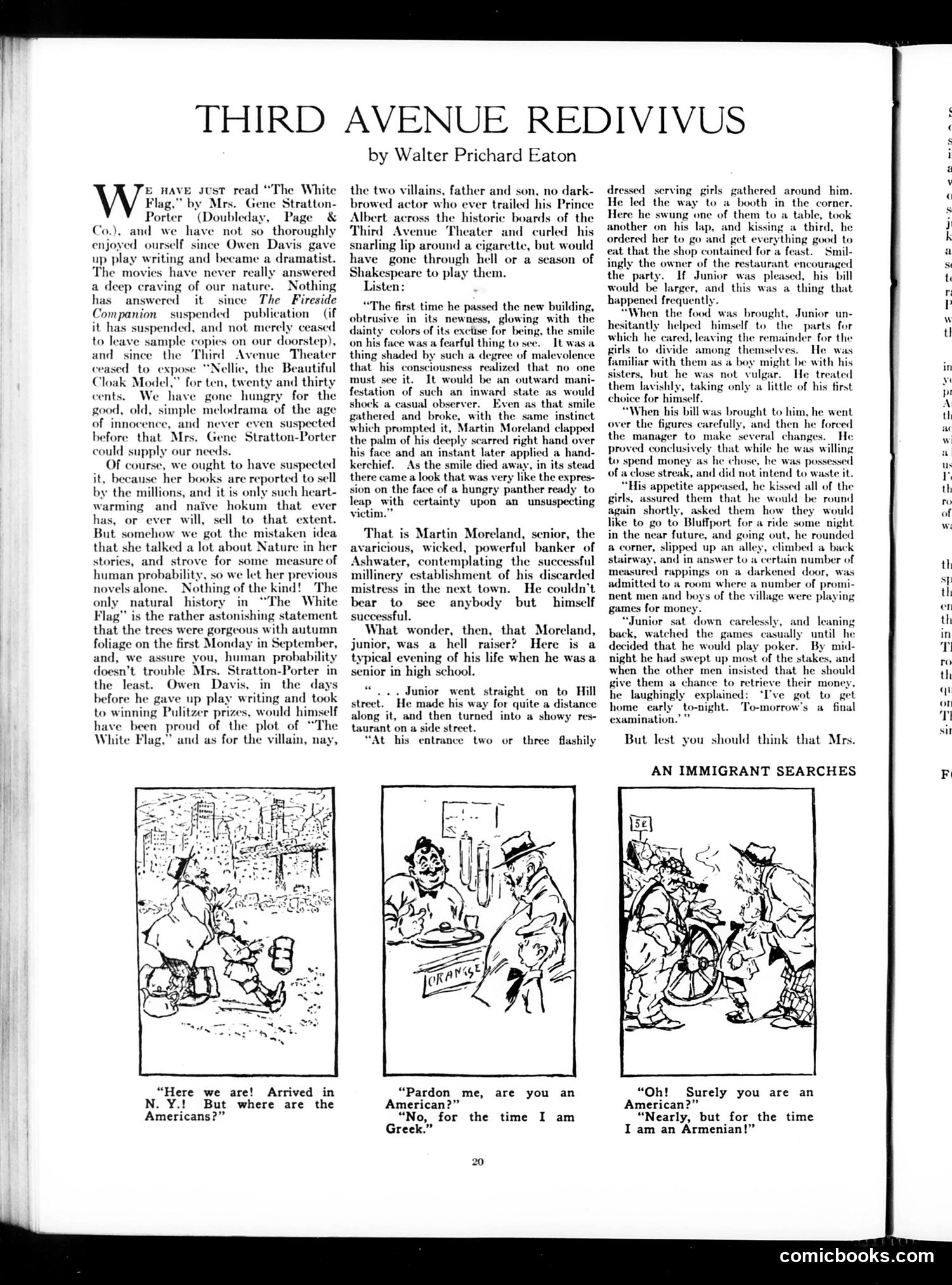
This page contains a literary review of *The White Flag* by Gene Stratton-Porter, praising it as old-fashioned melodrama. The reviewer compares it favorably to the simplistic moral tales of 19th-century popular entertainment, specifically the "Third Avenue Theater"—a real New York venue famous for staging cheap melodramas with exaggerated villains and heroes. The three cartoons below titled "An Immigrant Searches" are unrelated satirical sketches about confused immigrants in America, playing on ethnic stereotypes and language confusion—common Judge magazine humor of this era. The review's point: *The White Flag* succeeds because it delivers pure, shameless melodrama without pretense—villain Martin Moreland is cartoonishly evil (that unsettling smile over his discarded mistress's success), and his son is a dissolute spoiled brat. The author treats this earnestly, recalling an earlier era of American popular entertainment the reviewer nostalgically misses.
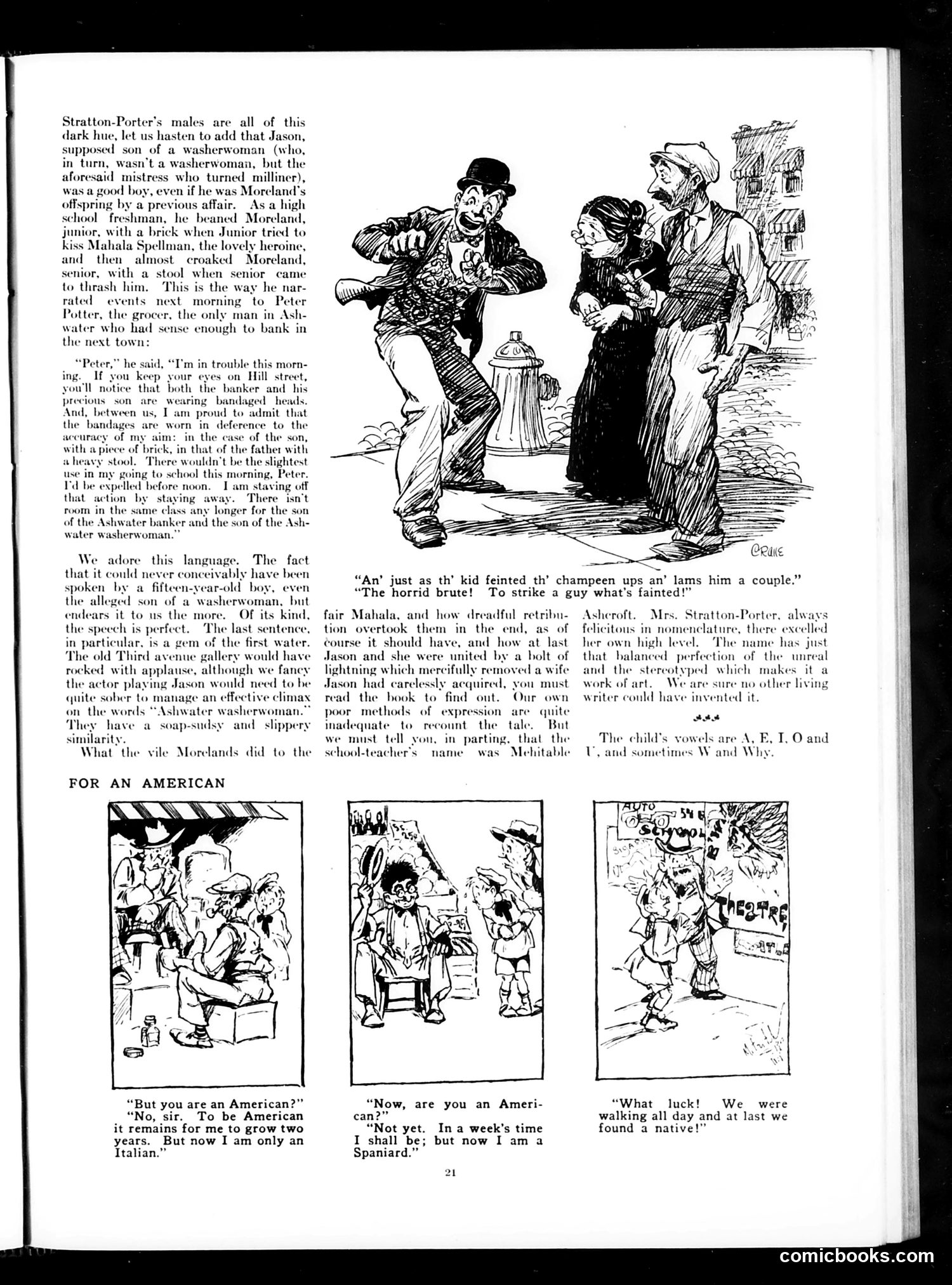
This page satirizes American attitudes toward immigrants and citizenship. The three small cartoons at the bottom depict immigrants in various stages of becoming "American": 1. An Italian man who will need two more years to qualify for citizenship 2. A man who will become American in a week (currently Spanish) 3. Tourists who treat a native person as an exotic discovery The satire mocks the arbitrary timeline and performative nature of American citizenship—suggesting that becoming American is merely a waiting period rather than genuine cultural integration. The joke is that these immigrants can declare themselves American simply by satisfying bureaucratic requirements, implying that "American" identity is hollow or mechanical. The upper text discusses a novel (likely by Gene Stratton-Porter), but the page's main satirical point concerns early 20th-century debates over immigration, naturalization, and what "American" actually means.
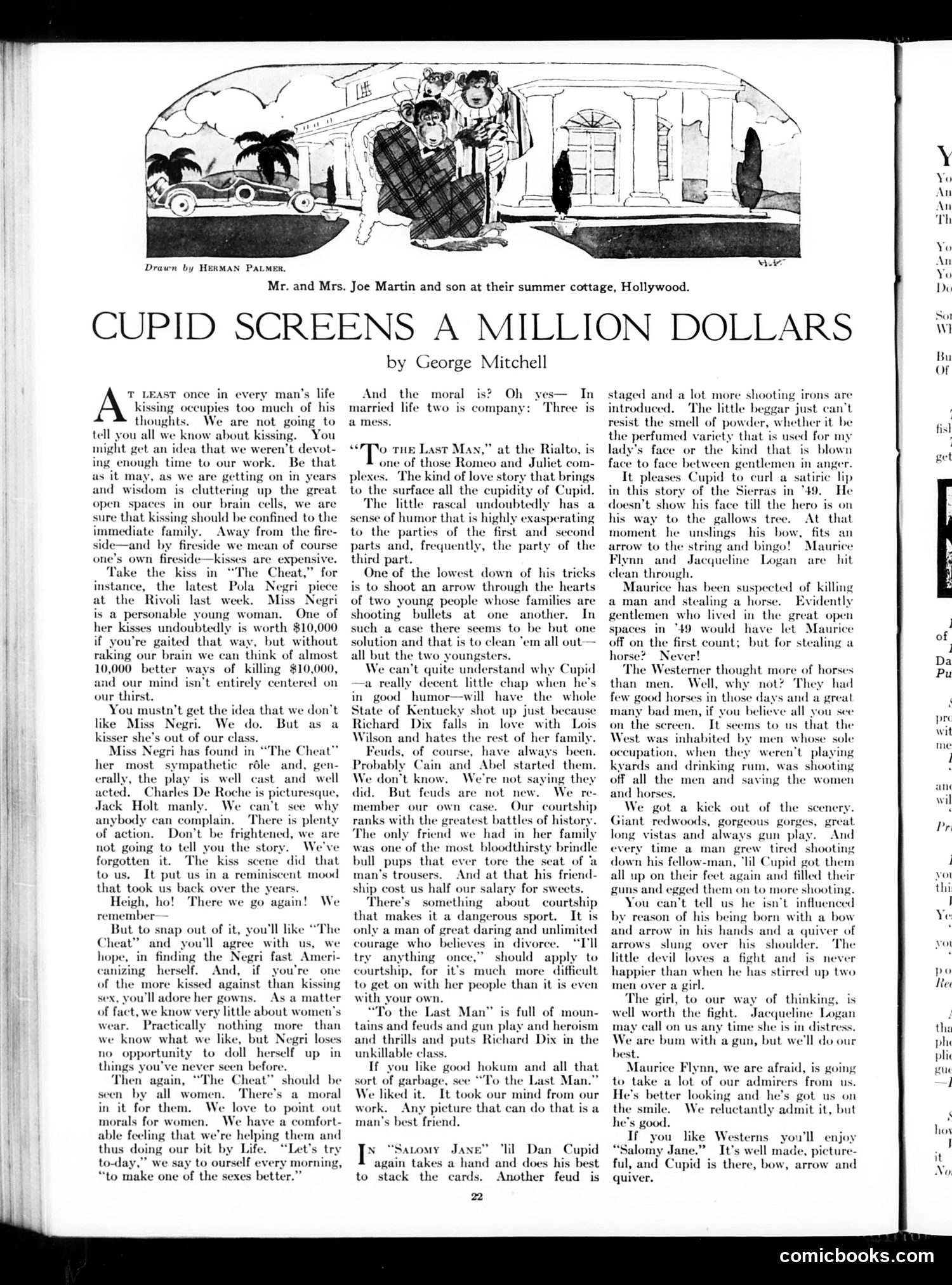
This page reviews two 1920s silent films through a humorous lens. The cartoon illustration shows a Hollywood cottage scene, setting up the entertainment industry context. The main article critiques "The Cheat" (starring Pola Negri) and "To the Last Man" (starring Richard Dix and Lois Wilson). The author sarcastically comments on cinema's treatment of romance and violence. In "The Cheat," he jokes that Negri's kiss is worth $10,000—expensive entertainment. In "To the Last Man," he ridicules the plot where a family feud escalates to full-scale gunplay simply because two young people fall in love, comparing it absurdly to Cain and Abel. The satire targets Hollywood's melodramatic storytelling: the notion that romance justifies elaborate, expensive production values and extreme violence. The author feigns moral concern about "the sexes" while clearly enjoying the spectacle—a common Judge magazine technique mocking both cinema excess and contemporary attitudes toward women and morality.
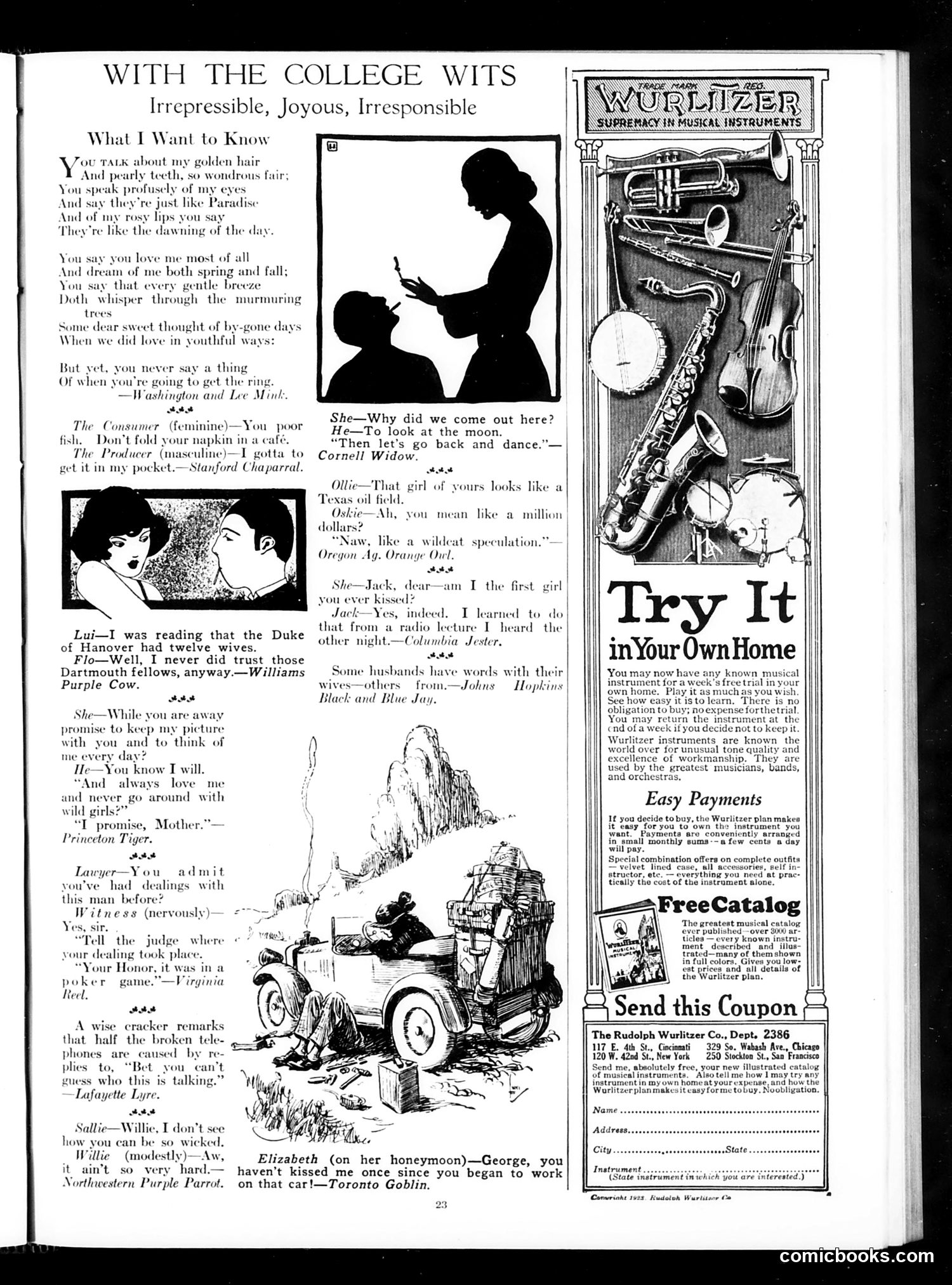
This page collects humorous quips from college humor magazines, satirizing romantic and social dynamics of the 1920s era. The jokes target: **Romantic themes**: A woman criticizes her suitor for complimenting her appearance endlessly but never proposing ("when you're going to get the ring"). Another bride complains her new husband ignores her for work. These mock the gap between male romantic gestures and actual commitment. **Gender roles**: A consumer/producer dialogue jokes about napkin etiquette and pocket space—likely satirizing emerging women's independence and changing social conventions. **College culture**: References to poker games, radio lectures, and wild behavior poke fun at college men as gamblers and moral hypocrites. The silhouette illustration shows a couple in a romantic moment, reinforcing the page's focus on courtship humor. The **Wurlitzer instrument advertisement** on the right is unrelated editorial content promoting musical instruments through free trial offers and easy payment plans.
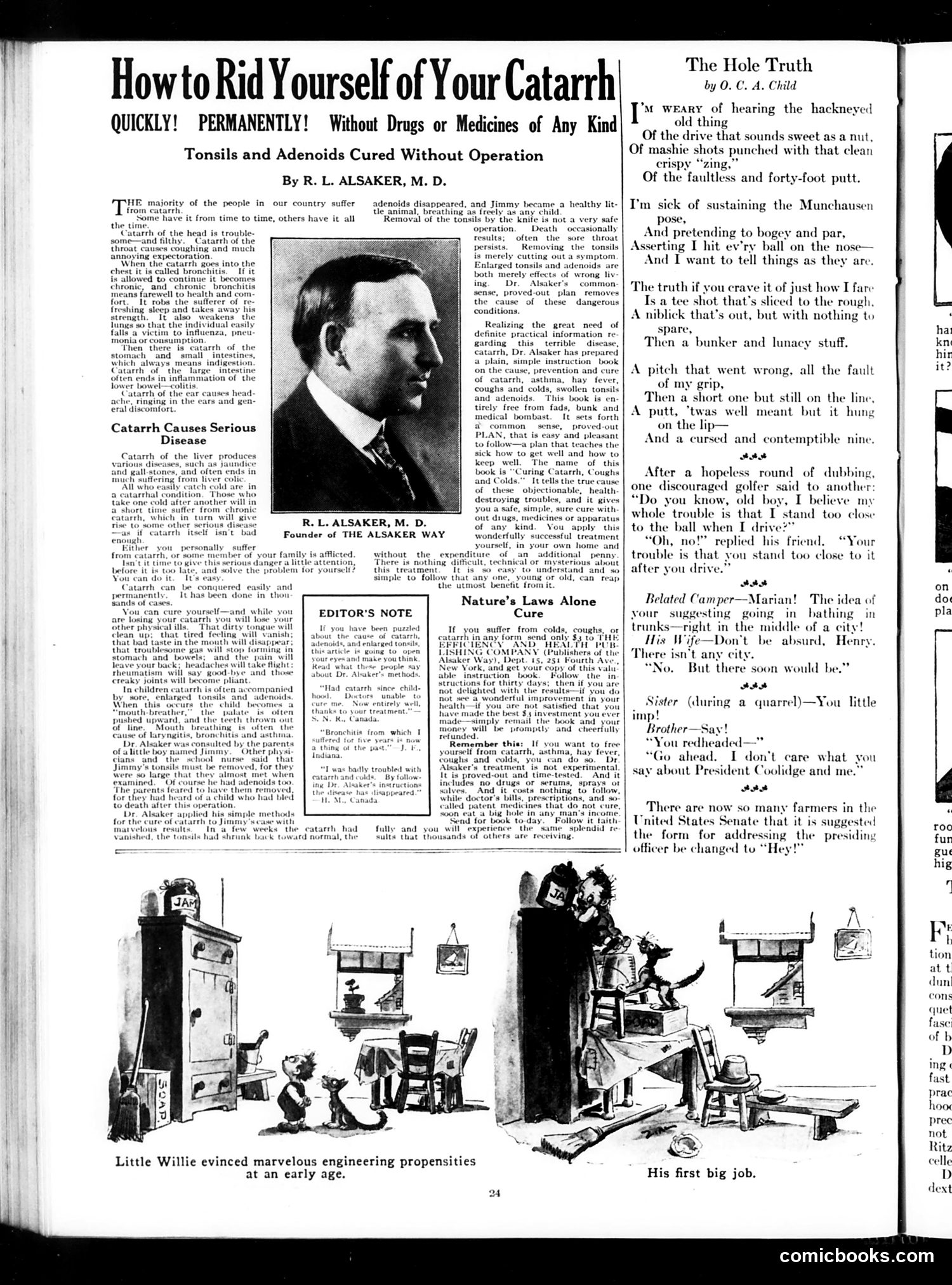
This page mixes medical advertising with humor content typical of Judge magazine. ## Main Advertisement The top half promotes Dr. R. L. Alsaker's treatment for catarrh (sinus/respiratory congestion), claiming to cure tonsil and adenoid problems "without operation" or drugs. This represents the era's widespread medical quackery—unproven home remedies marketed as miraculous cures. ## Cartoons & Humor **"The Hole Truth"** satirizes golfers' dishonesty about their game. The speaker mocks fellow golfers' exaggerated claims about perfect drives and putts, contrasting their boasts with his own honest admission of poor play (sliced shots, bunkers, missed putts). It's social satire on masculine bravado and the gap between appearance and reality. **Two small cartoons** show: (1) "Little Willie" as a precocious child engineer, and (2) a rural senator joke suggesting America's Senate now has so many farmer-members that the presiding officer should be addressed as "Hey!" instead of formal titles—mocking rural/agricultural representation in government.
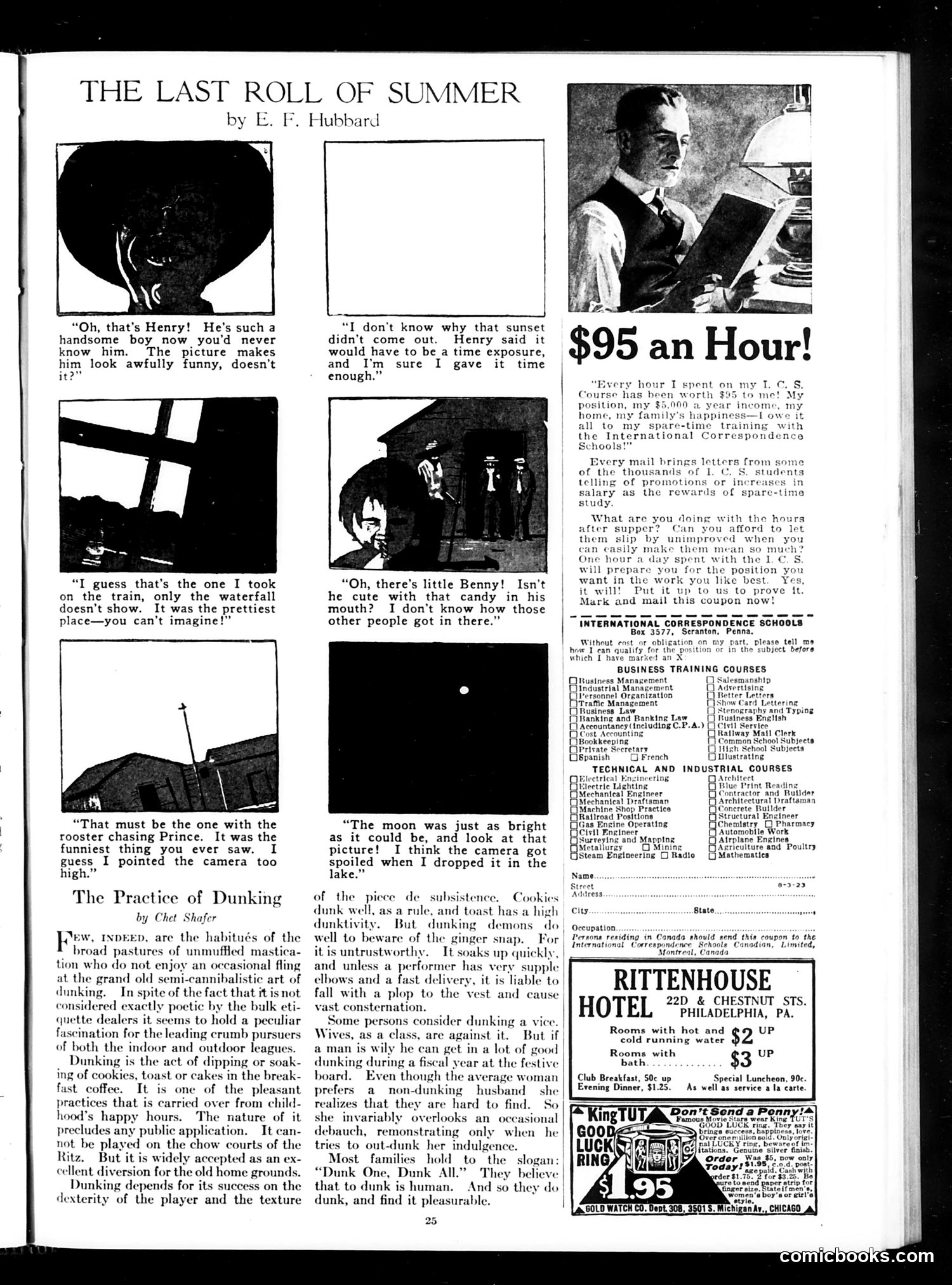
This page presents two distinct pieces: **"The Last Roll of Summer"** (top) humorously depicts people reviewing photographs from their summer camera roll. The joke centers on photography mishaps: blurry or poorly composed shots, accidental subjects, and failed technical attempts (the sunset time-exposure, the moon photo ruined when the camera dropped in a lake). The caption conversations reveal the gap between what photographers *intended* to capture versus what actually appears—a timeless humor about amateur photography's failures. **"The Practice of Dunking"** (bottom left) is a tongue-in-cheek essay about dunking cookies and toast in coffee. It treats this casual, informal eating habit with mock-serious language ("dunktivity," "semi-cannibalistic art"), noting that dunking is enjoyed at home but socially unacceptable in formal settings like the Ritz. The piece humorously acknowledges wives' disapproval while suggesting men nonetheless indulge this "vice." The remaining content is primarily **advertising**—notably an International Correspondence Schools ad promising career advancement through spare-time study.
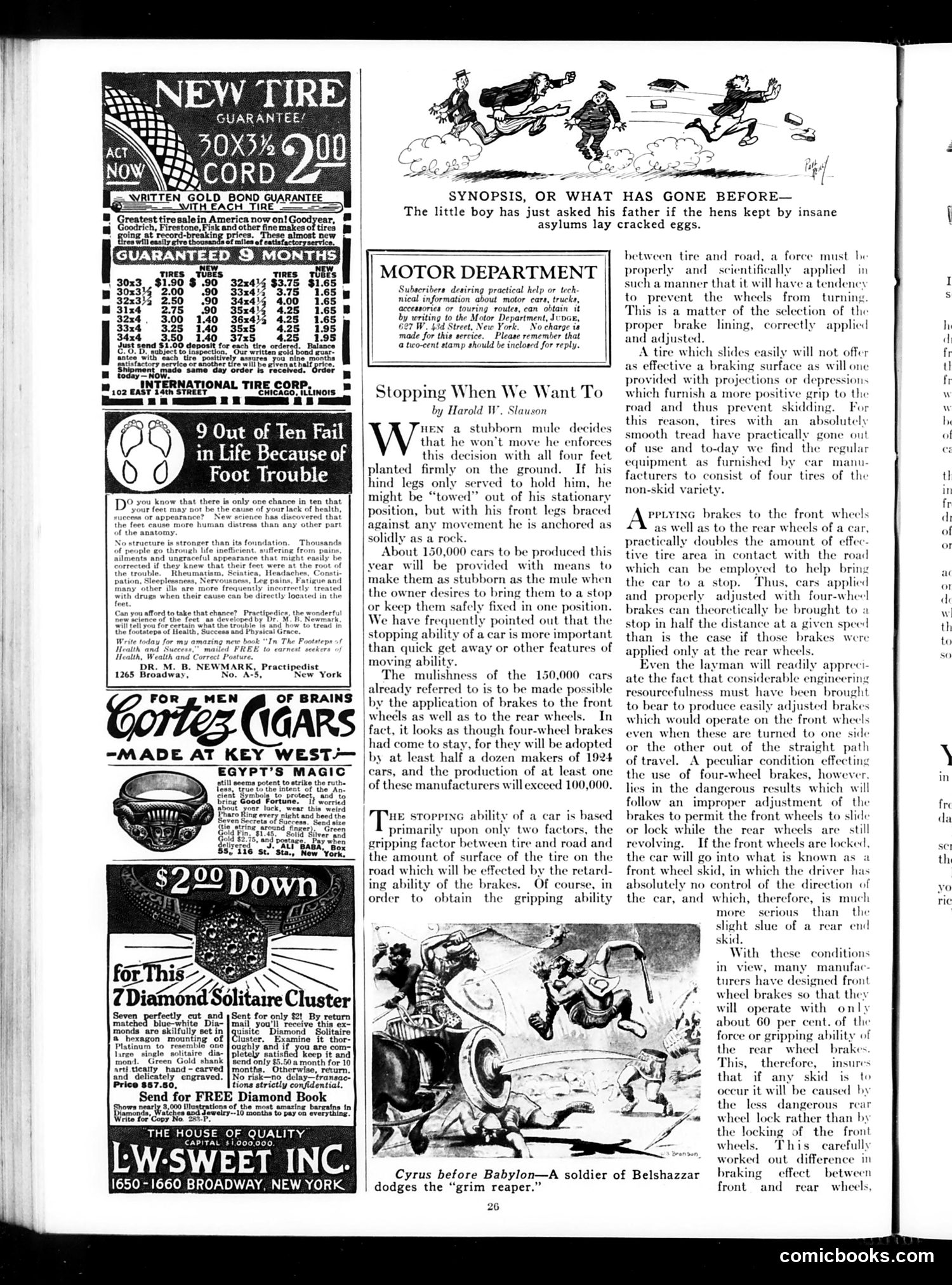
This page is primarily **advertising with one automotive article**. The main content is "Stopping When We Want To" by Harold W. Slauson, a technical piece about automobile braking systems—specifically, the emerging adoption of four-wheel brakes in 1924 cars. The article uses an extended mule metaphor: just as a stubborn mule uses all four legs to resist movement, modern cars will soon use four-wheel brakes for superior stopping power, rather than relying only on rear brakes. Slauson discusses the physics of braking—the grip between tire and road, tire tread design, and brake lining selection. The accompanying illustration shows a biblical scene (Cyrus before Babylon, "the grim reaper"), which appears unrelated to the text and likely illustrates an unshown story synopsis about asylum hens laying cracked eggs. The page is dominated by period advertisements: tire guarantees, Corley cigars, foot-trouble remedies, and diamond rings—typical Judge revenue sources.
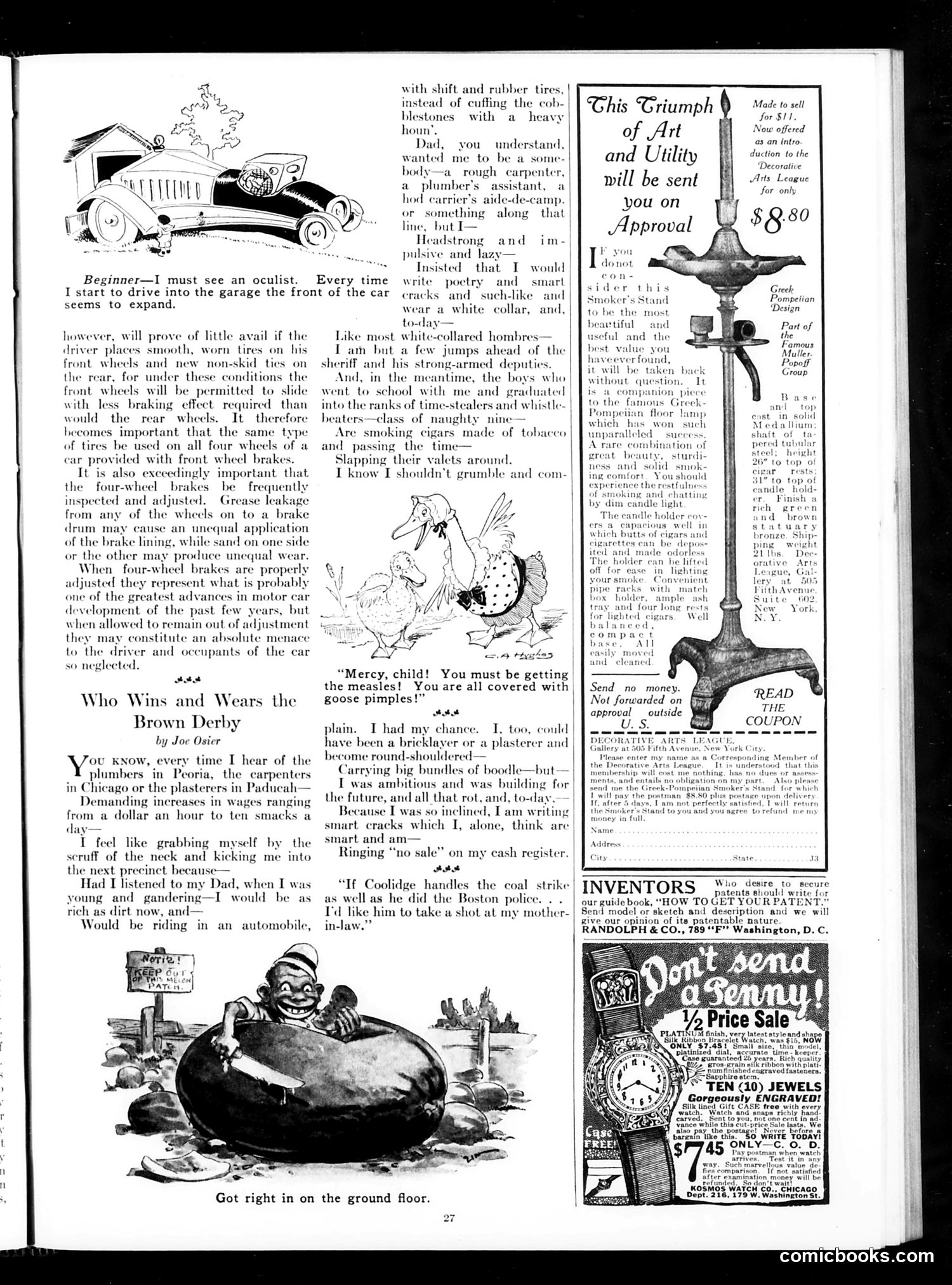
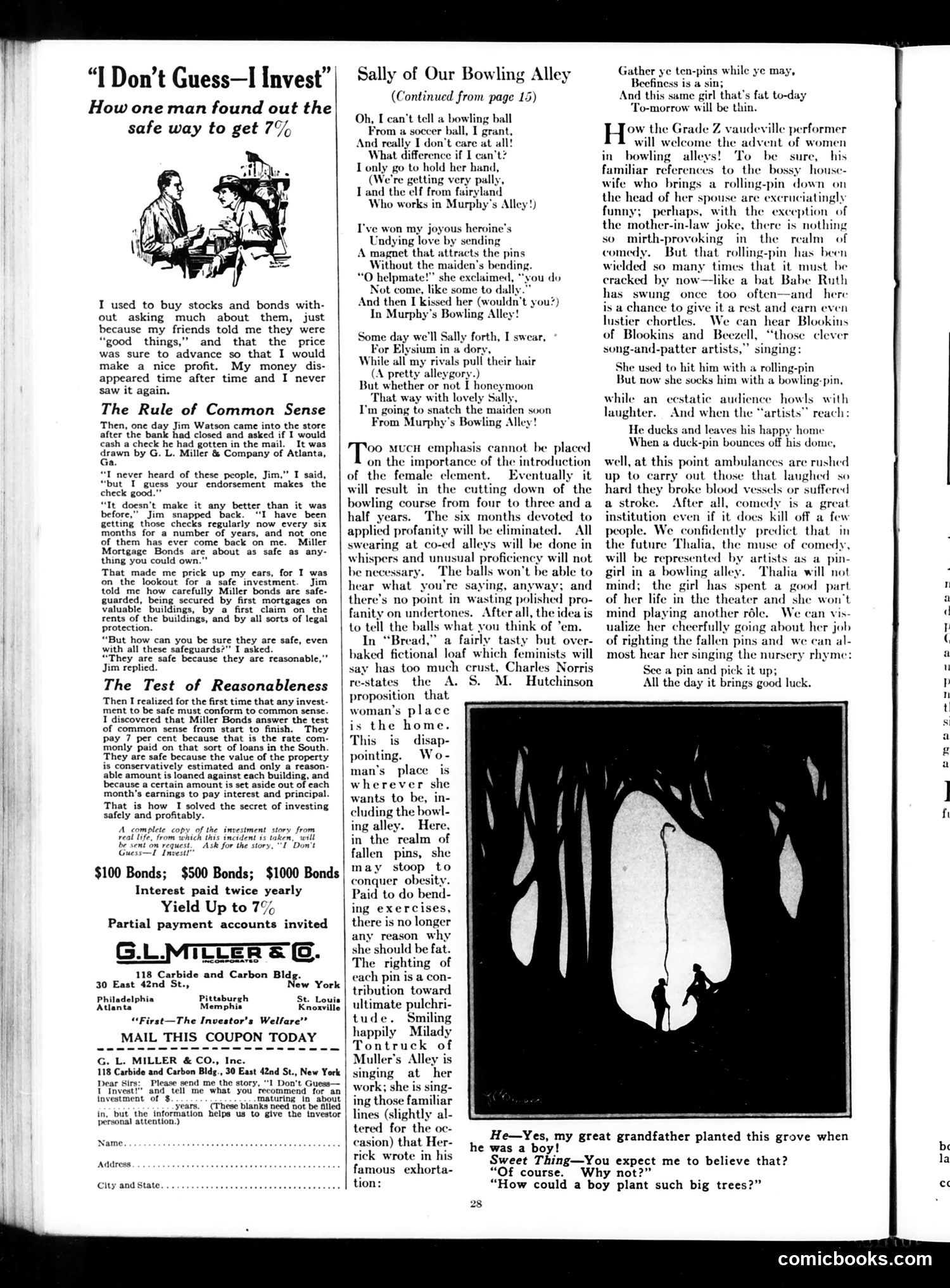
This page contains **primarily advertising** alongside light entertainment content. The main feature is a **G.L. Miller & Company investment advertisement** disguised as a personal testimonial story ("I Don't Guess—I Invest"). It promotes mortgage bonds yielding 7% interest, using a narrative about a skeptical investor convinced by a friend that these bonds are "safe" because they're "reasonable"—secured by real property and conservative lending practices. This reflects early 20th-century investment marketing before modern securities regulation. The smaller content includes "Sally of Our Bowling Alley," a humorous serialized poem about courtship in a bowling alley—typical light verse filler for magazines of this era. The joke relies on bowling alley slang and romantic clichés ("Sally forth," puns on "pins"). The page reflects a time when magazines blended advertising with editorial content less transparently than modern standards require, and when bowling alleys were popular middle-class social venues for courting couples.
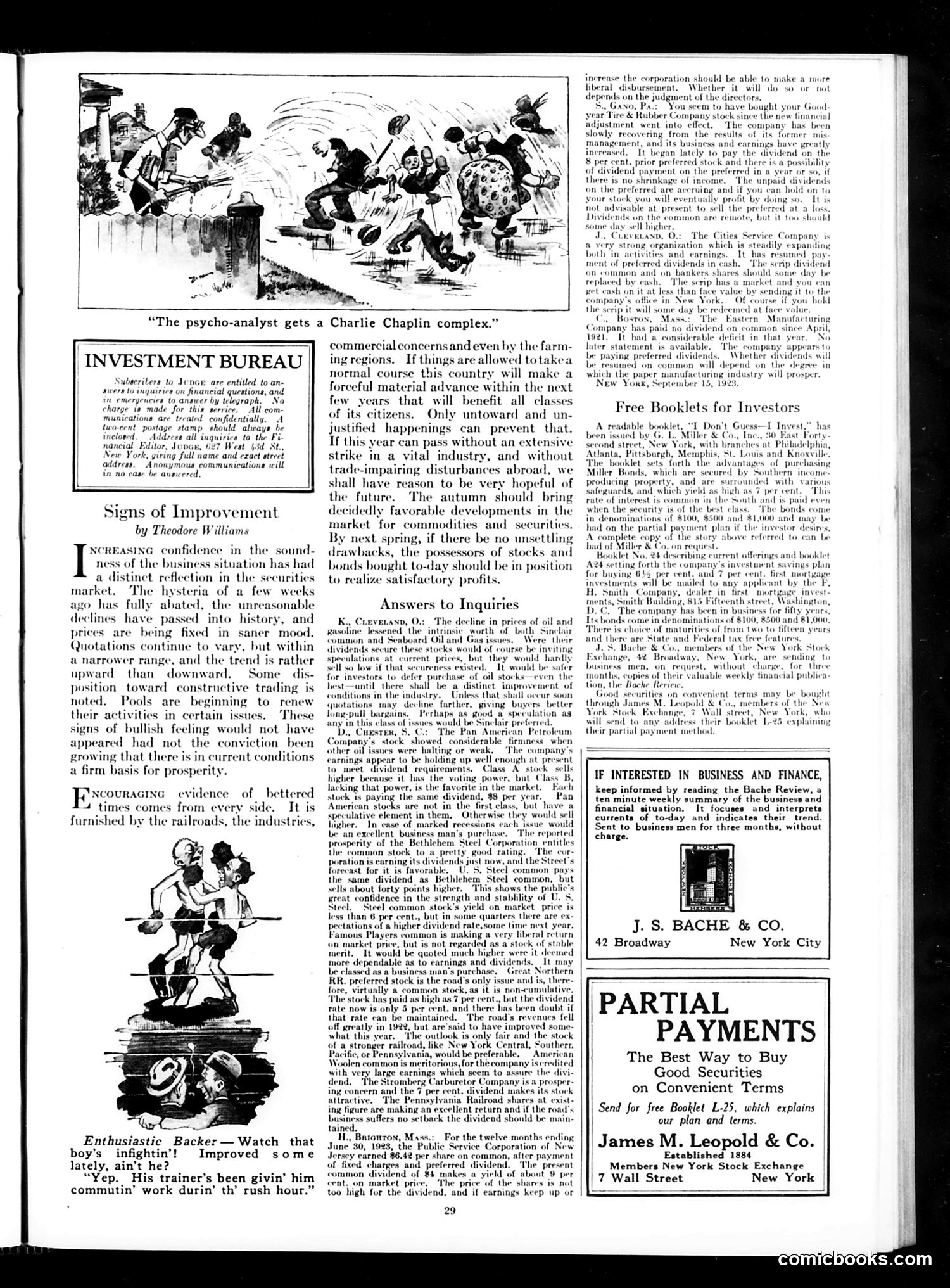
The top cartoon satirizes early 20th-century psychoanalysis (then trendy and associated with Sigmund Freud's theories). The caption "The psycho-analyst gets a Charlie Chaplin complex" is a play on words: rather than a patient having a "complex" (psychological hang-up), the analyst himself develops one. The image shows what appears to be a chaotic therapy session where the analyst and patient roles have reversed or become confused—a visual joke mocking both psychoanalysis's pretensions and the then-famous silent film comedian Charlie Chaplin's slapstick style. The page's main content is an **investment advice column** addressing financial market conditions. The writer ("Theodore Williams") expresses cautious optimism about improving business confidence and stock markets, warning that labor strikes or international trade disruptions could derail recovery. The bottom includes reader Q&A about specific stocks (oil, railroads, steel companies). The small cartoon about "Enthusiastic Backer" jokes about boxing training during rush-hour commuting—using working-class sports vernacular for humor.
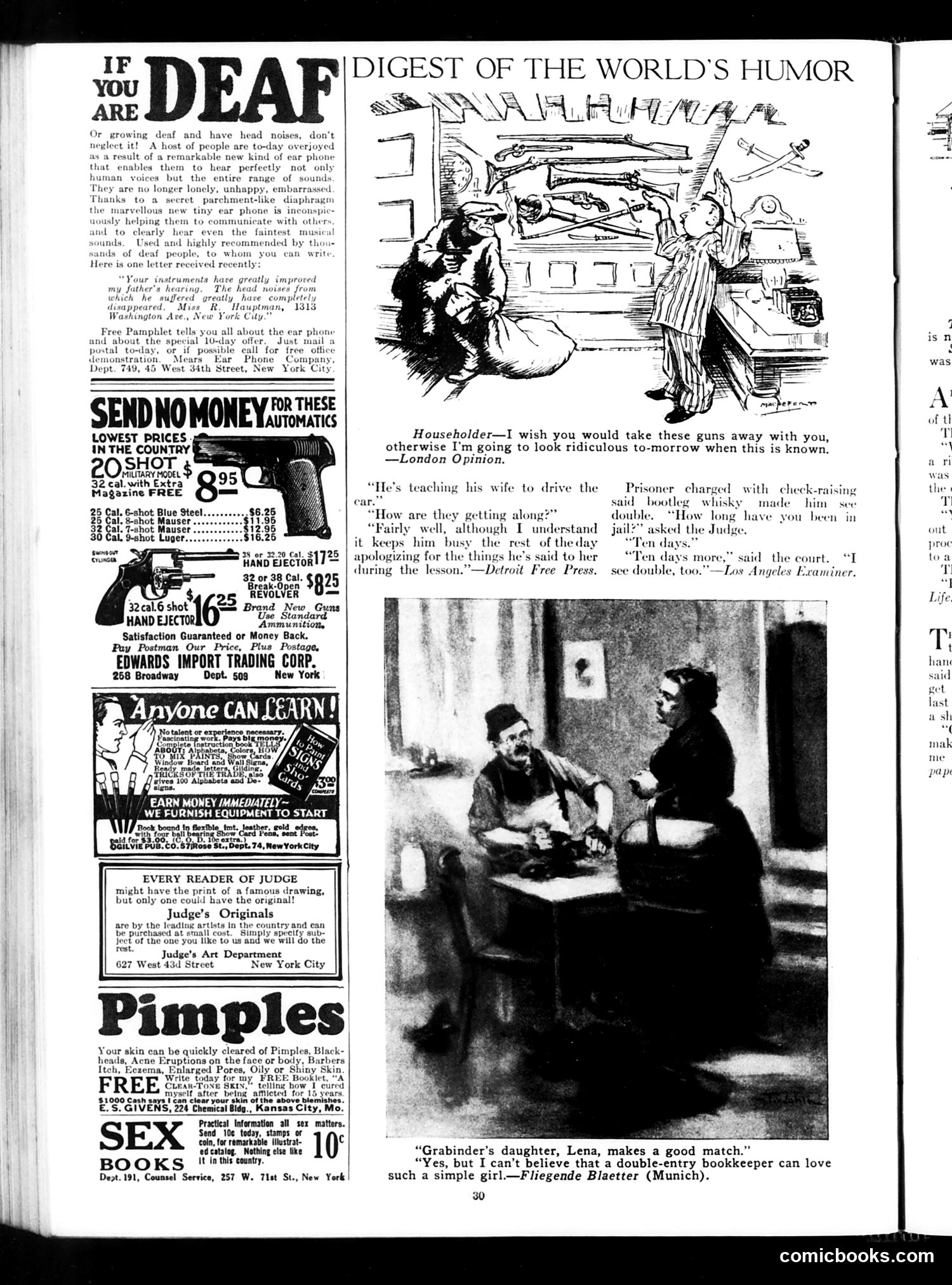
This page from the satirical magazine *Judge* contains multiple cartoons and advertisements reflecting early 20th-century American humor and concerns. **Main Cartoon (top):** A householder complains to a man carrying guns, saying he'll "look ridiculous tomorrow" when word spreads about the weapons visit. This appears to satirize anxieties about firearms or military presence in civilian homes. **Lower Cartoon:** Two men discuss a husband "teaching his wife to drive"—a then-novel domestic scenario. The joke plays on marital tension: she's kept so busy apologizing for driving mistakes that it occupies his day. This reflects early automotive-era anxieties about women drivers. **Smaller Jokes:** Include a courtroom exchange where a judge sentences someone to "ten days more" because he "see[s] double too"—mocking judicial drunkenness, likely referencing Prohibition-era corruption. **Advertisements** dominate the left side, hawking mail-order firearms, magic tricks, and self-improvement courses—typical of early-20th-century *Judge* revenue. The page reflects period concerns: gender roles, automobiles, Prohibition, and readily available weapons sales.
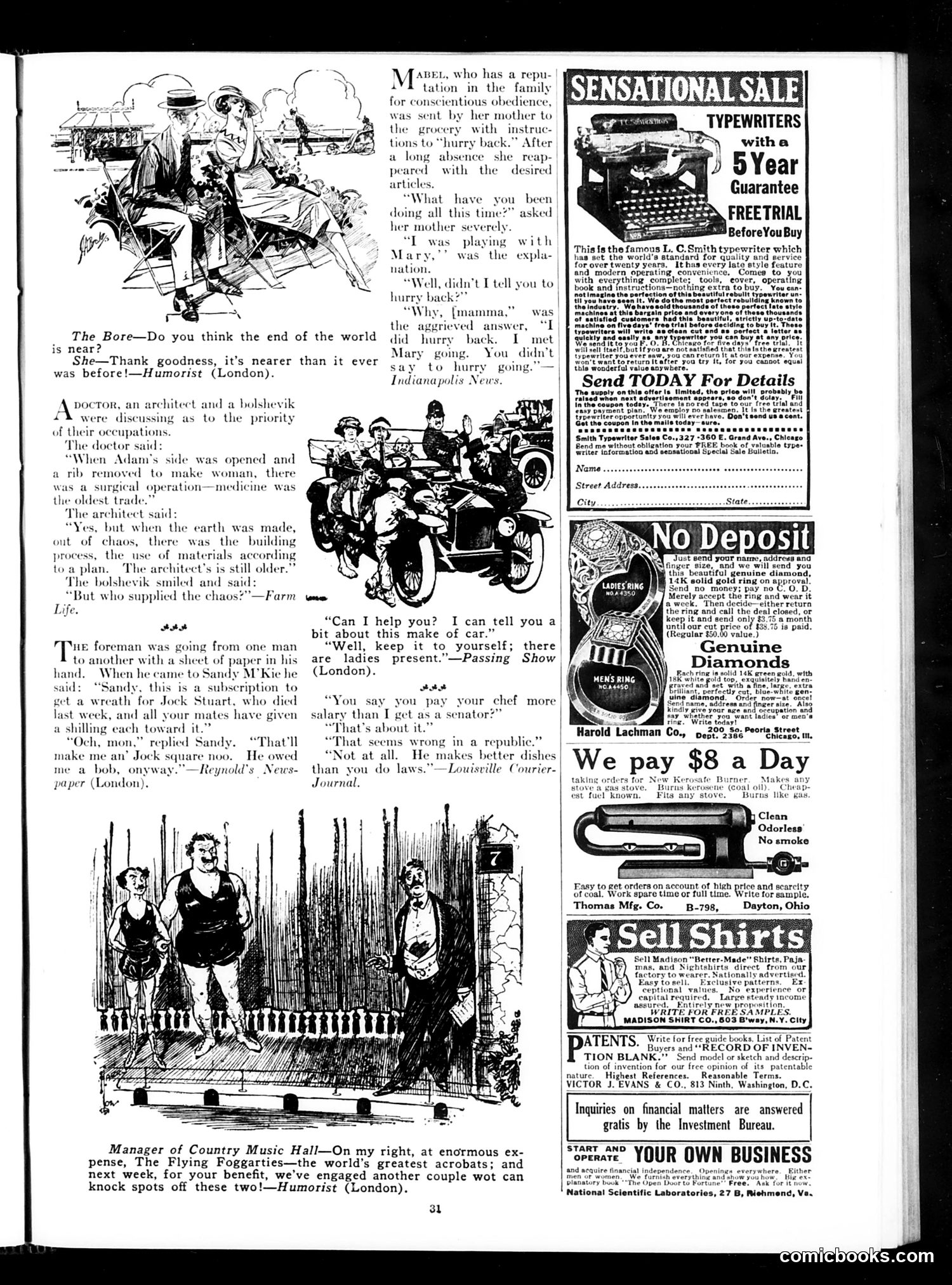
This page contains primarily **humor pieces and advertisements** from an early 20th-century American satirical magazine. ## The Cartoons/Jokes: The visual cartoons illustrate brief anecdotes about everyday life. Notable examples include: - **"The Bore"**: A man pestering a woman about the world's end; she retorts she's relieved since it couldn't be worse than before. - **The Doctor/Architect/Bolshevik joke**: Three professions argue about antiquity. The bolshevik's punchline—"who supplied the chaos?"—is a **contemporary political jab at Bolshevism** (the Russian Revolution occurred in 1917), portraying Bolsheviks as agents of chaos and disorder. - **Country Music Hall manager**: Hyperbolic promotional patter about acrobatic acts. The remaining content is **classified advertising**—typewriters, diamonds, patent services, shirt sales—typical of period magazine monetization. No specific political figures are caricatured on this page; the satire is social and situational rather than politically targeted.
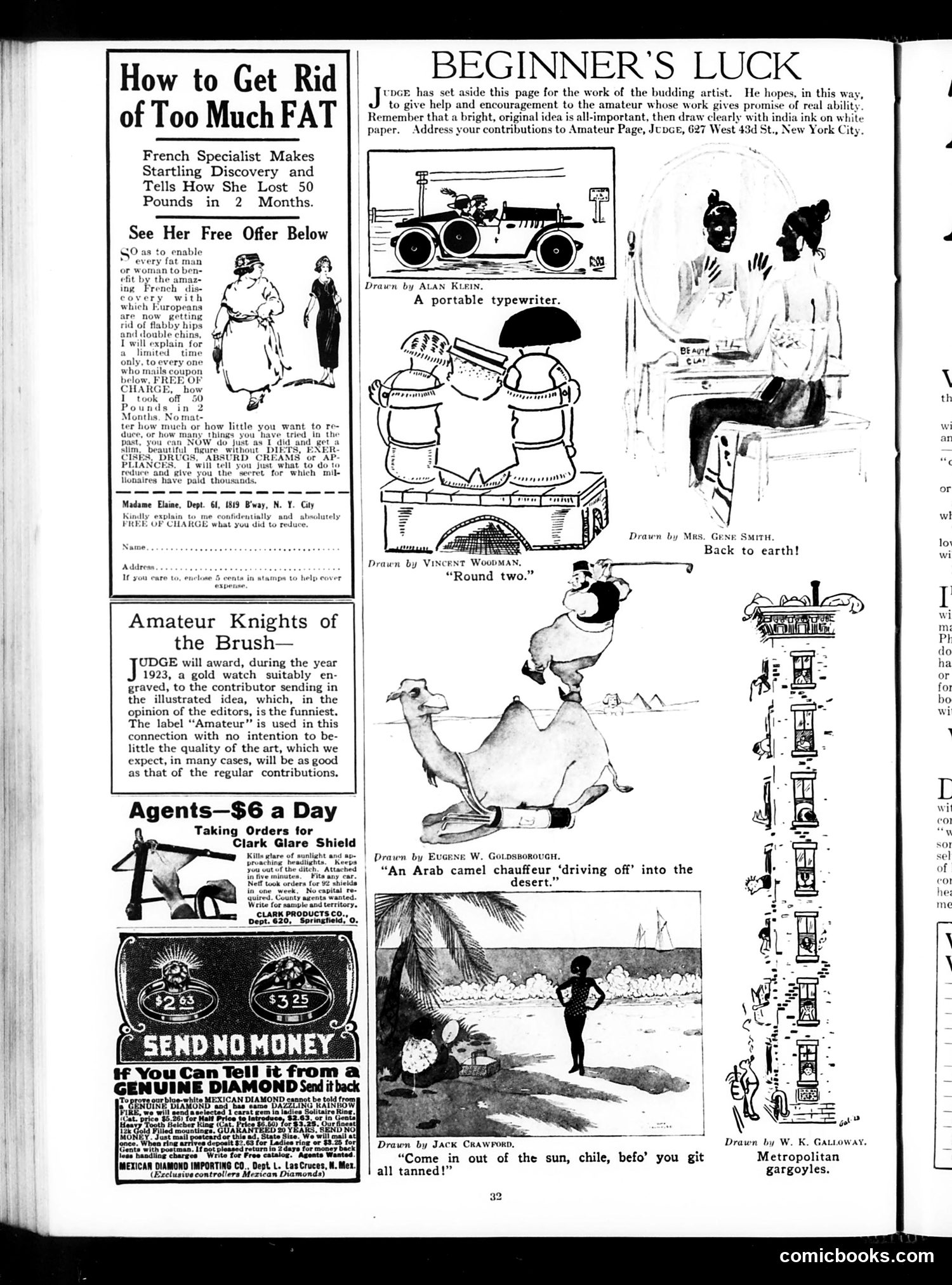
This page showcases amateur cartoon submissions to *Judge* magazine's artist competition. The "Beginner's Luck" section displays five humorous drawings by aspiring cartoonists: 1. **"A portable typewriter"** (Klein): Two rotund figures sharing an umbrella, likely depicting the typewriter as a shared object between portly people—physical comedy. 2. **"Back to earth!"** (Smith): Office scene with unclear satirical intent from this image alone. 3. **"Round two"** (Woodman): Appears to depict a boxing or confrontational scenario. 4. **"Arab camel chauffeur"** (Goldsborough): Colonial-era racial humor showing a camel driver; reflects period stereotyping common in 1920s satire. 5. **"Metropolitan gargoyles"** (Galloway): Architectural building drawing with decorative gargoyle details. The page also advertises weight-loss schemes, diamond sales, and other products typical of 1920s magazine advertising. The amateur submissions showcase varying quality and comedic approaches reflecting contemporary humor conventions.
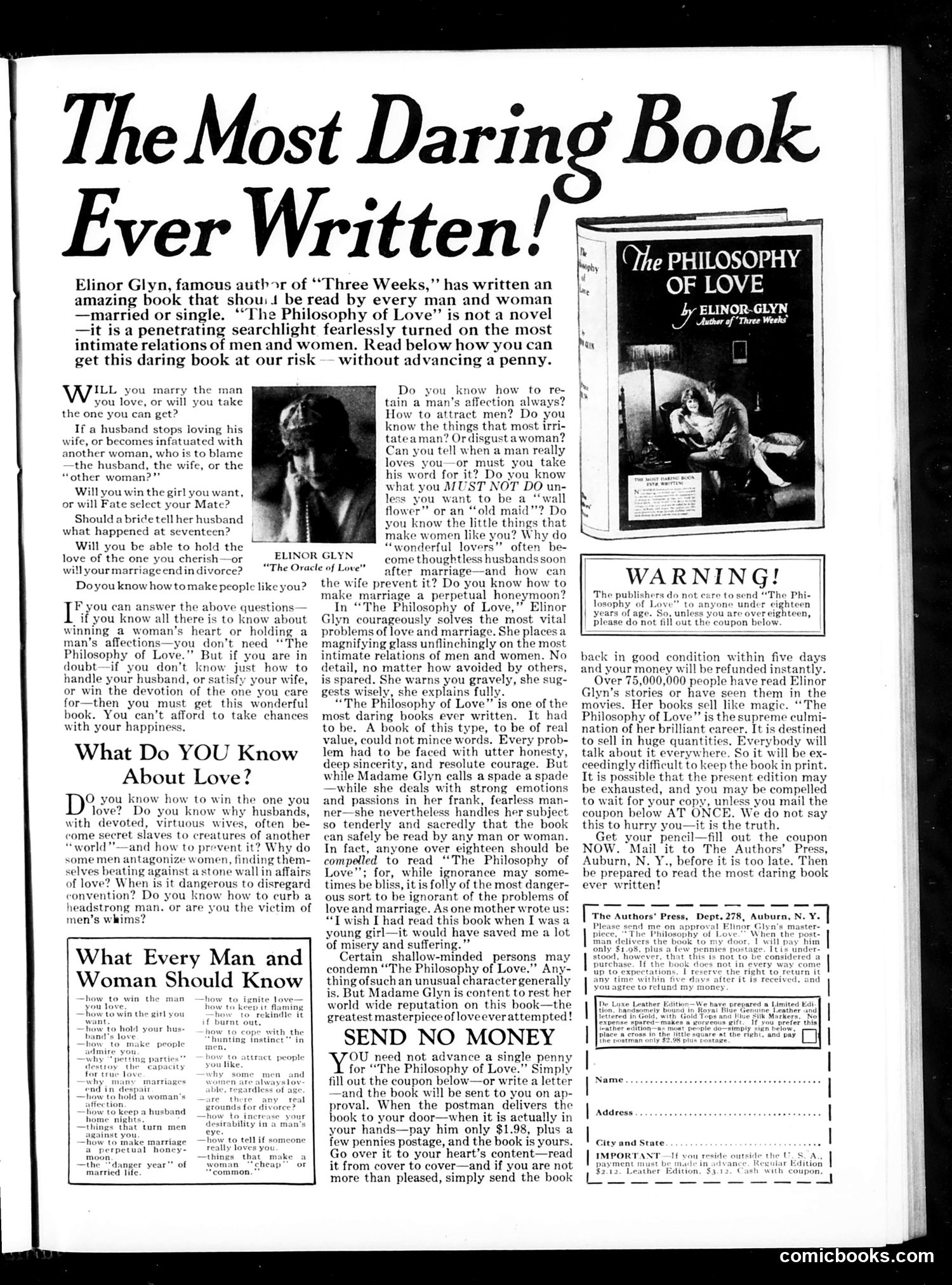
This is a full-page advertisement, not political satire. It promotes Elinor Glyn's book "The Philosophy of Love," marketed as a daring guide to romantic and marital relations. The ad uses rhetorical questions about marriage, infidelity, and attraction to entice readers of both sexes. The satire lies in the advertisement's *tone*: it presents the book as scandalous and forbidden ("The Most Daring Book Ever Written!"), with a mock "WARNING!" section and repeated emphasis on its frank treatment of intimate matters. This hyperbolic marketing was itself a joke—the ad's breathless hype parodies the sensationalism of contemporary publishing. Elinor Glyn was a real bestselling author known for provocative fiction. The ad plays on 1920s anxieties about changing sexual mores and marriage advice, while Judge magazine mocks the overwrought promotional tactics used to sell such books to eager readers.
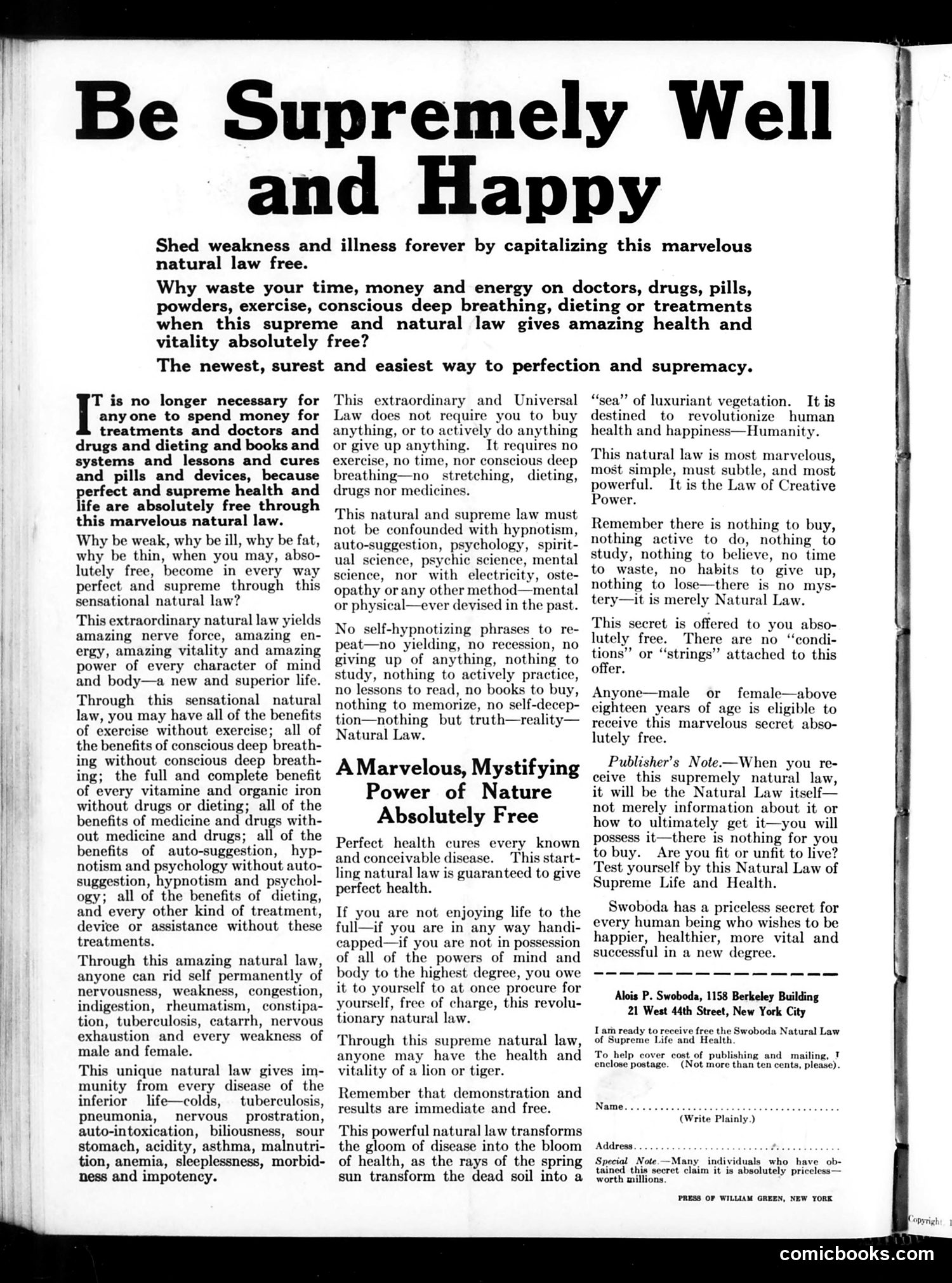
This page is primarily **advertising, not satire**—it's a pseudoscientific health pitch from the early 20th century. The advertisement promotes a mysterious "natural law" claiming to cure all diseases and ailments without doctors, drugs, exercise, diet, or any effort required. The appeal targets desperation: people suffering from tuberculosis, rheumatism, asthma, and other real ailments are promised free, effortless cures. Notably, the ad explicitly distinguishes this "natural law" from hypnotism and psychology—suggesting these were common health scams of the era, and this seller wants to differentiate their particular snake oil. The contact is Alcia P. Swoboda in New York. This represents a widespread early-1900s phenomenon: unregulated medical quackery that exploited people's fears before modern consumer protection laws existed. The ad's breathless promises ("absolutely free," "nothing to buy," "no effort") are classic manipulation tactics.