
Judge, 1923-09-22 · page 11 of 36
Judge — September 22, 1923 — page 11: what you’re looking at
What you’re looking at
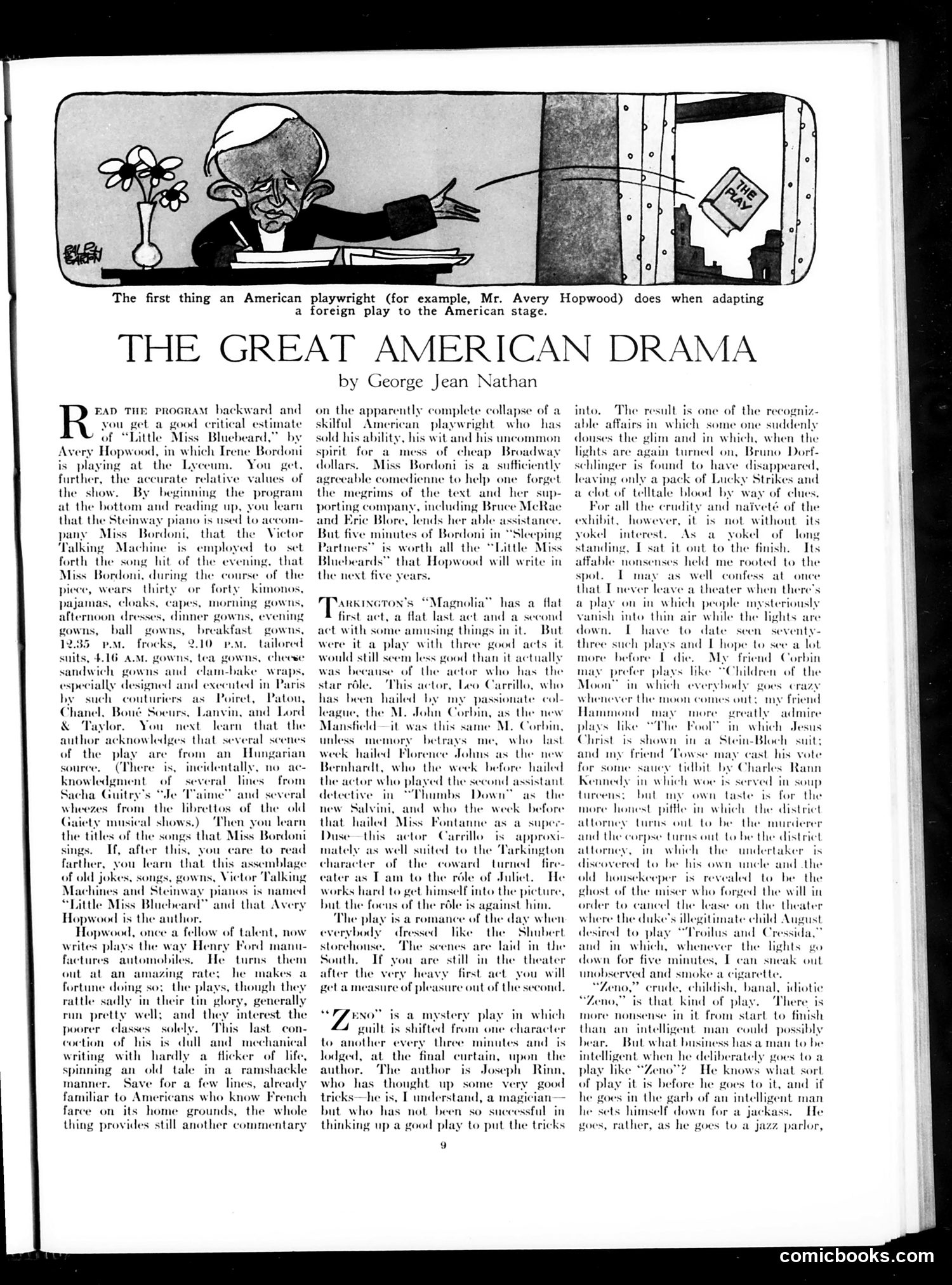
**The cartoon** (top left) depicts a caricatured playwright gesticulating at his desk—likely Avery Hopwood, whom the article criticizes. The image satirizes his mechanical, assembly-line approach to playwriting. **The satire's point:** Critic George Jean Nathan argues that Hopwood, once talented, now manufactures plays like Henry Ford produces automobiles—prioritizing profit over artistry. Nathan dissects "Little Miss Bluebeard" by reading the program backward, revealing the show is merely a collection of borrowed elements: French couture, a borrowed Hungarian plot, recycled jokes, piano music, and Victor phonograph songs—all assembled around actress Irene Bordoni. **The key critique:** American playwrights have abandoned wit and originality for cheap Broadway dollars. Hopwood's work lacks genuine dramatic structure, relying instead on spectacle and star power to draw "poorer classes" audiences. **Context:** This reflects 1920s theater criticism targeting commercialization of Broadway and the decline of American dramatic art.
📄 Transcribed text from this page (OCR, searchable)
Machine-transcribed from the original scan — historical spelling and the odd misread are preserved.
The first thing an American playwright (for example, Mr. a foreign play to the American stage. Avery Hopwood) does when adapting THE GREAT AMERICAN DRAMA by George Jean Nathan FAD THE procram backward and you geta 1 critical estimate of “Little Miss Bluebeard,” by Avery Hopwood, in which Irene Bordoni is playing at the Lyceum. You get. further, the accurate relative values of the show. By beginning the program at the bottom and reading up, you that the Steinway piano is used to accom- any Miss Bordoni, that the Victor Talking Machine is. employed to. set forth the song hit of the evening, that Miss Bordoni, during the course of the piece, wears thirty) or forty kimonos, pajamas, cloaks, capes, morning gowns, ternoon dresses, dinner gowns, evening ywns, ball gowns, breakfast gowns, 12.35 pm. frocks, 2.10 pa. tailored suits, 4.16 a.m. gowns, tea gowns, cheese sandwich gowns and clam-bake wraps, especially designed and executed in Paris by such couturiers as Poiret, Patou, Chanel, Boué Soeurs, Lanvin, and Lord & Taylor, You next learn that) the author acknowledges that several scenes of the play are from an Hungarian source. (1 incidentally, no ac- knowledgment of) several lines from Sacha Guitry’s “Je Tain nd sev the librettos of the ol Gaiety musical shows.) ‘Then you learn the titles of the songs that Miss Bordoni sings. If, after this, you care to read farther, you learn that this assemblage of old jokes, songs, gowns, Victor Talking Machines and Steiny dianos is named “Little Miss Bluebeard” and that Avery Hopwood is the author. Hopwood, once a fellow of talent, now writes plays the way Henry Ford manu- factures automobile turns them out at an amazing he makes a fortune doing soy the plays, though they rattle sadly in their tin glory, generally run pretty well; and they interest. the poorer classes solely. ‘This. | coction of his is dull and on writing with hardly a flicker of spinning an old tale ina ramst many 5 for a few lines, familiar to Americans who know farce on its home grounds, the whole thing provides still another commentary rere is, on the apparently complete collapse of a skilful American playwright) who has sold his ability, his wit and his uncommon spirit for a mess of cheap Broadway dollars. Miss Bordoni is a sufficiently agreeable comedienne to help one forget the mogrims of the text. and her sup- porting company, including Bruce McRae and Eric Blore, lends her able assistanc But five minutes of Bordoni in “Sleepi Partners” is worth all the “Little Miss Blucbeards” that Hopwood will write in the next five years. " Anesaran's “Magnolia” has a flat first act at last act and a second act with some amusing things in it. But were it a play with three good acts. if would still seem less good than i was because of the actor who star réle. ‘This actor, Leo Carrillo, who has been hailed by my passionate. col- league, the M. John Corbin, as the new Mansfield — it was this same M. Corbin, unless memory betrays me, who last week hailed Florence Johns as the new Bernhardt, who the week 1 > hailed the actor who played the second assistant detective in’ *’Phambs Down as— the new Salvini, and who the week before that hailed Miss Fontanne as a super- Duse—this actor Careillo is approxi- mately as well suited to the Tarkington acter of the coward turned fire- eater as Tam to the réle of Juliet. He works hard to get himself into the picture, but the focus of the réle is against him. The play is a romance of the day when everybody dressed like the Shubert storehouse. The scenes are laid: in’ the South. If you are still in’ the theater after the very heavy first act you will get a measure of pleasure out of the second. aS fait is a mystery play in which 4 guilt is shifted from one character to another every three minutes and is lodged, at. the final curtain, upon the author. The author is Joseph Rinn, who has thought up some very good tricks—he is, T understand, a magician but who has not been so successful in thinking up a good play to put the tricks 9 into. The result is one of the recogniz- able affairs in which some one suddenly douses the glim and in which, when the lights are again turned on, Bruno Dorf- schlinger is found to have disappeared, leaving only a pack of Lucky Strikes and a clot of telltale blood by way of clues. wll the crudity and naiveté of the exhibit, however, it is not without its yokel interest. As a yokel of long standing, T sat it out to the finish. Its affable nonsenses held me rooted to the spot. Tomay well confess at_ once that T never le iv theater when there’ a play on in which people mysteriously vanish into thin air while the lights are down. [have to date seen seventy- three such plays and [ hope to see a lot before TD die. My friend Corbin r plays like “Children of the in which everybody goes crazy whenever the moon comes out: my friend Hammond) may more greatly admire plays like °Phe Pool” in which Jesus Christ in a Stein-Bloch suits and my friend ‘Towse may cast his vote for some saucy tidbit by Charles Rann Kennedy in which woe is served in soup turcens: but my own is for the more honest piffle in which the district attorney turns oul to be the murderer and the corpse turns out to be the district attorney, in’ whieh the tker is discovered to be his own uncle and the old housekeeper is revealed to be the ghost of the miser who forged the will in order to cancel the lease on the theater where the duke’s illegitimate child August desired to play “Troilus and Cre * and in which, whenever the | down for five minutes, I can sne; unobserved and smoke a cigarette, eno,” crude, childish, banal, idiotie “eno,” is that kind of play. ‘There is More nonsense in it from: start to finish than an intelligent’ man could possibly bear. But what business has a man to be intelligent when he deliberately goes to a play like “Zeno”? He knows what sort of play it is before he goes to it, and if he goes in the garb of an intelligent man he sets himself down for a jackass. He goes, rather, as he goes to a jazz parlor, is shown taste comicbooks.com