
Judge, 1923-09-22 · page 28 of 36
Judge — September 22, 1923 — page 28: what you’re looking at
What you’re looking at
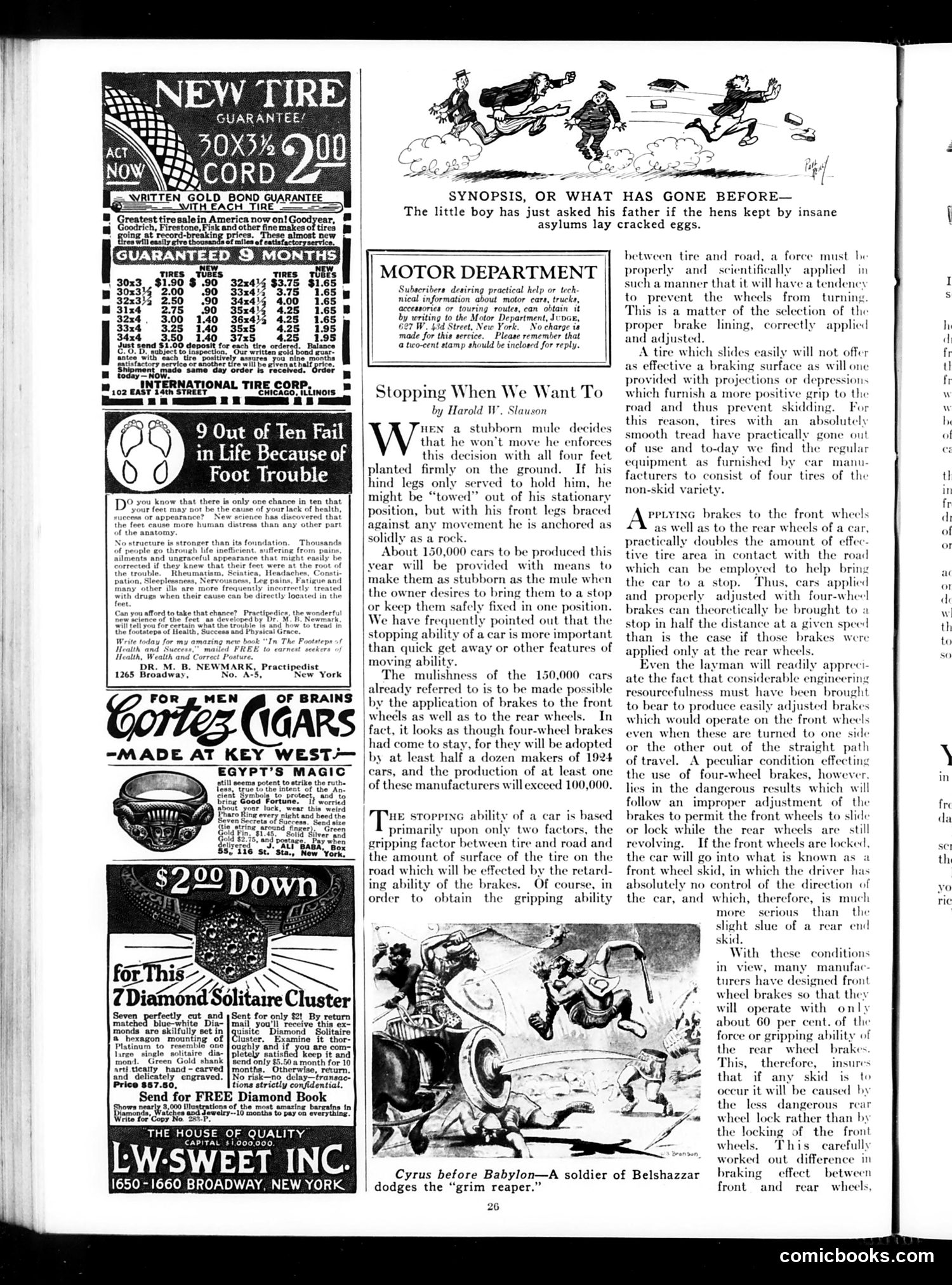
This page is primarily **advertising with one automotive article**. The main content is "Stopping When We Want To" by Harold W. Slauson, a technical piece about automobile braking systems—specifically, the emerging adoption of four-wheel brakes in 1924 cars. The article uses an extended mule metaphor: just as a stubborn mule uses all four legs to resist movement, modern cars will soon use four-wheel brakes for superior stopping power, rather than relying only on rear brakes. Slauson discusses the physics of braking—the grip between tire and road, tire tread design, and brake lining selection. The accompanying illustration shows a biblical scene (Cyrus before Babylon, "the grim reaper"), which appears unrelated to the text and likely illustrates an unshown story synopsis about asylum hens laying cracked eggs. The page is dominated by period advertisements: tire guarantees, Corley cigars, foot-trouble remedies, and diamond rings—typical Judge revenue sources.
📄 Transcribed text from this page (OCR, searchable)
Machine-transcribed from the original scan — historical spelling and the odd misread are preserved.
OXI op RITTEN GOLD BOND GUARANTEE | TEE == WITH EACH TIRE 1 Greatest tire salein America now on! Goodyear ——s j Goodrich, Firestone, Fisk and other fine makes o! ‘record-breaking prices. These GUARANTEED 9 MONTHS RES vies ES TR 30x3, $1.90 $ .90 322414 $37 a 90 ant 3er4: 36x4) 35x5 9 Out of Ten Fail in Life Because of Foot Trouble indation. Thousands many other ills fr tly with drugs when their cause can be directly located in th feet . NEWMARK, Practipedist,_ 1265 Broadway, No. A -MADE AT al WweESsT— EGYPT’S MAGIC gtill seems potent to strike the ruthe for’ ise ® mbad§ } os ZDiam AGélitare Cluster Seven mon it and »Sent for ‘only $21. By return mate! ie Arg Dia- | mail you'll receive this ex- monds are skilfully setin |quisite Diamond Solitaire @ hexagon mounting of | Cluster. Examine it thor- | pletely Sausid e keep it and send only $5.50 a month for 10 therwise, return. No risk—no delay—transac- tions strictly confidential. Send for. FREE Diamond Book tions of the mest amazing barratpa In ewelry-10 months to pay on everything. 1650 -1660 BROADWAY, NEW YORK tires py | SYNOPSIS, OR WHAT HAS GONE BEFORE— The little boy has just asked his father if the hens kept by insane asylums lay cracked eggs. MOTOR DEPARTMENT | Subscribers desiring practical help or tech- information about motor cara, trucks, accessories or touring routes, can obtain it by writing to the Motor Department, Jvnc 627 W, 43d Street, New York. No charge made for this sercice. Please remember that a tuco-cent stamp should be incloeed for reply. Stopping When We Want To by Harold W’, Slauson HEN a stubborn mule decides that he won't move he enforces this decision with all four feet planted firmly on the ground. If his hind legs only served te hold him, he might be “towed” out of his stationary position, but with his front legs brace against any movement he is anchored as solidly as a rock. About 150,000 cars to be produced this year will be provided with means to make them as stubborn as the mule when the owner desires to bring them to a stop or keep them safely fixed in one position. We have frequently pointed out that the stopping ability of a car is more important than quick get away or other features of moving ability. | The mulishness of the 150,000 cars | already referred to is to be made possible by the application of brakes to the front wheels as well as to the rear wheels. In fact, it looks as though four-wheel brakes | had come to stay, for they will be adopted \by at least half a dozen makers of 1924 cars, and the production of at least one of these manufacturers will exceed 100,000. [Te stoppine ability of a car is based primarily upon only two factors, the gripping factor between tire and road and the amount of surface of the tire on the road which will be effected by the retard- ing ability of the brakes. Of course, in order to obtain the gripping ability dodges the “grim reaper.” 26 between tire and road force must he properly and scientifically applied in such a manner that it will have a tendency to prevent the wheels from turning This is a matter of the selection of the proper brake lining, correctly applied and adjusted. A tire which slides easily will not offer as effective a braking surface as will one provided with projections or depressions which furnish a more positive grip to t road and thus prevent skidding. this reason, tires with an absolutely smooth tread have practically gone out of use and to-day we find the regular equipment as furnished by car manu facturers to consist of four tires of the non-skid variety. Arete brakes to the front whe as well as to the rear wheels of a car, cally doubles the amount of effec- tire area in contact with the road which can be employed to help bring the to a stop. Thus, ears applied and properly adjusted with four-wheel brakes can theoretically be brought to a stop in half the distance at a given speed than is the case if those brakes were applied only at the rear wheels. Even the layman will readily appreci- ate the fact that considerable engineering resourcefulness must ha to bear to produce easily adjusted brakes which would operate on the front wheels even when these are turned to one sidc or the other out of the straight path of travel. A peculiar condition effecting the use of four-wheel brakes, however lies in the dangerous results which will follow an improper adjustment of the brakes to permit the front wheels to slid or lock while the rear wheels are: still revolving. If the front wheels are locked, the car will go into what is known as a front wheel skid, in which the driver has absolutely no control of the direction of the car, and which, therefore, is much more serious than — the slight slue of a rear end skid. With these conditions in view, many manufac turers have designed front wheel brakes so that they will operate with only about 60 per cent. of the force or gripping ability of the rear wheel brakes This, therefore, insures that if any skid is to occur it will be caused by the less dangerous rear wheel lock rather than by the locking of the front wheels. This carefully worked out difference in Cyrus before Babylon—A soldier of Belshazzar braking effect. between front. and rear wheels, comicbooks.com in fre da scl th yo ric