
Judge, 1923-09-22 · page 22 of 36
Judge — September 22, 1923 — page 22: what you’re looking at
What you’re looking at
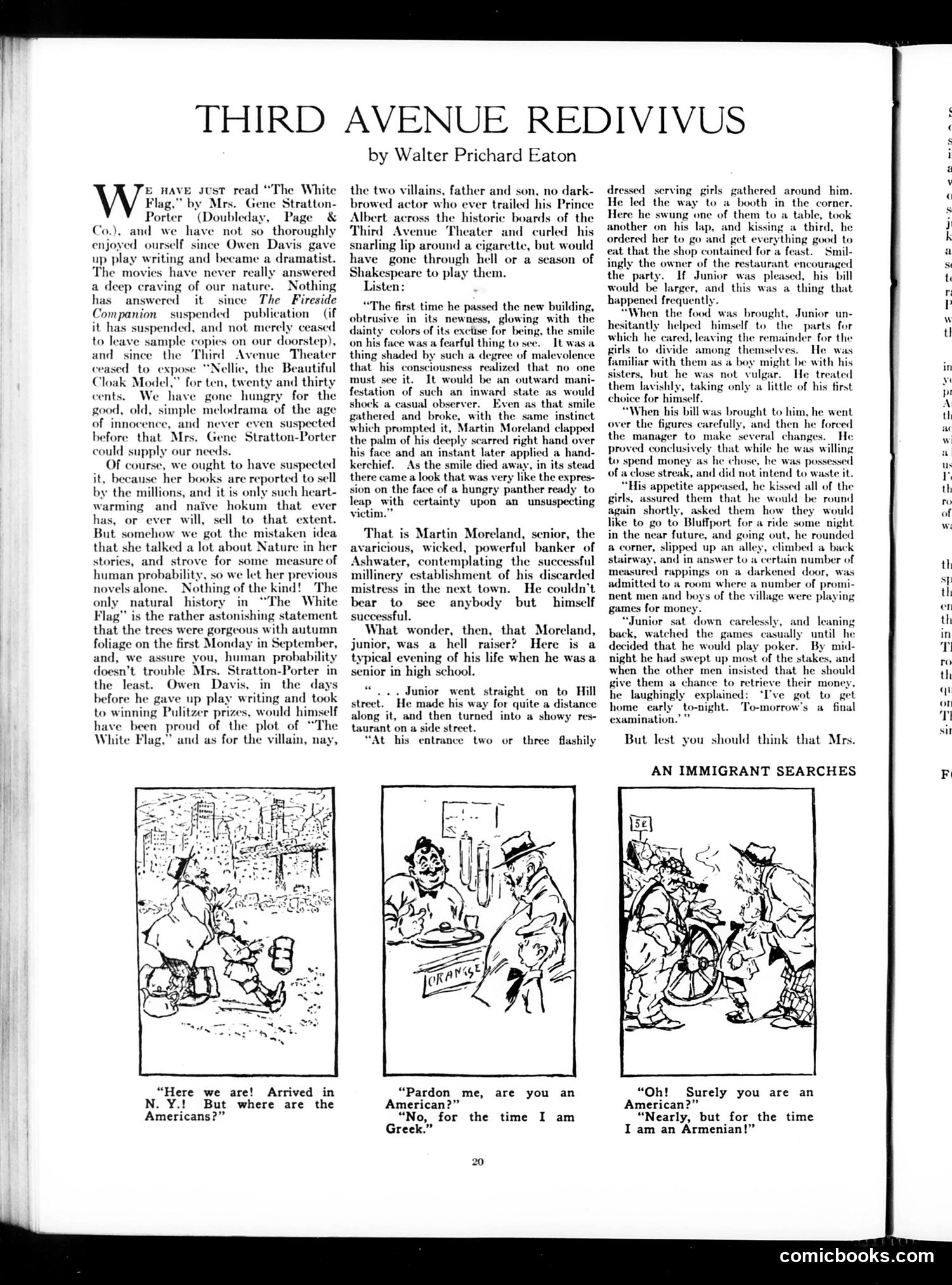
This page contains a literary review of *The White Flag* by Gene Stratton-Porter, praising it as old-fashioned melodrama. The reviewer compares it favorably to the simplistic moral tales of 19th-century popular entertainment, specifically the "Third Avenue Theater"—a real New York venue famous for staging cheap melodramas with exaggerated villains and heroes. The three cartoons below titled "An Immigrant Searches" are unrelated satirical sketches about confused immigrants in America, playing on ethnic stereotypes and language confusion—common Judge magazine humor of this era. The review's point: *The White Flag* succeeds because it delivers pure, shameless melodrama without pretense—villain Martin Moreland is cartoonishly evil (that unsettling smile over his discarded mistress's success), and his son is a dissolute spoiled brat. The author treats this earnestly, recalling an earlier era of American popular entertainment the reviewer nostalgically misses.
📄 Transcribed text from this page (OCR, searchable)
Machine-transcribed from the original scan — historical spelling and the odd misread are preserved.
HAVE Just read “The White W 2.” by Mrs. Gene Stratton- Porter (Doubleday, Page & Co.), and we have not so thoroughly enjoyed ourself since Owen Davis gave up play writing and became a dramatist. The movies have never really answered a deep craving of our nature. Nothing answered it since The Fireside Companion suspended publication (if it has suspended, and not merely ceased to leave sample copies on our doorstep), and since the Third Avenue Th ceased to expose “Nellie, the Beautiful Cloak Model,” for ten, twenty and thirty cents. We have gone hungry for the good, old, simple melodrama of the age of innocence, and never even suspected before that Mrs. Gene Stratton-Porter could supply our needs. Of course, we ought to have suspected it, because her books are reported to sell by the millions, and it is only such heart- warming and naive hokum that ev has, or ever will, sell to that extent. But somehow we got the mistaken idea that she talked a lot about Nature in her stories, and strove for some measure of human probability, so we let her previ novels alone. Nothing of the kind! only natural history in “The White FI is the rather astonishing statement that the trees were gorgeous with autumn foliage on the first Monday in September, and, we assure you, human probability doesn’t trouble Mrs. Stratton-Porter in the least. Owen Davis, in the days before he gave up play writing and took to winning Pulitzer prizes, would himself have been proud of the plot of ‘The White Flag,” and as for the villain, nay, THIRD AVENUE REDIVIVUS by Walter Prichard Eaton the two villains, father and son, no dark- browed actor who ever trailed his Prince Albert across the historic boards of the Third Avenue Theater and curled his snarling lip around a cigarette, but would have gone through hell or a season of Shakespeare to play them. Listen: “The first time he passed the new building, obtrusive in its newness, glowing with the dainty colors of its exctise for being, the smile on his face was a fearful thing to see. It was a thing shaded by such a degree of malevolence that his consciousness realized that no one must see it. It would be an outward mani- festation of such an inward state as would shock a casual observer. Even as that smile gathered and broke, with the same instinct h prompted it, Martin Moreland clapped the palm of his deeply scarred right hand over his face and an instant later applied a hand- kerchief. As the smile died away, in its stead there came a look that was very like the expres- sion on the face of a hungry panther ready to leap with certainty upon an unsuspecting victim.” That is Martin Moreland, senior, the avaricious, wicked, powerful banker of Ashwater, contemplating the successful millinery establishment of his discarded mistress in the next town. He couldn't bear to see anybody but himself suc ul. What wonder, then, that Moreland, junior, was a hell raiser? Here is a typical evening of his life when he was a senior in high school. ... Junior went straight. on to Hill street. He made his way for quite a distance along it, and then turned into a showy res- t nt on a side street. “At his entrance two or three flashily dressed serving girls gathered around him. He led the way to a booth in the corner. Here he swung one of them to a table, took another on his . and kissing a third, he ordered her to go and get everything good to eat that the shop contained for a feast. Smil- ingly the owner of the restaurant encouraged the party. If Junior was pleased, his bill would be larger, and this was a thing that happened frequently. “When the food was brought, Junior un- hesitantly helped himself to the parts for which he cared, leaving the remainder for the i ivide among themselves. He was with them as a boy might be with his ut he was not vulgar. He treated them lavishly, taking only a little of his first choice for himself. “When his bill was brought to him, he went over the figures carefully, and then he forced the manager to make several changes. He proved conclu ly that while he was willing to spend money as he chose, he was possessed of a close streak, and did not intend to waste it. His appetite appeased, he kissed all of the rls, assured them that he would be round again shortly, asked them how they would like to go to Bluffport for a ride some night in the near future, and going out, he rounded a corner, slipped up an alley, climbed a back ay rtain number of rkened door, w re a number of pre nent men and boys of the village were playi games for mone: “Junior sat down careles and leaning back, watched the games ¢ ly until he decided that he would play poker. By mid- night he had swept up most of the stakes, and when the other men insisted that he should give them a chance to retrieve their money, he laughingly explained: ‘I've got to get home early to-night. To-morrow’s a final examination.’ ” But lest you should think that Mrs. AN IMMIGRANT SEARCHES “Here we are! Arrived in N. Y.! But where are the Americans?” “Pardon me, are you an American?” “No, for the time I am Greek.” “Oh! Surely you are an American?” “Nearly, but for the time I am an Armenian!” comicbooks.com