
A complete issue · 36 pages · 1923
Judge — July 28, 1923
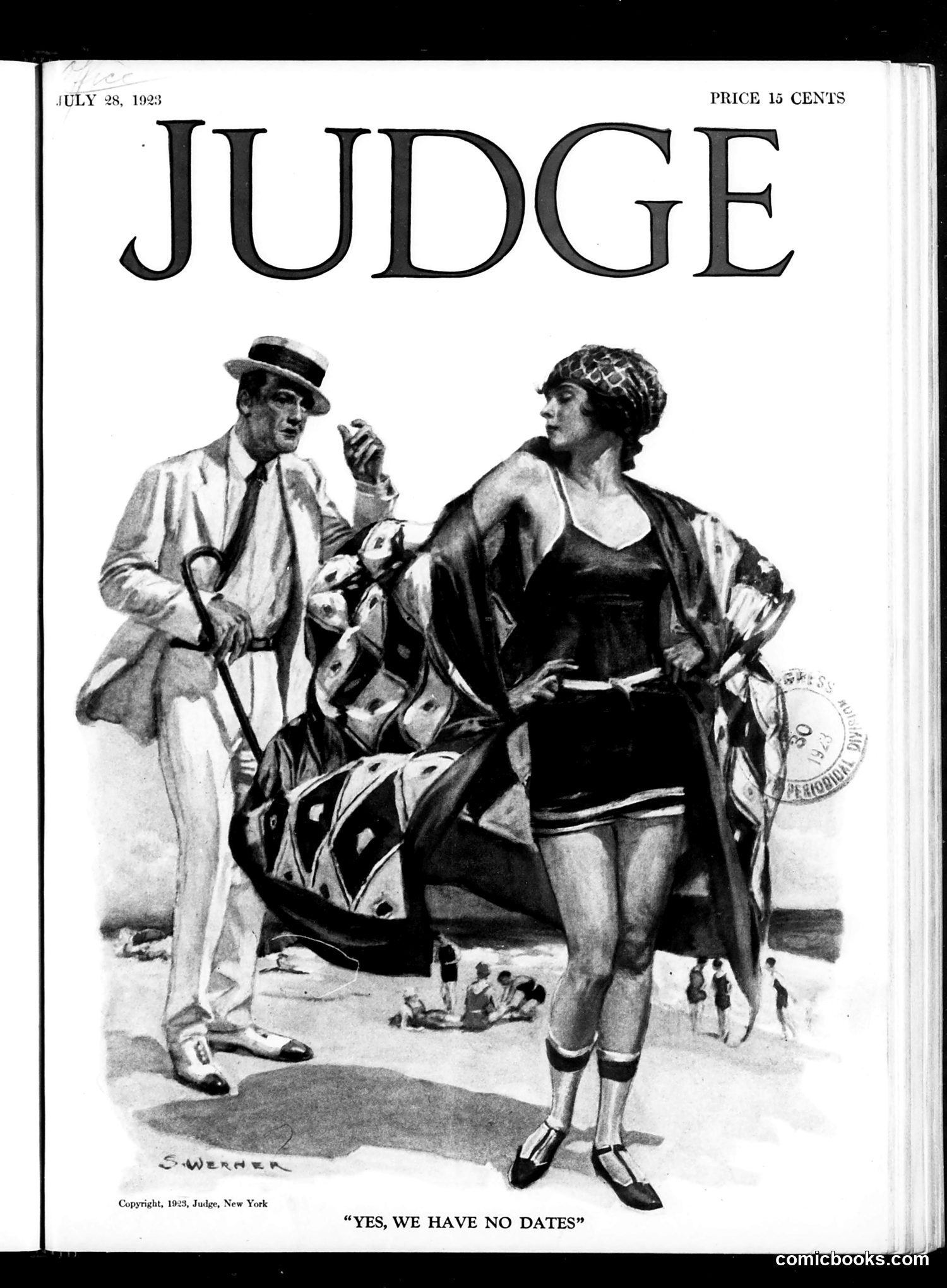
This cartoon satirizes the dating practices of the 1920s "flapper" era. The caption "Yes, We Have No Dates" is a play on the popular 1923 song "Yes, We Have No Bananas." The illustration shows a woman in a bathing suit appearing to proposition a well-dressed man carrying golf clubs. The satire targets the new social freedom of 1920s women—particularly their increased independence in dating and courtship rituals. The man's bemused, somewhat scandalized expression suggests surprise at the woman's boldness in directly soliciting a date. The golf clubs likely indicate leisure, wealth, and the casual social scene. The humor derives from role-reversal: traditionally men pursued women; here a woman actively pursues a man, reflecting anxieties about changing gender dynamics during the Jazz Age.
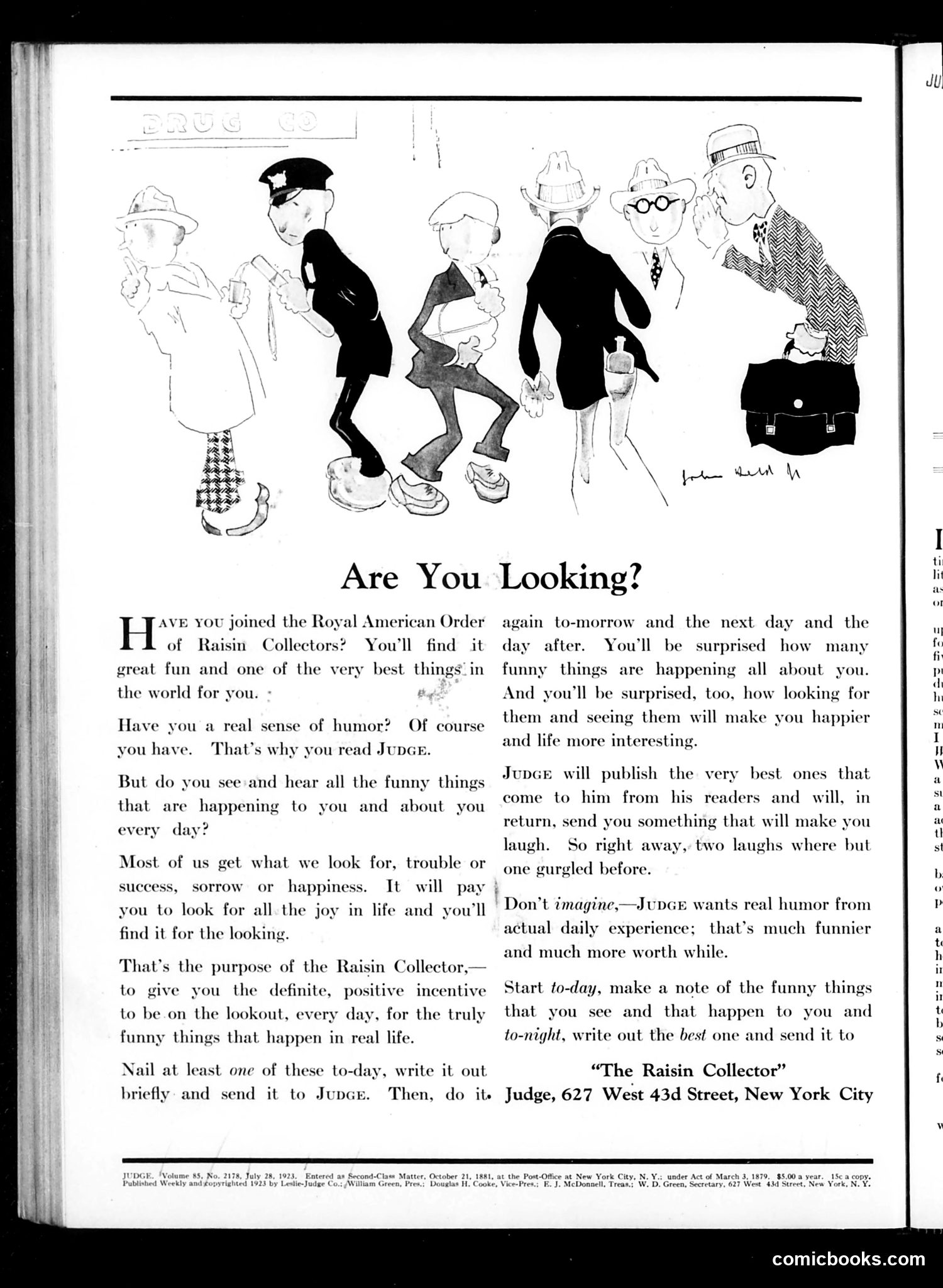
This page is primarily an **advertisement for Judge magazine's reader-submission feature** rather than political satire. The cartoon illustrations at top show six comically-drawn figures in various styles of dress and comportment, representing different personality types or social archetypes of the era. The text invites readers to contribute humorous observations from daily life to "The Raisin Collector" column—presumably named after finding small, valuable moments of humor ("raisins") in everyday experience. Judge promises to publish the best submissions and send contributors something in return. The appeal is straightforward: readers should actively observe life around them, note funny incidents, and submit them. This was a common engagement strategy for magazines of this period, crowdsourcing humor content from their audience.
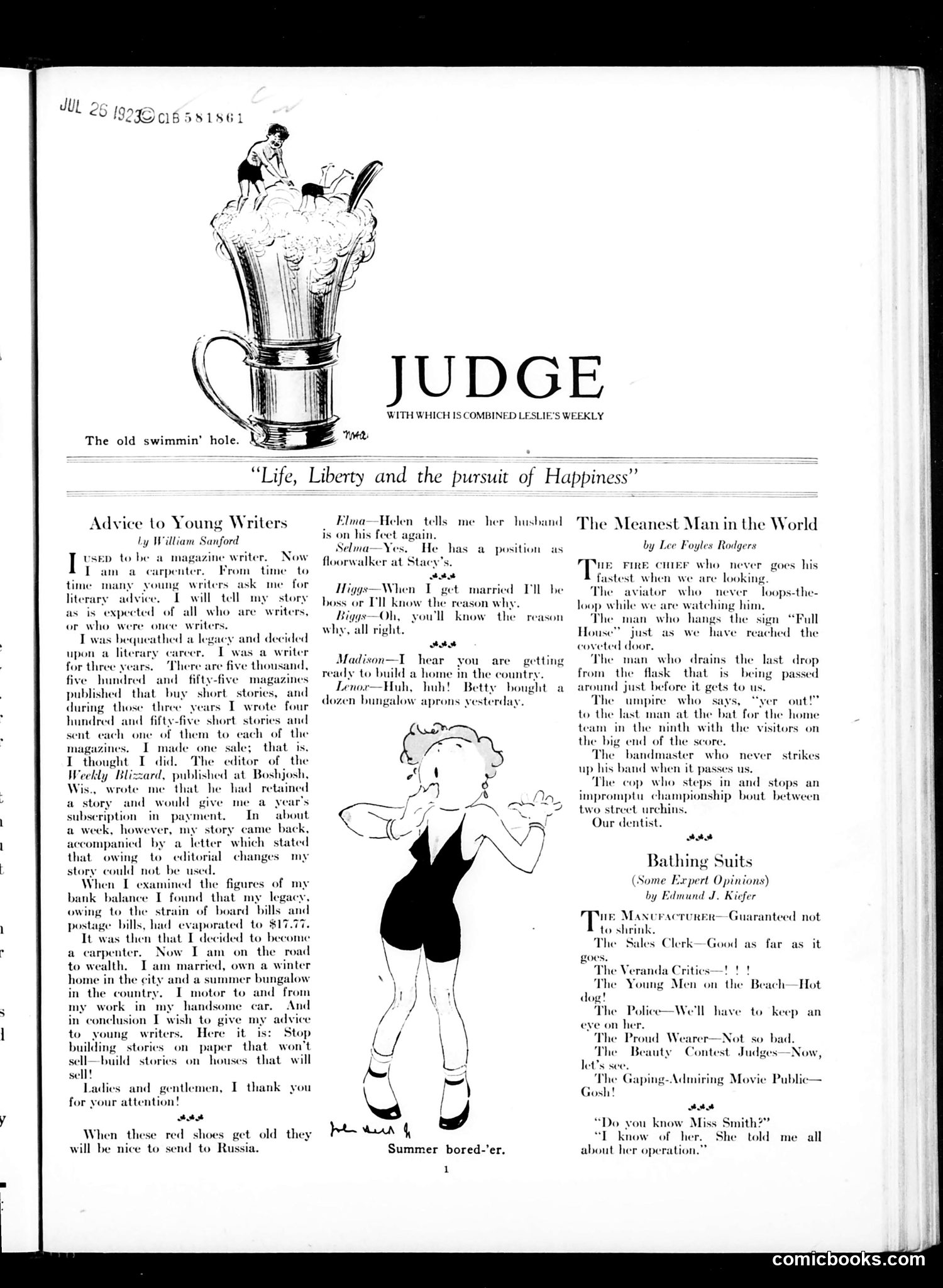
This page contains **"The old swimmin' hole"** — a cartoon showing a man emerging from a large beer mug/pitcher, satirizing Prohibition-era culture. The figure represents someone indulging in illegal alcohol consumption despite the ban. The joke targets the widespread defiance of Prohibition laws through hidden drinking. The page also features William Sanford's "Advice to Young Writers," where he recounts his own magazine publishing struggles, and Edmund J. Kiefer's "Bathing Suits" commentary on contemporary women's fashion and social attitudes. The central illustration depicts a young woman in a 1920s-style bathing suit, likely commenting on changing moral standards regarding women's bodies and beach culture — a social controversy during this era. The overall tone is satirical commentary on contemporary American social and legal issues.
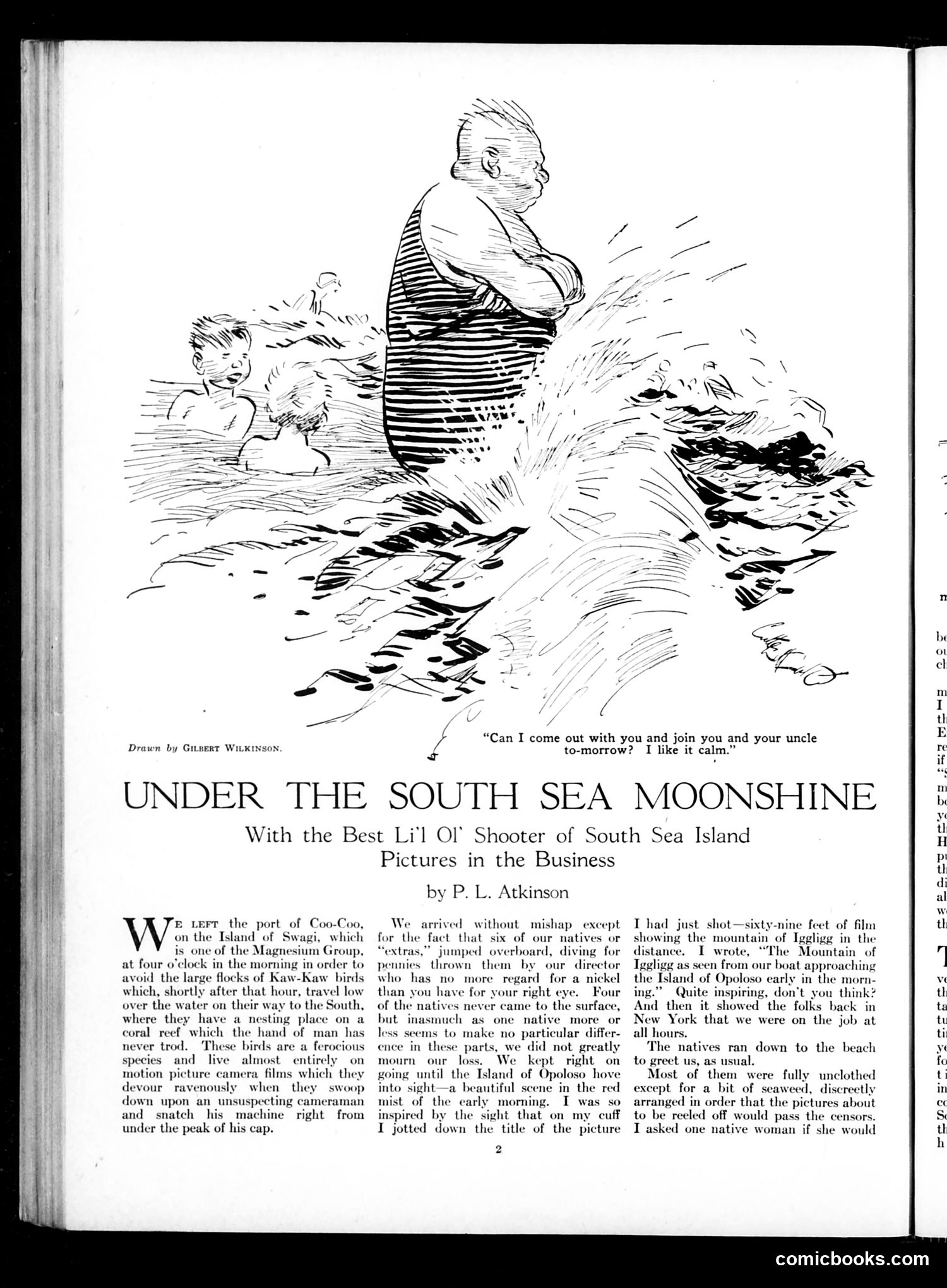
This page contains an illustrated story titled "Under the South Sea Moonshine" by P. L. Atkinson, drawn by Gilbert Wilkinson. Rather than political satire, it's a travel narrative about filmmaking in the South Seas. The illustration shows an adult and child in the ocean with indigenous people on shore. The accompanying text describes a film expedition to Coo-Coo Island in Swat, documenting native life and landscapes. The author discusses shooting footage of "natives" and arranging scenes for the camera, reflecting early ethnographic filmmaking practices. This represents **not satire but period adventure journalism**—typical Judge content mixing exotic travel accounts with illustration, presenting colonial-era attitudes toward indigenous peoples as entertainment for American magazine readers.
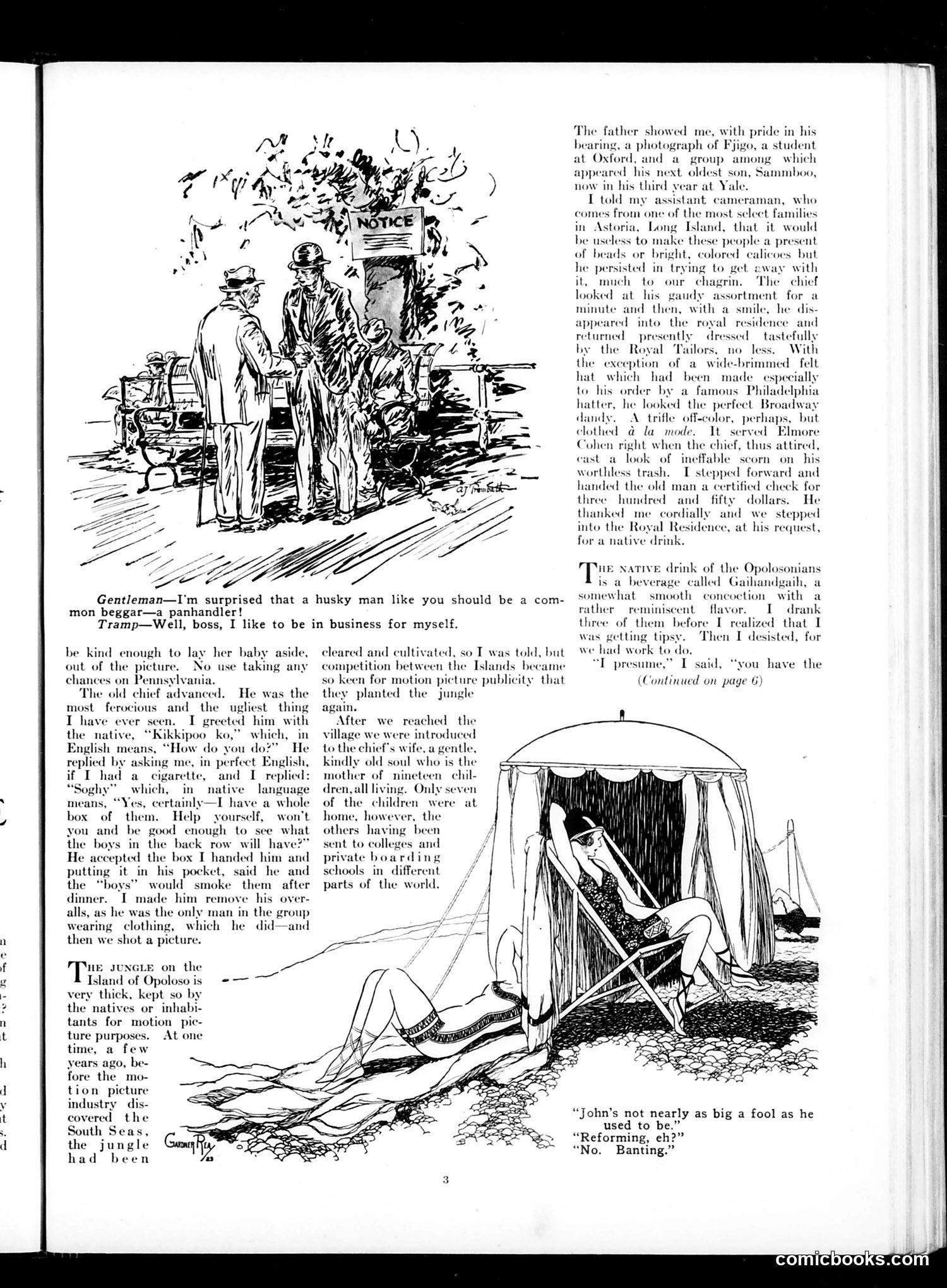
This page contains travel writing and illustrations rather than political satire. The text describes the author's expedition to the Opoloso Islands, documenting encounters with indigenous people and colonial administrators. The top cartoon depicts a dialogue between two men—one appears to be a Western businessman or traveler (in a hat and coat) and another figure near a "NOTICE" sign, likely representing colonial authority. The joke plays on cultural misunderstanding: the Western man expects the indigenous person to be simple, but receives a straightforward business-focused reply. The lower illustration shows a woman resting under a parasol, accompanying text about native beverages. The final caption joke ("John's not nearly as big a fool...") suggests comedic commentary on character reformation or personal change, though context is limited.
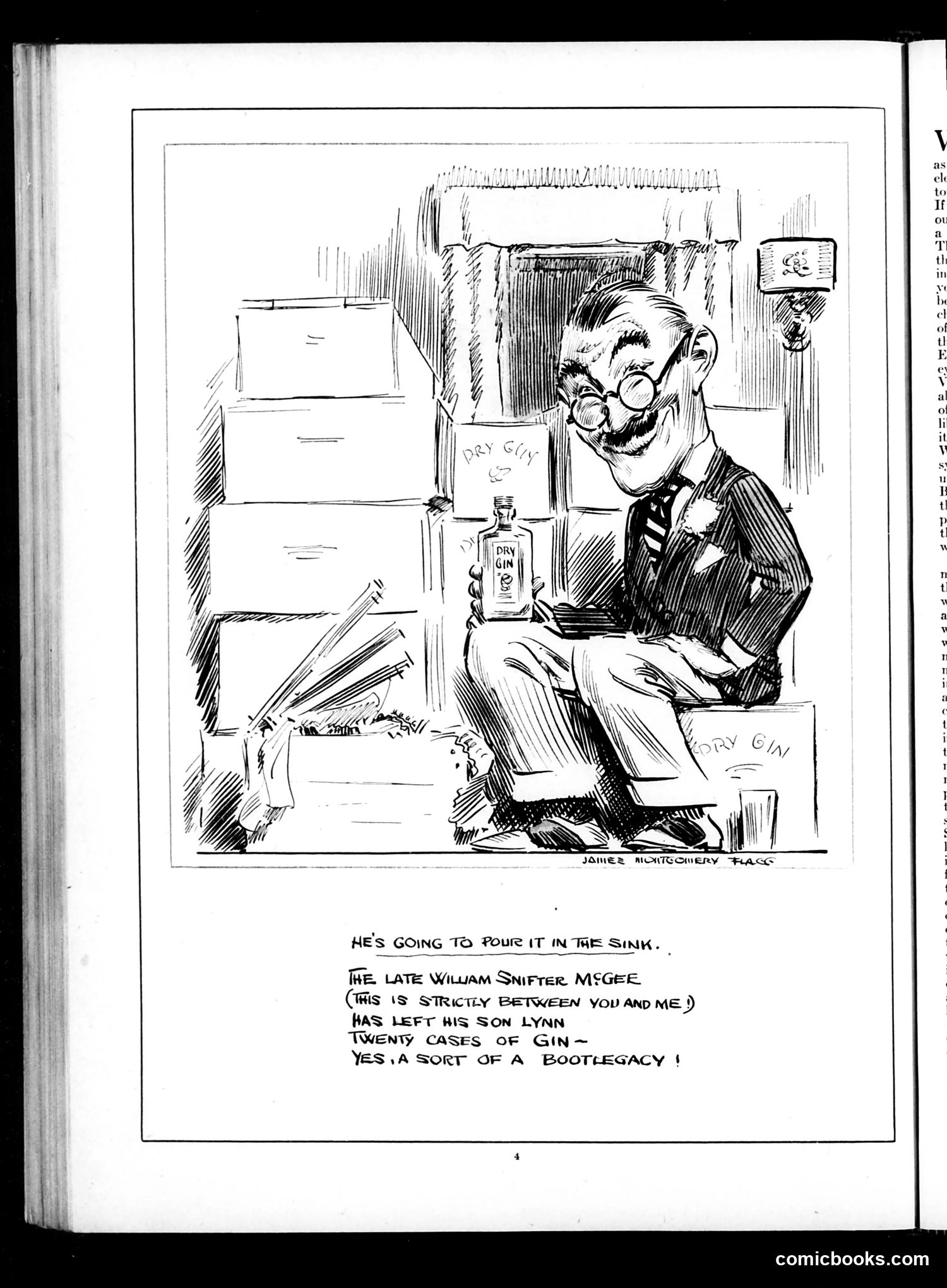
This Judge magazine cartoon satirizes the estate of the late William Sniffer McGee. The caricatured figure sits amid boxes labeled "DRY GIN," holding a bottle—depicted as someone about to "pour it in the sink." The joke targets McGee's son Lynn, who inherited twenty cases of gin. The cartoon suggests this represents a "bootlegacy"—a play on "legacy" and "bootleg," referring to illegal alcohol during Prohibition. The satire mocks both the inheritance of contraband liquor and the absurdity of the son receiving such an impractical, legally problematic bequest. The cartoon dates to America's Prohibition era (1920-1933), when alcohol possession and distribution were federally banned. The humor derives from this prohibition-era context.
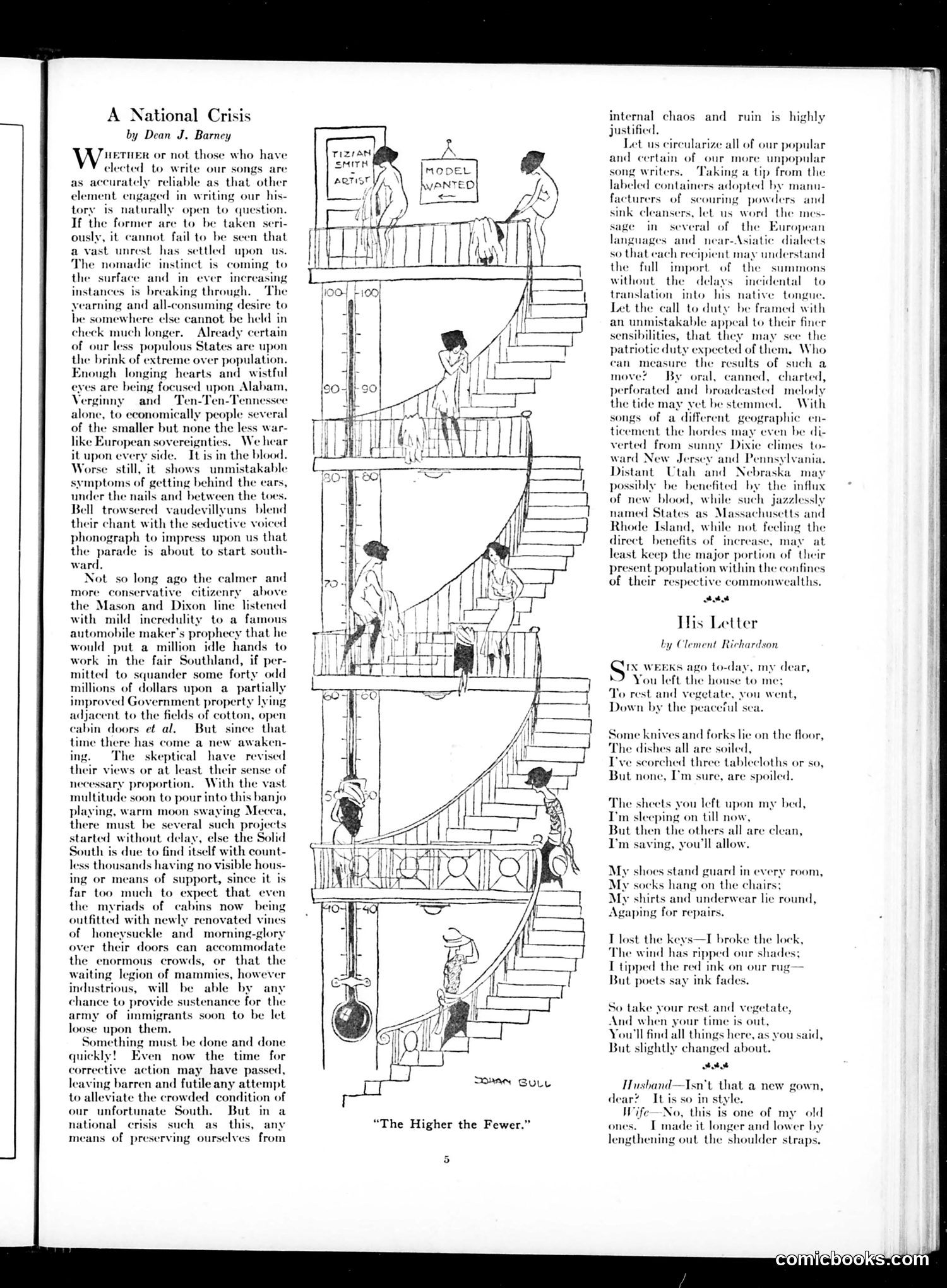
This cartoon satirizes the massive internal migration threatening the American South. The illustration depicts a crowded staircase descending into the depths, representing an exodus of people leaving Northern states for the South. **The Crisis Referenced:** The article warns that popular songs romanticizing the South (like those celebrating Alabama, Virginia, Tennessee) are causing overpopulation in the region. The author humorously proposes the solution: convince songwriters to write songs promoting *other* destinations—New Jersey, Pennsylvania, Utah, Nebraska—to redirect migration away from the overwhelmed South. **The Satire:** The piece mocks both the gravity of Southern overpopulation fears and the absurdity of using popular music as population control. It plays on Depression-era anxieties about migration, employment, and regional strain. **Artist Credit:** Signed "Cowan Bull" at bottom. The cartoon visually emphasizes the scale of movement, showing countless figures navigating the architectural structure—a visual pun on the "higher the fewer" problem of too many people in one place.
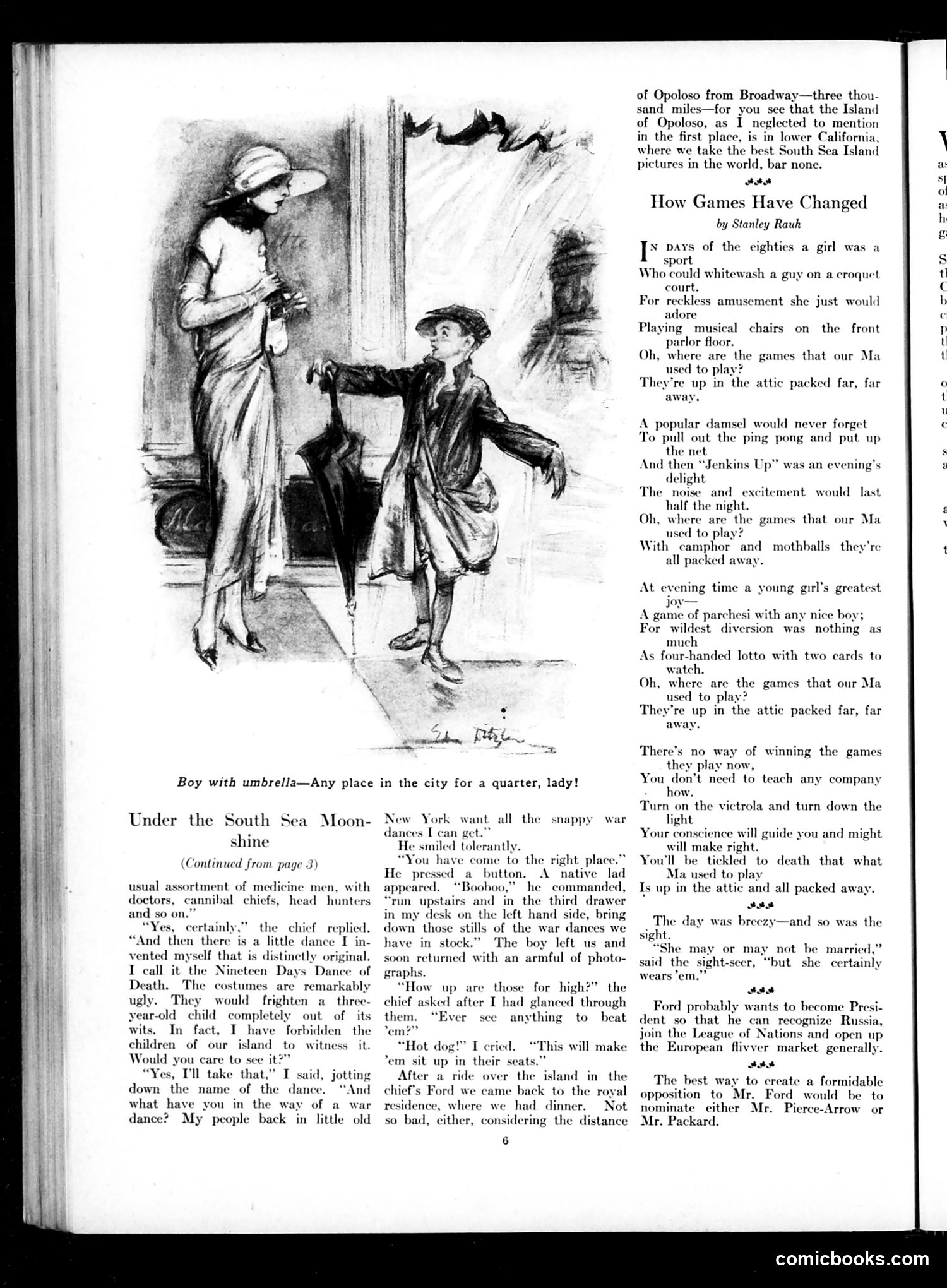
This page contains two distinct pieces from Judge magazine: **The Cartoon (top left):** Shows a boy with an umbrella approaching a woman on the street with the caption "Any place in the city for a quarter, lady!" This appears to be a mild flirtation joke—the boy is offering to escort her anywhere for a quarter (25 cents), likely a reference to prostitution solicitation or street hustling, presented as cheeky humor. **"How Games Have Changed" (right):** A nostalgic poem by Stanley Rauk contrasts old-fashioned parlor games (croquet, musical chairs, ping-pong, Jenkins Up, parchesi, lotto) with modern entertainment. The satire criticizes current youth: they've replaced wholesome games with phonograph dancing and romance, where "your conscience will guide you and might will make right"—implying moral looseness. The final jabs at Henry Ford's political aspirations appear unrelated to the main piece, suggesting editorial commentary on Ford's potential presidential ambitions and business rival competition. The overall tone is conservative social criticism typical of the 1920s Judge.
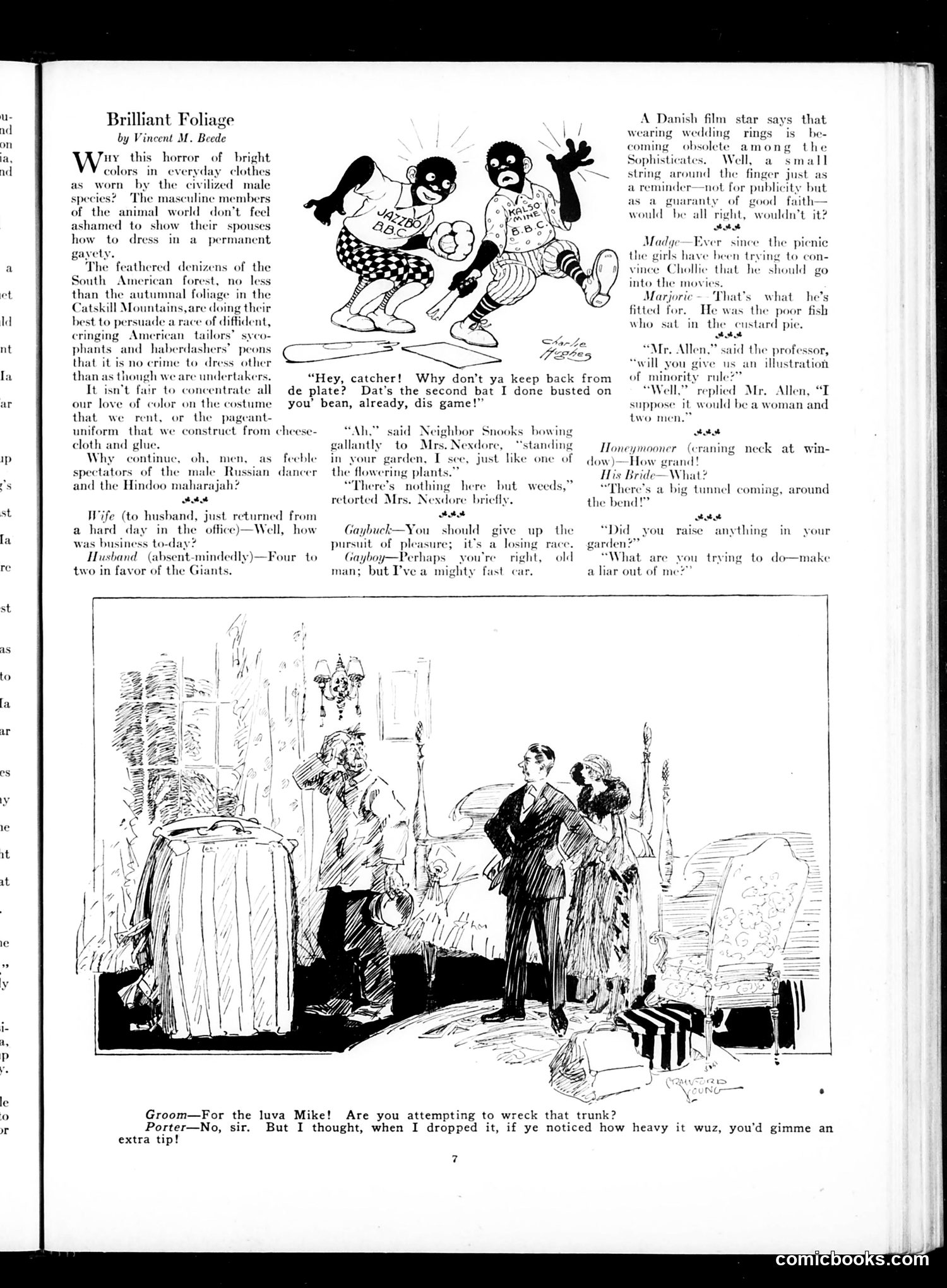
This page contains several unrelated jokes and illustrations typical of early 20th-century American humor magazines. **"Brilliant Foliage" essay** argues that men should wear brighter colors in everyday dress, not just formal black. It compares restricted male fashion to how male animals and birds display vibrant plumage to attract mates—suggesting American men are prudish compared to nature and other cultures (references to Russian dancers and Hindu maharajahs). **The cartoons** feature: - A baseball dialogue with ethnic dialect humor - A couple discussing whether their acquaintance should pursue movies - A professor joke about minority rights illustration - A neighbor conversation about gardening - A wealthy man prioritizing pleasure/fast cars over responsibility - Newlyweds on a honeymoon train - A porter/groom dispute over trunk-handling and tipping The humor relies on period conventions: ethnic accents, marital stereotypes, class-based servant interactions, and wordplay. Most jokes are mild domestic or social commentary without clear political content.
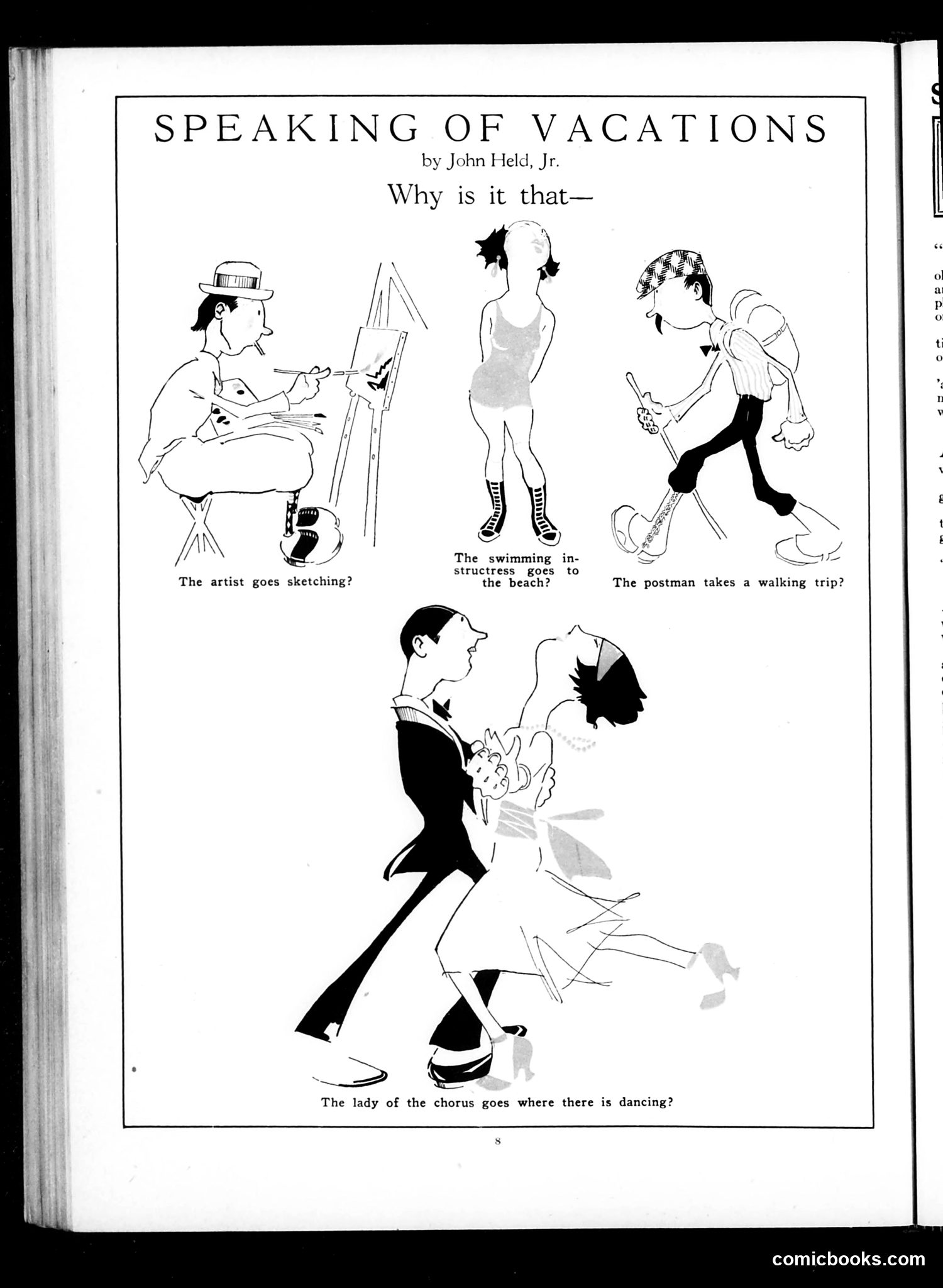
This cartoon page presents five humorous observations about vacation behavior, illustrated in Held's characteristic 1920s style. Each panel poses rhetorical questions about why people pursue specific leisure activities: - An artist goes sketching - A bathing instructress goes to the beach - A postman takes walking trips - A chorus girl goes where there's dancing The humor relies on ironic contrasts: people seeking vacations from their professions paradoxically engage in activities identical to their work. The artist paints on vacation; the swimming instructor goes to beaches; the postman hikes; the chorus performer dances. The satire gently mocks human nature—our inability to truly escape our routines even during leisure time. Held's witty social observation suggests vacations don't provide the genuine escape people expect.
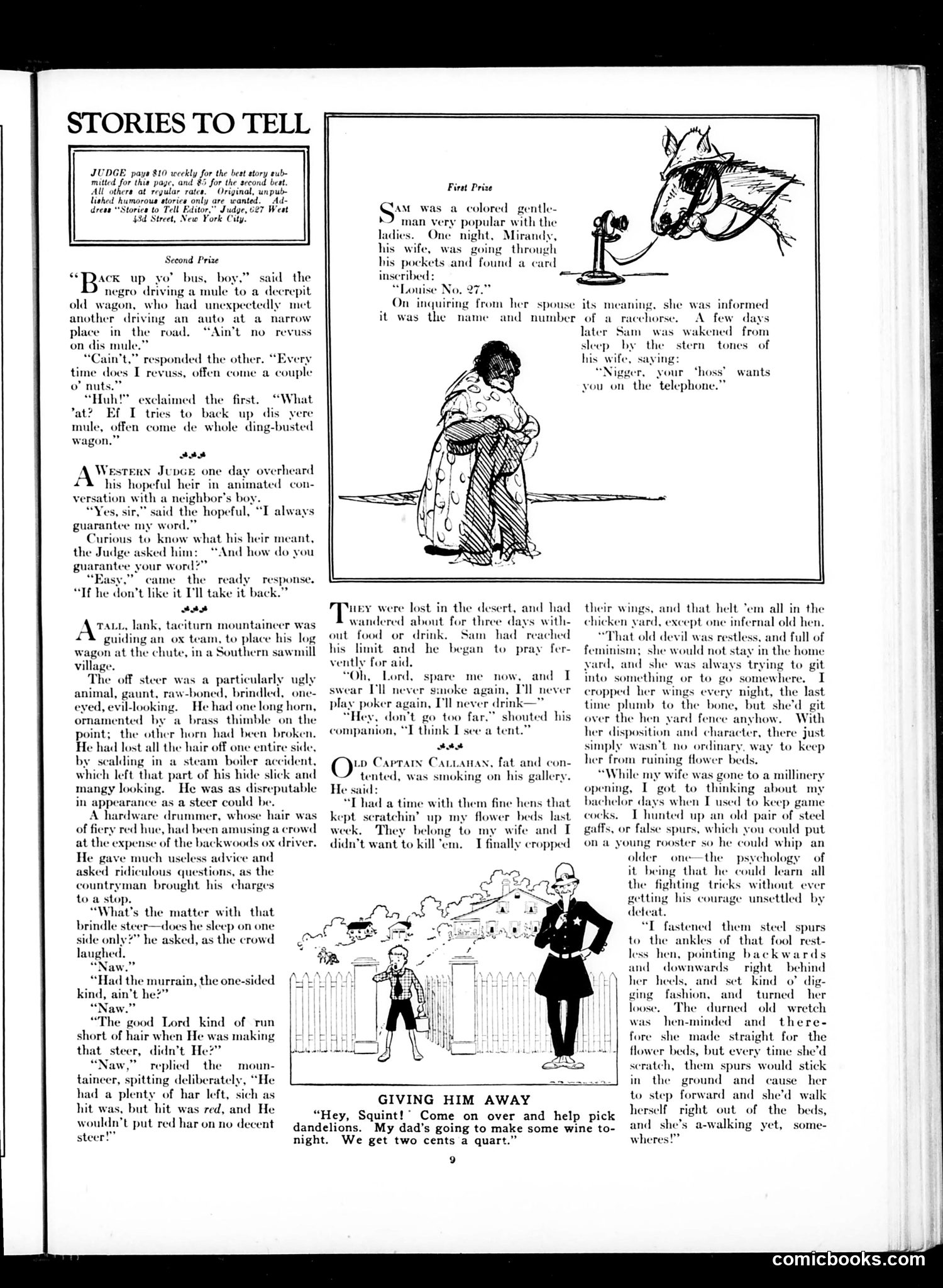
This page from *Judge* magazine contains five humorous short stories submitted by readers, competing for cash prizes ($10 for first place). The humor relies heavily on **racial stereotypes and rural dialect** common to early 20th-century American comedy. The stories mock: - **African Americans** ("Sam," "Nigger") through exaggerated dialect and stereotyping - **Rural/backwoods characters** depicted as ignorant or simple-minded - **Gender dynamics** (wives controlling husbands, a "feminist" hen refusing domesticity) The satire targets social "types" rather than politics. For modern readers, the offensive racial language and caricatures are jarring—what passed as mainstream humor in this era would be considered deeply racist today. The magazine's editorial voice treats these stereotypes as universally amusing, reflecting the casual racism embedded in early 20th-century American popular culture. The cartoons accompanying these stories use exaggerated visual caricature to reinforce the written stereotypes.
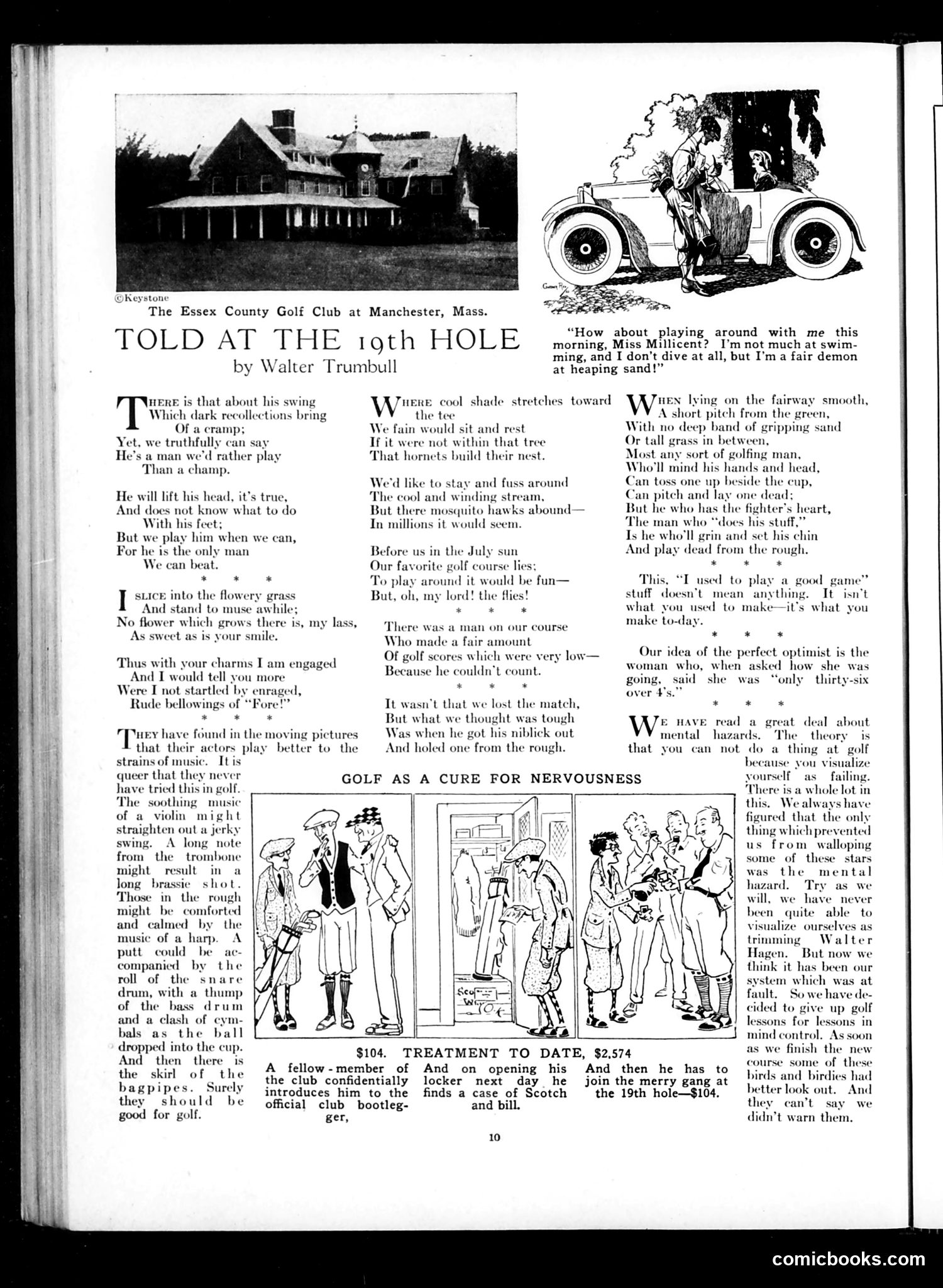
This page satirizes golf culture and golfers' chronic excuses through humorous verse and cartoons. The main poem by Walter Trumbull depicts golfers at Essex County Golf Club in Massachusetts who complain endlessly about conditions—flies, mosquitoes, hornets, sand traps—rather than acknowledging poor play. The joke is that these obstacles provide convenient excuses for mediocre scores. The sidebar cartoon "Golf as a Cure for Nervousness" mocks the psychology-based explanation that visualization causes poor performance. The satirist argues golfers blame "mental hazards" when they simply play badly, then proposes absurdly that adding orchestral music during shots might help—a reductio ad absurdum critique. The anecdote about a member who "couldn't count" and therefore appeared to score well, plus the footnote about bootleg whiskey costing more than golf lessons, underscores the satire: golfers delude themselves through self-deception and alcohol rather than honest self-assessment. The 19th hole (the bar) gets the final word.
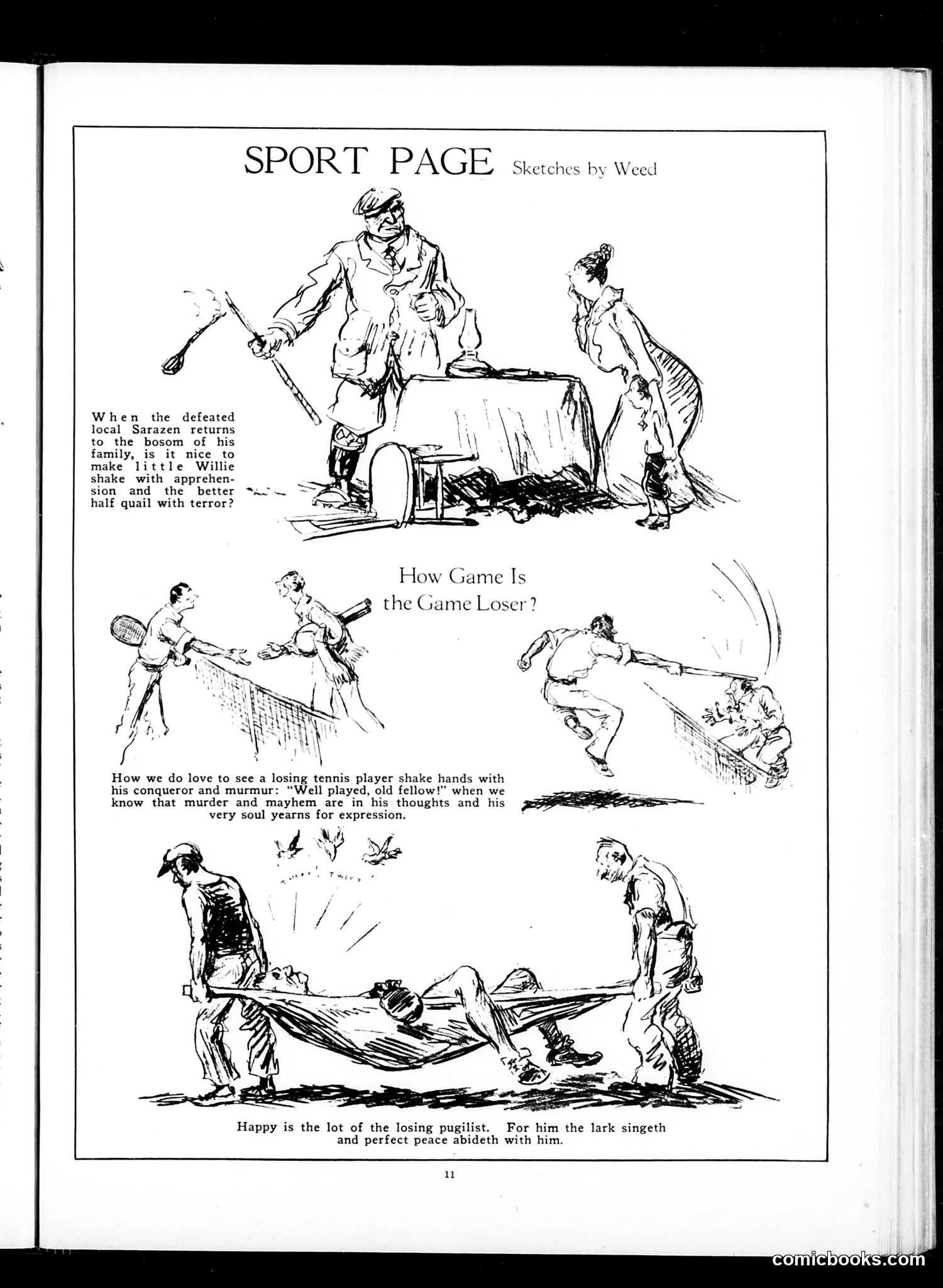
This is a humorous sports commentary page mocking the contrasting behavior of losing athletes across different sports. The top sketch references "Sarazen" (likely golfer Gene Sarazen), showing a defeated player returning home where his family fears his angry reaction. The middle section contrasts tennis and boxing: tennis players must maintain genteel composure, shaking hands and offering false compliments ("Well played, old fellow!") while seething internally with rage and violent impulses. The bottom illustration depicts a losing pugilist being carried away on a stretcher, suggesting he's too physically exhausted or injured to feel disappointment—thus achieving genuine peace unavailable to other athletes constrained by social etiquette. The satire critiques the hypocrisy of "civilized" sports requiring emotional suppression, versus boxing's brutal honesty where defeat's physical toll provides its own catharsis.
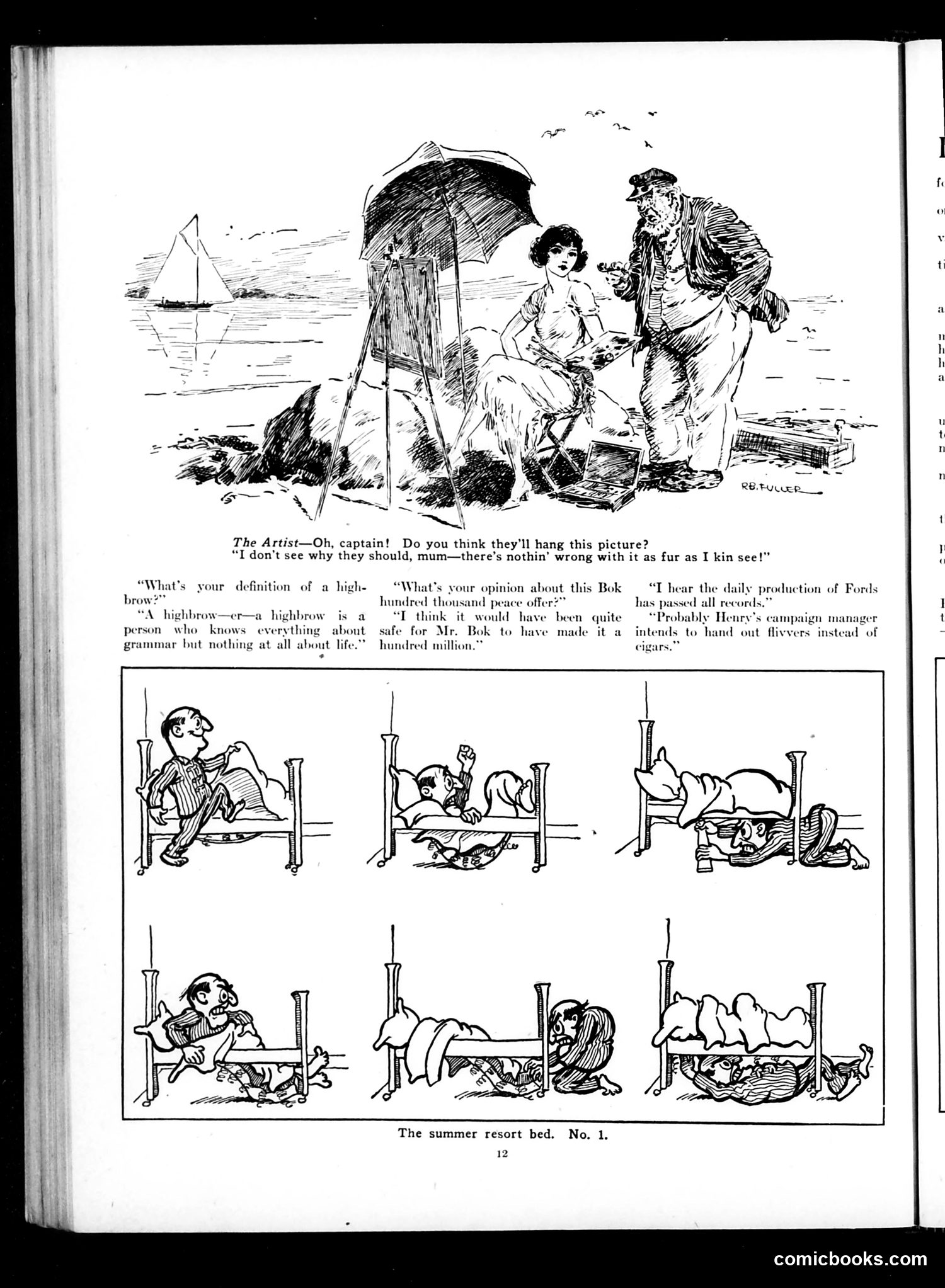
**Top Panel:** A beach scene where an artist asks a captain if her picture will be rejected. The captain reassures her it contains "nothin' wrong." This introduces a conversation about what constitutes "highbrow" art—the artist defines it as knowing "everything about grammar [but] nothin' at all about life." The dialogue satirizes pretentious art criticism and intellectual snobbery. **Additional References:** The text mentions Edward Bok's "hundred thousand peace offer" (Bok was a real peace advocate), and jokes about Henry Ford's mass production of automobiles ("flivvers"), suggesting Ford might distribute cars as campaign merchandise. **Bottom Panel:** "The Summer Resort Bed, No. 1" shows six comic vignettes of people in various sleeping positions on a bed—apparently depicting humorous sleeping poses common at vacation resorts. This is physical comedy humor typical of Judge magazine's style. The page mixes social satire about intellectualism with lighthearted vacation-themed humor.
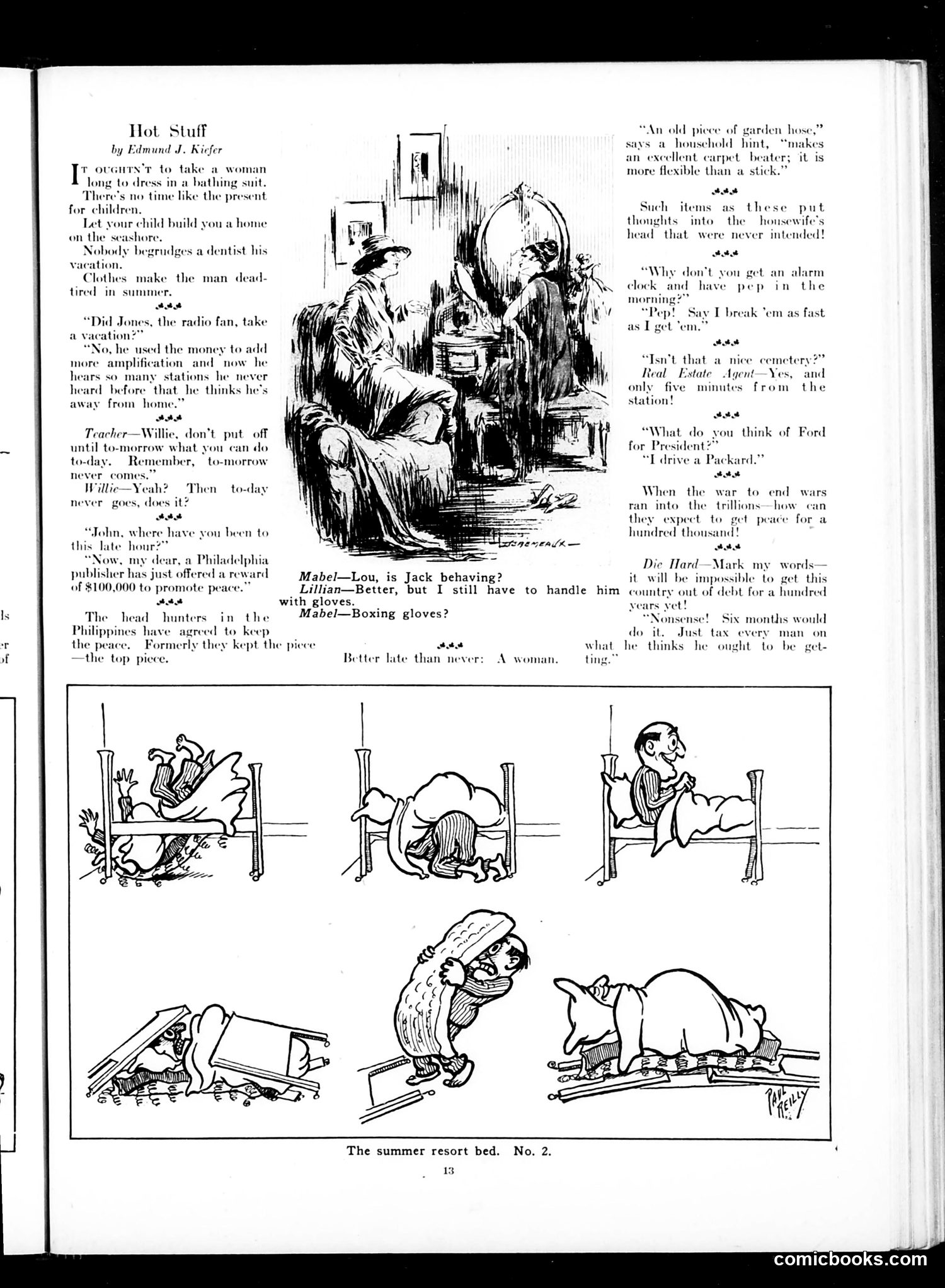
This page contains a collection of brief satirical quips and observations about American life, plus a comic strip about summer resort beds. **The text satire** targets contemporary absurdities: a radio fan wasting money on amplifiers; a Philadelphia publisher offering $100,000 to promote peas (likely referencing an actual historical promotion); and commentary on post-WWI debt, with a character arguing the government can't afford peace after spending trillions on war. **The Ford/Packard joke** references Henry Ford's 1916 presidential speculation, with the punchline dismissing him in favor of luxury cars—satirizing American materialism over politics. **The comic strip** "The summer resort bed. No. 2" depicts increasingly absurd sleeping positions on a bed, suggesting discomfort at vacation accommodations—visual humor about the gap between vacation expectations and reality. The overall tone reflects 1920s satirical humor: cynical about economics, politics, and consumer culture while poking fun at domestic life and modern conveniences.
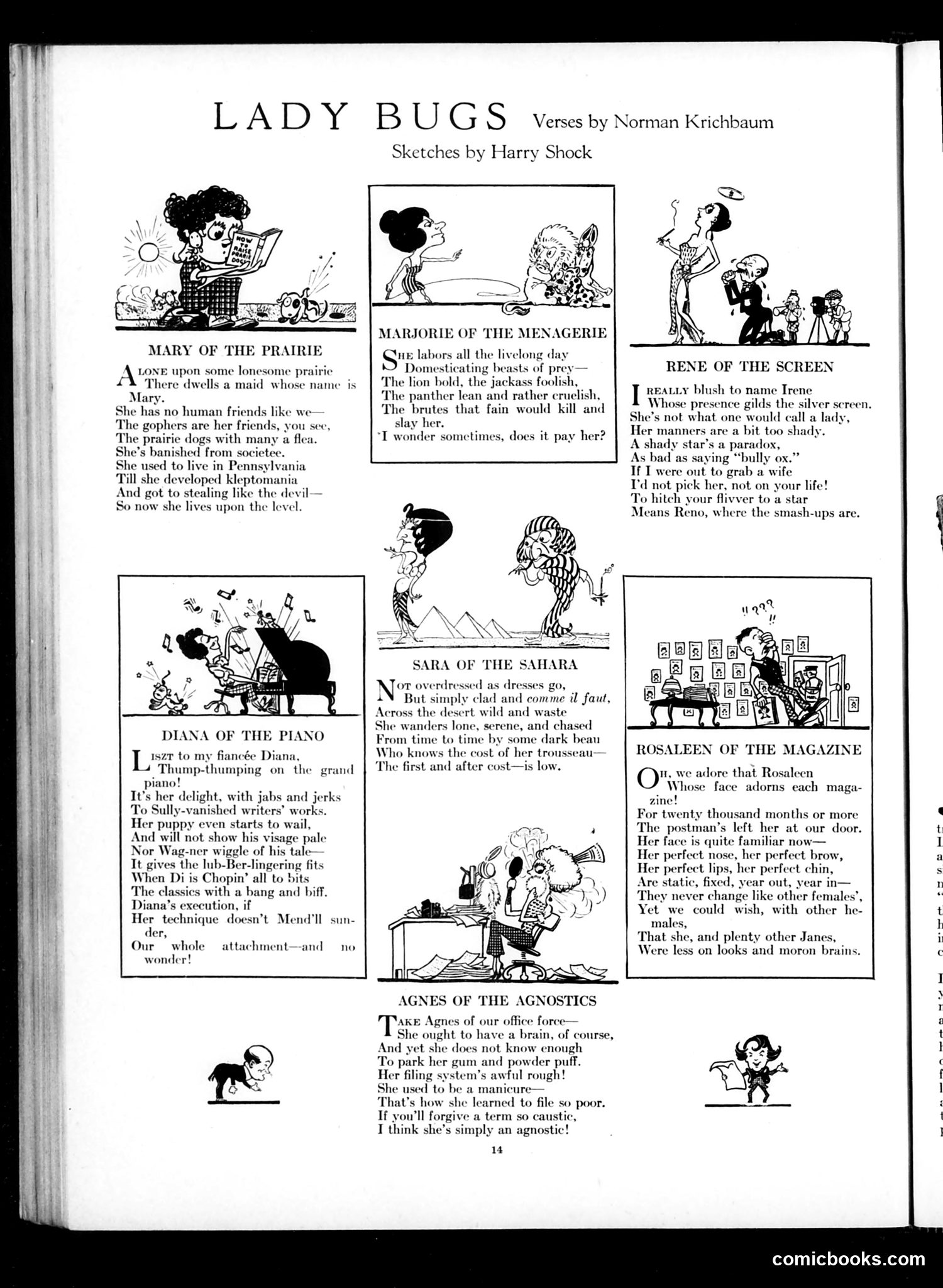
This page presents seven character sketches lampooning different types of women in 1920s America. Each "Lady Bug" is a caricature of a contemporary female archetype: **Mary** is a prairie girl turned petty criminal. **Diana** is an untalented pianist whose aggressive playing tortures everyone (musical puns on composers' names: "Sully-vanished," "Chopin' all to bits"). **Marjorie** works with dangerous animals in a menagerie. **Sara** is a wandering desert woman. **Rene** is a morally questionable actress associated with Hollywood infidelity ("Reno, where the smash-ups are" references the divorce capital). **Rosaleen** is a magazine model praised only for her looks, not intelligence. **Agnes** is an office worker dismissed as intellectually empty (an "agnostic" about filing systems). The satire targets women's changing social roles—working outside the home—while employing condescending humor about their competence and moral character. The cartoons reflect period anxieties about women's independence.
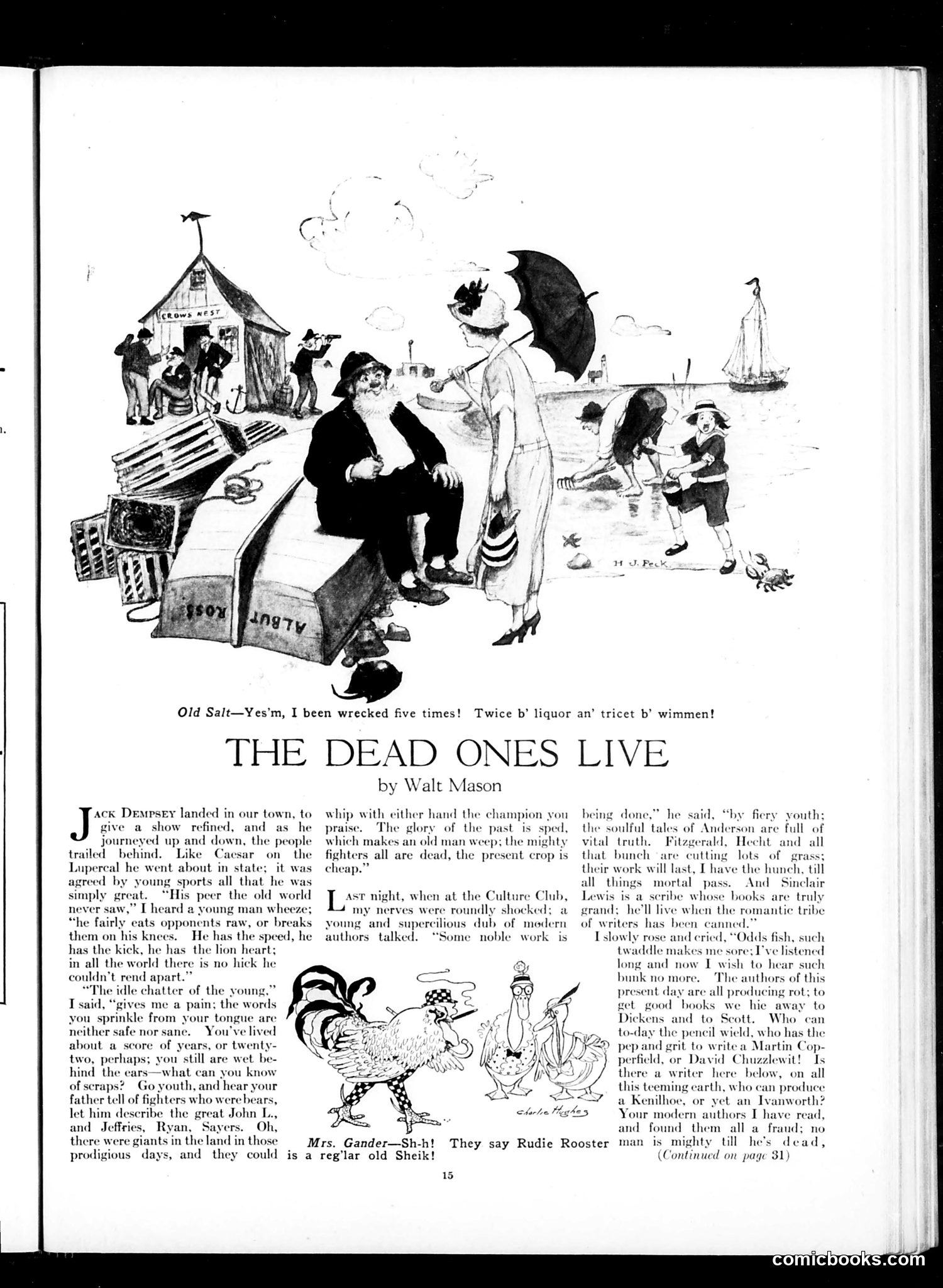
This satirical story criticizes young people's uncritical admiration for contemporary authors and celebrities while dismissing past greats. An old man (representing tradition) confronts a young "dub" at a Culture Club who praises modern writers like Anderson, Fitzgerald, Hecht, and Sinclair Lewis as superior to classics. The narrator counters that these authors produce "rot" compared to established masters like Scott, Dickens, and Chuzzlewit. The opening beach scene with "Old Salt" establishes the generational theme: an elderly sailor has survived shipwrecks and vice, implying he possesses earned wisdom the young lack. The satire targets **youthful arrogance** — the assumption that contemporary work automatically surpasses the past. Mason argues modern authors are overrated; only the dead achieve true literary immortality. The cartoon mocks the pretentiousness of "modern" literary taste among young sophisticates. The title's paradox — that the dead remain alive (through enduring work) while the living fade — frames Mason's conservative critique of 1920s literary culture.
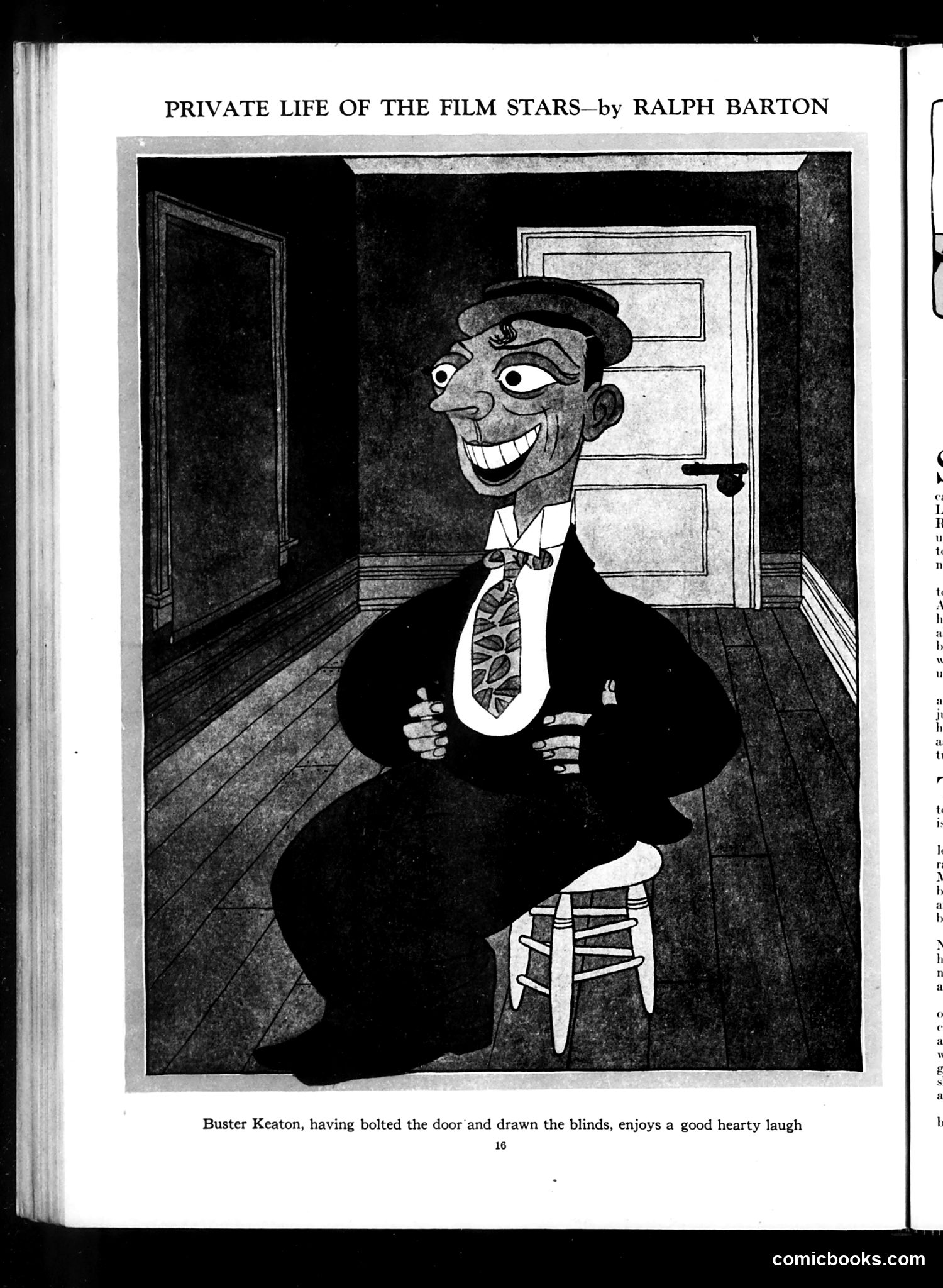
This is a satirical illustration by Ralph Barton from Judge magazine's "Private Life of the Film Stars" series. It depicts Buster Keaton, the famous silent film comedian known for his deadpan expression and "stone face," laughing heartily behind closed doors. The joke is ironic: Keaton's public persona was defined by never smiling or showing emotion on screen, so the cartoon humorously reveals his "private" self as the opposite—a man who laughs uproariously when nobody is watching. The exaggerated facial features and theatrical setting emphasize the contrast between his famous on-screen stoicism and his supposedly genuine off-screen personality, poking fun at both Keaton's iconic image and the gap between celebrity personas and reality.
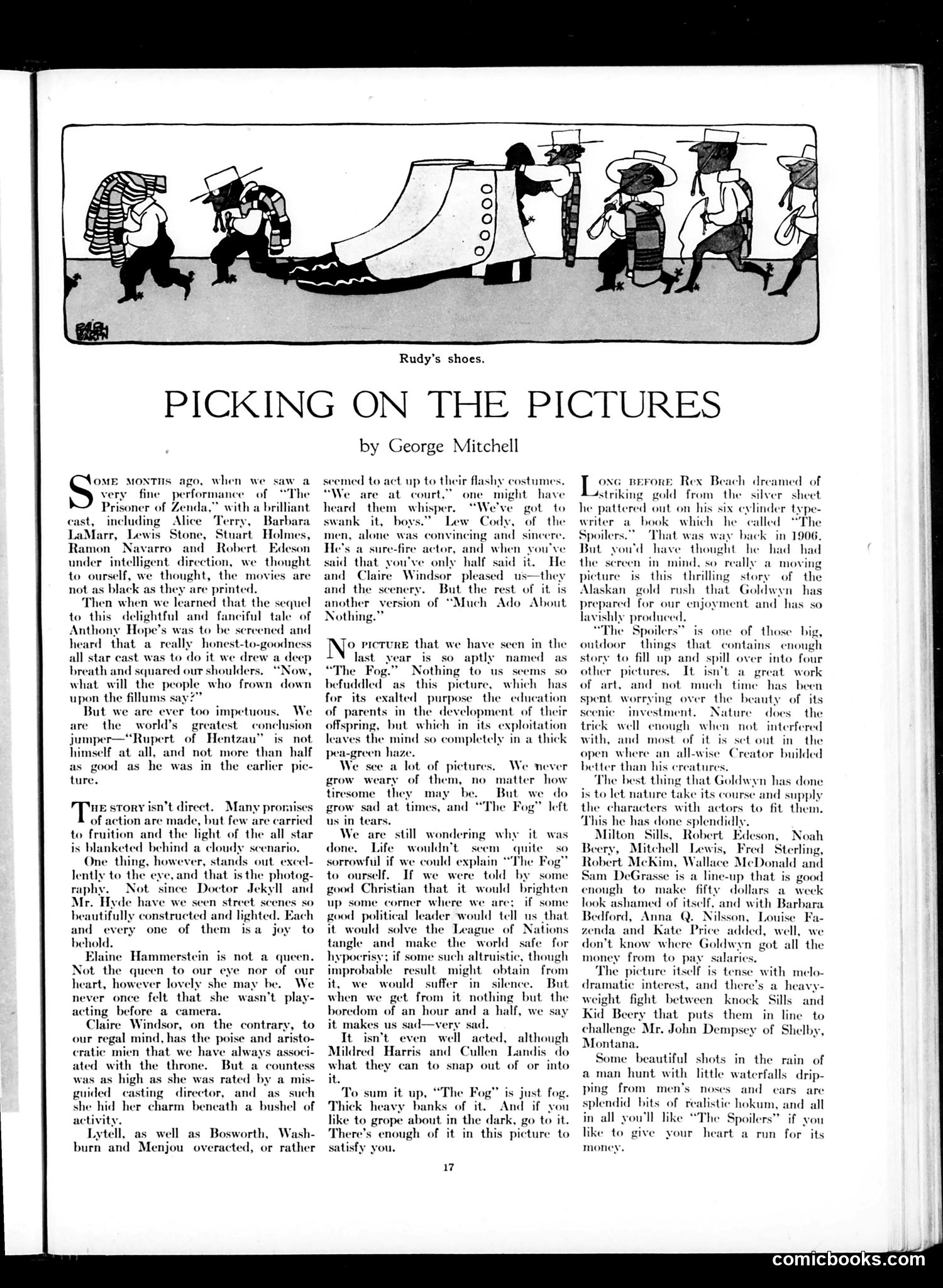
This page contains George Mitchell's film reviews for Judge magazine, critiquing recent movie releases. The cartoon at top shows characters in elaborate costumes from "Rudy's shoes" (likely referencing a film's production design). Mitchell reviews **"Rupert of Hentzau"** (a sequel to "The Prisoner of Zenda"), criticizing its unclear narrative and overwrought acting by the ensemble cast, though praising Claire Windsor's natural performance and the cinematography. He praises Lew Cody as the only convincing actor. He also pans **"The Fog,"** finding it narratively pointless and emotionally manipulative—calling it literally just "fog" with no redeeming educational or social value, despite the film's stated purpose of educating parents. The reviews showcase Judge's satirical approach to entertainment criticism, using hyperbole and sarcasm to skewer pretentious or poorly-executed films while acknowledging occasional merit in performances or technical craft.
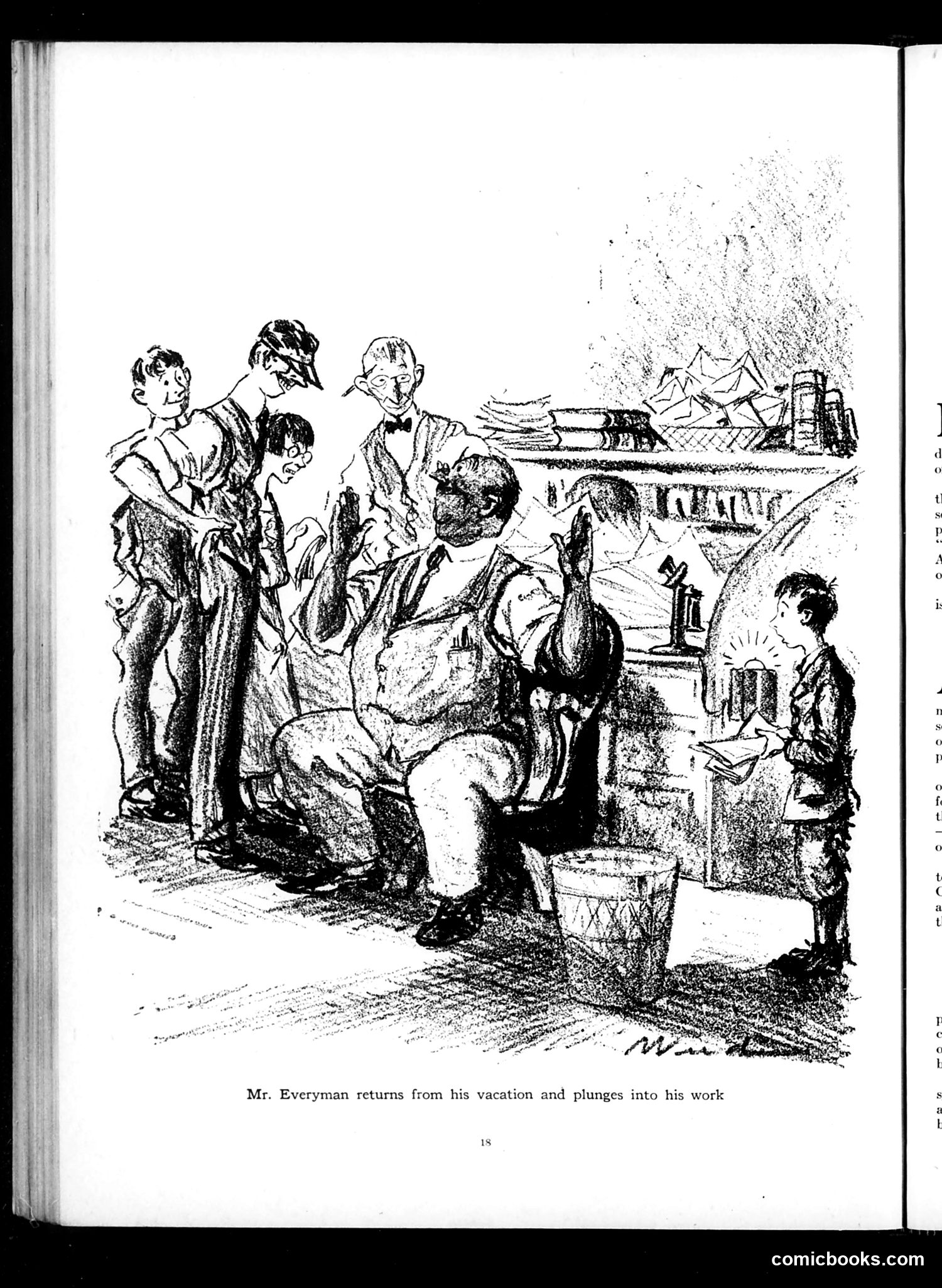
This is a single cartoon captioned "Mr. Everyman returns from his vacation and plunges into his work." The image shows a portly businessman seated at a desk, surrounded by several men (likely colleagues or subordinates) who appear to be presenting him with stacks of papers and documents. The scene depicts the common workplace experience of returning from time off to find an overwhelming backlog of work awaiting attention. The satire is straightforward workplace humor: the contrast between vacation relaxation and the chaotic reality of accumulated tasks. "Mr. Everyman" is a generic everyman figure—representing any ordinary working person—facing the universal frustration of post-vacation office life. The cartoon mocks the inevitable deluge of paperwork and responsibilities that greet returning employees, a timeless complaint that remains relatable today.
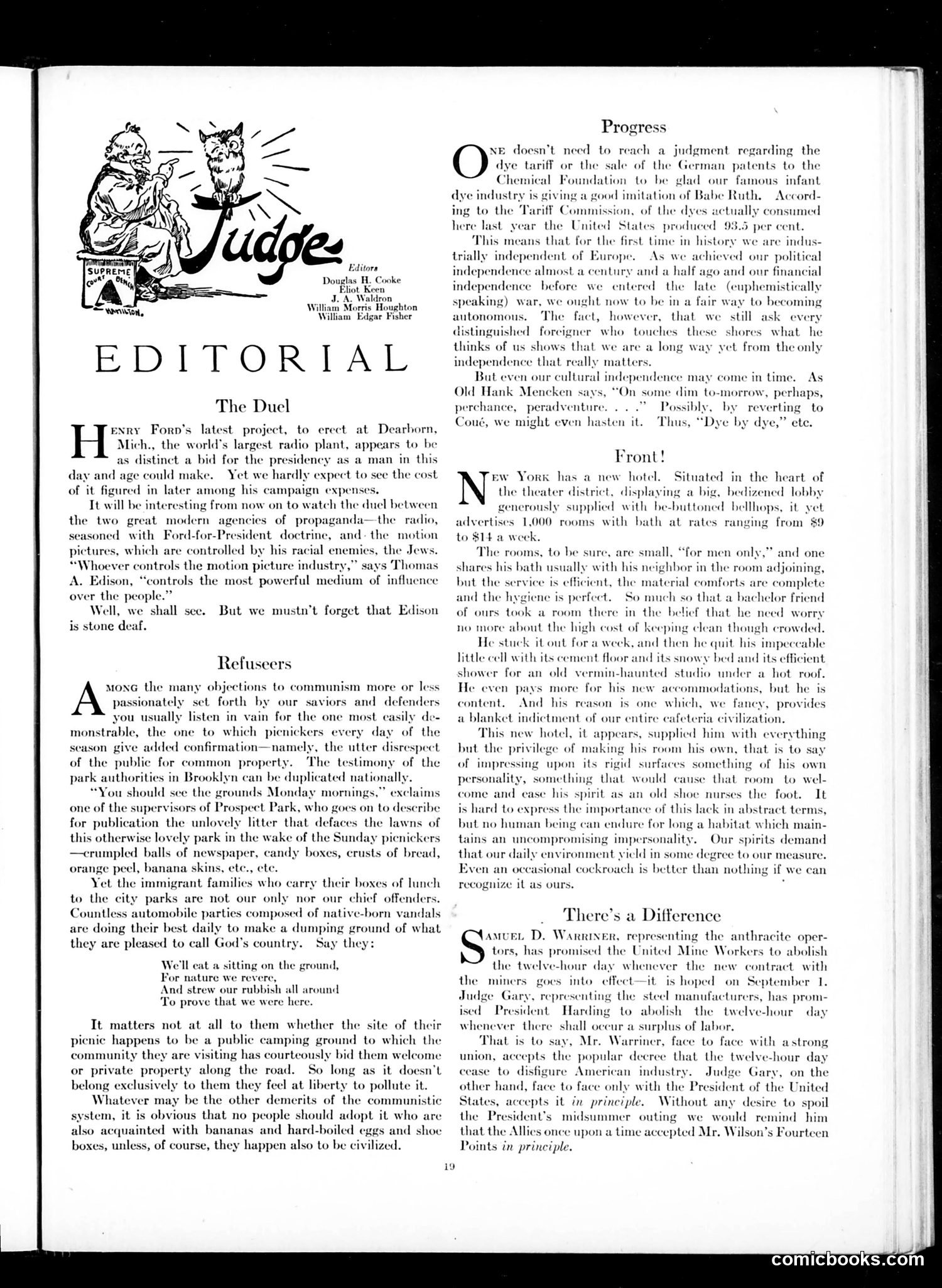
The masthead cartoon depicts a figure labeled "Judge" - the magazine's personification - wielding a gavel to strike down an owl, likely representing foolishness or ignorance that needs correcting. The editorials address contemporary 1920s concerns: **"The Duel"** attacks Henry Ford's radio plant project at Dearborn, Michigan, interpreting it as a presidential bid. The passage contains explicit antisemitism, characterizing motion pictures as controlled by "his racial enemies, the Jews" and referencing Edison's famous (and false) claims about Jewish control of Hollywood—reflecting widespread American antisemitism of the era. **"Refusers"** criticizes communist ideology by pointing to immigrant and native picnickers littering public parks, arguing this disrespect for common property proves communism's impracticality. **"Progress"** celebrates American chemical industry independence from German dyes following WWI tariffs, though laments that cultural independence from Europe remains distant. The page reflects Judge's conservative, nativist perspective typical of 1920s American political satire.
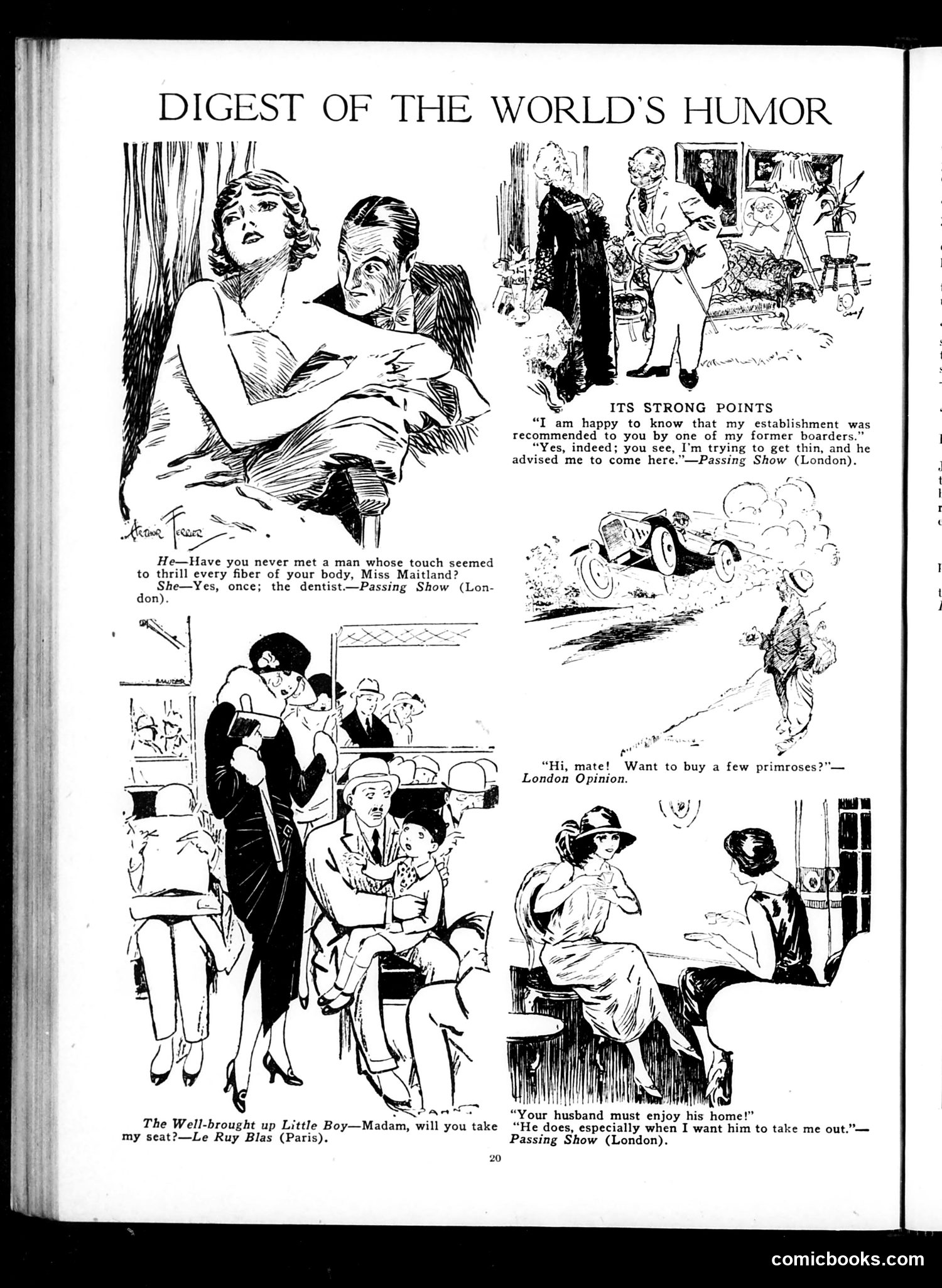
This page collects brief jokes and cartoon gags from international sources (Paris, London publications). The humor is predominantly domestic and romantic satire aimed at early 20th-century middle-class readers. Key jokes include: a woman seeking to lose weight at an establishment, presumably through unpleasant means; a dentist joke playing on physical sensation; a street vendor selling primroses; a well-mannered boy offering his seat; and marital humor about a husband preferring home only when avoiding outings with his wife. The cartoons depict typical social scenarios—romantic encounters, public transportation, street life, and domestic situations. The satire targets conventional behaviors: feminine vanity, dental anxiety, social courtesy, and strained marriages where husbands resist spousal companionship. The page's purpose is light entertainment through observational humor about recognizable social situations, with no apparent political content—primarily social commentary on manners and relationships.
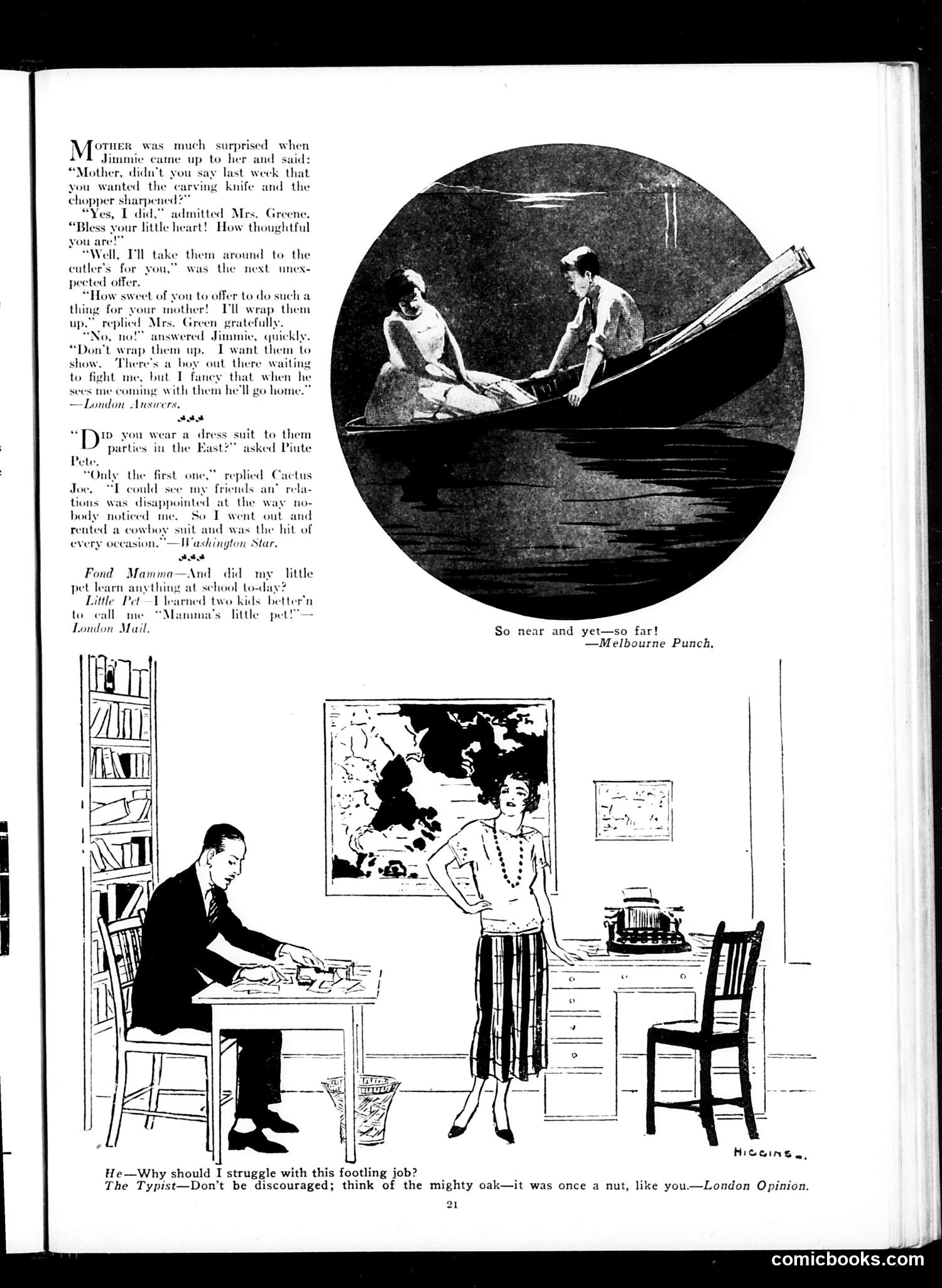
This page contains three separate humor pieces typical of early 20th-century satirical magazines: **Top story ("London Answers")**: A boy offers to sharpen his mother's knives—not from filial devotion, but to intimidate a boy waiting to fight him. The joke plays on unexpected child psychology and dishonesty masquerading as helpfulness. **Middle anecdote ("Washington Star")**: A man describes wearing formal dress to Eastern parties, finding it unappreciated, then switching to a rented cowboy suit which became a hit. This satirizes social pretension and the appeal of authentic Western imagery to Eastern audiences. **Bottom cartoon ("London Opinion")**: A typist consoles a struggling male coworker by comparing him to an oak tree that was once a nut—implying he's a fool. The humor derives from the double meaning of "nut" and the typist's cheeky insult disguised as encouragement. All three pieces use gentle, domestic humor typical of the era, relying on wordplay and unexpected reversals rather than topical satire.
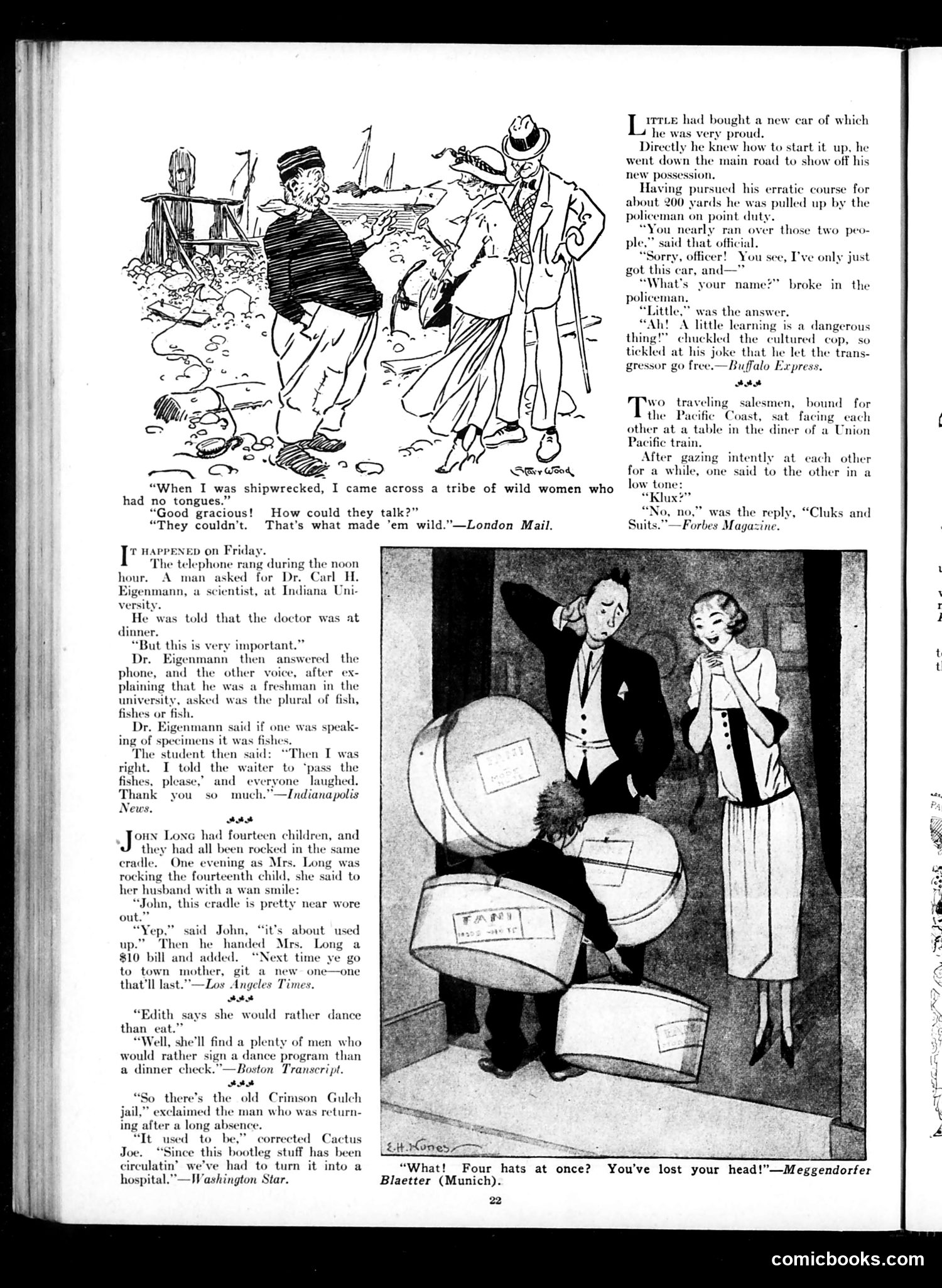
This page contains several brief humorous anecdotes and two cartoon illustrations typical of early 20th-century satirical journalism. **Top cartoon**: Shows a policeman stopping a reckless new car driver who nearly hit pedestrians. The joke plays on the officer's cultured response—when the nervous driver introduces himself as "Little," the cop quips "A little learning is a dangerous thing," a literary reference, then permits the transgression out of amusement at his own wit. **Bottom cartoon** (credited to Munich's *Meggendorfer Blätter*): Depicts a man carrying four large hat boxes while a woman exclaims he's "lost his head"—a visual pun on the expression meaning to act irrationally. The page's written anecdotes mock various subjects: reckless driving, sailors' tall tales, academic pedantry, large families, and Prohibition-era bootlegging. They reflect period concerns about automobiles, gender stereotypes, and contemporary social issues. The humor relies on wordplay, puns, and situational comedy typical of Judge's satirical style.
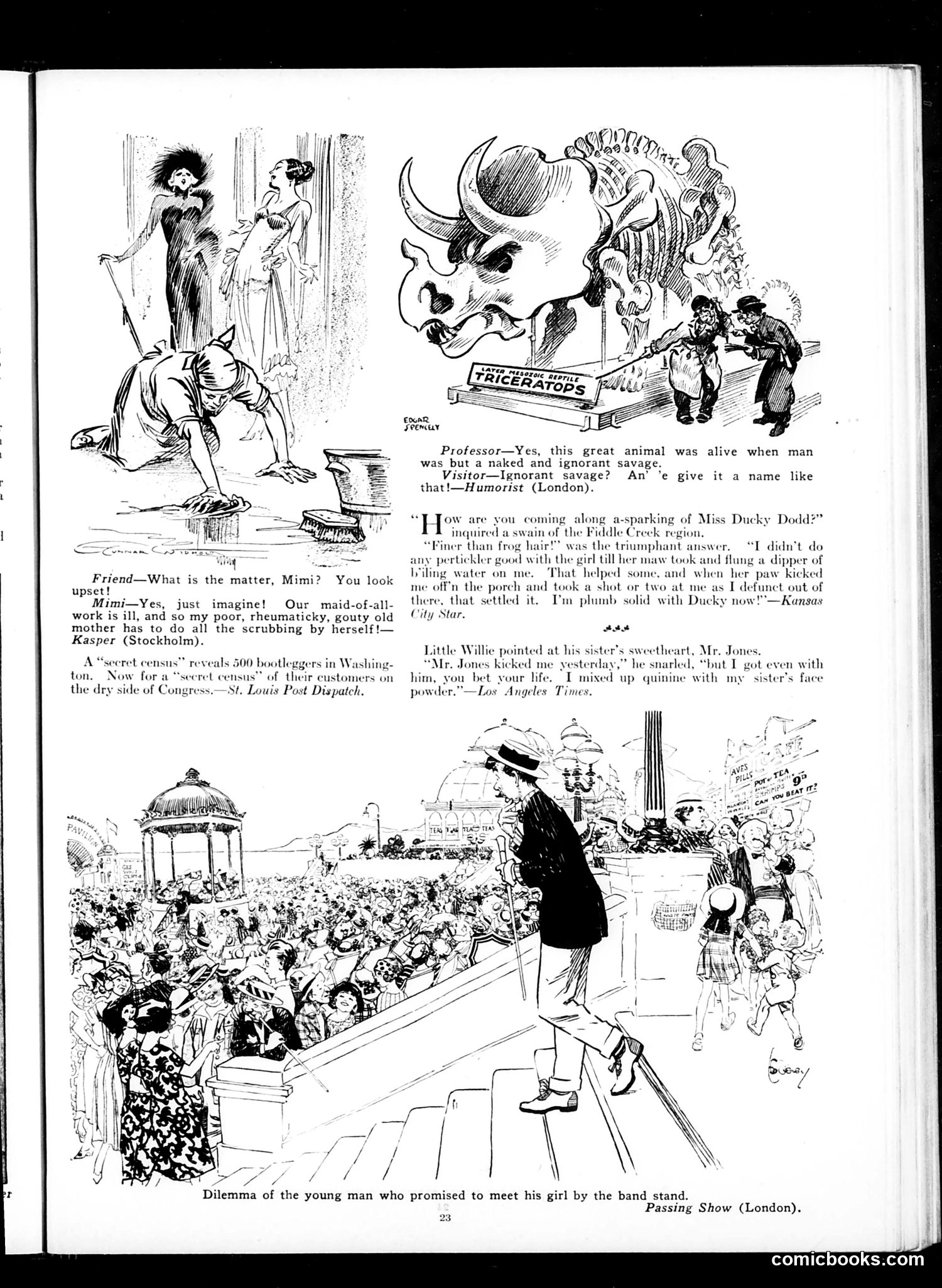
This page contains several brief humorous anecdotes and cartoons typical of early 20th-century satirical magazines: **Top cartoons** show domestic complaints: a maid's illness forcing an elderly mother to do housework, and a museum professor's irony about prehistoric animals being named by "ignorant savages." **Middle jokes** mock Prohibition-era Washington (referencing 500 bootleggers) and romantic misadventures—a young man's unsuccessful courtship attempt where he's doused with water and shot at by the girl's father, yet somehow wins her favor. **Little Willie joke** features a child character (a recurring figure in period humor) getting revenge on his sister's boyfriend by poisoning her face powder with quinine. **Bottom cartoon** depicts a young man caught between meeting his girlfriend at a bandstand while distracted by other women—a common "dilemma" theme in romantic comedies of the era. The satire relies on slapstick, class commentary, and period-specific references (Prohibition, domestic service hierarchies) that would've resonated with early 1900s readers.
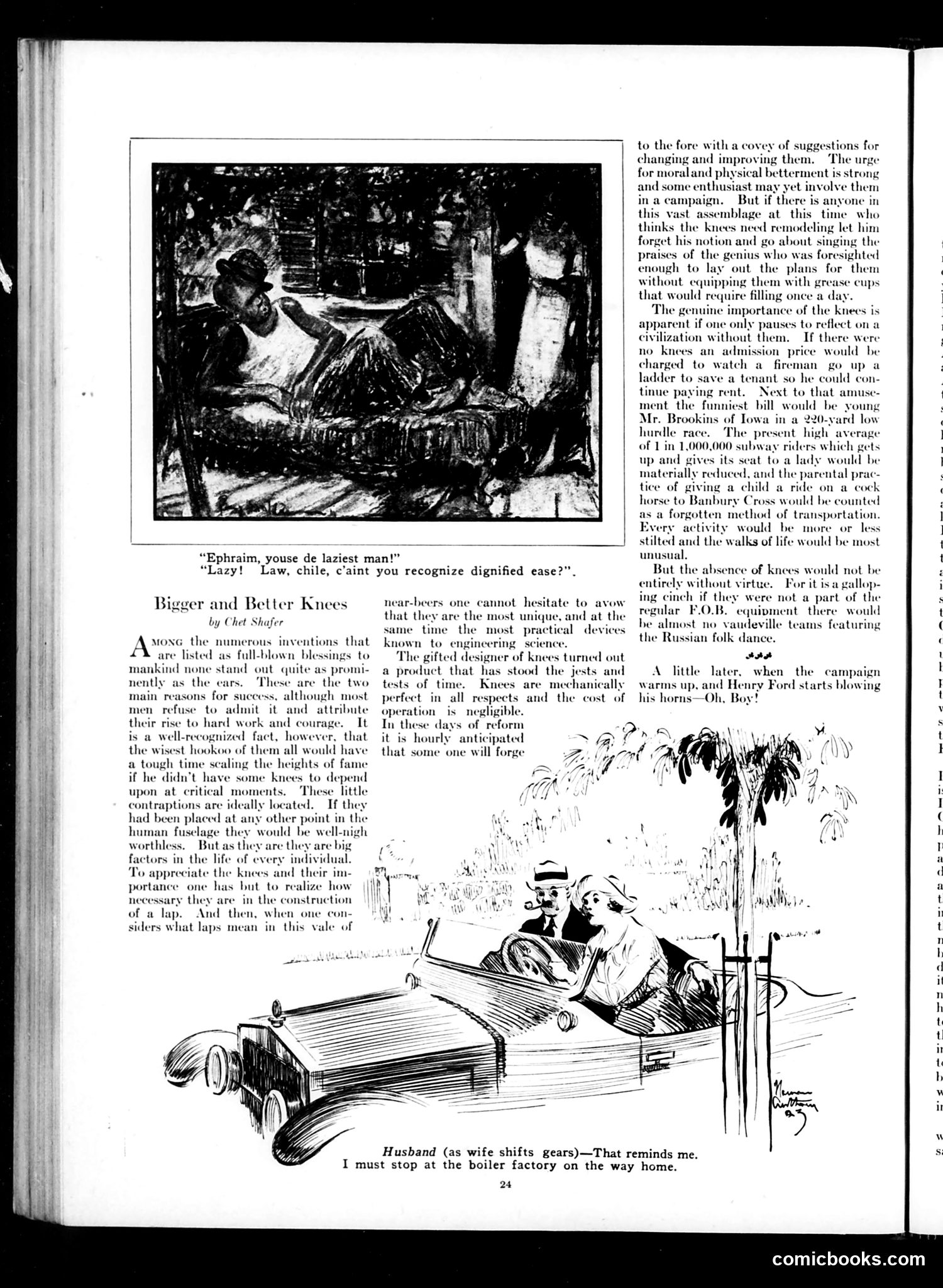
This page contains a humorous essay by Chet Shafer satirizing the early-20th-century reform movement's obsession with "improving" society through design and engineering. **The Satire:** Shafer mockingly argues that knees—presented as humanity's greatest mechanical invention—are perfect and need no reforming. He ridicules the contemporary impulse toward "moral and physical betterment" by imagining absurd consequences if knees were "improved": firemen couldn't climb ladders, hurdlers couldn't race, subway passengers couldn't stand, and crucially, the Russian folk dance would disappear from vaudeville. **The Context:** This targets Progressive Era reformers who advocated radical redesigns of everyday life. The final cartoon shows a husband and wife in a car with manual transmission—a new technology itself—joking about stopping at a "boiler factory," suggesting anxieties about constant industrial change. **The Frames:** The top photograph and bottom sketch feature African American figures in dialect, using period conventions of humor that would be considered offensive today. The piece ultimately mocks over-engineering and social reform as unnecessary when existing systems work adequately.
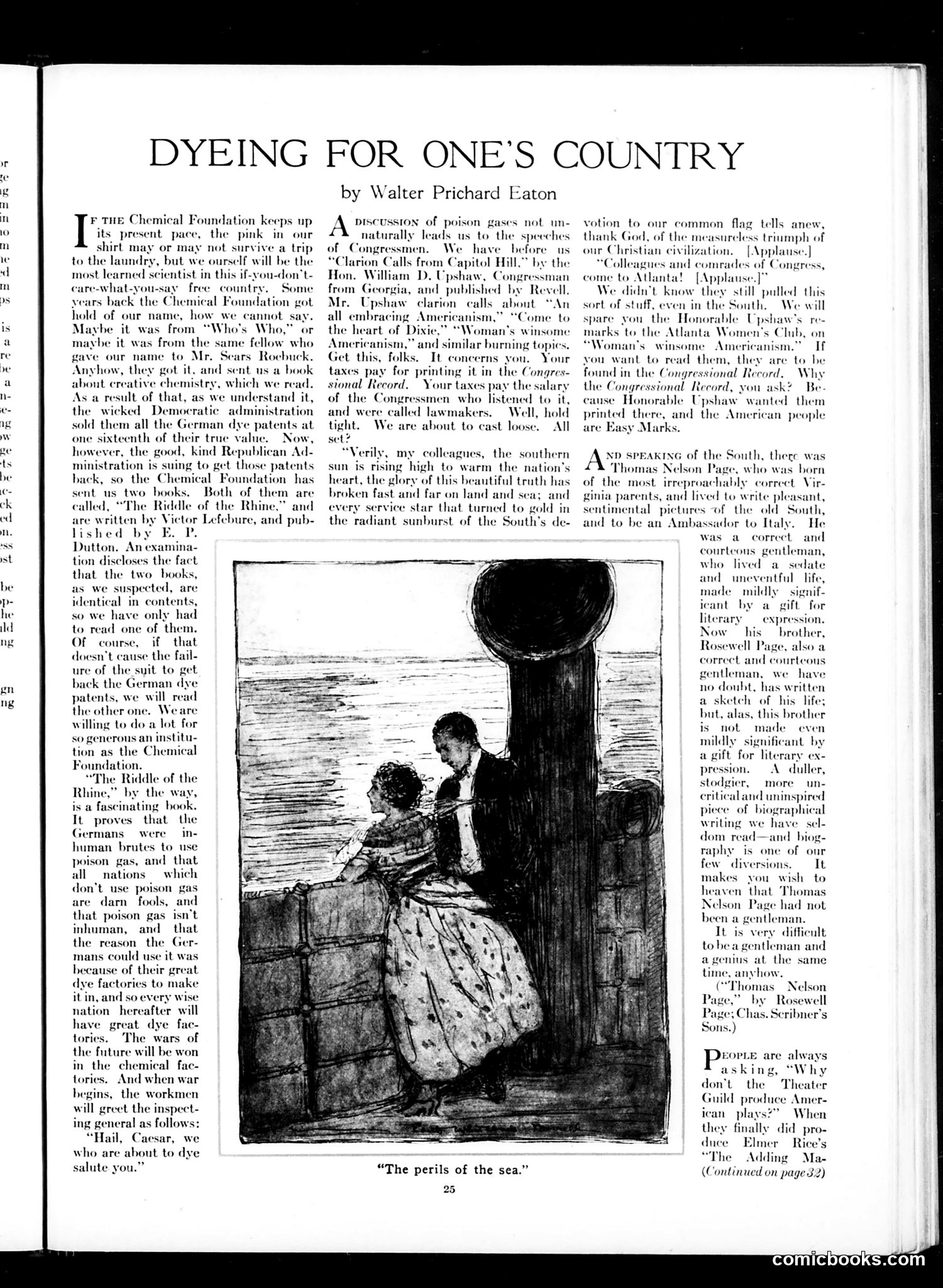
This Judge magazine page satirizes post-WWI American politics through overlapping critiques: **The Chemical Industry subplot** mocks the Republican administration's lawsuit to recover German dye patents from a Chemical Foundation (seemingly compensating for past Democratic-era patent sales). Eaton sardonically notes he received two identical books promoting dye manufacturing—appearing propagandistic—and sarcastically endorses the "wisdom" of building national dye factories for future chemical warfare. **The Congressional Hypocrisy section** targets Congressman William D. Upshaw's self-promoting patriotic speeches, printed at taxpayer expense in the *Congressional Record*. Eaton ridicules the grandiose rhetoric ("winsome Americanism," "Christian civilization") and applause, calling Americans "Easy Marks" for funding politicians' vanity publications. **The illustration** depicts a couple in period dress on a boat—captioned "The perils of the sea"—likely related to the broader theme of national sacrifice or romance amid wartime concerns. The unifying joke: Americans naively support jingoistic rhetoric and corporate interests masquerading as patriotism.
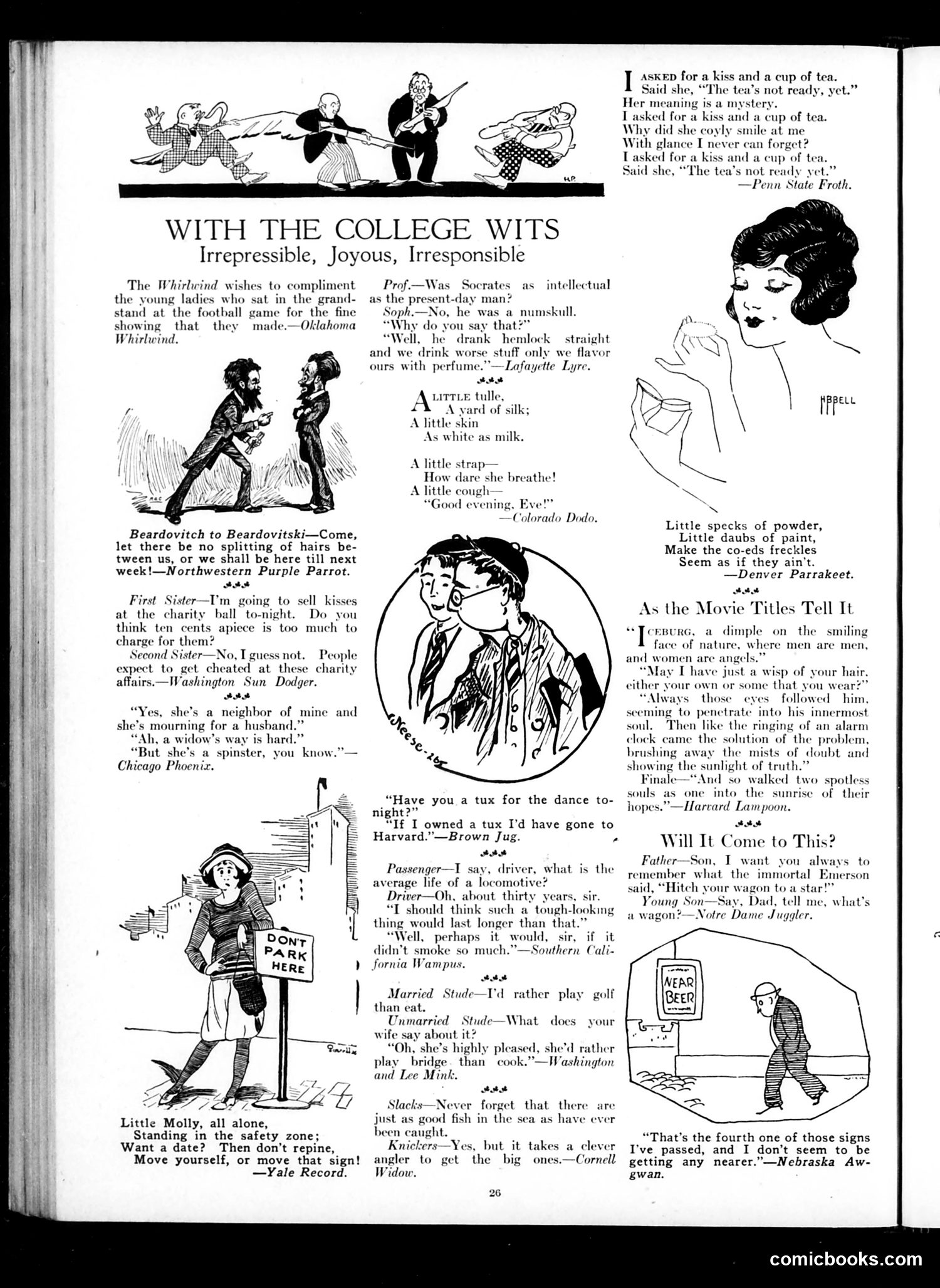
This page collects satirical quips from college newspapers mocking undergraduate life and romantic pursuits. The humor targets: **College students' pretensions**: A philosophy exchange mocks students who claim intellectual superiority while drinking inferior alcohol (with perfume to mask the taste). **Women's fashion and appearance**: Jokes about "co-eds" wearing excessive makeup and powder to hide freckles, and minimal clothing ("a little tulle," "a little skin"). **Romance and dating**: Multiple jokes about young men awkwardly pursuing women—one pays for kisses at charity balls; another can't afford a tuxedo for Harvard. A woman mysteriously delays offering tea when a man requests a kiss, implying sexual negotiation. **Marriage**: Contrasting a newlywed's preference for golf over eating with a married woman preferring bridge to cooking—both avoiding domestic duties. The page reflects 1920s-era college culture where chasing women, displaying wealth (formal wear), and questioning women's sincerity were standard satirical subjects. The underlying tone treats female students as objects of pursuit and ridicule.
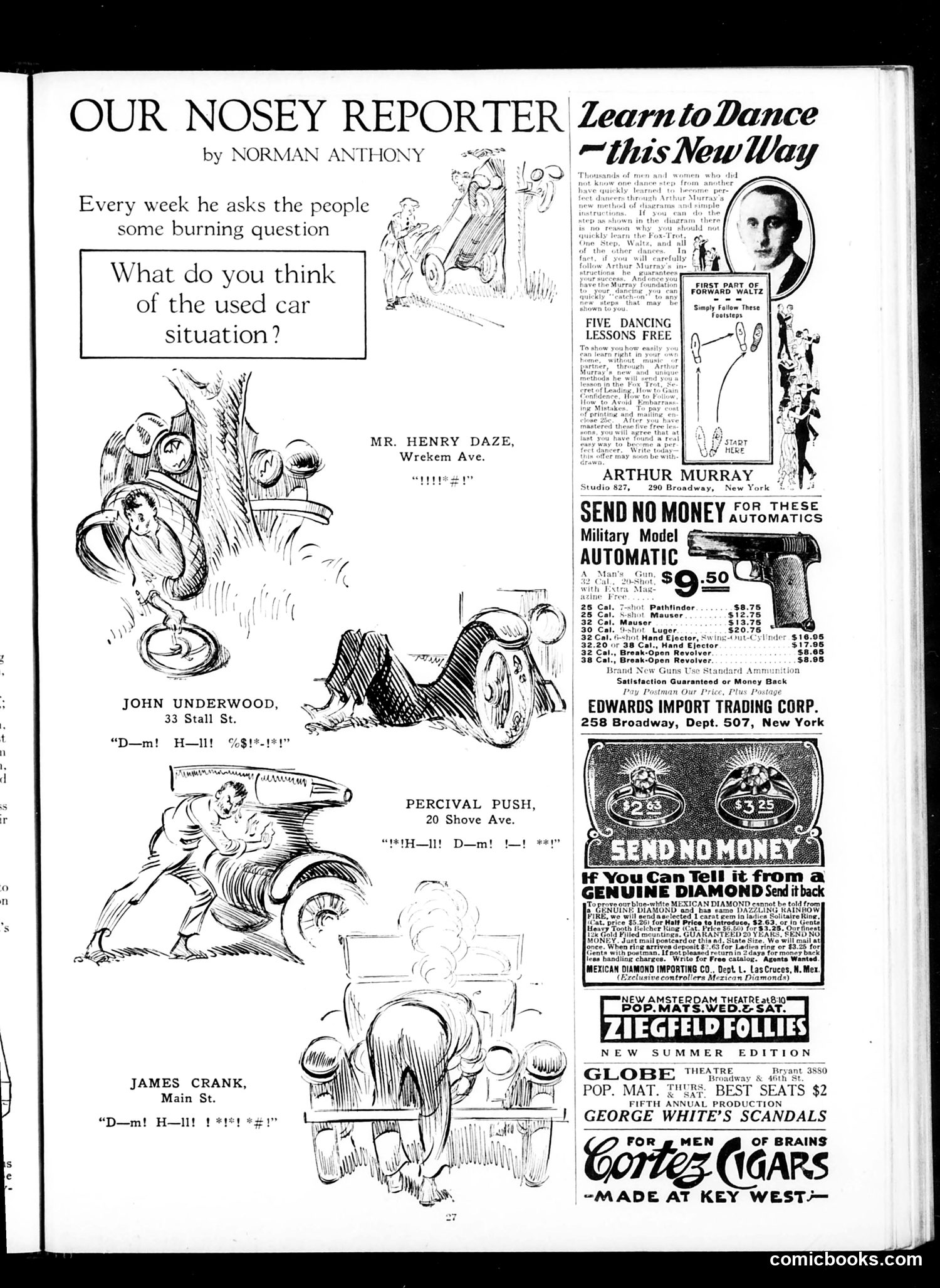
This is a humor column where Norman Anthony asks ordinary people about timely topics. Here, the question concerns the "used car situation"—likely referring to post-WWI economic conditions and the booming secondhand automobile market of the 1920s. The four respondents express frustration through exasperated exclamations ("D—m! H—ll!"), their garbled outbursts suggesting the used-car market was chaotic, confusing, or exploitative. The accompanying cartoons show them physically distressed or contorted—visual metaphors for how the used-car situation made people feel. The satire targets both the murky, frustrating nature of buying used vehicles and perhaps the aggressive salesmanship of the era. The page is primarily advertising (dance lessons, toy guns, cigars), typical of Judge magazine's format.
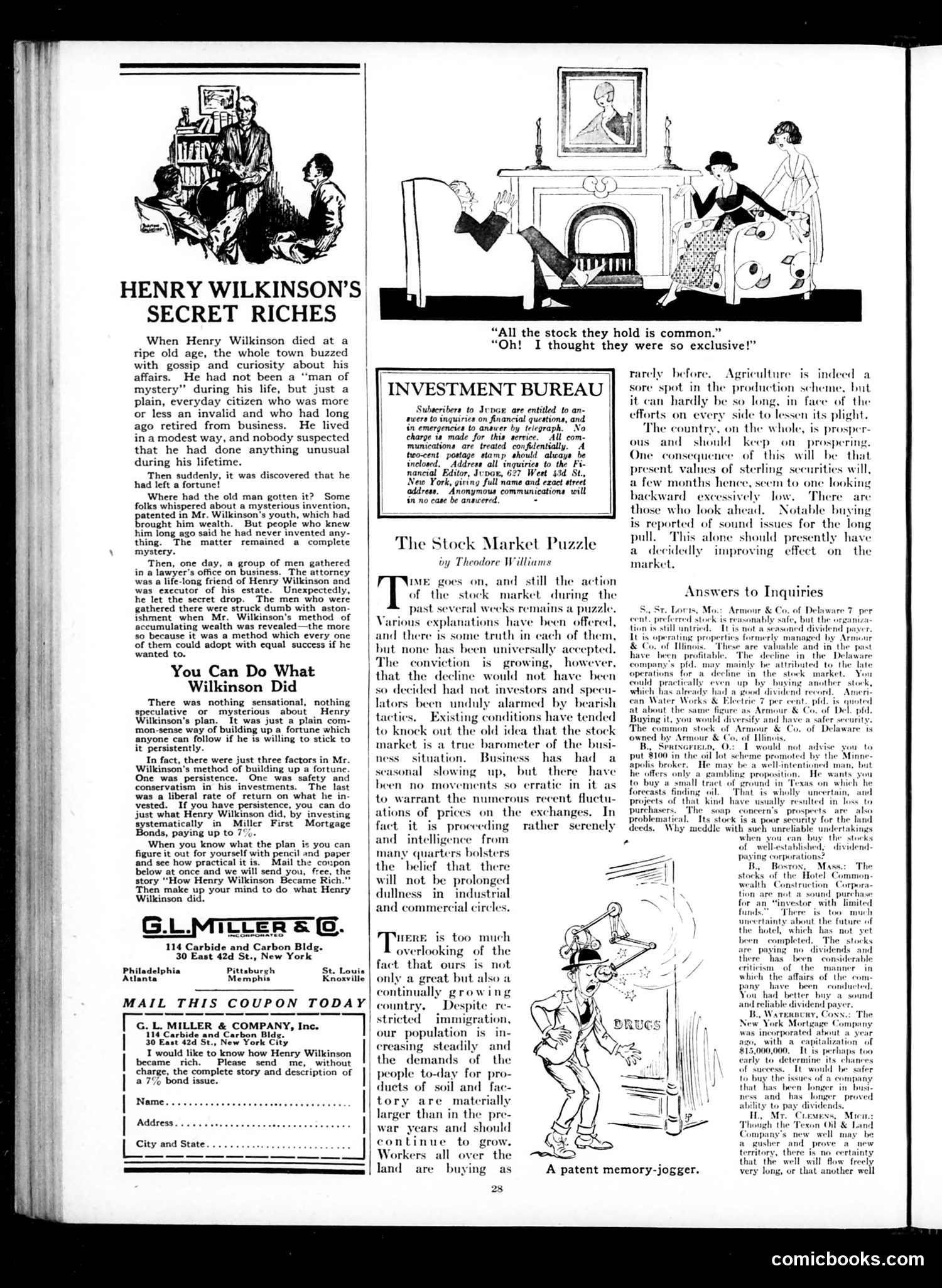
This page is primarily **advertising disguised as editorial content**—a common Judge magazine practice. The main narrative, "Henry Wilkinson's Secret Riches," is a fictional story promoting G.L. Miller & Company's investment bonds (paying 7% returns). The "mystery" of how an ordinary retired man became wealthy is revealed to be simple: persistent investment in conservative, high-yield securities. The implicit message: readers can replicate this success by buying Miller bonds. The cartoon at top-right shows wealthy investors discussing stock holdings, with the joke being that even "exclusive" (high-class) investors hold common stock—normalizing stock ownership among the affluent. "The Stock Market Puzzle" article discusses recent market volatility, attributing declines partly to investor panic over "bearish tactics" rather than fundamentals—a reassuring message for nervous investors. The entire page essentially argues: steady, conservative investing (like Miller bonds) beats speculative stock trading. This reflects 1920s-era financial advertising, when such hybrid advertorial content was standard.
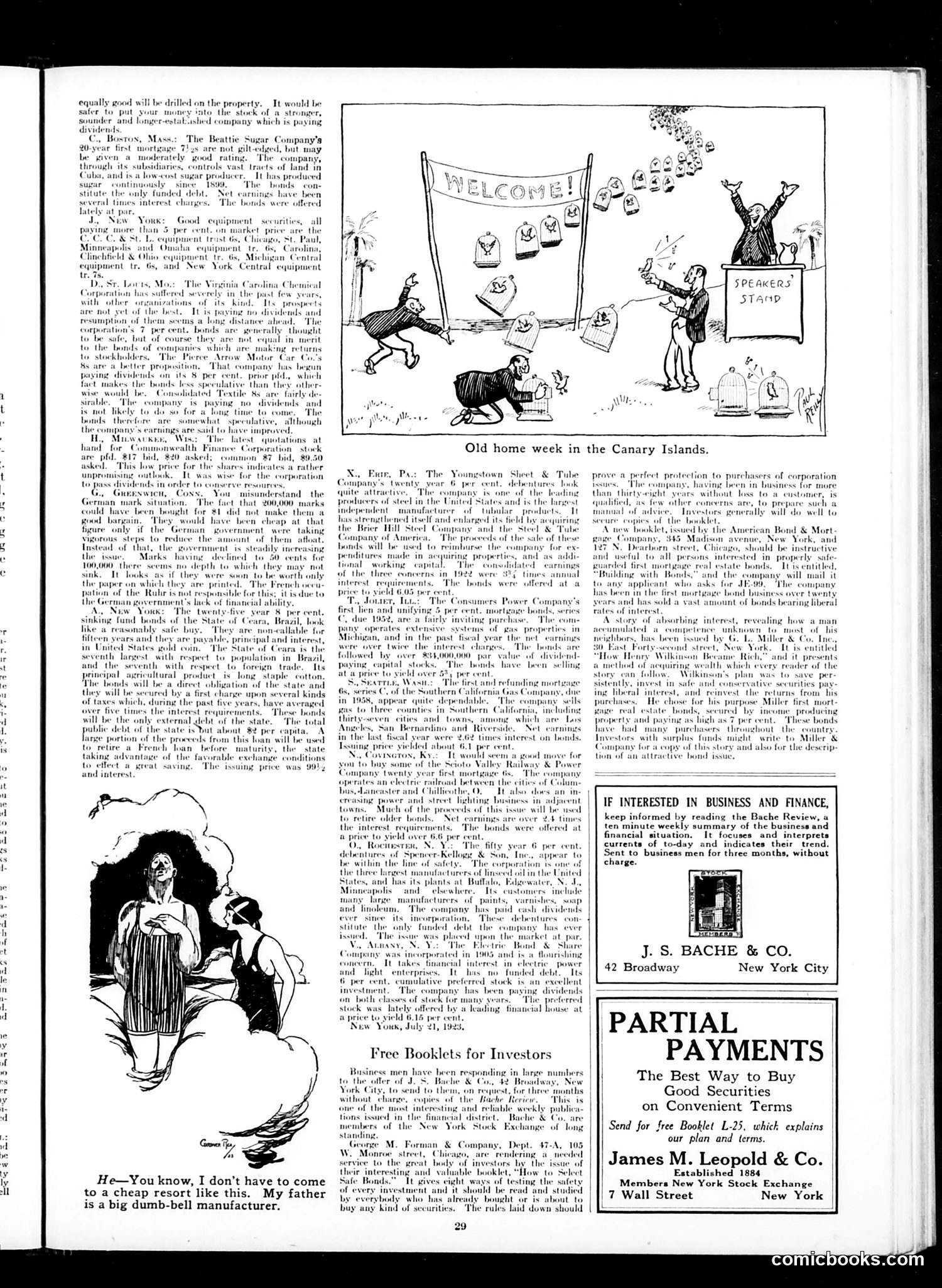
This satirical cartoon depicts wealthy investors being "welcomed" to the Canary Islands with a banner, while various investment schemes literally rain down upon them. The figures appear to be financial speculators or investors being lured by promises of profitable ventures. The joke targets the gullibility of investors during what was likely a period of speculative financial activity. The cartoon suggests that naive or greedy investors are being deliberately "caught" by dubious investment opportunities presented as attractive deals. The "Speakers Stand" sign in the background appears to reference promotional pitches. The accompanying text discusses various bond offerings and financial instruments, indicating this is satirizing the investment advice industry itself. The overall message: investors flocking to attractive-sounding but potentially risky financial schemes are like naive tourists being consciously baited. The bottom cartoon shows a young man boasting his father manufactures "dumb-bells"—a visual pun suggesting the father produces items for fools, reinforcing the magazine's skeptical view of financial naiveté.
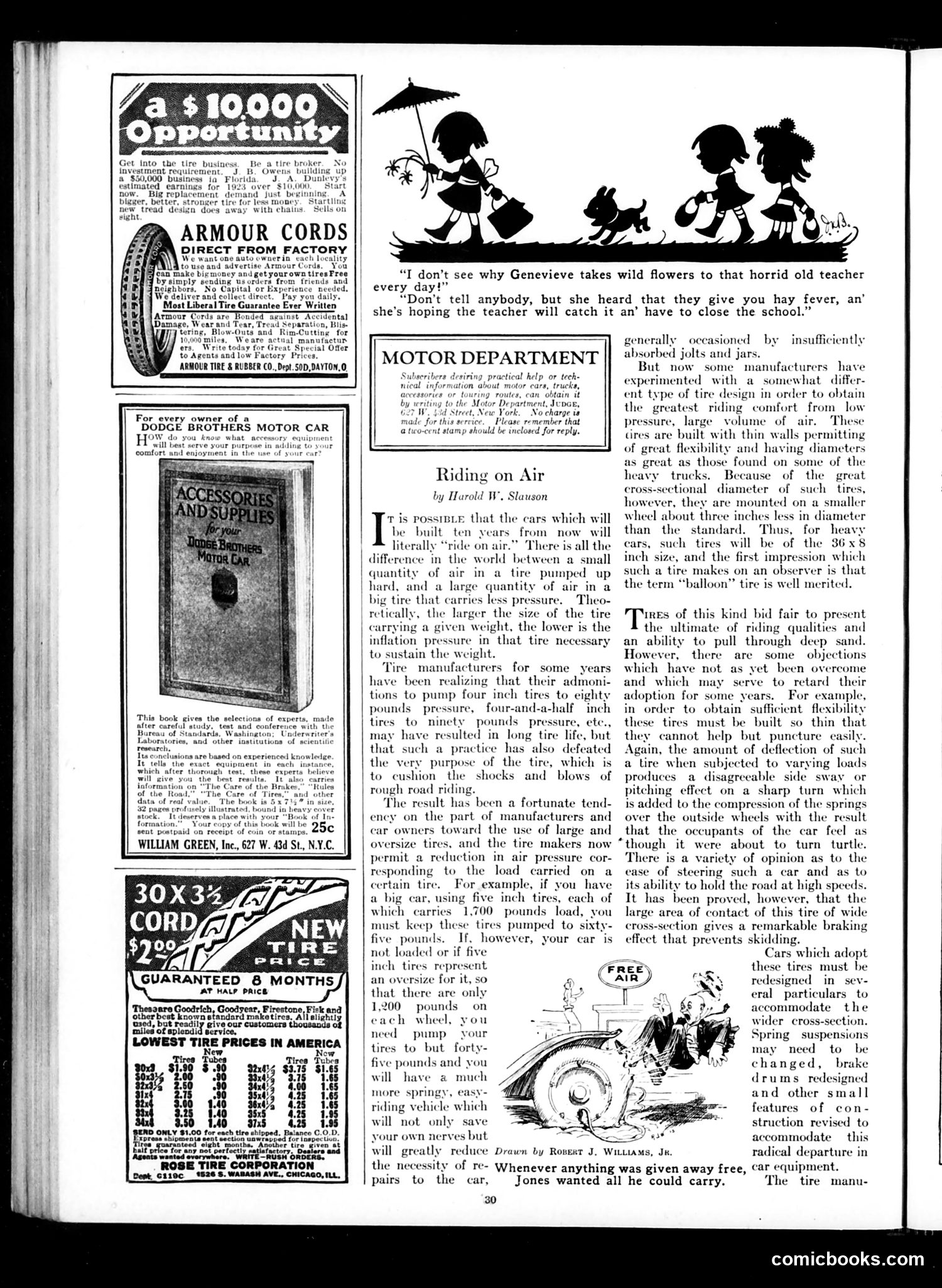
This page from *Judge* magazine contains primarily **advertisements and technical automotive content** rather than political satire. The main cartoon depicts two girls discussing one named Genevieve, who brings wild flowers to her teacher daily. The joke reveals the darker scheme: the second girl reveals Genevieve hopes the teacher will catch hay fever and close the school. This is **children's mischief humor**—common to the era—satirizing a student's creative (if mean-spirited) scheme to escape school. The page is dominated by **tire and automotive advertisements** (Armour Cords, Dodge Brothers, tire pricing) and a serious technical article titled "Riding on Air" by Harold W. Slauson about pneumatic tire design and "balloon tires"—large, low-pressure tires that provide better comfort. The illustration accompanying the article shows a car bouncing on oversized tires, humorously depicting this new automotive technology. **Context for modern readers:** This reflects the 1920s automotive boom when tire technology was rapidly evolving, and magazines published detailed consumer guidance on car maintenance.
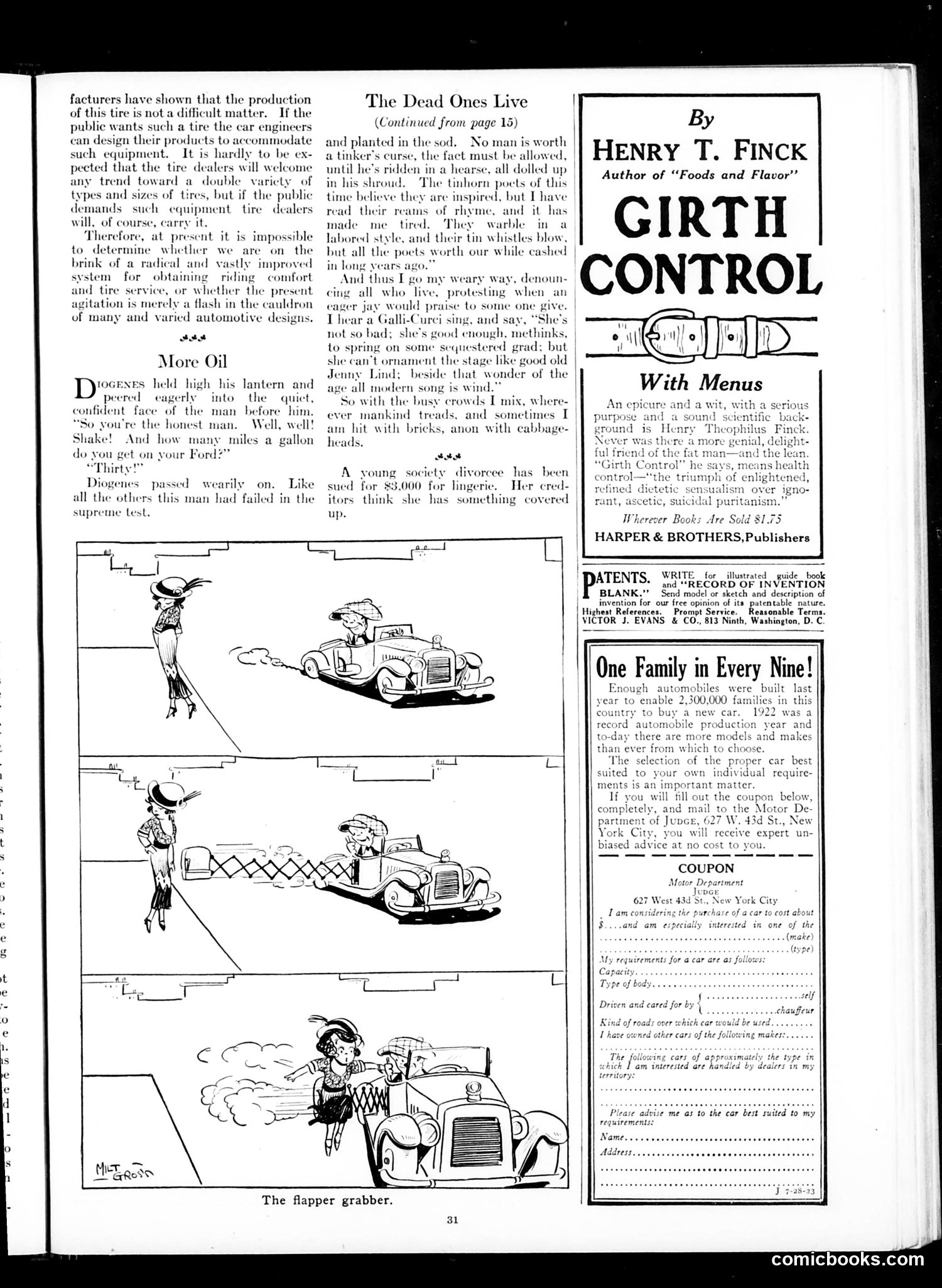
This page contains three distinct elements: **Main Cartoon ("The Flapper Grabber"):** Three panels depicting a man in a car pursuing a young woman (a "flapper"—the modern, independent woman of the 1920s). The humor satirizes male anxiety about changing gender roles; the flapper represents the new social freedom women enjoyed post-WWI, which threatened traditional courtship dynamics. The man's desperate, comedic attempts to "grab" her reflect anxieties about women's increasing autonomy and sexual independence. **Literary Content:** "The Dead Ones Live" and "More Oil" appear to be satirical prose pieces about modern pretension—one mocking contemporary poets as inferior to historical greats, another using Diogenes (the ancient cynic philosopher) as a frame to critique modern dishonesty. **Advertisements:** Patent and automobile purchasing services—typical Judge content aimed at middle-class readers. The overall tone reflects 1920s anxieties about rapid social change, particularly women's liberation.
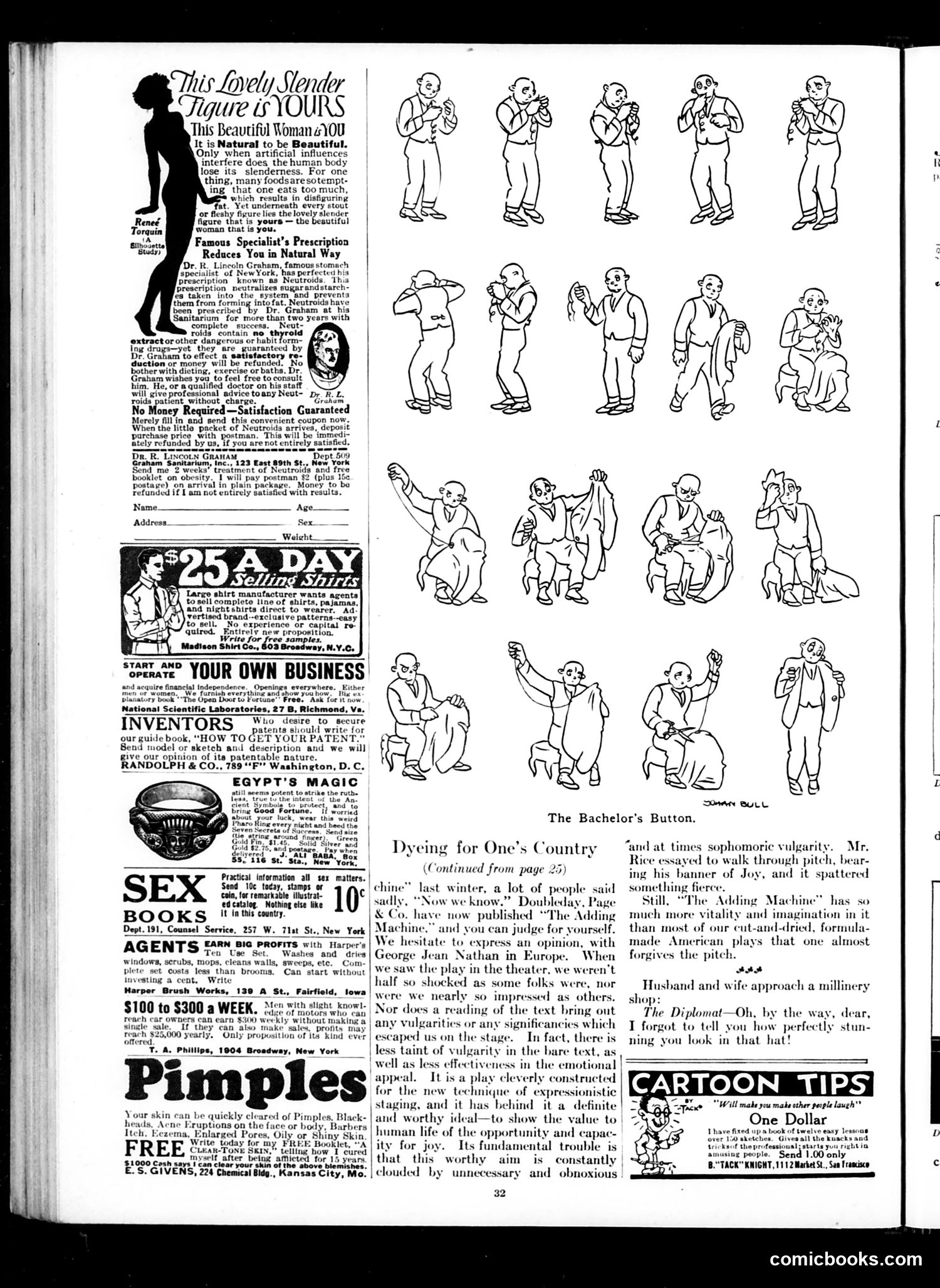
This page contains a comic strip titled "The Bachelor's Button" by Johan Bull, depicting a man in various physical positions and activities—appearing to show someone engaging in exercise or physical exertion across multiple panels. The accompanying text article, "Dyeing for One's Country" (continued from a previous page), discusses George Jean Nathan's theater criticism. It references "The Adding Machine," a contemporary play, and critiques its staging and dramatic effectiveness. The author argues the play employs exaggerated techniques and theatrical vulgarity, suggesting the text lacks emotional impact despite innovative staging. The title "The Bachelor's Button" likely plays on the flower name as a pun related to the male character shown, though the specific satirical meaning requires context from earlier installments not visible here. The page is primarily filled with period advertisements for weight-loss products, business opportunities, and patent services—typical commercial content of 1920s Judge magazine.
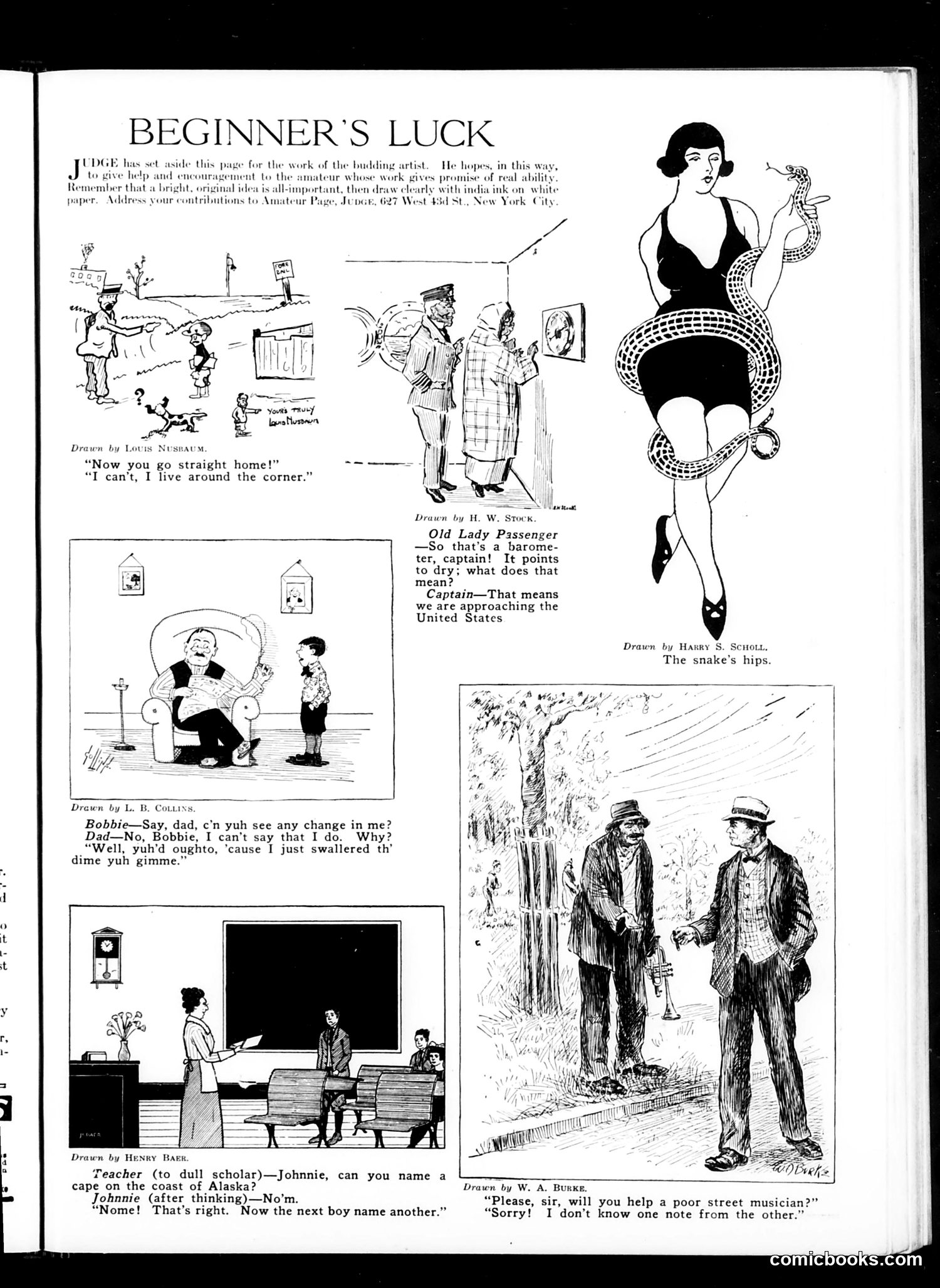
This is an instructional page showcasing amateur cartoonists' work, featuring six short comic strips with gentle humor aimed at early 20th-century readers. The jokes rely on wordplay and situational comedy: a child can't go straight home because he "lives around the corner"; a ship's barometer pointing to "dry" humorously predicts arrival at the United States (implying America is dry—likely referencing Prohibition); a boy swallows a dime and expects visible change; a student names Alaska's "Nome" cape by accident; and a street musician admits ignorance of music theory. One cartoon shows a woman in a bathing suit with a snake—captioned "The snake's hips," a reference to the 1920s "flapper" era's obsession with hip movements in dance (the Charleston). These are gentle, pun-based gags typical of Judge's amateur section, designed to encourage budding cartoonists while entertaining readers with simple, family-friendly humor.
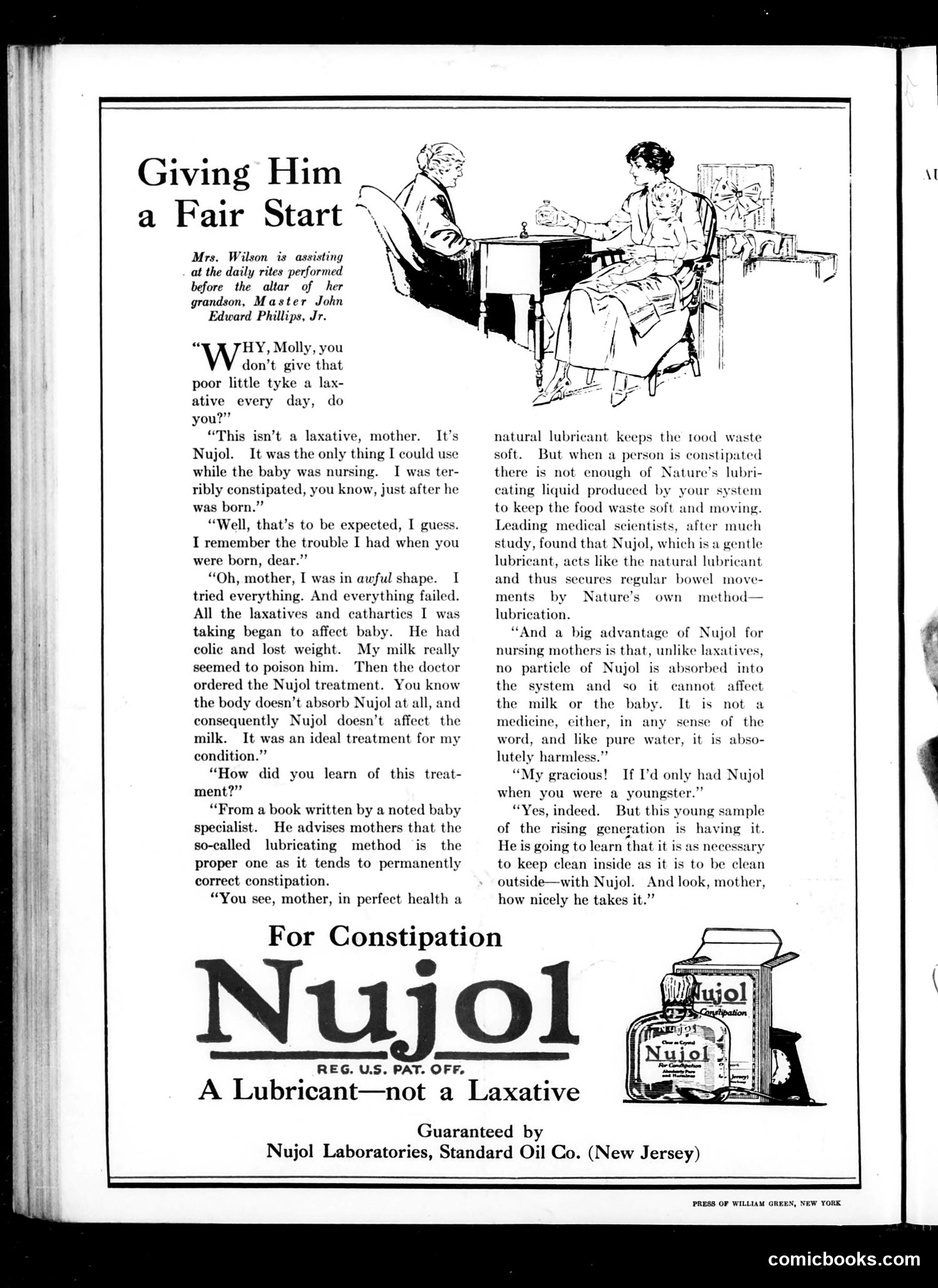
This is primarily a **Nujol product advertisement** disguised as editorial content in Judge magazine. The "cartoon" depicts a three-generation conversation between a grandmother, mother (Mrs. Wilson), and infant grandson about constipation remedies. The narrative functions as testimonial marketing: the mother explains how Nujol—a mineral oil lubricant made by Standard Oil—solved her postpartum constipation without affecting her breast milk, unlike harsh laxatives that caused her baby colic. The grandmother validates the advice, and the mother implies this product represents modern medical wisdom for the "rising generation." **The satire or "point"** isn't really satirical—it's straightforward advertising presented as family advice. The humor (if any) derives from the frank discussion of bowel health in a genteel domestic setting, which was somewhat unusual for the era but presented as progressive medical knowledge. The page title "Giving Him a Fair Start" uses the infant as a marketing hook: proper digestive habits from infancy ensure lifelong health—achieved through Nujol.