
Judge, 1923-07-28 · page 5 of 36
Judge — July 28, 1923 — page 5: what you’re looking at
What you’re looking at
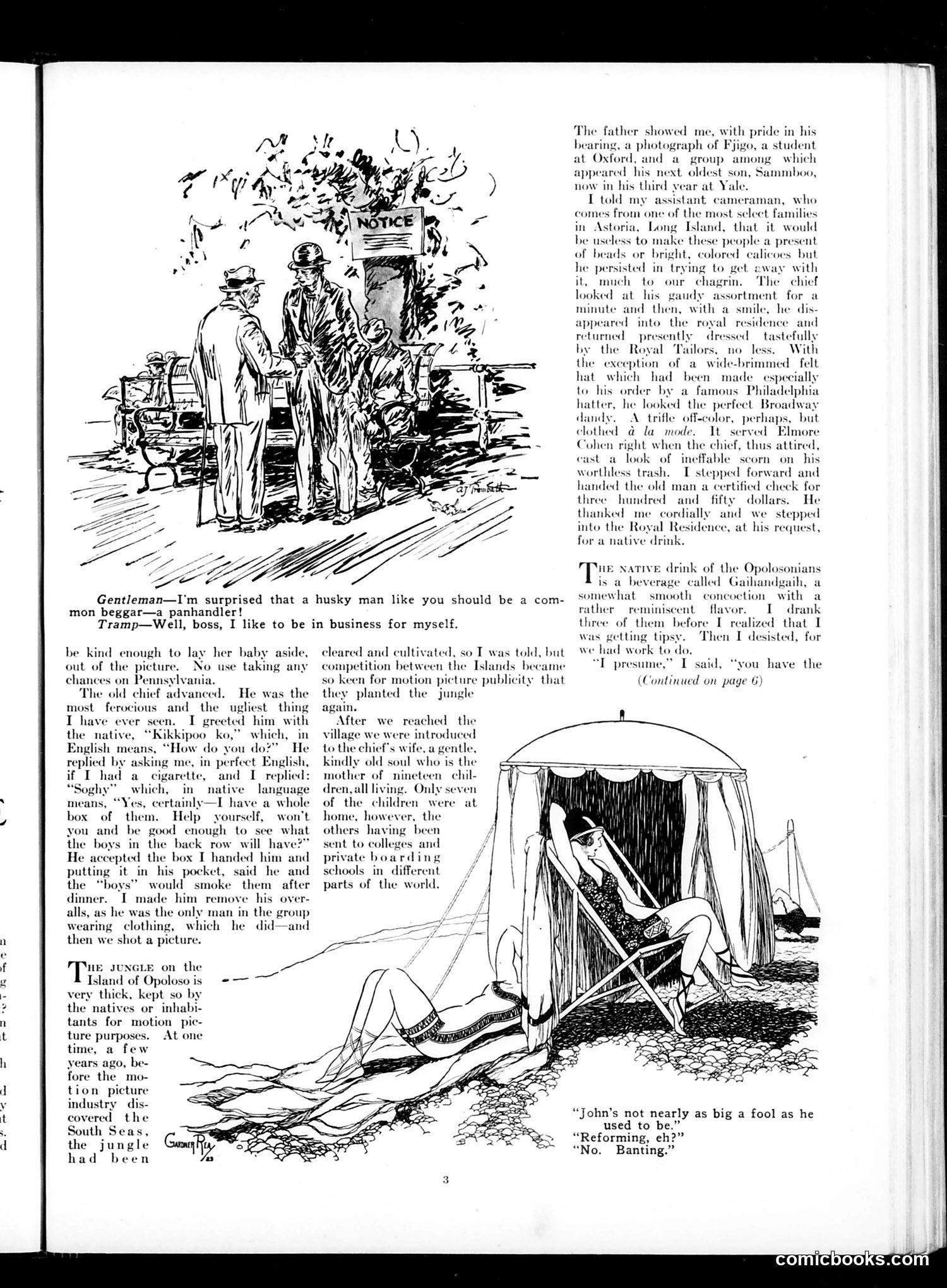
This page contains travel writing and illustrations rather than political satire. The text describes the author's expedition to the Opoloso Islands, documenting encounters with indigenous people and colonial administrators. The top cartoon depicts a dialogue between two men—one appears to be a Western businessman or traveler (in a hat and coat) and another figure near a "NOTICE" sign, likely representing colonial authority. The joke plays on cultural misunderstanding: the Western man expects the indigenous person to be simple, but receives a straightforward business-focused reply. The lower illustration shows a woman resting under a parasol, accompanying text about native beverages. The final caption joke ("John's not nearly as big a fool...") suggests comedic commentary on character reformation or personal change, though context is limited.
📄 Transcribed text from this page (OCR, searchable)
Machine-transcribed from the original scan — historical spelling and the odd misread are preserved.
Gentleman—I'm surprised that a husky man like you should be a com- mon beggar—a panhandler! Tramp—Well, boss, I like to be in business for myself. be kind enough to li out of the picture. chances on Penns; The old ch most ferocious I have ever the nativ English mi replied by if The He was the and the ugliest thing en. I greeted him with “Kikkipoo ko,” which, in s, “How do you de e nglish, and I replied: in ‘native language certainly—I have a whole Help yourself, won't you and be good enough to see what the boys in the back row will have?” He accepted the box I handed him and putting it in his pocket, said he and the “boys” would smoke them after dinner. I made him remove his over- alls, as he was the only man in the group wearing clothing, which he did—and then we shot a picture. means, box of nm. JUNGLE on the sland of Opoloso is | -— ick, kept so by the natives or inhabi- tants for motion pic- ture purpe At one time, a few years ago, be- fore the mo- tion picture industry dis- covered the South Seas, the jungle had been cleared and cultivated, so T was told, but competition between the Islands so keen for motion picture publici they planted the jungle again. After we ri village we were introduced to the chief's wife, a gentle, kindly old soul who is the hed the father showed me, with pride in his photograph of Fjigo, a student and a group among which appeared his next oldest son, Sammboo, now in his third year at Y; I told my assistant cam n, who comes from one of the most select families in Astoria, Long Island, that it) would be useless to make these people a present of beads or bright, colored calicoes but he persisted in trying to get eway with it, much to our chagrin. The chief looked at his gaudy assortment for a minute and then, with a smile, he dis- appeared into the royal residence and returned — prese dressed — tastefully by the Royal lors, With the exception of a wide-brimmed_ felt hat which had been made especially to his order by a famous Philadelphia hatter, he looked the perfect Broadway dandy. A trifle off-color, perhaps, but clothed @ la mode. It served Elmore Cohen right when the chief, thus attired, east a look of ineffable scorn on his worthless trash. I stepped forward and handed the old man a certified check for three hundred and fifty dollars. He thanked me cordially and we stepped into the Royal Residence, at his request, for a native drink, no less. Te NATIVE drink of the Opolosonians is a beverage called Gaihandgaih, a somewhat smooth concoction with a rather reminiscent flavor I drank three of them before I realized that I was getting tipsy. Then I desisted, for we had work to do. “I presume,” I said, “you have the (Continued on page 6) mother of nineteen chil- dren, all living. Only seven of the children were at home, however, the others having been sent to colleges and private boarding schools in different parts of the world. ae - “John’s not nearly as big a fool as he used to be.” “Reforming, eh?” “No, Banting.”