
Judge, 1923-07-28 · page 4 of 36
Judge — July 28, 1923 — page 4: what you’re looking at
What you’re looking at
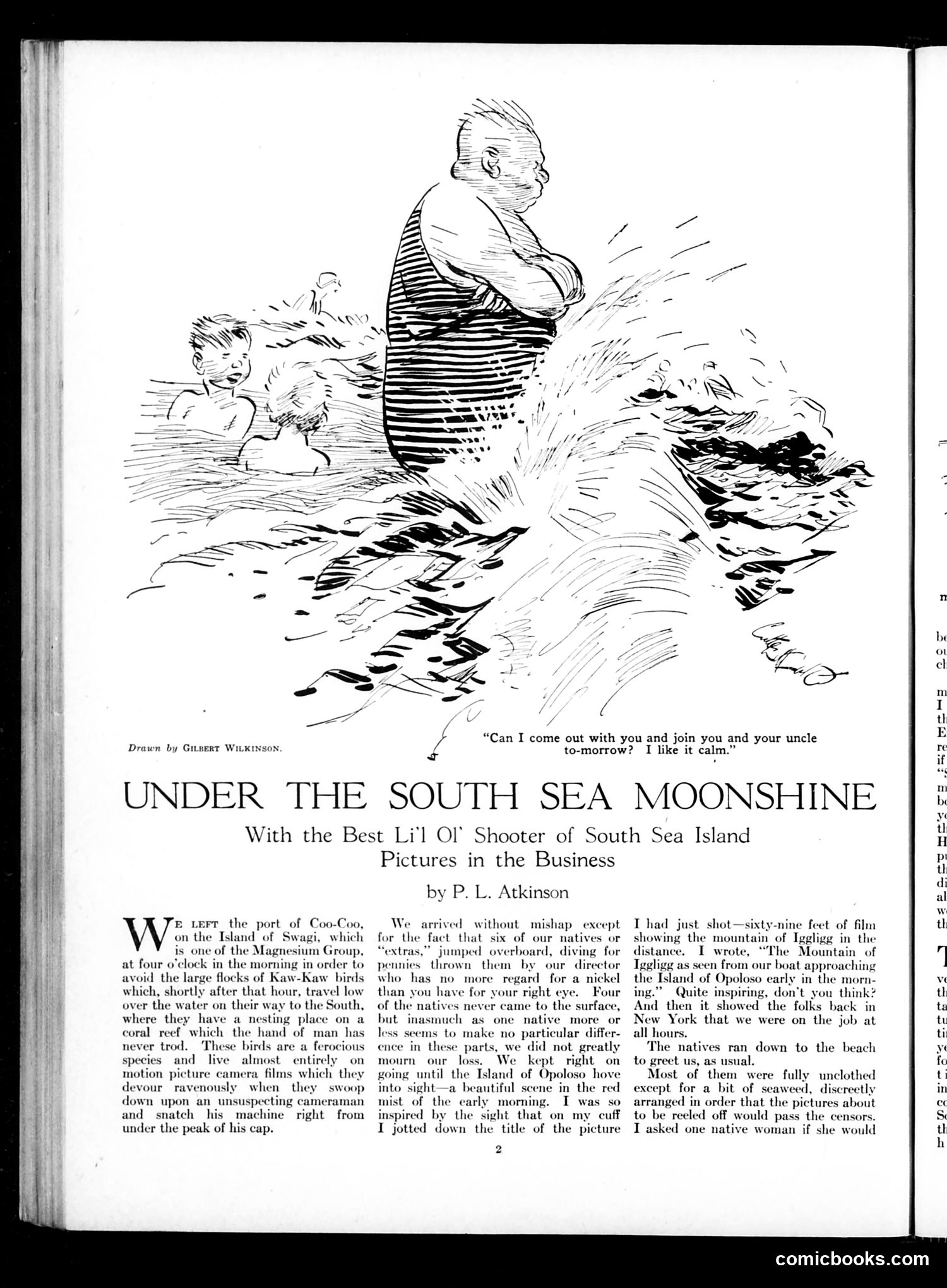
This page contains an illustrated story titled "Under the South Sea Moonshine" by P. L. Atkinson, drawn by Gilbert Wilkinson. Rather than political satire, it's a travel narrative about filmmaking in the South Seas. The illustration shows an adult and child in the ocean with indigenous people on shore. The accompanying text describes a film expedition to Coo-Coo Island in Swat, documenting native life and landscapes. The author discusses shooting footage of "natives" and arranging scenes for the camera, reflecting early ethnographic filmmaking practices. This represents **not satire but period adventure journalism**—typical Judge content mixing exotic travel accounts with illustration, presenting colonial-era attitudes toward indigenous peoples as entertainment for American magazine readers.
📄 Transcribed text from this page (OCR, searchable)
Machine-transcribed from the original scan — historical spelling and the odd misread are preserved.
Drawn by GiLpert WILKINSON. E LEFT the port of Coo-Coo, on the Island of Swagi, which is one of the Magnesium Group, at four 0'¢ in the morning in order to avoid the large flocks of Kaw-Kaw birds which, shortly after that hour, travel low over the water on their way to the South, where they have a nesting place on a coral reef which the hand of man has never trod. These birds are a ferocious species and live almost entirely on motion picture camera films which they devour ravenously when they swoop down upon an unsuspecting cameraman and snatch his machine right from under the peak of his cap. “Can I come out with you and join you and your uncle to-morrow? I like it calm.” UNDER THE SOUTH SEA MOONSHINE With the Best Li'l Ol’ Shooter of South Sea Island Pictures in the Business by P. L. Atkinson We arrived without mishap for the fact that six of our n < “extras,” jumped overboard, diving for pennies thrown them by our director who has no more regard for a nickel than you have for your right eye. Four of the natives never came to the surface, but inasmuch as one native more or less seems to make no particular differ- ence in these parts, we did not greatly mourn our loss. We kept right on going until the Island of Opoloso hove into sight—a beautiful scene in the red mist of the early moming. I was so inspired by the sight that on my cuff I jotted down the title of the picture 2 T had just shot—sixty-nine feet of film showing the mountain of Iggligg in the distance. I wrote, “The Mountain of Iggligg as seen from our boat approaching the Island of Opoloso early in the morn- ing.” Quite inspiring, don’t you thin And then it showed the folks back in New York that we were on the job at all hours. The natives ran down to the beach to greet us, as usual. Most of them were fully unclothed except for a bit of seaweed, discreetly arranged in order that the pictures about to be reeled off would pass the censors. I asked one native woman if she would comicbooks.com