
Judge, 1923-07-28 · page 11 of 36
Judge — July 28, 1923 — page 11: what you’re looking at
What you’re looking at
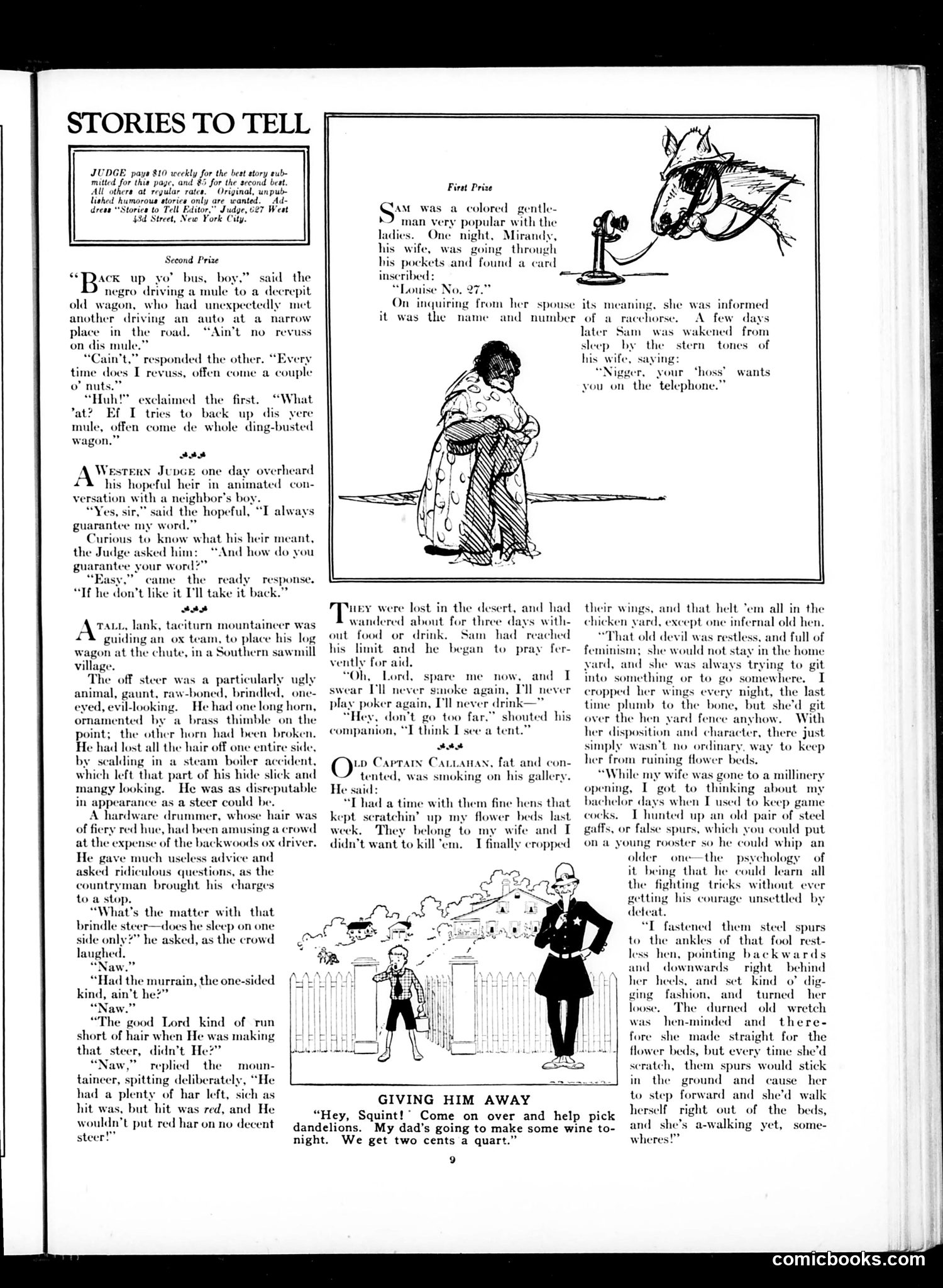
This page from *Judge* magazine contains five humorous short stories submitted by readers, competing for cash prizes ($10 for first place). The humor relies heavily on **racial stereotypes and rural dialect** common to early 20th-century American comedy. The stories mock: - **African Americans** ("Sam," "Nigger") through exaggerated dialect and stereotyping - **Rural/backwoods characters** depicted as ignorant or simple-minded - **Gender dynamics** (wives controlling husbands, a "feminist" hen refusing domesticity) The satire targets social "types" rather than politics. For modern readers, the offensive racial language and caricatures are jarring—what passed as mainstream humor in this era would be considered deeply racist today. The magazine's editorial voice treats these stereotypes as universally amusing, reflecting the casual racism embedded in early 20th-century American popular culture. The cartoons accompanying these stories use exaggerated visual caricature to reinforce the written stereotypes.
📄 Transcribed text from this page (OCR, searchable)
Machine-transcribed from the original scan — historical spelling and the odd misread are preserved.
STORIES TO TELL JUDGE pays $10 weekly for the best story aub- mitted for this paye, and &5 for the second best. Al others at regular rates.” Original, unpub- humorous atorice only are wanted. Ad- “Storice to Tell Editor,” Judge, 627 Weat 43d Street, New York City. Second Prize “Birce up yo" dus. boy.” said the negro driving a mule to a decrepit old wagon, who had unexpectedly met aother driving an auto at a narrow place in the road. “Ain't no. revuss on dis mule.” “Cain’t,” responded the other. “Every time does I revuss, offen come a couple o’ nuts.” “Huh!” exclaimed the first. “What ‘at? Ef I tries to back up dis yere mule, offen come de whole ding-busted wagon,” sae A Westerns Juvce one day overheard his hopeful heir in animated con- sation with a neighbor's bc “Yes, sir,” said the hopeful, “I always guarantee my word.” Curious to know what his heir meant, the Judge asked him: “And how do you guarantee your wor “Easy,” came the ready response. “Tf he don’t like it P'Il take it back.” sae Am lank, taciturn mountaineer was f° guiding an ox team, to place his log on at the chute, in a Southern sawmill The off steer was a particularly ugly animal, gaunt, raw-boned, brindled, one- eyed, evil-looking. _ He had one long horn, ornamented by a brass thimble on the point; the other horn had been broken. He had lost all the hair off one entire side, by scalding in a steam boiler accident, which left that part of his hide slick and mangy looking. He was as disreputable in appearance as a steer could be. A hardware drummer, whose hair was of fiery red hue, had been amusing a crowd at the expense of the backwoods ox driver. He gave much useless advice and asked ridiculous questions, as the countryman brought his charges to a stop. “What's the matter with that brindle steer—does he sleep on one side on he asked, as the crowd laughed. “Naw. Had the murrain, the one-sided ain’t he?” “The good Lord kind of run short of hair when He was making replied — the taincer, spitting deliberately, “He had a plenty of har left, sich as hit was, but hit was red, and He wouldn’t put red har on no decent moun- night. dandelions. Firat Prize Sam was a colored gentle- man very popular with the ladies. One night, Mirandy, his wife, was going through his pockets and found a card inscribed: K On inquiring from her spouse its meaning, she was informed and number of a it was the name T sy were lost in the desert, and had wandered about for three « out food or drink, Sam had reached his limit and he began to pray fer- vently for aid. Yh, Lord are me now dT swear I'll neve ke again, Tl never play poker again, I'll never drink—” “He mt go too far.” shouted his. companion, “I think I see a tent.” sae Ov Caprary Cattanan, fat and con- tented, was smoking on his gallery. He said: “Thad a time with them fine hens that kept scratchin’ up my flower beds last week, They belong to my wife and I didn’t want'to kill ‘em. I finally cropped racehorse. A few days later Sam) was wakened from sleep by the stern tones. of his wife, saying: “Nigger. your ‘hos’ you on. the telephone.” wants their wings, and that helt ‘em all in the chicken yard, except one infernal old hen, “That old devil was restless, and full of feminism; she would not stay in the home yard, and she was always trying to git into something or to go somewhere, cropped her wings every night, the last time plumb to the bone, but she’d git over the hen yard fence anyhow. With her disposition and character, there just simply wasn’t no ordinary, way to keep her from ruining flower beds. “While my wife was gone to a millinery opening, I got to thinking about my bachelor days when I used to keep game cocks. T hunted up an old pair of steel gaffs, or false spurs, which you could put on a young rooster so he could whip an older one—the psychology of it being that he could learn all the fighting tricks without ever getting his courage unsettled by deteat. “T fastened them steel spurs to the ankles of that fool rest- less hen, pointing backwards and downwards — right — behind her heels, and set kind 0” dig- ging fashion, and turned her loose. The durned old wretch was hen-minded and there- fore she made straight for the flower beds, but every time she'd scratch, them spurs would stick in the ground and cause her GIVING HIM AWAY “Hey, Squint!” Come on over and help pick My dad’s going to make some wine to- We get two cents a quart.” 9 to step forward and she'd walk herself right out. of the beds, and she’s a-walking yet, some- wheres!” comicbooks.com