
Judge, 1923-07-28 · page 17 of 36
Judge — July 28, 1923 — page 17: what you’re looking at
What you’re looking at
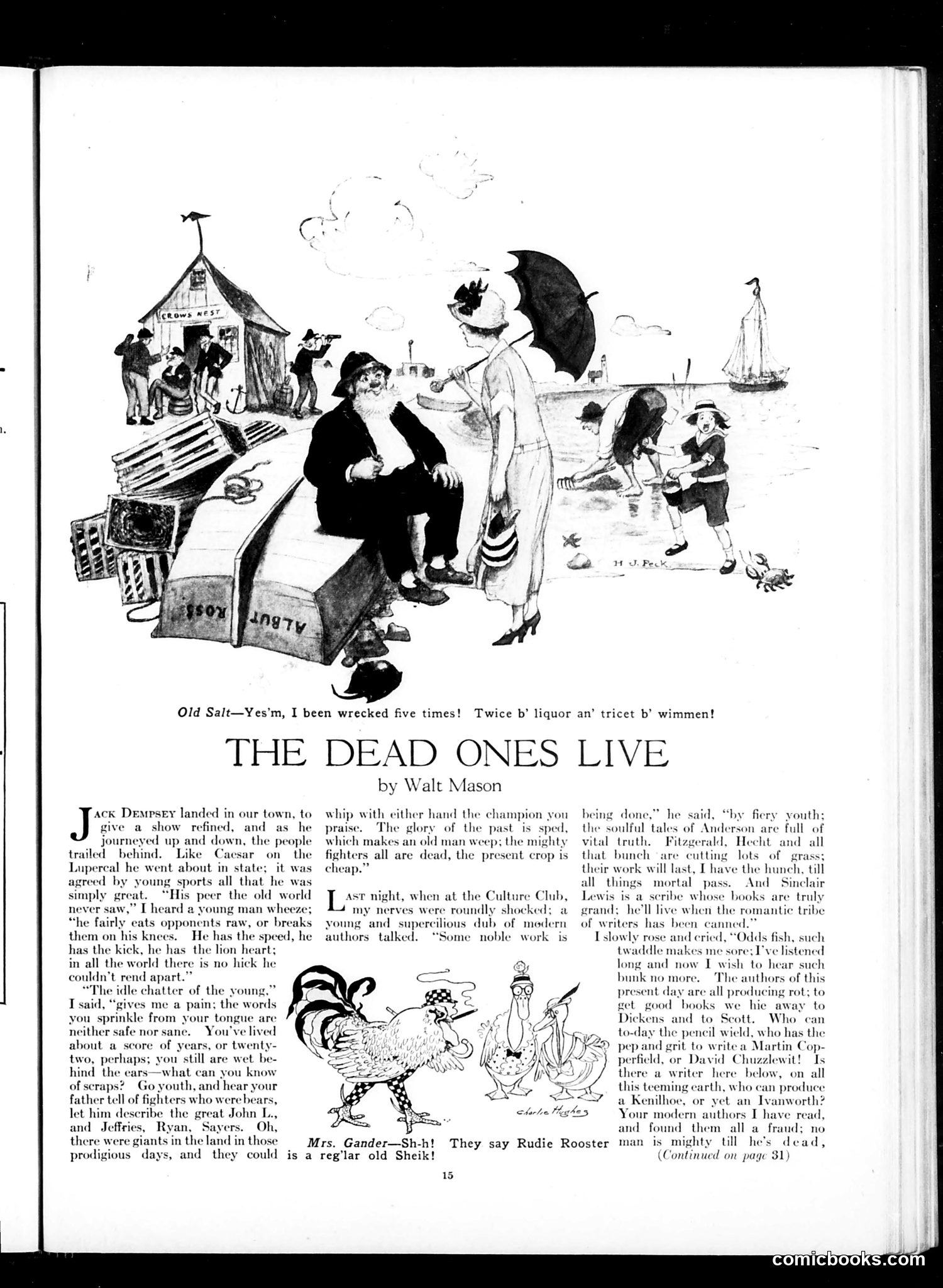
This satirical story criticizes young people's uncritical admiration for contemporary authors and celebrities while dismissing past greats. An old man (representing tradition) confronts a young "dub" at a Culture Club who praises modern writers like Anderson, Fitzgerald, Hecht, and Sinclair Lewis as superior to classics. The narrator counters that these authors produce "rot" compared to established masters like Scott, Dickens, and Chuzzlewit. The opening beach scene with "Old Salt" establishes the generational theme: an elderly sailor has survived shipwrecks and vice, implying he possesses earned wisdom the young lack. The satire targets **youthful arrogance** — the assumption that contemporary work automatically surpasses the past. Mason argues modern authors are overrated; only the dead achieve true literary immortality. The cartoon mocks the pretentiousness of "modern" literary taste among young sophisticates. The title's paradox — that the dead remain alive (through enduring work) while the living fade — frames Mason's conservative critique of 1920s literary culture.
📄 Transcribed text from this page (OCR, searchable)
Machine-transcribed from the original scan — historical spelling and the odd misread are preserved.
Old Salt—Yes'm, I been wrecked five times! Twice b’ liquor an’ tricet b’ wimmen! THE DEAD ONES LIVE J ack Dempsey landed in our town, to give a show refined, and as he journeyed up and down, the people trailed behind. Like Caesar on the Lupereal he went about in state; it was agreed by young sports all that he was simply great. “His peer the old world never saw,” I heard a young man whe “he fairly eats opponents raw, or bred them on his knees. He has the speed, he has the kick, he has the lion heart; in all the world there is no hick he couldn’t rend apart.” “The idle chatter of the young,” Tsaid, “gives me a pain; the words you sprinkle from your tongue are neither safe nor sane. You've lived about a score of years, or twenty- two, perhi u still are wet be- hind the ears—what can you know of scraps? Go youth, and hear your father tell of fighters who werebears, let him describe the great John L., and Jeffries, Ryan, Sayers. Oh, there were giants in the land in those prodigious days, and they could Mrs. Gander—Sh-h! is a reg'lar old Sheik! by Walt Mason whip with either hand the champion you praise. The glory of the past is sped, which makes an old man weep; the mighty fighters all are dead, the present crop is cheap.” [22 night, when at the Culture Club, my nerves were roundly shocked; i young and. supercilious dub of modern authors talked. “Some noble work is chorhe Megha 15 They say Rudie Rooster being done,” he said, “by fiery youth: the soulful tales of Anderson are full of vital truth. Fitzgerald, Hecht and all that bunch are cutting lots of grass; their work will last, I have the hunch, till all things mortal And Sinclair Lewis is a scribe whose books are truly grand; he'll live when the romantic tribe of writers has been canned.” I slowly rose and cried, “Odds fish, such twaddle makes me sore; I've listened long and now I wish to hear such bunk no more. The authors of this present day are all producing rot; to get good books we hie away to kens and to Scott. Who can to-day the pencil wield, who has the id grit to writea Martin Cop- perfield, or David Chuzzlewit! Is there a writer here below, on all this teeming carth, who can produce a Kenilhoe, or yet an Ivanworth? Your modern authors I have read, and found them all a fraud; no man is mighty till he’s dead, (Continued on page 31) pass.