
Judge, 1923-07-28 · page 27 of 36
Judge — July 28, 1923 — page 27: what you’re looking at
What you’re looking at
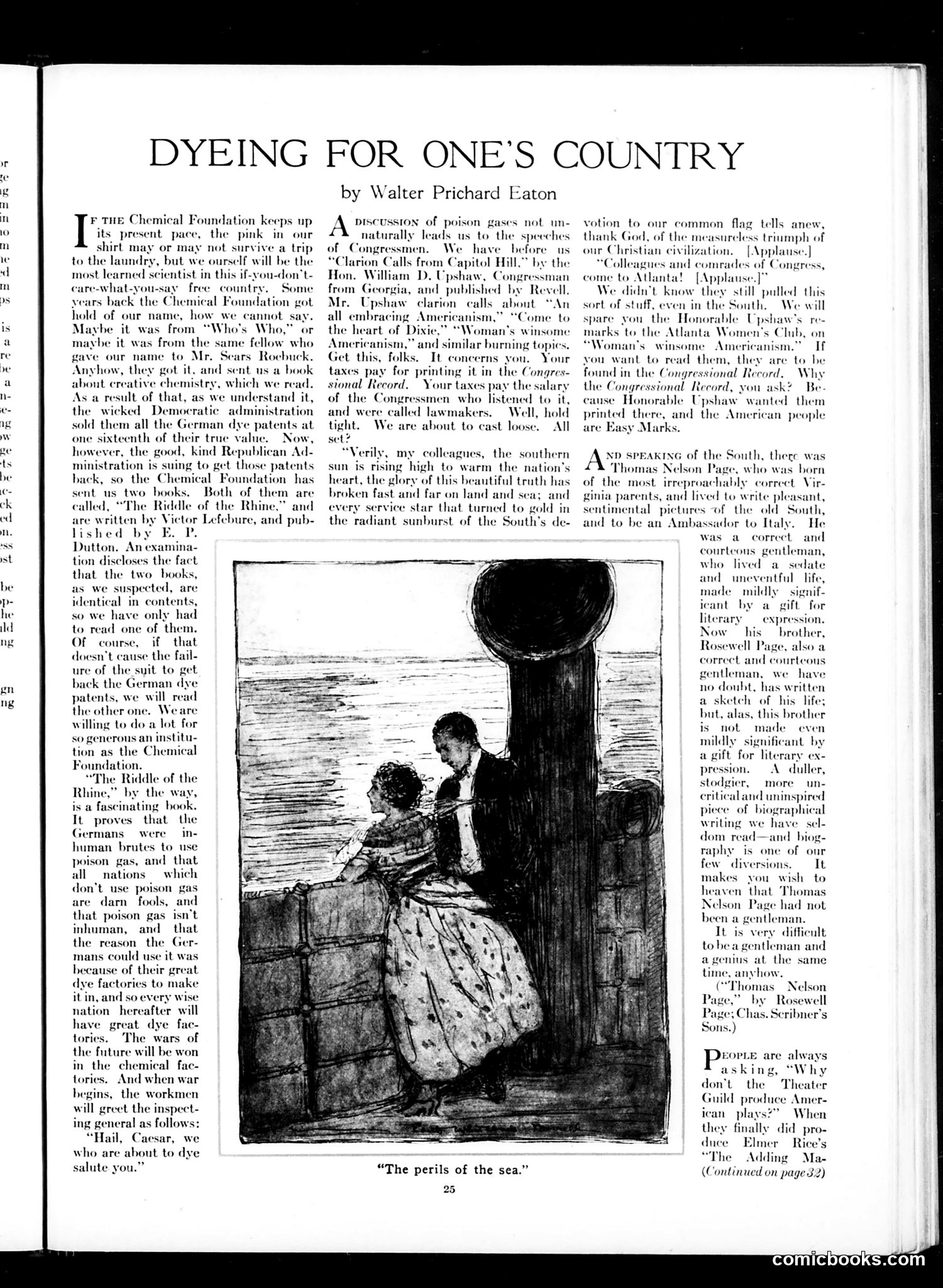
This Judge magazine page satirizes post-WWI American politics through overlapping critiques: **The Chemical Industry subplot** mocks the Republican administration's lawsuit to recover German dye patents from a Chemical Foundation (seemingly compensating for past Democratic-era patent sales). Eaton sardonically notes he received two identical books promoting dye manufacturing—appearing propagandistic—and sarcastically endorses the "wisdom" of building national dye factories for future chemical warfare. **The Congressional Hypocrisy section** targets Congressman William D. Upshaw's self-promoting patriotic speeches, printed at taxpayer expense in the *Congressional Record*. Eaton ridicules the grandiose rhetoric ("winsome Americanism," "Christian civilization") and applause, calling Americans "Easy Marks" for funding politicians' vanity publications. **The illustration** depicts a couple in period dress on a boat—captioned "The perils of the sea"—likely related to the broader theme of national sacrifice or romance amid wartime concerns. The unifying joke: Americans naively support jingoistic rhetoric and corporate interests masquerading as patriotism.
📄 Transcribed text from this page (OCR, searchable)
Machine-transcribed from the original scan — historical spelling and the odd misread are preserved.
DYEING FOR ONE’S COUNTRY its present pace, the pink in our shirt may or may not survive a trip to the laundry, but we ourself will be the most learned scientist in this if-vou-don't- y free I’ tie Chemical Foundation keeps up our name to Mr. Sears Roebuck. Anyhow, they got it id sent us a book about creative chemistry, which we read. As a result of that, as we understand it, the wicked Democratic administration sold them all the German dye patents at one sixteenth of their true value. Now, however, the good, kind Republican Ad- ministration is suing to get those patents back, so the Chemical Foundation has sent us two books. Both of them are called, “The Riddle of the Rhine,” and are written by Victor Lefebure, and pub- lished by E Dutton. An examina- tion discloses the fact that the two books, as we suspected, are identical in contents, so we have only had to read one of them. Of course, if th doesn’t cause the ure of the syit to get back the German dye patents, we will re the other one. Weare willing to do a lot for so generous an institu- tion as the Chemical Foundation. “The Riddle of the Rhine,” by the wa is a fascinating book. It proves that the Germans) were in- human brutes to use poison and that all nations — which don’t use poison gas are darn fools, and that poison gas isn’t inhuman, and that the reason the Ger- mans could use it was because of their great dye factories to make it in, and so every wise nation hereafter will have great dye fac- tories. The wars of the future will be won in the chemical fac- tories. And when war hegins, the workmen will greet the inspect- ing general as follows: “Hail, Caesar, we who are about to dye salute you.” by Walter Prichard Eaton A DISCUSSION of poison gases not une naturally leads us to t of Congressmen. We have before us “Clarion Calls from itol Hill,” by the Hon. William D, Upshaw, Congressman from Georgia, and published by Revell. Mr. Upshaw clarion calls about) “An all embracing Americanism,” “Come to the heart of Divi Woman's winsome Americanism,” burning topies. Get this, folks. rns you. Your taxes pay for printing it in the Congres- stonal Record. Your taxes pay the salary of the Congressmen who listened to it, and were called lawmakers. Well, hold tight. We are about to cast loose. All set? “Verily, my colleagues, the southern sun is rising high to warm the nation’s heart, the glory of this beautiful truth has en fast and far on land and sea; and every service star that turned to gold in the radiant sunburst of the South’s de- votion to our common flag tells anew, thank God, of the measureless triumph of our Christian civilization. [Applause.] “Colleagues and comrades of Congress, come to Atlanta! [Applause.]” We didn’t know they still pulled this sort of stuff, even in the South. We will spare you the Honorable Upshaw’s re- marks to the Atlanta Women's Club, on “Woman's winsome Americanism.” If you want to read them, they are to be Tound in the Congressional Record. Why the Congressional Record, you ask? Be cause Honorable Upshaw’ wanted them printed there, and the American people are Easy Marks. ‘D SPEAKING of the South, there was Thomas Nelson Page, who was born of the most irreproachably correct. Vir- ginia parents, and lived to write pleasant, sentimental pictures “of the old) South, and to be an Ambassador to Italy. He Was a correct’ and courteous gentleman, who lived a sedate and uneventful [i made mildly signif. icant by a gift’ for literary expression. Now his brother, Rosewell Page, also a correct and courteous gentleman, we have no doubt, has written a sketch of his life; but, alas, this brother is not made even mildly significant. by a gift for literary ex- pression. — A’ duller, stodgier, more un- critical and uninspired piece of biographical wriling we dom read rd biog raphy is one of our few diversions. It makes you wish to heaven that ‘Thomas Nelson Page had not been a gentleman. It is very difficult tobea gentleman and agenins at the same time, anyhow. homas Page,” by Nelson Rosewell Page; Chas. Scribner's Sons.) Per are always asking, “Why don’t the Theater Guild produce Amer- ican pl. When they finally did pro- duce Elmer R “The Adding M. (Continued on page 3:2