
Judge, 1923-07-28 · page 7 of 36
Judge — July 28, 1923 — page 7: what you’re looking at
What you’re looking at
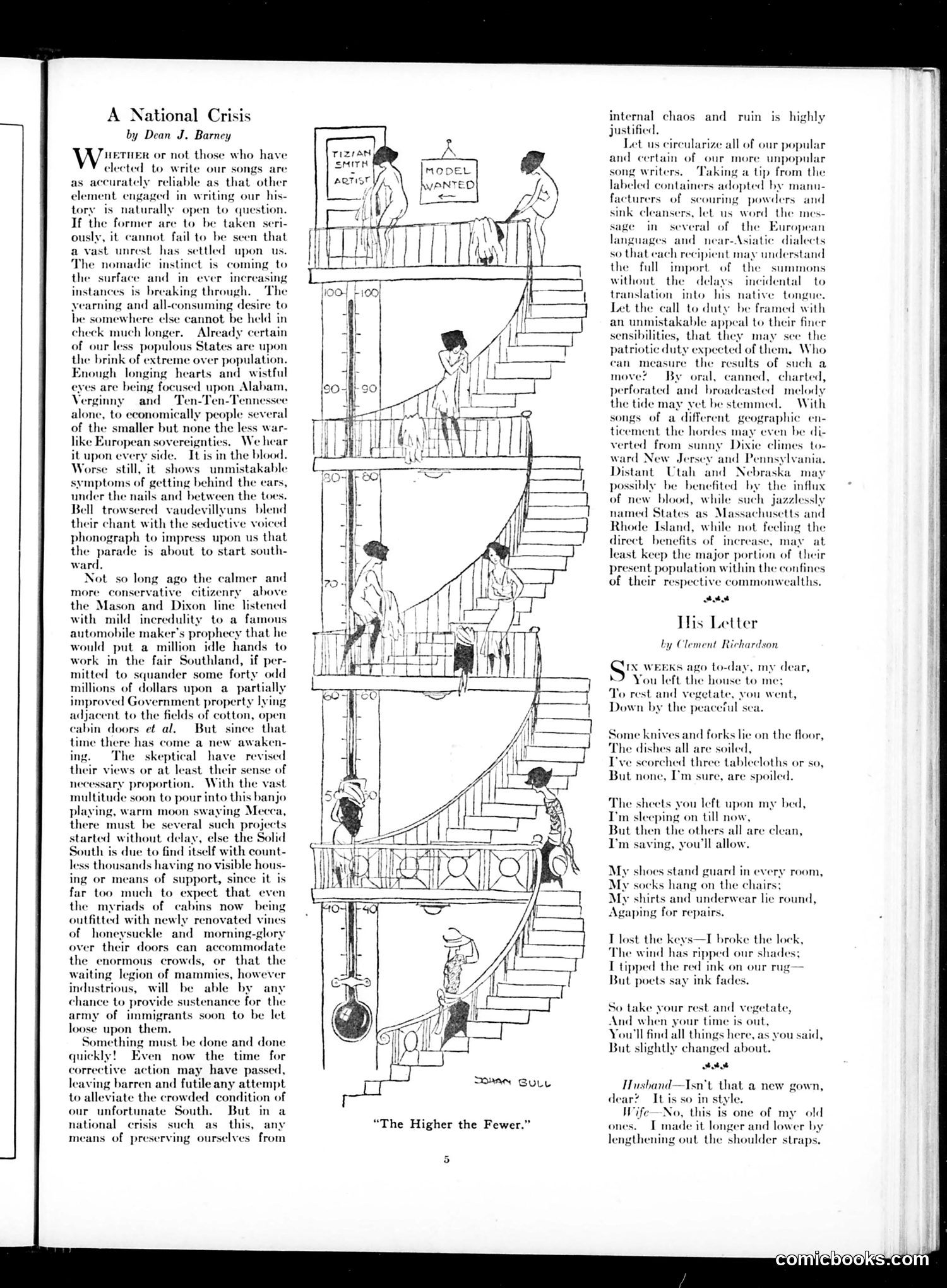
This cartoon satirizes the massive internal migration threatening the American South. The illustration depicts a crowded staircase descending into the depths, representing an exodus of people leaving Northern states for the South. **The Crisis Referenced:** The article warns that popular songs romanticizing the South (like those celebrating Alabama, Virginia, Tennessee) are causing overpopulation in the region. The author humorously proposes the solution: convince songwriters to write songs promoting *other* destinations—New Jersey, Pennsylvania, Utah, Nebraska—to redirect migration away from the overwhelmed South. **The Satire:** The piece mocks both the gravity of Southern overpopulation fears and the absurdity of using popular music as population control. It plays on Depression-era anxieties about migration, employment, and regional strain. **Artist Credit:** Signed "Cowan Bull" at bottom. The cartoon visually emphasizes the scale of movement, showing countless figures navigating the architectural structure—a visual pun on the "higher the fewer" problem of too many people in one place.
📄 Transcribed text from this page (OCR, searchable)
Machine-transcribed from the original scan — historical spelling and the odd misread are preserved.
A National Crisis by Dean J. Barney HETHER or not those who have ed to write our songs as accurately reliable as that other element engaged in writing our his- tory is naturally open to question. If the former are to be taken seri- ously, it cannot fail to be seen that avast unrest has settled upon us. The nomadic instinct is coming to the surface and in ever increasing instances is breaking through. The yearning and all-consuming desire to be somewhere else cannot be held in check much longer. Already certain of our less populous States are upon the brink of extreme over population. Enough longing hearts and wistful are being focused upon Alabam, Verginny and Ten-Ten-Tenness alone, to economically people seve of the smaller but none the less war- like European sovereignties. We hear it upon ¢ side. It is in the blood. Worse still, it. shows unmistakable symptoms of getting behind the ears, under the nails and between the toes. Bell trowsered. vaudevillyuns blend their chant with the seductive voiced phonograph to impress upon us that the parade is about to start south- ward, Not so long ago the calmer and more conservative citizenry abov the Mason and Dixon line listened with mild incredulity to a famous automobile maker's prophecy that he would put a million idle hands to work in the fair Southland, if per- mitted to squander some forty odd millions of dollars upon a_ partially improved Government property lying cent to the fields of cotton, open vin doors ef al. But since that time there has come a new awaken- i The skeptical have revised views or at least their sense of ary proportion. With the vast multitude soon to pour into this banjo playing, warm moon swaying Mecca, such projects rted without delay, else the Solid uth is due to find itself with count- less thousands having no visible hous- ing or means of support, since it is far too much to expect that even the myriads of cabins now being outfitted with newly renovated vines of honeysuckle and) morning-glory over their doors can accommodate the enormous crowds, or that the waiting legion of mammies, however industrious, will be able by any chance to provide sustenance for the army of immigrants soon to be let loose upon them, ing must be done and done mn now the time for ve action may have passed, leaving barren and futile any attempt to alleviate the crowded condition of our unfortunate South. But in a national crisis such as_ this, any means of preserving ourselves from “The Higher the Fewer.” internal chaos and ruin is highly justified. Let us circularize all of our popular and certain of our more unpopuls song writers, ‘Taking a tip from the labeled containers adopted by manu- facturers of scouring powders and sink cleansers, let us word the mes- sage in several of the European languages and near-Asiatic dialects so that each recipient may understand the full import. of the summons without the delays incidental to translation into’ his native tongue. Let the call to duty be framed with an unmistakable appeal to their finer sensibilities, that they may see the patriotic duty expected of them, Who ean measure the results of such a move? — By oral, canned, charted, perforated and broadcasted) melody the tide may yet be stemmed. With songs of a different. geographic. en- ticement the hordes may even be di- verted from sunny Dixie climes to- ward New Jersey and Pennsylvania Distant Utah and Nebraska may possibly be benefited by the influx of new blood, while such jazzlessly named States as Massachusetts and Rhode Island, while not fecling the direct. benefits of increase, may at least keep the major portion of t! present population within the confines of their respective commonwealths. This Letter by Clement Richardson IX WEEKS ago to-day, my dear, ‘J You left the house to me; To rest and vegetate, you went, Down by the peaceful sea. Some knives and forks lie on the floor, The dishes all are soiled, I've scorched three tablecloths or so, But none, I’m sure, are spoiled. The sheets you left upon my bed, T'm sleeping on till now, But then the others all are clean, T'm saving, you'll allow. My shoes stand guard in every room, socks hang on the chair: shirts and underwear lie round, aping for repairs. T lost the keys—I broke the lock, The wind has ripped our shades; I tipped the red ink on our rug— But poets say ink fades. So take your rest and vegetate, And when your time is out, You'll find all things here, as you said, But slightly changed about. ttt Hushand—Isn't that a new gown, dear? It isso in style. Wife—No, this is one of my old ones. [made it longer and lower by lengthening out the shoulder straps.