
A complete issue · 36 pages · 1923
Judge — July 7, 1923
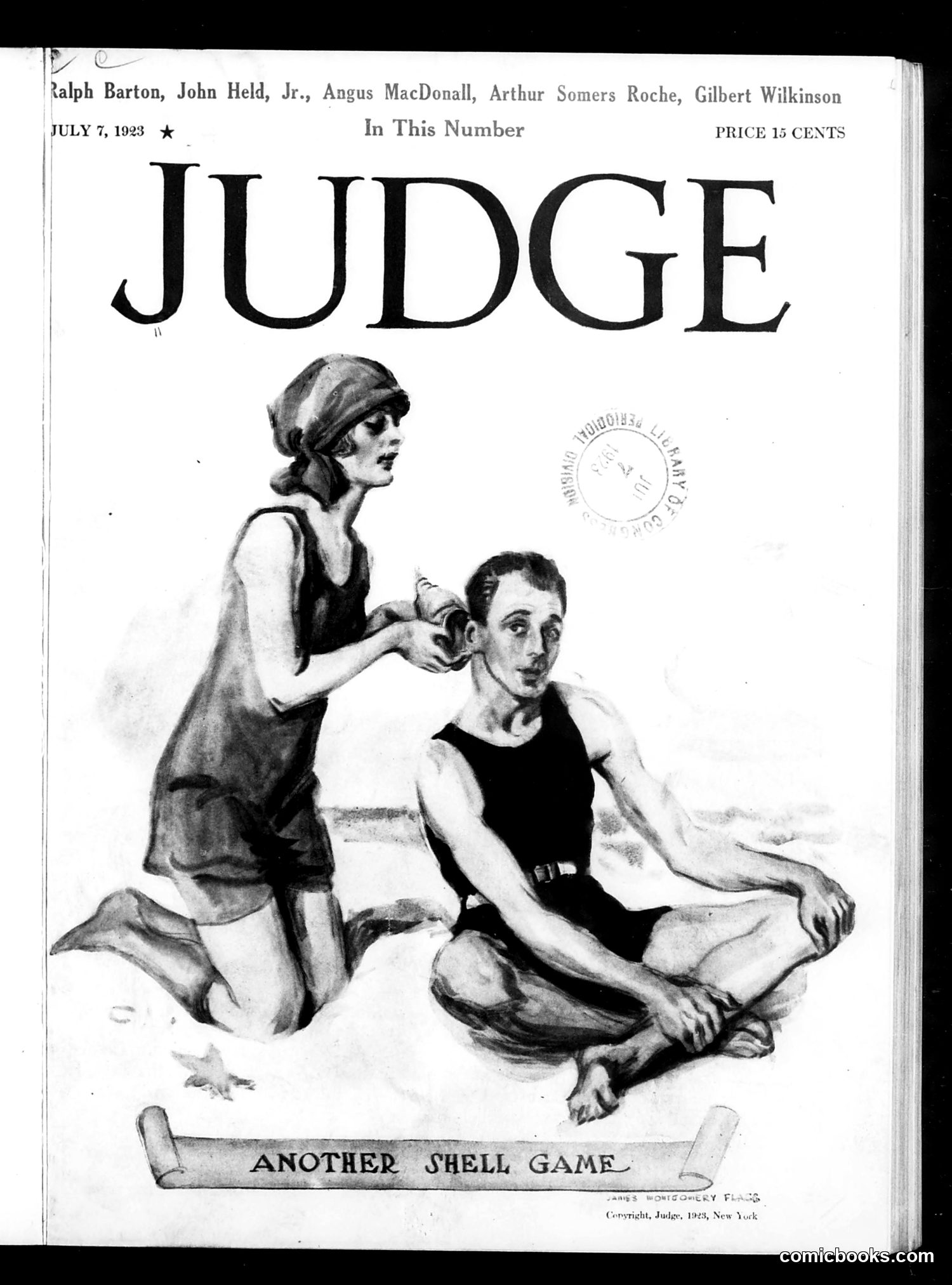
This cartoon satirizes political deception through the metaphor of a shell game—a con artist's trick where a hidden object moves between shells, fooling observers about its location. The illustration shows a woman (representing the public or a political constituency) attempting to follow a shell game operated by a man. The caption "ANOTHER SHELL GAME" suggests politicians are deceiving the public through misdirection and false promises. Without identifying the specific political figures depicted, the satire critiques what the magazine's editors viewed as political sleight-of-hand—politicians making promises or shifting positions to confuse or manipulate voters. This was a common Judge theme during the 1920s, when postwar disillusionment made Americans skeptical of political rhetoric.
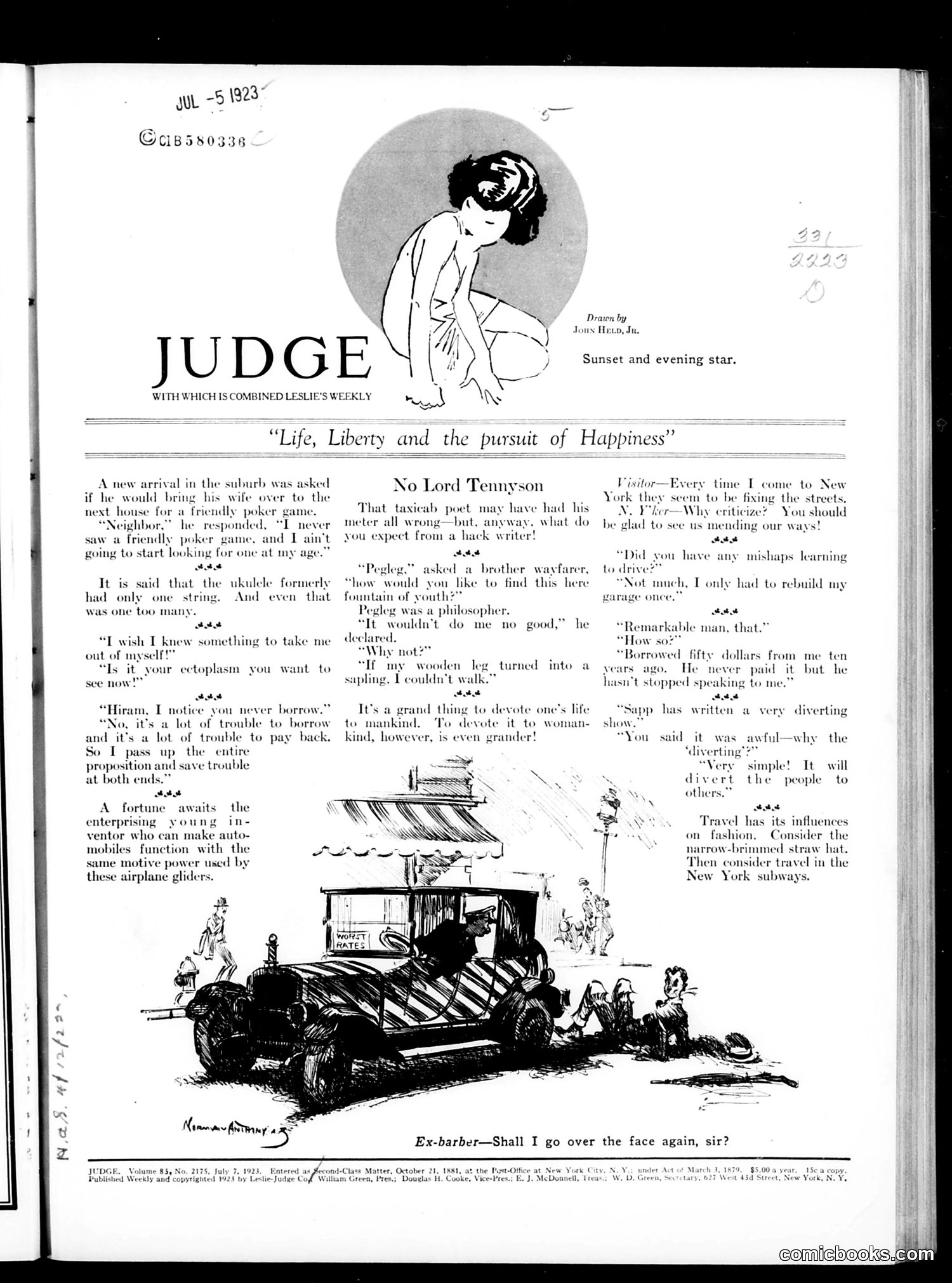
This page combines humor columns with a satirical cartoon about automobiles and their dangers. The main illustration depicts an old-fashioned car hitting a pedestrian, with the ex-barber's punchline: "Shall I go over the face again, sir?"—a dark joke equating the car's repeated impacts to a barber's razor strokes. The text columns mock various social pretensions: borrowing money without repaying it, devoting one's life to women (deemed less noble than philosophy), and travel fashion trends. References to "Lord Tennyson" and philosophical discussion suggest the magazine targeted educated, middle-class readers. The overall tone satirizes modern anxieties about automobiles (still relatively new in 1923), alongside timeless human follies like vanity and financial irresponsibility.
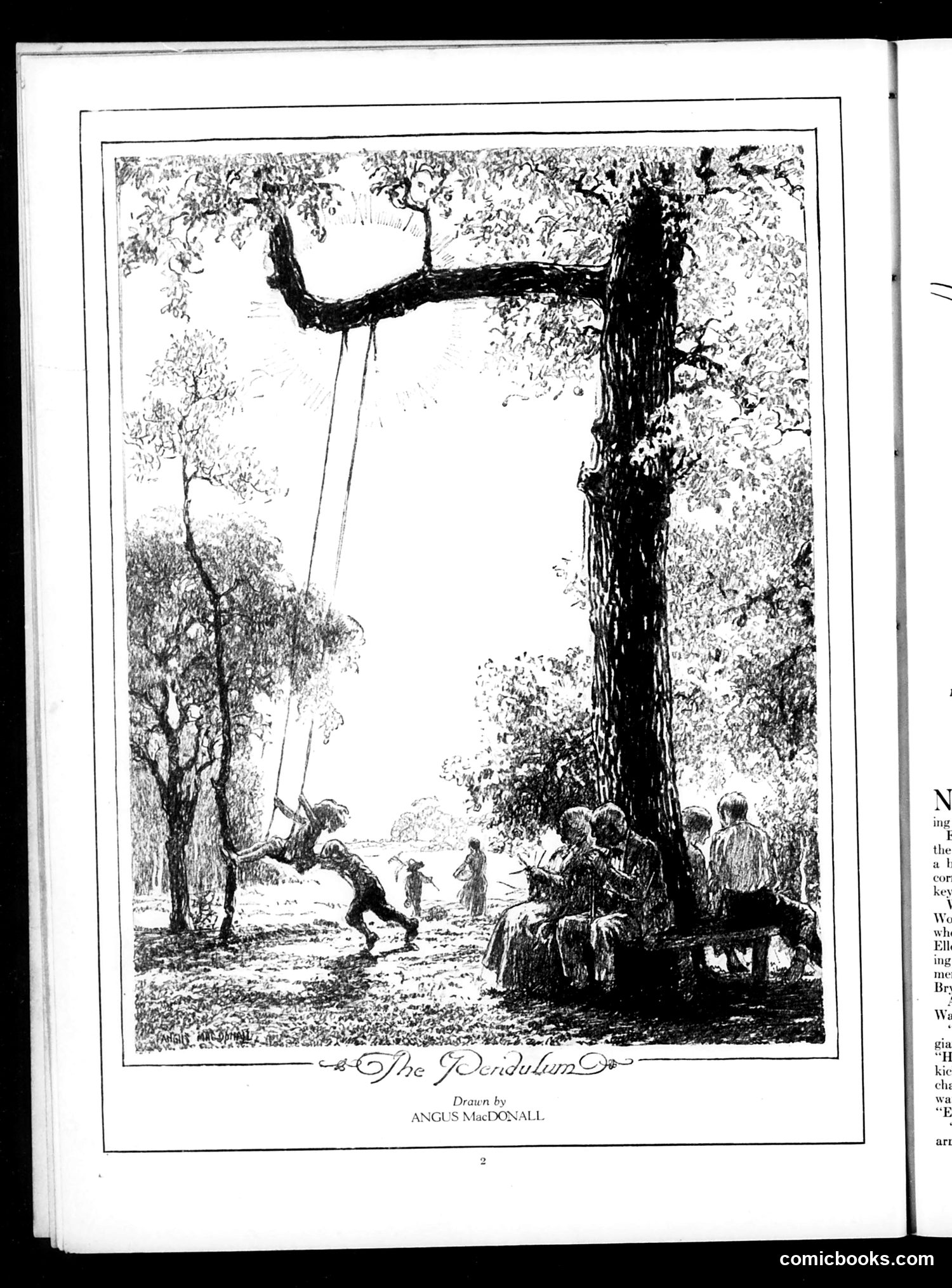
This illustration depicts a large tree swing set up in a forest clearing, with children and adults enjoying recreational activity. The title "The Pendulum" and the artistic style suggest this is likely a nostalgic or allegorical image rather than a direct political cartoon. Without additional context from surrounding text or page content, I cannot definitively identify what specific political or social commentary this illustration intends. The image could represent concepts of childhood innocence, natural recreation, social leisure, or possibly serve as a metaphor for cyclical patterns in society or politics—hence "pendulum." The OCR text provided contains no legible caption explaining the cartoon's meaning, limiting interpretation to visual analysis alone.
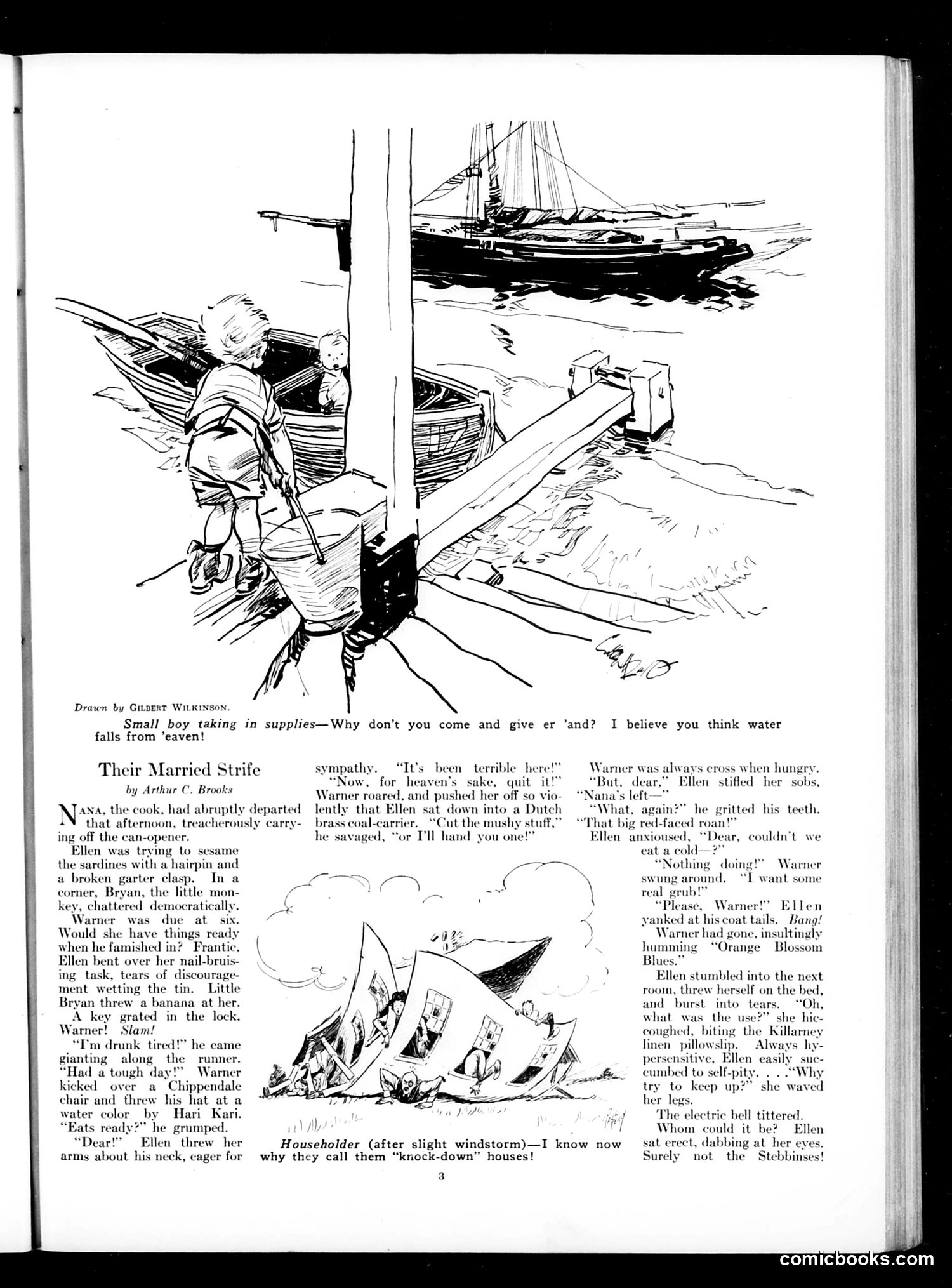
This story illustration depicts a domestic quarrel between a married couple named Warner and Ellen. Warner returns home drunk and angry about missing supplies, demanding Ellen provide water. Ellen, exasperated, responds sarcastically about their poverty and his behavior. The narrative shows Warner as irritable and domineering—he's "always cross when hungry," throws objects, and insults Ellen. Ellen appears long-suffering, though she pushes back verbally. The story illustrates working-class marital discord, with themes of poverty, alcoholism, and gender tension typical of early 20th-century domestic fiction. The accompanying illustration at bottom shows a "knock-down house" after a windstorm—a visual pun commenting on the couple's precarious domestic situation, both literally and metaphorically unstable.
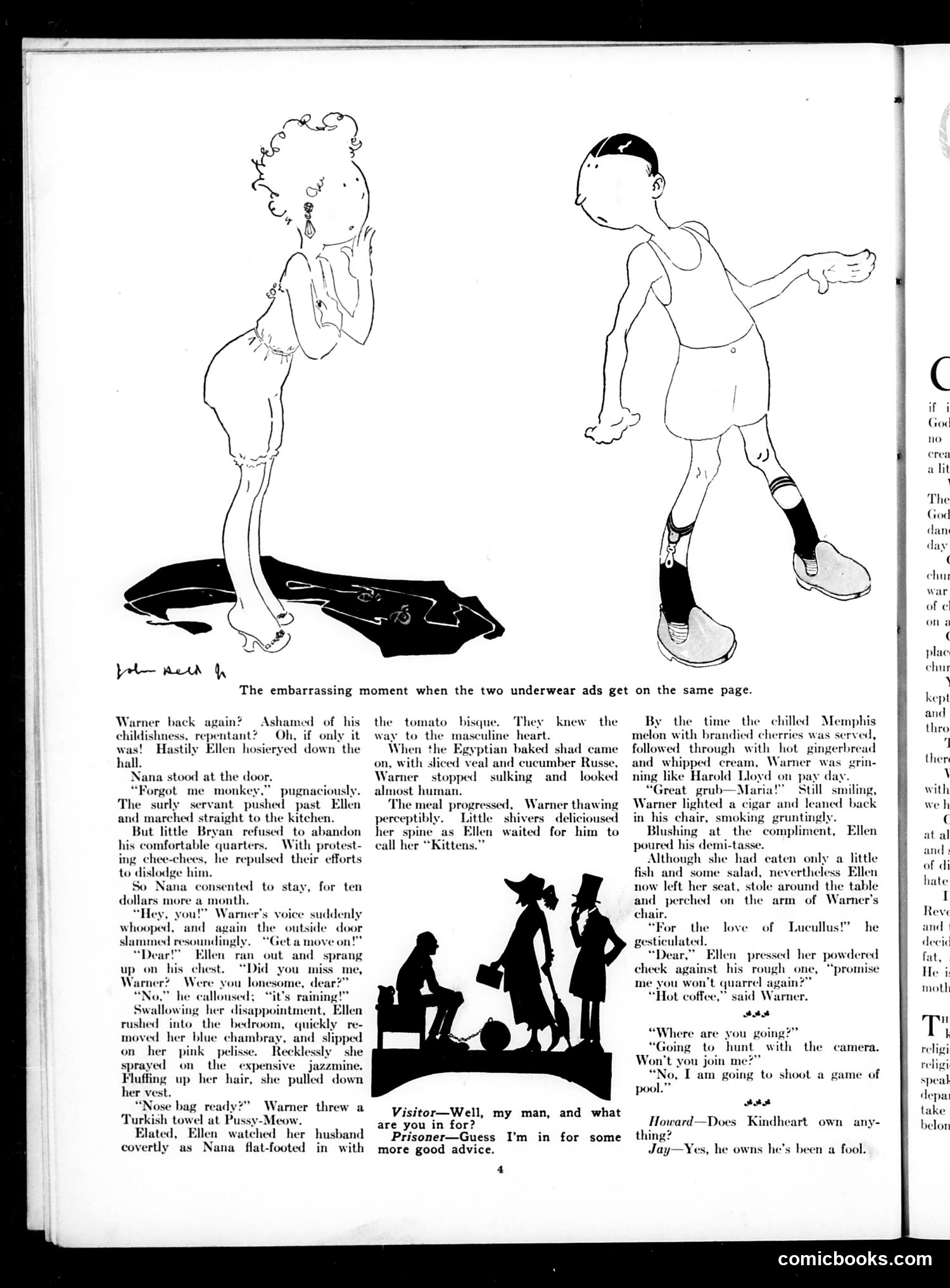
This page from *Judge* magazine contains two main elements: **Top illustration:** A satirical cartoon captioned "The embarrassing moment when the two underwear ads get on the same page." It shows two figures in minimal clothing—a woman on the left and a child on the right—appearing awkwardly exposed. This is visual satire about advertising juxtaposition and the absurdity of seeing multiple undergarment advertisements together. **Bottom section:** A narrative story with accompanying silhouette illustration about characters named Warner, Ellen, and Nana. The text concerns domestic matters—servants, household management, and marital relations. The dialogue discusses romantic and domestic mishaps, typical of *Judge's* humor focusing on upper-class social situations and relationship comedy. Both pieces target middle-to-upper-class audiences with humor about advertising, servants, and matrimonial awkwardness.
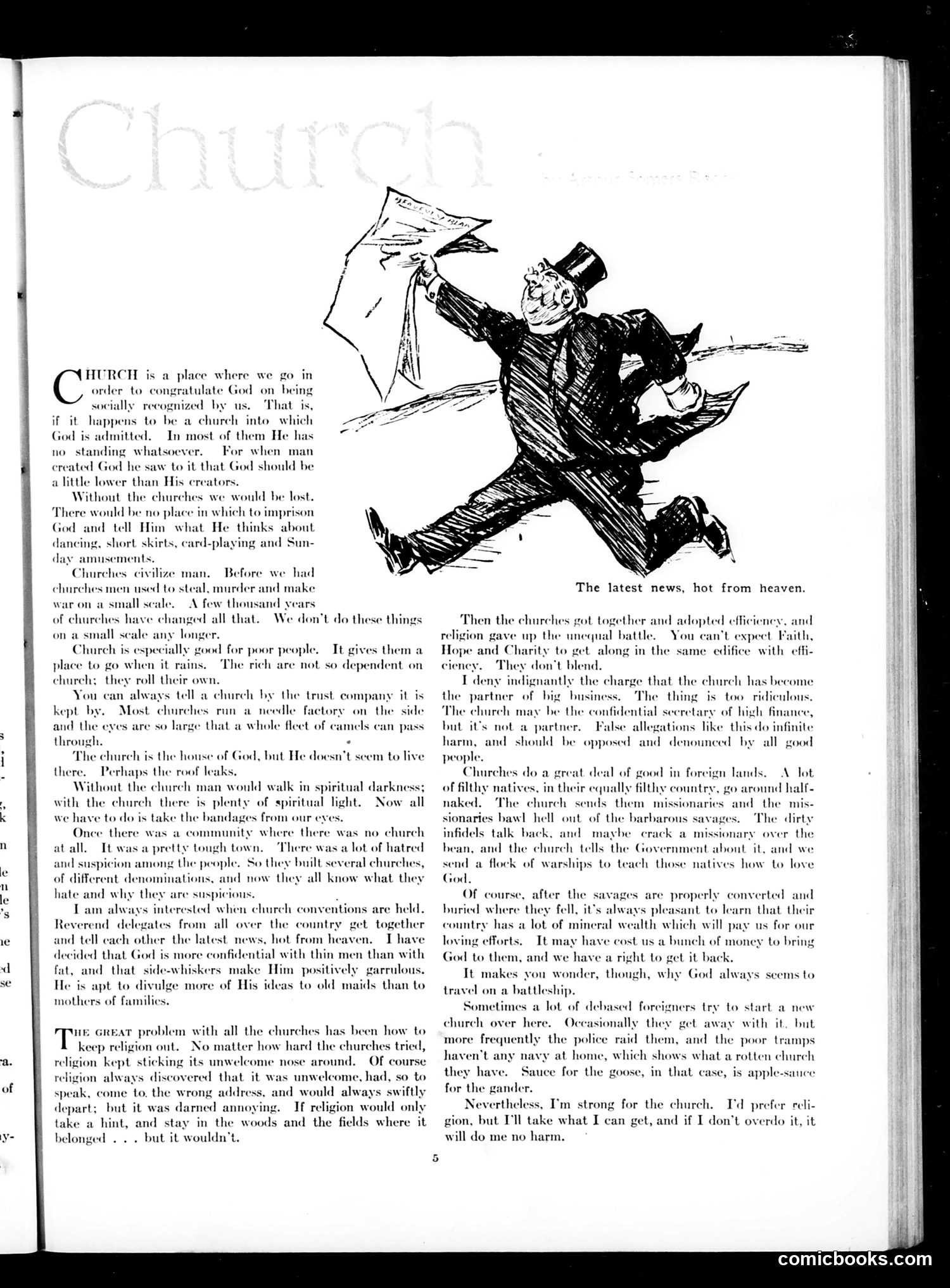
This satirical essay attacks American churches for hypocrisy and institutional corruption. The cartoon shows a well-dressed man (likely representing institutional religion or a church official) gleefully delivering "the latest news, hot from heaven"—a visual joke suggesting churches traffic in convenient divine messages. The text's key targets: churches that imprison God with arbitrary rules (dancing, short skirts), exploit poor congregants, operate as financial enterprises ("needle factory"), suppress genuine religion while claiming to promote it, and serve as "confidential secretary of high finance." The author particularly mocks missionary work, suggesting churches use foreign conversion as cover for colonial resource extraction and economic exploitation. The piece satirizes churches as socially useful only for controlling behavior and providing shelter to the poor, while actually serving wealthy interests and preventing authentic spirituality. The tone is bitterly ironic throughout—praising churches while describing their actual corruption.
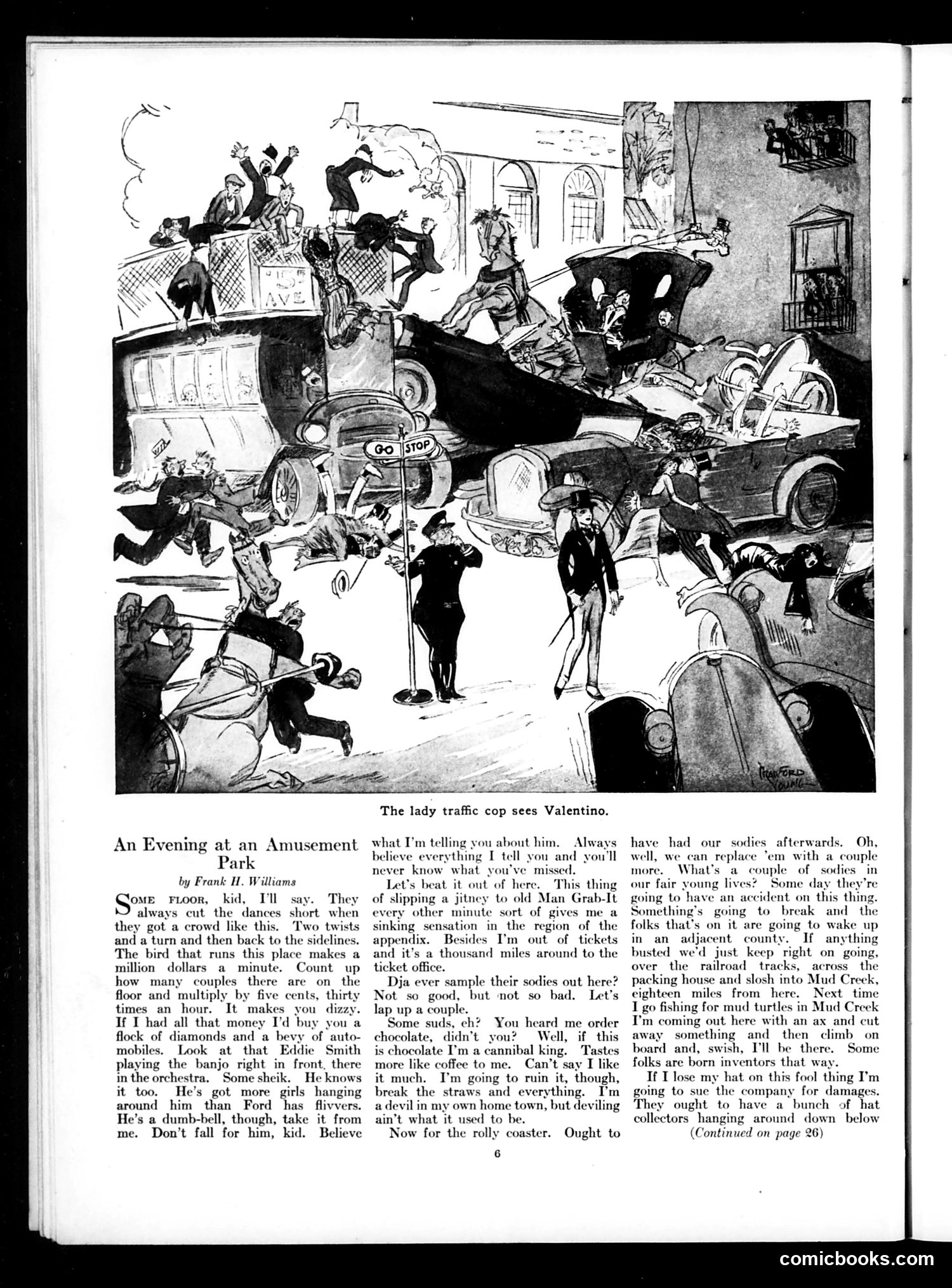
This is a humorous short story by Frank H. Williams depicting working-class visitors to an early 20th-century amusement park. The cartoon illustration shows a chaotic scene of automobiles, couples, and crowds at what appears to be a roller coaster or similar attraction. The narrative voice is a cynical man explaining the park's economics and attractions to a young companion ("kid"), mentioning the operator makes "a million dollars a minute" from dance floors and rides. He gossips about Eddie Smith, a popular banjo player with many admirers, calling him a "dumb-bell" despite his appeal. The story satirizes the narrator's own contradictions—he complains about poor-quality sodas while ruining them, jokes about causing accidents, and threatens lawsuits over lost hats. It captures period attitudes toward modern commercial entertainment, affordable leisure for ordinary people, and the somewhat reckless attitude toward safety at these early amusement venues.
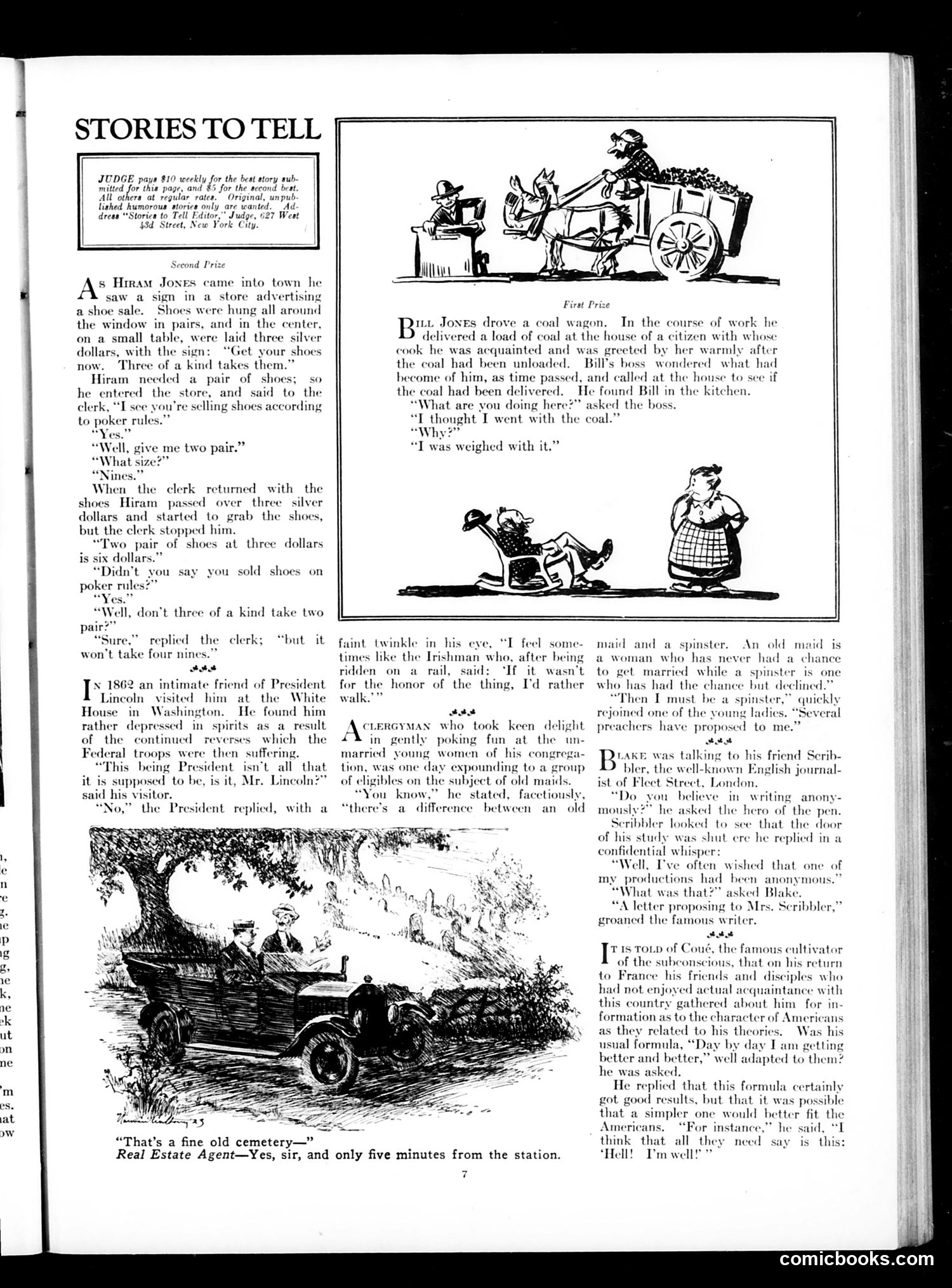
This page from Judge (a satirical weekly) contains several humor pieces typical of early 20th-century American magazines: **"Stories to Tell" Section:** A contest soliciting humorous anecdotes, with multiple brief stories illustrating wordplay and situational comedy—shoes sold by "poker rules," a Lincoln anecdote about the burdens of presidency, and stories about a coal deliveryman, a clergyman's distinction between "old maids" and "spinsters," and a writer's embarrassing anonymous letter. **The Cartoons:** Simple line drawings accompany stories—showing a coal wagon scene and a cemetery reference. These illustrate the narrative jokes rather than serving as political commentary. **Social Context:** The humor reflects period attitudes about class (domestic servants), gender (unmarried women), and politics (Lincoln's wartime stress). The Émile Coué reference at bottom suggests contemporary interest in the French "autosuggestion" self-help movement. **Overall:** This is light entertainment and humor, not political satire. The "joke" for modern readers is that the humor relies on now-dated social assumptions and wordplay.
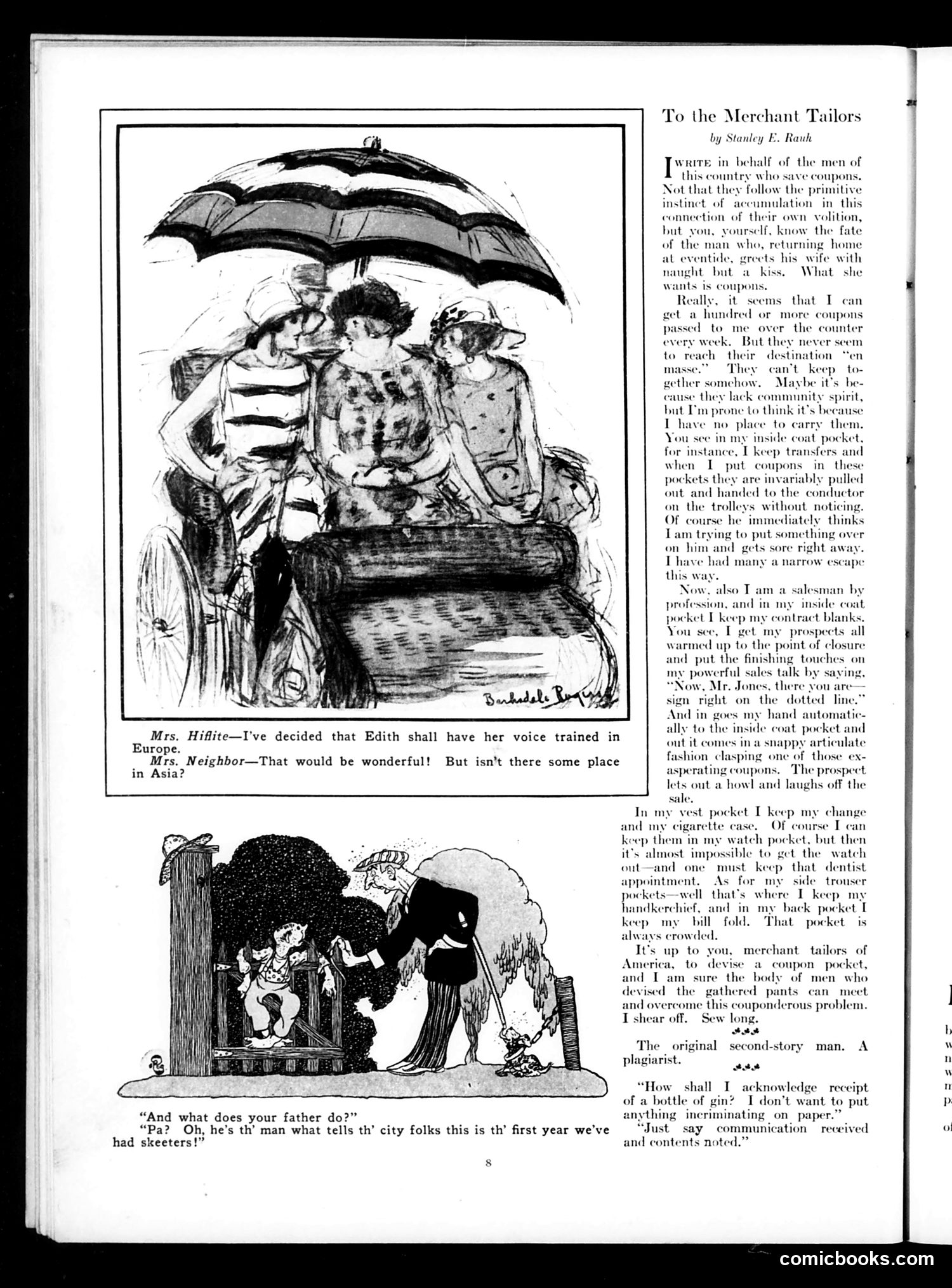
This page satirizes the proliferation of **trading coupons** that retailers distributed with purchases in the early 20th century. The author complains that while wives demand husbands collect coupons (apparently redeemable for premiums), men have nowhere to store them—coupons get lost in coat pockets, accidentally handed to trolley conductors, or fall out during business transactions, embarrassing the carrier. The satire targets **merchant tailors** directly: the author demands they design a dedicated "coupon pocket" into men's suits to solve this problem. The joke is that tailors have already innovated "gathered pants," so surely they can add one more practical feature. The cartoon above shows three people sharing an umbrella in rain—unrelated domestic humor about voice training in Europe. The bottom cartoon appears to be a separate joke about a "second-story man" (burglar) and avoiding incriminating written receipts for gin—a nod to Prohibition-era sensibilities.
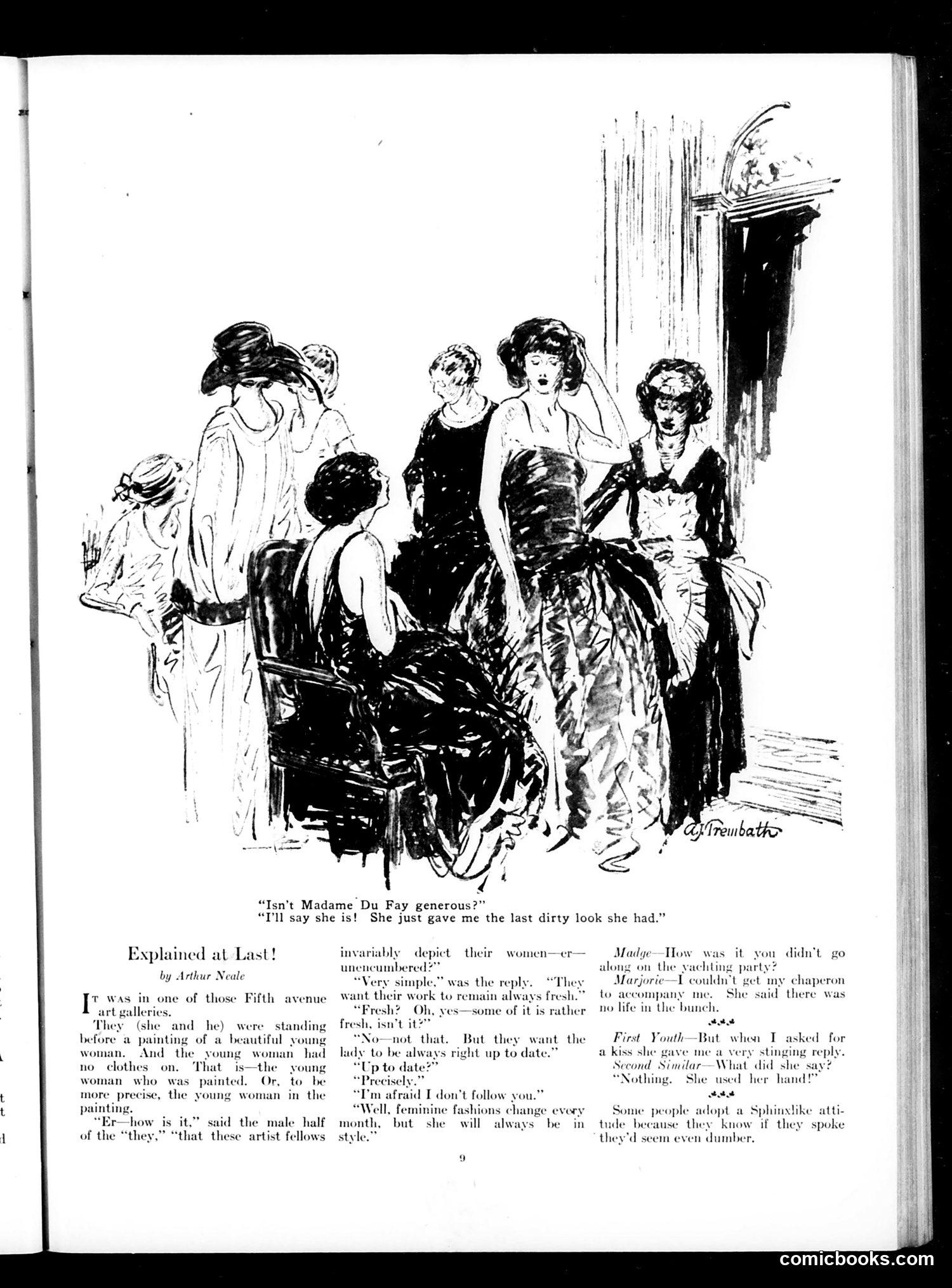
This page contains multiple satirical humor pieces targeting early 20th-century social conventions: **Main Cartoon (top):** A joke about artists painting nude female models. The satire mocks both artists' pretensions and fashion obsession: artists claim nudity keeps paintings "timeless," yet fashion-conscious women remain perpetually "up to date" regardless. The humor targets the hypocrisy of high-art justifications for depicting unclothed women. **"Madame Du Fay" Caption:** A woman gave another "the last dirty look she had"—suggesting women have limited supplies of hostile expressions, a gendered insult. **Smaller Jokes Below:** Social commentary on courtship and gender relations—women rejecting male advances, chaperon rules constraining young women's freedom, and the implication that silent women appear less foolish than those who speak. Overall, these pieces satirize artistic pretension, strict social conventions limiting women, and the awkwardness of courtship rituals in this era.
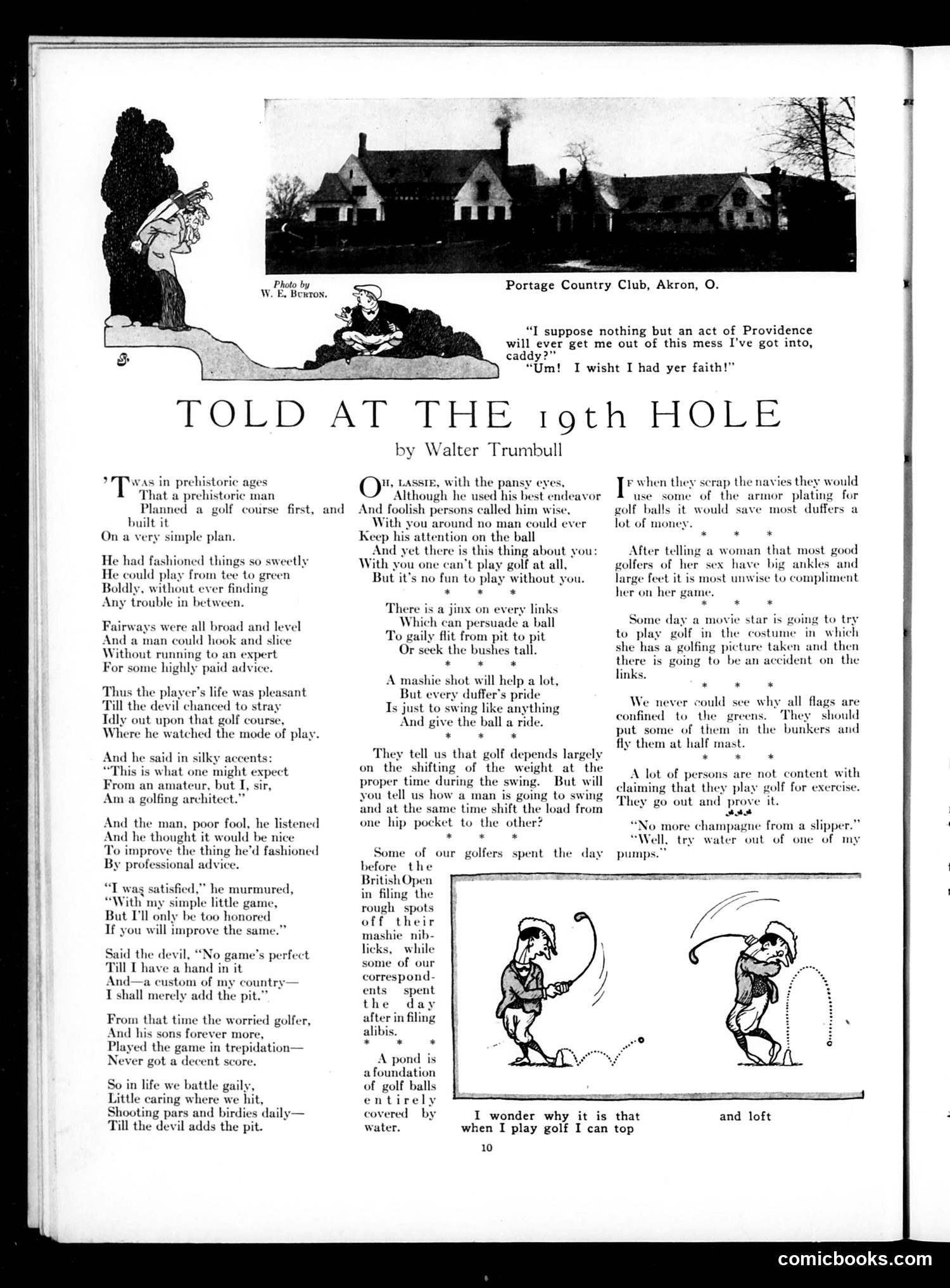
This page presents golf humor from the early 20th century. The main poem by Walter Trumbull uses an extended allegory: a prehistoric man creates a simple, enjoyable golf course, but the Devil persuades him to "improve" it by adding hazards (pits/bunkers). The moral is that life's complications stem from tampering with simplicity—a common satirical theme about modern society's obsession with "progress." The surrounding quips mock golfers' common complaints and pretensions: excuses about weight-shifting during swings, women golfers' ankles being criticized, the futility of trying to play while distracted, and the universal failure to hit decent scores despite improvements. The cartoons humorously depict golfers in various states of frustration. The overall satire targets not politics but golf culture itself—the sport's growing popularity and how it transforms amateurs into obsessive, anxiety-ridden players constantly seeking improvement while paradoxically performing worse.
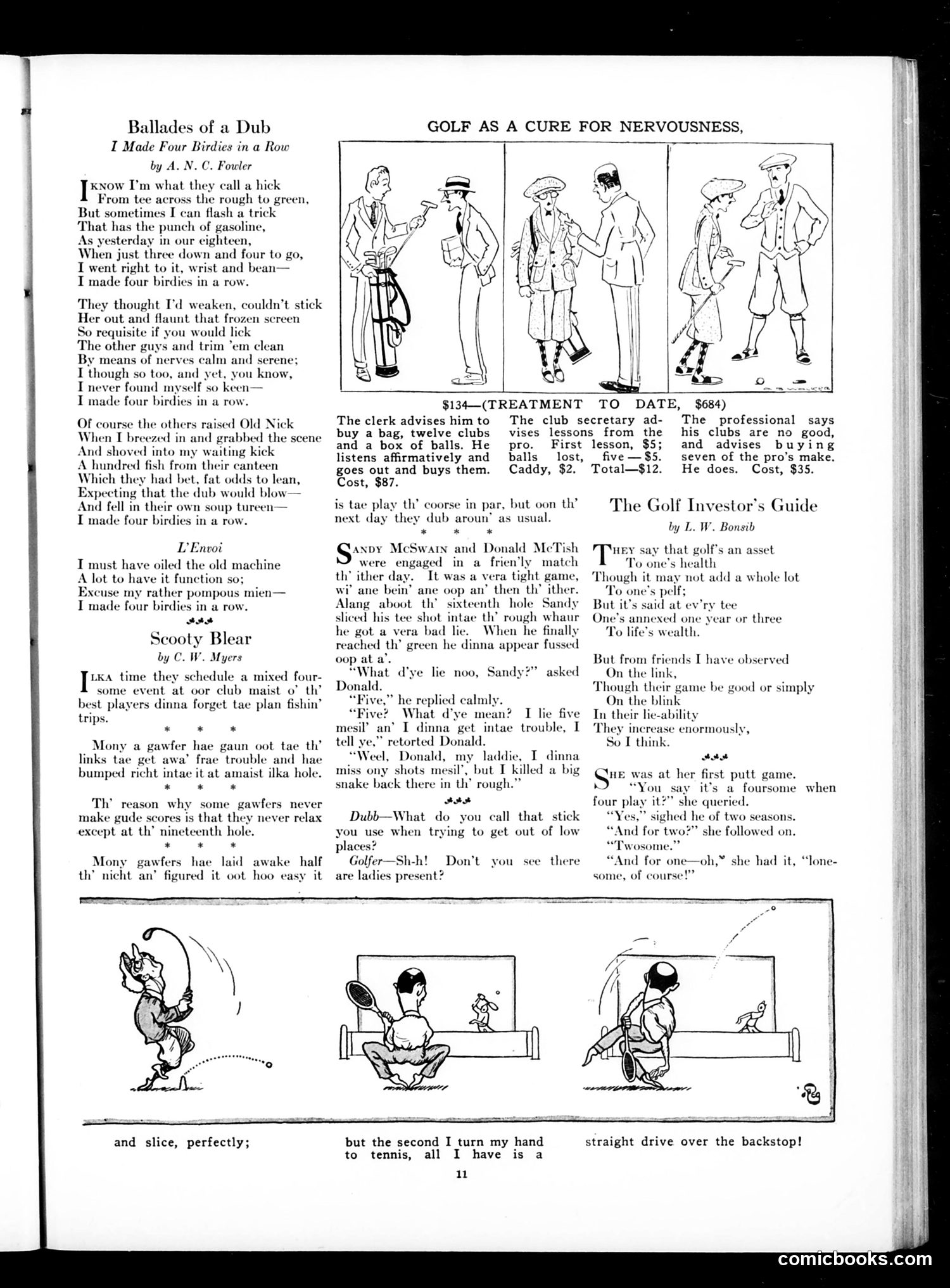
This page contains humorous verse and cartoons about golf's therapeutic value for nervous people. The main content includes: **"Ballades of a Dub"** and **"Scots' Blear"** — poems mocking amateur golfers who consistently play poorly despite effort. **"Golf as a Cure for Nervousness"** — a comic strip showing six panels where golf fails to calm an anxious person; he becomes increasingly agitated through the game. **"The Golf Investor's Guide"** — satirical verses suggesting golf supposedly improves health, but the author observes players actually "increase enormously" their frustration and drink. The cartoons at page bottom illustrate bad golf technique with humorous exaggeration. The satire's point: golf, despite claims of being therapeutic, actually frustrates players and makes them worse—not better.
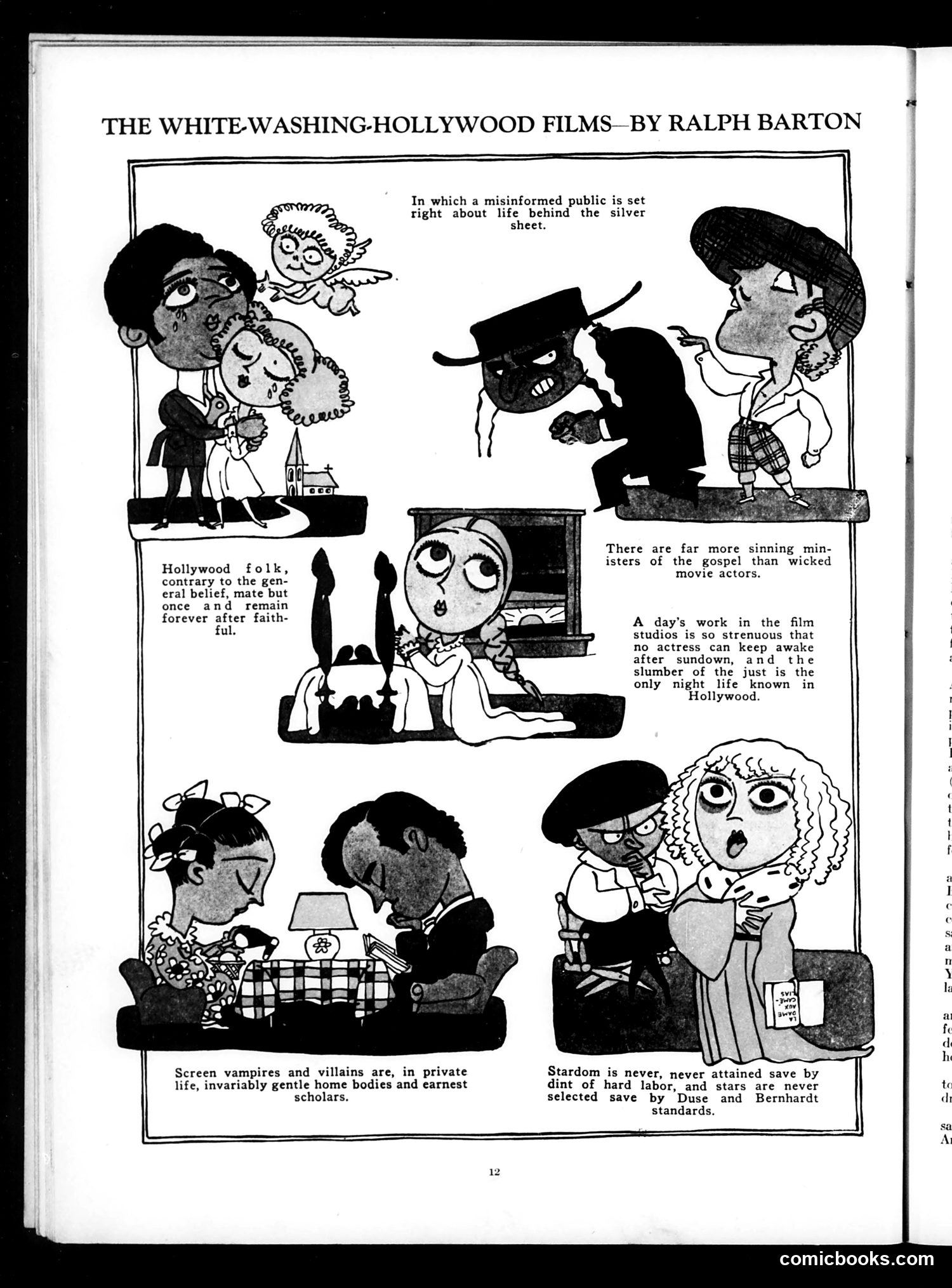
Ralph Barton's cartoon satirizes Hollywood's public relations efforts to rehabilitate the industry's scandalous reputation. During the 1920s, Hollywood faced moral criticism over actors' personal lives—divorces, affairs, and alleged decadence. The studio system responded with "whitewashing" propaganda. Barton's title announces his ironic purpose: he'll reveal the *truth* behind Hollywood's sanitized image. Each panel presents absurd counter-claims: that actors are monogamous, that film work exhausts actresses into virtue, that villainous actors are actually gentle scholars, and that stardom requires legitimate talent (referencing Eleonora Duse and Sarah Bernhardt, respected stage actresses). The caricatured figures represent generic Hollywood types rather than specific people. The satire mocks both the industry's laughable damage-control narratives and the "misinformed public" gullible enough to believe them—suggesting the public knows Hollywood is morally questionable despite official denials.
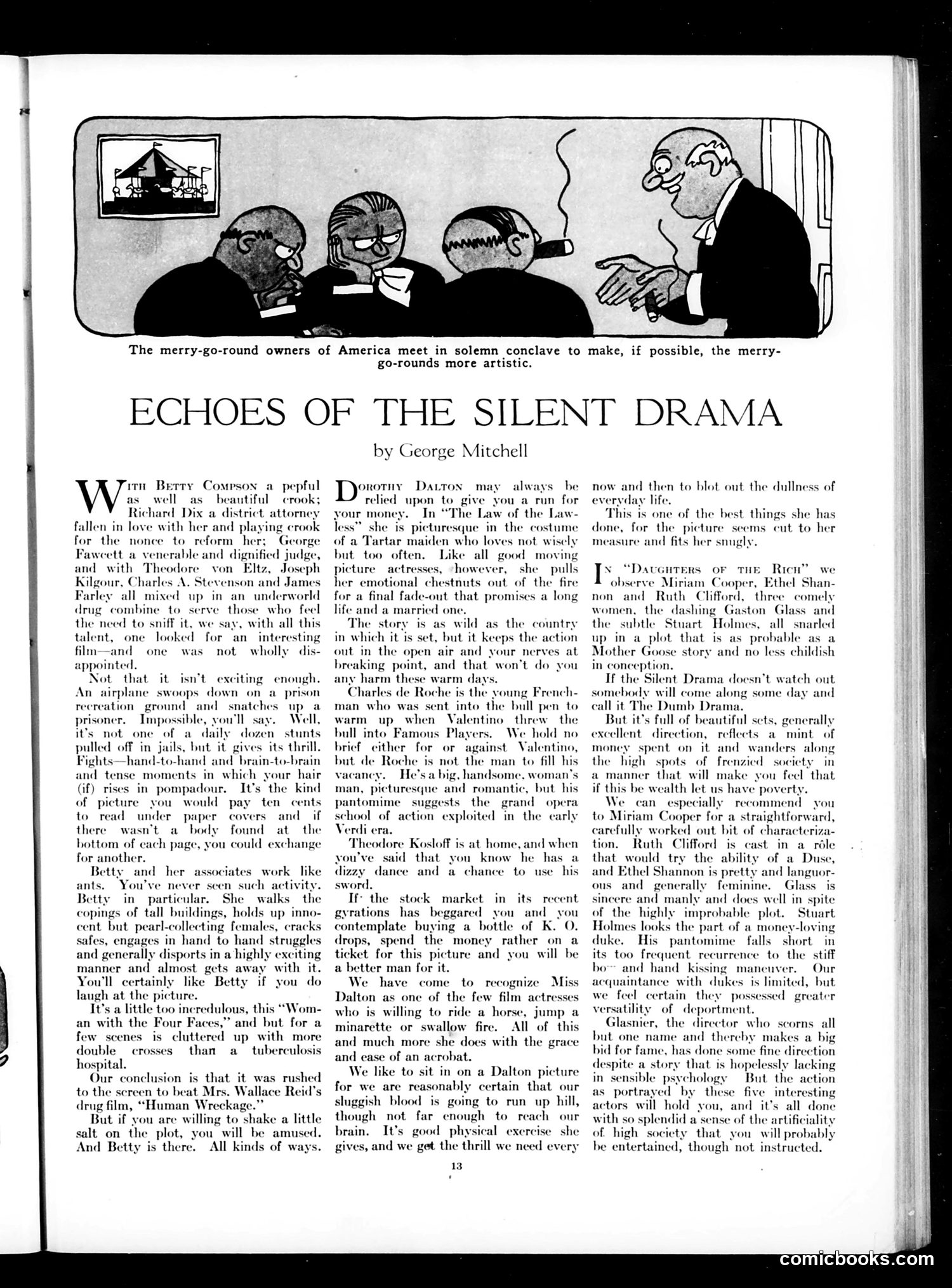
The cartoon at the top satirizes the merry-go-round industry's pretensions to artistic legitimacy. "Merry-go-round owners" (appearing to reference carnival/amusement operators) meet in formal business attire, solemnly discussing how to make their rides more "artistic"—a humorous juxtaposition of lowbrow entertainment with high-minded artistic ambitions. The caricatured figures suggest these are working-class businessmen trying to elevate their commercial enterprise beyond its practical purpose. Below this is a film review by George Mitchell discussing several silent movies, including works starring Betty Compton, Dorothy Dalton, and others. The review critiques these melodramas for their implausible plots while praising the actresses' physical performances and willingness to perform dangerous stunts. The satire targets the gap between artistic pretension and commercial reality—whether carnival operators or film producers, both seek respectability while remaining fundamentally entertainment-focused businesses.
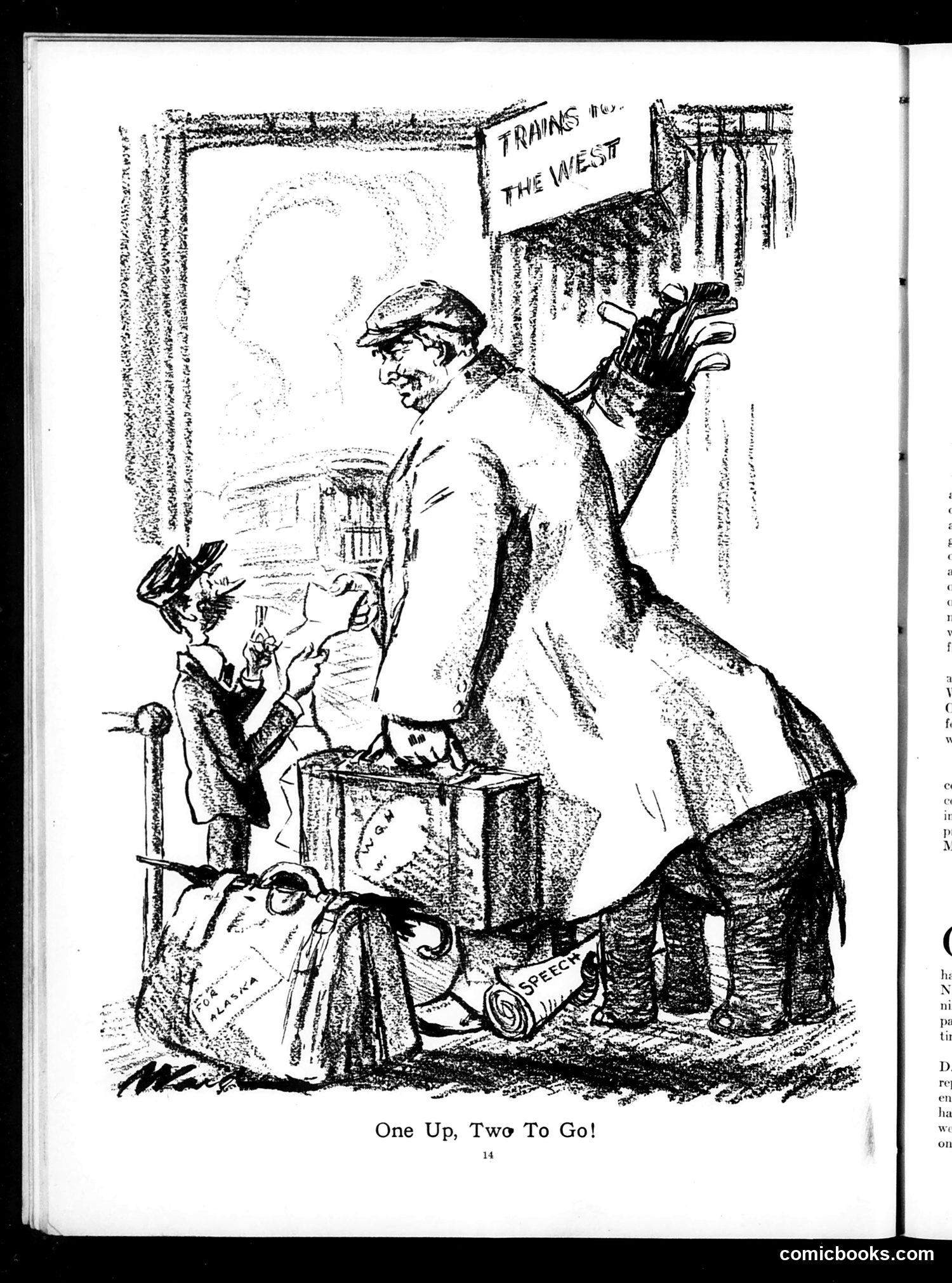
This cartoon shows a well-dressed traveler with luggage marked "SPECIAL" boarding a train bound for "The West," carrying what appears to be a large suitcase or trunk. The caption "One Up, Two To Go!" suggests this is the first of three planned westward journeys or departures. The satire likely comments on late 19th/early 20th-century western migration or emigration trends—possibly mocking a specific public figure or type of person relocating westward. The "special" luggage and deliberate phrasing about multiple trips implies either: - Someone repeatedly attempting western ventures - A satirical commentary on commercial or social movements westward - Possibly immigration or relocation patterns of the era Without additional context about the specific issue of *Judge* magazine, the exact target of ridicule remains unclear, though the implication is that multiple such departures are anticipated.
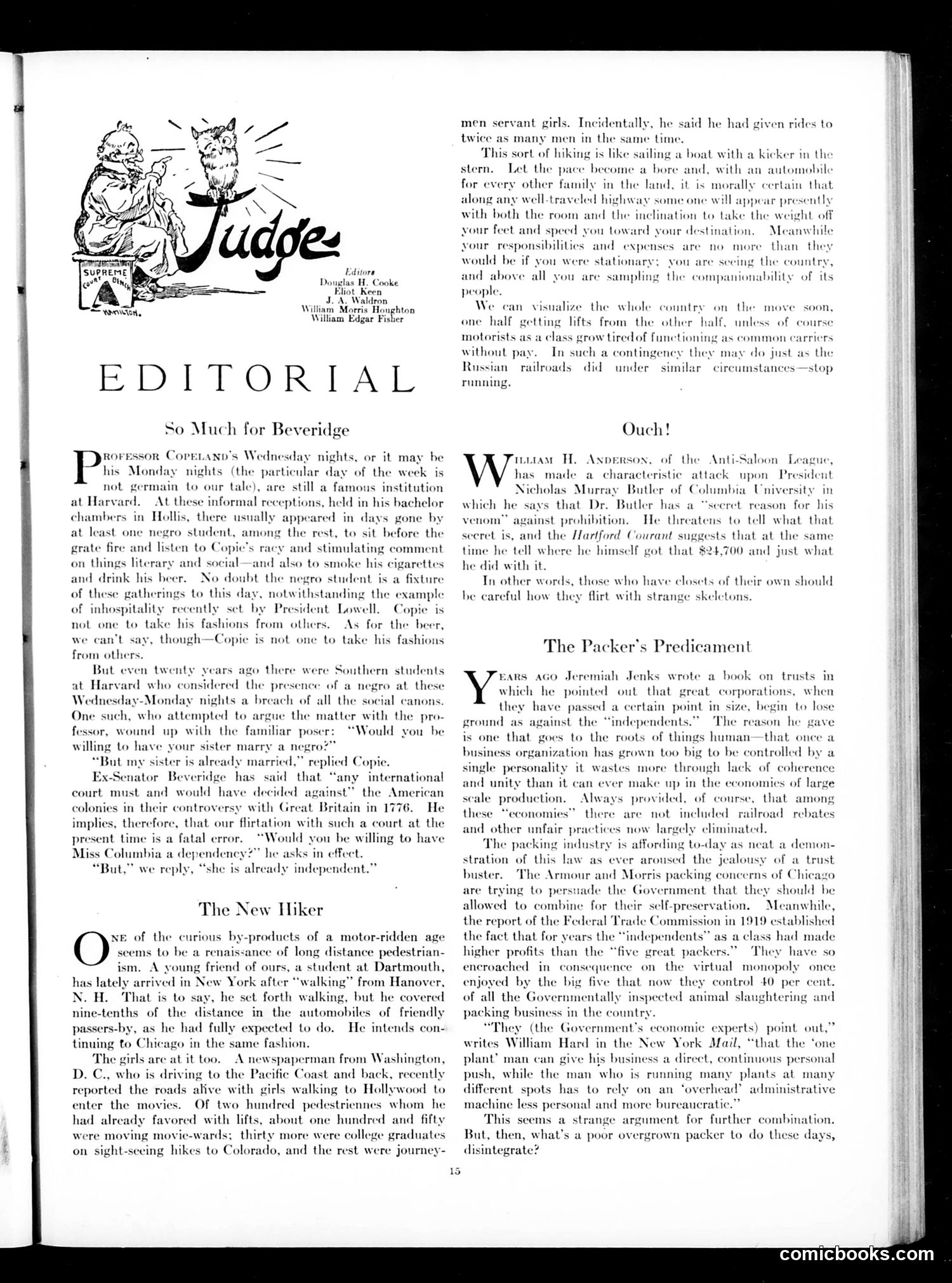
This page contains three editorials satirizing contemporary American issues circa 1910s-1920s. **"So Much for Beveridge"** mocks Ex-Senator Albert Beveridge's argument against an international court, using a reductio ad absurdum. Beveridge claimed such a court would have wrongly sided with American colonies against Britain in 1776. The editor retorts that America, like a grown woman, is now independent and needn't fear foreign judgment—unlike the dependent colonies Beveridge imagines. **"The New Hiker"** ridicules a fad of young people (particularly women) claiming to "walk" long distances to Hollywood or Colorado, while actually hitching automobile rides for most journeys. The satire suggests this hybrid travel mode—combining pedestrianism's romance with motorcar convenience—represents modern affectation. The closing joke warns that if this becomes widespread, motorists may refuse free rides, forcing society to regulate automobile travel like railroads do. Both pieces target contemporary social pretension and modern contradictions with gentle, witty criticism typical of *Judge*'s satirical approach.
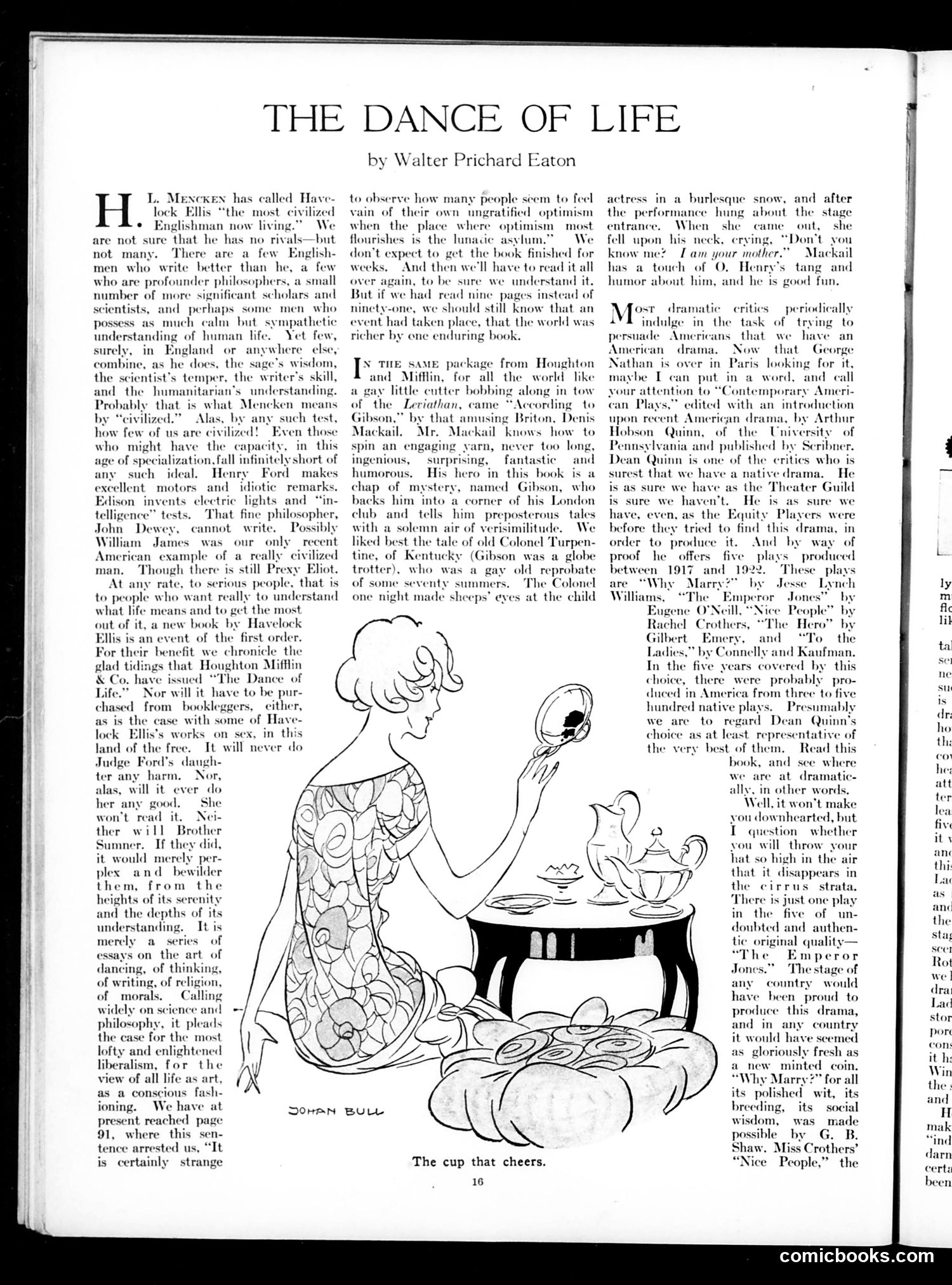
This page reviews Havelock Ellis's book "The Dance of Life," praising Ellis as perhaps the most "civilized" modern Englishman—combining wisdom, scientific rigor, literary skill, and human understanding. The author argues Ellis's work on art, philosophy, and morals is essential reading for serious people seeking life's meaning. The accompanying illustration by Johan Bull shows a woman at a table with tea—"The cup that cheers"—a genteel domestic scene befitting Ellis's philosophical work. The page also briefly reviews Denis Mackail's "According to Gibson," noting his talent for entertaining yarns told in London club settings, with humor reminiscent of O. Henry. The content reflects early 20th-century literary criticism valuing both intellectual rigor and accessible wisdom, while the magazine's stance embraces "enlightened liberalism" and viewing life itself as art.
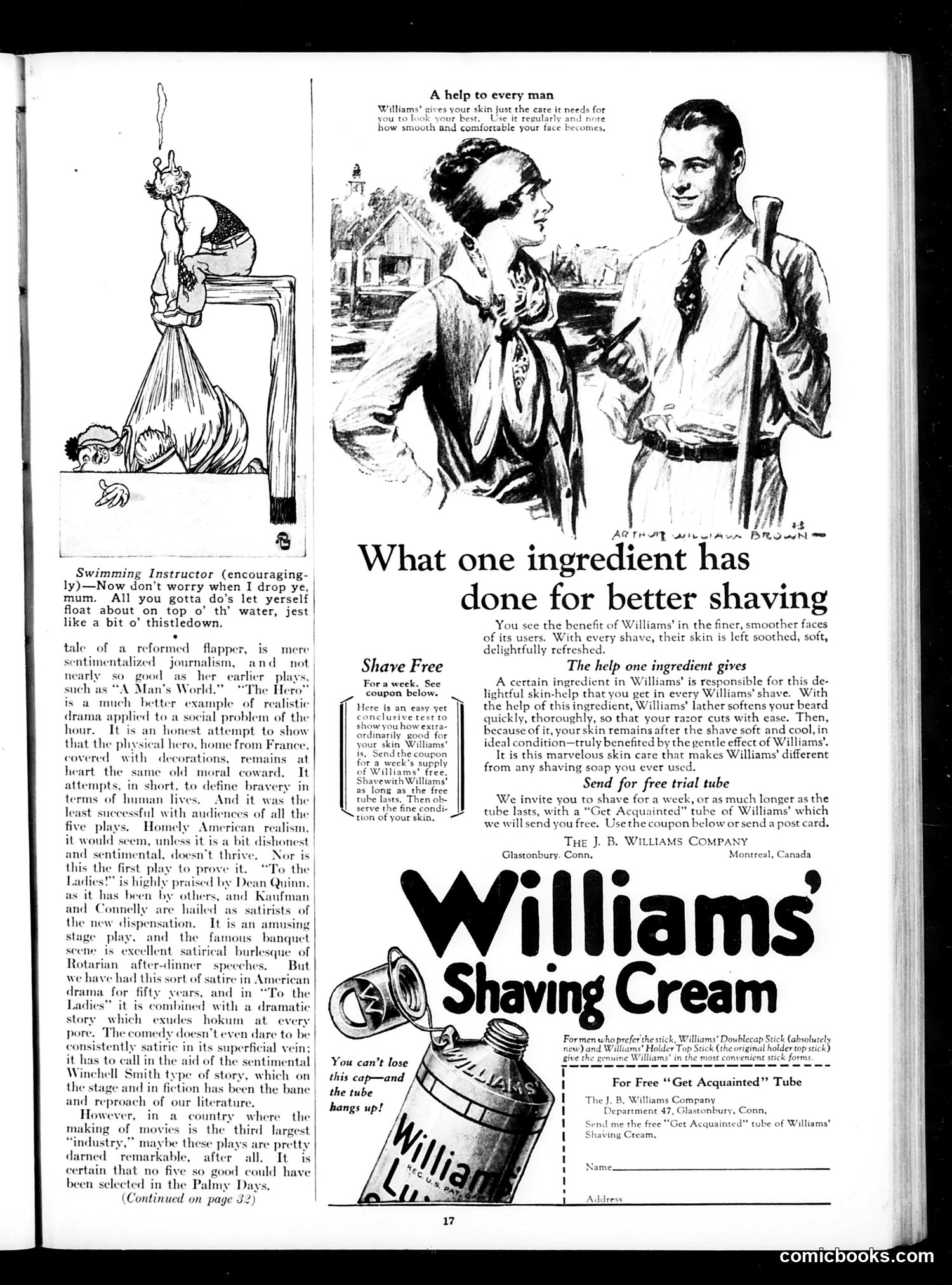
This page is primarily **advertising**, not political satire. The dominant content is a Williams' Shaving Cream advertisement featuring a couple discussing the product's benefits. The small cartoon at top left shows a "Swimming Instructor" encouraging a nervous woman with reassuring but condescending dialect humor—typical early 20th-century class-based comedy where working-class figures speak in exaggerated accents. The left column contains theater criticism (continued from an earlier page), discussing plays by women writers and commenting on American drama's preference for sentimentality over honest realism. The critic notes audiences reject pure satire unless mixed with emotional plot elements. The advertisement itself uses an idealized couple to promote one unnamed ingredient in Williams' cream that supposedly softens beard and soothes skin. A "free trial" coupon invites readers to test the product. The marketing appeals to masculine grooming standards and skin care benefits—positioning shaving as a desirable, modern practice requiring quality products.
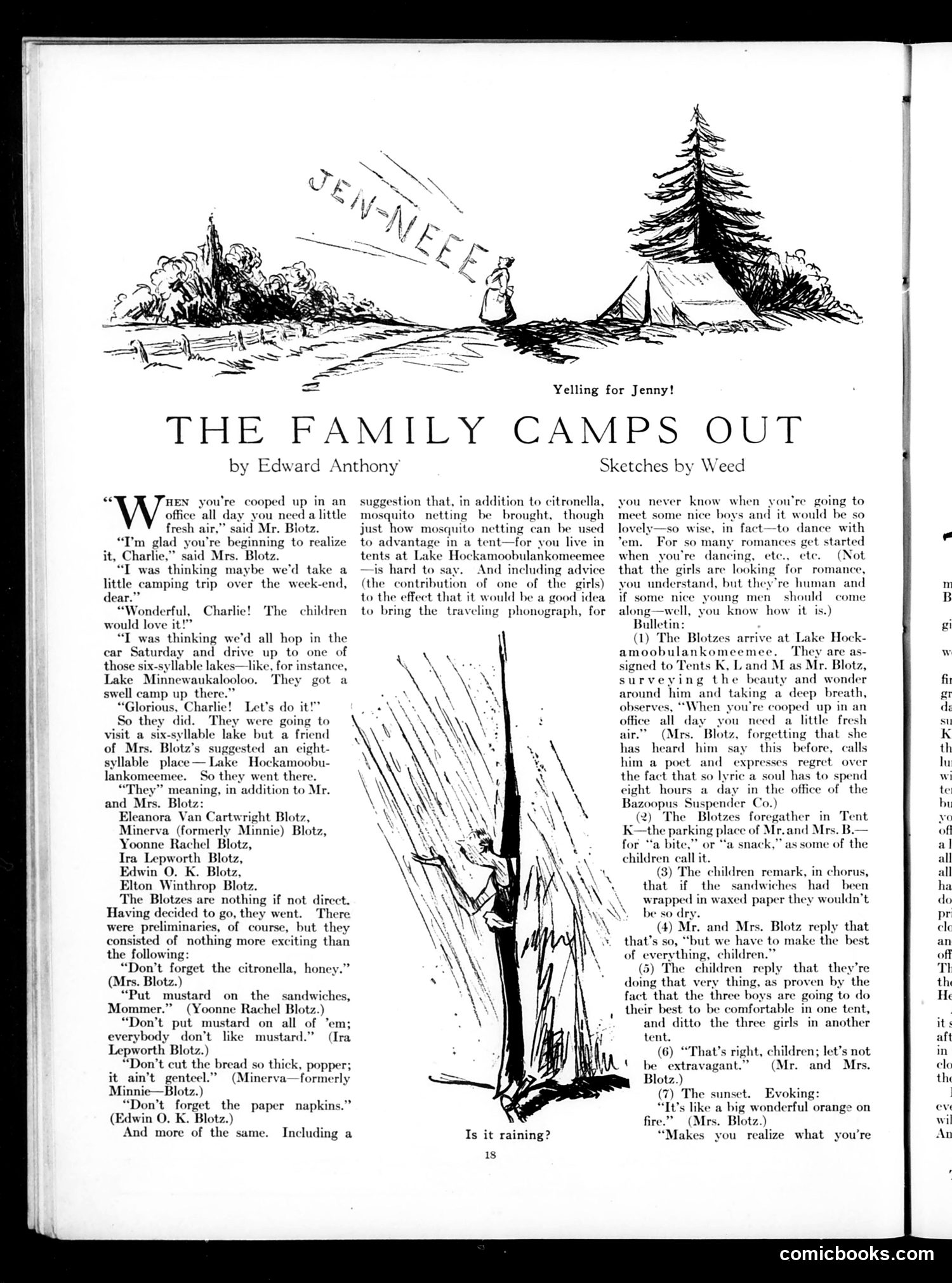
This is a humorous story illustrated with sketches, not political satire. It depicts the Blotz family's weekend camping trip to a humorously named lake ("Lake Hockamoobulankomeemee"). The comedy comes from contrasting Mr. Blotz's romantic idealization of camping—escaping the office for fresh air and nature—with the mundane reality of family logistics. The narrative catalogs the children's practical complaints (dry sandwiches, mosquitoes, cramped tents) and their unexpected romantic motivations (bringing a phonograph to "dance with nice boys"). The humor targets middle-class aspirations and family dynamics: well-intentioned parents versus children's priorities, verbose preparations masking simple camping, and the gap between pastoral fantasy and suburban reality. The sketches by "Weed" show the contrast between the scenic campsite and domestic chaos. This appears to be gentle, mainstream humor about American family life rather than political commentary.
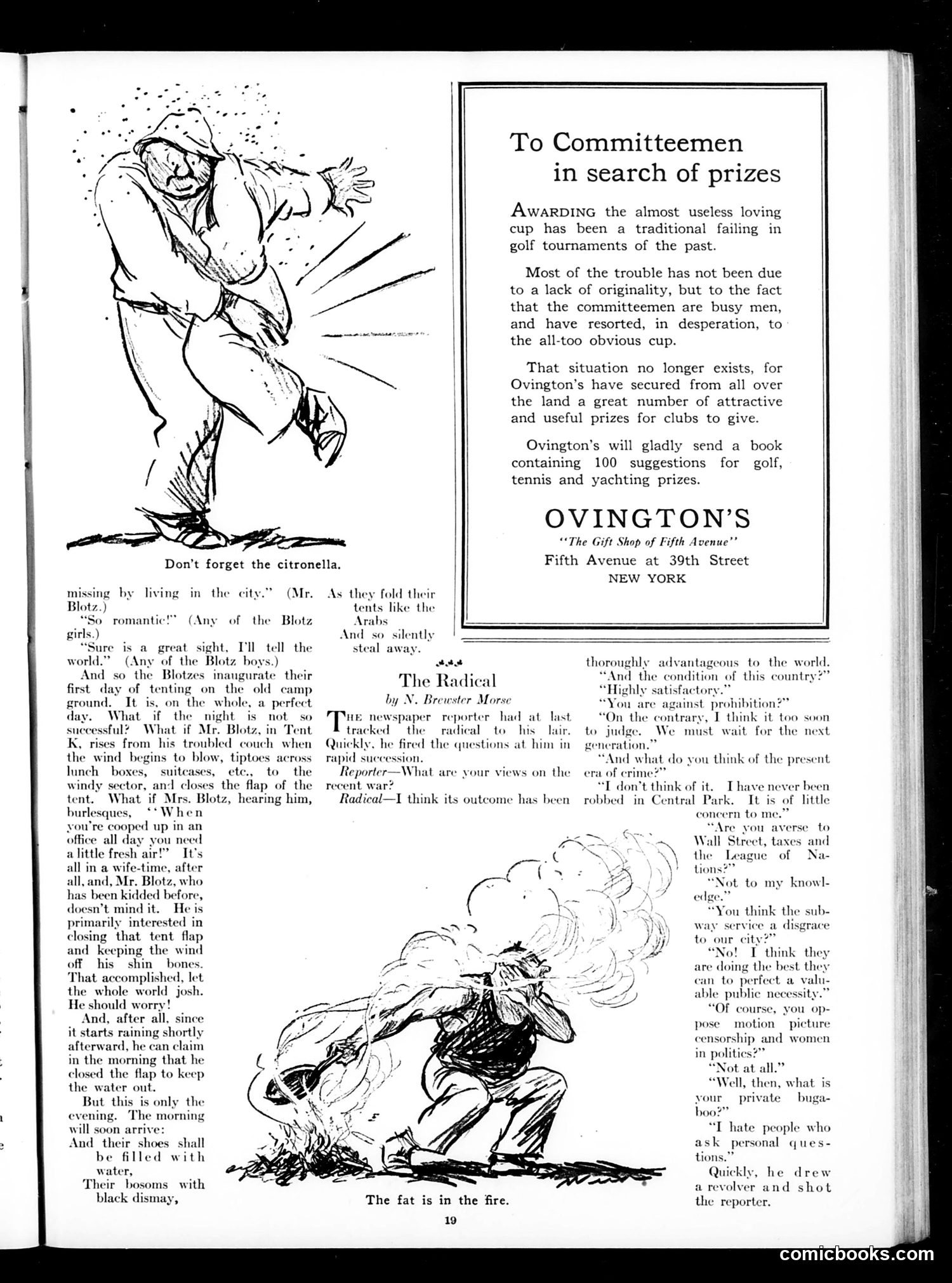
This satirical piece mocks radical political activists of the early 20th century. A newspaper reporter tracks down "the radical" to his lair and fires rapid-fire questions about contemporary issues: the recent war (likely WWI), crime, prohibition, Wall Street, the League of Nations, subway service, film censorship, and women in politics. The joke is that the radical—despite his supposedly principled stance—either has no consistent opinions or absurdly contradictory ones. When finally asked what his "private bugaboo" is, he reveals his only genuine passion: hatred of people asking personal questions. He then shoots the reporter. The satire targets radical activists as hypocritical, self-righteous ideologues with no real substance behind their rhetoric—more interested in performative outrage than actual positions. It's a common conservative critique of radicals as all bluster and no coherent philosophy.
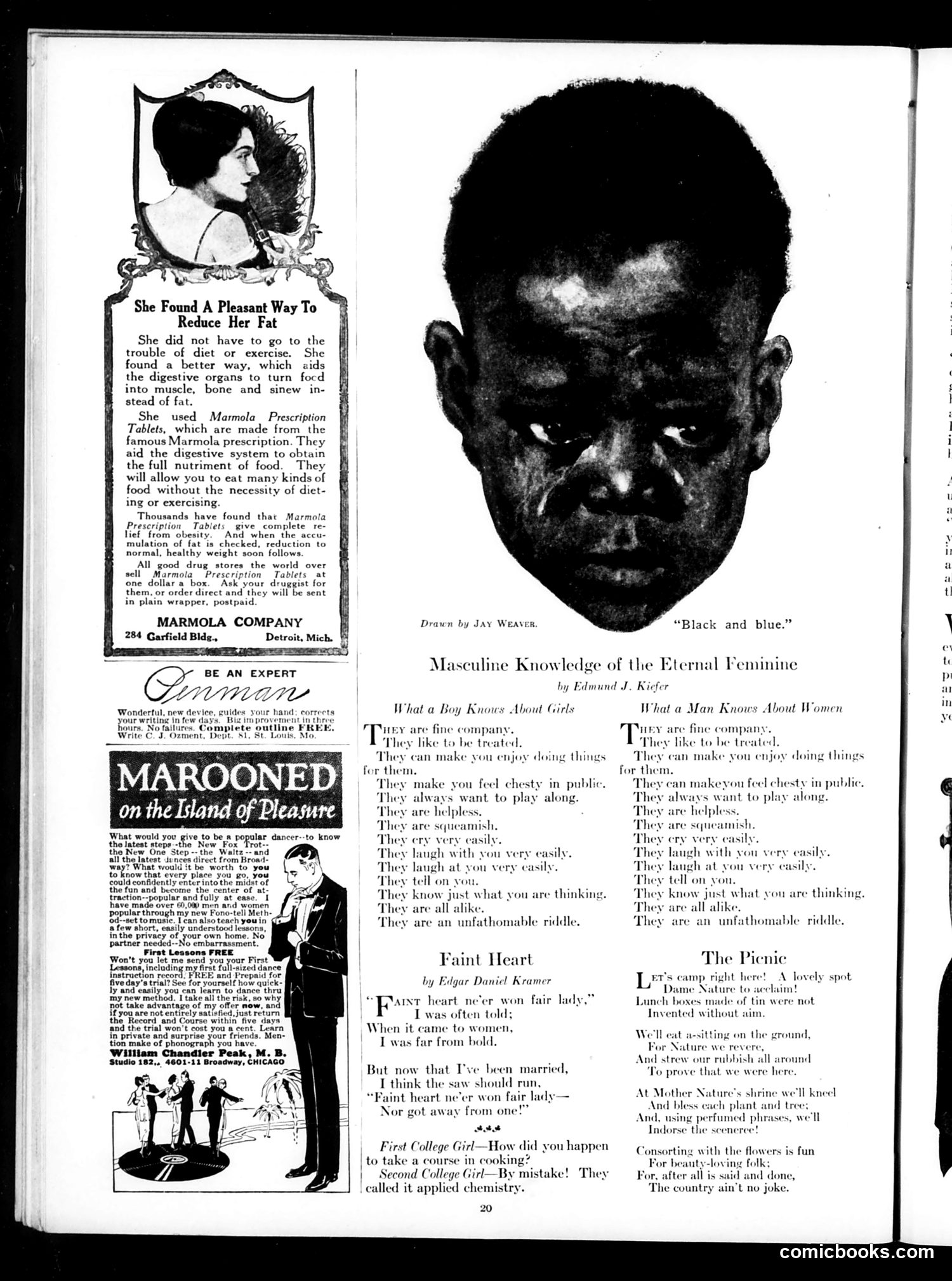
This page mixes advertisements with satirical poetry about gender relations, typical of early 20th-century Judge magazine humor. **The Advertisements:** Top and left feature patent medicine ads (Marmola tablets for weight loss, a dance instruction course) — common exploitative advertising of the era. **The Main Satire:** "Masculine Knowledge of the Eternal Feminine" by Edmund J. Kiefer presents parallel lists of what boys versus men claim to know about women. The joke is that despite apparent differences in perspective, both lists are identical — suggesting men of all ages hold the same superficial, contradictory stereotypes about women (helpless yet scheming, alike yet incomprehensible). **The Poems:** "Faint Heart" jokes that marriage traps men. "The Picnic" satirizes nature enthusiasts who claim to revere the outdoors while littering. The portrait labeled "Black and blue" (drawn by Jay Weaver) likely illustrates marital discord, supporting the "Faint Heart" theme.
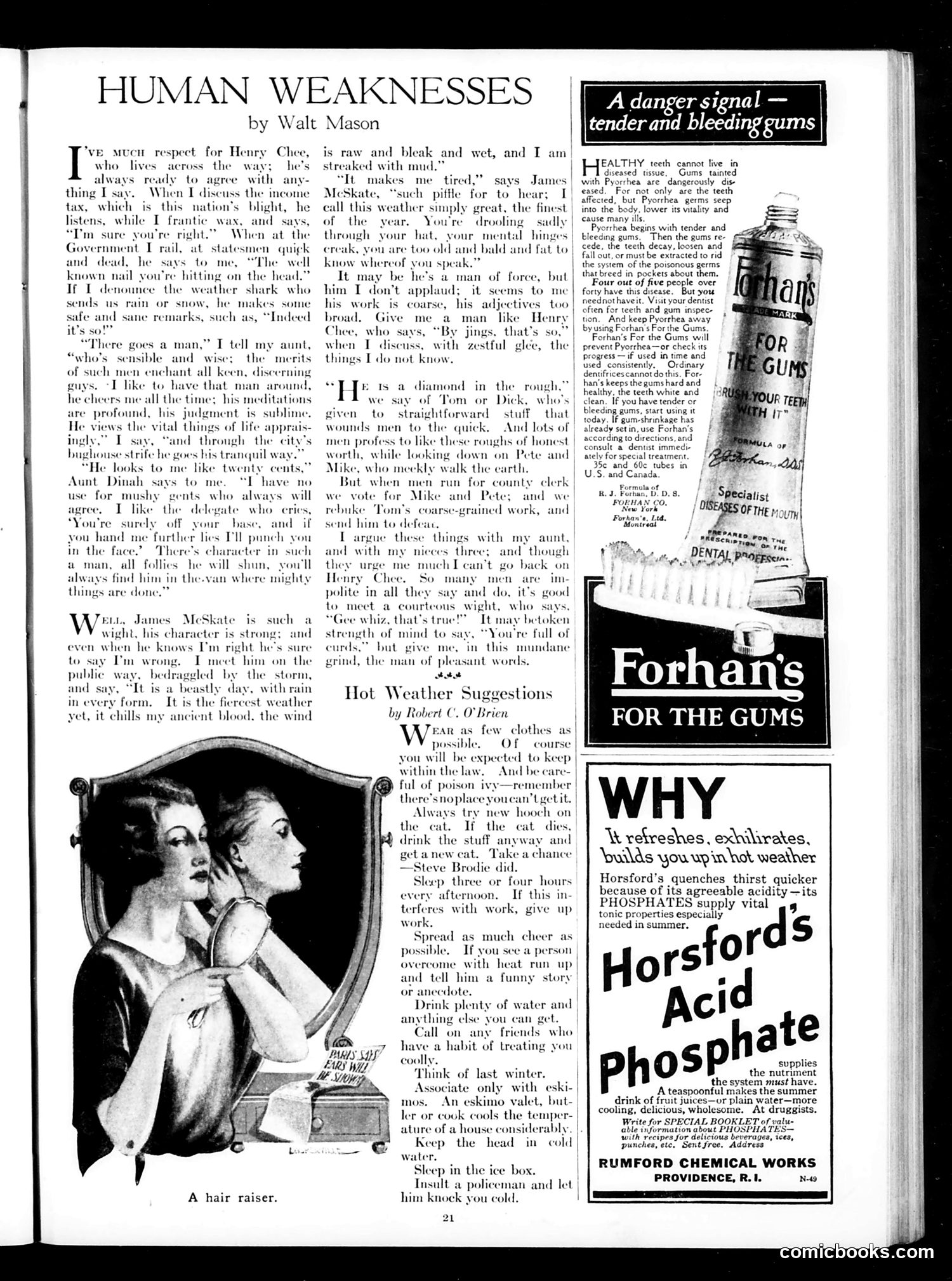
This page contains two distinct pieces of social commentary: **"Human Weaknesses" by Walt Mason** (main essay): A satirical critique of contradictory human behavior. Mason contrasts two men: Henry Chee, who agreeably accepts everything the narrator says (even obvious falsehoods), versus James McSkate, who reflexively disagrees with everything. The satire exposes how we praise opposite traits depending on context—we value courteous agreement in daily life, yet reward combative strength in politics (voting for the "coarse" Tom over meek Mike). The piece mocks our inconsistent values. **"Hot Weather Suggestions" by Robert C. O'Brien**: A humorous advice column offering deliberately absurd summer tips (test new alcohol on your cat; sleep during work; befriend Eskimos to cool your house). This is mock-serious humor—clearly impractical recommendations presented as genuine advice. **Advertisements**: The page includes period ads for Forhan's gum treatment and Horsford's Acid Phosphate drink, typical of Judge's revenue model. The illustration shows two women—likely representing vanity or social pretension ("A hair raiser").
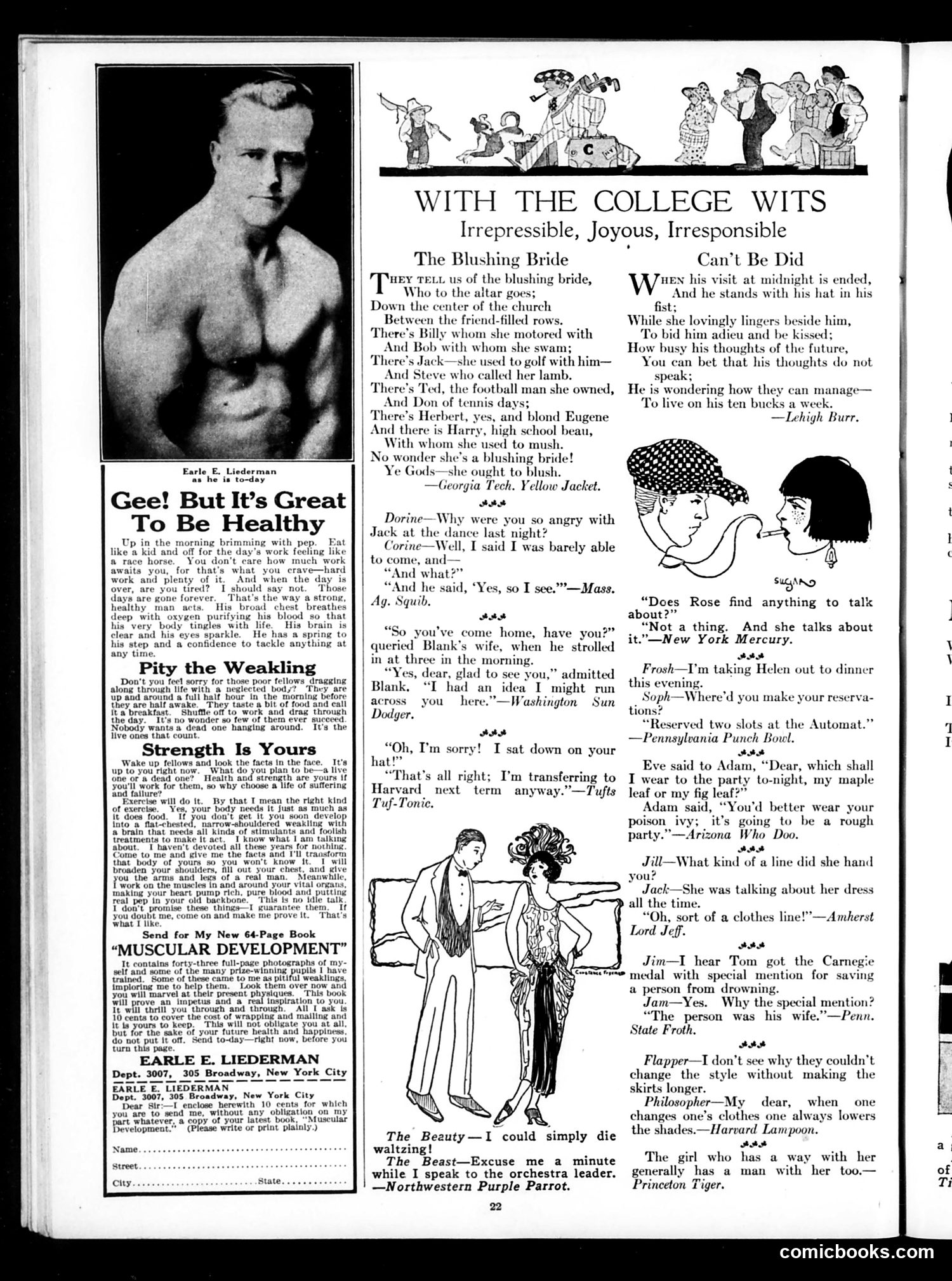
This page combines a health advertisement with college humor. **Left side:** Earle E. Liederman's muscular development ad promotes physical fitness to young men, emphasizing the contrast between "healthy" strong men and pitiful "weaklings." This reflects early 20th-century bodybuilding marketing that equated masculinity with muscularity. **Right side:** "With the College Wits" presents humorous anecdotes about college life and romance. The jokes target: - Young women's dating habits ("The Blushing Bride" lists multiple suitors) - Male courtship awkwardness and presumption - The casual rudeness of college men toward women - Dating etiquette violations The humor assumes a college-educated, probably male audience familiar with campus social dynamics. The overall tone is light mockery of both genders' romantic mishaps, typical of 1920s-era magazine humor. The pairing with bodybuilding ads suggests the target demographic: young men concerned with health, fitness, and social success.
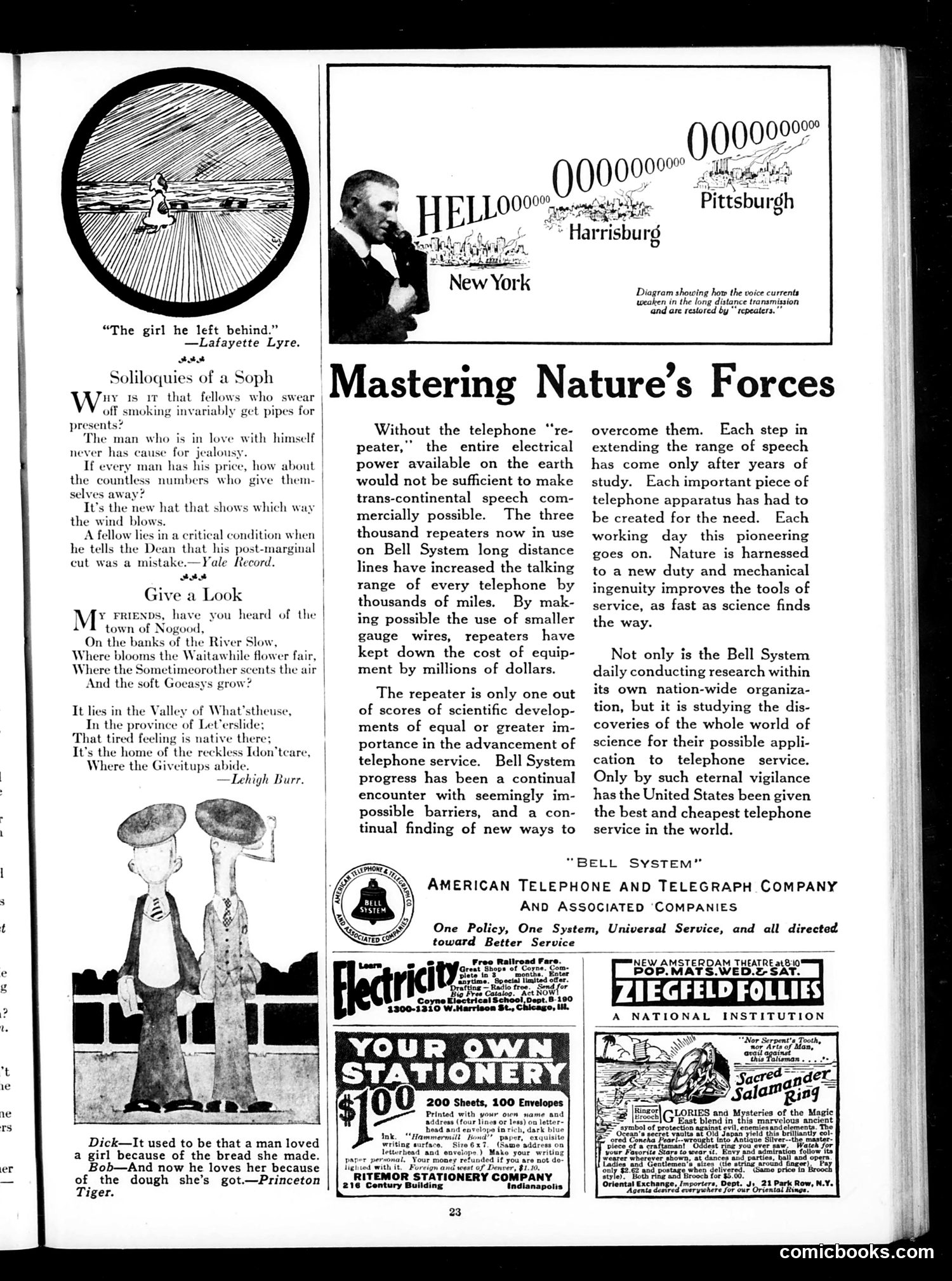
This page contains primarily **advertising and filler content** rather than political cartoons. The main elements are: **"Soliloquies of a Soph"** and humor columns: Brief witticisms about college life and romance, typical of Judge's light satirical fare. These make contemporary social observations (jealousy, hat fashions, propriety) rather than political statements. **"Mastering Nature's Forces"**: A substantial **Bell Telephone System advertisement** disguised as editorial content, promoting the technological achievements of long-distance telephony and "repeaters" that amplify signals. It positions Bell as scientifically progressive and serving the nation. **The cartoons**: Small illustrations accompany the humor pieces—one circular vignette about romantic separation, another showing two figures in conversation. **Additional ads**: For stationery, theatrical productions, and imported goods. The page reflects Judge's 1920s-era blend of humor, corporate messaging, and consumer advertising—the "repeater" technology promoted was genuinely innovative for the period. There is no identifiable political satire or caricature of public figures on this particular page.
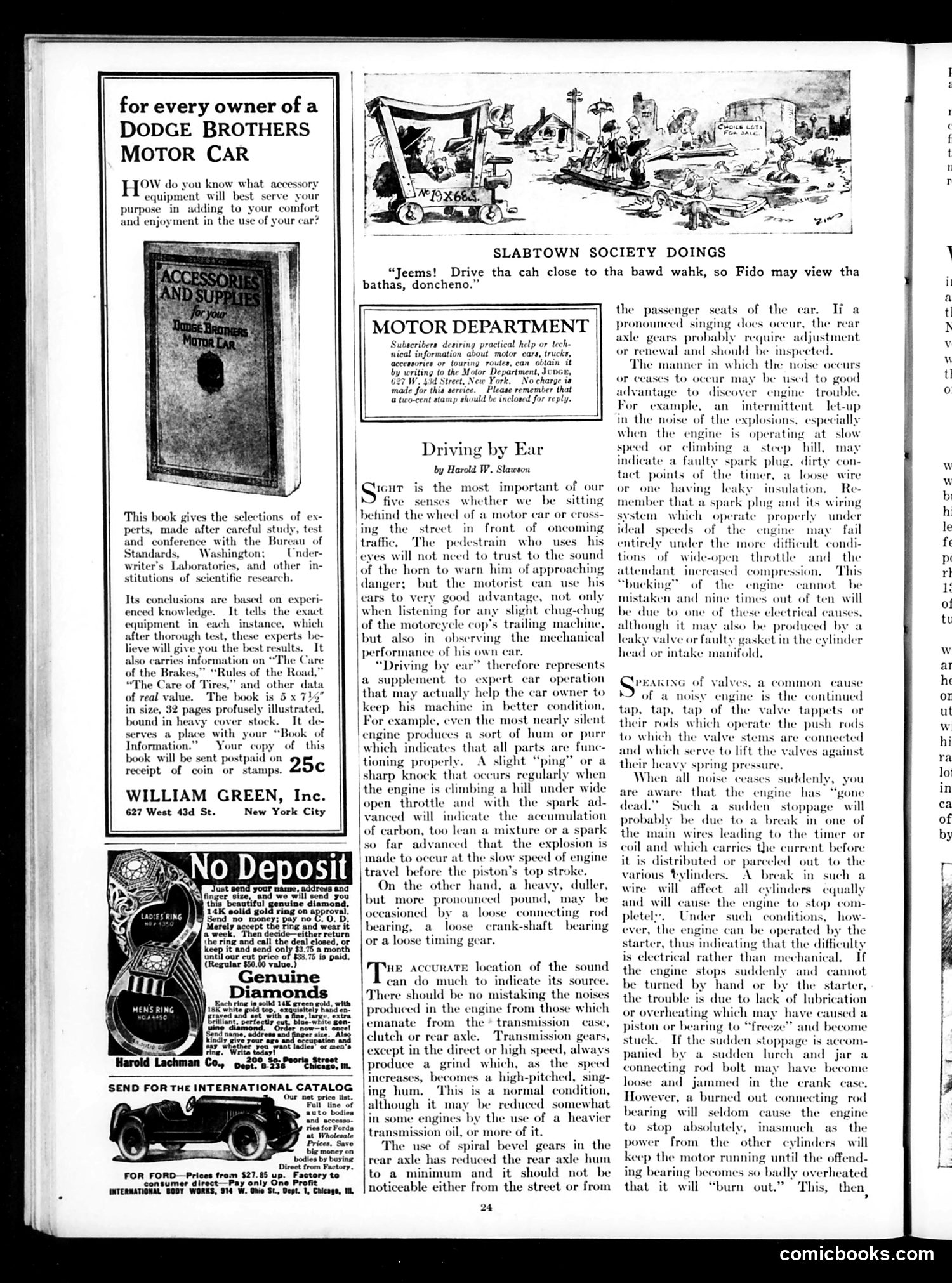
This page is primarily **advertising and instructional content** rather than political satire. The main elements are: **Dodge Brothers Advertisement**: Promotes an accessory guide for car owners, positioning it as scientifically vetted by the Bureau of Standards and research institutions. This reflects early 1920s marketing emphasizing technical expertise and safety. **"Driving by Ear" Article**: A practical guide teaching motorists to diagnose engine problems by sound—distinguishing normal "hums" from problematic "pings" and "knocks." This represents pre-electronic diagnostics. **"Slabtown Society Doings" Cartoon**: A brief satirical sketch mocking rural or working-class speech patterns. A character named "Jeems" uses exaggerated dialect ("tha cah," "tha bawd wahk") while wanting to show his dog the sights. This reflects contemporary class-based humor common in Judge magazine, gently ridiculing non-urban/non-educated speech. The page contains no significant political satire—it's typical 1920s automotive-era commercial and light social humor content.
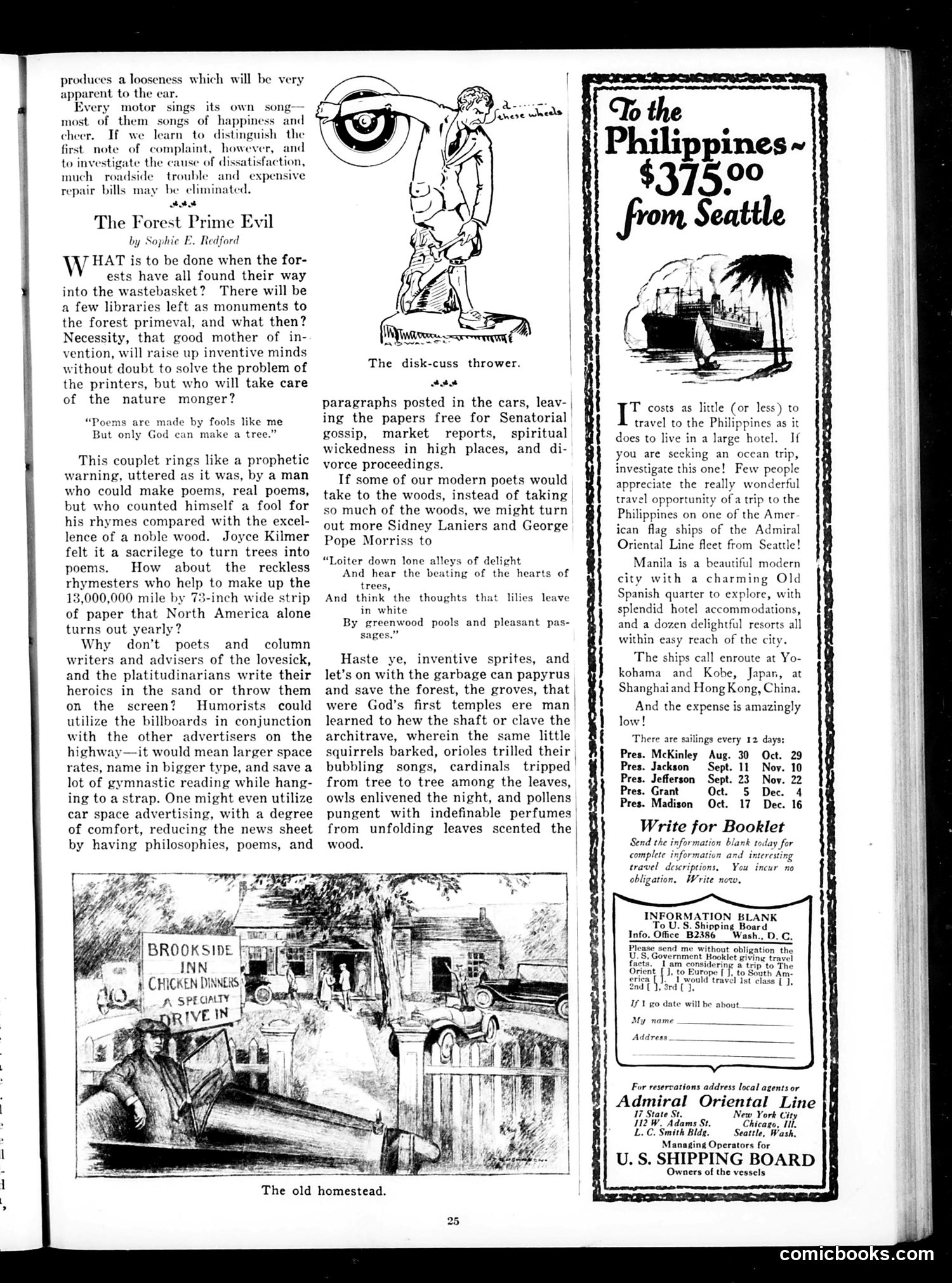
This page contains two distinct sections: **editorial content and advertising**. The main article, "The Forest Prime Evil" by Sophie E. Redford, satirizes modern waste and carelessness toward natural resources. It opens with a Joyce Kilmer quote ("Poems are made by fools like me / But only God can make a tree") to argue that writers and poets are wastefully consuming forests to produce newspapers and printed matter. Redford sarcastically suggests alternative media—billboards, sand, screens, streetcar advertisements—to reduce paper consumption, mocking both excessive journalism and writers who treat forests as expendable. The accompanying cartoon "The disk-cuss thrower" appears to be a visual pun, though its specific satirical target is unclear from context alone. The right side is a **U.S. Shipping Board advertisement** promoting $375 ocean travel to the Philippines from Seattle, describing Manila as a modern city with colonial Spanish architecture and nearby resorts. This reflects early 20th-century American expansion and tourism marketing to recently acquired territories. The page number is 25.
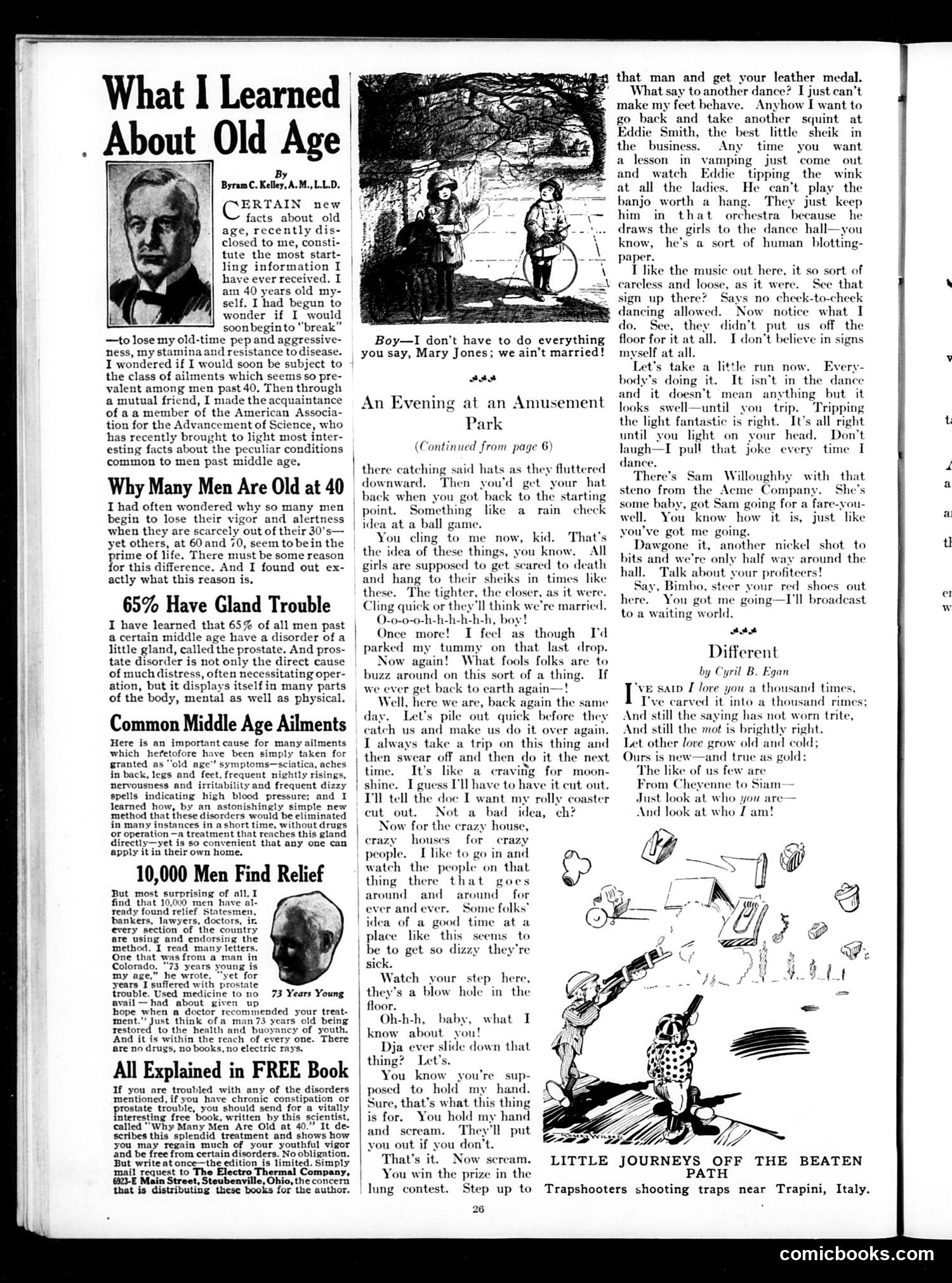
This is primarily **medical advertising disguised as editorial content**. The main article by Byram C. Kee promotes a mail-order treatment for prostate gland disorders marketed to middle-aged men worried about losing vitality. The pseudo-scientific language ("65% Have Gland Trouble," "10,000 Men Find Relief") and testimonial from a "73 Years Young" Colorado man aim to convince readers that decline at 40 is treatable through the advertiser's mysterious "Electro Thermal Company" device. The sidebar content about an amusement park and a dialogue about dating appear to be filler entertainment. This page exemplifies early 20th-century medical quackery—exploiting male anxiety about aging through exaggerated health claims and unproven mail-order remedies, a practice *Judge* magazine itself might have satirized in other contexts.
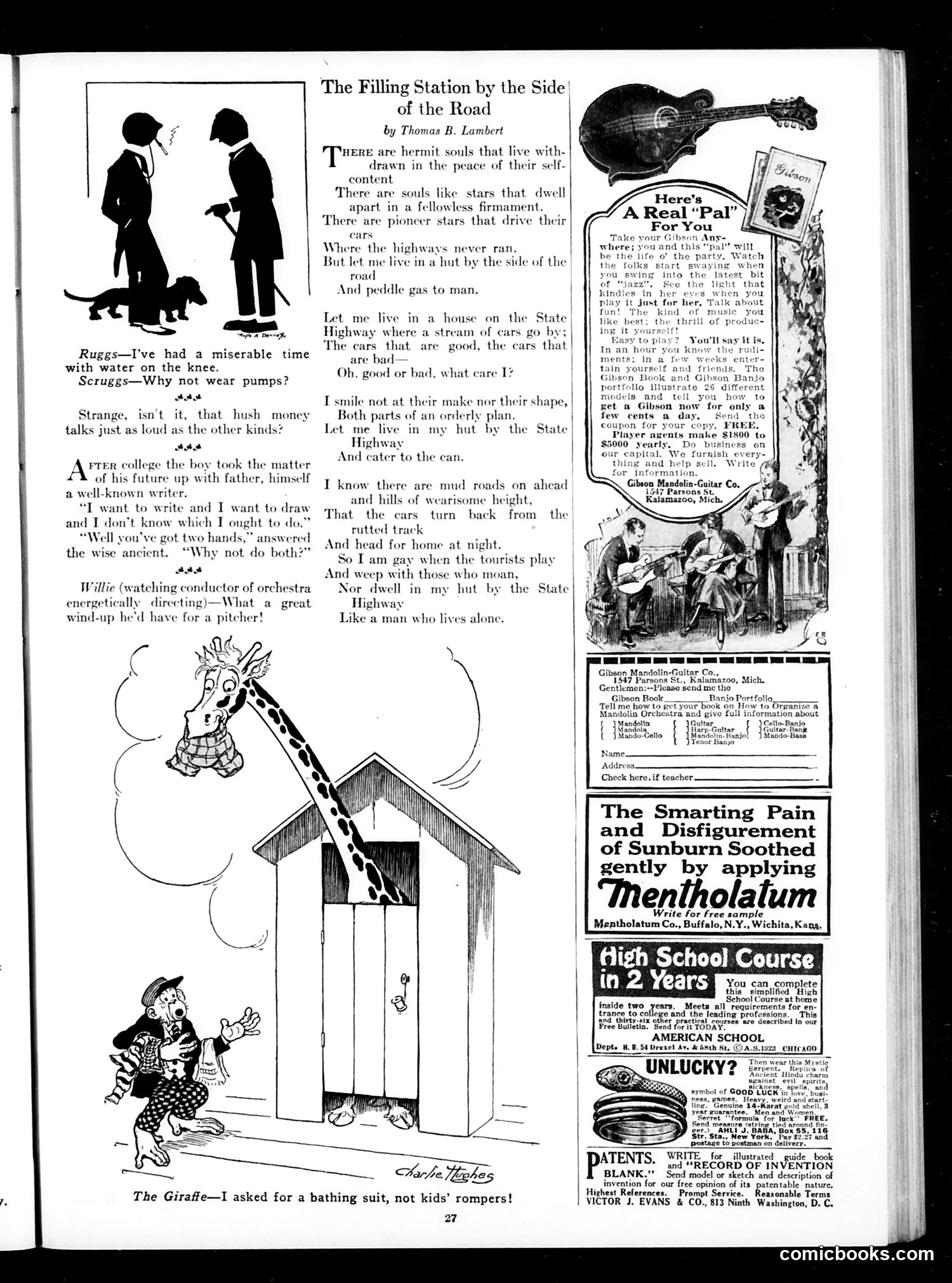
This page presents a sentimental poem by Thomas B. Lambert celebrating roadside gas station attendants as modern hermits serving automobile travelers on state highways. The poem romanticizes this humble occupation—men who "peddle gas" and "cater to the can"—as a form of simple, dignified living. The accompanying cartoons are unrelated jokes: one depicts a conductor's exaggerated wind-up (comparing orchestral conducting to baseball pitching), and another shows a giraffe complaining about receiving children's rompers instead of an adult bathing suit. The page is dominated by period advertisements for music instruction, patent services, and remedies—typical Judge magazine content. The satire's target is unclear, though the poem may gently mock either the romanticization of menial labor or changing American car culture circa 1910s-1920s. The context suggests this reflects early automotive era attitudes.
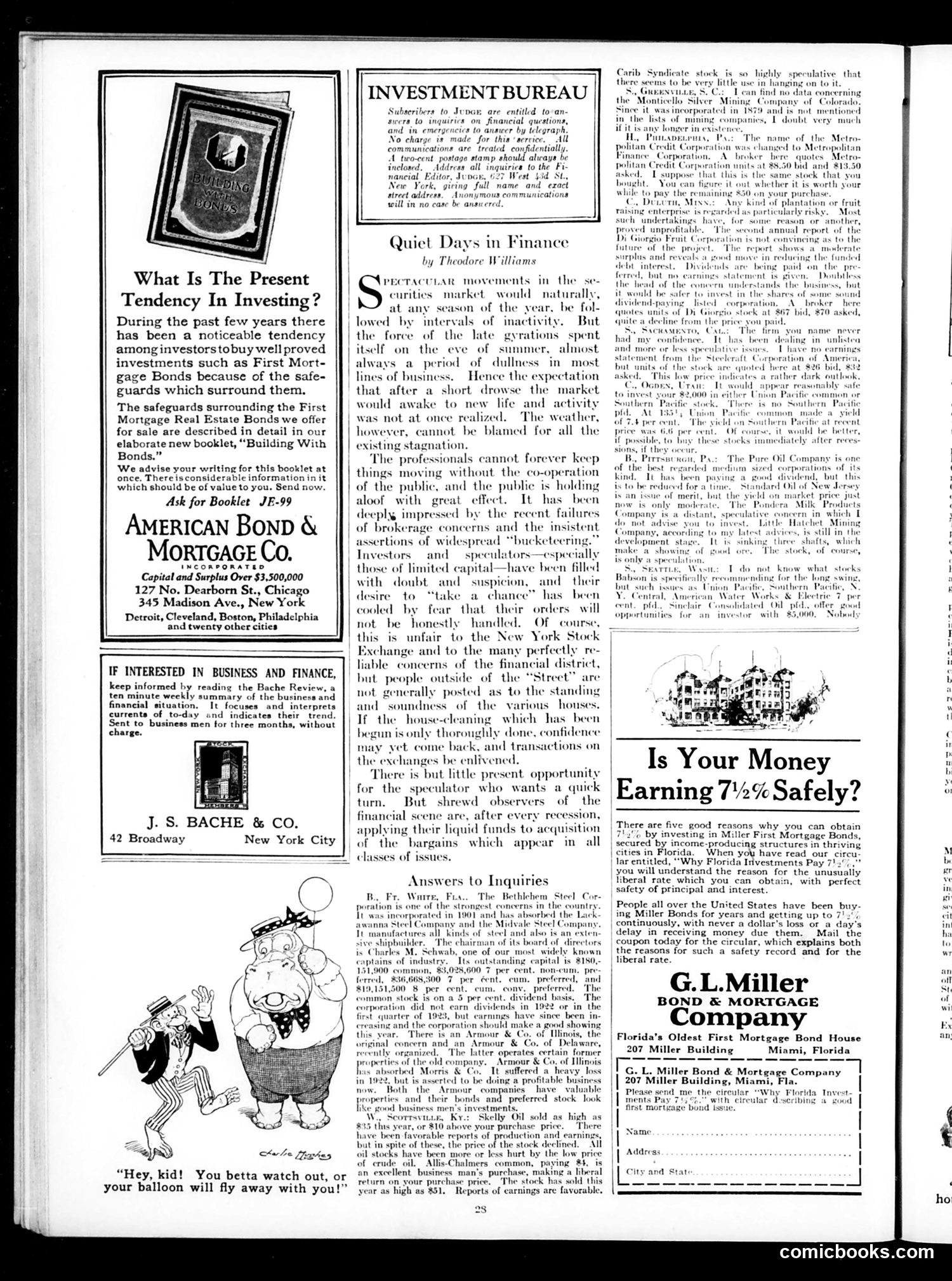
This page primarily contains **financial advertisements and advice** rather than political satire. The main cartoon—showing a child with a balloon being warned "Hey, kid! You betta watch out, or your balloon will fly away with you!"—is an **allegory about financial speculation**. The cartoon warns investors against risky stock market behavior during the 1920s era. The "balloon" represents inflated stock prices and speculative bubbles; the child represents inexperienced investors who might lose control of their investments. This reflects the article "Quiet Days in Finance," which discusses how public confidence in the stock market has been shaken by recent brokerage failures and "bucketeering" (bucket shops—illegal operations that took client money without executing trades). The surrounding advertisements for bonds and mortgages reinforce the message: **safe, proven investments are preferable to speculative gambling**. The page reflects genuine concerns about market manipulation and fraud that would become tragically relevant before the 1929 crash.
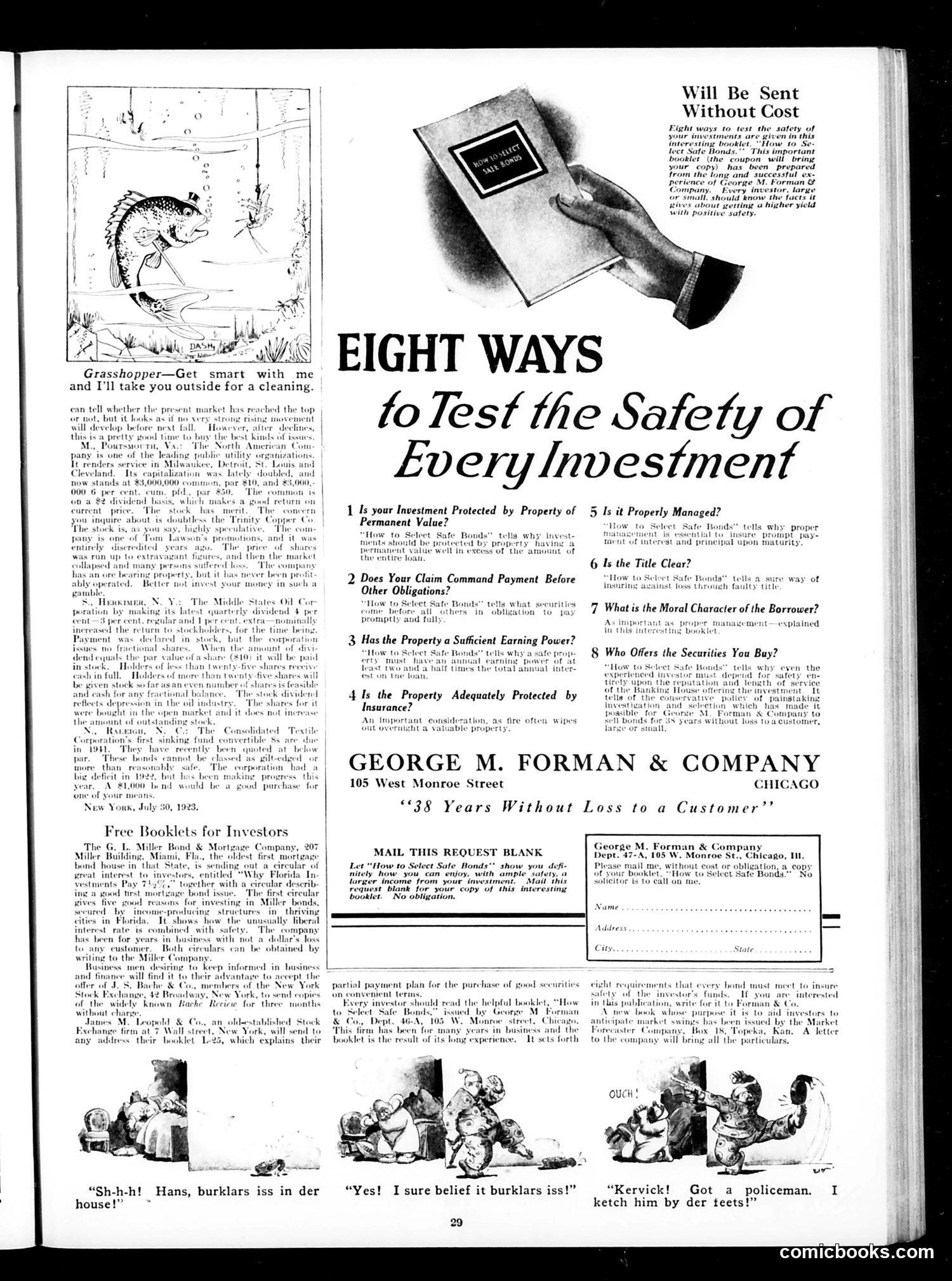
This page combines financial advertising with ethnic humor cartoons, typical of Judge magazine in the 1920s. **Main Content:** A George M. Forman & Company advertisement promoting their investment advisory booklet, "Eight Ways to Test the Safety of Every Investment." The ad lists eight criteria for evaluating bonds—property value, claim priority, earning power, insurance, management, moral character of borrower, and proper management—positioning Forman as a trustworthy guide through investment selection. **The Cartoons:** Three small panels at bottom feature crude ethnic caricatures (appearing to be German immigrants based on dialect spelling: "der" for "the," "burklars" for "burglars"). The joke plays on stereotypical portrayals of working-class immigrants discussing a burglary, with the punchline being the character's malapropism ("ketch him by der teets"—teeth). **Context:** These caricatures reflect 1920s American attitudes toward recent European immigrants, using exaggerated accents and simplistic humor that was commercially acceptable then. The contrast between serious financial advice and crude ethnic humor was unremarkable to period audiences.
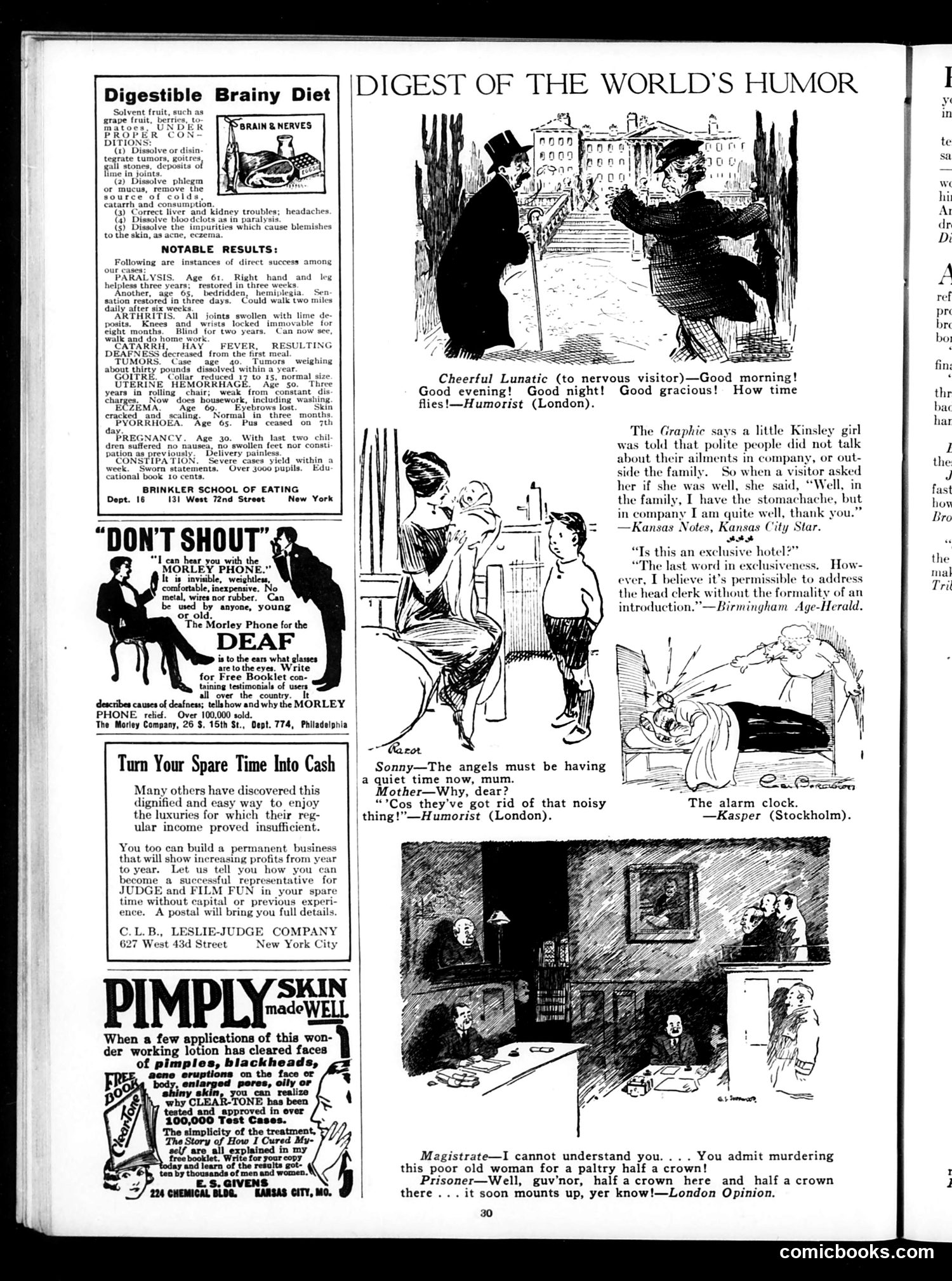
This page from *Judge* (a satirical American magazine) contains several distinct humor pieces: **Main Cartoons:** 1. **"Cheerful Lunatic"** depicts a mentally ill man greeting a nervous visitor with rapid-fire contradictory salutations, satirizing asylum inmates and nervous conditions. 2. **"Sonny" dialogue** shows a child innocently suggesting angels are happy because "they've got rid of that noisy thing"—likely referring to church bells or religious noise, mocking both childhood logic and religious excess. 3. **"The Alarm Clock"** (Stockholm source) is a visual joke about an alarm clock, though specifics are unclear from the image. 4. **"Magistrate" scene** depicts a prisoner convicted of murdering an elderly woman "for a paltry half a crown" (small coin), satirizing class inequality and the desperation of poverty. **Context:** These are general-audience humor pieces typical of early 20th-century satire—focusing on mental illness, poverty, and social absurdities. The page also contains period advertisements for health treatments and business opportunities, typical of magazines from this era.
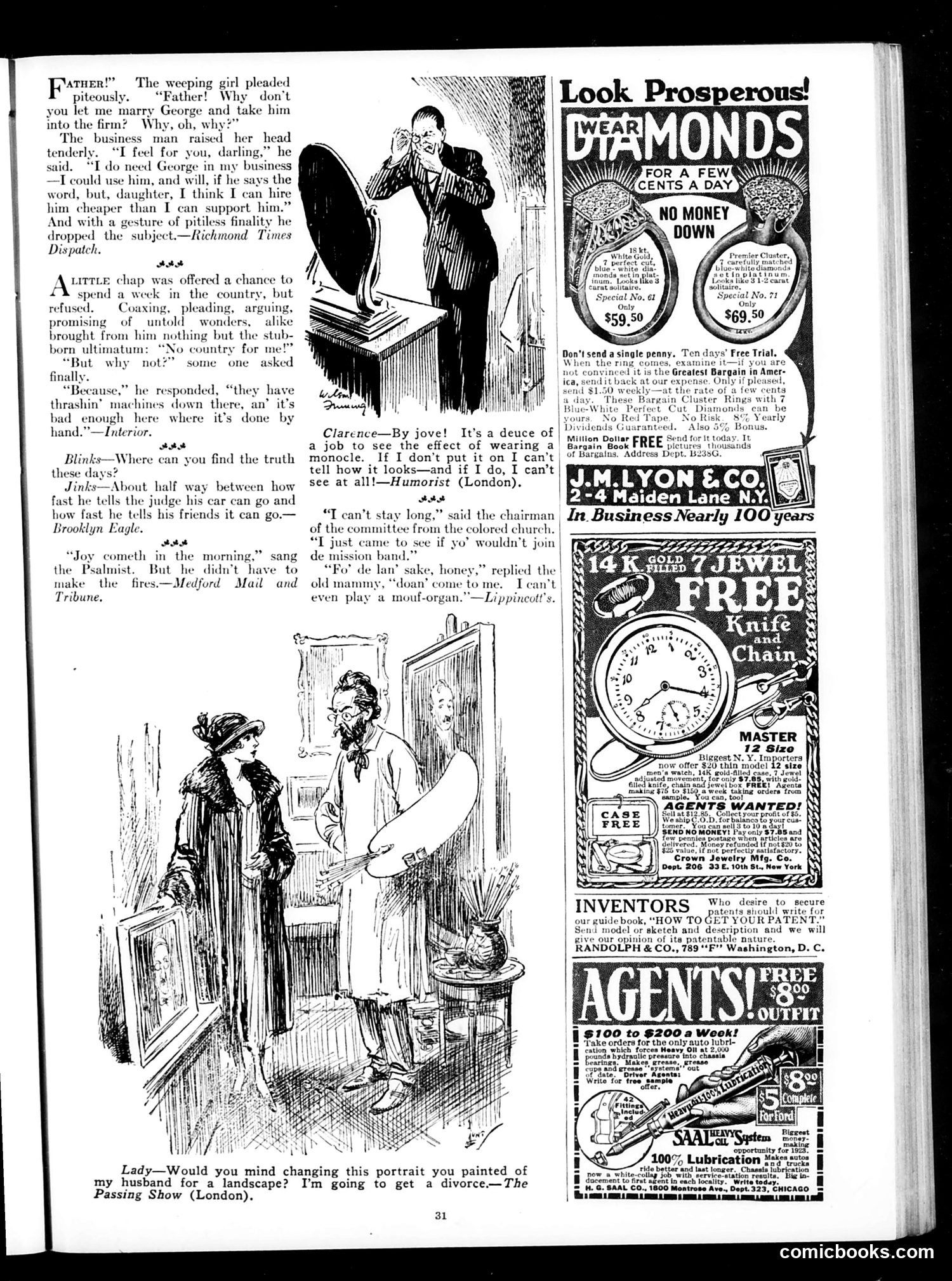
This page contains **humor columns and advertisements** rather than political cartoons. The satirical content addresses class and gender dynamics of the era: **"Father" sketch**: A businessman refuses to let his daughter marry George, despite needing him for the firm—because he can't afford to support a son-in-law. The joke critiques both paternal control and economic hypocrisy. **"Country visit" joke**: A man refuses a country vacation, fearing threshing machines. The humor plays on rural industrial dangers. **"Portrait/divorce" cartoon**: A woman asks her painter to change her husband's portrait into a landscape because she's divorcing him—dark humor about marital dissolution. The remaining content is **period advertising**: diamond rings ("no money down"), jewelry with free gifts, and agents' outfit pitches—typical early 20th-century mail-order marketing promising wealth and opportunity. The page reflects contemporary anxieties about marriage, work, and class while showcasing the commercial culture of the era.
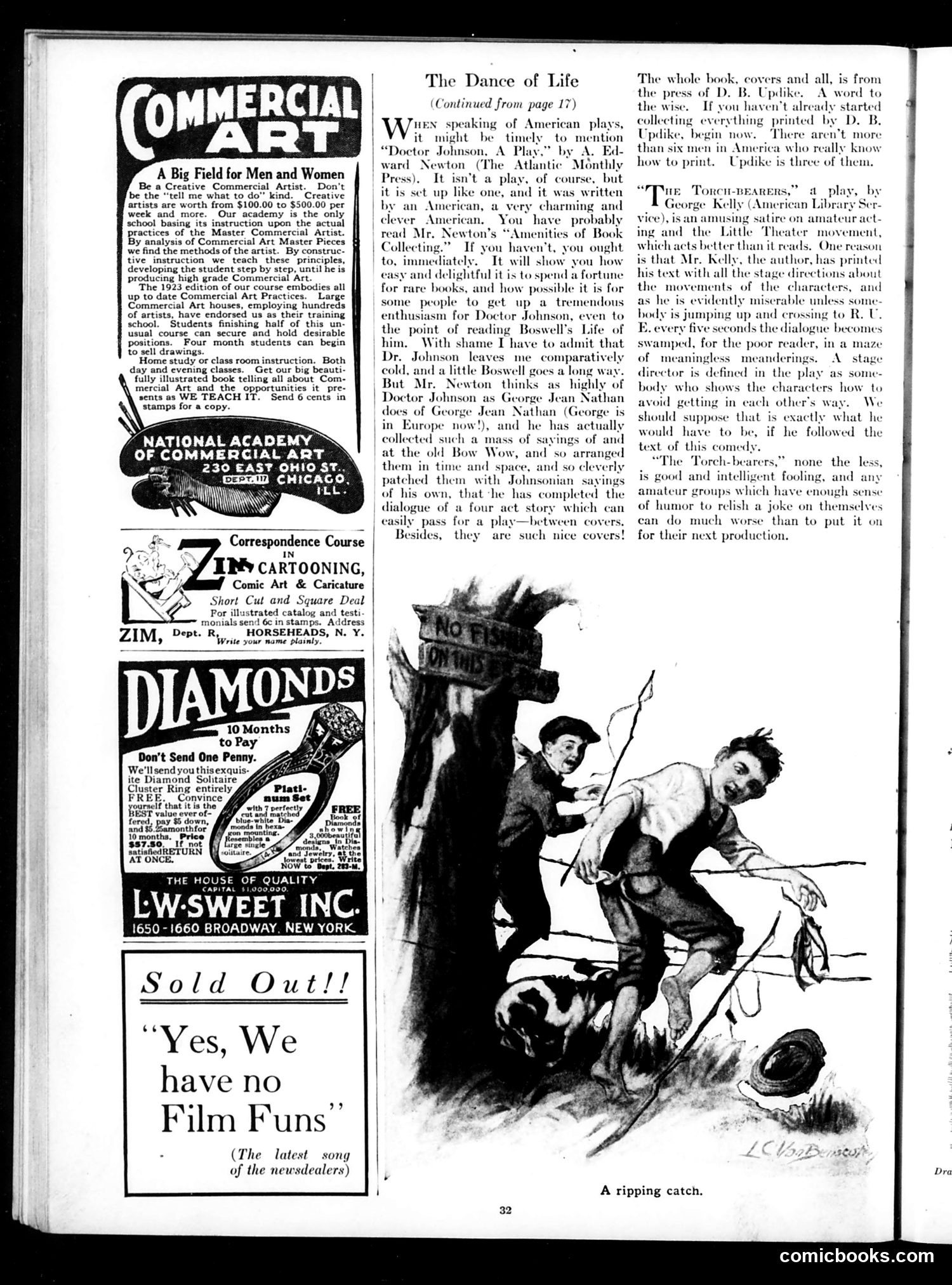
This page contains primarily advertising alongside a book review column. The cartoon—titled "A ripping catch"—depicts two figures in period costume (appearing to be 18th or 19th century dress) in an exaggerated physical struggle, seemingly pulling at something between them. The cartoon likely illustrates a scene or concept referenced in the accompanying review of "The Dance of Life" (continued from previous page), though the text discusses plays and books rather than directly explaining this image. The joke or satire appears visual rather than textual—probably playing on theatrical or literary themes mentioned in the reviews, though **the specific reference remains unclear without fuller context**. The advertisement-heavy layout is typical of Judge magazine's era.
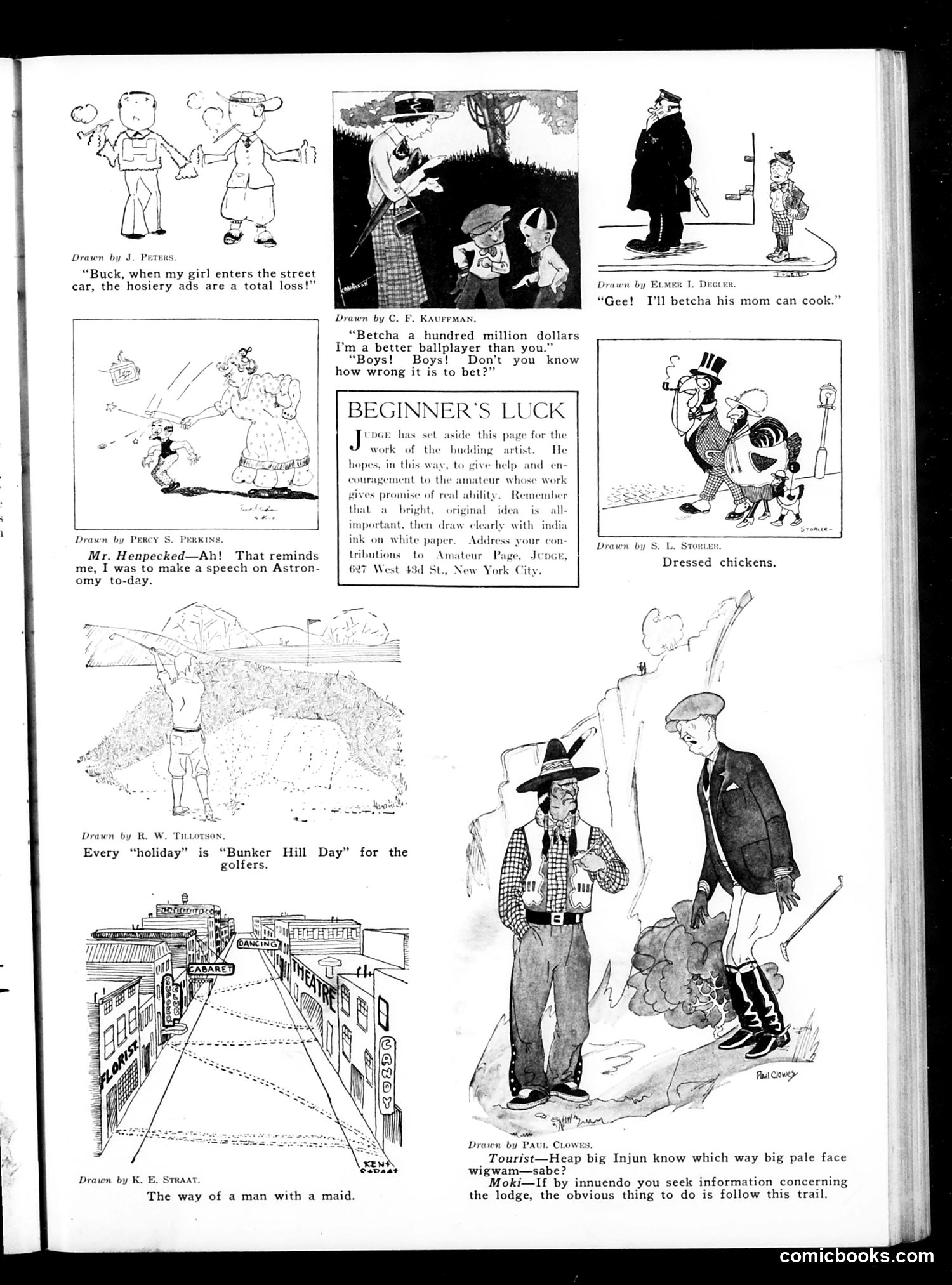
This page from *Judge* magazine features six separate comic cartoons satirizing early 20th-century American life: 1. **Street car distraction**: A man notes that attractive women entering streetcars render advertising signs invisible—commenting on male distraction and commercial competition for attention. 2. **Boys betting on baseball**: Adults scold young boys for wagering money, reflecting era concerns about gambling and moral instruction of youth. 3. **Henpecked husband**: A domestically-dominated man forgot his astronomy speech obligation—standard marital satire about wives controlling husbands. 4. **Golf "holidays"**: Golfers treat every occasion as excuse for the game, mocking sport obsession among leisure classes. 5. **Tourist and "Moki"**: Uses offensive period stereotypes ("big Injun," "wigwam," "sabe") depicting Native Americans as guides—reflecting era's casual racial caricature in tourism contexts. 6. **"Way of a man with a maid"**: Illustrates courtship dynamics. The "Beginner's Luck" section solicits amateur artwork, indicating *Judge*'s role promoting aspiring artists alongside established contributors.
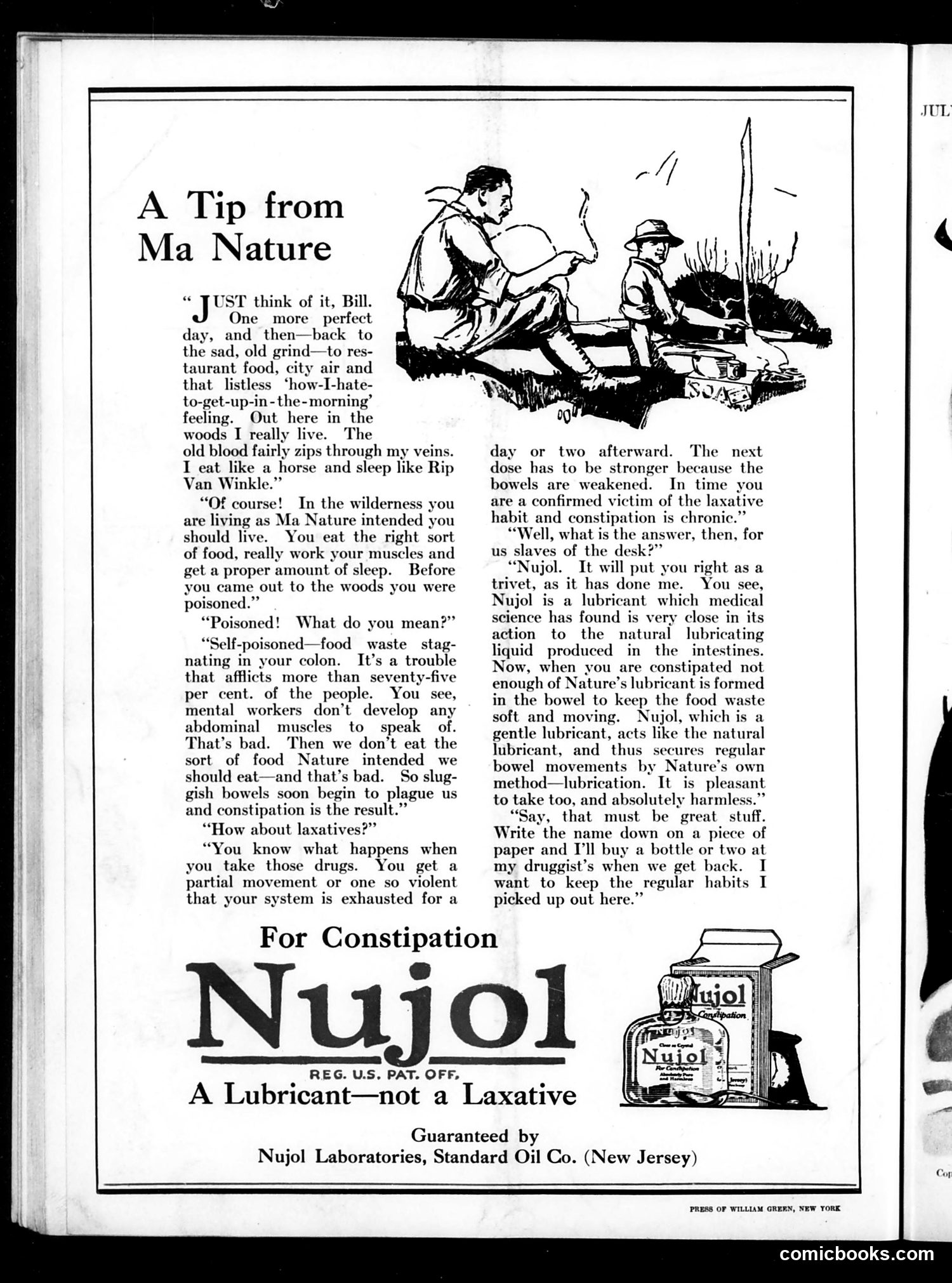
This is a **product advertisement masquerading as editorial content**—a common practice in early 20th-century magazines. Two men camping in the woods discuss constipation and digestive health. The satire targets **desk workers and urban life**: the city-dwelling "Bill" suffers from constipation caused by sedentary work, poor restaurant food, and lack of exercise. His friend attributes this to abandoning "Nature's" intended lifestyle. The humor lies in the **contrast between rustic health and urban malfunction**—outdoor living cures what city life breaks. However, the advertisement's real pitch is that **Nujol (a mineral oil lubricant by Standard Oil) mimics nature's own intestinal lubrication**, making it superior to harsh laxatives that create dependency. The message: modern desk workers can't escape the city, so they need a product that restores natural function without the drawbacks of chemical laxatives. It's dressed as frontier wisdom but sells pharmaceutical intervention.