
Judge, 1923-07-07 · page 26 of 36
Judge — July 7, 1923 — page 26: what you’re looking at
What you’re looking at
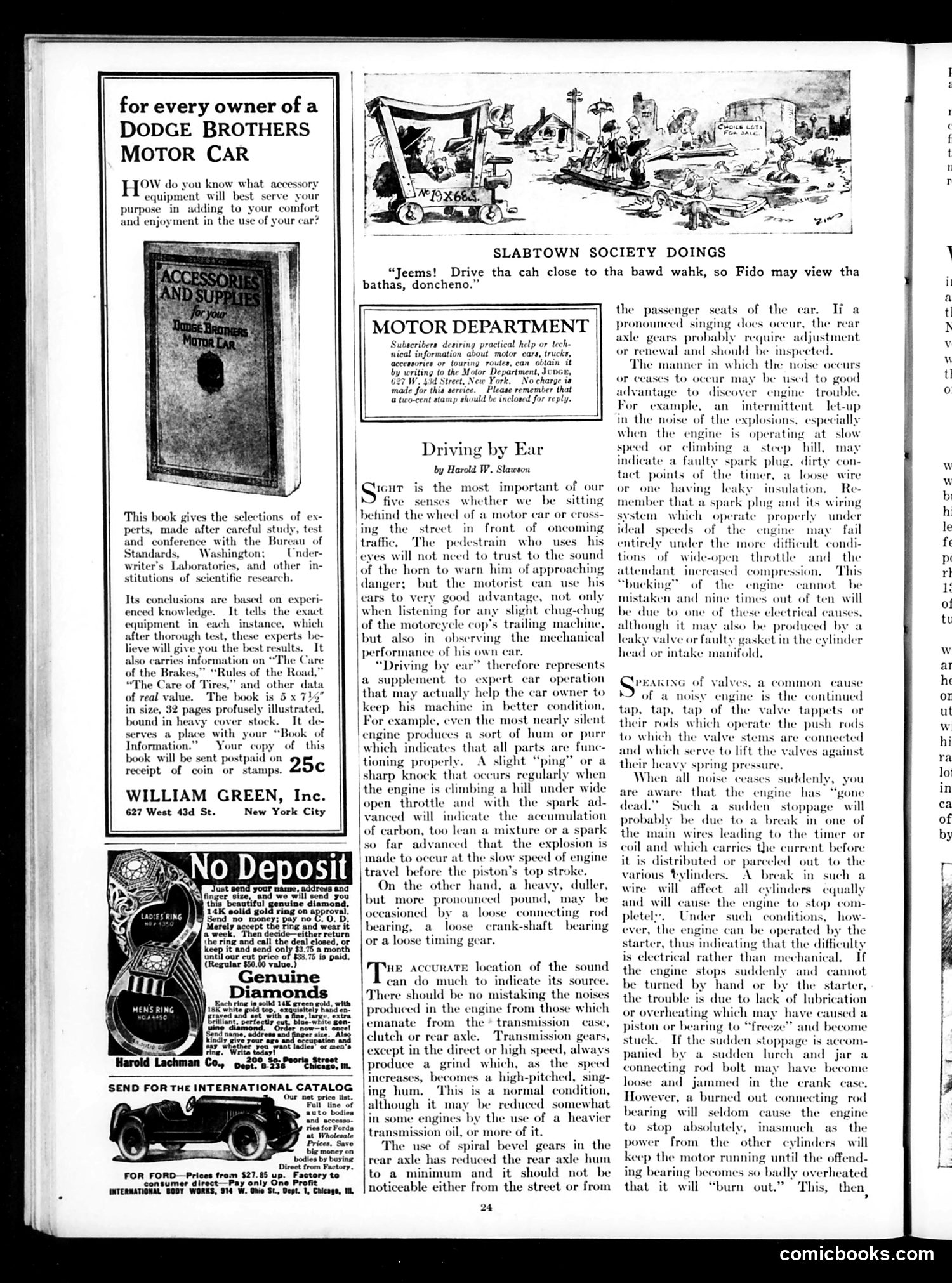
This page is primarily **advertising and instructional content** rather than political satire. The main elements are: **Dodge Brothers Advertisement**: Promotes an accessory guide for car owners, positioning it as scientifically vetted by the Bureau of Standards and research institutions. This reflects early 1920s marketing emphasizing technical expertise and safety. **"Driving by Ear" Article**: A practical guide teaching motorists to diagnose engine problems by sound—distinguishing normal "hums" from problematic "pings" and "knocks." This represents pre-electronic diagnostics. **"Slabtown Society Doings" Cartoon**: A brief satirical sketch mocking rural or working-class speech patterns. A character named "Jeems" uses exaggerated dialect ("tha cah," "tha bawd wahk") while wanting to show his dog the sights. This reflects contemporary class-based humor common in Judge magazine, gently ridiculing non-urban/non-educated speech. The page contains no significant political satire—it's typical 1920s automotive-era commercial and light social humor content.
📄 Transcribed text from this page (OCR, searchable)
Machine-transcribed from the original scan — historical spelling and the odd misread are preserved.
for every owner of a DODGE BROTHERS MOTOR CAR OW do you know what accessory equipment will best serve your purpose in adding to your comfort and enjoyment in the use of your car? This book gives the selections of ex- perts, made after careful study, test and conference with the Bureau of Standards, — Washington; Under- writer’s Laboratories, and other in- stitutions of scientific research. Its conclusions are based on experi- enced knowled It tells the exact equipment in each instance, which after thorough test, these experts be- lieve will give u the best results. It also carri i he € of the Brakes,” “Rules of the Road,” “The Care of Tires,” and other date of real value. The book is 5 x 7 in size, 32 pages profusely illustrated, bound in heavy cover stock. It de- serves a place with your “Book of Information.” Your copy of this book will be sent postpaid on jexcipt of coin or stamps 2OC WILLIAM GREEN, Inc. 627 West 43d St. New York City 'JOUF name, addrevs and ‘and we will send you wine diamond, 14K eolid gold ring Send ae fit W. Ohio St., Dept. 1, Chicage, ML bathas, doncheno.” ' MOTOR DEPARTMENT | | Subscribers desiring practical help or tech- | | nical information about motor cars, trucks, accessories or touring routes, can obtain it by writing to the Motor Department, Jvpc 627 W., 4d Street, New York. No charge is made for this service. Please remember that @ two-cent stamp should be incloaed for reply. Driving by Ear by Harold W. Slarceon icut is the most important of our five senses whether we be sitting behind the wheel of a motor car or cross- ing the street in front of oncoming traffic. The pedestrain who uses his eyes will not need to trust to the sound of the horn to warn him of approaching danger; but the motorist can use his cars to very good advantage, not only when listening for any slight chug-chug of the motorcycle cop's trailing machine, but also in observing the mechanical performance of his own car. “Driving by ear” therefore represents a supplement to expert car operation that may actually help the car owner to keep his machine in better condition. For example, even the most nearly silent engine produces a sort. of hum or purr which indicates that all parts are func- tioning properly. A slight “ping” or a sharp knock that occurs regularly when the engine is climbing a hill under wide open throttle and with the spark vanced will indicate the accumulation of carbon, too lean a mixture or a spark so far advanced that the explosion is ade to occur at the slow speed of engine travel before the piston’s top stroke. On the other hand, a heavy, duller, but. more pronounced pound, may be occasioned by a loose connecting rod |bearing, a loose crank-shaft bearing or a loose timing gear. MIE ACCURATE location of the sound can do much to indicate its sou There should be no mistaking the no produced in the engine from those which emanate from the * transmission case, clutch or rear axle. Transmission ged except in the direct or high speed, alw; produce a grind which, as the speed increases, becomes a high-pitched, sing- ing hum. This is a normal condition, although it y be reduced somew in some engines by the use of a hea transmission oil, or more of it. The use of spiral bevel ge: rear axle reduced the rear ax to a minimum and it should not be noticeable either from the street or from 24 SLABTOWN SOCIETY DOINGS “Jeems! Drive tha cah close to tha bawd wahk, so Fido may view tha the passenger seats of the car, Tia pronounced. sit does occur, the rear axle gears probably require adjustment or renewal and should be inspected. The manner in which the noise occurs or ceases to occur may be used to good advantage to discover engine trouble. For example, an intermittent let-up in the noise of the explosions, especially when the engine is operating at slow speed or climbing a steep hill, may indicate a faulty spark plug. dirty con- tact points of the timer, a loose wire or one having leaky insulation. Re- member that a spark plug and its wiring system which operate) properly under ideal speeds of the engine may fail entirely under the more difficult: condi- tions of wide-open throttle and the attendant increased compression. ‘This bucking” of the engine cannot be mistaken and nine times out of ten will be due to one of these electrical causes, although it may also be produced by a leaky valve or faulty gasket in the cylinder head or intake manifold. Greanese of valves, a common cause \D of a noisy engine is the continued tap, tap, tap of the valve tappets or their rods which operate the push rods to which the valve stems are connected and which serve to lift the valves against their heavy spring pressure. When all noise ceases suddenly, you are aware that the engine has “gone dead.” Such a sudden stoppage will probably be due to a break in one of the main wires ling to the timer or coil and which carries the current before it is distributed or parceled out to the various ‘tylinders. A’ break in’ such wire will’ affect. all cylinders equally and will cause the engine to stop com- pletel. Under such conditions, how- ever, the engine can be operated by the starter, thus indicating that the difficulty is electrical rather than mechanical. If the engine stops suddenly and cannot be turned by hand or by the s the trouble is due to lack of lubric or overheating which n : piston or bearing to “freeze” and become If the sudden stoppage is connecting rod bolt may have bec loose and jammed in the crank case. However, a burned out connecting rod bearing will seldom cause the engine to stop absolutely, inasmuch as the power from the other cylinders will keep the motor running until the offend- ing bearing becomes so badly overheated that it will “burn out.” This, then, comicbooks.com