
Judge, 1923-07-07 · page 18 of 36
Judge — July 7, 1923 — page 18: what you’re looking at
What you’re looking at
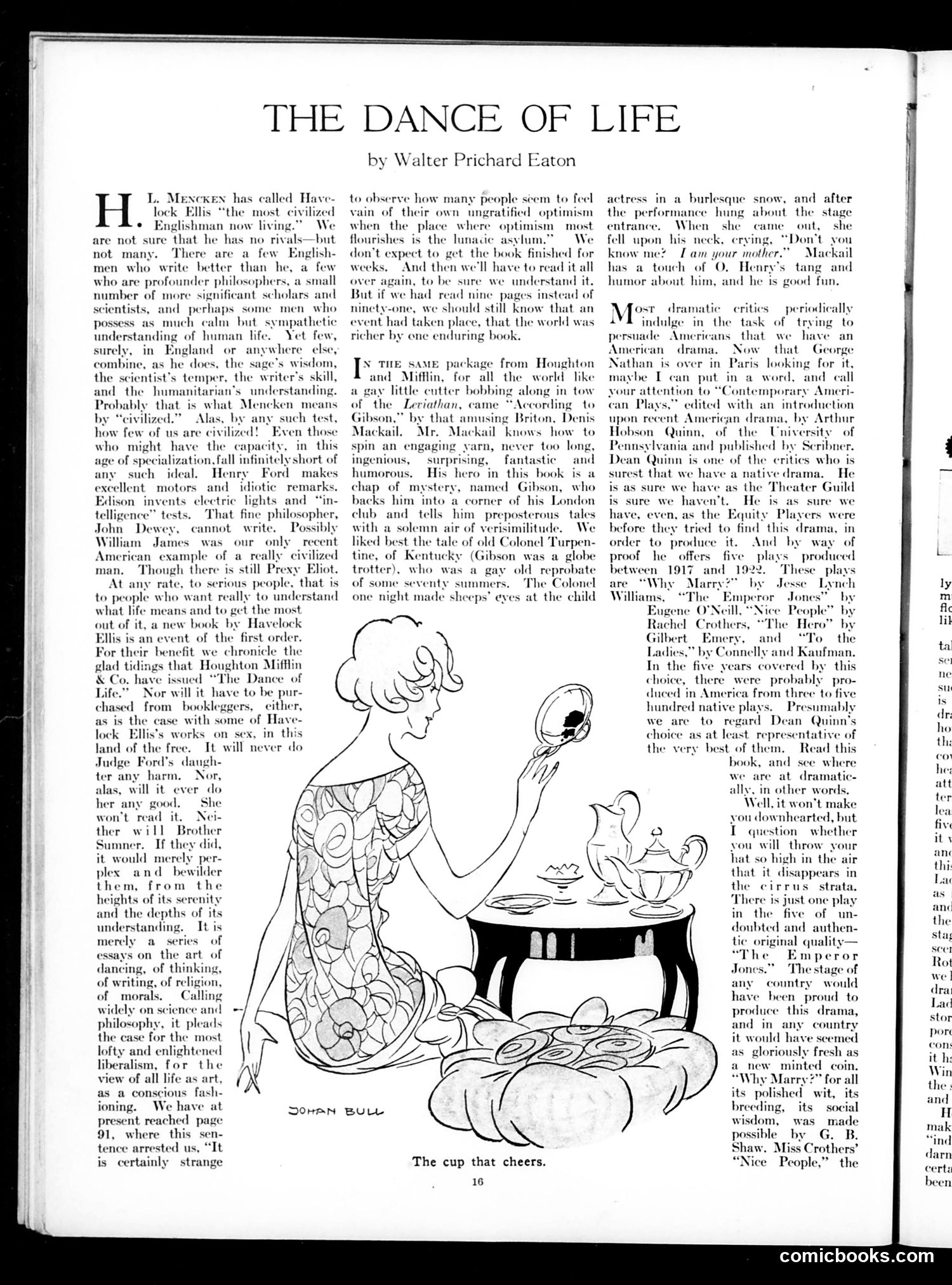
This page reviews Havelock Ellis's book "The Dance of Life," praising Ellis as perhaps the most "civilized" modern Englishman—combining wisdom, scientific rigor, literary skill, and human understanding. The author argues Ellis's work on art, philosophy, and morals is essential reading for serious people seeking life's meaning. The accompanying illustration by Johan Bull shows a woman at a table with tea—"The cup that cheers"—a genteel domestic scene befitting Ellis's philosophical work. The page also briefly reviews Denis Mackail's "According to Gibson," noting his talent for entertaining yarns told in London club settings, with humor reminiscent of O. Henry. The content reflects early 20th-century literary criticism valuing both intellectual rigor and accessible wisdom, while the magazine's stance embraces "enlightened liberalism" and viewing life itself as art.
📄 Transcribed text from this page (OCR, searchable)
Machine-transcribed from the original scan — historical spelling and the odd misread are preserved.
THE DANCE OF LIFE by Walter Prichard Eaton L. Mencken has called Have lock Ellis “the most civilized ¢ Englishman now living.” We are not sure that he has no rivals—but not many. There are a few English- men who write better than he, a few who are profounder philosophers, a small number of more significant scholars and scientists, and perhaps some men who possess as much calm but sympathetic understanding of human life. Yet few, surely, in England or anywhere else, combine, as he does, the sage’s wisdom, the scientist’s temper, the writer's skill, and the umanytaren understanding. Probably at is what Mencken means by * ‘civilize 2” Alas, by any such test, how few of us are civilized! "Even those who might ha i y, in this age of specialization, fall infinitely short of such ideal. Henry ds makes ent motors and idiotic remarks. Edison invents electric lights and “‘in- telligence” tests. That fine philosopher, John Dewey, cannot write. Possibly William James was our only recent American example of a really’ civilized man. Though there is still Prexy Eliot. At any rate, to serious people, that is to people who want really to understand what life means and to get the most out of it, a new book by Havelock Ellis is an event of the first order. For their benefit we chronicle the glad tid that Houghton Mifflin & Co. have issued “The Dance of Life.” Nor will it have to be pur- chased from bookleggers, _ either, as is the case with some of Have- lock Ellis’s works on sex, in this land of the free. It will never do Judge Ford's daugh- ter any harm. Nor, . will it ever do er any good, She won't read it, N ther will Brother ad Sumner. If they did, it would merely per- plex and _ bewilder them, from the heights of its serenity and the depths of its understanding. It is a series of son the art of ing, of thinking, of writing, of religion, of morals. Calling widely on science and philosophy, it pled ase for the most y and enlightened liberalism, for the view of all life as art, a conscious fash- ng. We have at it reached 91, where this sen- tence arrested us, “It is certainly strange to observe how many people seem to feel vain of their own ungratified optimism when the place where optimism most flourishes is the linacie asylum.” We don’t expect to get the book finished for weeks. And then we'll have to read it all over again, to be sure we understand it. But if we had read nine pages instead of nincty-one, we should still know that an event had taken place, that the world was richer by one enduring book. Ik THE SAME package from Houghton and Mifflin, for all the world like a gay little cutter bobbing along in tow of the Leviathan, came “According to Gibson,” by that amusing Briton, Denis Mackail. Mr. Mackail knows how to spin an engaging yarn, never too long, ingenious, surprising, fantastic and humorous. His hero in this book is a chap of mystery, named Gibson, who backs him into a corner of his London club and_ tells him preposterous tales with a solemn air of verisimilitude. We liked best the tale of old Colonel Turpen- tine, of Kentucky (Gibson was a globe trotter), who was a gay old reprobate of some seventy summers. The Colonel one night made sheeps’ eves at the child The cup that cheers, 16 actress in a burlesque snow, and after the performance hung about the stage entrance. When she came out, she fell upon his neck, erying, “Don't you know me? [am your mother.” Mackail has a touch of O. Henry’s tang and humor about him, and he is good fun. ost dramatic critics periodically indulge in the task of trying to F Americans that we have an 1 drama. Now that George Nathan is over in Paris looking for it, maybe [can put in a word, and ca your attention to “Contemporary Ameri- can Pl edited with an introduction upon recent American drama, by Arthur Hobson Quinn, of the Univer Pennsylvania and published by Scribner. Dean Quinn is one of the ¢ surest that we have a native « is as sure we have as the is sure we vt. He is sure we have, even, as the Equity Pl were before they tried to find this drama, in order to produce it. And by way of proof he offers five plays produced between 1917 and 1922. ‘These plays are “Why Marry?” by Jesse) Lynch Williams, Smperor Jones” by Eugene I, “Nice People” by Rachel Crothers, “The Hero” by Gilbert mery, and “To the Ladies,” Connelly and Kaufman. In the five years covered by. this choice, there were probably pro- duced in America from three to five hundred native plays. Presumably we are to regard Dean Quinn's choice as at least representative of the very best of them. Read this book, and see where © at dramatic- Iv, in other words. Well, it won't make you downhearted, but I question whether you will throw your hat so high in the air that it disappears in the cirrus. stra There is just one play in the five of un- doubted and authen- tic original quality— “The Emperor Jones.” The stage of any country would have been proud to produce this drama, and in any country it would have seemed as gloriously fresh as a new minted coin, “Why Marry?” for all its polished wit, its breeding, its social wisdom, was made possible | by Miss Crothers* People,” the su is dr. ho th: cor he: att ter lea five ity anc thi Lac as and the sta seer Rot we | drai Lad stor por cons it h: Win the ; comicbooks.com