
Judge, 1923-07-07 · page 9 of 36
Judge — July 7, 1923 — page 9: what you’re looking at
What you’re looking at
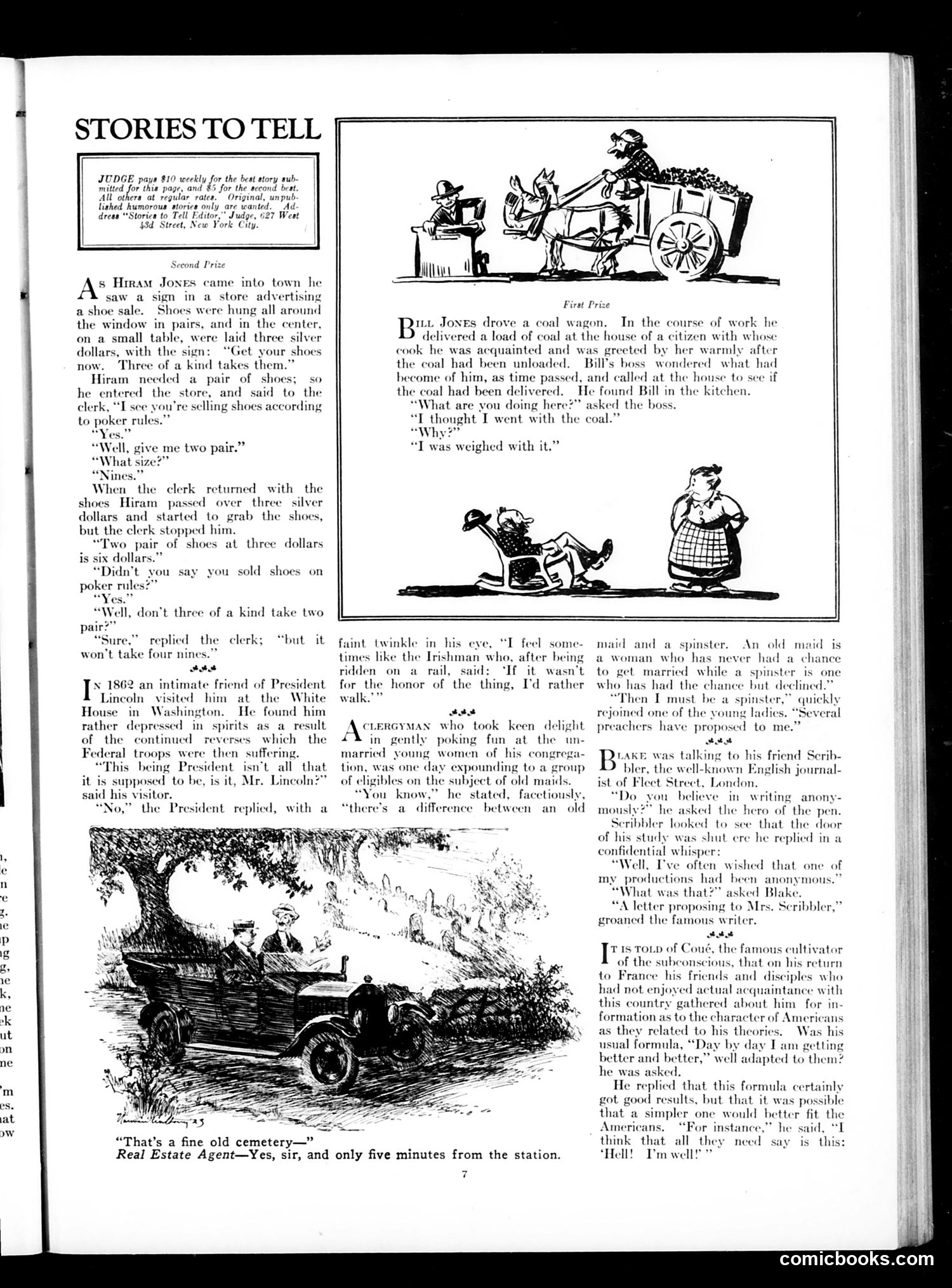
This page from Judge (a satirical weekly) contains several humor pieces typical of early 20th-century American magazines: **"Stories to Tell" Section:** A contest soliciting humorous anecdotes, with multiple brief stories illustrating wordplay and situational comedy—shoes sold by "poker rules," a Lincoln anecdote about the burdens of presidency, and stories about a coal deliveryman, a clergyman's distinction between "old maids" and "spinsters," and a writer's embarrassing anonymous letter. **The Cartoons:** Simple line drawings accompany stories—showing a coal wagon scene and a cemetery reference. These illustrate the narrative jokes rather than serving as political commentary. **Social Context:** The humor reflects period attitudes about class (domestic servants), gender (unmarried women), and politics (Lincoln's wartime stress). The Émile Coué reference at bottom suggests contemporary interest in the French "autosuggestion" self-help movement. **Overall:** This is light entertainment and humor, not political satire. The "joke" for modern readers is that the humor relies on now-dated social assumptions and wordplay.
📄 Transcribed text from this page (OCR, searchable)
Machine-transcribed from the original scan — historical spelling and the odd misread are preserved.
STORIES TO TELL JU pays $10 weekly for the beat story sub- mitted for thie page, and $5 for the accond beat All others at regular rates.” Original, unpub: lished humorous storie only are wanted. Ad dreas “Stories to Tell Editor,” Judge, 627 West 43d Street, New York City. Second Prize A s Hiram Jones came into town he wa sign in a store advertising a shoe sale. Shoes were hung all around the window in pairs, and in the center, on a small table, were laid three silver dollars, with the sign: “Get your shoes now. Three of a kind takes them.” Hiram needed a pair of shoes; so ed the store, and said to the I sce you're selling shoes according shoes Hiram passed over three silver dollars and started to grab the shoes, but the clerk stopped him. “Two pair of shoes at three dollars is six dollars.” “Didn't you say you sold shoes on poker rules?” , don’t three of a kind take two Sure,” replied the clerk; “but it won't take four nines.” Rn atad N 1862 an intimate friend of President Lincoln visited him at the White House in Washington. He found him rather depressed in spirits as a result of the continued reverses which the Federal troops were then suffering. “This being President isn’t all that it is supposed to be, is it, Mr. Lincoln?” said his visitor. “No,” the President replied, with a Pa Sw ss “That’s a fine old cemetery—” Firat Prize ILL Jones drove a coal wagon. In the course of work he at the house of a citizen with whose cook he was acquainted and was greeted by her warmly after Bill’s boss wondered what had hecome of him, as time passed, and called at the house to see if He found Bill in the kitchen. delivered a load of co: the coal had been unloaded. the coal had been delivered “What are you doing her “T thought I went with the coal.” “Twas weighed with it.” faint twinkle in his eye, “I feel some- times like the Irishman who, after being for the honor of the thing, I'd rather CLERGYMAN who took keen delight poking fun at married young women of his congrega- tion, was one day expounding to a group ibles on the subject of old maids. ou know,” he stated, facetiously, * Real Estate Agent—Yes, sir, and only five minutes from the sked the boss. maid and a spinster. An old maid is a woman who has never had a chance to get married while a spinster is one as had the chance but declined.” ‘nT must be a spinster,” quickly »ined one of the young ladies. “Several sachers have proposed to me. ee LAKE was talking to his friend Serib- bler, the well-known English journal- ist of Fleet Street, London. “Do you believe in wr mously?" he asked the hero of the pen. Seribbler looked to see that the door of his study was shut ere he replied in a confidential whisper: “Well, I've often wished that one of my productions 1 anonymous. “What was th 1 Blake. “A letter proposing to Mrs. Scribbler,” groaned the famous writer. we pre ng anony- C 1s TOLD of Coué, the famous cultivator of the subconscious, that on his return to France his friends and disciples who had not enjoyed actual acquaintance with this country gathered about him for in- formation as to the character of Americans as they related to his theories, Was his usual formula, “Day by day I am getting better and better,” well adapted to them? he was asked. He replied that this formula certainly got good results, but that it was possible that a simpler one would better fit the Americans. “For instance,” he said, “I think that all they need say is. this: ‘Hell! D’'m well! ” comicbooks.com