
A complete issue · 36 pages · 1923
Judge — June 23, 1923
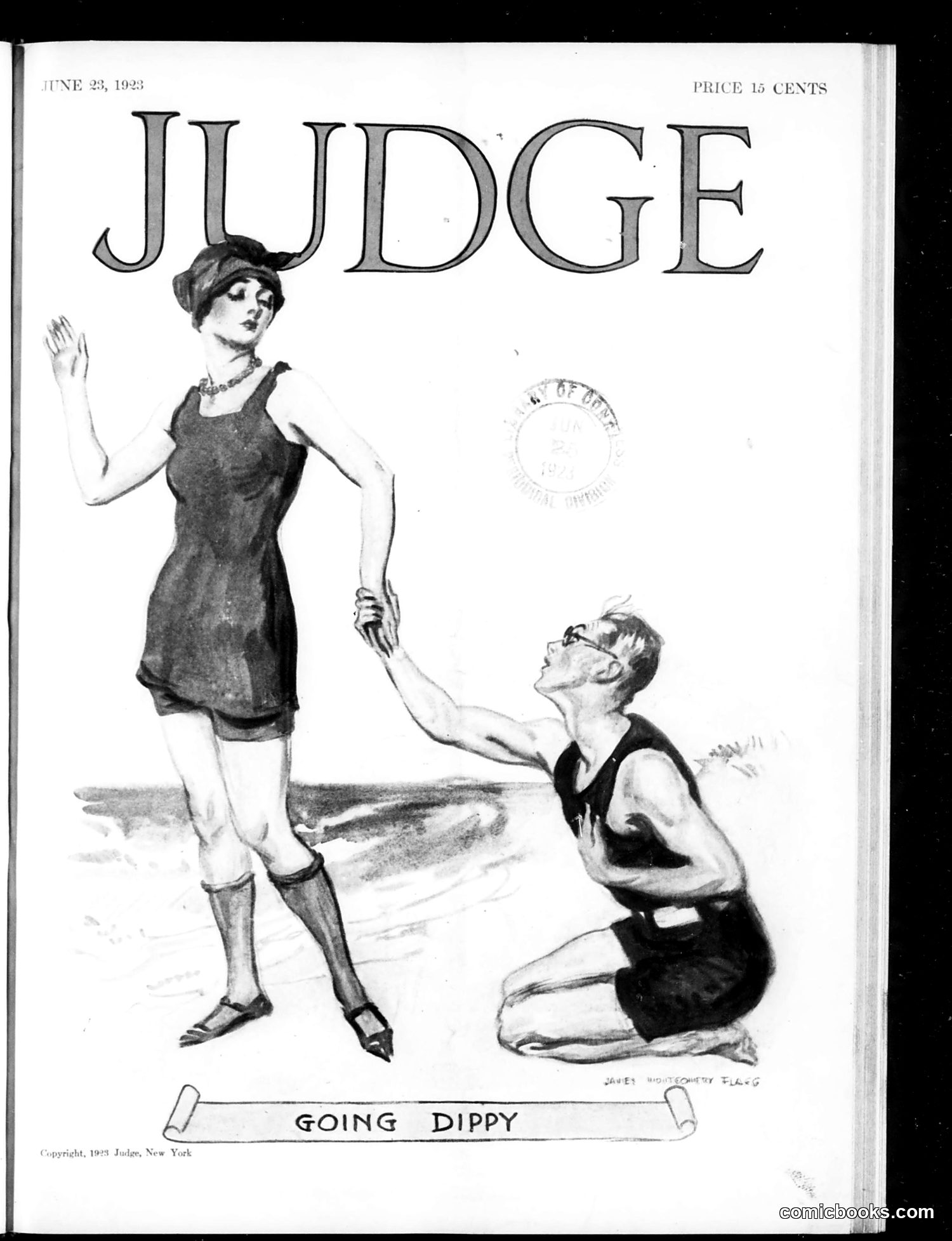
This satirical cover depicts a couple at the beach, titled "Going Dippy." The phrase likely references the 1920s slang term "dippy" (meaning silly or foolish), while "going" suggests the fashionable activities of the era. The cartoon humorously portrays the woman in a modern, abbreviated bathing costume with a cloche hat—representing the "flapper" style of the Jazz Age—while the man kneels before her in an exaggerated, besotted pose. The satire appears to mock the period's changing gender dynamics and male infatuation with the new, more independent and fashionably daring woman. It's a commentary on how modern women's liberation and style choices bewildered and entranced men of the era.
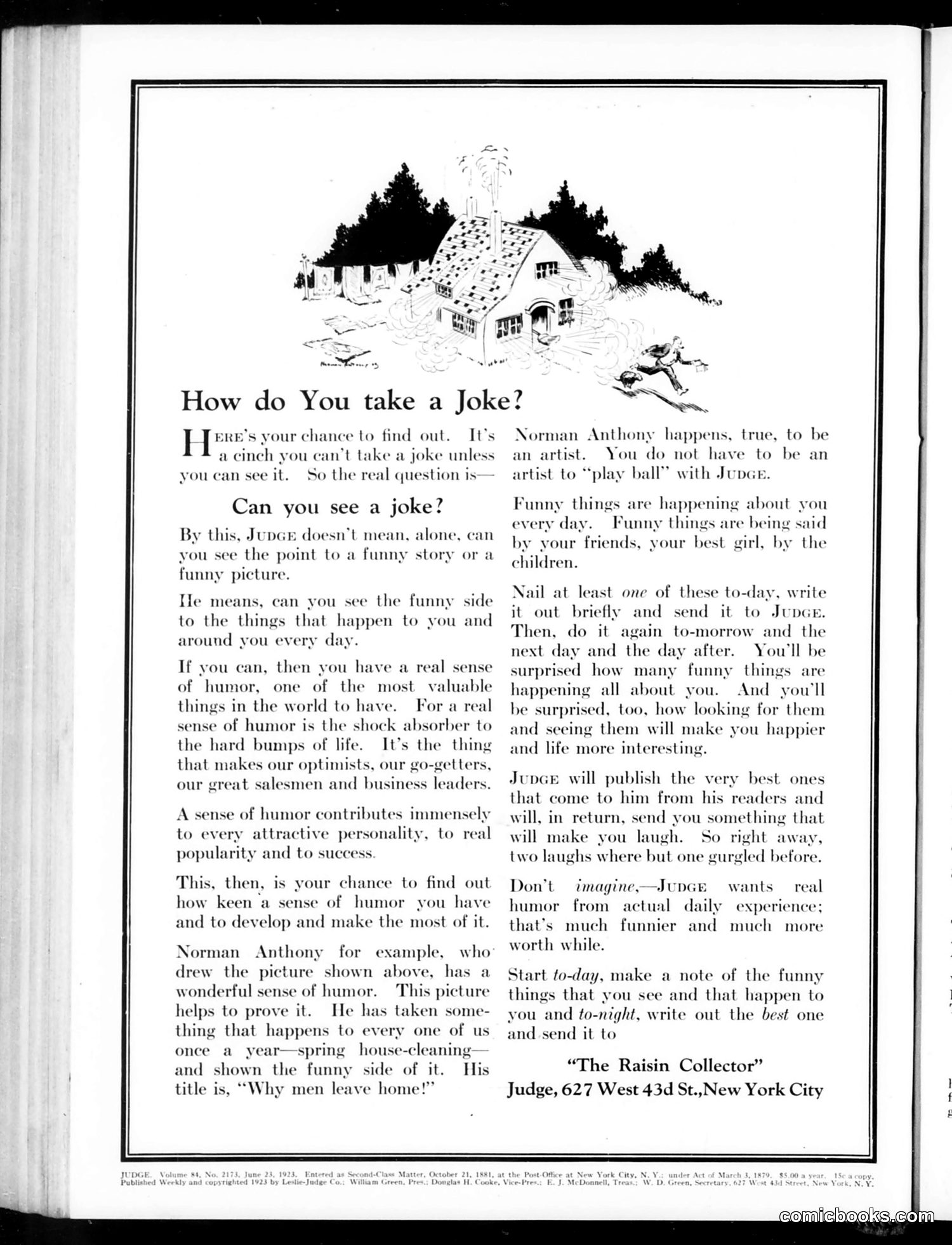
This page is primarily **editorial content, not political satire**. It features a Norman Anthony illustration of a spring house-cleaning scene and uses it to launch a humor-collection campaign titled "How do You take a Joke?" The piece invites readers to submit funny observations from daily life to Judge magazine's editor. The satire is gentle: it pokes fun at the universal human experience of spring cleaning (Anthony's title: "Why men leave home!") and encourages readers to develop their sense of humor by noticing life's absurdities. The "Raisin Collector" address indicates this was a reader-participation feature. There's no identifiable political target—instead, the content celebrates humor as a valuable personal trait contributing to success and happiness.
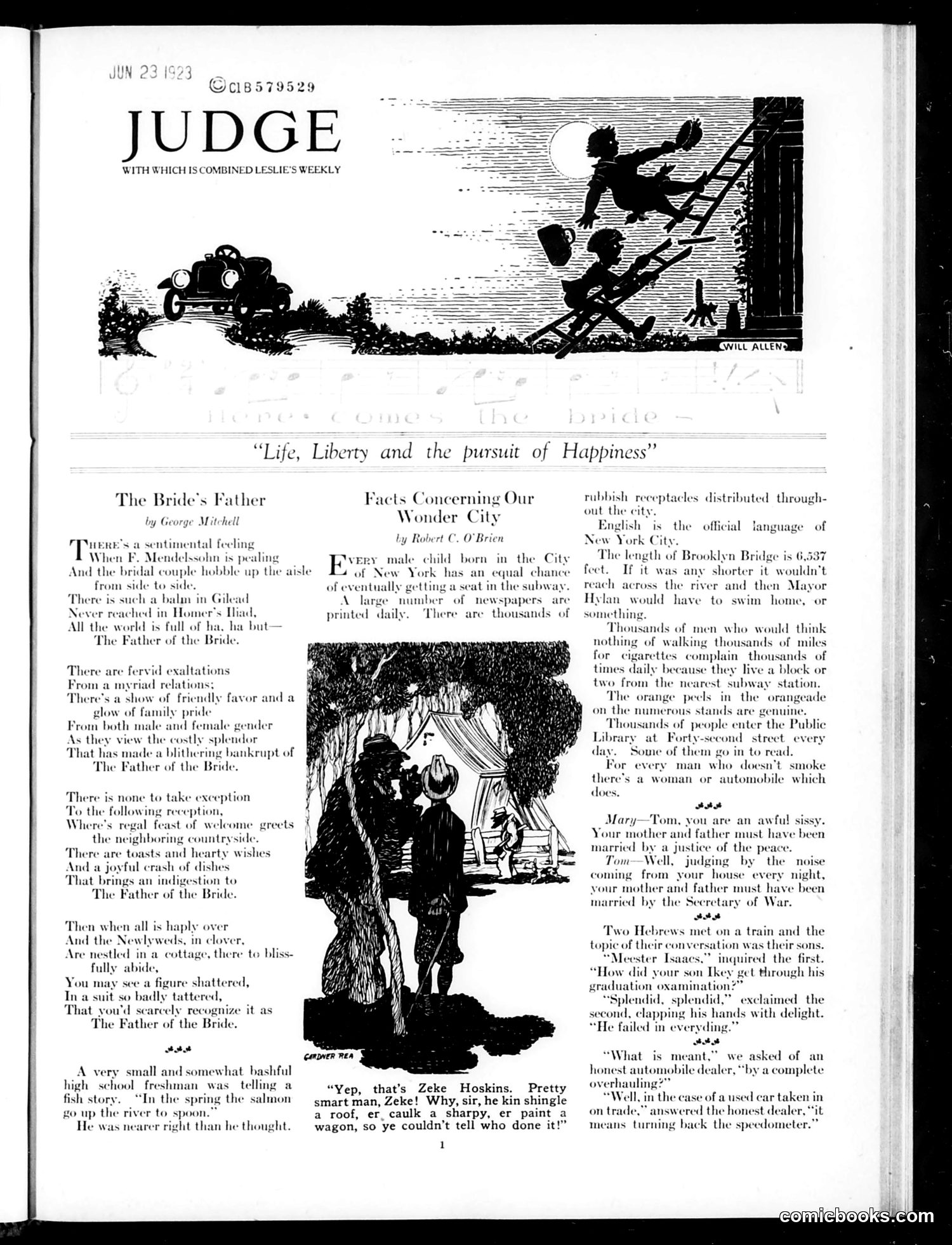
The page features **"The Bride's Father"** poem by George Weld satirizing the wedding-day experience of the bride's father. The accompanying silhouette illustration depicts a man appearing distressed on a ladder or roof—likely representing the father's frantic state amid wedding preparations and expenses. The other main content, **"Facts Concerning Our Wonder City"** by Robert C. O'Brien, discusses New York City statistics, including subway access and the Brooklyn Bridge's dimensions. It includes anecdotes about city life and humor. The bottom cartoon shows two figures, captioned about "Zeke Hoskins," discussing automobile repairs—a joke about mechanic incompetence or deception regarding vehicle damage. The overall theme reflects 1920s urban American life and its comedic frustrations.
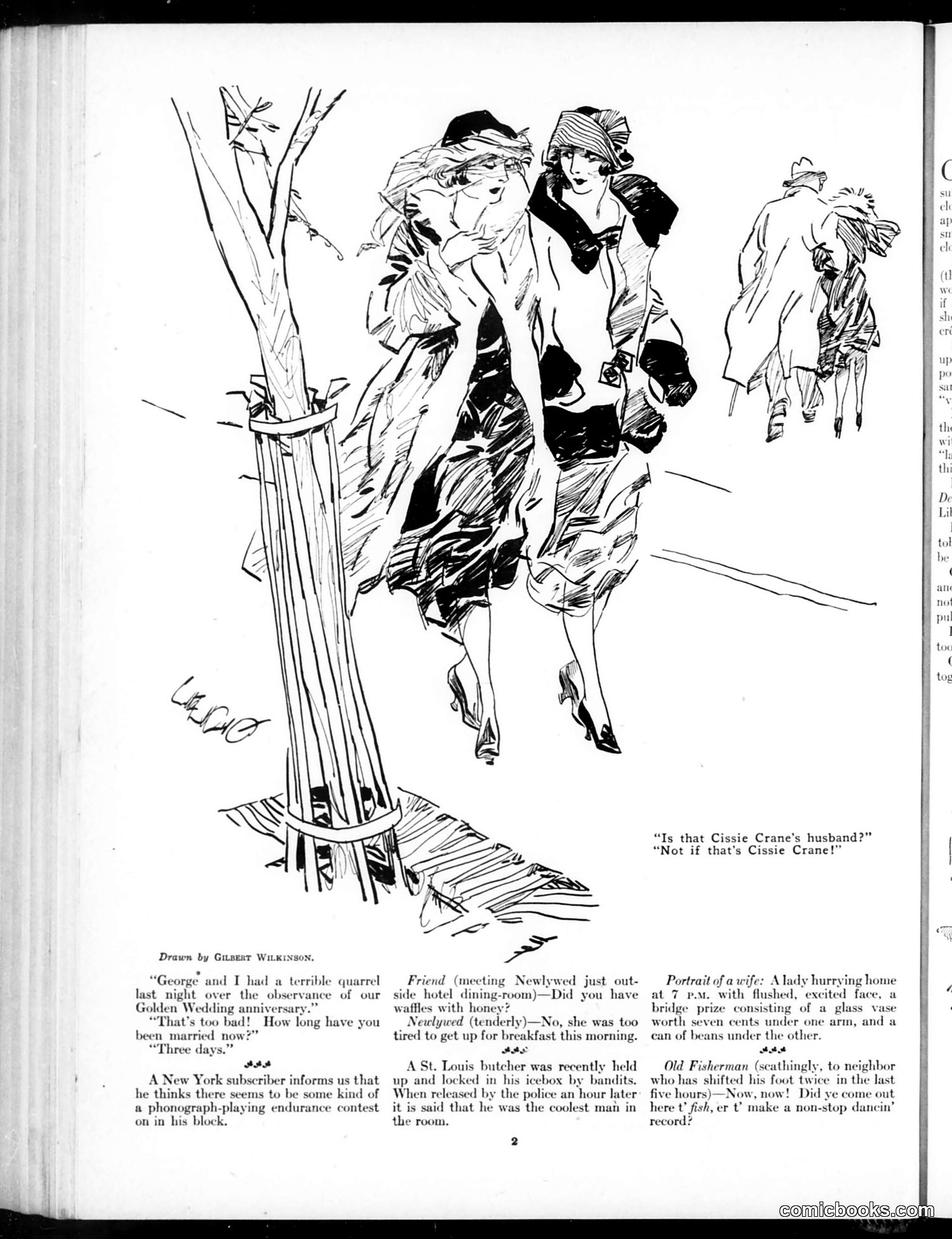
This page from *Judge* magazine features a cartoon by Gilbert Wilkinson depicting two fashionably dressed women walking past a bare tree. The main joke concerns marital status and social propriety in early 20th-century America. The caption reads: "Is that Cissie Crane's husband?" / "Not if that's Cissie Crane!" The humor relies on the woman's appearance—she's dressed fashionably but appears disheveled or improper in some way that suggests she's engaged in scandalous behavior or an affair. The joke implies that if this woman is Cissie Crane, then the man accompanying her cannot be her actual husband, suggesting infidelity or impropriety. The surrounding anecdotes about marital quarrels and domestic situations reinforce the magazine's satirical commentary on marriage and social expectations of the era.
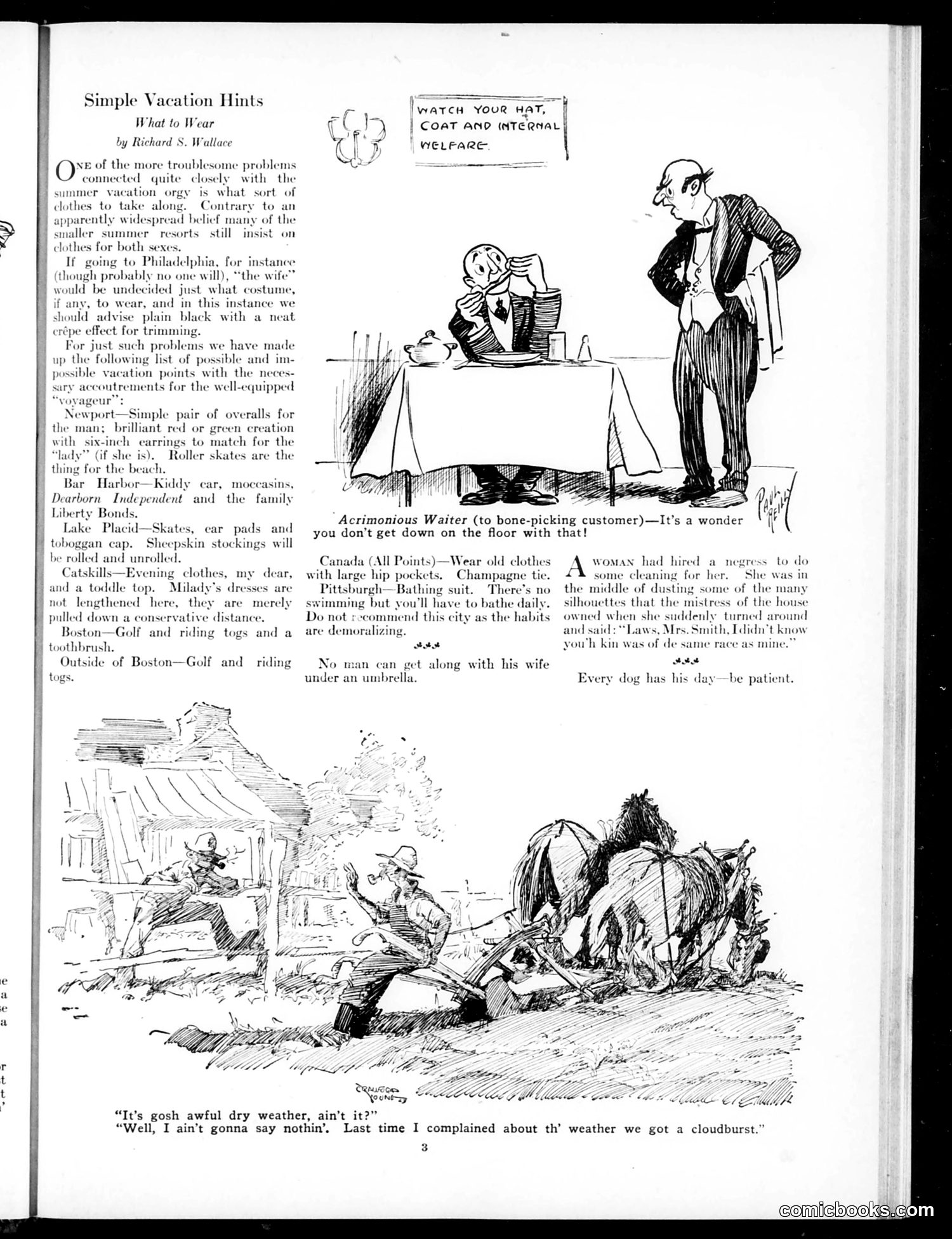
This page contains "Simple Vacation Hints" by Richard S. Wallace, offering practical clothing advice for different American vacation destinations (Philadelphia, Newport, Bar Harbor, Pittsburgh, Canada, and Boston). The main cartoon depicts a waiter confronting a customer about behavior—the caption reads: "It's a wonder you don't get down on the floor with that!" This appears to be satire about uncouth vacation behavior or poor manners at dining establishments. A secondary anecdote describes a woman hiring a maid of a different race, with the employer shocked to discover the deception—social commentary on racial passing or discrimination in domestic service. The bottom cartoon shows people in poor weather conditions complaining about dry weather, contrasting their complaint with actual stormy conditions—satirizing human tendency to complain regardless of circumstances.
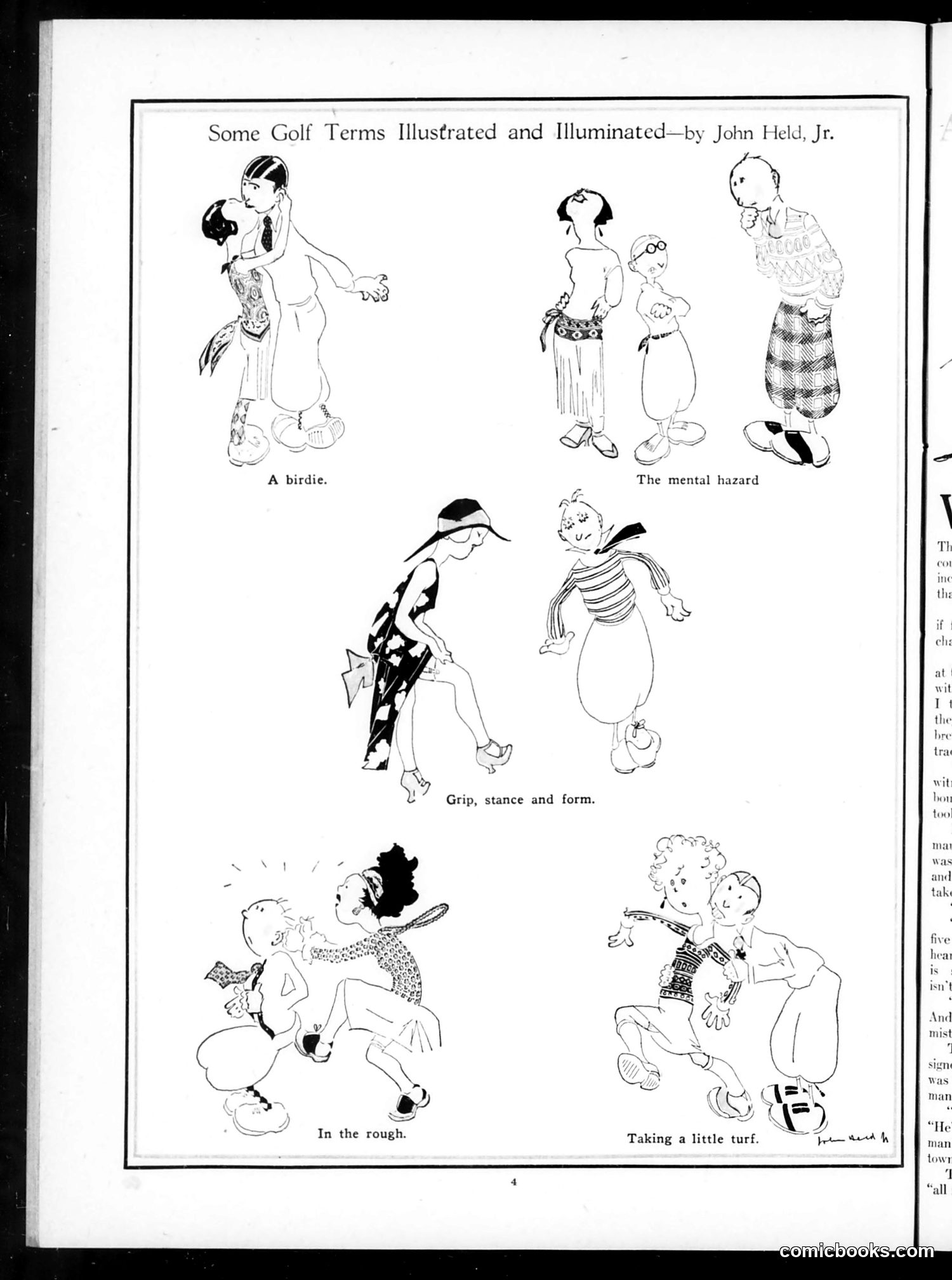
This is a humorous illustrated guide to golf terminology from *Judge* magazine. Rather than explaining terms through text, cartoonist John Held Jr. uses visual gags depicting the social consequences of golf performance. Each panel illustrates a golf term through domestic or social scenarios: "A birdie" shows a woman proudly displaying her achievement; "The mental hazard" depicts marital tension; "Grip, stance and form" shows exaggerated posture; "In the rough" and "Taking a little turf" depict physical chaos and mishaps. The satire targets golf's cultural significance in early-20th-century leisure society, suggesting that golf performance directly impacts relationships, reputation, and social standing. The cartoons mock both the sport's seriousness and golfers' obsessive dedication to perfecting their game.
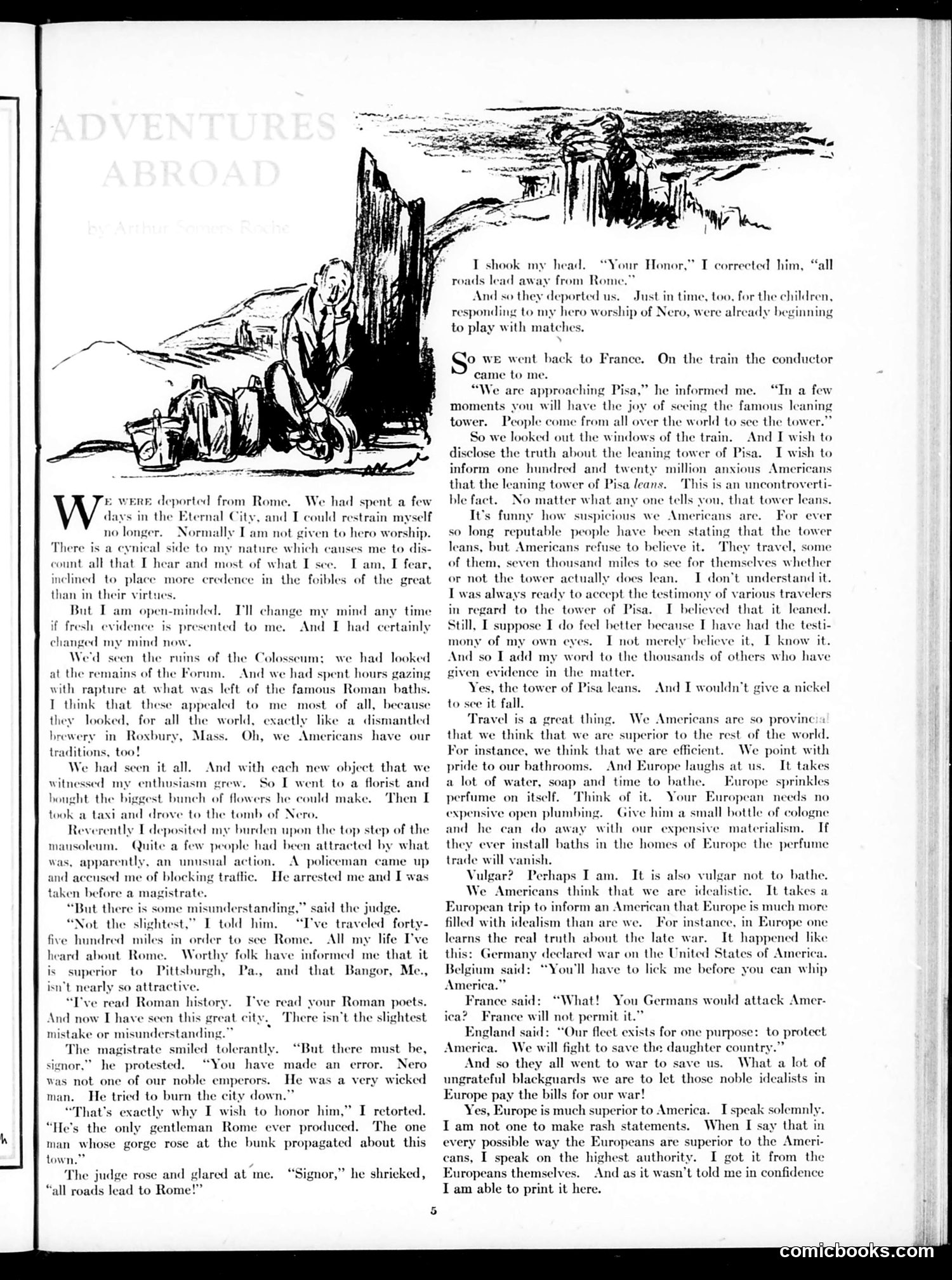
This is a satirical travel narrative mocking American tourists and their attitudes abroad. The narrator recounts being deported from Rome after leaving flowers at Nero's tomb—praising Nero as Rome's "only gentleman" because he opposed Roman propaganda, a absurd inversion of history that gets him arrested. The satire targets American provincial arrogance: the narrator dismisses Rome by comparing its famous baths to "a dismantled brewery in Roxbury, Mass." Later, he obsessively verifies the Leaning Tower of Pisa actually leans, refusing to trust centuries of witnesses—emblematic of American distrust and need for personal validation. The broader mockery: Americans travel thousands of miles seeking confirmation of what Europeans already know, inflate their own culture's superiority, and remain fundamentally incapable of genuine appreciation for history or foreign perspectives. The humor derives from the narrator's complete obliviousness to his own absurdity.
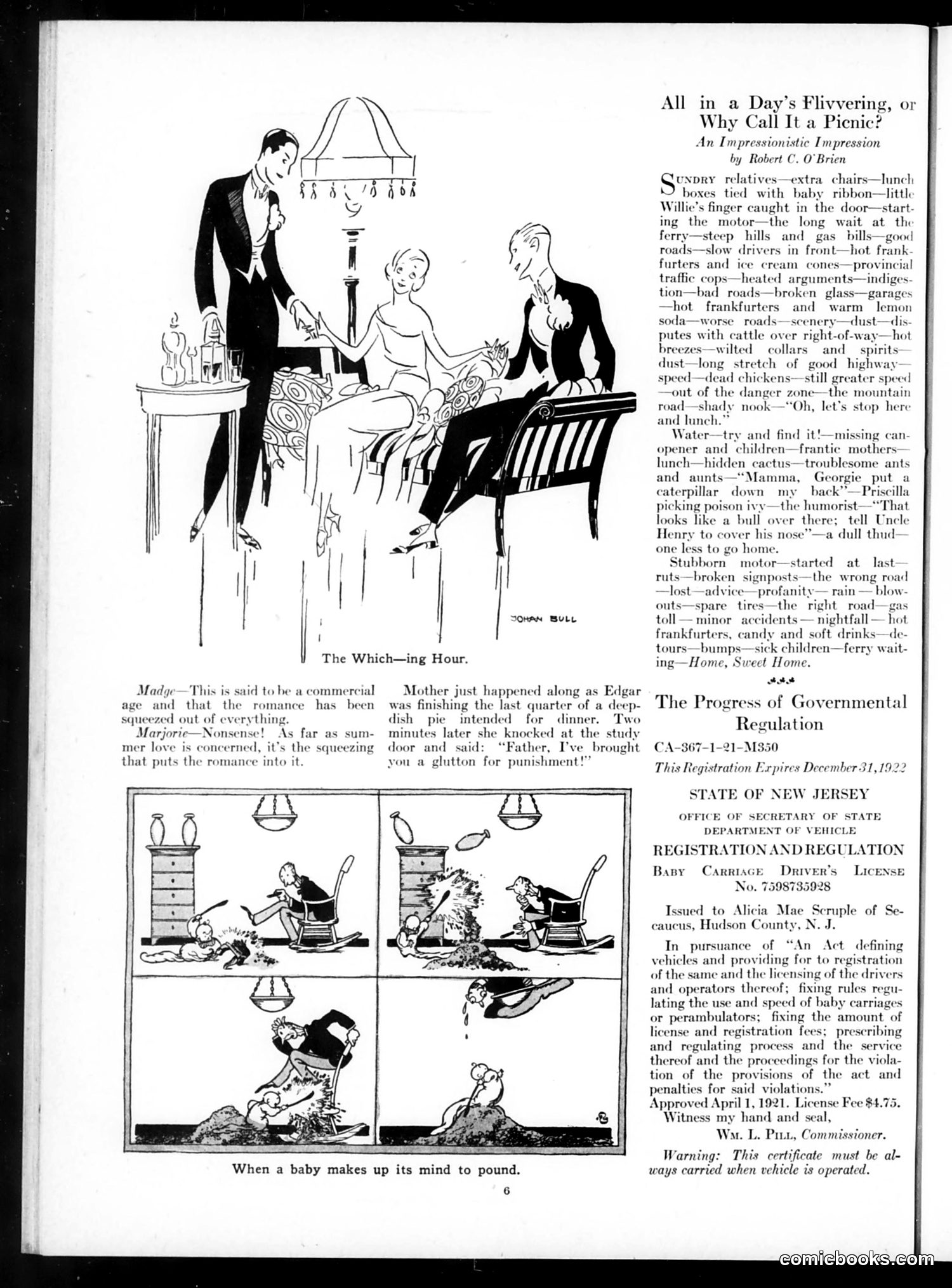
**Main Content:** This page contains satirical commentary on 1920s American leisure and government overreach. **"All in a Day's Flyvering" (top):** A humorous stream-of-consciousness essay mocking automobile outings ("flivvers" being cheap cars, likely Model Ts). The joke catalogs every annoyance of a family car trip: relatives, mechanical problems, traffic, bad roads, accidents, and squabbling—sarcastically asking why anyone calls this activity a "picnic." **The Whiching Hour (cartoon, left):** A romantic scene where a man flirts with a woman while her husband reads. The dialogue jokes that commercial/industrial culture has removed romance from life—but physical "squeezing" (embracing) compensates. **Baby Carriage Cartoon (center):** Comic panels showing domestic chaos when a baby pounds things, likely referencing destructive toddler behavior. **"Progress of Governmental Regulation" (right):** Satirical mock-document parodying bureaucratic absurdity by treating a baby carriage as a vehicle requiring government registration and licensing—mocking excessive regulation expanding into ridiculous areas. The page satirizes 1920s complaints about commercialism, automotive culture frustrations, and growing government bureaucracy.
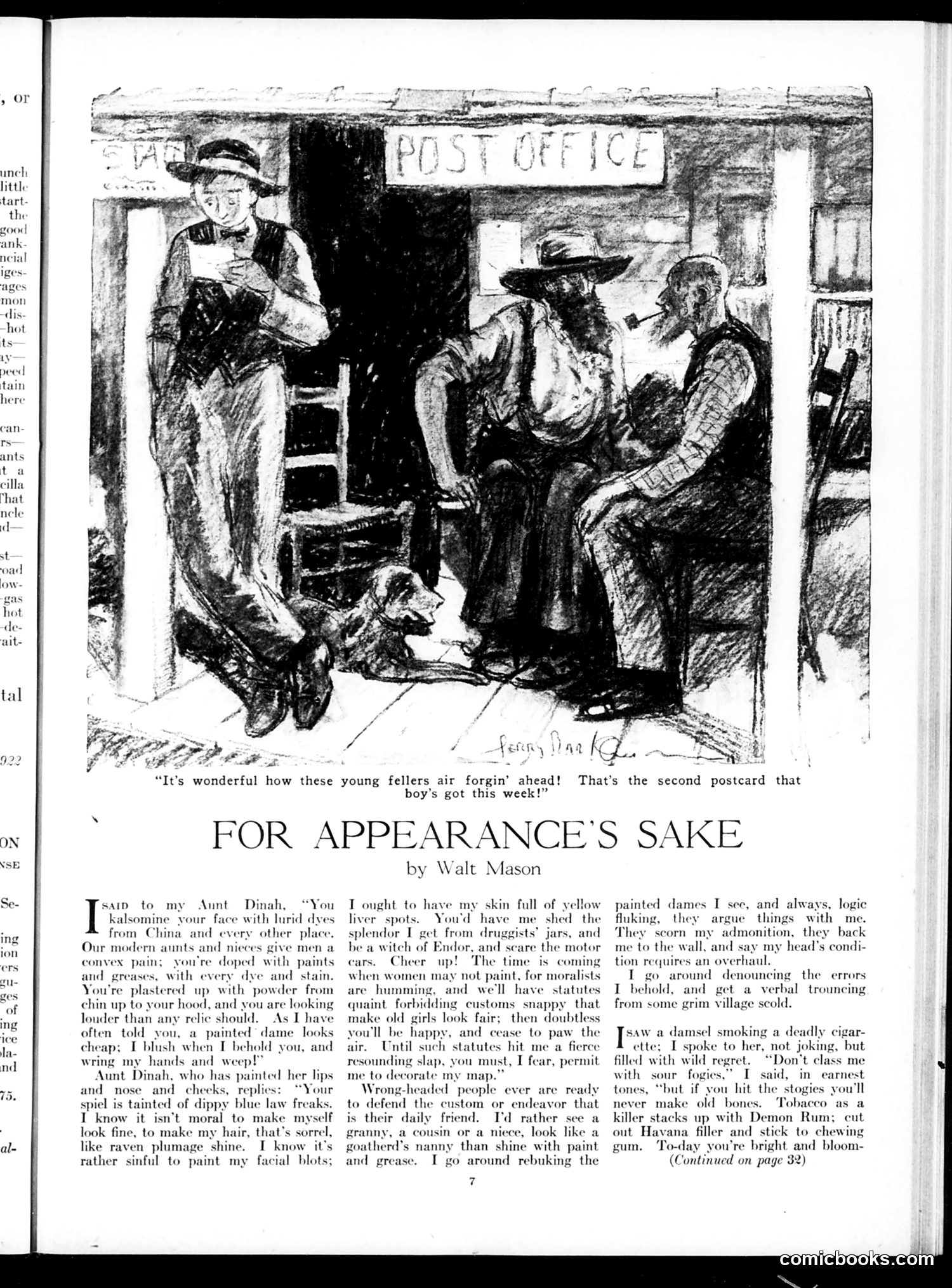
This page contains a **moral lecture disguised as humor**, typical of early 1920s American attitudes about women's appearance and behavior. **The Cartoon:** Shows a post office scene where young men receive postcards. The caption jokes that these "young fellers" are "forgin' ahead"—a pun suggesting they're advancing in life, though the postcards hint at romantic/potentially scandalous correspondence. **The Story "For Appearance's Sake":** A narrator complains to his Aunt Dinah about women wearing makeup, dyed hair, and cosmetics—practices he considers immoral and cheap. She defends herself, noting that until laws prohibit such "customs," she'll continue. The narrator admits his moral crusades fail; women ignore his criticism. **The Satire's Point:** Mason mocks the hypocrisy of moralists like the narrator, who self-righteously condemn women's cosmetics while failing to change behavior. The story also criticizes women smoking cigarettes and painting their faces—viewed as markers of moral decline in that era. The piece reflects 1920s anxieties about changing women's roles, sexuality, and independence following WWI and women's suffrage.
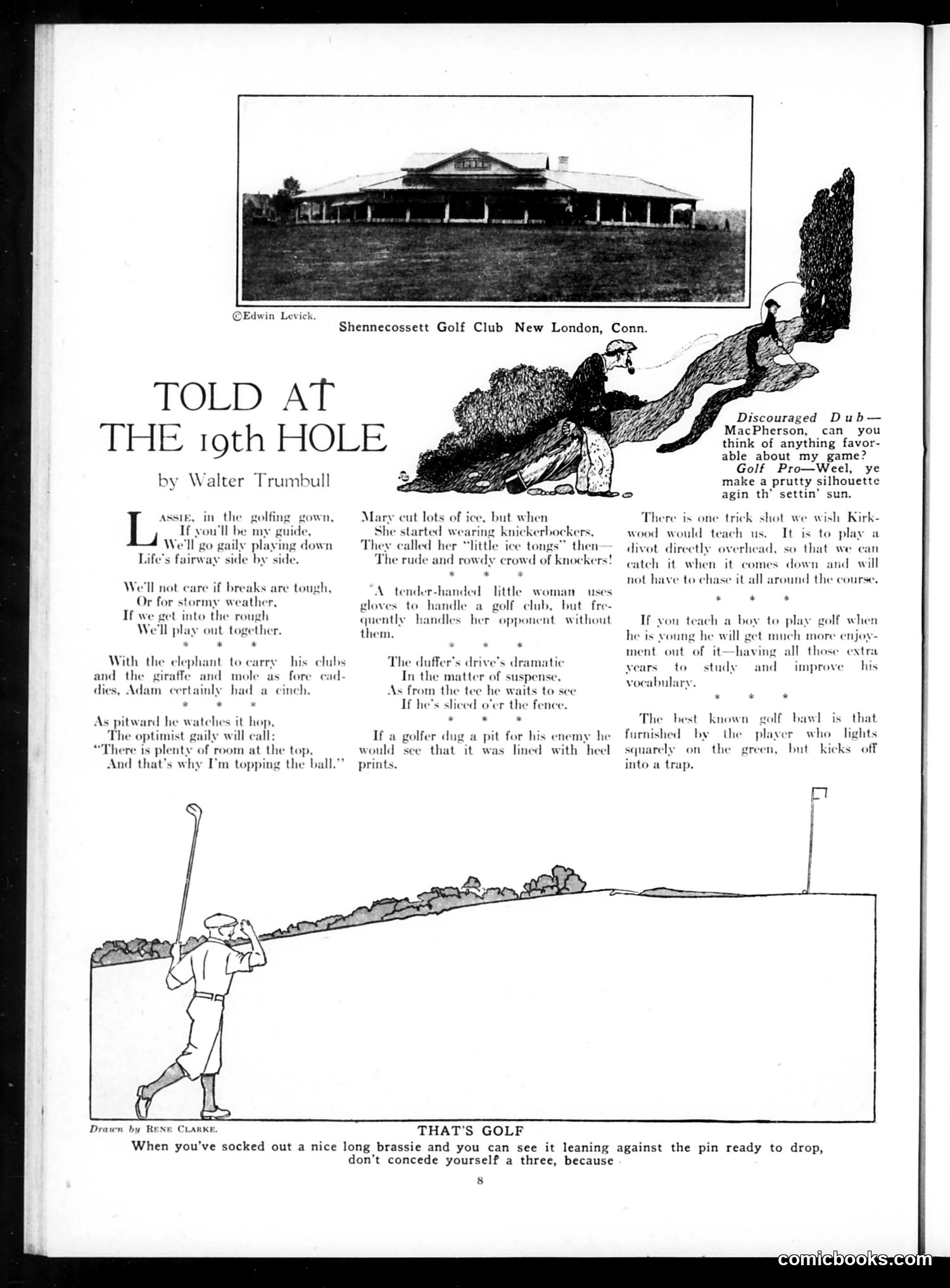
This is a humorous piece about golf etiquette and player behavior, not political satire. The "19th hole" (a golf term for the clubhouse bar) frames various observations about golfers. The jokes target common golf frustrations: women golfers wearing practical knickerbockers facing criticism ("ice tongs"), clumsy players ("duffers"), optimistic but poor shots ("topping the ball"), and competitive gamesmanship (digging pits for enemies). A Scottish golf pro offers gentle mockery to a struggling player—his only positive attribute is making "a prutty silhouette agin th' settin' sun." The cartoon illustrations by René Clarke show a golfer and a landscape. The top photograph shows Shennecossett Golf Club in Connecticut. The humor is gentle, club-based social satire about golf culture rather than political commentary—typical of Judge magazine's lighter sporting humor pieces.
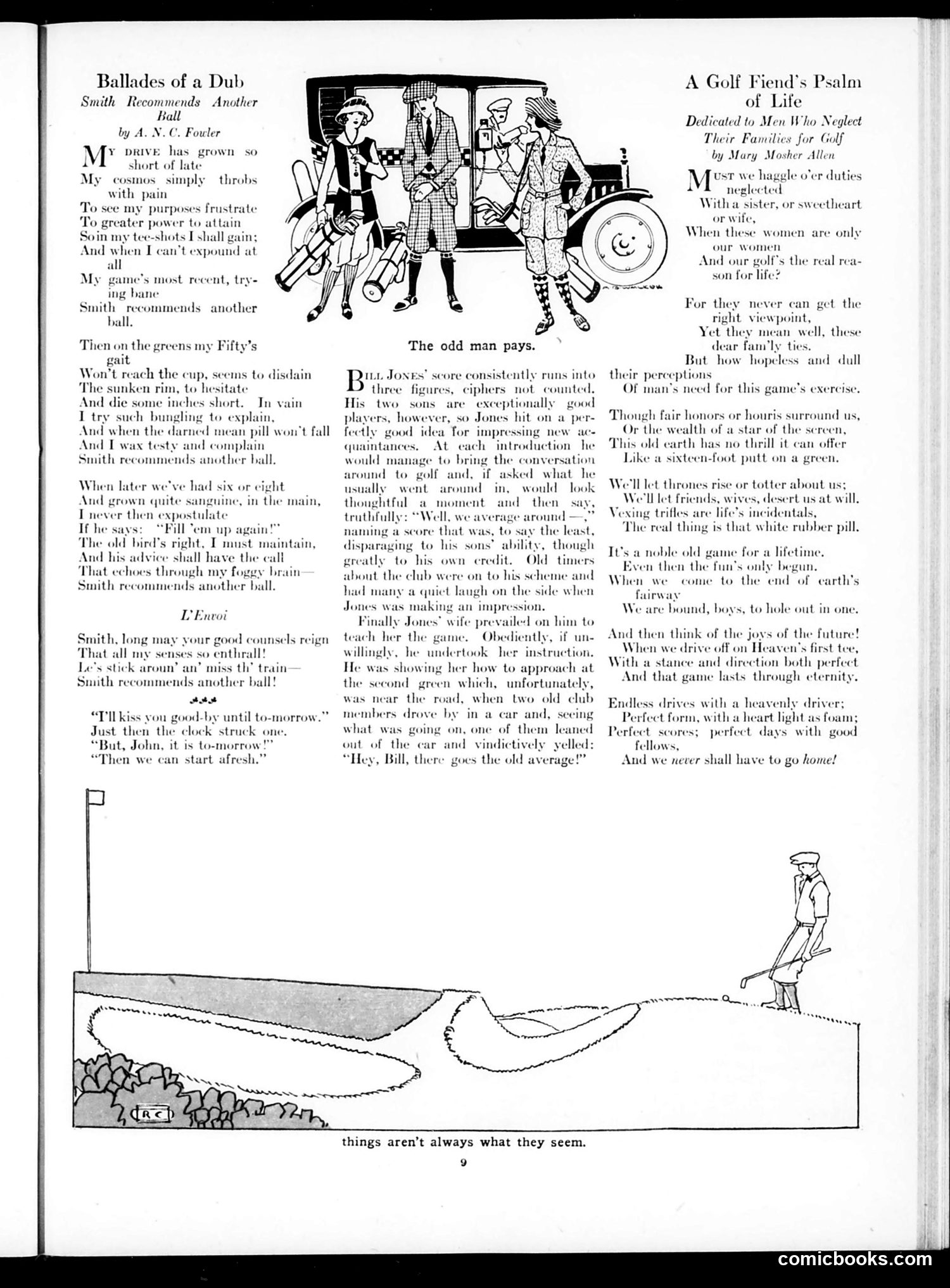
This page contains two golf-themed pieces satirizing early 20th-century leisure culture. **"Ballades of a Dub"** (left): A humorous poem about a mediocre golfer whose poor performance leads his club pro, Smith, to repeatedly recommend buying new golf balls. The joke is that the golfer blames his equipment rather than accepting his lack of skill. The anecdote about "the odd man pays" depicts Jones impressing acquaintances by mentioning his sons' golfing ability while concealing his own incompetence—until his wife's public lesson reveals the truth to observers, who laugh at his deception. **"A Golf Fiend's Psalm of Life"** (right): A satirical "psalm" mocking men who prioritize golf above family obligations. It mockingly celebrates golf's importance, suggesting golfers would abandon wives, friends, and duties for "that white rubber pill." The poem's bitter tone suggests the author views such obsession as spiritually empty—even imagining eternal golf in heaven as a grim joke rather than paradise. Both pieces gently mock golf's grip on American men's leisure time and the social pretenses surrounding the sport.
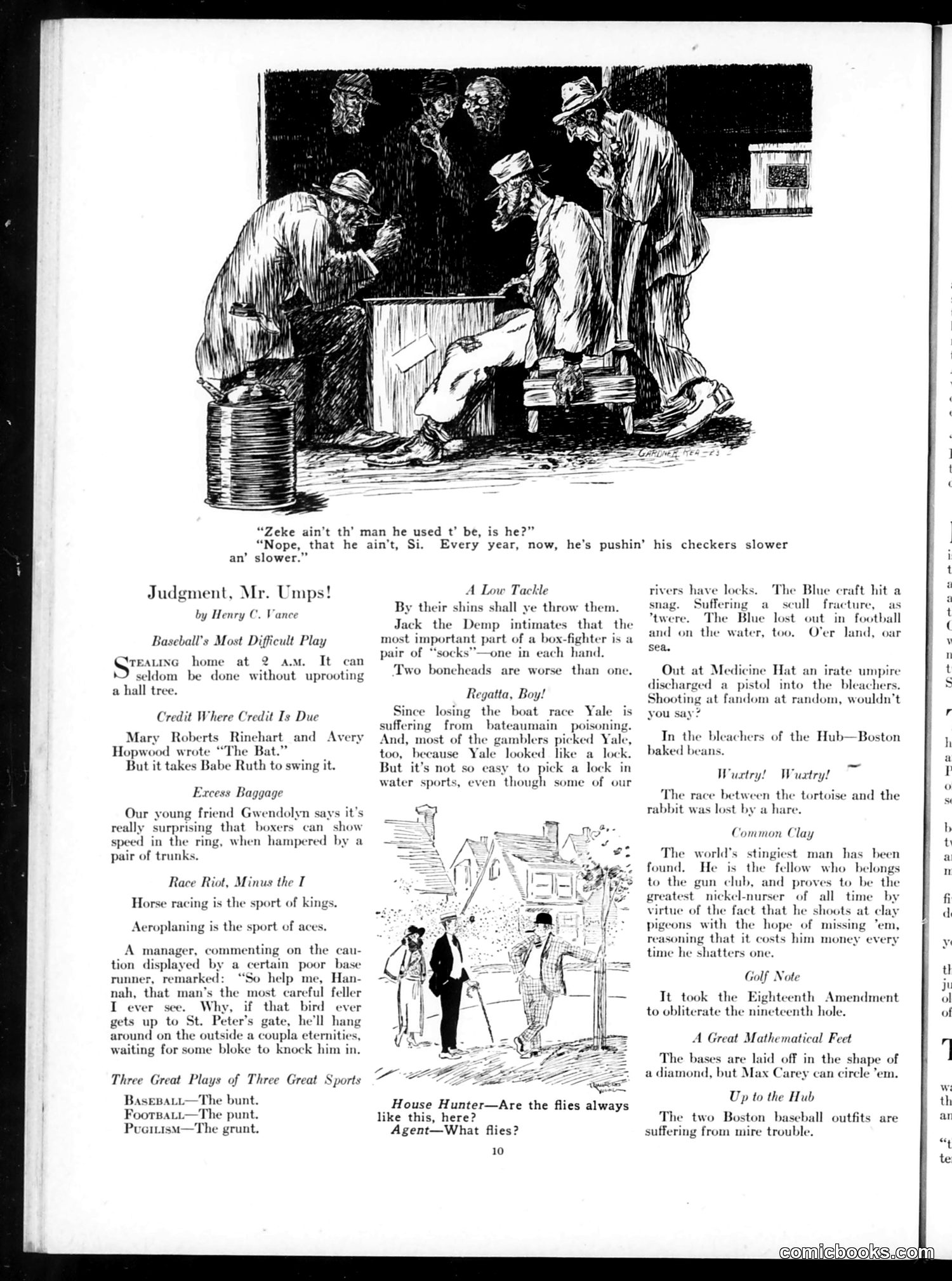
This page from *Judge* contains sports-themed humor pieces typical of early 20th-century American satire. The main illustration shows men at what appears to be a gambling or betting scene, with the caption about "Zeke" being slower—likely joking about aging athletes or declining performance. The text pieces satirize baseball, boxing, racing, and other sports through wordplay and social commentary. Notable references include: - **"Babe Ruth to swing it"**: Crediting the famous baseball player's popularity to a play's success - **"Jack the Demp"**: Jack Dempsey, heavyweight boxing champion, referenced for emphasizing footwork ("socks") - **Yale boat race**: A collegiate rowing competition - **The Eighteenth Amendment joke**: Prohibition-era humor equating golf's "nineteenth hole" (the bar) with the amendment - **Boston baseball teams**: References to Boston's two major league teams ("mire trouble" likely means performance issues) The humor relies on puns, double entendres about sports terminology, and contemporary celebrity references that *Judge* readers would recognize. It's primarily recreational sports commentary rather than political satire.
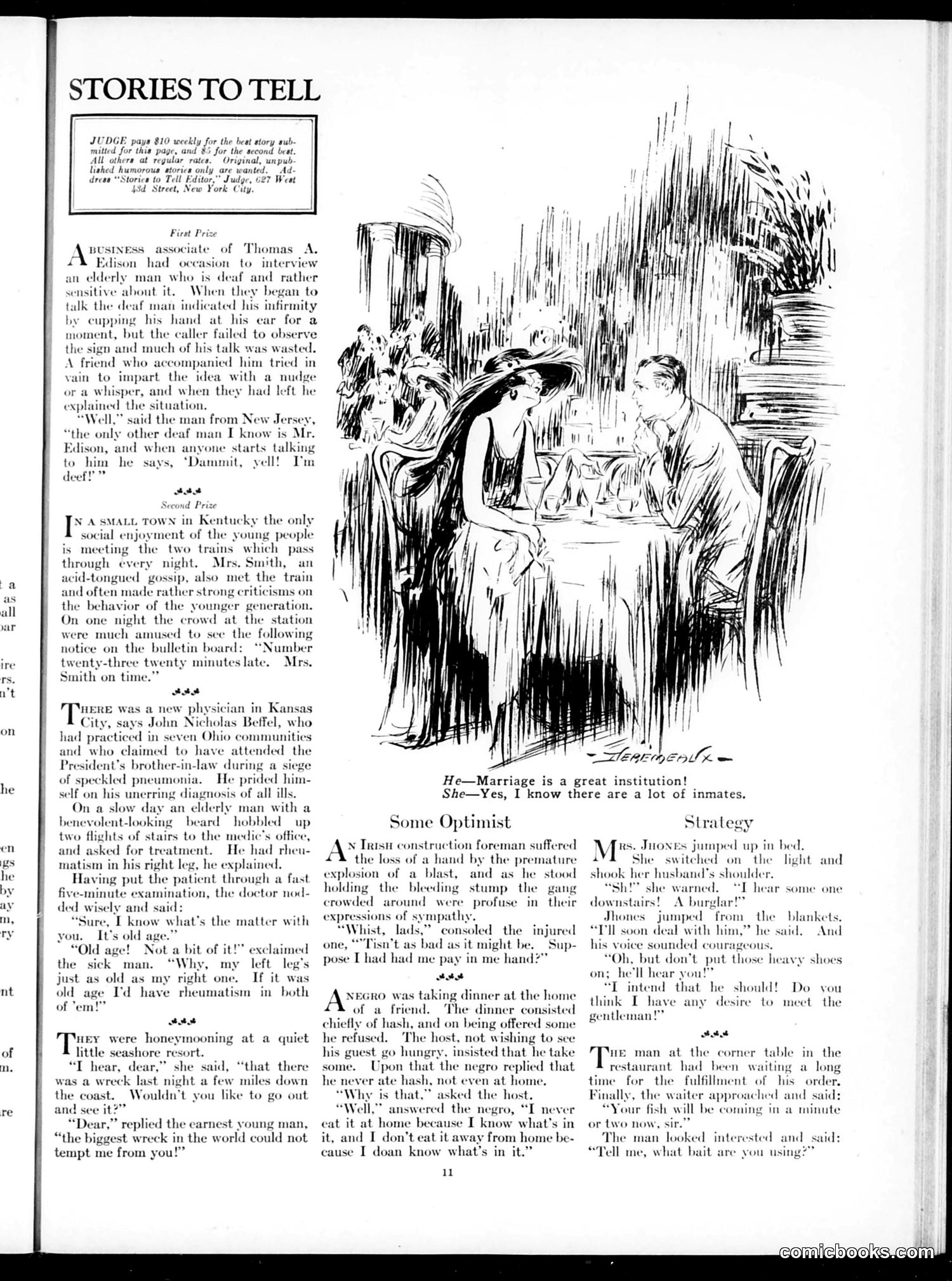
This page from Judge presents a collection of humorous short stories and anecdotes typical of early-to-mid 20th century American humor magazines. **Key Content:** The illustrated cartoon shows a couple dining, with the caption "Marriage is a great institution! She—Yes, I know there are a lot of inmates"—a play on the phrase equating marriage to imprisonment. **The Stories Include:** - A deaf man anecdote contrasting Edison's blunt manner with another deaf man's politeness - A small-town gossip named Mrs. Smith, perpetually late, humorously called out on a train station bulletin board - A doctor's misdiagnosis of "old age" as rheumatism - Racial stereotypes in a story about a Black man refusing hash - Various domestic comedy scenarios about marriage, burglary, and restaurant service **Context:** These reflect period attitudes—some affectionate, some mocking toward working-class life, gender dynamics, and racial caricature. The humor relies on wordplay, situational irony, and observational comedy typical of 1920s-30s popular magazines.
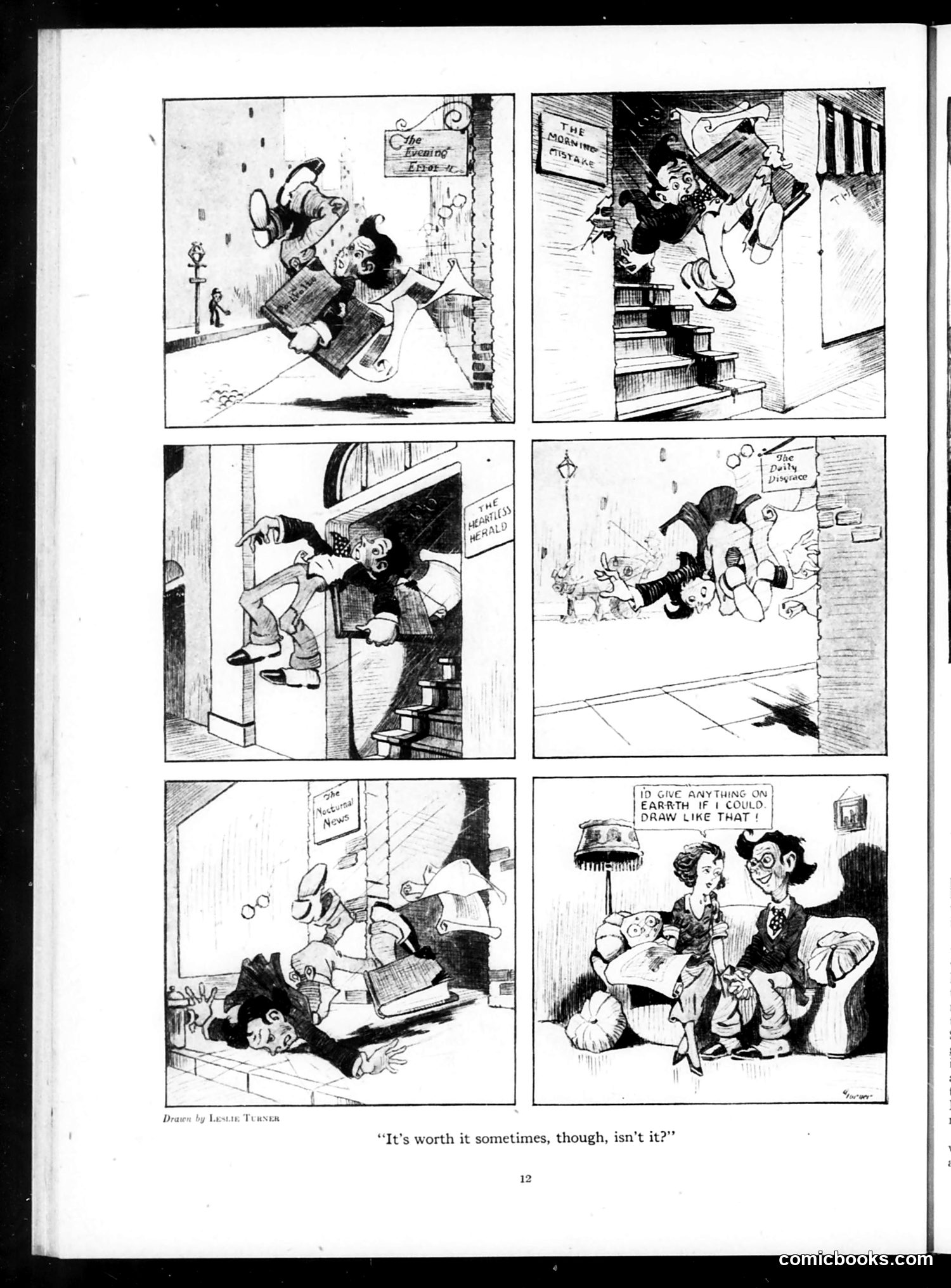
This is a six-panel comic strip drawn by Lynne Turner about an amateur artist's chaotic attempts to create drawings. The narrative follows someone trying to draw, creating increasingly absurd mishaps—overturned furniture, scattered papers, and general destruction—while pursuing artistic ambition. The final panel shows two figures admiring a finished drawing, with one exclaiming they'd give anything to draw like that. The caption's punchline—"It's worth it sometimes, though, isn't it?"—suggests the humor lies in the gap between artistic aspiration and comedic reality: the character has caused tremendous mess and destruction, yet still values the end result enough to justify the chaos. It's gentle satire of artistic pretension and the suffering-artist trope, using physical comedy rather than political commentary.
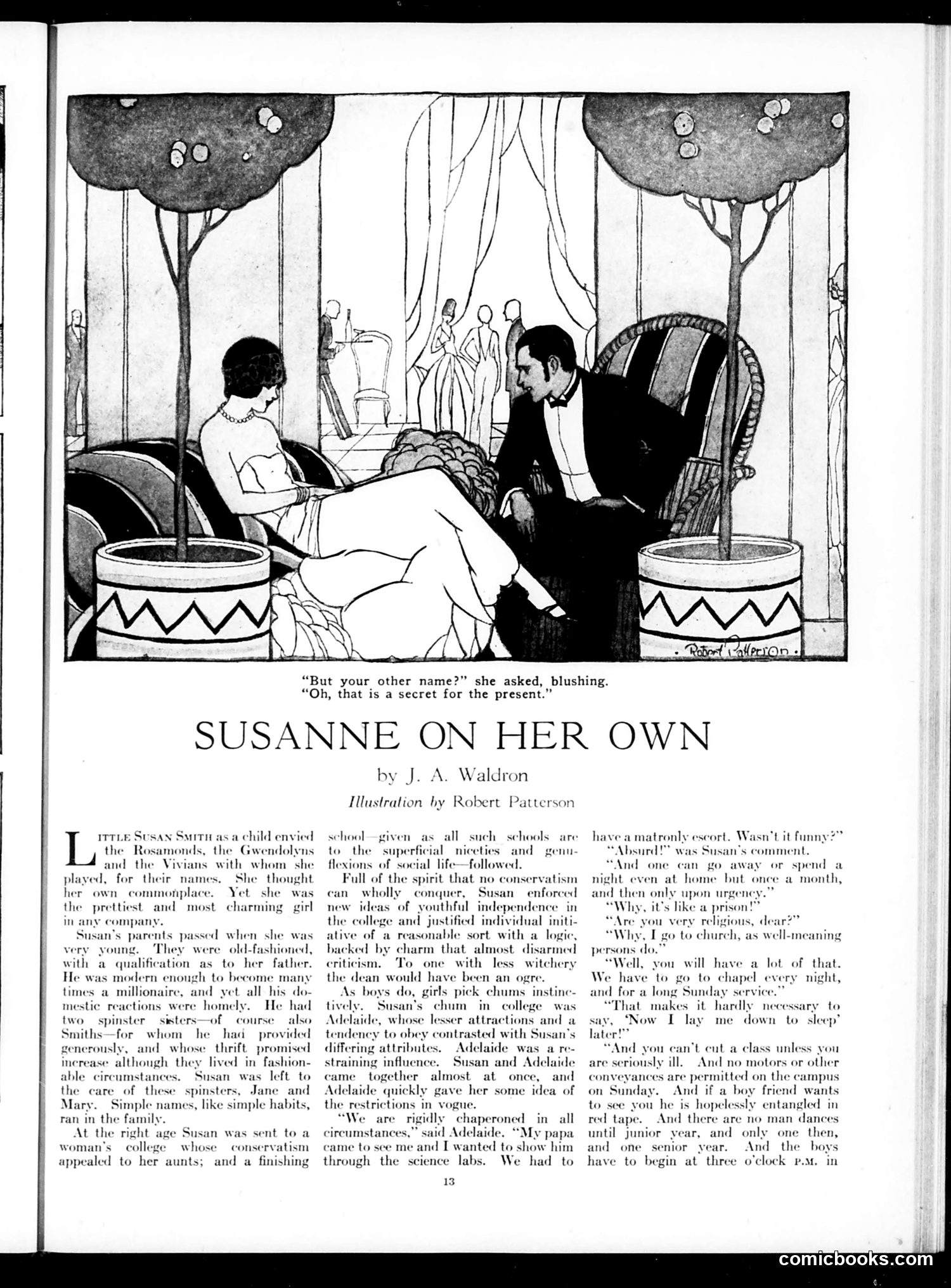
This is a serialized story (not political satire) about a young woman navigating social independence. The illustration shows an intimate scene between two characters—likely Susan and a male acquaintance—in a luxurious interior with fountains and draped fabrics, establishing an upper-class setting. The text reveals the story's theme: Susan, raised by conservative aunts despite her wealthy father, attends a women's college with strict rules. Her friend Adelaide describes absurd restrictions—requiring chaperones for lab tours, limiting unsupervised time, prohibiting motor vehicles on Sundays, and severely restricting male visitors. The dialogue mocks these oppressive regulations governing young women's behavior. The story appears to critique early 20th-century institutional constraints on female independence and social freedom, positioning Susan as someone with "spirit" who questions these arbitrary rules alongside her more rebellious friend Adelaide.
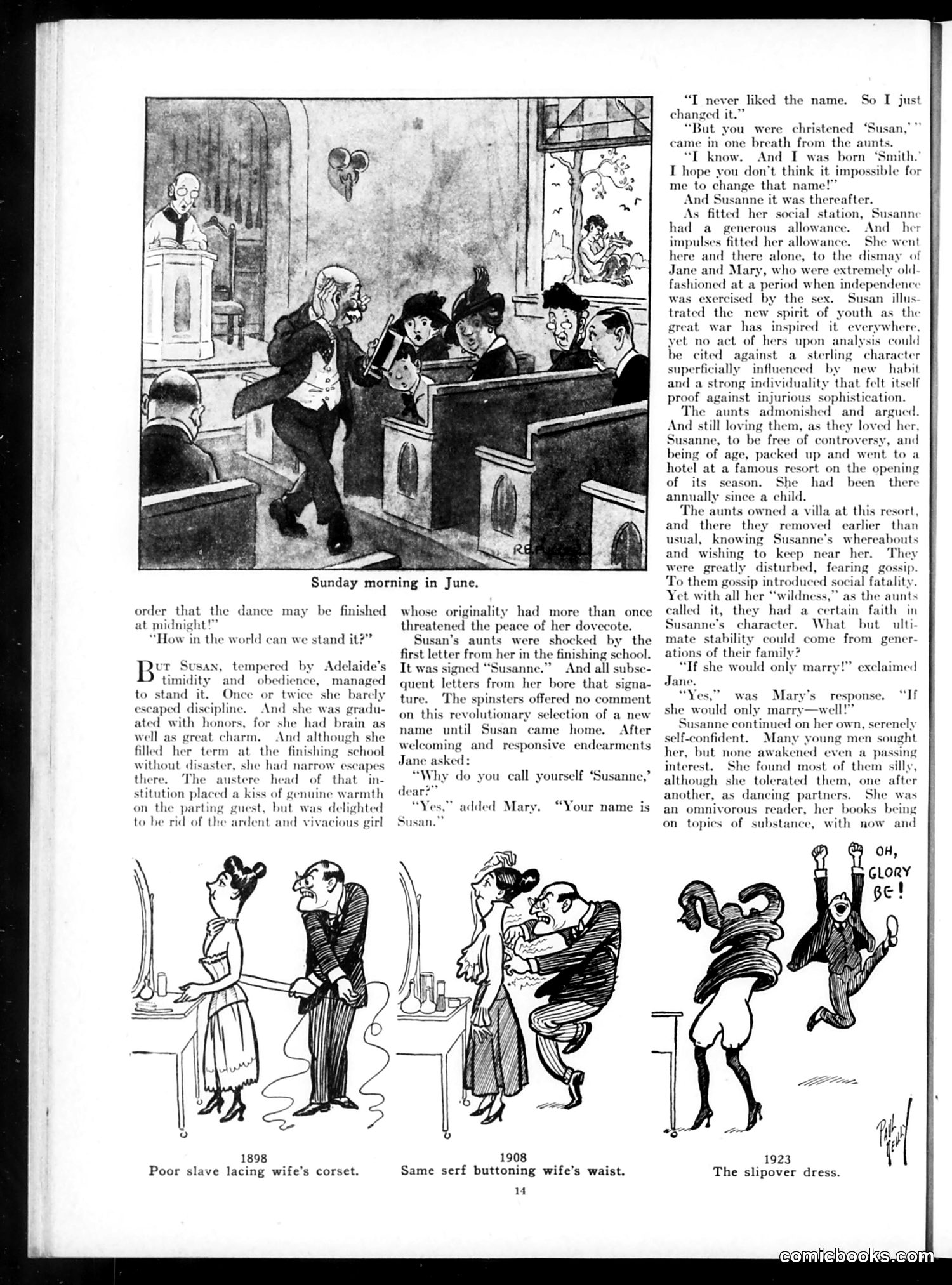
This page from *Judge* magazine presents a serialized story about "Susanne," a young woman rebelling against her conservative elderly aunts by changing her name and embracing modern independence following World War I. The three small cartoons at the bottom illustrate changing fashion and gender dynamics across three decades (1898, 1908, 1923), showing men lacing women's corsets progressively looser, culminating in the 1923 "slipover dress"—satirizing how rapidly women's fashion and autonomy evolved. The story itself mocks the aunts' anxiety about gossip and propriety versus Susanne's matter-of-fact individualism. The satire targets generational conflict: elderly spinsters fearing scandal contrasted with a modern young woman uninterested in marriage, unimpressed by suitors, and confident in self-determination. The narrative celebrates Susanne's "strong individuality" as representative of post-WWI youth culture—implying the war accelerated social change that made traditional restrictions obsolete.
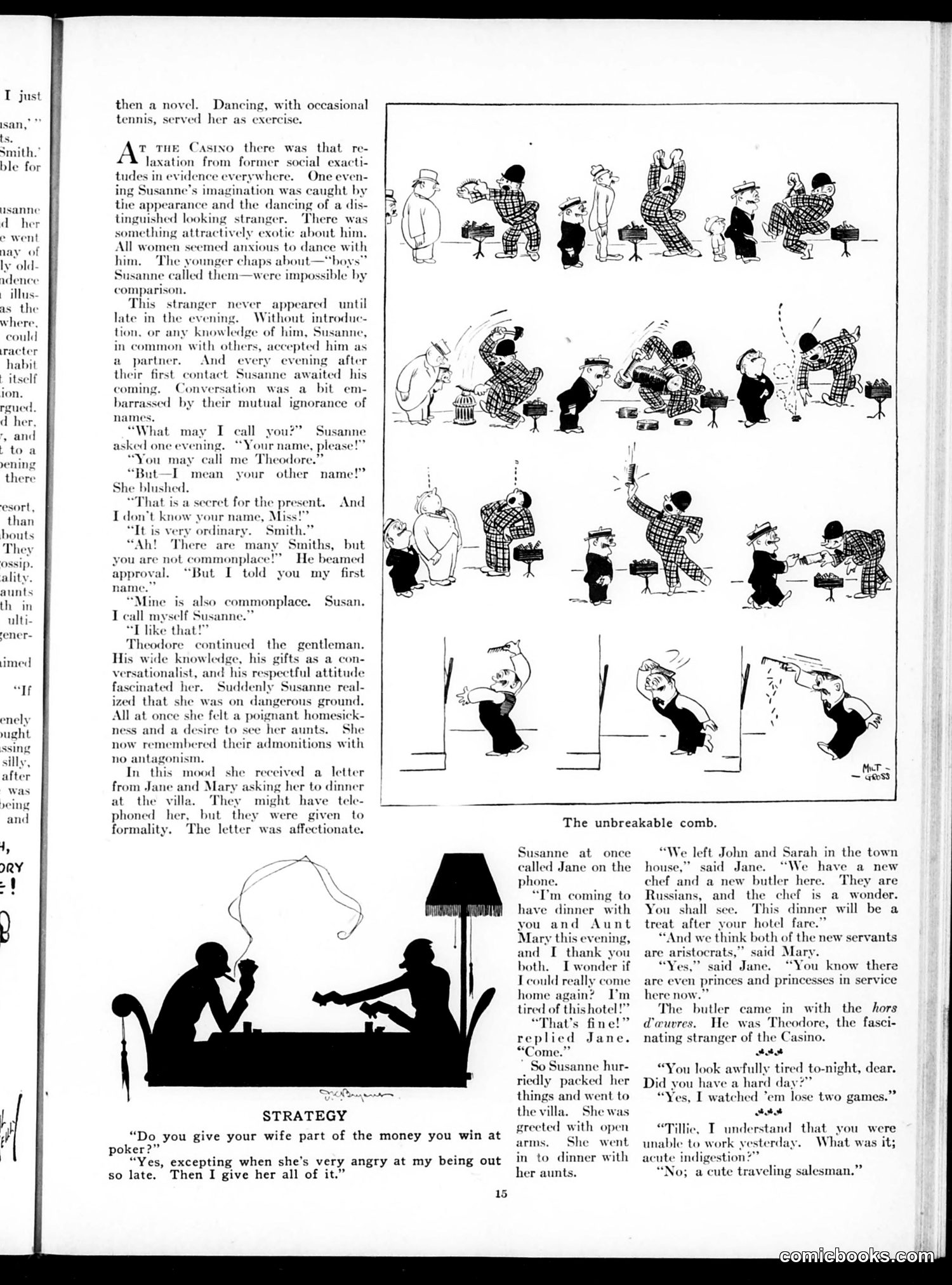
This page contains a serialized story illustrated with comic panels about a young woman named Susanne who encounters a mysterious, charming stranger ("Theodore") at a casino. The narrative warns against her fascination with this unknown man, as her concerned aunts previously advised against such entanglements. The story resolves with dramatic irony: Susanne flees the casino for her aunts' villa, only to discover that "Theodore"—the very man she was becoming dangerously attached to—is actually their new butler, a Russian servant. This twist undercuts any romantic possibilities and reinforces the aunts' moral lesson about propriety. The page also includes unrelated satirical cartoons: one about poker winnings and marital dynamics, another titled "The unbreakable comb," and a brief exchange about a "cute traveling salesman." These reflect Judge's typical format mixing serialized fiction with standalone humor reflecting early 20th-century social attitudes toward courtship, class boundaries, and gender relations.
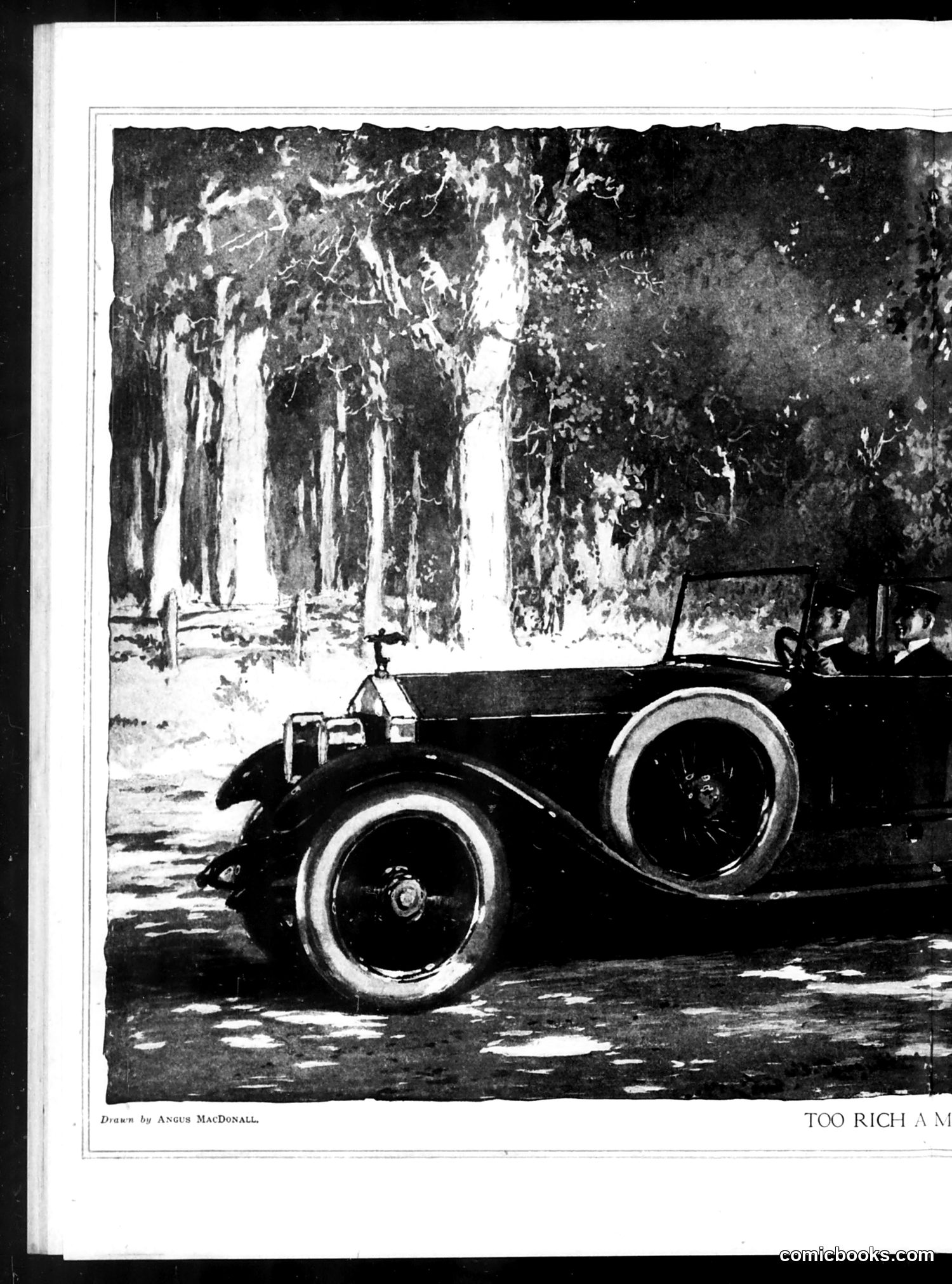
This appears to be an illustration from Judge magazine drawn by Angus MacDonald, titled "Too Rich A[?]" (title cut off). The image shows an early automobile (appearing to be from the 1910s-1920s era) with well-dressed passengers, positioned beneath towering redwood or sequoia trees. The satire likely comments on wealth and luxury—the fancy motorcar contrasts with the natural grandeur of the ancient forest, possibly critiquing the nouveau riche or materialism of wealthy automobile owners. The juxtaposition suggests irony: despite their expensive vehicle, these wealthy travelers are dwarfed by nature's majesty, implying their material possessions cannot compete with or should not overshadow natural splendor. Without the complete title, the specific satirical target remains unclear, though the theme appears to be commentary on class, consumption, or the relationship between industrial wealth and nature.
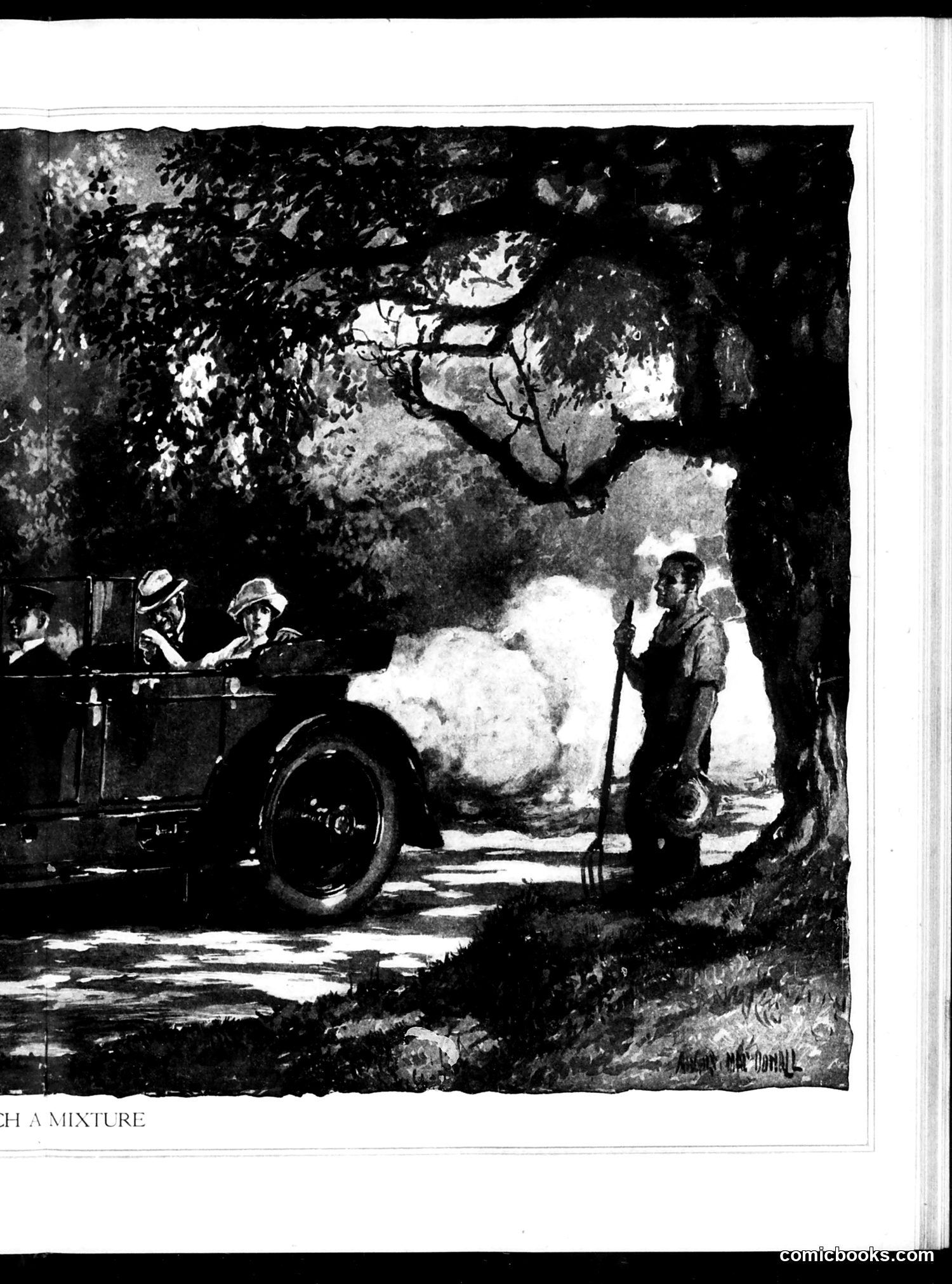
This appears to be an illustration from Judge magazine depicting an early automobile scene. The image shows a vintage car with several figures—two men in the vehicle and at least one man standing nearby, all wearing period hats. There's visible smoke or steam coming from the automobile. The partial text at bottom reads "CH A MIXTURE," which is incomplete and unclear without the full caption. The scene likely satirizes early automobile problems—the smoke suggests mechanical failure, engine trouble, or overheating, common sources of humor in early 1900s automotive satire. However, **without the complete caption and without being able to identify specific individuals in the cartoon, I cannot determine the precise political or social point being made**. The illustration may be mocking automotive unreliability, a specific incident, or particular figures associated with early motoring.
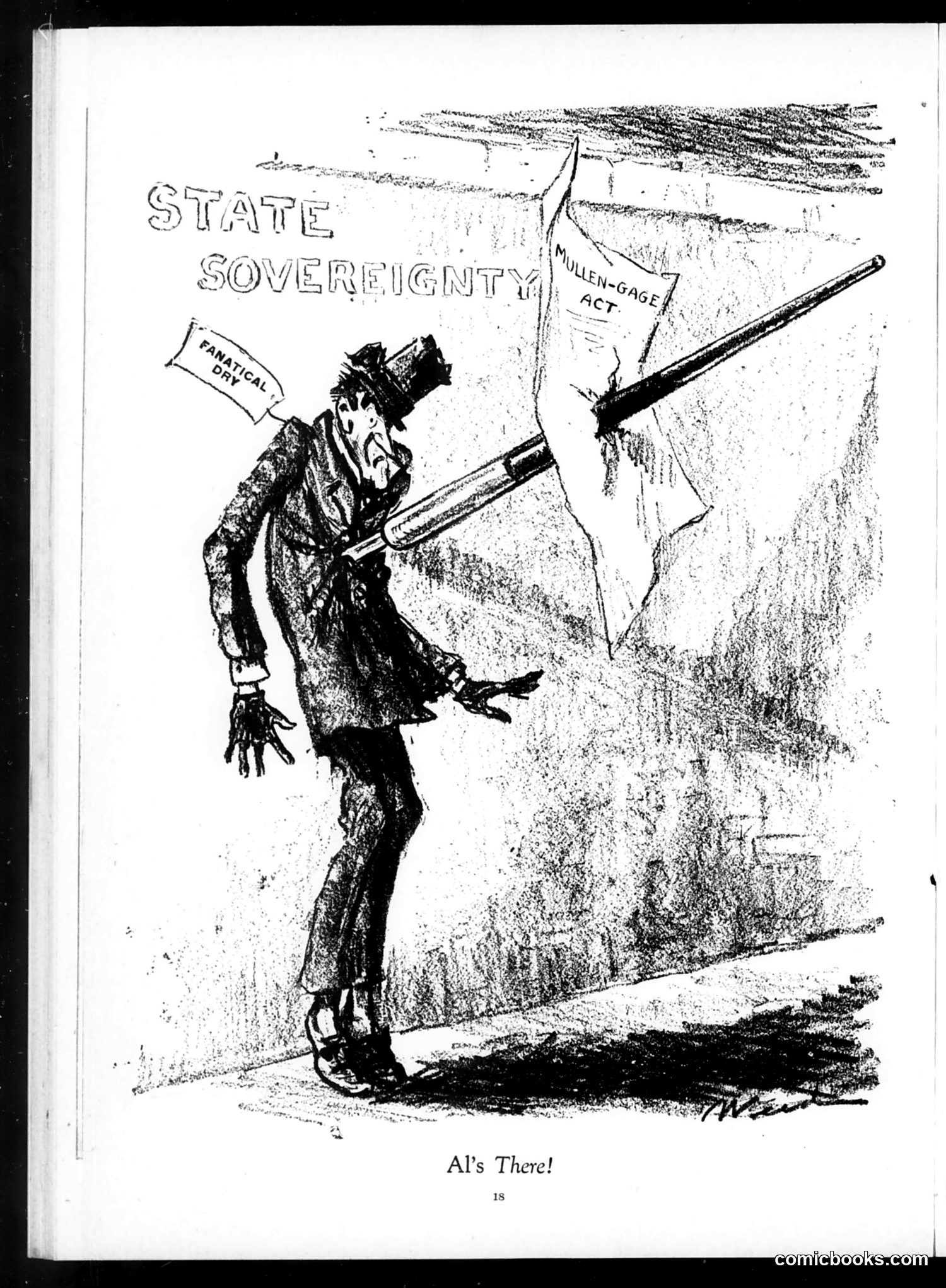
This Judge magazine cartoon satirizes threats to **state sovereignty** during what appears to be early-20th-century American constitutional debates. A caricatured figure labeled "FANATICAL" juggles two documents: the "MULLEN-GAGE ACT" and "STATE SOVEREIGNTY." The figure's exaggerated, menacing expression suggests dangerous ideological extremism. The cartoon critiques advocates of the Mullen-Gage Act (likely referring to federal legislation) as threatening state independence through federal overreach. The title "Al's There!" suggests a political figure named Al (possibly unclear without additional context) is responsible for or associated with this threat to constitutional balance. The cartoon's central message: federal expansion of power endangers the autonomy states traditionally protected under American federalism. This reflects Judge magazine's typical role critiquing progressive reforms perceived as centralizing government power.
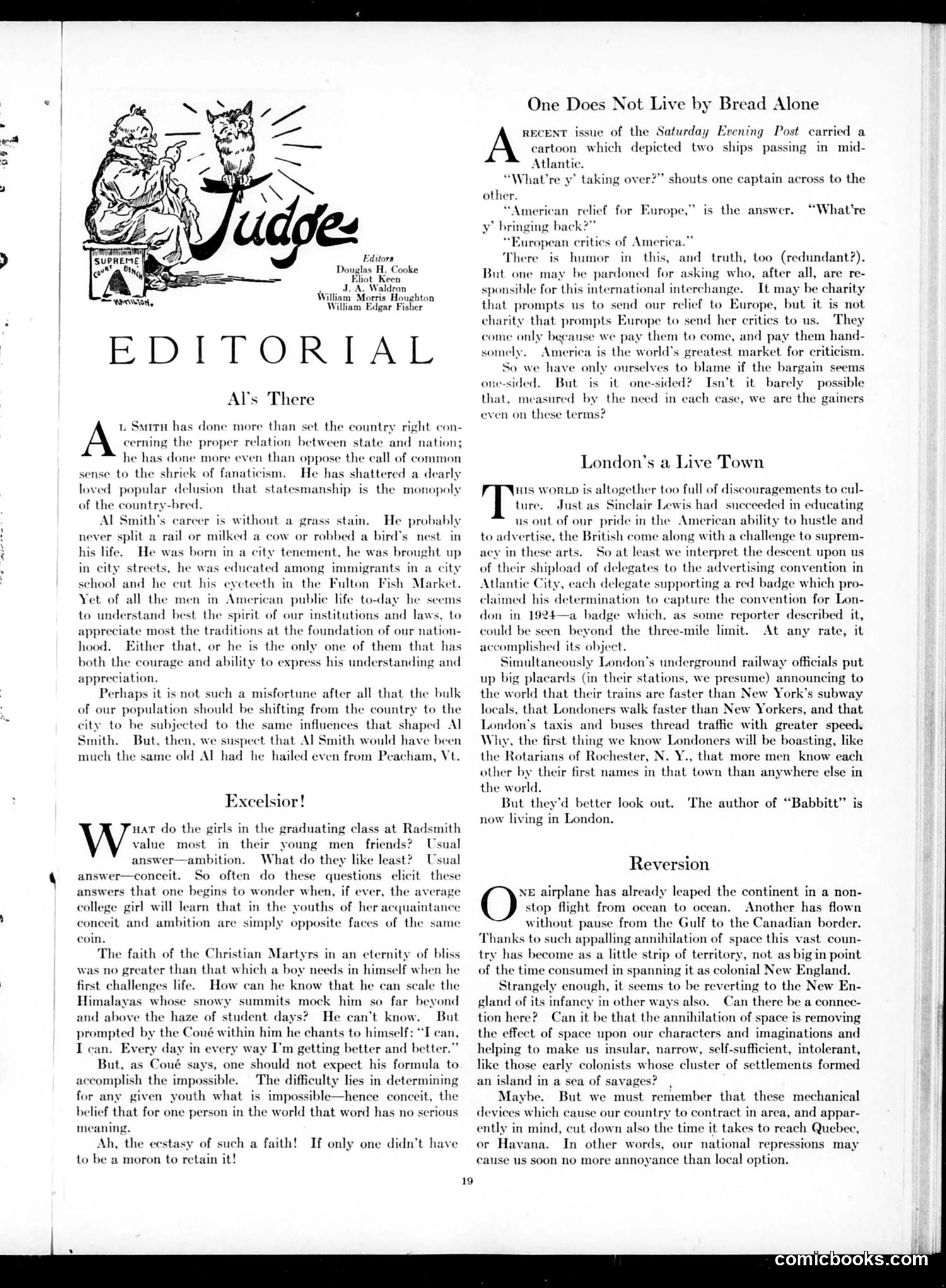
## Main Cartoon (Top Left) The "Judge" masthead features the magazine's signature owl and jester character—recurring symbols of satirical commentary. ## "Al's There" Editorial Praises Al Smith, likely the 1920s-era New York politician and future presidential candidate. The piece defends Smith's urban, working-class background (born in a tenement, educated among immigrants at the Fulton Fish Market) as actually superior qualification for public office than rural origins. This challenges the then-common assumption that statesmanship required country breeding—a dated American ideal. ## "One Does Not Live by Bread Alone" References a *Saturday Evening Post* cartoon about transatlantic ships: one carries American relief aid to Europe; the other carries European critics back to America. Judge satirizes American willingness to pay handsomely for foreign criticism while sending charity—implying Americans are willing dupes underwriting their own mockery. All content reflects early 20th-century debates about urbanization, American cultural superiority, and foreign relations.
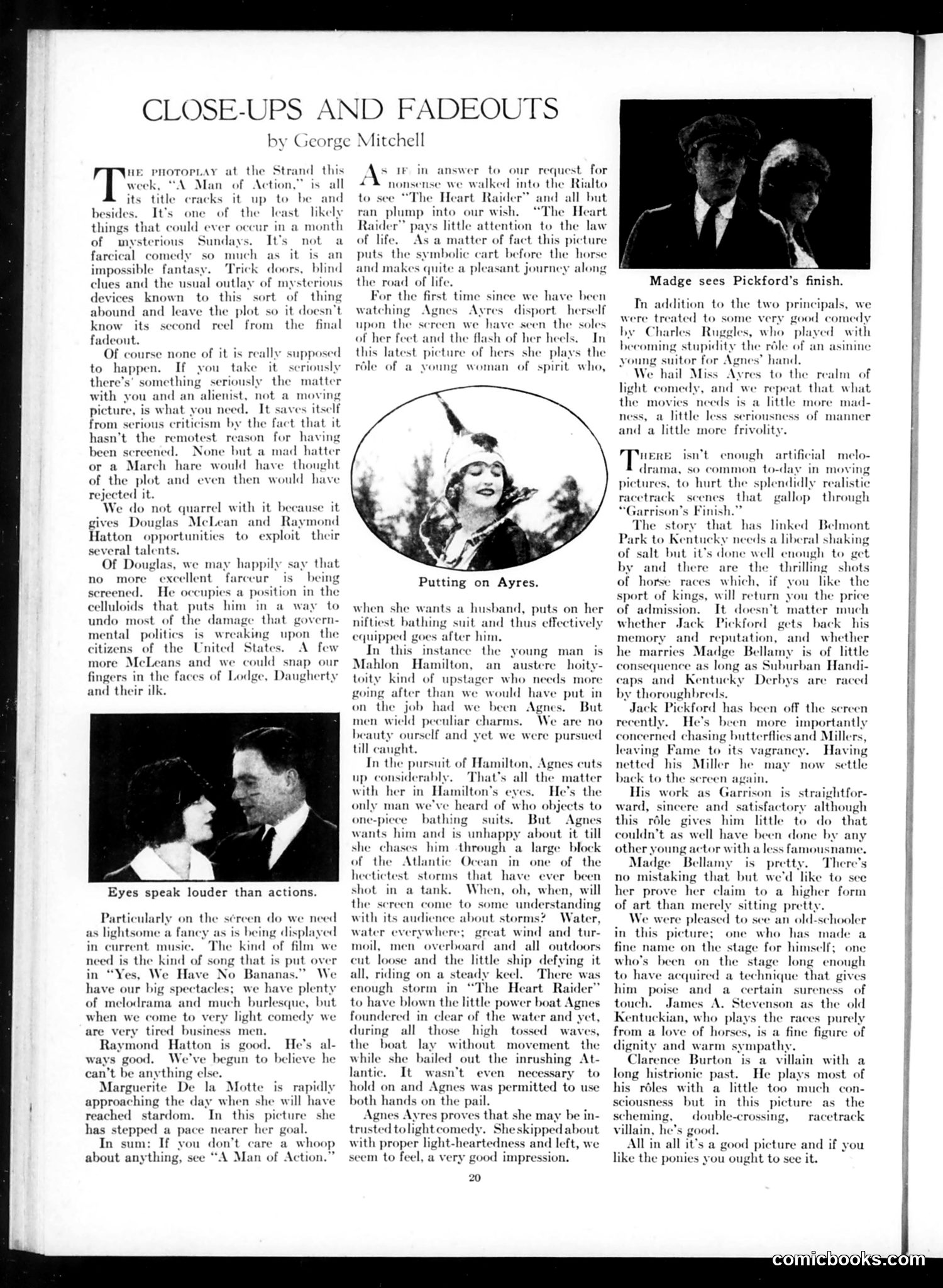
This is a film review column discussing three contemporary movies. The text contains no political satire or cartoon content—it appears to be a straightforward cinema criticism piece from Judge magazine's entertainment section. The reviewer discusses: 1. **"A Man of Action"** — starring Douglas McLean and Raymond Hatton, described as lightweight farce. The critic praises McLean's comedic talents as beneficial counterweight to "governmental politics" damaging American citizens (a subtle political reference, though not satirical). 2. **"The Heart Raider"** — featuring Agnes Ayres and Mahlon Hamilton. The reviewer humorously notes Ayres' character pursues Hamilton by wearing a bathing suit, and criticizes Hollywood's overuse of storm scenes. The column includes photographs of the actors but no political cartoons. It's essentially entertainment journalism offering opinions on current film releases to Judge's readership, mixing genuine critique with light humor about cinema conventions.
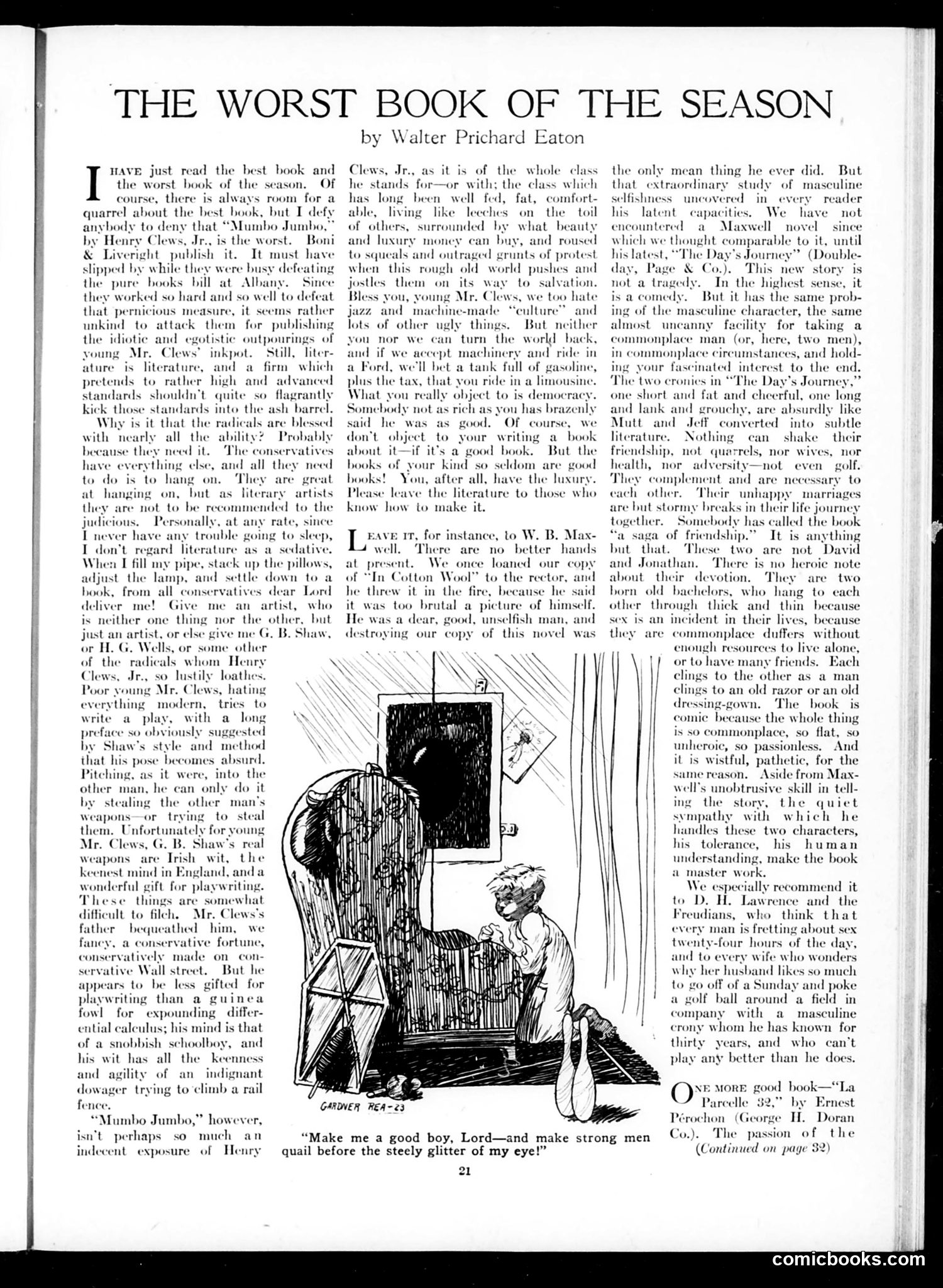
This is a book review essay attacking Henry Clews Jr.'s novel "Mumbo Jumbo" as the season's worst book. The accompanying illustration depicts a wealthy, rotund gentleman (likely Clews himself, based on context) in formal dress, representing the privileged class Eaton criticizes. Eaton's satire targets Clews as emblematic of conservative, wealthy elites who oppose modernism while hypocritically adopting modern conveniences. Clews attempts writing a play mimicking G.B. Shaw's style but lacks Shaw's genuine wit and Irish intellect. The criticism extends to the entire class Clews represents—wealthy, comfortable people living off others' labor, now protesting the modern world they secretly depend upon (Fords, limousines, machinery). Eaton contrasts Clews unfavorably with genuine literary talent like W.B. Maxwell, suggesting that quality literature requires authentic artistic ability, not merely conservative complaints about modern culture.
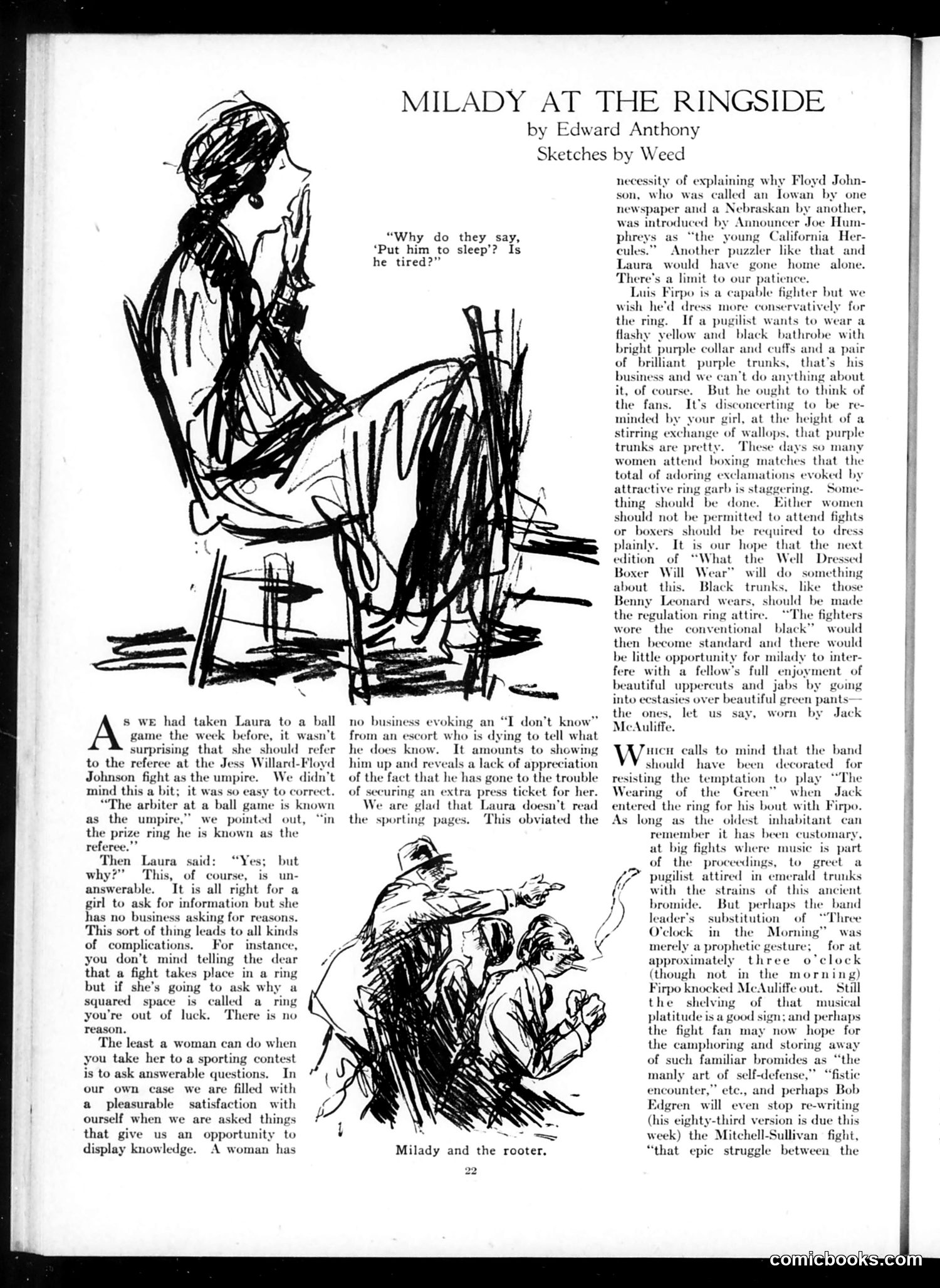
This is a humorous essay by Edward Anthony (illustrated by Weed) about taking a woman named Laura to a boxing match. The piece satirizes both female spectators at sporting events and the pretensions of male escorts eager to display knowledge. The main joke: Laura asks naive questions ("Why do they say 'Put him to sleep'?"), which the narrator finds simultaneously annoying and gratifying—annoying because she won't accept answers without demanding explanations, but satisfying because it lets him show off his expertise. The essay references actual boxers (Jess Willard, Floyd Johnson, Luis Firpo, Jack McAuliffe) competing around 1923. The secondary satire targets boxers' flashy attire: Firpo's purple trunks distract female spectators from enjoying the fight itself. The author argues boxers should wear regulation black trunks, and bands should stop playing sentimental Irish songs for Irish fighters. It's fundamentally a piece of 1920s gender humor—condescending toward women's sporting knowledge while mocking male vanity.
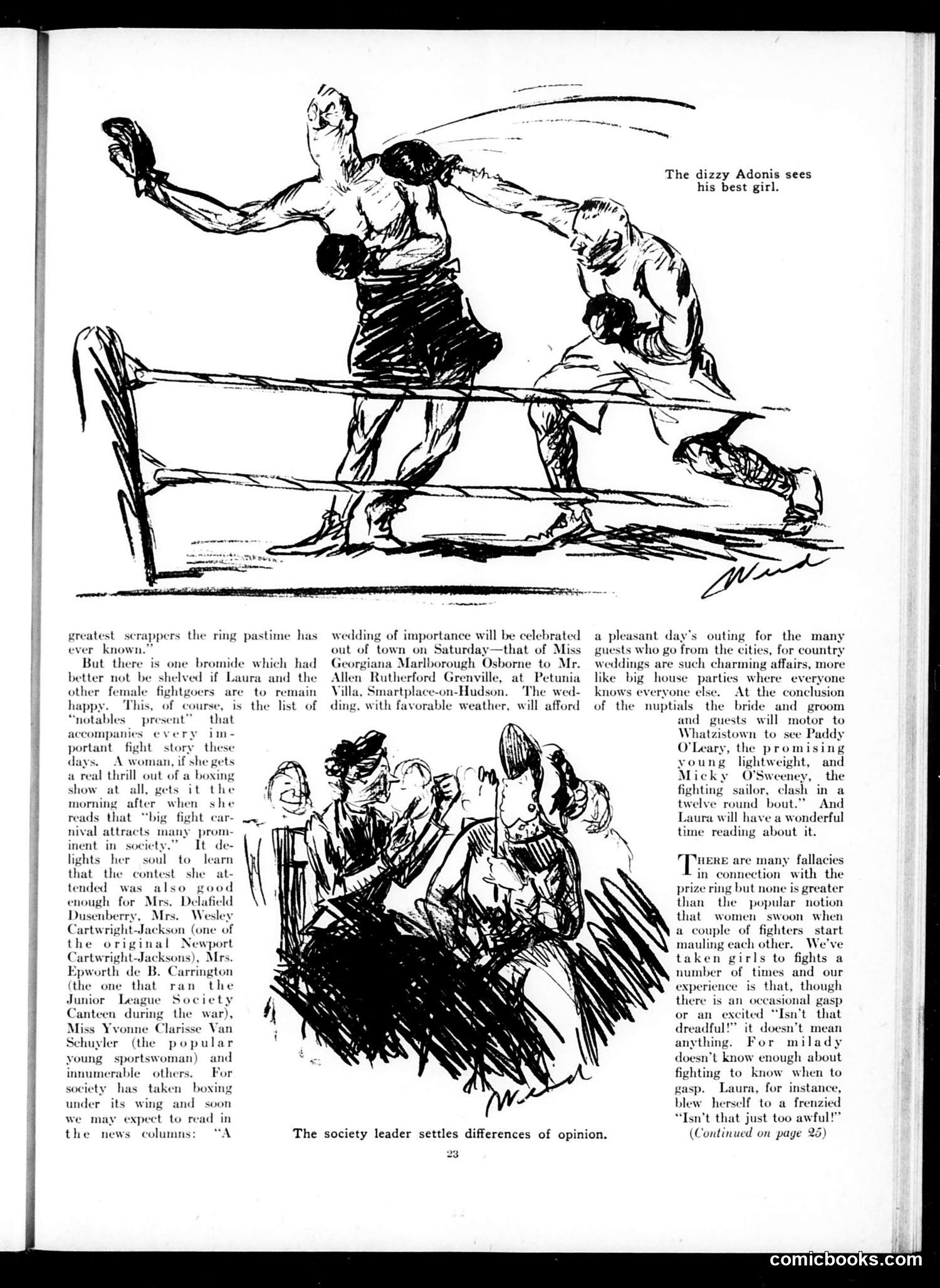
This Judge magazine page satirizes upper-class women's newfound enthusiasm for boxing, a sport previously considered unsuitable for "society" ladies. **The Satire:** The article mocks how wealthy women attend prizefights primarily to be seen alongside other prominent society figures—names like "Mrs. Cartwright-Jackson" and "Miss Yvonne Clarisse Van Schuyler" are listed as attractions. The humor lies in the absurd notion that high-society women find boxing fashionable only because other society women attend. **The Cartoons:** The top illustration shows a dizzy boxer seeing his "best girl" (likely multiple visions from being punch-drunk). The bottom cartoon depicts "the society leader" settling disputes—suggesting wealthy women now view themselves as authorities on boxing disputes. **The Point:** The piece debunks the myth that women "swoon" at fights, claiming women lack actual boxing knowledge but still attend for social status. The punchline: Laura exclaims "Isn't that just too awful!" at entirely the wrong moment—proving the emptiness of her participation. This reflects 1920s anxieties about changing gender roles as women gained more public presence.
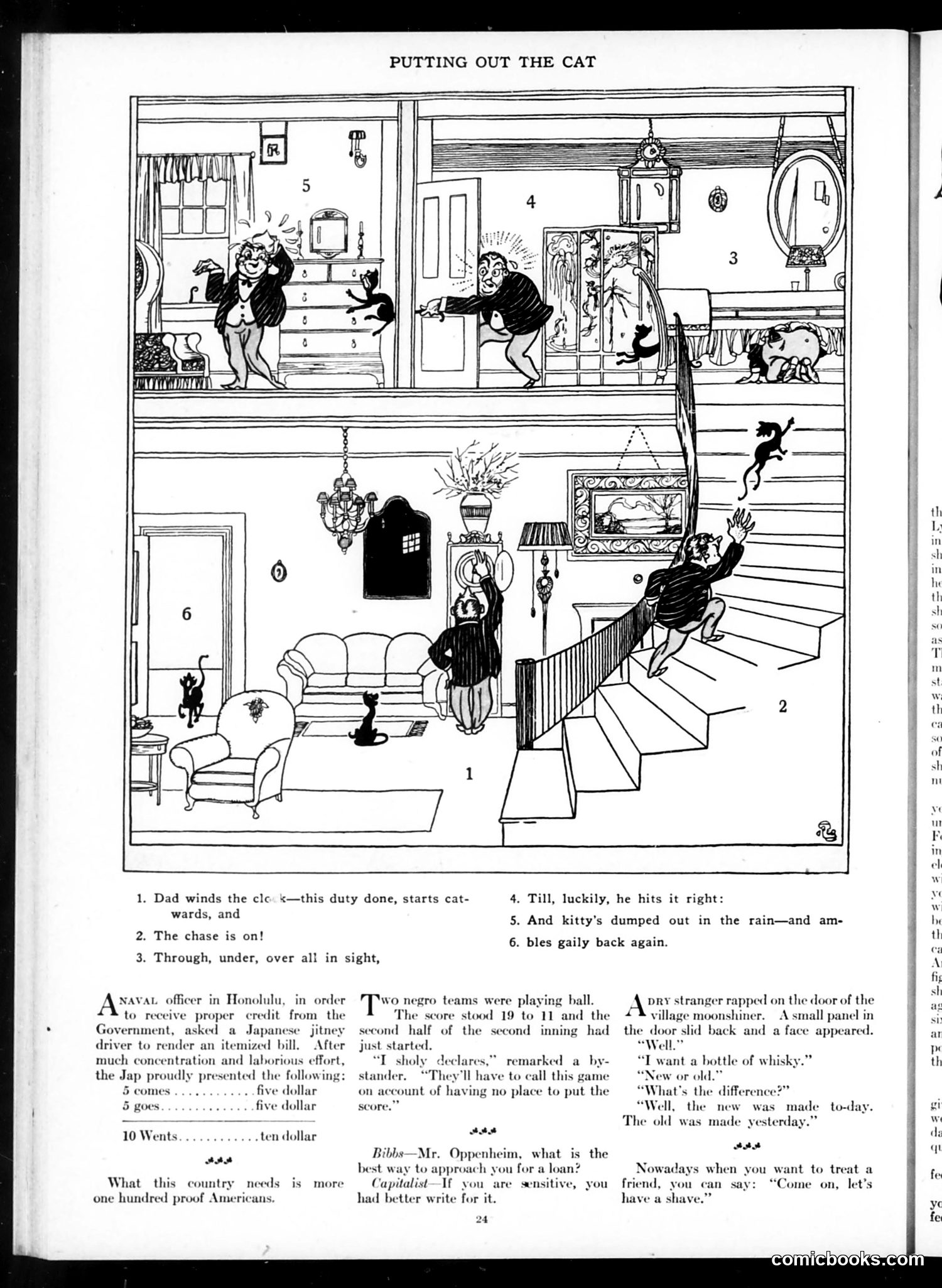
This page contains three satirical pieces typical of early 20th-century American humor: **Main Comic Strip**: A domestic humor sequence showing a man repeatedly chasing the family cat out of the house into the rain—only to have it return. The joke plays on the futility of the task and the cat's determination. **Japanese Jitney Driver Anecdote**: Mocks both Japanese immigrants and bureaucratic absurdity. A Japanese driver's itemized bill for a ride lists nonsensical items ("5 comes," "5 goes," "10 Wents") rather than actual charges. The joke relies on ethnic stereotype humor common to the era, suggesting Japanese incompetence with American business practices. **Remaining Anecdotes**: Brief jokes about racial stereotypes (Black baseball teams, a moonshiner) and capitalist wealth ("write for it"). The overall tone reflects pre-WWII American satirical magazine conventions: domestic humor mixed with casual ethnic stereotyping considered acceptable entertainment at the time.
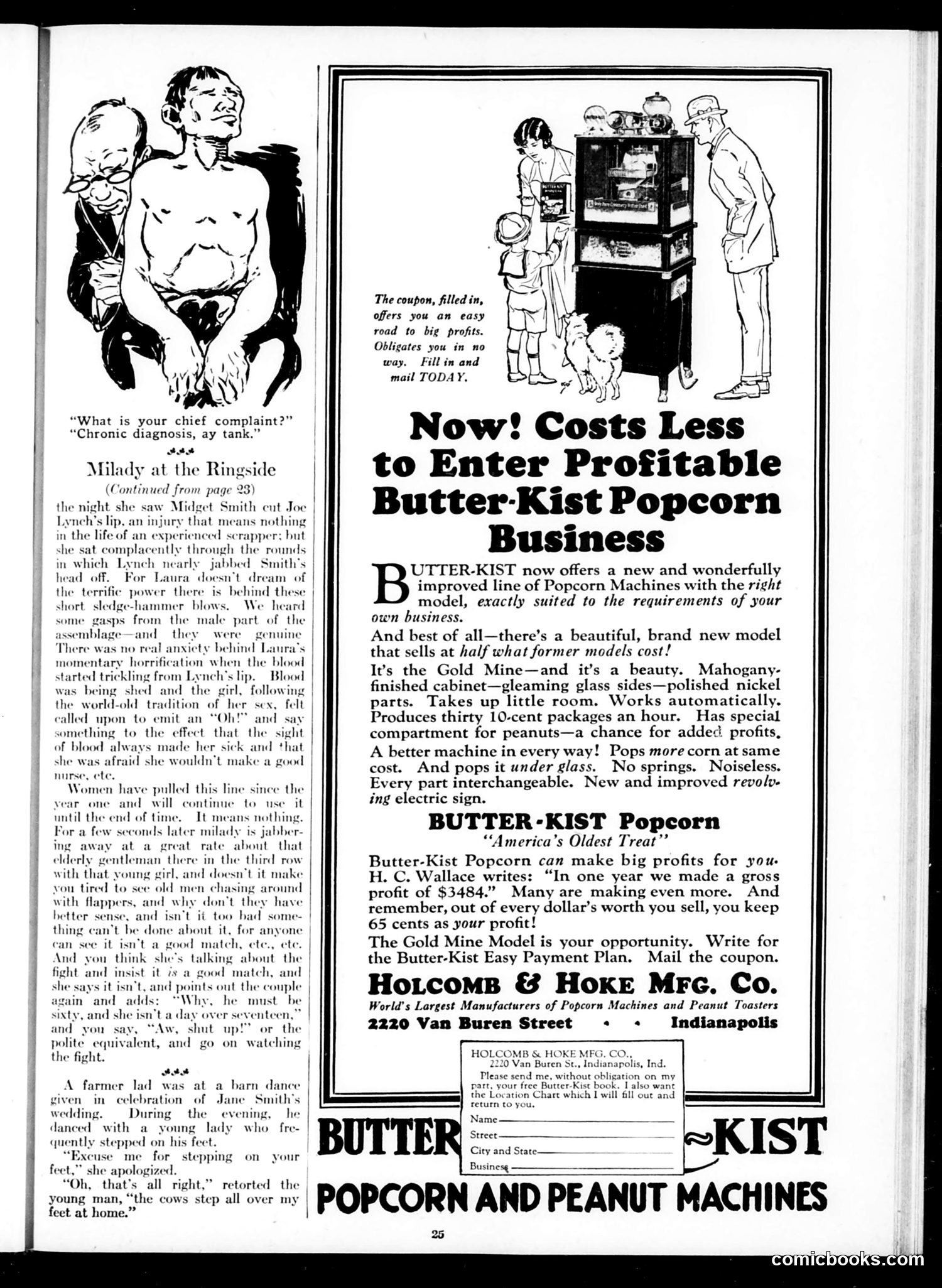
This page contains three distinct elements: **Left cartoon**: A medical joke showing a doctor asking a patient "What is your chief complaint?" The patient, appearing to be an immigrant (suggested by broken English: "Chronic diagnosis, ay tank"), presents a nonsensical answer. The satire mocks both medical jargon's opacity and immigrants' language struggles—common fodder for early 20th-century American humor. **Middle story continuation**: "Milady at the Ringside" continues a narrative about a woman attending a boxing match. The satire targets women's performative delicacy—they claim squeamishness about blood and violence while actually enjoying the spectacle, then distract themselves with gossip about other spectators. A closing joke about a farmer's daughter stepping on his feet plays on rural courtship awkwardness. **Right advertisement**: A full-page ad for Butter-Kist Popcorn machines, promoting franchise opportunities with promises of high profit margins (65 cents per dollar). This represents the era's small-business entrepreneurship marketing. The page is primarily advertising with satirical content secondary.
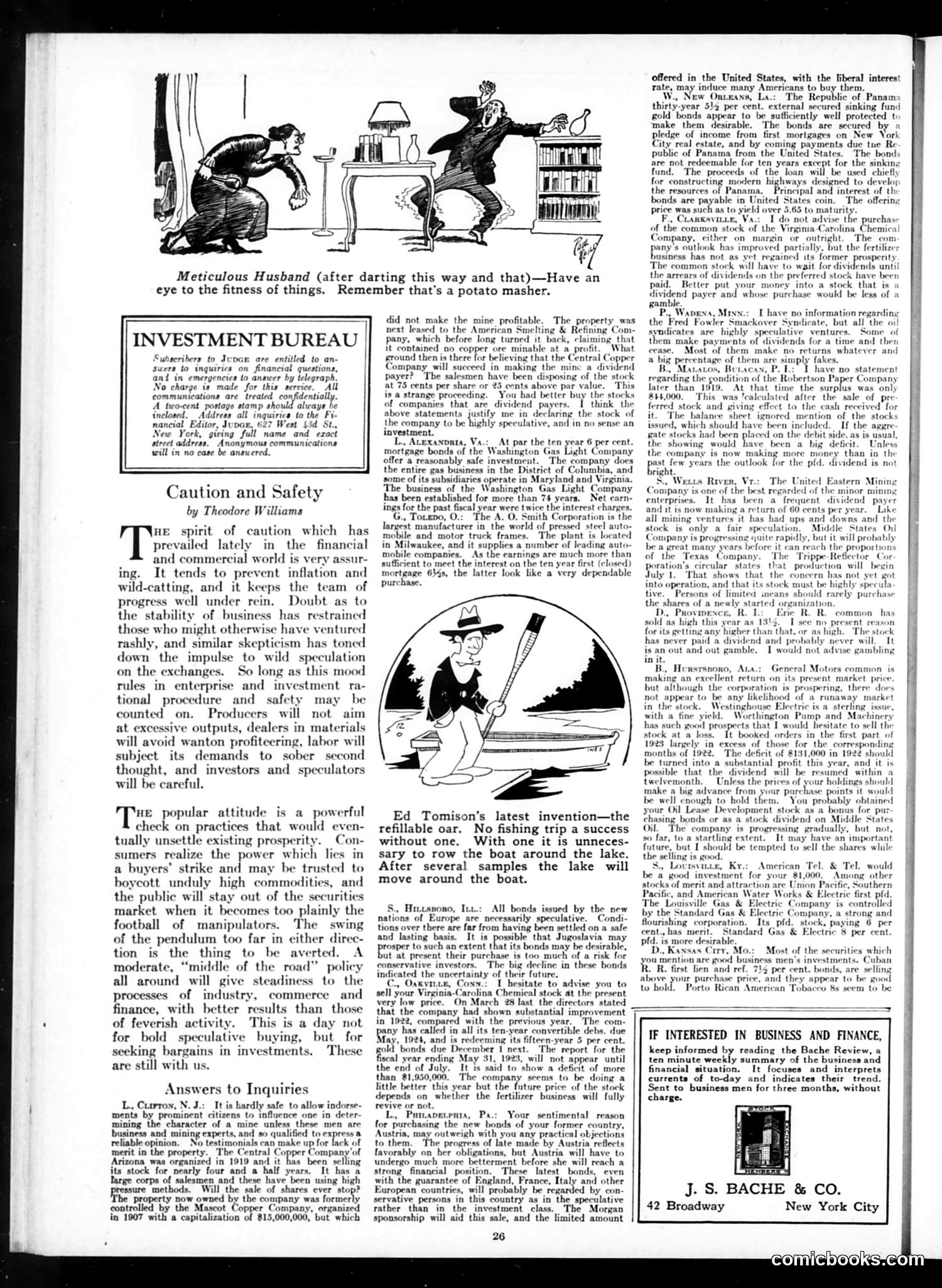
This page contains two elements: **Top Cartoon:** A domestic humor sketch showing a husband critiquing his wife's housekeeping ("Have an eye to the fitness of things"), while she appears to be doing vigorous cleaning work. The joke plays on the double meaning of "fitness"—he means propriety/appropriateness, but she's doing physical exertion. It's mild Victorian-era domestic comedy. **Main Content:** An "Investment Bureau" advice column and essay titled "Caution and Safety" by Theodore Williams. The article advocates for conservative financial practices during what appears to be a period of market speculation. It warns against "wild-catting" (risky ventures) and excessive speculation, praising restraint and skepticism as healthy market correctives. The Q&A section below critiques dubious mining stocks (Central Copper Company, Arizona) whose salesmen use aggressive tactics and celebrity endorsements—red flags indicating the stock is speculative, not a legitimate investment. It represents Judge magazine's role as a voice of financial caution during an era of speculative excess.
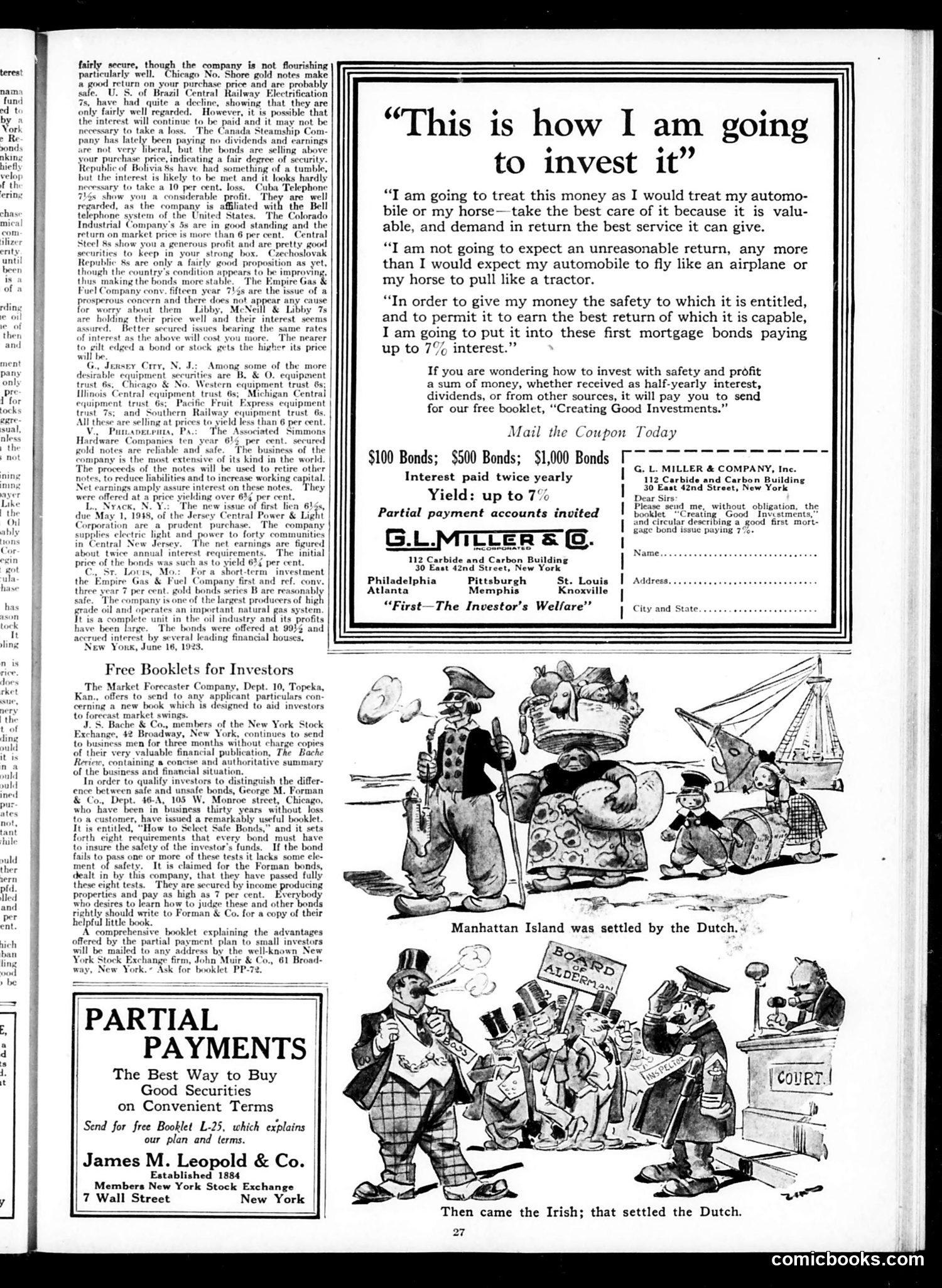
This page is primarily **financial advertising** from June 1923, with a small historical cartoon at the bottom. The main content features G.L. Miller & Company promoting first mortgage bonds (yielding up to 7%) using an analogy: treat your investment money like you'd care for a valuable automobile or horse—expect reasonable returns, not unrealistic ones. This reflects post-WWI investment culture when bonds were marketed as safe, stable income sources. The cartoon at the bottom illustrates the settlement history of Manhattan Island. It depicts the Dutch arriving first, then Irish immigrants arriving later (shown displacing the Dutch), with the caption "Then came the Irish; that settled the Dutch." This is **ethnic humor** playing on the phrase "settle" (both meaning to establish residence and to resolve a conflict). It reflects early 20th-century American attitudes toward Irish immigration and ethnic succession in cities like New York, presenting the Irish arrival as comically decisive or superior to the Dutch presence.
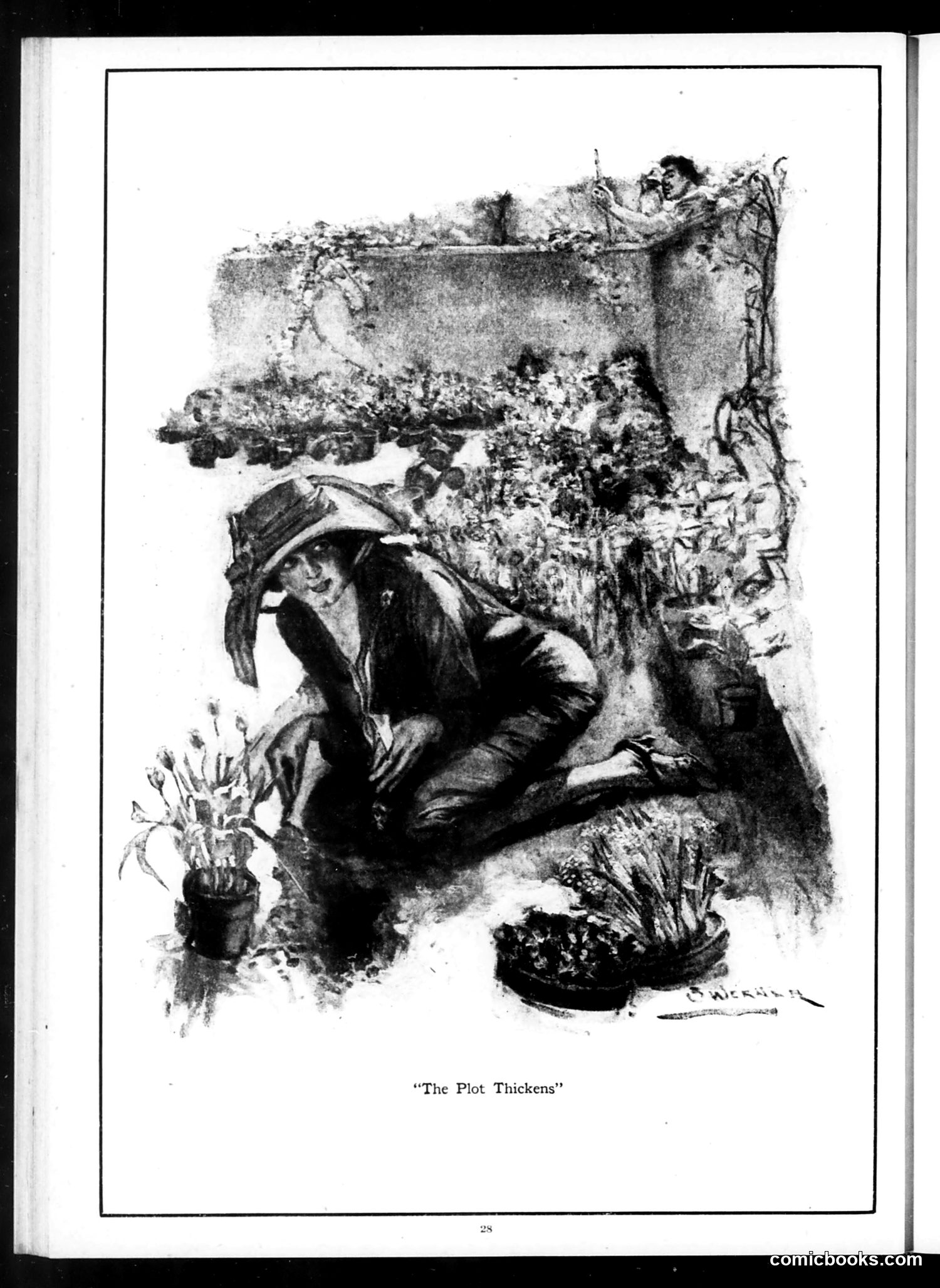
This illustration shows a figure in working-class attire (hat, worn clothing) crouching among plants and garden plots, appearing to tend or examine vegetation. The title "The Plot Thickens" is a pun—playing on both literal garden plots and the figurative meaning of "plot" as conspiracy or scheme. The cartoon likely satirizes either political scheming disguised as humble labor, or conversely, working-class agitation being dismissed as mere gardening. The figure's furtive posture and the emphasis on "thickening" suggests something growing or developing secretly. Without the publication date visible, the specific political context remains unclear, though Judge magazine typically targeted political corruption, labor disputes, or social movements of the era.
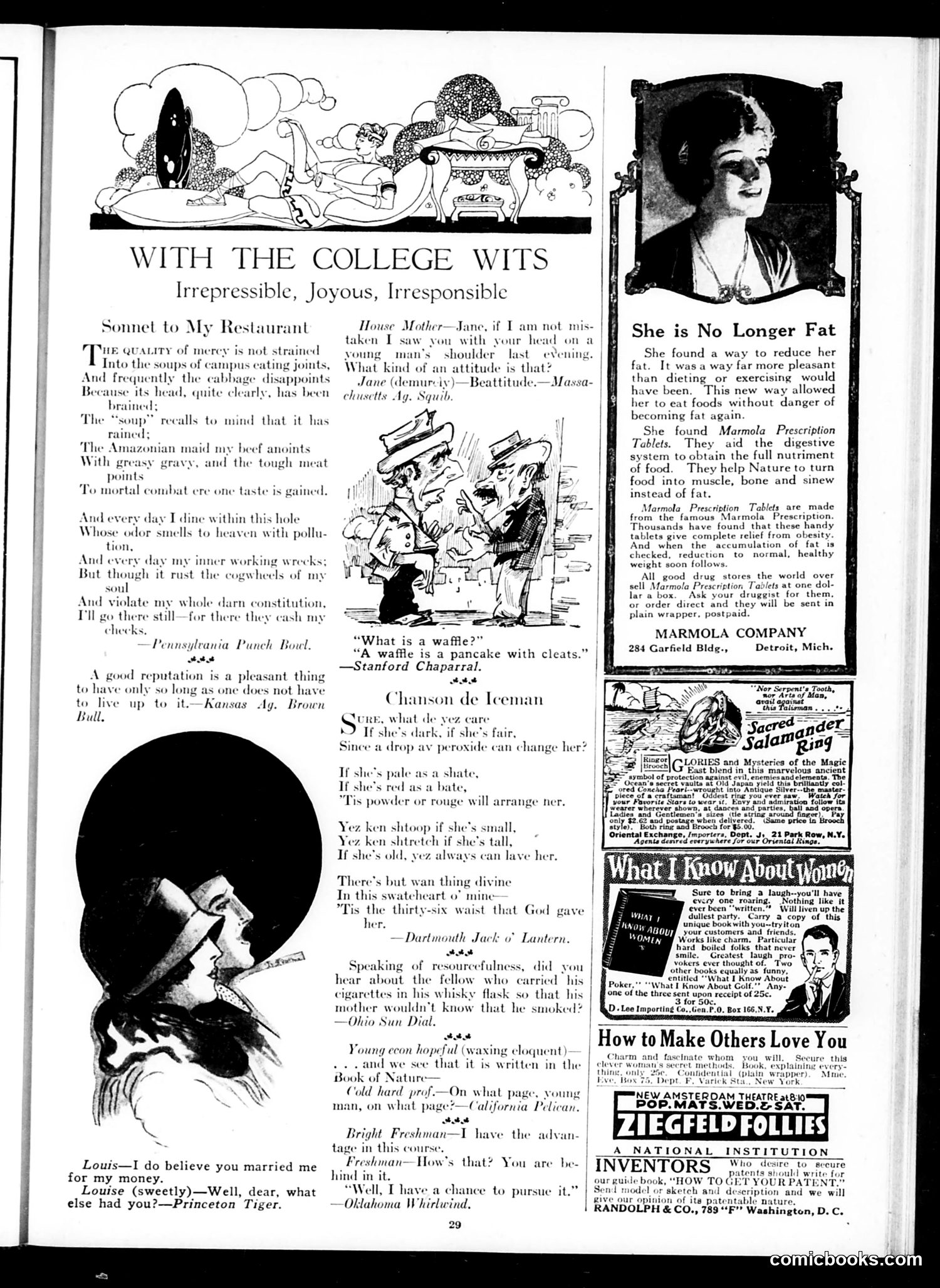
This page from *Judge* magazine contains college humor—poems and jokes contributed by various campus literary publications (Pennsylvania Punch Bowl, Kansas Ag. Brown Bull, Stanford Chaparral, etc.). The satirical content mocks college life: dining hall food ("mortal combat"), student attitudes toward work and relationships, and romantic ideals. The "House Mother" joke plays on generational conflict—concerned authority figures versus irreverent youth. The "Iceman" poem satirizes shallow attitudes toward women, reducing them to physical appearance and body measurements ("thirty-six waist"). The large illustration (bottom left) appears to be a caricatured figure, likely representing a typical college character, though the specific reference is unclear. The page is primarily **humorous social commentary** rather than political satire—poking fun at college culture, dining, dating customs, and youthful attitudes. A modern reader would recognize this as typical college magazine humor of the era, emphasizing student irreverence and romantic cynicism.
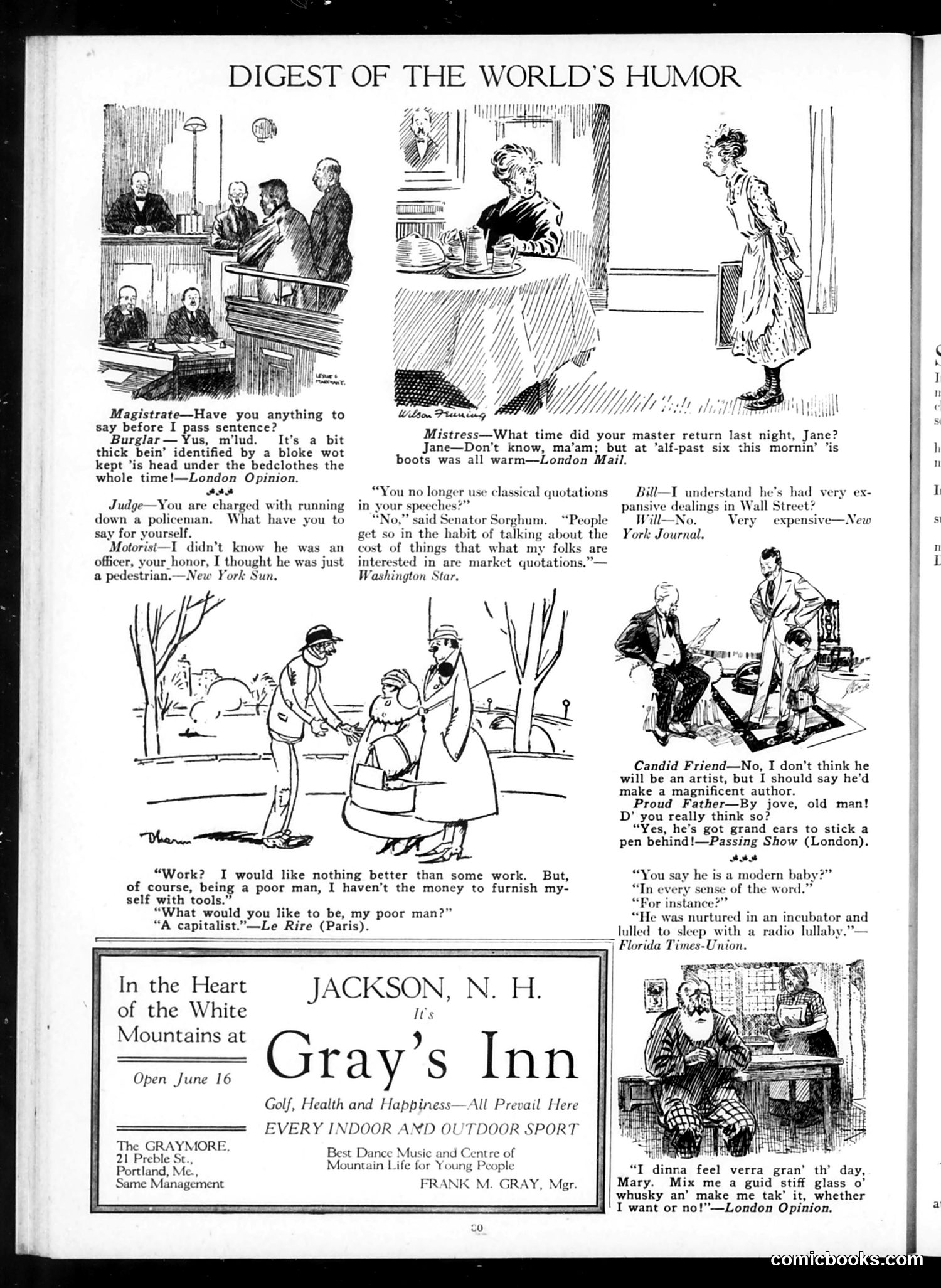
This page collects brief humorous anecdotes from international publications, satirizing early 20th-century social behaviors and class dynamics. **Key jokes:** 1. **Burglar's complaint**: A thief objects to being identified by a witness who hid under bedclothes—absurd logic undermines his credibility. 2. **Motorist's defense**: A driver hits a policeman but claims he thought he was "just a pedestrian"—mocking indifference to authority and reckless driving. 3. **Servant's observation**: A maid reveals her master's late return through his warm boots—sly domestics exposing their employers' secrets. 4. **Political satire**: A senator avoids classical quotations because constituents care only about market prices—critiquing mercenary American politics. 5. **Capitalist aspiration**: A poor man wants to become a capitalist but lacks tools—ironic commentary on class mobility and capitalism's promises. 6. **Author's ears**: Mocking paternal pride by suggesting large ears suit a writer—absurdist physical humor. The page exemplifies Judge's tradition of satirizing vanity, hypocrisy, and social pretension across classes and nations.
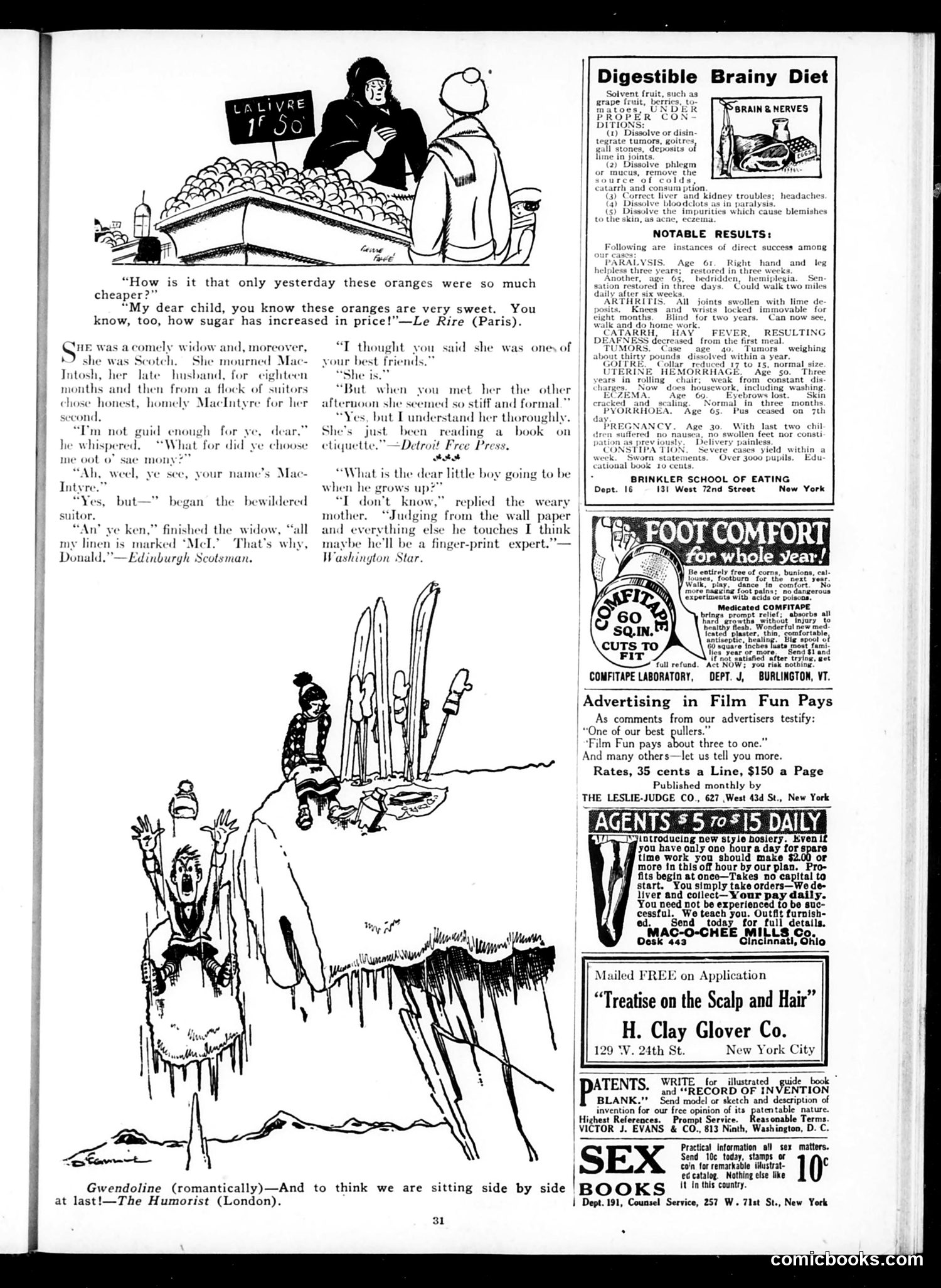
This page contains **three separate humorous anecdotes** (typical of Judge magazine's format) plus advertisements: 1. **The Orange Merchant**: A vendor justifies raising orange prices by claiming they're "sweeter" because sugar prices have risen. The satire mocks price gouging and dubious business logic. 2. **The Widow's Marriage Choice**: A Scottish widow marries plain "Maclntyre" over more attractive suitors. The punchline: all her linen is monogrammed "Mel" (her maiden name), so she chose a man whose surname matched her existing embroidered linens—pure practicality over romance. This satirizes Scottish frugality. 3. **The Fingerprint Expert**: A mother, observing her child constantly touching everything, jokes he'll become a fingerprint expert. This is a contemporary reference to early 20th-century forensic science becoming popular in public consciousness. The right side features medical and commercial advertisements typical of this era—patent medicines, hair treatments, and mail-order opportunities. The "Digestible Brainy Diet" promises miraculous cures for various ailments through fruit consumption, representing dubious health claims common to the period.
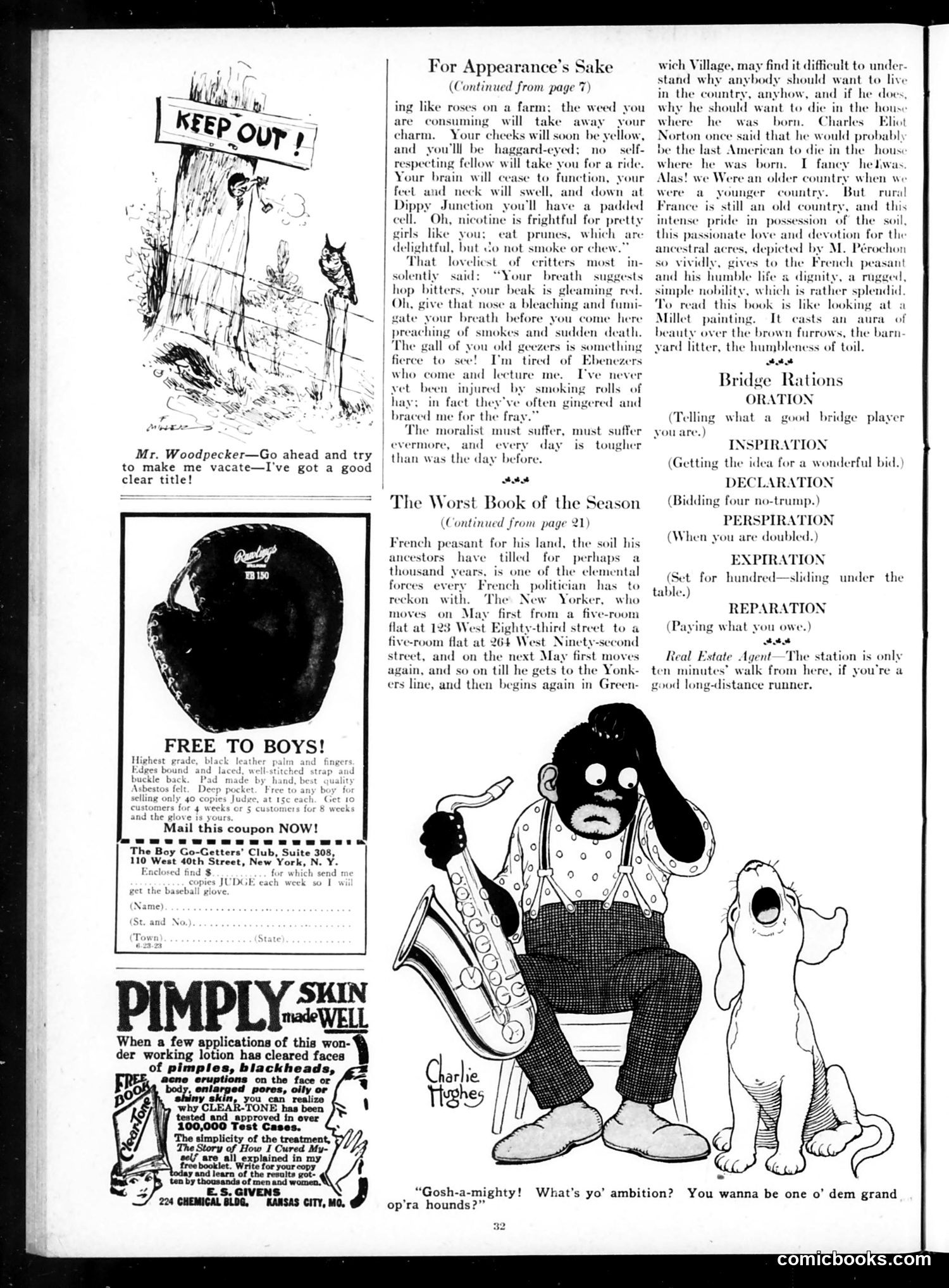
This page contains multiple unrelated content pieces typical of Judge magazine's format: **Top cartoon:** A woodpecker refuses to vacate a tree, claiming he has "good clear title"—a property law joke playing on woodpeckers' natural tree-boring habits. **Main illustrated piece:** A caricatured Black musician with a saxophone and dog, captioned with dialect humor about operatic ambitions. This reflects early 20th-century minstrelsy-influenced comedy common in period publications, offensive by modern standards. **Articles:** Includes "For Appearance's Sake" (moralistic advice about avoiding tobacco and maintaining beauty), "The Worst Book of the Season" (literary commentary comparing French peasant life to American transience), and "Bridge Rations" (humorous definitions of bridge-playing terms: oration, inspiration, declaration, perspiration, expiration, reparation). **Advertisements:** For a boy's leather palm, acne treatment ("Pimply made Well"), and the Boy Go-Getters Club. The page exemplifies Judge's mix of satire, advertisements, and period-typical racial humor.
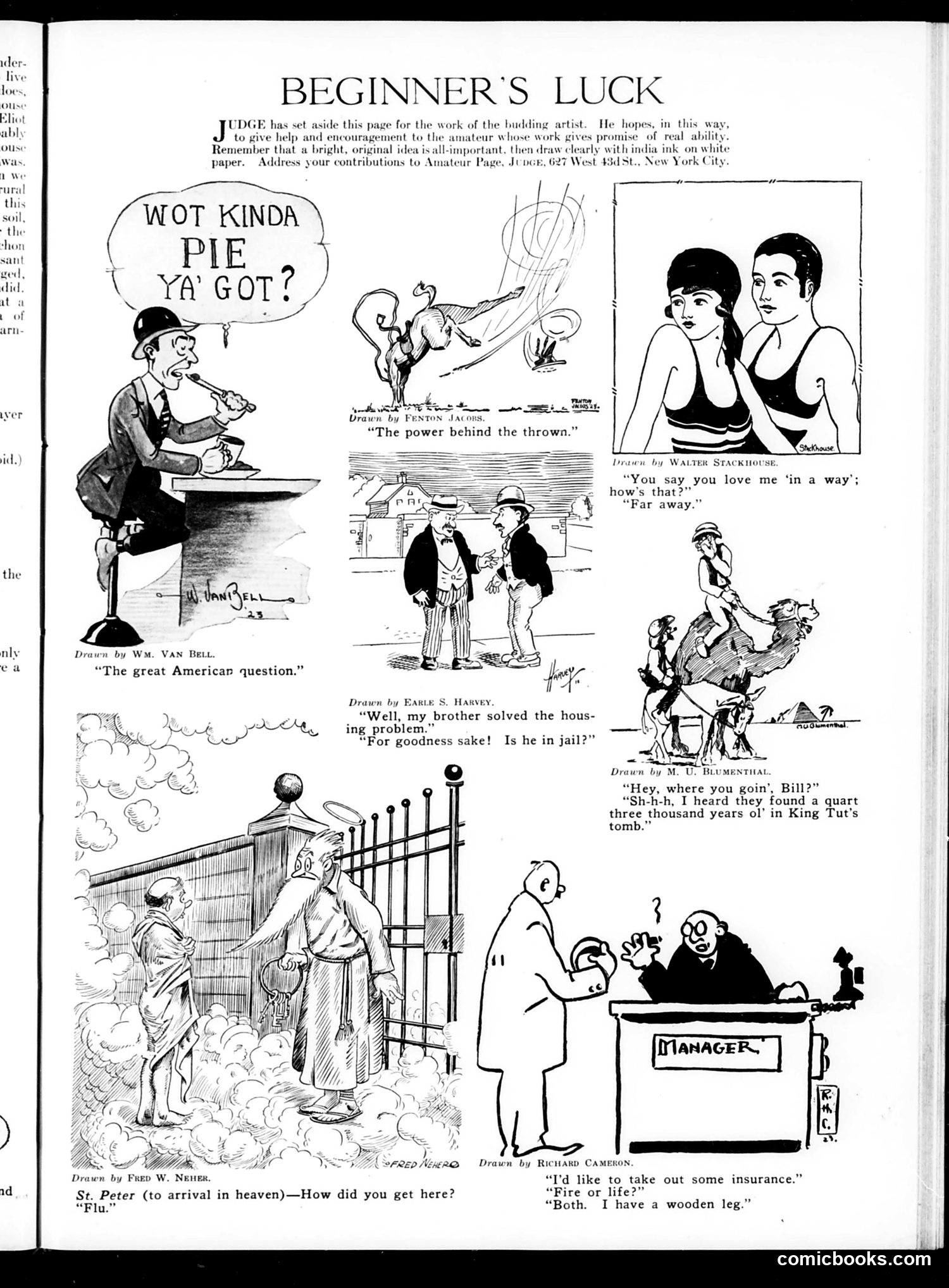
This page collects humorous single-panel cartoons on various topics: **Top left**: A working-class man asks "Wot kinda pie ya got?"—simple working-class humor about food. **"The great American question"**: Two men discuss housing affordability, a persistent social issue. **Housing problem**: A joke about someone solving housing by ending up in jail (dark humor about poverty/homelessness). **King Tut's tomb**: References the 1922 King Tutankhamun discovery craze; the joke involves finding alcohol in the tomb. **"Flu" cartoon**: Playing on death/afterlife, using the recent Spanish Flu pandemic (1918-1920) as the punchline for how someone arrived in heaven. **Insurance joke**: Relies on disability humor—a man with a wooden leg seeking fire or life insurance presents comedic absurdity to the manager. **Romance cartoon**: Simple romantic humor about distant love. These represent typical Judge satire: topical references, working-class life, and period-specific anxieties mixed with slapstick and wordplay.
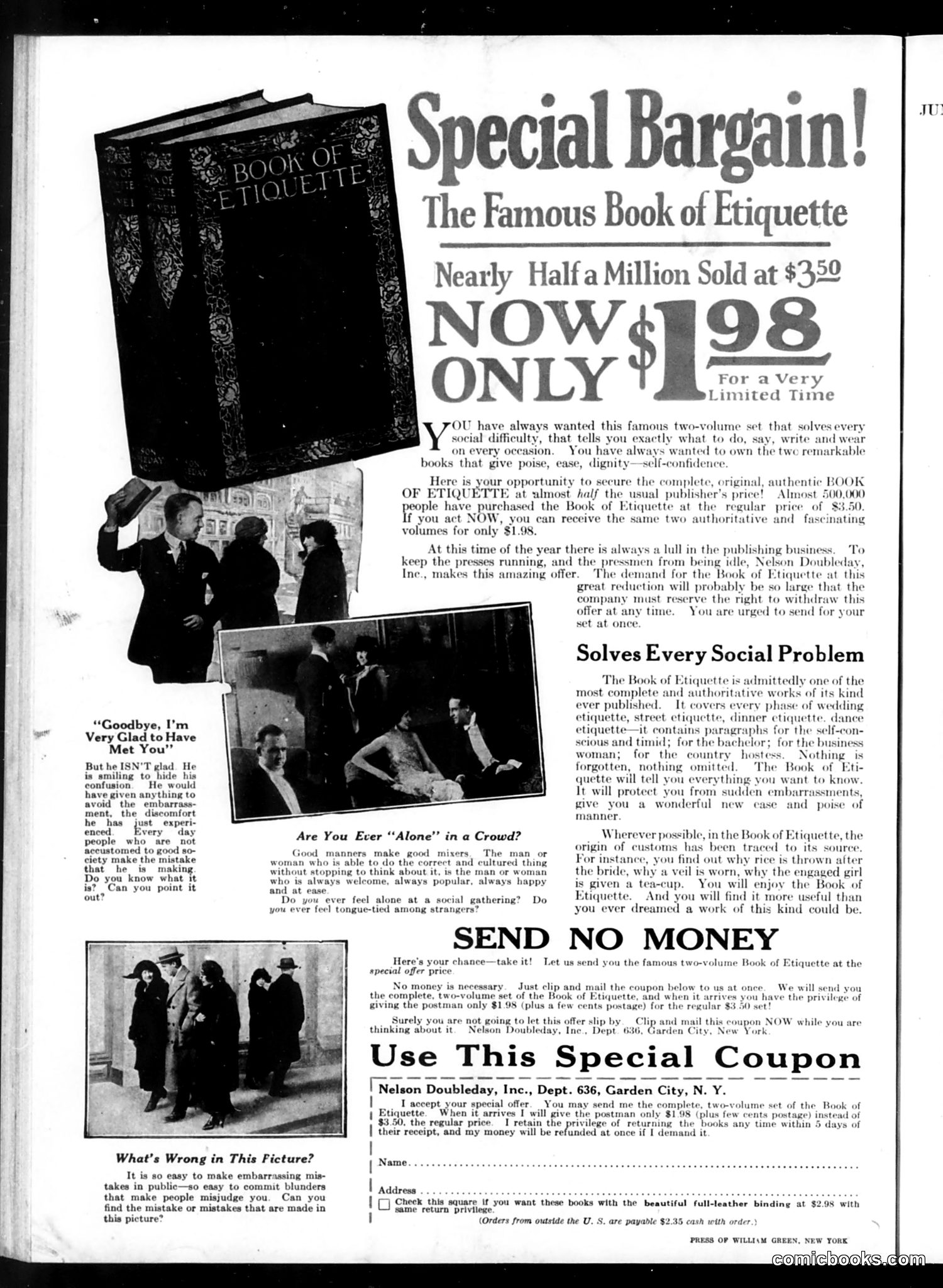
This page is primarily a **commercial advertisement** for a two-volume etiquette guide, but it's wrapped in satirical commentary typical of Judge magazine's social humor. The small embedded cartoon titled "What's Wrong in This Picture?" appears to show people in formal dress committing social blunders in public—the satire being that even with an etiquette book, people still embarrass themselves. This serves the advertisement's purpose by highlighting the book's claimed necessity. The broader satire emerges in the ad copy itself: the framing suggests that purchasing proper etiquette guides is the solution to all social anxiety and class anxieties. The repeated scenarios—feeling "alone in a crowd," not knowing proper customs, risking "sudden embarrassments"—target insecure readers desperate for social respectability and "poise." The "special offer" angle (selling $3.50 books for $1.98) adds comedic irony: the publisher claims a publishing "lull" forces this discount, implying even etiquette book sales fluctuate with economic conditions—undermining the text's promotion of timeless social refinement. The satire critiques **American consumer anxiety about social status and propriety** during this era.