
Judge, 1923-06-23 · page 23 of 36
Judge — June 23, 1923 — page 23: what you’re looking at
What you’re looking at
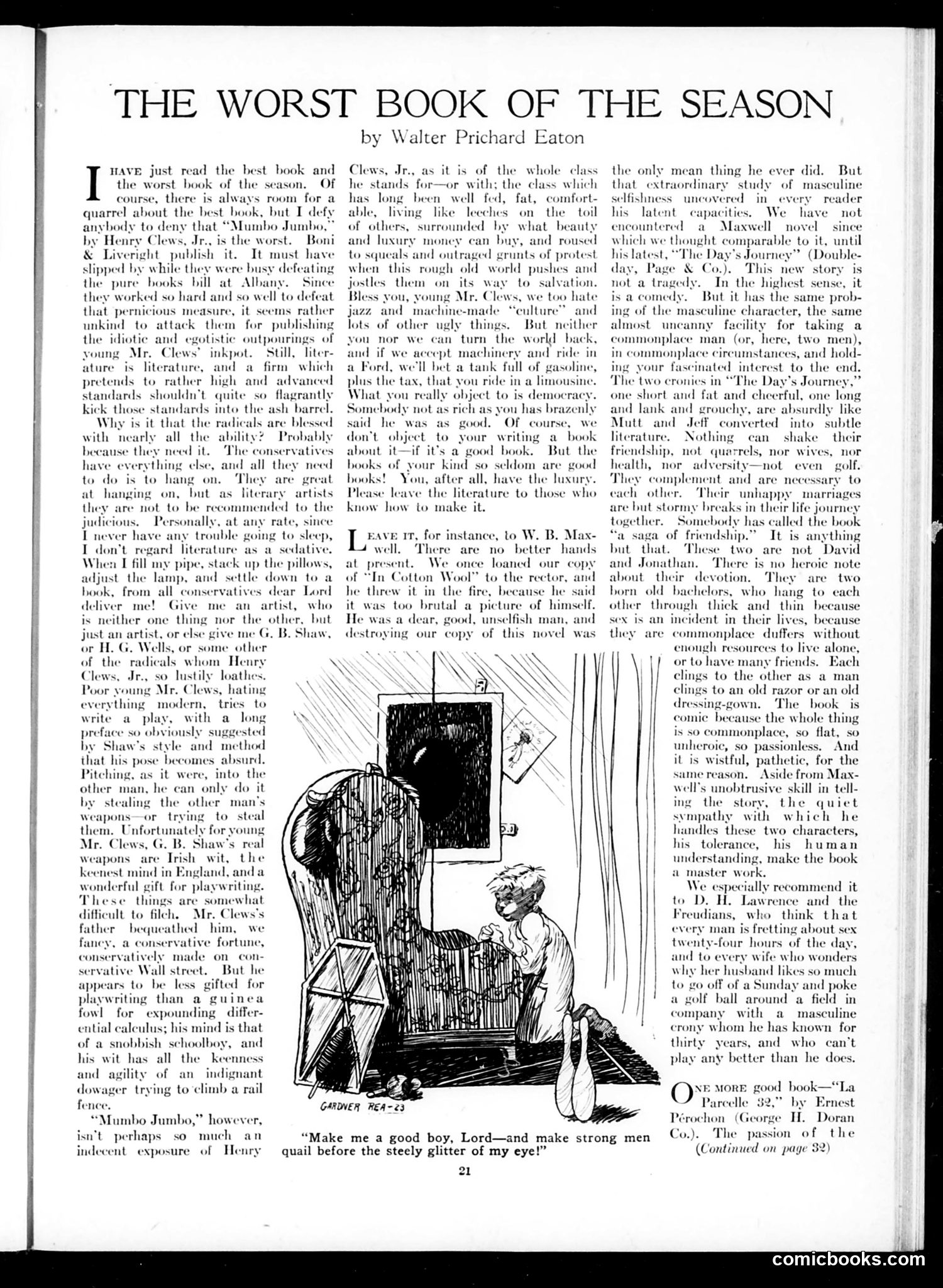
This is a book review essay attacking Henry Clews Jr.'s novel "Mumbo Jumbo" as the season's worst book. The accompanying illustration depicts a wealthy, rotund gentleman (likely Clews himself, based on context) in formal dress, representing the privileged class Eaton criticizes. Eaton's satire targets Clews as emblematic of conservative, wealthy elites who oppose modernism while hypocritically adopting modern conveniences. Clews attempts writing a play mimicking G.B. Shaw's style but lacks Shaw's genuine wit and Irish intellect. The criticism extends to the entire class Clews represents—wealthy, comfortable people living off others' labor, now protesting the modern world they secretly depend upon (Fords, limousines, machinery). Eaton contrasts Clews unfavorably with genuine literary talent like W.B. Maxwell, suggesting that quality literature requires authentic artistic ability, not merely conservative complaints about modern culture.
📄 Transcribed text from this page (OCR, searchable)
Machine-transcribed from the original scan — historical spelling and the odd misread are preserved.
the worst book of the on. Of course, there is always room for a quarrel about the best book, but I defy anybody to deny that “Mumbo Jumbo,” by Henry Clews, Jr., is the worst. Boni & Liveright publish it. It must have slipped by while they were busy defeating the pure books bill at Albany. Since they worked so hard and so well to defeat that pernicious measure, it seems rather unkind to attack them for publishing the idiotic and egotistic outpourings of young Mr. Clews’ inkpot. Still, liter- ature is literature, and a firm) which pretends to rather high and advanced standards shouldn't quite so f kick those standards into the Why is it that the radicals blessed with nearly all the ability? Probably because they need it. The conservati have everything ¢ and all the to do is to hang on, They are at hanging on, but as lite artists snot to be recommended to the judicious. Personally, rate, since IT never ha u I don’t reg: as a sedative. When I fill my pipe, stack up the pillows, adjust the lamp, and settle down to a book, from all conservatives dear Lord deliver me! Give me an artist, who is neither one thing nor the other, but just an artist, or else give me G. B. Shaw, or H. G. Wells, or some other of the radicals whom Henry Clews, Jr., so lustily loathes. Poor young Mr. Clews, hating everything modern, tries to write a play, with a long “eso obviously suggested » Shaw's style and method ut his pose becomes absurd. Pitching, as it were, into the other man, he can only do it by stealing the other man’s weapons—or trying to steal them. Unfortunately for young Mr. Clews, G. B. Shaw's real Weapons Irish wit, the keenest mind in England, and a wonderful gift for playwriting. These things are somewhat difficult to filch, Mr. Clews’s ather bequeathed him, we ive fortune, I HAVE just read the best book and great tively made on con- servative Wall stre But he appears to be less gifted for playwriting than a guinea fowl for expounding differ- ential calculus; his mind is that of a snobbish schoolboy, and his wit has all the agility of an trying to‘climb a rail and indi doy THE WORST BOOK OF THE SEASON by Walter Prichard Eaton Clews, Jr., as it is of the whole class he stands for—or with; the class which has long been well fed, fat, comfort- able, living like leeches on the toil of others, surrounded by what beauty and luxury money can buy, and roused to squeals and outraged grunts of protest when this rough old world pushes and jostles them on its way to. salvation. Bless you, young Mr. Clews, we too hate jazz and machine-made “culture” and lots of other ugly things. But neither ou nor we ean turn the world bi and if we accept machinery and. ride a Ford, we'll bet a tank full of gasoline, plus the tax, that you ride in a limousine. What you reall *t to is democi you has bi as good, Of course, We don’t object to your writing a book about it—if it’s a good book. But the yur kind so seldom are good u, after all, have the luxury. the literature to those who know how to make it. EAVE IT, for instance, to W. B. Max- 4 well. There are no better hands at present. We once loaned our copy of “In Cotton Wool” to the rector, aunt he threw it in the fire, because he said it was too brutal a picture of himself. He was a dear, good, unselfish man, and destroying our copy of this novel was the only mean thing he ever did. But that extraordinary study of masculine selfishness une doin ev reader his latent capacities. We have not encountered a Maxwell novel — since whic h we thought comparable to it, until he Day's Journey” (Double- & Co.). This new story is gedy. In the highest sense, it is a comedy. But it has the same prob- ing of the masculine character, the same almost uncanny facility for taking a commonplace man (or, here, two men), in commonplace circumstances, and hold- ing your fascinated interest to the end. ‘The two cronies in “The Day’s Journey,” one short and fat and cheerful, one long and lank and grouchy, are absurdly like Mutt and Jeff converted into subtle literature. Nothing can shake — their sls, nor wives, ndship, not que nor Ith, nor adversity—not even golf. They complement and are necessary to cach other. ‘Their unhappy marriages are but stormy breaks in their life journey together. Somebody has called the book “a saga of friendship.” It is anything but that. These two are not David and Jonathan. There is no heroic note about the svotion. They are two born old bachelors, who hang to each other through and thin be sex is an incident in their lives, be they are commonplace duffers without enough resources to live alone, or to have many friends. Each clings to the other as a man clings to an old razor or an old dressing-gown. The book is comic because the whole thing is so commonplace, so flat, so unheroic, so passionless. And it is wistful, pathetic, for the same reason. Aside from Max- well’s unobtrusive skill in tell- ing the story, the quiet sympathy with which he handles these two characters, his tolerance, his human understanding, make the book a master work, We espe ! | yy recommend it D. H. wrence and_ the udians, who think that man is fretting about sex four hours of the day, and to every wife who wonde why her husband likes so much I to go off of a Sunday and poke a golf ball around a field in company with a masculine crony whom he has known for thirty y who can’t play any better than he does. ars, and Oe MoRE good book—“La Parcelle 82," by E trnest fence. GARDVER REA-23 “Mumbo Jumbo,” however, Pérochon (George TH. Doran isn’t perhaps so much an “Make me a good boy, Lord—and make strong men ©»-)- The passion of the indecent exposure of Henry quail before the steely glitter of my eye!” (Continued on page 32) 21 comicbooks.com