
Judge, 1923-06-23 · page 21 of 36
Judge — June 23, 1923 — page 21: what you’re looking at
What you’re looking at
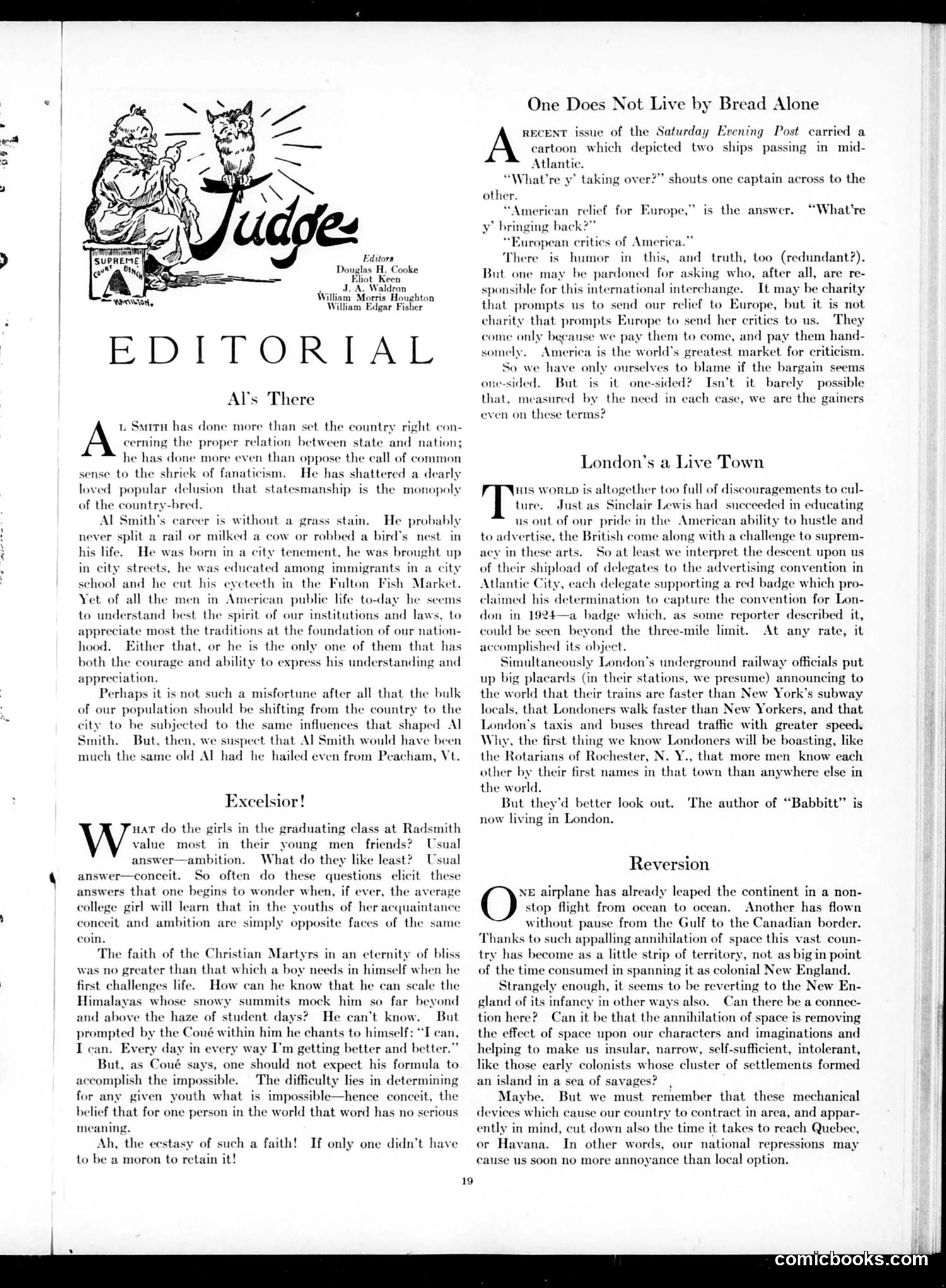
## Main Cartoon (Top Left) The "Judge" masthead features the magazine's signature owl and jester character—recurring symbols of satirical commentary. ## "Al's There" Editorial Praises Al Smith, likely the 1920s-era New York politician and future presidential candidate. The piece defends Smith's urban, working-class background (born in a tenement, educated among immigrants at the Fulton Fish Market) as actually superior qualification for public office than rural origins. This challenges the then-common assumption that statesmanship required country breeding—a dated American ideal. ## "One Does Not Live by Bread Alone" References a *Saturday Evening Post* cartoon about transatlantic ships: one carries American relief aid to Europe; the other carries European critics back to America. Judge satirizes American willingness to pay handsomely for foreign criticism while sending charity—implying Americans are willing dupes underwriting their own mockery. All content reflects early 20th-century debates about urbanization, American cultural superiority, and foreign relations.
📄 Transcribed text from this page (OCR, searchable)
Machine-transcribed from the original scan — historical spelling and the odd misread are preserved.
William William Al's There L Smitn has done more than set the country right con- cerning the proper relation between state and nation; he has done more even than oppose the call of common of fanaticism. He has shattered a dearly sense to the shriek loved popular delusion that statesmanship is the monopoly of the country-bred. Al Smith's career is without a grass stain. He probably bird's nest in never split a rail or milked a cow or robbed ¢ his life. He was born in a city tenement, he was brought up in city streets, he was educated among immigrants in a city school and he cut his eyeteeth in the Fulton Fish Market. Yet of all the men in Ame an public life to-day he seems to understand best the spirit of our institutions and laws, to appreciate most the traditions at the foundation of our nation- hood. Either that, or he is the only one of them that has both the courage and ability to express his understanding and appreciation. Perhaps it is not such a misfortune after all that the bulk of our population should be shifting from the country to the city to be subjected to the same influences that shaped Al Smith. But, then, we suspect that Al Smith would have been much the same old Al had he hailed even from Peacham, Vt. Excelsior! uar do the girls in the graduating class at Radsmith V V alue most in their young men friends? Usual answer—ambition. What do they like least? Usual So often do these questions clicit these answer—conceit. answers that one begins to wonder when, if ever, the average college girl will learn that in the youths of her acquaintance conceit and ambition are simply opposite faces of the same coin. The faith of the Christian Martyrs in an eternity of bliss was no greater than that which a boy needs in himself when he first challenges life. How can he know that he can scale the Himalayas whose snowy summits mock him so far beyond and above the haze of student days? He can’t know. But prompted by the Coué within him he chants to himself: “I can, I can. Every day in every way I'm getting better and better.” But, as Cou , one should not expect his formula to accomplish the impossible. The difficulty lies in determining for any given youth what is impossible—hence conceit, the belief that for one person in the world that word has no serious meaning. Ah, the ecstasy of such a faith! to be a moron to retain it! If only one didn’t have 19 One Does Not Live by Bread Alone RECENT issue of the Saturday Evening Post carried a A cartoon which depicted two ships passing in mid- Atlantic. “What're y other. “American relief for Europe,” taking over?” shouts one captain across to the is the a “What're cr. y’ bringing back: European critics of America. There is humor in this, and truth, too (redundant?). But one may be pardoned for asking who, after all, are re- sponsible for this international interchange. It may be charity that prompts us to send our relief to Europe, but it is not charity that prompts Europe to send her critics to us. They come only because we pay them to come, and pay them hand- somely. America is the world’s greatest market for criticism. So we have only ourselves to blame if the bargain seems sided. But is it Isn't it’ barely possi that, measured by the need in each case, we are the ga even on these terms? iners London’s a Live Town HIS WORLD is altogether too full of discouragements to cul- ture. Just as Sinclair Lewis had succeeded in educating us out of our pride in the American ability to hustle and to advertise, the British come along with a challenge to suprem- So at least we interpret the descent upon us Ivertising convention in acy in these arts. of their shipload of delegates to th Atlantic City, each delegate supporting a red badge which pro- claimed his determination to capture the convention for Lon- don in 1924—a badge which, as some reporter described it, At any rate, it could be seen beyond the three-mile limit. accomplished its object. Simultaneously London’s underground railway officials put up big placards (in their stations, we presume) announcing to the world that their trains are faster than New York's subway locals, that Londoners walk faster t ew Yorkers, and that London’s taxis and buses thread traffic with greater speed. Why, the first thing we know Londoners will be boasting, like the Rotarians of Rochester, N. Y., that more men know each other by their first names in that town than anywhere else in the world. But they'd better look out. now living in London. The author of “Babbitt” is Reversion O- airplane has already leaped the continent in a non- stop flight from ocean to ocean. Another has flown without pause from the Gulf to the Canadian border. Thanks to such appalling annihilation of space this vast coun- try has become as a little strip of territory, not as big in point of the time consumed in spanning it as colonial New England. Strangely enough, it seems to be reverting to the New En- gland of its infancy in other ways also. Can there be a connec- tion here? Can it be that the annihilation of space is removing the effect of space upon our characters and imaginations and helping to make us insular, narrow, self-sufficient, intolerant, like those early colonists whose cluster of settlements formed an island in a sea of savages? , Maybe. But we must remember that these mechanical devices which cause our country to contract in area, and appar- ently in mind, cut down also the time it takes to reach Quebec, or Havana. In other words, our national repre cause us soon no more annoyance than local option.