
Judge, 1923-06-23 · page 22 of 36
Judge — June 23, 1923 — page 22: what you’re looking at
What you’re looking at
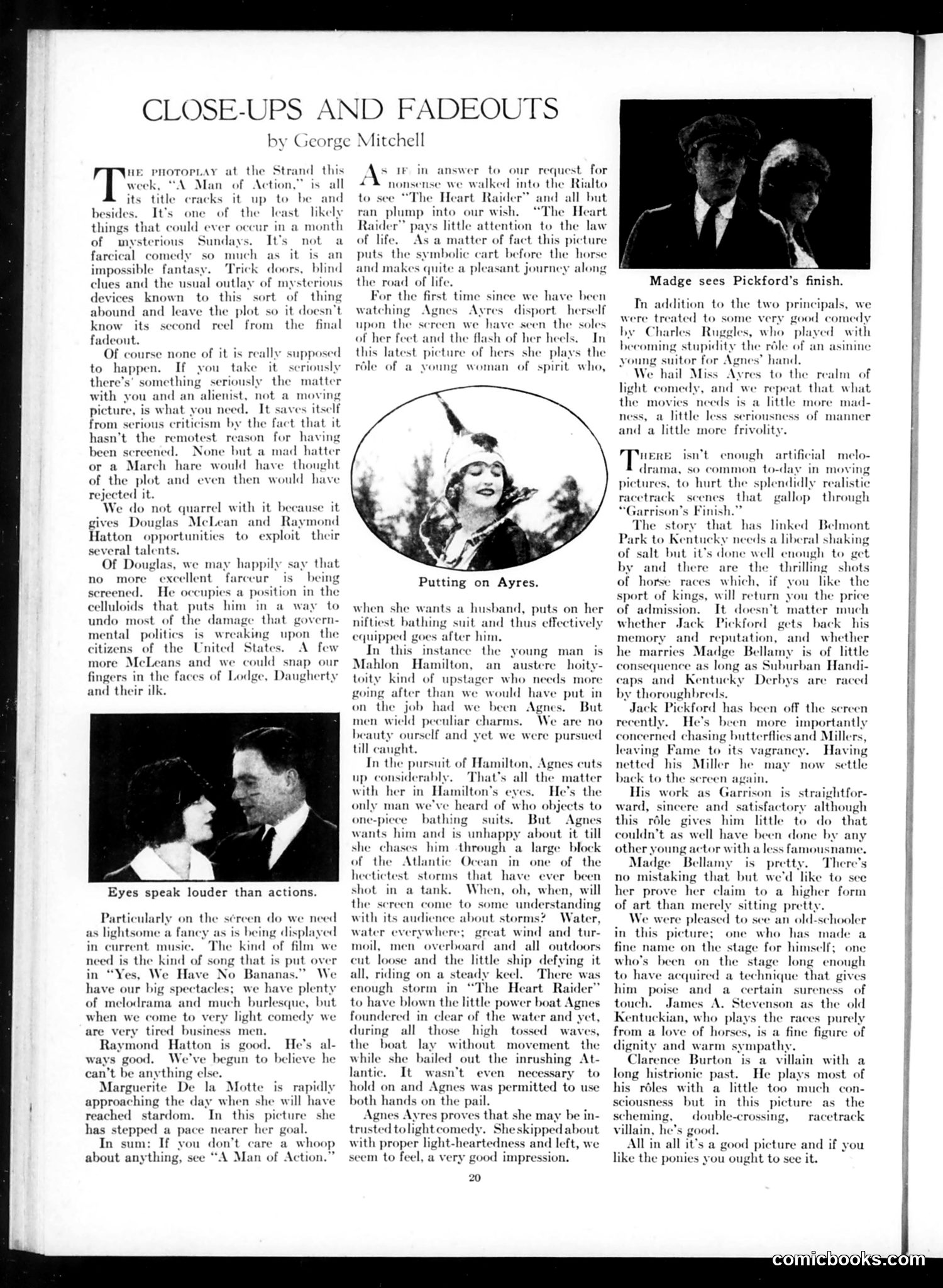
This is a film review column discussing three contemporary movies. The text contains no political satire or cartoon content—it appears to be a straightforward cinema criticism piece from Judge magazine's entertainment section. The reviewer discusses: 1. **"A Man of Action"** — starring Douglas McLean and Raymond Hatton, described as lightweight farce. The critic praises McLean's comedic talents as beneficial counterweight to "governmental politics" damaging American citizens (a subtle political reference, though not satirical). 2. **"The Heart Raider"** — featuring Agnes Ayres and Mahlon Hamilton. The reviewer humorously notes Ayres' character pursues Hamilton by wearing a bathing suit, and criticizes Hollywood's overuse of storm scenes. The column includes photographs of the actors but no political cartoons. It's essentially entertainment journalism offering opinions on current film releases to Judge's readership, mixing genuine critique with light humor about cinema conventions.
📄 Transcribed text from this page (OCR, searchable)
Machine-transcribed from the original scan — historical spelling and the odd misread are preserved.
CLOSE-UPS AND FADEOUTS by George Mitchell HE protorLay at the Strand this | week, “A Man of Action,” is all its title cracks it up to be and besides. It's one of the least likely things that could r occur ina month of mysterious Sundays. It’s not a farcical much as it is an impossible fantasy. Trick blind clues and the usual outlay of mysterious devices known to this sort of thing abound and leave the plot so it doesn’t know its second reel from the final fadeout. Of course none of it is really supposed to happen. If you take it seriously there’s’ something seriously the matter with you and an alienist, not a moving picture, is what you need. It saves itself from serious criticism by the fact that it hasn't the remotest reason for having been screened. None but a mad hatter or a March hare would have of the plot and even then would have rejected it. comedy so doors, We do not quarrel with it because it gives Douglas McLean and Raymond Hatton opportunities to exploit their several talents. Of Douglas, we may happily say that no more excellent’ farceur is | being screened. He occupies a position in the celluloids that puts him in a way to undo most of the damage that govern- mental polities is wreaking upon the citizens of the United States. A’ few more MecLeans and we could snap our fingers in the faces of L Daugherty and their ilk. Eyes speak louder than actions. Particularly on the séreen do we need as lightsome a fancy as is being displayed in current music. we kind of film we need is the kind of song that is put over in “Yes, We Have No Bananas.” We have our big spectacles; we have plenty of melodrama and much burlesque, but when we come to very light comedy we are very tired business men. Raymond Hatton is good. He's al- ways good. We've begun to believe he can’t be anything else. Marguerite De la Motte is rapidly approaching the day when she will have reached stardom. In this picture she has stepped a pace nearer her goal. In sum: If you don’t care a whoop about anything, see “A Man of Action.” IF in answer to our request for nonsense we walked into the Rialto to see “The Heart Raider” and all but ran plump into our wish. “The Heart Raider” pays little attention to the of life. Asa matter of fact this picture puts the symbolic cart before the horse and makes quite a pleasant journey along the road of life. For the first time since we have been watching Agnes Ayres disport herself upon the sereen we have seen the soles of her feet and the flash of her heels. In this latest picture of hers she plays the role a young woman of spirit: who, Putting on Ayres. when she wants a husband, puts on her niftiest bathing suit and thus effectively s after him. In this instance the young man is Mahlon Hamilton, an ‘austere hoity- oity kind of upstager who needs more going after than we would have put in on the job had we been Agnes. But men wield peculiar charms. We are no beauty ourself and yet we were pursued till caught. In the pursuit of Hamilton, Agnes cuts up considerably. That's all the matter with her in Hamilton’s eves. He’s the only man we've heard of who objects to one-piece bathing suits. But Agnes wants him and is unhappy about it till she chases him through a large block of the Atlantie Ocean in one of the heetictest. storms that have ever been shot in a tank. When, oh, when, will the sereen come to some understanding with its audience about storms? Water, water everywhere; great wind and tur- moil, men overboard and all outdoors cut loose and the little ship defying it all, riding on a steady keel. There was enough storm in “The Heart Raider” to have blown the little power boat Agnes foundered in clear of the water and yet, during all those high tossed waves, the boat without movement the while she bailed out the inrushing At- lantic. It wasn’t even necessary to hold on and Agnes was permitted to use both hands on the pail. Agnes Ayres proves that she may be in- trusted tolight comedy. Sheskipped about with proper light-heartedness and left, we seem to feel, a very good impression. equipped 20 Madge sees Pickford’s finish. Tn addition to the two principals, we were treated to some very good comedy by Charles Ruggles, who played with becoming stupidity the réle of an asinine young suitor for Agnes’ hand. » hail Miss Ayres to the realm of light comedy, and we repeat that what the movies needs is a little more mad- ness, a little less seriousness of manner and_a little more frivolity. Tues isn’t enough artificial melo- drama, so common to-day in moving pictures, to hurt the splendidly realistic retrack scenes that gallop through “Garrison's Finish.” The story that has linked Belmont Park to Kentucky needs a liberal shaking of salt but it’s done well cnough to get by and there are the thrilling shots of horse races which, if you like the sport of kings, will return you the price of admission. It doesn’t matter much whether Jack Pickford gets back his memory and reputation, and whether he marries Madge Bellamy is of little consequence as long as Suburban Handi- caps and Kentucky Derbys are raced thoroughbreds. ack Pickford has been off the sereen recently. He's been more importantly concerned chasing butterflies and Millers, leaving Fame to its vagraney. Having netted his Miller he may ‘now settle back to the sereen again, His work as Garrison is straightfor- ward, sincere and satisfactory although this réle gives him little to do that couldn’t as well have been done by any other young actor with a less famousname, Bellamy is pretty. There's no mistaking that but we'd like to see her prove her claim to a higher form of art than merely sitting pretty. We were pleased to sce an old-schooler in this picture; one who has made a ne on the stage for himse s been on the stage long enough quired a technique that gives one him poise and a certain sureness of touch. James A. Stevenson as the old Kentuckian, who plays the races purely from a love of horses, is a fine figure of dignity and warm sympathy. Clarence Burton is a villain with a long histrionic past. He plays most of his réles with a little too much con- sciousness but in this picture as the scheming, double-crossing, racetrack Villain, he's good. All in all it’s a good picture and if you like the ponies you ought to see it.