
A complete issue · 36 pages · 1923
Judge — June 16, 1923
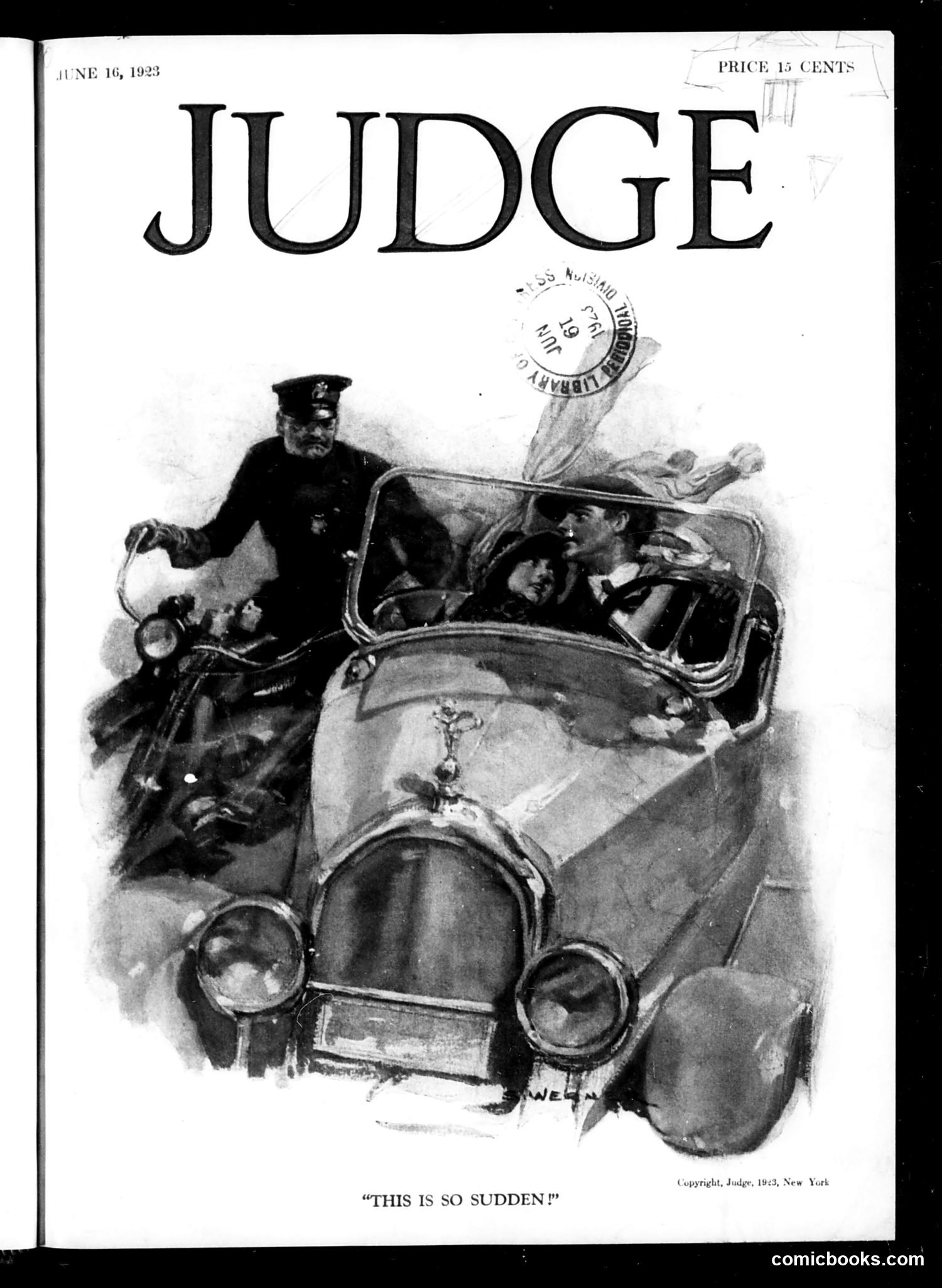
This cover cartoon depicts a dramatic automobile accident. A police officer on a motorcycle is stopped mid-gesture, appearing startled, while a car has collided with what seems to be a weighing scale mounted above. The caption reads "THIS IS SO SUDDEN!" The satire likely comments on the unexpected consequences of reckless driving or speed enforcement during the 1920s automobile era. The scale suggests the impact has been forceful enough to register measurement—a visual pun on the collision's severity. The officer's exclamation expresses surprise at how quickly the accident occurred. The cartoon reflects early 20th-century anxieties about automobile safety and traffic hazards as cars became increasingly common on American roads.
This page from Judge magazine is primarily **advertising/promotional content**, not satirical editorial material. The section titled "Just Between Ourselves" promotes Judge's weekly Thursday evening social gatherings at New York venues like the Salmagundi Club or Ralph Barton's studio. The text lists prominent entertainers and personalities—cartoonist Clive Weed, drama critic George Jean Nathan, illustrator Ralph Barton, author Walter Prichard Eaton, and others—who would attend and perform. It's essentially a social event advertisement highlighting celebrity participants to attract readers. While Judge was typically satirical, this particular page functions as lifestyle promotion rather than political commentary or humor satire.
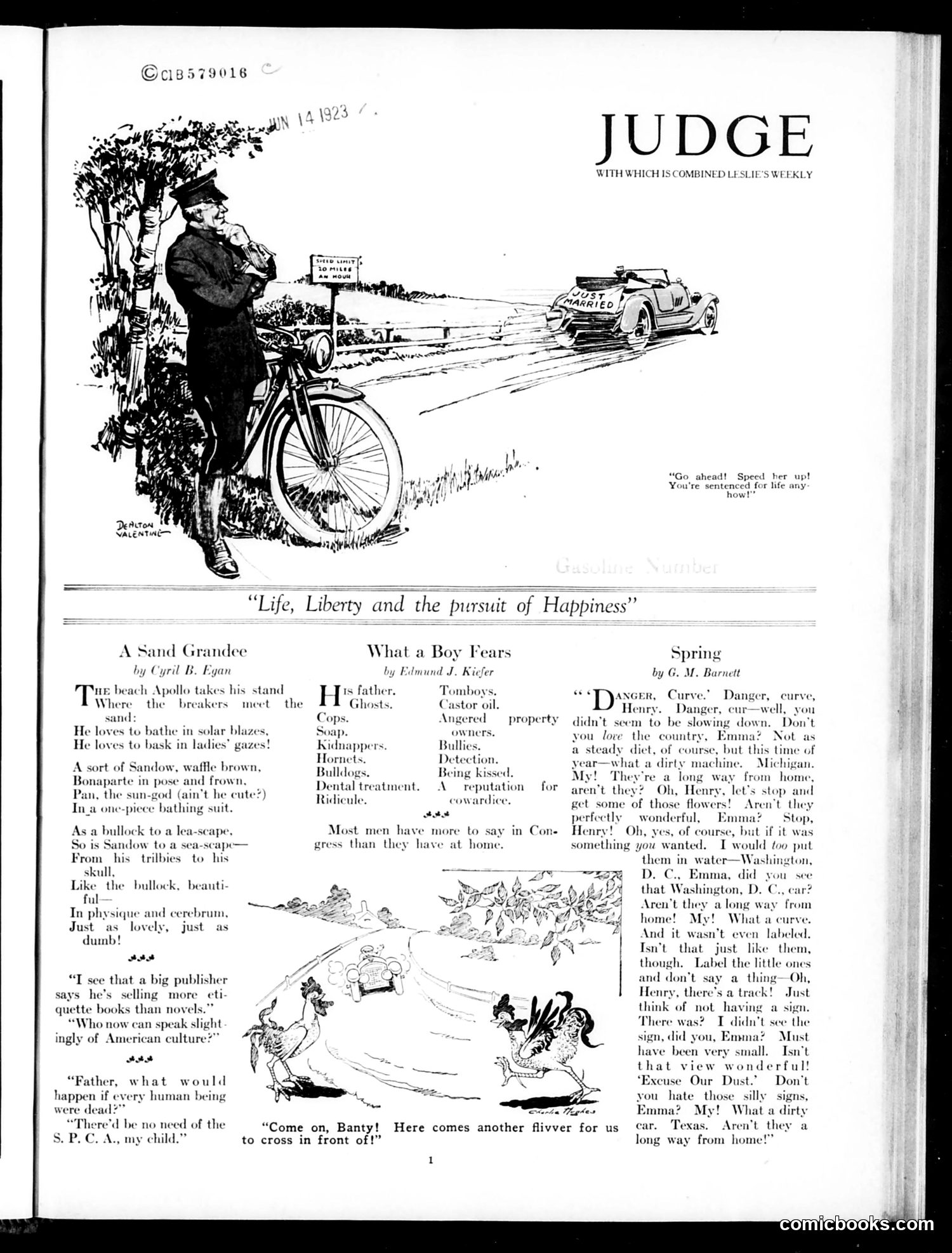
This 1923 Judge page contains three humorous literary pieces rather than political cartoons. The content satirizes everyday American anxieties: **"A Sand Grandee"** mocks pretentious beachgoers who adopt grandiose personas. **"What a Boy Fears"** lists mundane domestic concerns—ghosts, tomboys, soap, dental work—poking fun at masculine anxieties and household drudgery. **"Spring"** depicts a couple arguing about visiting Washington, D.C., with the husband dismissing tourist attractions and road signs, while the wife enthusiastically wants to see landmarks. The satire targets marital discord over vacations and masculine indifference to cultural sites. The page's motto—"Life, Liberty and the pursuit of Happiness"—ironically frames these petty domestic conflicts as obstacles to happiness. The drawings accompany lighthearted social commentary typical of 1920s humor magazines.
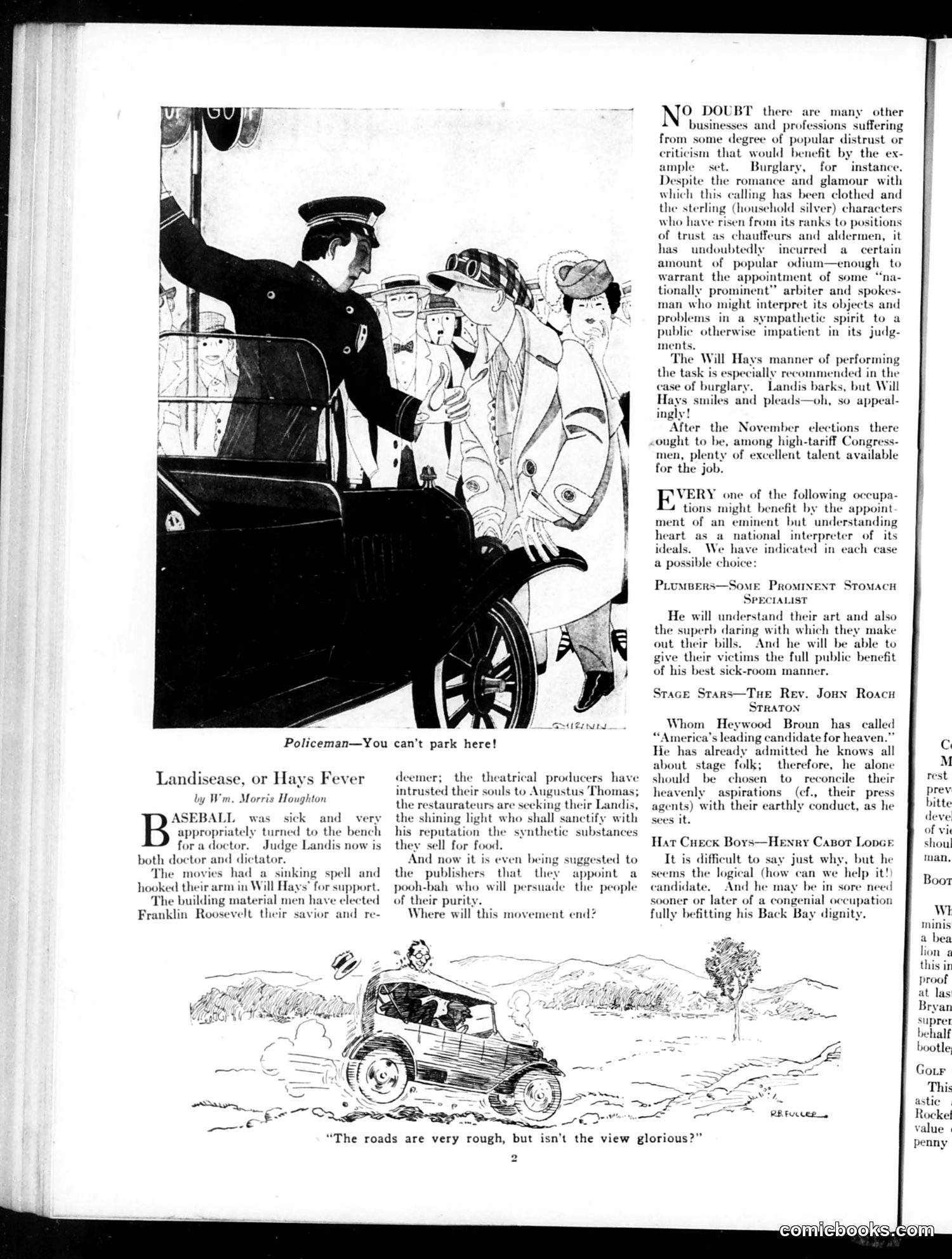
This page contains a satirical article titled "Landscape, or Hays Fever" by W.M. Morris Houghton, mocking Will H. Hays, a prominent figure in early cinema (the text identifies him as involved in film industry disputes). The top cartoon shows a policeman stopping a car full of well-dressed men, with the caption "You can't park here!"—likely satirizing how Hays or similar authority figures enforced rules on the entertainment industry. The bottom illustration depicts a rough country road with a car, captioned "The roads are very rough, but isn't the view glorious?"—suggesting ironic commentary on uncomfortable conditions being tolerated for some perceived benefit. The accompanying text discusses potential government appointments and various professions (plumbers, stage stars, hat-check boys), using satirical proposals to critique public trust and professional competence during what appears to be post-election political maneuvering.
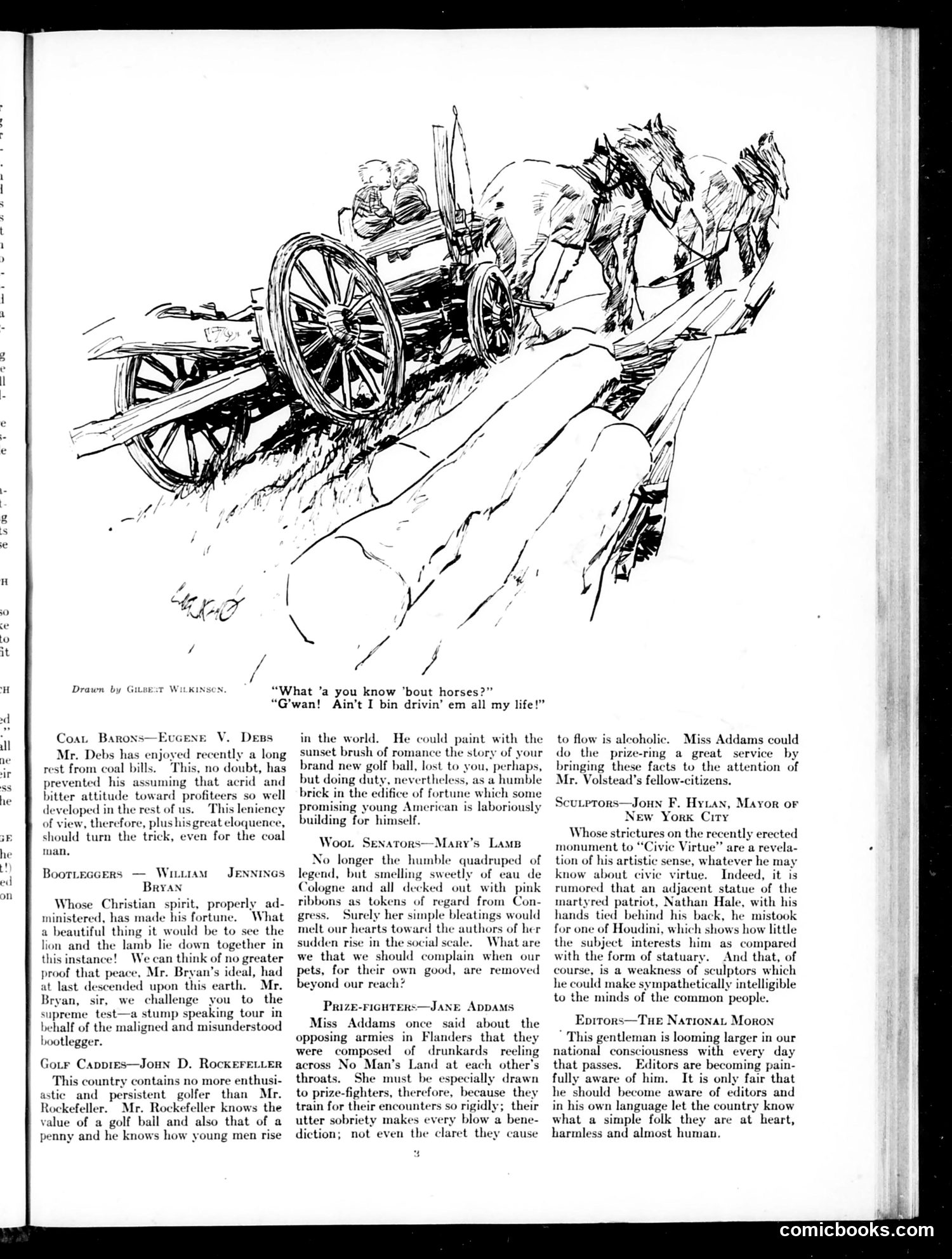
The main cartoon shows a horse-drawn wagon on a steep incline, with a driver and passengers. The caption reads: "What 'a you know 'bout horses?" / "G'wan! Ain't I bin drivin' 'em all my life!" This appears to be a humorous scene about an overconfident teamster, likely satirizing working-class bravado despite obvious danger or poor judgment. Below are brief biographical sketches of prominent figures ("Coal Barons," "Wool Senators," "Bootleggers," "Golf Caddies," etc.), each with satirical commentary on their character or social position. These appear to be typical Judge magazine content—caricatures of wealthy industrialists and politicians, using humor to critique their perceived flaws, greed, or hypocrisy. The format suggests this is early-to-mid 20th century American social satire.
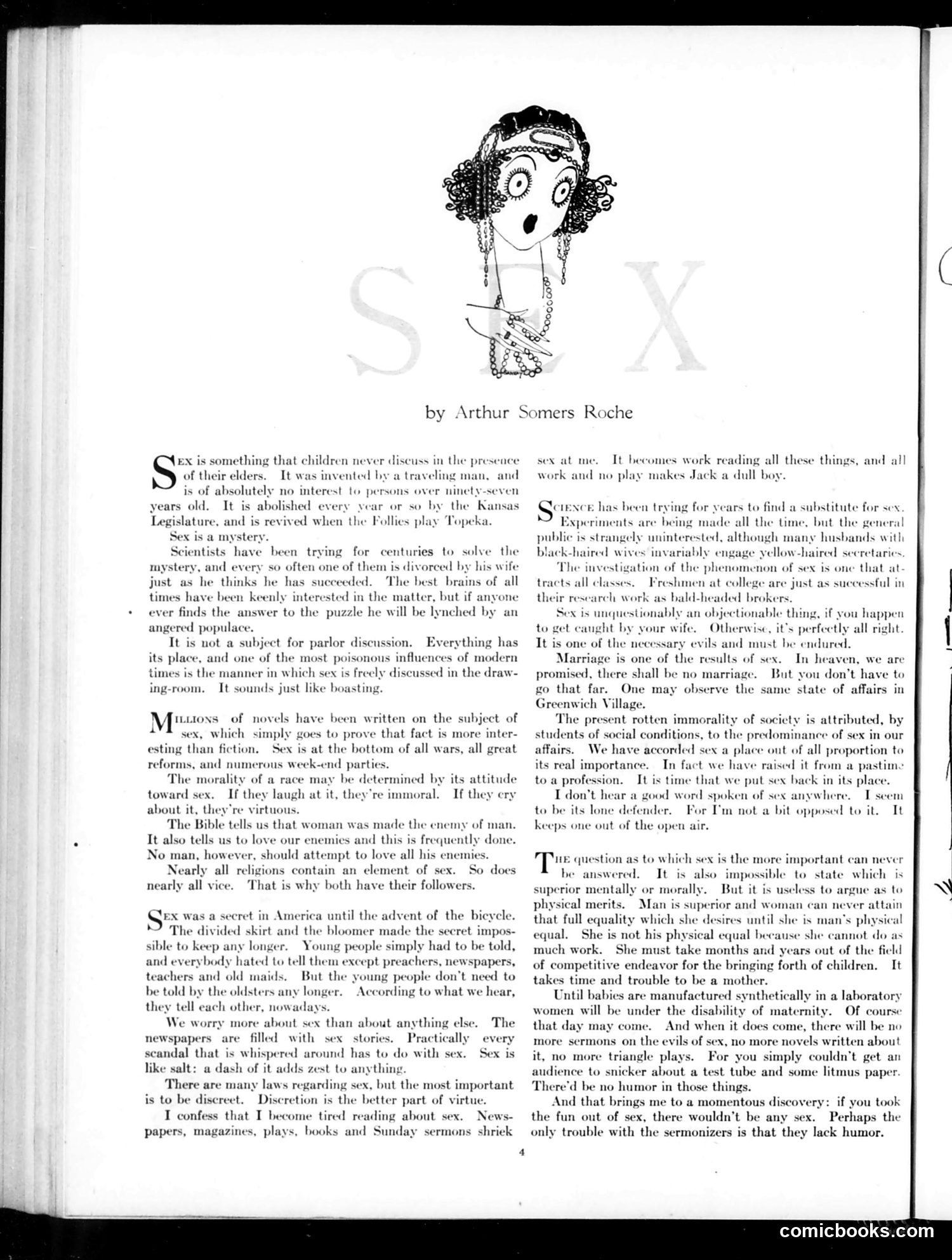
The illustration at the top depicts a woman with an exaggerated, shocked expression wearing 1920s-style clothing and jewelry. The accompanying article by Arthur Somers Roche is titled "SEX" and discusses society's attitudes toward discussing sexuality. The text humorously argues that sex is simultaneously a forbidden topic (children don't discuss it around elders) and an obsessive subject in literature and public discourse. Roche satirizes the hypocrisy: society claims to ignore sex yet produces countless novels, sermons, and newspaper stories about it. The cartoon's shocked female figure likely represents society's prudish public stance—the scandalized reaction people performed when sex was mentioned, despite their private fascination. This captures the early 20th-century tension between Victorian propriety and modern curiosity about sexuality that Judge's satirical readership would recognize and find amusing.
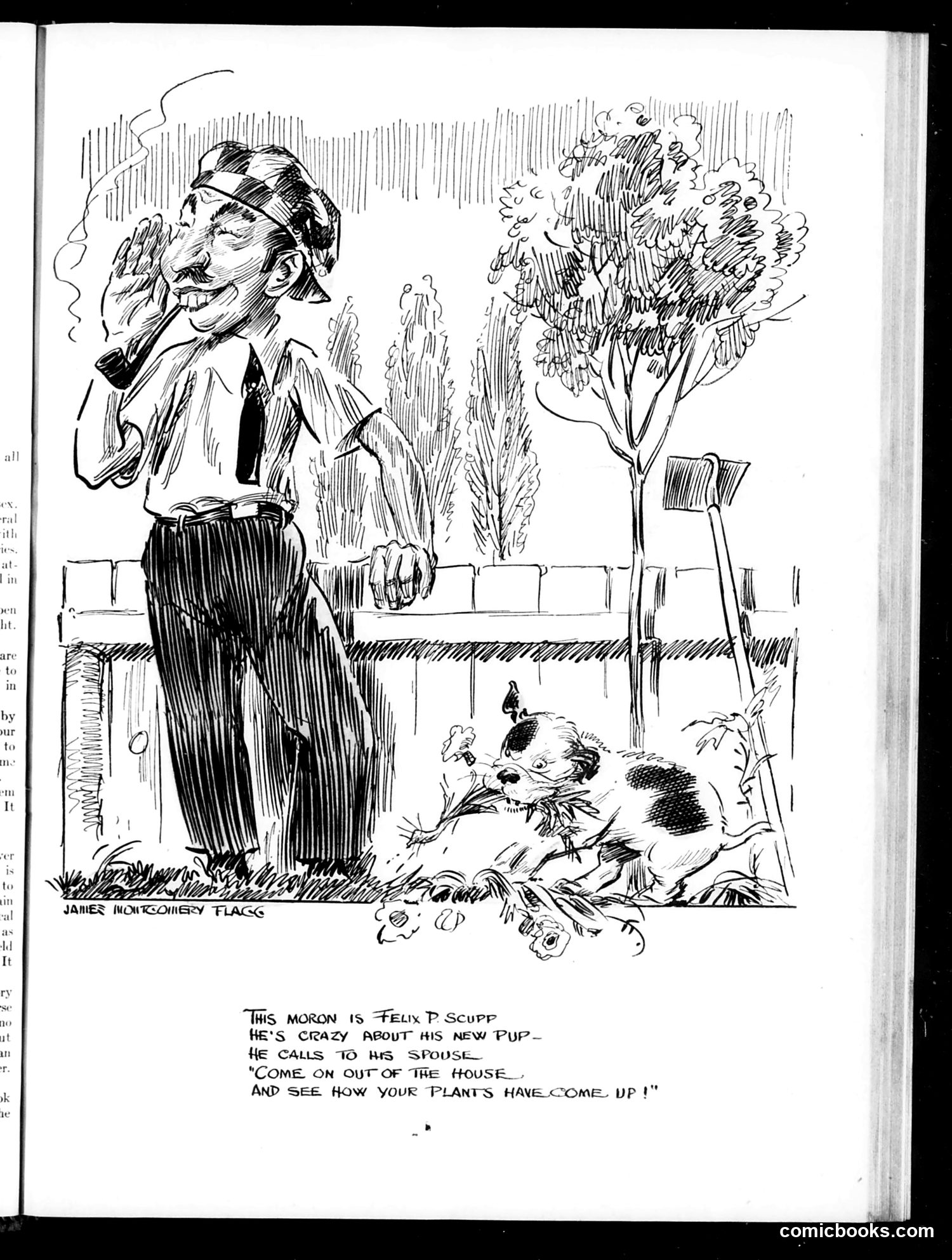
This cartoon by James Montgomery Flagg depicts a man named Felix P. Scupp, characterized as a "moron" obsessed with his new puppy. The joke centers on Scupp's misguided enthusiasm: he's calling to his spouse to come outside and admire how "your plants have come up," but the visual reveals the puppy has destroyed the garden, digging up and trampling the plants. The satire mocks foolish pet owners who are blind to their animals' destructive behavior, attributing the damage to growth rather than destruction. The exaggerated caricature of Scupp—with prominent mustache and simplified features—emphasizes his lack of intelligence. This represents common early-20th-century humor targeting oblivious or dim-witted individuals and their domestic mishaps.
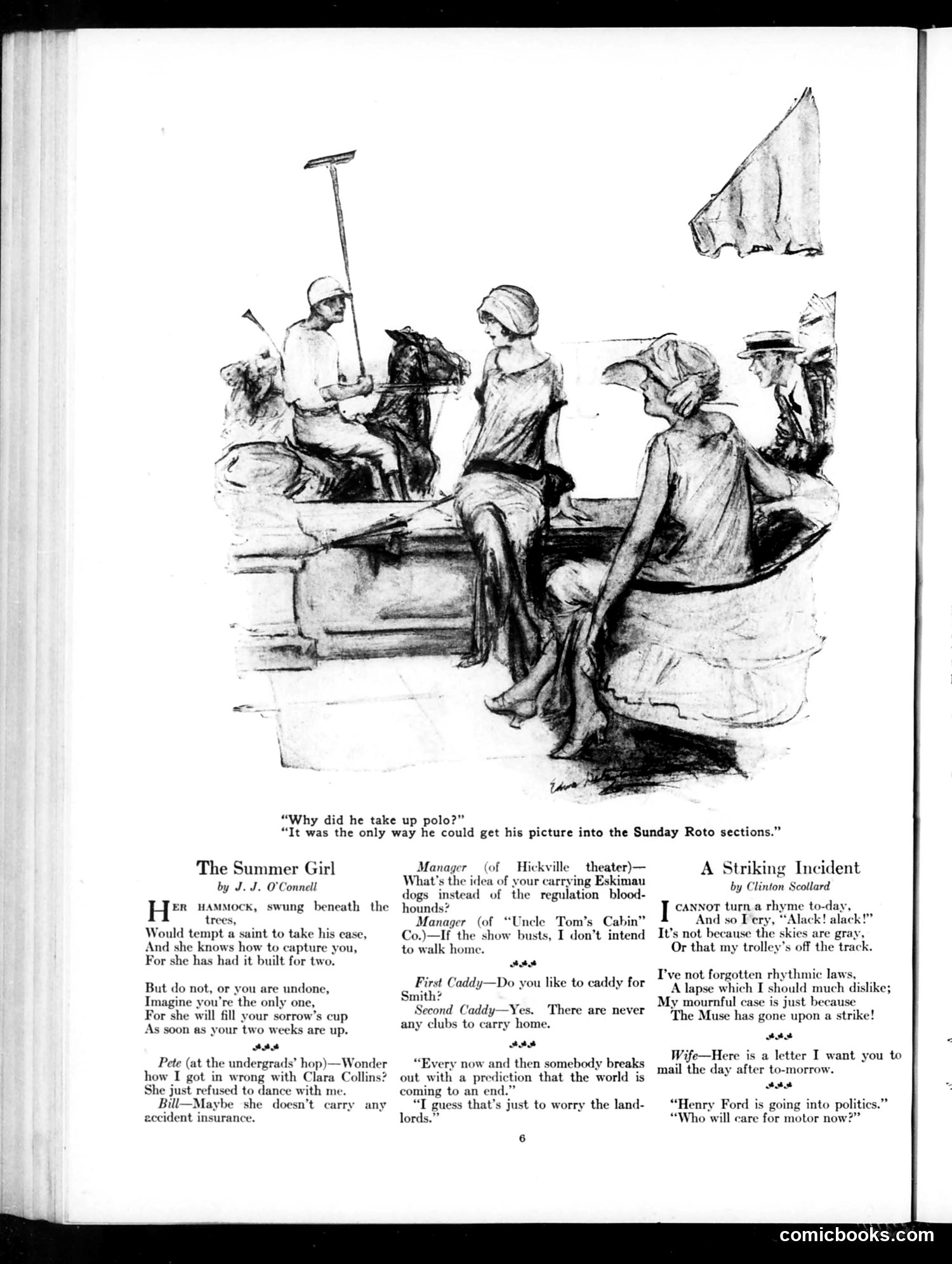
This page from *Judge* magazine contains multiple short humorous pieces satirizing early 20th-century American social life and anxieties. **"The Summer Girl"** jokes about romantic fickleness—a woman lures men with hammock romance but abandons them after two weeks. The accompanying cartoon depicts polo players; the caption mocks wealthy men adopting polo solely for newspaper publicity ("Sunday Roto sections"). **Theater manager jokes** reference economic anxiety: one manager carries Eskimo dogs instead of bloodhounds, planning to ride them home if his show fails; another won't walk home after his production closes—both implying show business is precarious. **Caddy joke** suggests Smith is a poor golfer who loses all his clubs. **"Striking Incident"** is a poem about a poet's creative block—"The Muse has gone upon a strike," punning on contemporary labor strikes. **Ford joke** references Henry Ford's rumored political ambitions, joking that industrial America would collapse without him managing automobile production. The overall tone reflects pre-WWI middle-class humor about wealth, romance, labor, and celebrity.
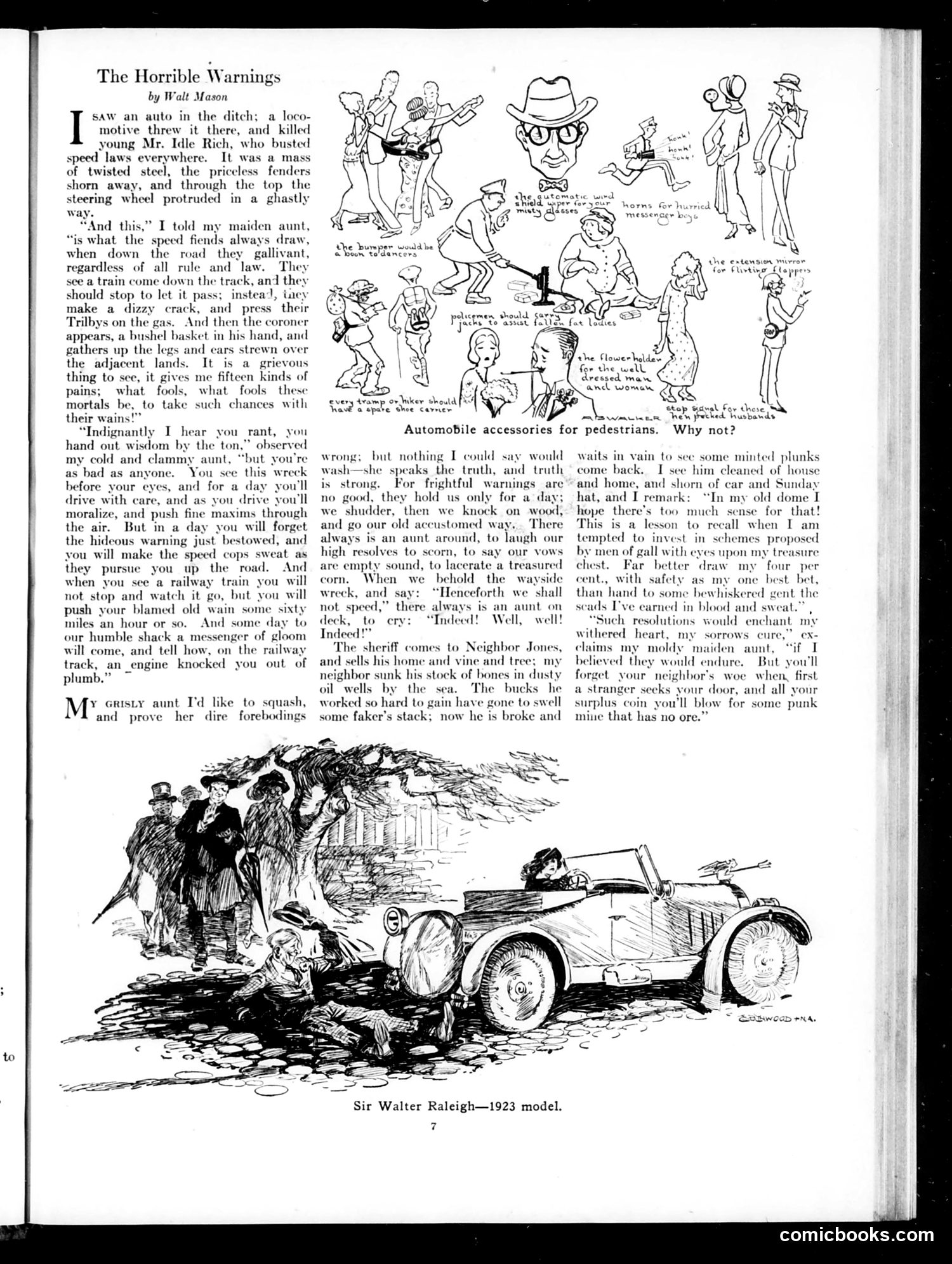
This page satirizes human nature's failure to learn from cautionary tales. The main narrative poem describes a fatal car accident involving "Mr. Idle Rich" who ignored speed laws. The narrator moralizes to his aunt about reckless driving dangers, but she cynically retorts that he—like everyone—will forget these warnings within days and resume dangerous behavior. The upper cartoon illustrates various pedestrian hazards from automobiles with dark humor ("Automobile accessories for pedestrians. Why not?"). The bottom illustration captioned "Sir Walter Raleigh—1923 model" shows a man struck by a car, sarcastically comparing modern automotive casualties to historical figures. The secondary narrative about the sheriff and "Neighbor Jones" reinforces the theme: Jones loses everything to fraudulent investment schemes, yet the narrator insists he'll avoid similar traps—prompting the aunt's knowing dismissal that he too will eventually be swindled. The satire targets human hypocrisy: we observe others' disasters, declare we've learned lessons, then repeat identical mistakes.
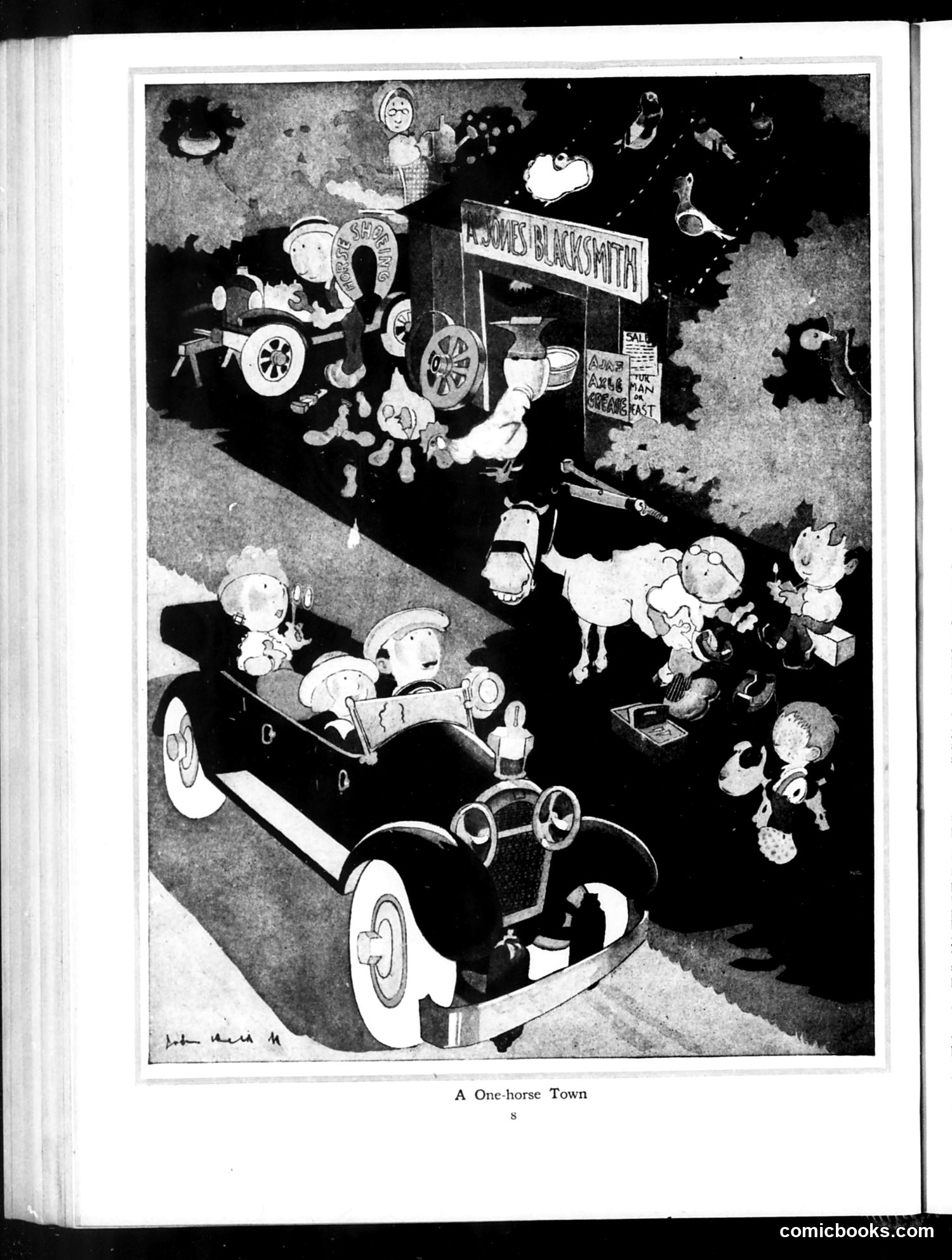
This cartoon depicts a miniature town populated by cartoon characters and toys, viewed from above. The scene shows a blacksmith shop, various toy vehicles (cars and tricycles), and small figures engaged in town activities. The title "A One-horse Town" is a period idiom meaning a small, insignificant, or economically limited community. The satire appears to mock small-town life by literally rendering it toy-like and diminished—suggesting such towns are trivial or underdeveloped compared to major cities. The juxtaposition of modern toys (automobiles) with traditional blacksmith work may also comment on rural America's slower pace of modernization. This reflects early 20th-century attitudes of urban sophistication viewing rural communities as backward or quaint.
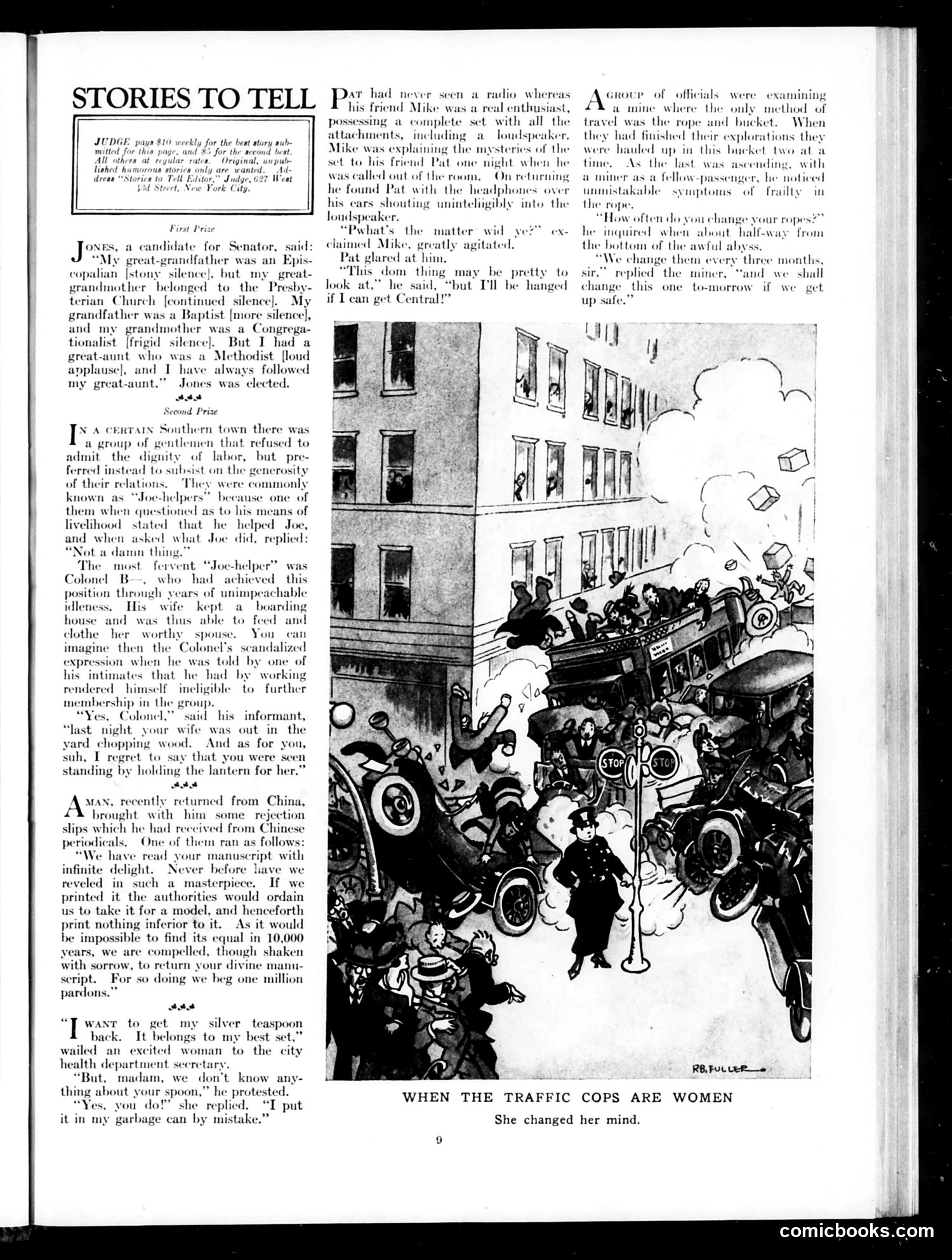
This page contains humorous anecdotes mocking American social pretensions and absurdities. Key stories include: **"Jones for Senator"**: A candidate wins election by listing his family's various Protestant denominations—a satire on meaningless political posturing where voters respond to vague religious credentials rather than policy. **"The Joe-Helpers"**: Southern gentlemen refuse honest work but accept charity. The scandal occurs when one is caught *working*—exposing the hypocrisy of their class pride. **Chinese Rejection Letter**: Parodies rejection slips by presenting an absurdly flattering refusal, mocking both Chinese bureaucratic censorship and the pretentiousness of literary journals. **Radio Joke**: An Irish immigrant (Pat) treats a radio like a telephone, shouting into the headphones trying to reach "Central"—ethnic humor based on technological ignorance. **The cartoon** (bottom): Shows chaotic traffic with female traffic cops, titled "When the Traffic Cops Are Women—She changed her mind." This mocks women in authority roles, suggesting female officers are unreliable or indecisive. The page reflects early 20th-century American class anxieties, ethnic stereotyping, and resistance to women's professional advancement.
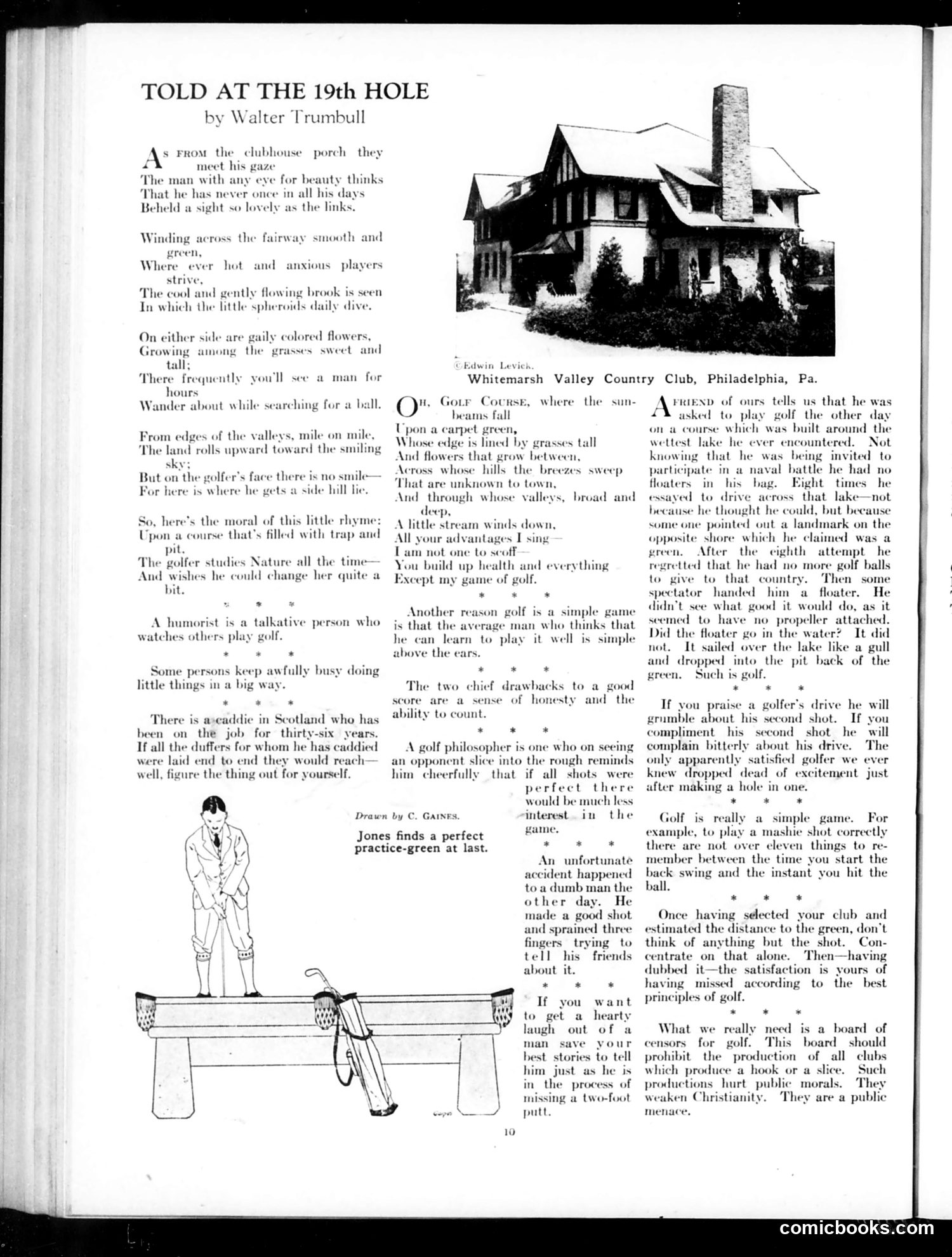
This page from *Judge* (a satirical magazine) humorously critiques golf and golfers through poetry and anecdotes by Walter Trumbull. The central satire mocks golfers' obsessive, often delusional relationship with the sport. The poem romanticizes golf's natural beauty while sardonically noting golfers never actually enjoy it—they're too frustrated searching for lost balls and suffering "side hill lies." The scattered jokes that follow ridicule golfing absurdities: golfers' inability to accept compliments without complaint, their dishonesty about scores, their tendency to sprain themselves celebrating good shots, and the irony that only a golfer who dies mid-hole seems genuinely satisfied. The illustration (by C. Gaines) depicts a typical golfer in a putting stance. The anecdote about the friend invited to play on a lake-surrounded course satirizes both poor course design and golfers' blind persistence despite obvious obstacles. The overall message: golf transforms normally rational men into obsessive, frustrated, often ridiculous versions of themselves.
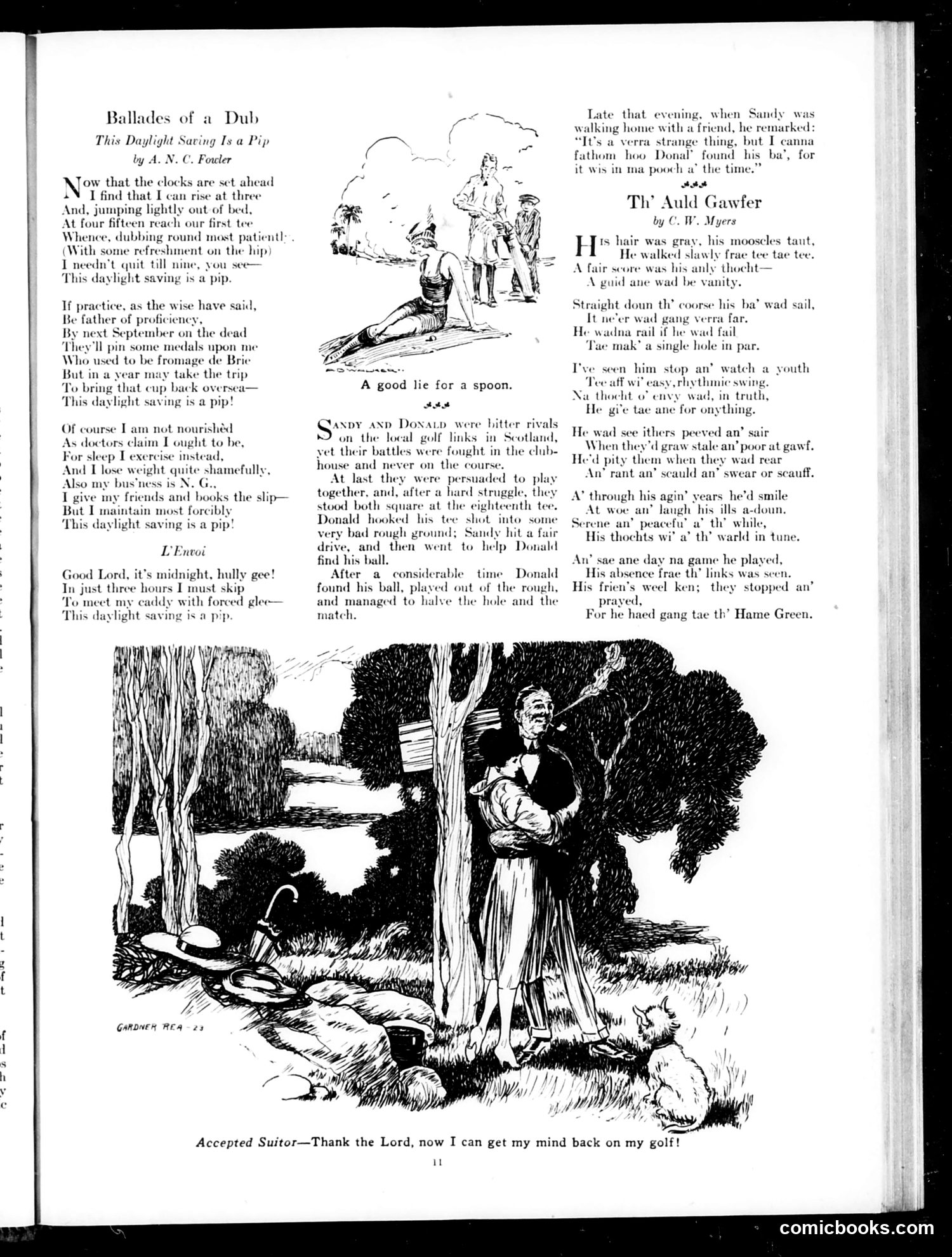
This page contains three golf-themed pieces satirizing early 20th-century leisure culture. **"Daylight Saving Is a Pip"** mocks the newly-implemented daylight saving time (introduced in the U.S. in 1918). The poem's speaker obsessively uses extra evening hours for golf rather than sleep or productive work, neglecting his business and health. The satire targets how middle-class men prioritize recreation over responsibility—and how daylight saving enables this self-indulgence. **"A Good Lie for a Spoon"** is a brief anecdote about Scottish golfers Sandy and Donald. The joke: Sandy discovers Donald's ball was in Sandy's own pocket the whole time, yet Donald somehow still tied the match. It mocks gullibility and cheating. **"Th' Auld Gawfer"** presents a virtuous elderly golfer—serene, patient, non-competitive—who accepts golf's outcomes with grace. This nostalgic tribute contrasts sharply with modern golfers' rage and vanity, implicitly criticizing the era's increasingly competitive, temperamental approach to the sport.
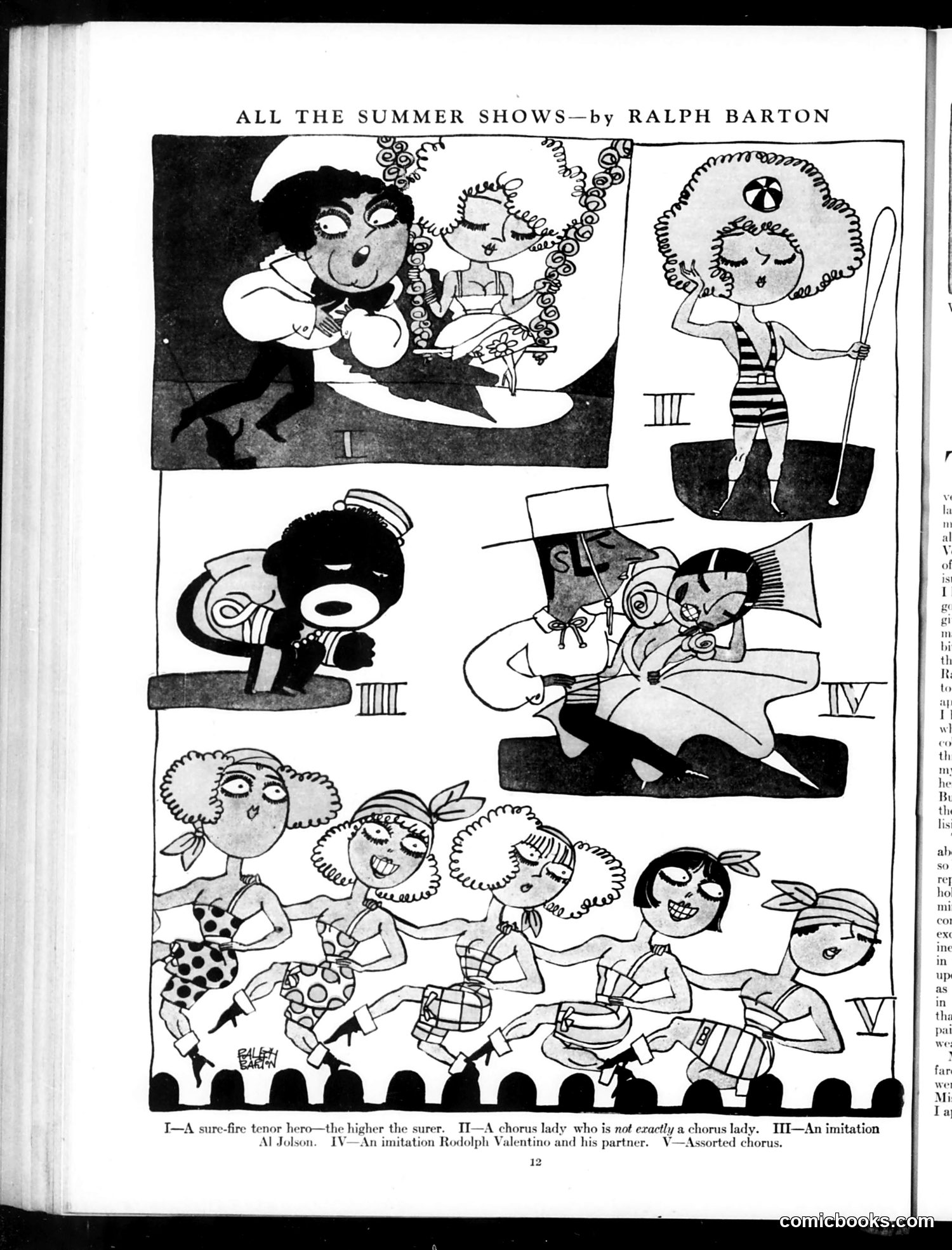
This 1920s satirical cartoon mocks Broadway summer theatrical productions. Barton's five vignettes parody common entertainment tropes: Panel I ridicules operatic tenors whose success depends on hitting high notes. Panel II jokes about a "chorus lady" whose talents lie elsewhere than dancing. Panel III explicitly caricatures Al Jolson, the era's most famous entertainer known for blackface performances. Panel IV mocks the popularity of Rudolph Valentino imitations—the silent-film star inspired countless copycat performers. Panel V shows generic chorus dancers. The satire targets how summer theater relied on celebrity impressions, novelty acts, and formulaic productions rather than original talent. Barton captures the era's entertainment culture where impersonating famous stars was a reliable commercial strategy, and where physical appearance and gimmicks often mattered more than genuine ability.
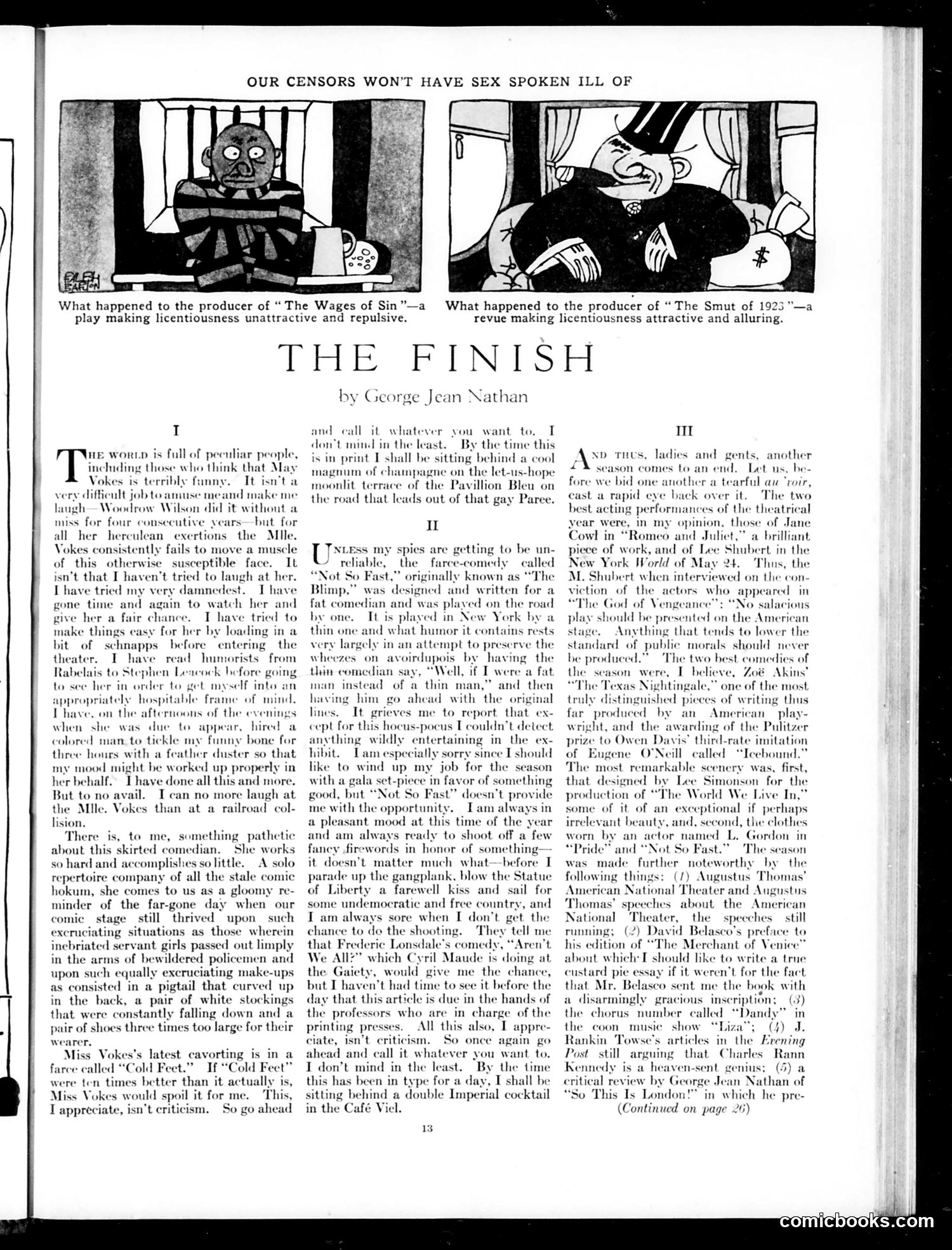
This page contains theatrical criticism disguised as satire. The header cartoons mock **theatrical censorship**: the left panel shows a producer jailed for presenting "The Wages of Sin" (depicting licentiousness as repulsive), while the right shows another jailed for "The Smut of 1923" (depicting it as attractive). The joke criticizes inconsistent moral policing—censors punish opposite messages equally. Nathan's essay attacks **Miss Vokes**, a stage comedian he finds unfunny and dated, describing her work as stale hokum evoking an earlier era of theatrical slapstick (exaggerated physical comedy with props like feather dusters and oversized shoes). He dismisses two recent Broadway productions: a farce called "Cold Feet" and a thin-man adaptation of a fat-comedian farce called "Not So Fast." Nathan, preparing to leave New York for Paris, critiques both shows as lacking genuine entertainment value, particularly the latter's reliance on weak verbal gags about body size rather than actual humor. The piece reflects 1920s Broadway criticism and contemporary debates over theatrical standards and censorship.
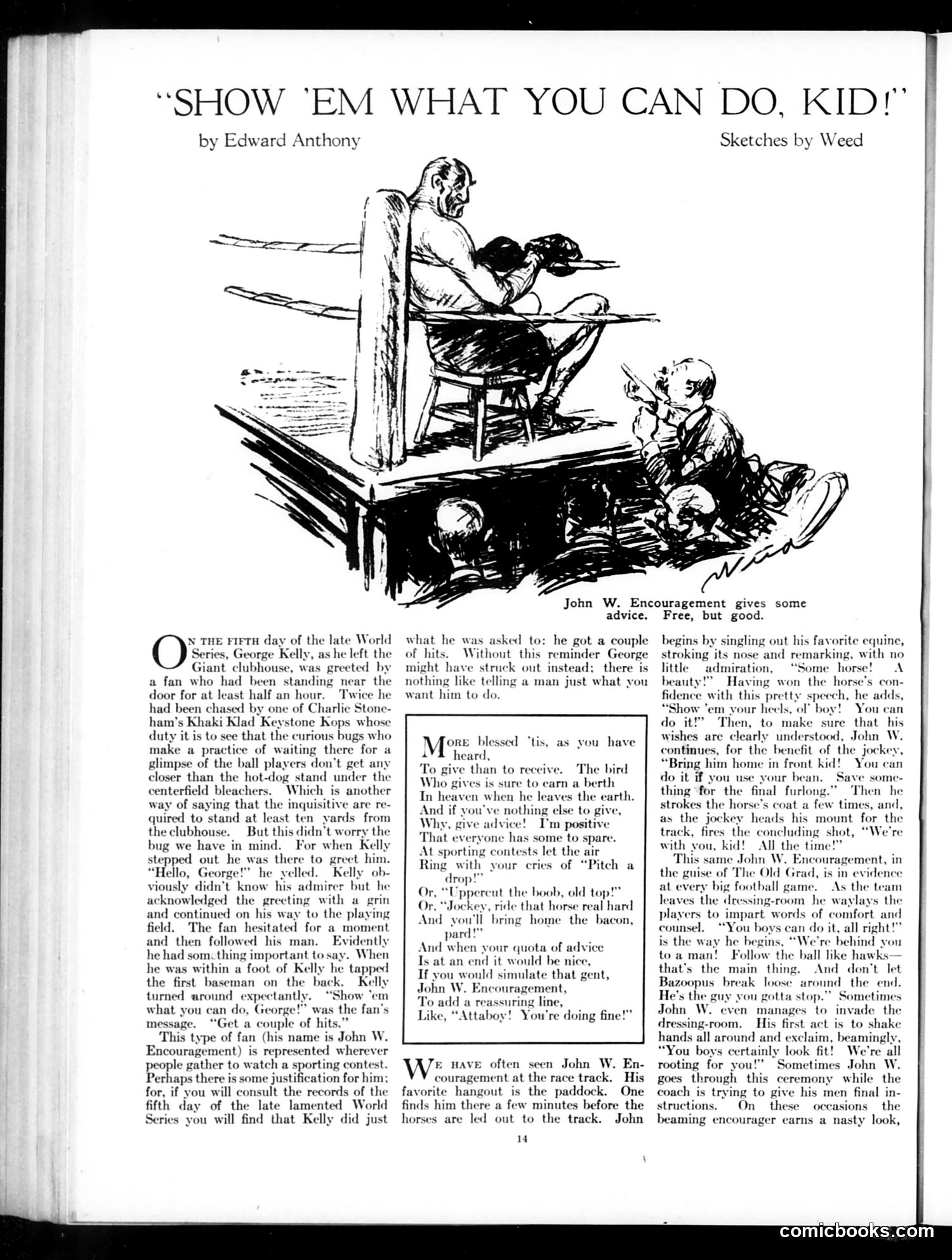
This humorous article satirizes "John W. Encouragement"—a stock character representing the overeager sports fan who offers unsolicited advice to athletes. The piece references George Kelly of the New York Giants baseball team (likely from the 1921-1924 World Series era), describing how a persistent fan follows him from the clubhouse shouting encouragement. The satire identifies this fan-type as ubiquitous at sporting events—present at horse races (accosting jockeys in the paddock), football games (ambushing players in locker rooms), and baseball games. These fans believe their vocal support and tactical suggestions directly influence outcomes. The article gently mocks their earnest belief that telling athletes "Show 'em what you can do!" somehow improves performance, while acknowledging they mean well. The humor lies in exposing how commonplace and harmless yet comedically presumptuous such fan behavior is.
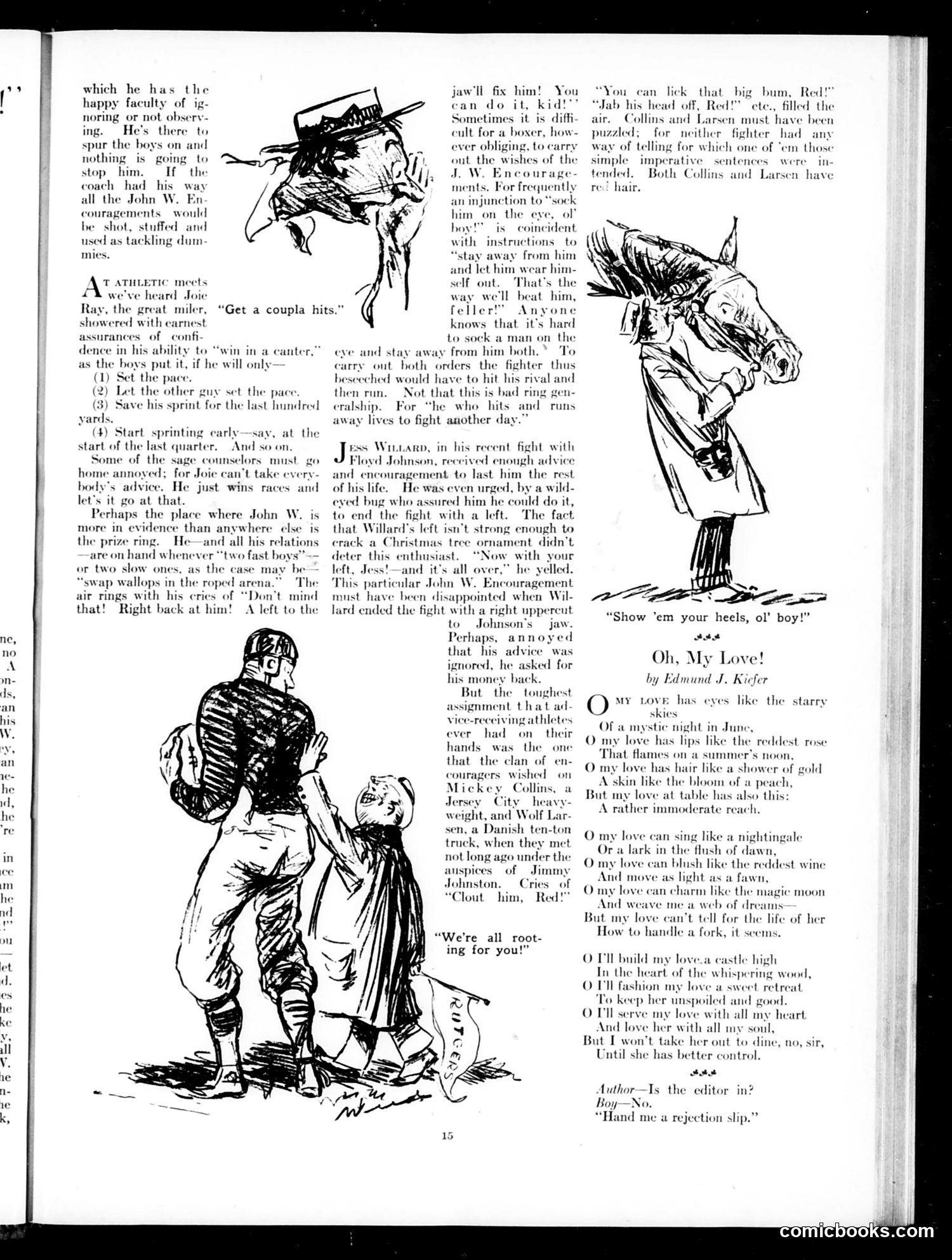
This page satirizes the ubiquitous "John W. Encouragement"—the overzealous sports spectator who shouts conflicting, often impractical advice at athletes during competition. The main article mocks these well-meaning but counterproductive fans, using examples from track (miler Joie Ray receiving contradictory pacing instructions) and boxing. The Jess Willard-Floyd Johnson fight illustration shows the absurdity: a fan urges Willard to end the fight with a left punch despite Willard's left being notoriously weak. The Mickey Collins boxing cartoon illustrates peak confusion: with fighters being simultaneously shouted at to "clout him" and "stay away," neither boxer can determine which advice applies to him. The cartoons ridicule how amateur sports fans, despite zero expertise, bombard athletes with impossible, contradictory directives—the central joke being that accomplishing all the shouted instructions simultaneously is physically impossible. This reflects early 20th-century American sporting culture's vocal spectator tradition.
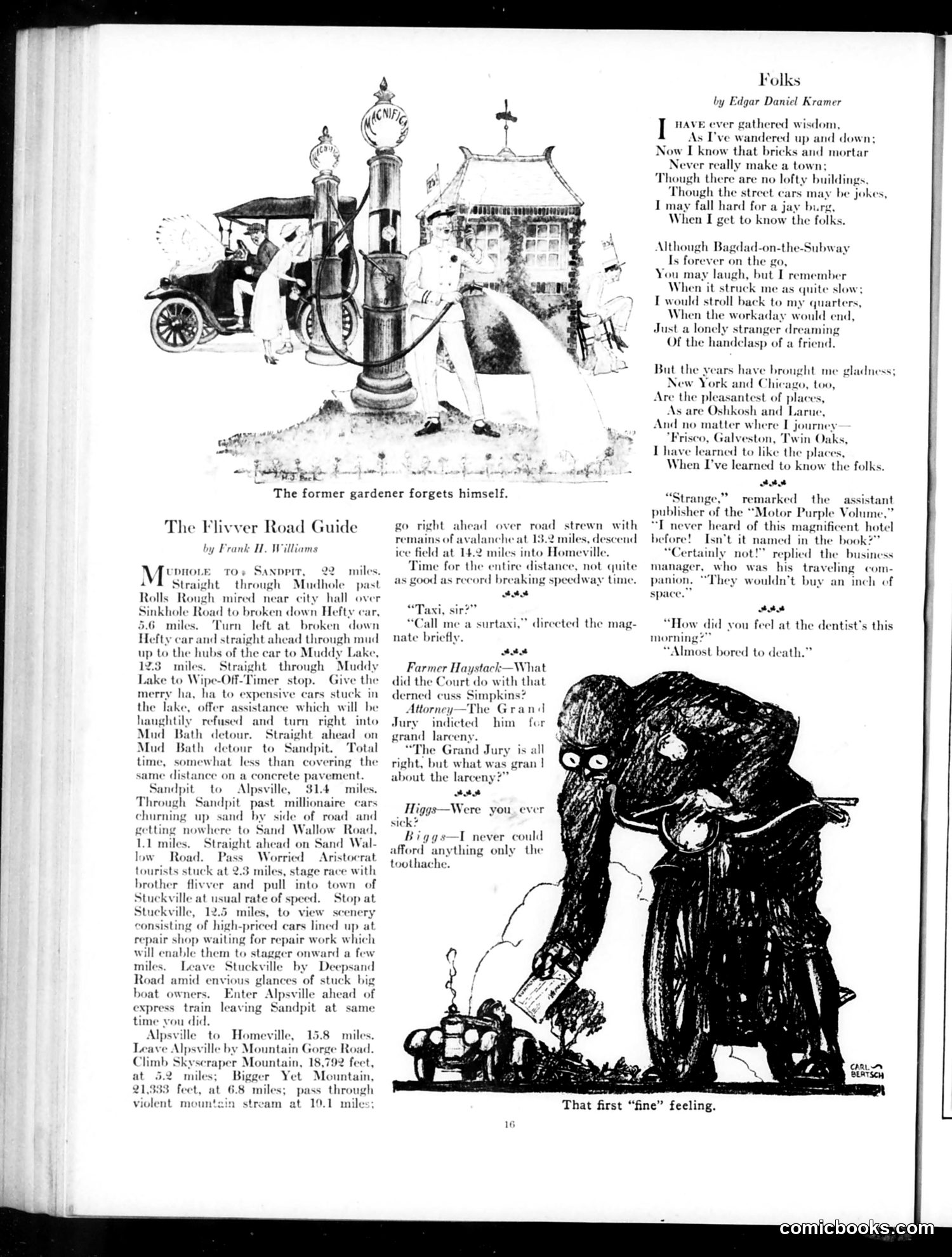
This page contains three distinct pieces: **"The Flivver Road Guide"** satirizes the Model T Ford (the cheap "flivver") by presenting an absurdly detailed driving route filled with mudhole stops, stuck luxury cars, and mountain passes—mocking how primitive roads made early automobile travel arduous and unreliable. The joke is that wealthy "Aristocrat tourists" in expensive cars get stuck while cheap Fords persevere. **"Folks" (poem)** sentimentally celebrates small-town America over flashy cities like "Bagdad-on-the-Subway" (New York). It reflects 1920s nostalgia for rural community bonds versus urban anonymity. **Small satirical exchanges** include a magnate insisting on being called a "surtaxi" (pretentious), and a poor farmer (Biggs) who could "only afford the toothache"—commentary on class and hardship. The top illustration shows an early automobile near ornate street fixtures, captioned "The former gardener forgets himself"—likely mocking nouveau riche or social climbing through automobile ownership.
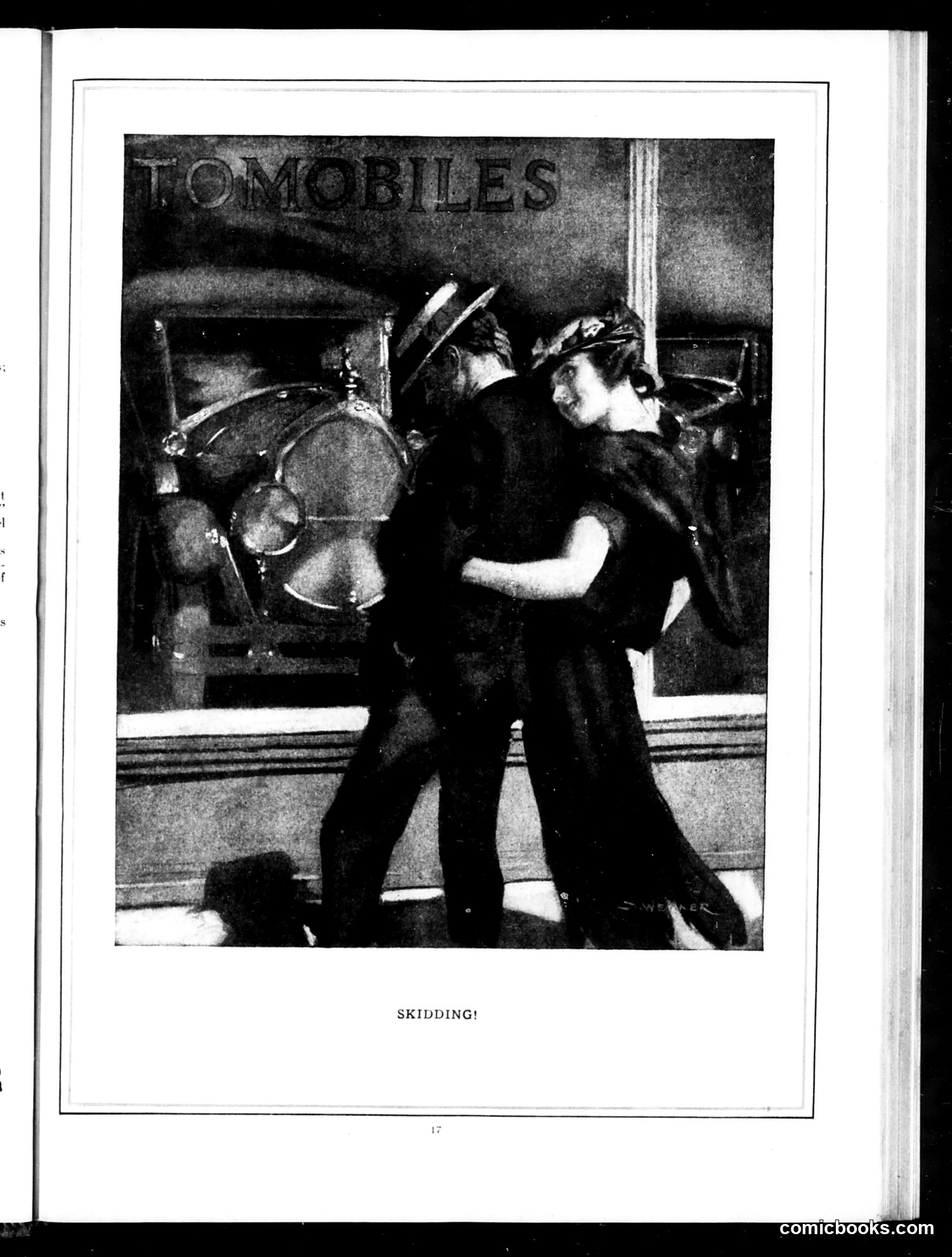
This page shows two women in dark clothing appearing to lose their footing or balance near an automobile, with the word "SKIDDING!" as the caption. The "TOMOBILES" text visible at top suggests this relates to early automobiles. The satire likely plays on multiple meanings of "skidding"—both the literal loss of traction/control of a vehicle and the slang meaning of romantic misbehavior or moral slipping. The women's physical loss of balance on or near an automobile becomes a visual joke about the perceived dangers of automobiles and, possibly, the social anxieties surrounding women's newfound mobility and independence that cars enabled. This reflects early 20th-century satirical concerns about changing social norms and the automobile's role in loosening traditional moral constraints.
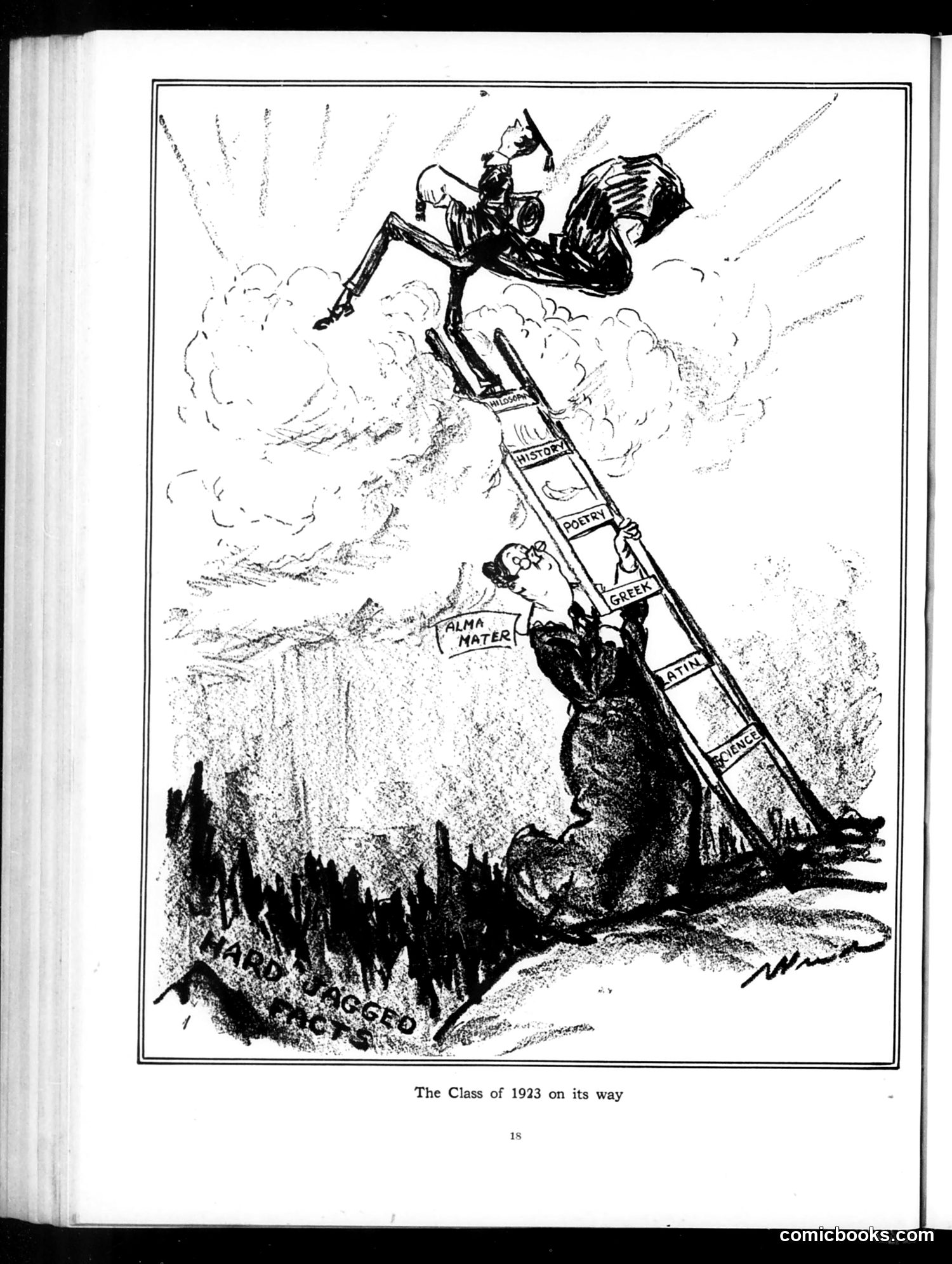
This allegorical cartoon depicts Death (skeleton figure) climbing a ladder toward clouds, carrying what appears to be a graduate or young person. The ladder's rungs are labeled with subjects: "Alma Mater," "History," "Poetry," "Greek," "Latin," and "Science." The satire critiques the educational system and its perceived failures or dangers facing the Class of 1923. The "Barbarian" label at the base suggests the cartoon warns that classical education (Greek, Latin, History, Poetry) is inadequate preparation for modern times, leaving graduates vulnerable or unprepared for the future—hence Death awaits them. The cartoon likely reflects post-WWI anxieties about whether traditional education equipped young people to survive in a transformed world.
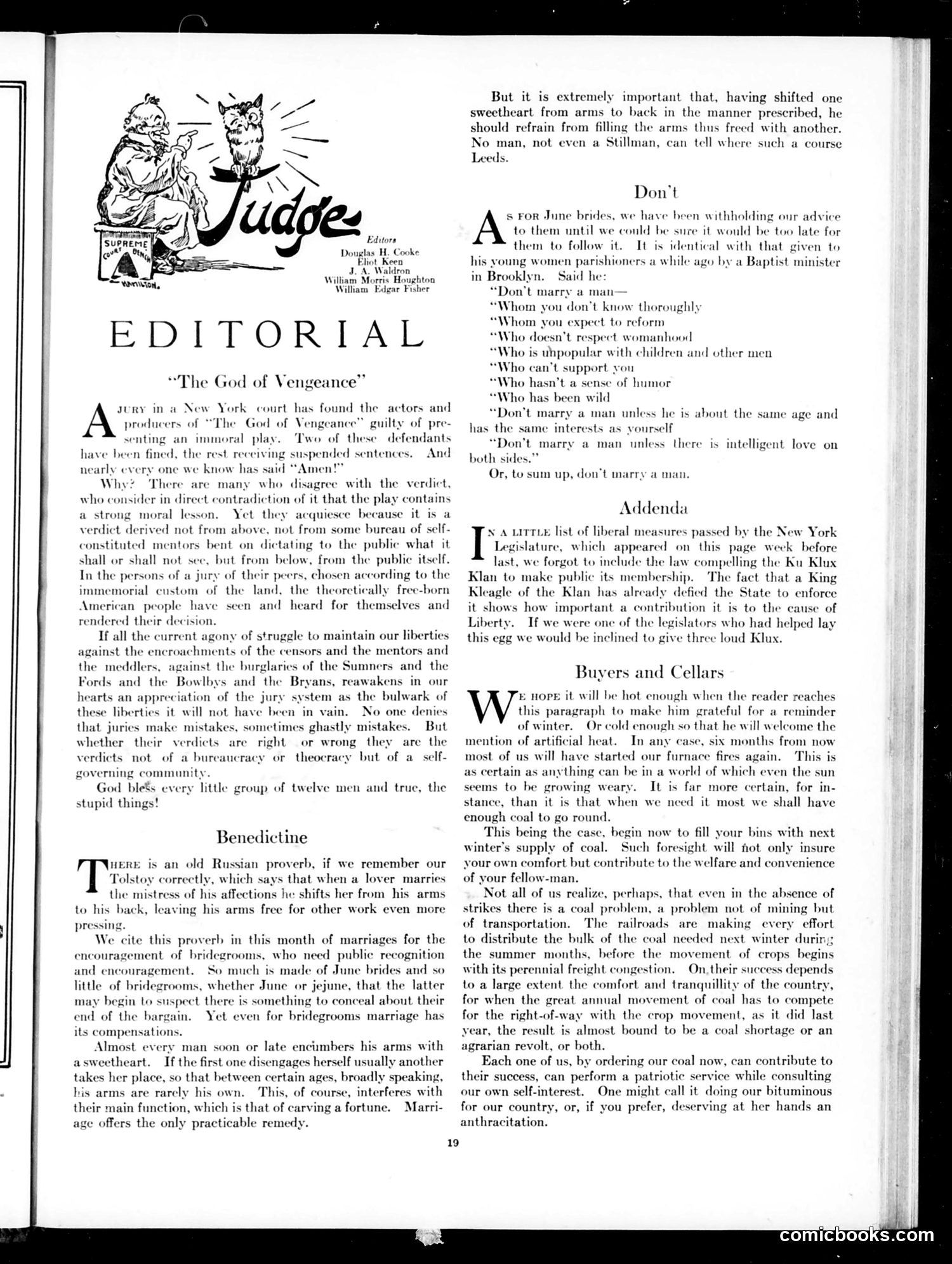
This page contains three editorials reflecting Judge magazine's progressive stance on early 20th-century social issues. **"The God of Vengeance"** discusses a recent obscenity trial. A New York jury found a play immoral and convicted its producers. Judge celebrates this verdict—not because it agrees the play is immoral, but because the decision came from ordinary citizens via jury, not from censorious authorities or bureaucratic control. The editorial defends the jury system as democracy's safeguard against censorship by elites. **"Benedictine"** uses a Tolstoy proverb about marriage to humorously address grooms: when a man marries, he shifts his sweetheart "from arms to back," freeing his arms for earning a living. The joke warns grooms not to immediately acquire new romantic entanglements. **"Don't"** reprints advice a Brooklyn Baptist minister gave young women: don't marry men who are wild, disrespectful, unsupportive, or unpopular. The satirical conclusion: "don't marry a man" at all—highlighting the impossible standards women face.
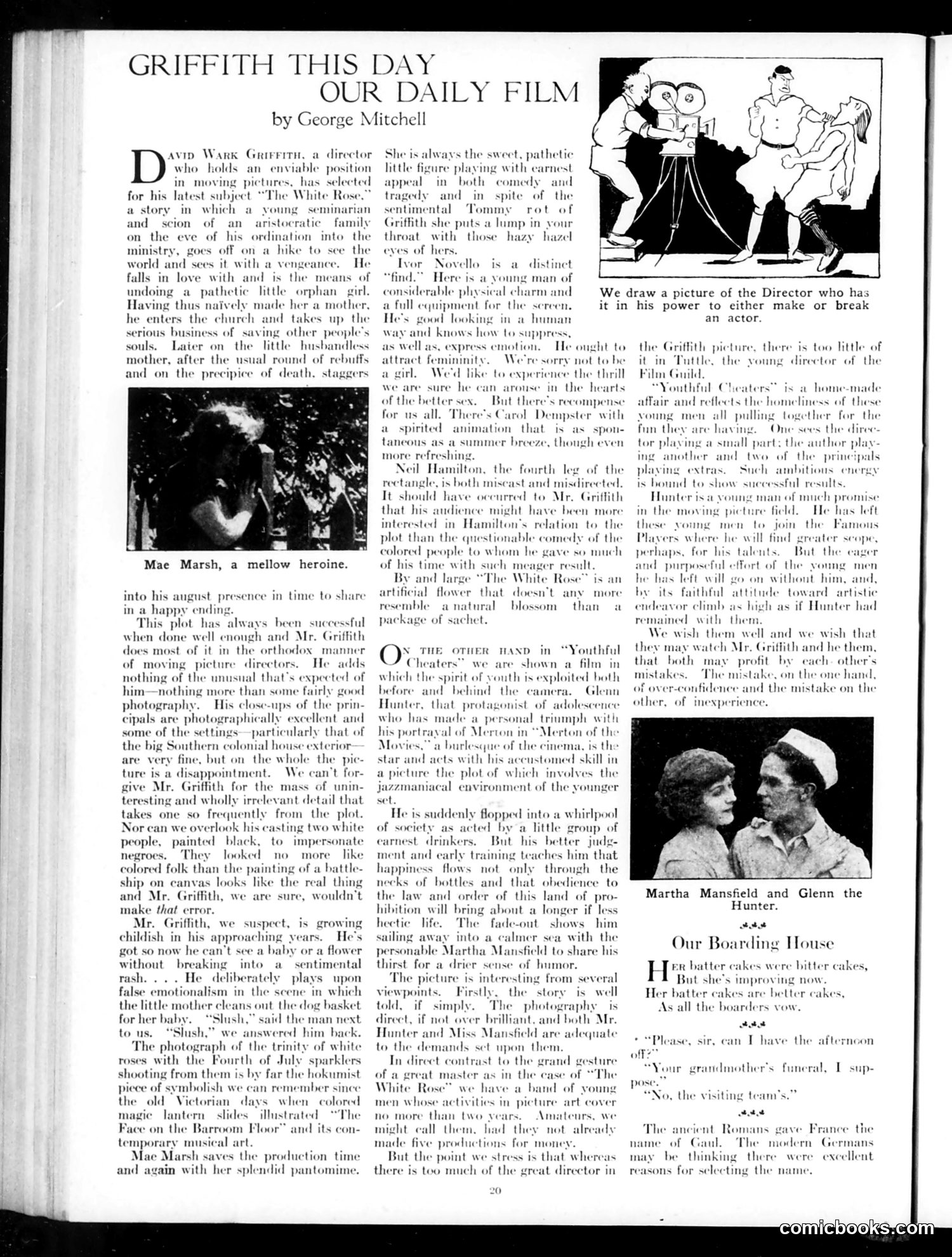
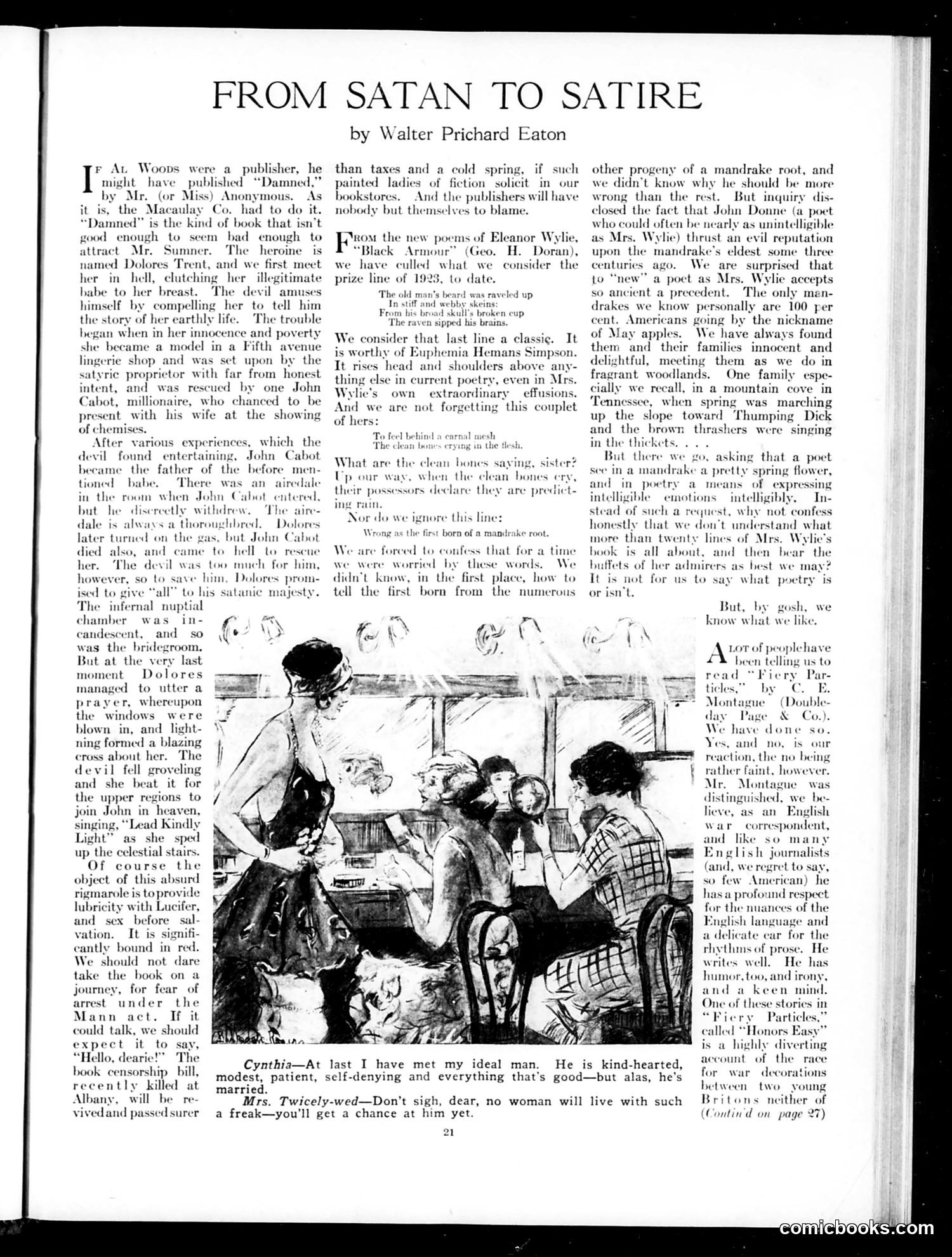
This page from *Judge* magazine contains two separate satirical pieces by Walter Prichard Eaton. **Top section ("From Satan to Satire"):** Eaton mocks a scandalous novel called *"Damned"* by an anonymous author, published by Macaulay Co. The plot—featuring a woman named Dolores Trent who becomes a model, has an illegitimate child with a wealthy man (John Cabot), and ends in hell before redemption—is criticized as sensationalist trash. Eaton sarcastically notes the book is "bound in red" and jokes it could be prosecuted under the Mann Act (federal law against transporting women across state lines for immoral purposes), treating the novel as dangerously obscene. **Bottom section:** Eaton critiques poet Eleanor Wylie's collection *"Black Armour"* (1923), mocking her deliberately obscure, difficult imagery—particularly her references to mandrakes' "first born" and other bizarre poetic conceits. He compares her to 19th-century poet Felicia Hemans. **The cartoon** depicts a domestic scene, accompanying a brief dialogue about an ideal but married man—typical *Judge* humor about infidelity and marriage.
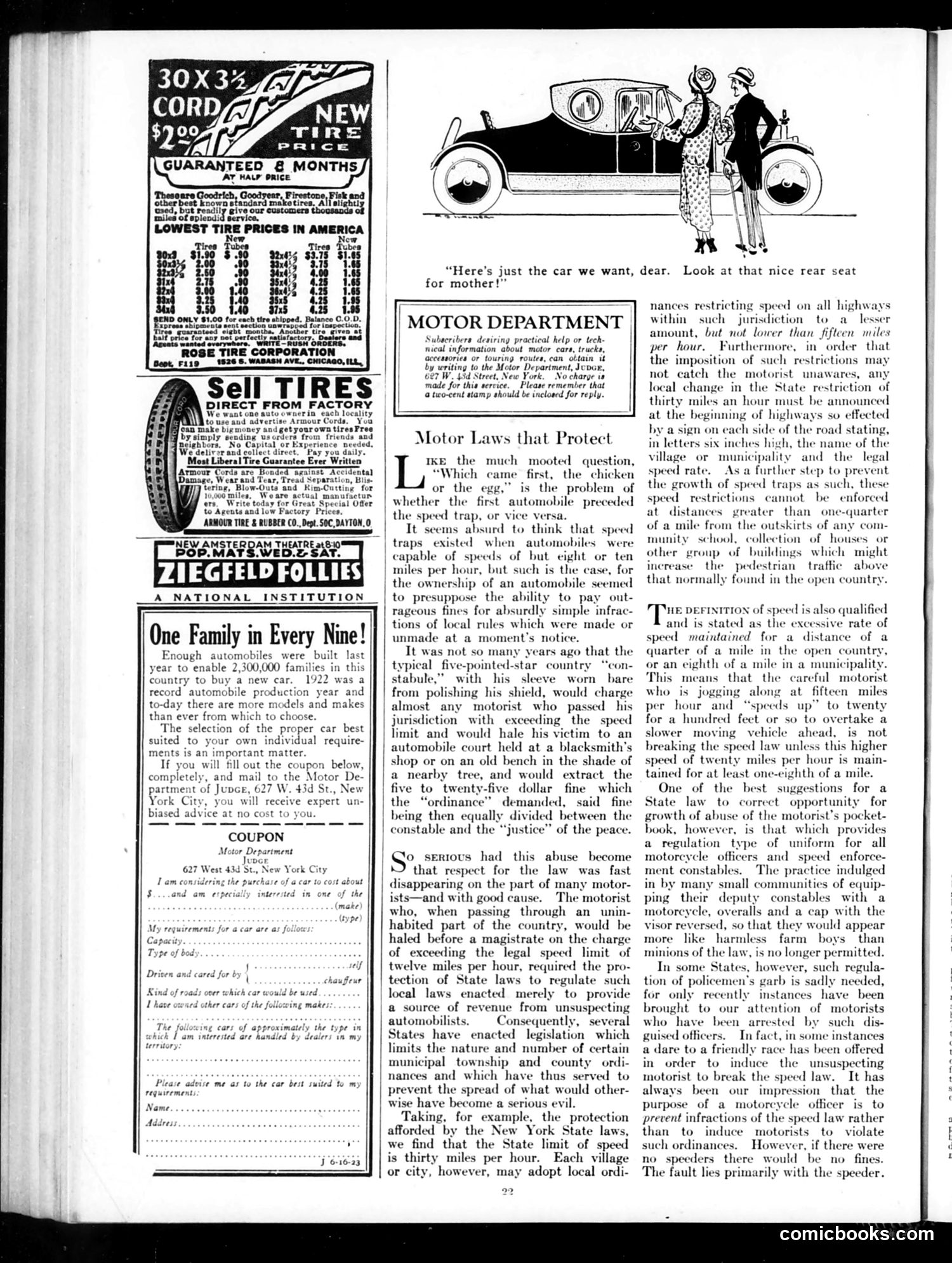
This page from Judge (circa 1922, based on automobile references) contains primarily **advertisements and practical advice rather than political satire**. The main cartoon shows a couple admiring a car, with the caption "Here's just the car we want, dear. Look at that nice rear seat for mother!"—a gentle domestic humor joke about family automobile shopping, not political commentary. The substantive content is the **"Motor Department" editorial** addressing speed traps and traffic laws. It discusses the historical absurdity of early speed-trap enforcement: local constables would fine motorists for exceeding arbitrary speed limits (sometimes 8-10 mph) in rural areas, pocketing fines alongside corrupt local magistrates. The article advocates for state-level regulation to prevent this revenue-driven abuse of motorists. The satire is **social rather than political**—mocking corrupt small-town law enforcement that exploited automobile owners. The article argues New York State speed laws (30 mph limit) represent legitimate reform protecting citizens from predatory local authorities. Surrounding content includes tire and automotive advertisements targeting the newly mobile middle class.
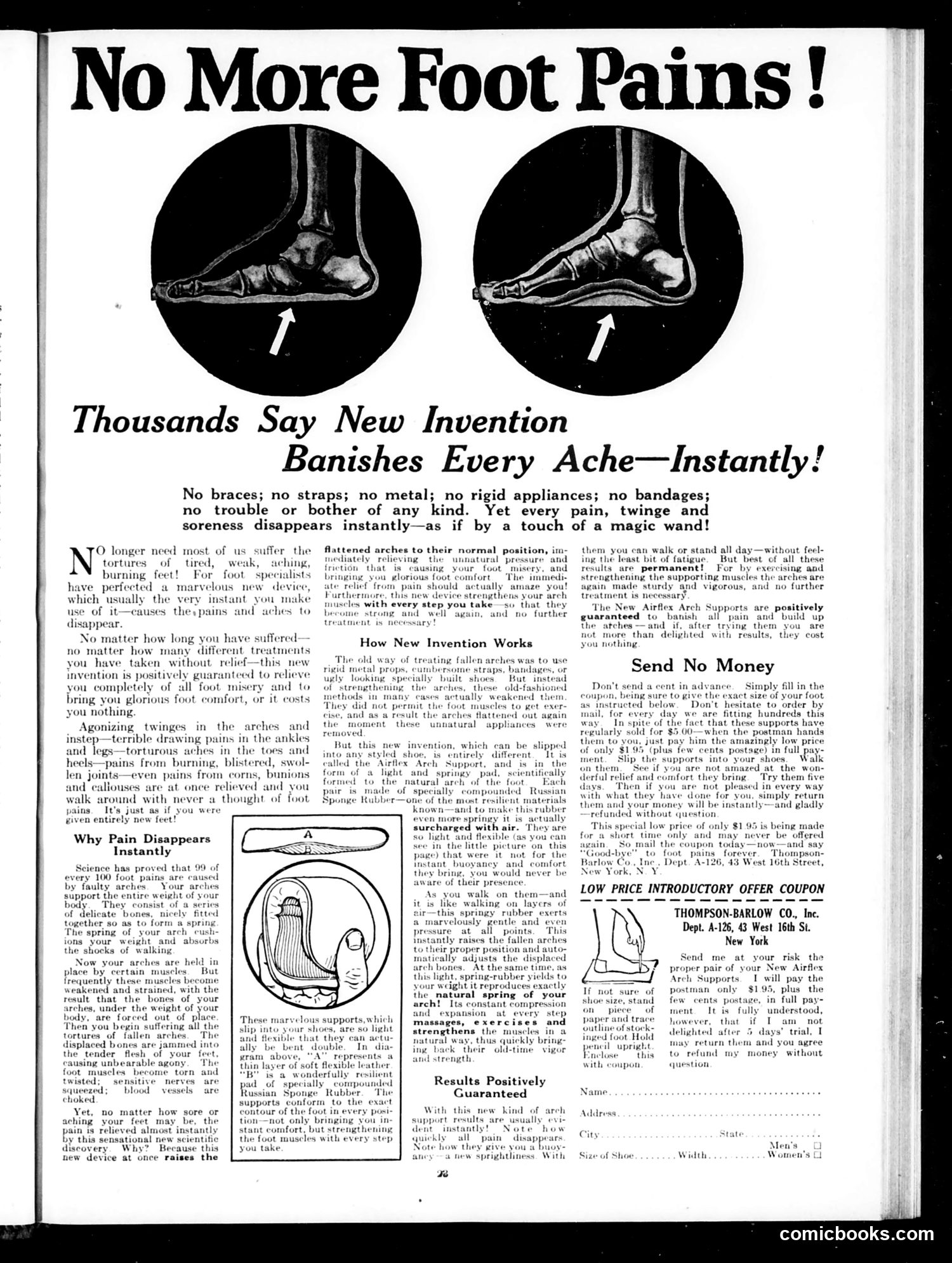
This is **not political satire**—it's a full-page **advertisement** disguised as editorial content, a common practice in early 20th-century magazines like Judge. The page promotes the "Airflex Arch Support," a shoe insert claiming to cure foot pain instantly. The two anatomical diagrams show a flat arch (left, with arrow indicating pain) versus a properly supported arch (right). The text uses pseudo-scientific language ("99 of every 100 foot pains are caused by faulty arches") and exaggerated claims ("pain disappears instantly") typical of dubious medical products of the era. There's a money-back guarantee and an order coupon. **The satire angle**: Judge magazine was likely poking fun at the abundance of quack medical devices marketed to the gullible public. By presenting this ad prominently, Judge may have been satirizing consumer culture and false advertising claims—though the line between genuine ad and parody is deliberately blurred for humorous effect.
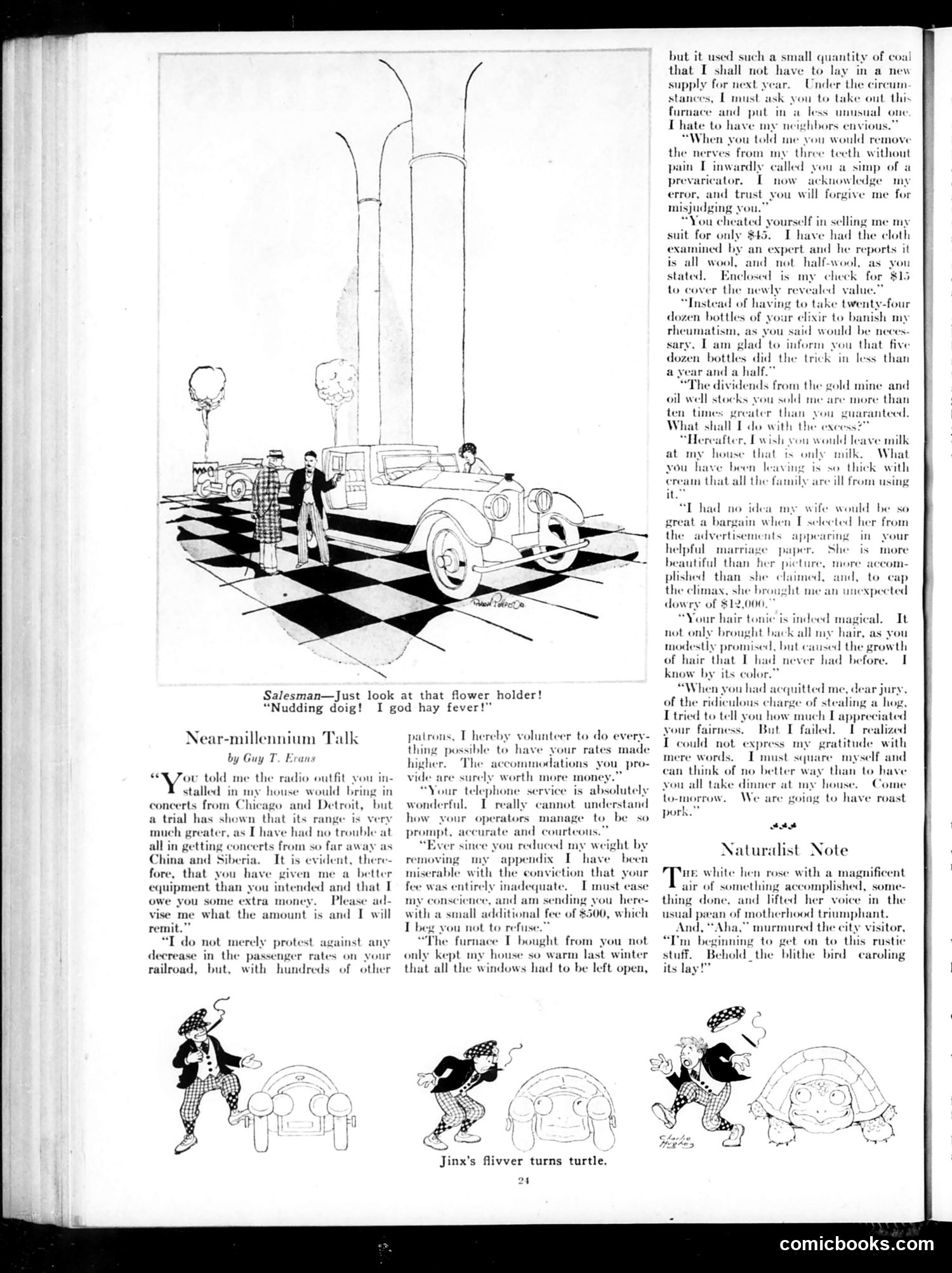
This piece satirizes the absence of honesty and fairness in early 20th-century commerce. The unnamed narrator presents a series of letters from satisfied customers who—contrary to standard practice—are *voluntarily* offering extra payment or praise when businesses have actually overdelivered or undercharged them. The satire's target is clear: such integrity was apparently so rare that it would be remarkable and noteworthy. By having customers confess they feel *guilty* receiving better service than paid for, the author mocks the prevailing business culture of his era—one where overcharging, underselling goods, and misleading advertising were standard practice. The "Near-millennium Talk" title suggests these virtuous exchanges represent an idealized future that hasn't arrived. The humor lies in the implausibility: real customers, the piece implies, would never admit overpayment or volunteer additional fees. This is gentle social criticism dressed as humor, highlighting corruption in radio sales, railroads, medicine, and other industries.
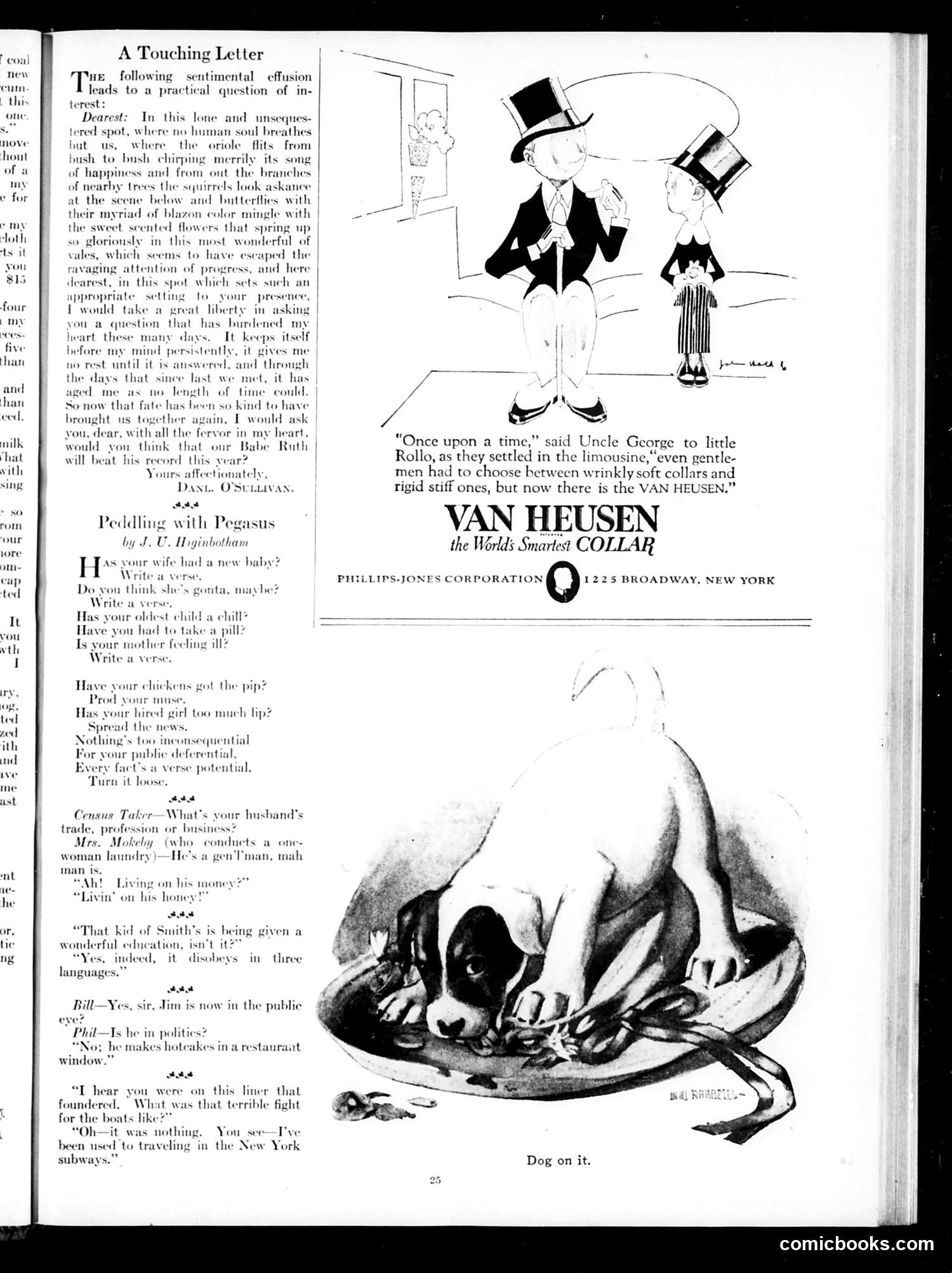
This page mixes humor columns with advertising. **"A Touching Letter"** satirizes overwrought romantic sentiment—a man writes an elaborate, flowery love letter to his sweetheart, building to an intimate question, only to ask about Babe Ruth's baseball record. The joke mocks both excessive sentimentality and Americans' obsession with sports. **"Peddling with Pegasus"** humorously instructs readers to write verses about mundane life events (babies, sick children, chickens with disease, gossip), mocking both the proliferation of greeting-card poetry and people's eagerness to publicize trivia. The **Van Heusen collar advertisement** uses a framing device where "Uncle George" tells a story to a child about how collars have improved—transitioning from uncomfortable rigid collars to softer, smarter ones. This represents early 20th-century advertising's shift toward lifestyle messaging rather than pure product description. The "Dog on it" illustration below is unrelated filler artwork.
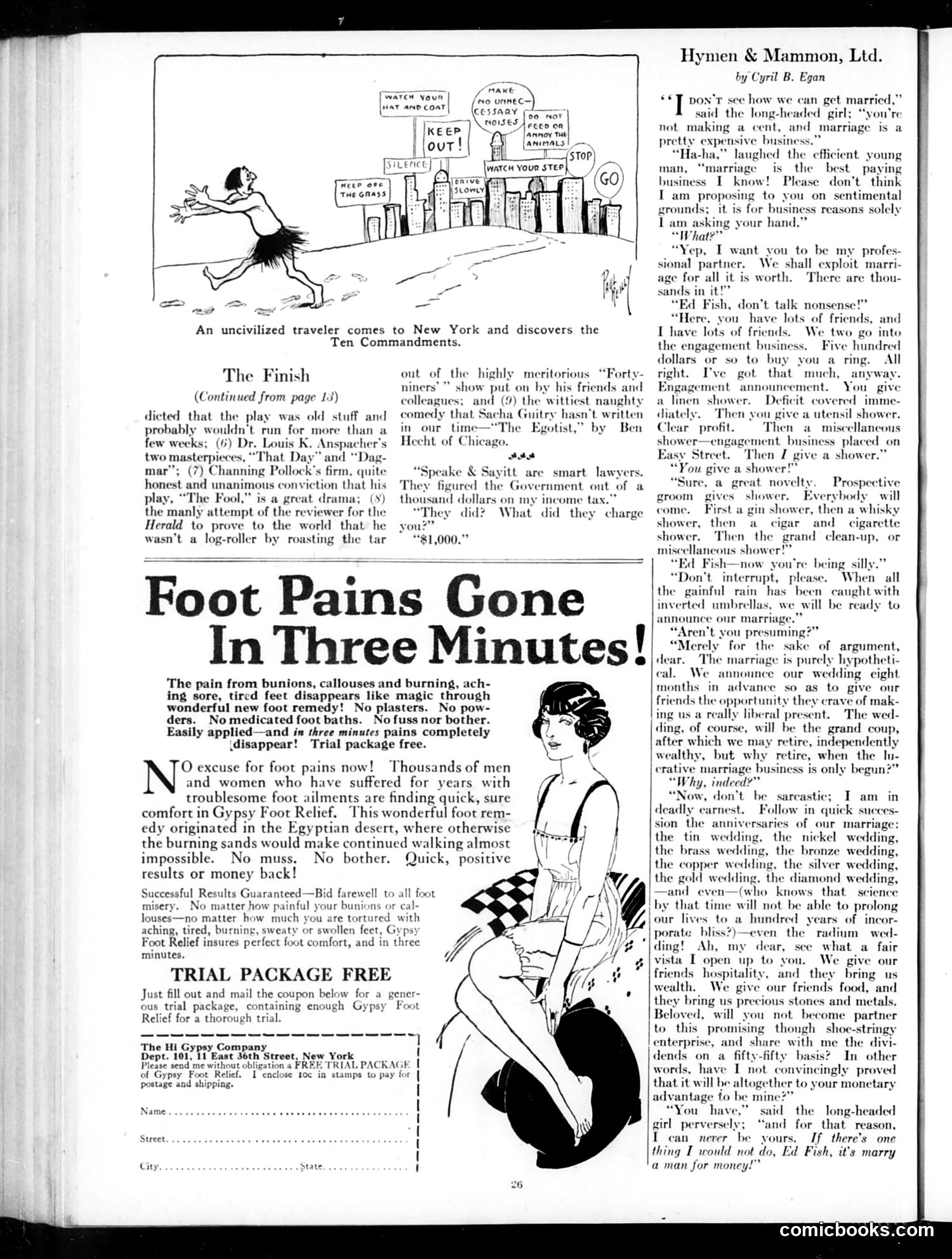
## The Cartoons/Content: **Top cartoon:** "An uncivilized traveler comes to New York and discovers the Ten Commandments" depicts a disheveled figure among city buildings with signs reading "KEEP OUT," "TRESPASSERS," etc. The joke satirizes New York City's unwelcoming nature—suggesting that instead of spiritual commandments, visitors encounter only prohibitions and warnings. **Main story:** "Hymen & Mammon, Ltd." by Cyril B. Egan satirizes commercialized marriage. A man proposes to a woman purely as a "business partnership," planning to profit from engagement-related social events (showers, announcements). The woman initially resists this cynical approach. The satire mocks how modern marriage—particularly among the wealthy—has become transactional rather than romantic. **Advertisement:** The page includes a Gypsy Foot Relief ad promoting a mail-order foot remedy, typical of 1920s patent medicine marketing. The overall theme critiques urban rudeness, commercialism, and the erosion of traditional values in modern American life.
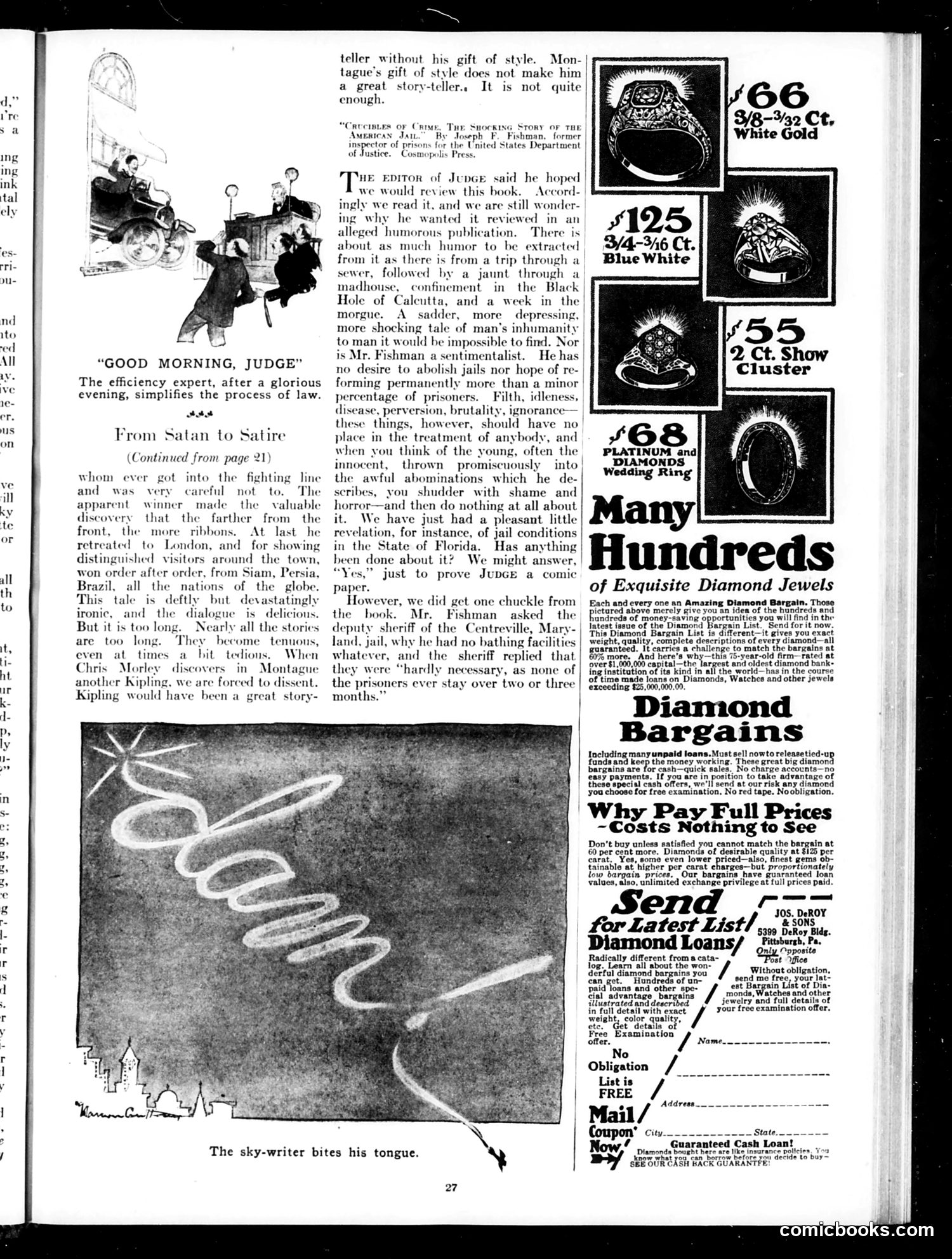
This page contains a small cartoon captioned "Good Morning, Judge" showing an "efficiency expert" who, after an evening out, has simplified legal procedure by apparently replacing judges and courtrooms with mechanical apparatus. The joke satirizes the early 20th-century "efficiency expert" craze—consultants who applied industrial management techniques to every institution. The cartoon mocks the absurdity of mechanizing justice itself, suggesting these experts would reduce the law to mere machinery, eliminating human judgment entirely. The cartoon's humor relies on the contradiction between the serious dignity of law and the reductive logic of efficiency optimization. It reflects contemporary skepticism about whether all human institutions could or *should* be "streamlined" like factories. The page also contains book reviews and diamond jewelry advertisements, with no apparent connection to the cartoon's satire.
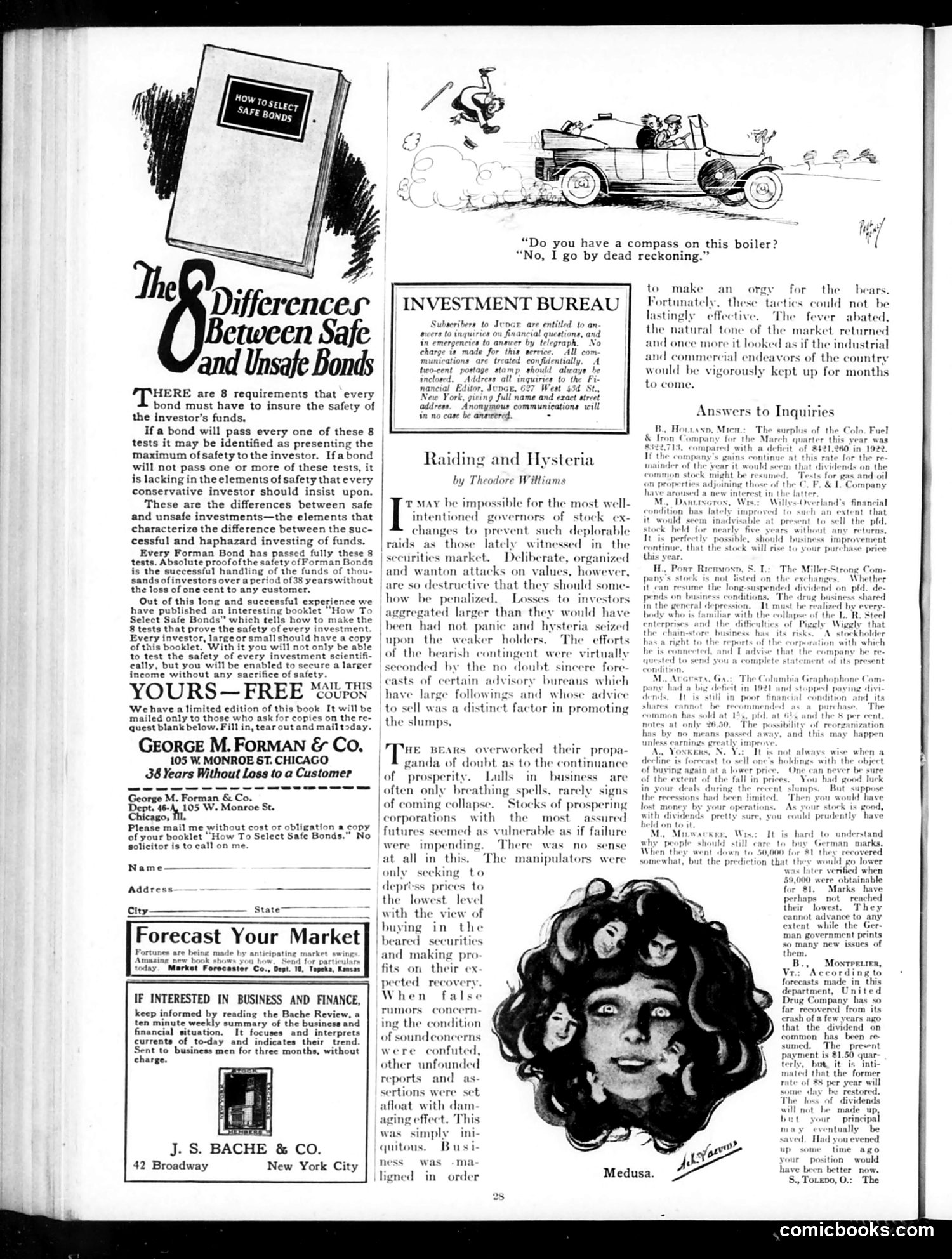
This page primarily contains **financial advertisements and investment advice** rather than political satire. The main content includes: **"The 8 Differences Between Safe and Unsafe Bonds"** — A Forman & Co. advertisement promoting their bond-selection booklet, emphasizing investor protection through eight safety criteria. The ad claims 36 years without customer losses. **"Raiding and Hysteria" article** by Theodore Williams discusses stock market manipulation, specifically criticizing deliberate raids on securities markets and the panic they cause. Williams argues that bearish advisory bureaus spread unfounded doubt about business prosperity, driving down stock prices unnecessarily. **The cartoon** (top right) appears unrelated to bonds—it shows a car with someone asking "Do you have a compass on this boiler? No, I go by dead reckoning," depicting humorous navigation confusion. The page reflects early-20th-century investment concerns: market manipulation, information reliability, and investor protection—issues that remain relevant today.
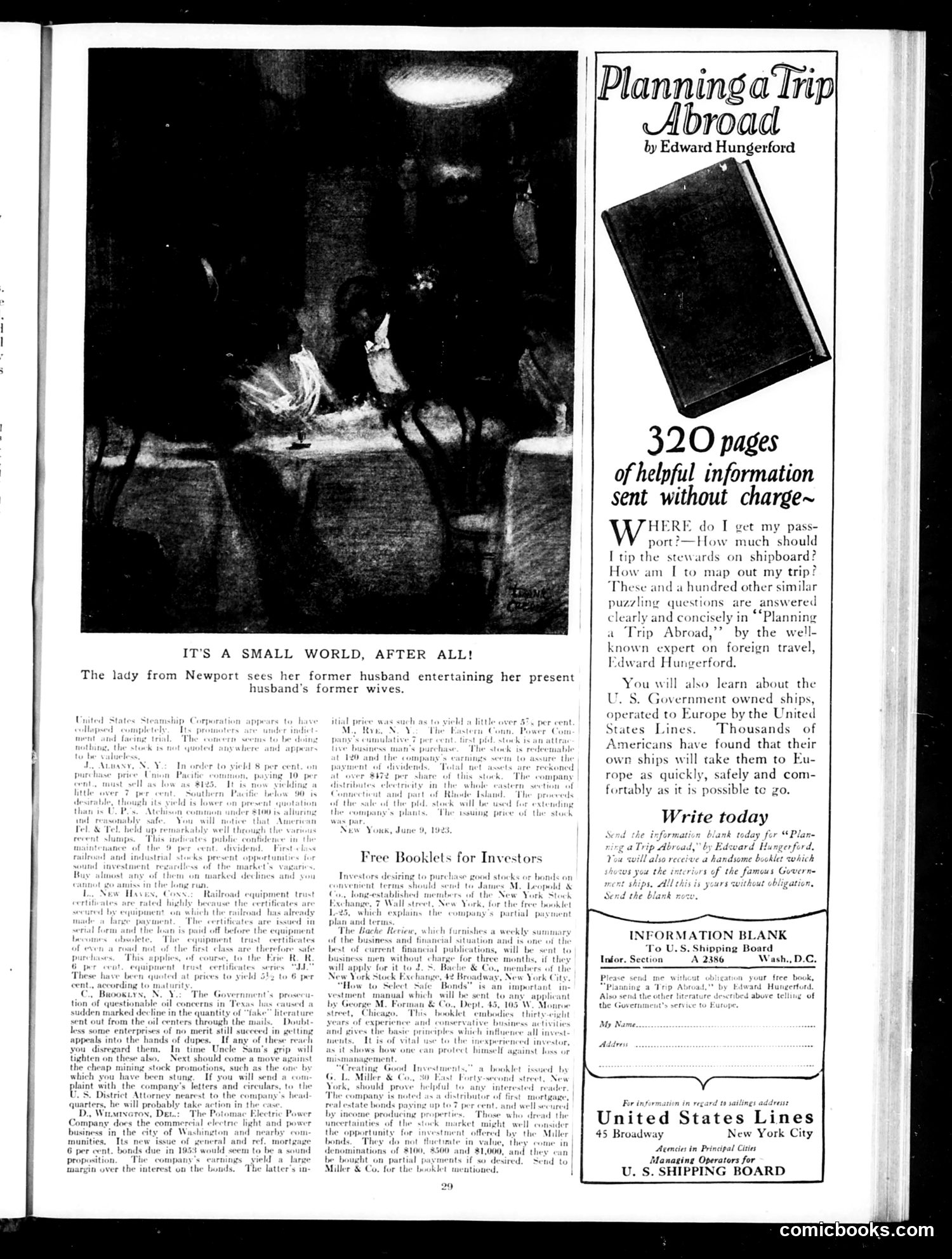
**The Cartoon:** The main image shows a social comedy about wealthy New York society. A woman from Newport (an exclusive East Coast resort town) encounters her ex-husband at what appears to be an elegant dinner party. The joke is that he's entertaining multiple women—identified as his "former wives." The caption "It's a Small World, After All" suggests the ironic coincidence of this awkward social encounter in high society circles. **The Satire:** This mocks the marital practices and social circles of the wealthy elite, implying serial marriage and the interconnected nature of Newport's exclusive social world. The humor relies on the assumption that a man with multiple ex-wives would inevitably encounter them socially. **The Advertisements:** The page also contains ads for travel guides and U.S. Shipping Board services—practical content for wealthy readers planning European trips.
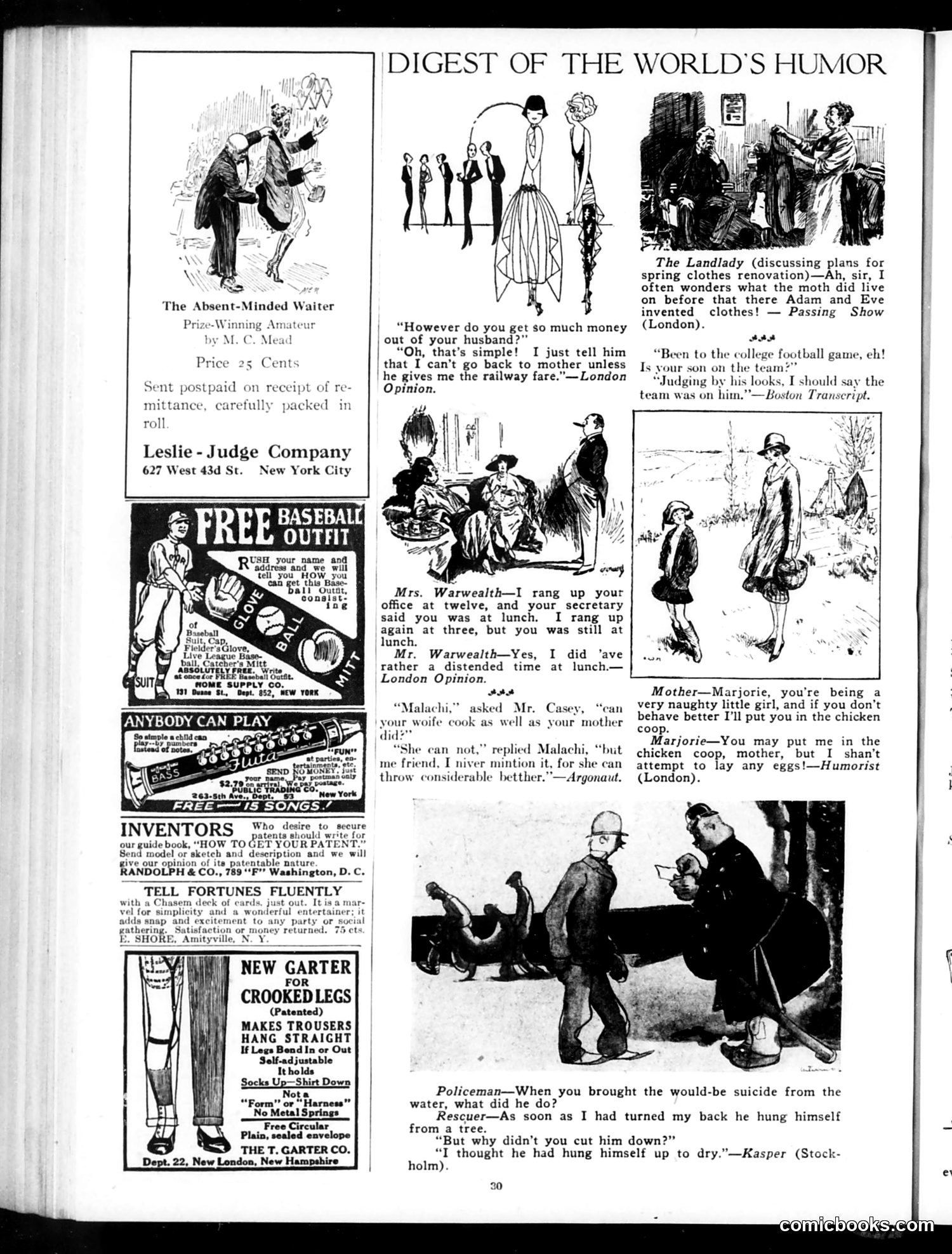
This page collects brief humorous anecdotes reprinted from international publications—a common Judge magazine format. The jokes rely on wordplay and social observation rather than political satire. Key examples: "The Absent-Minded Waiter" depicts a server's inattention (a stock comedic character). "The Landlady" features working-class speech patterns as humor. The "Mrs. Warwealth" exchange mocks the wealthy's leisured lunching habits. The "Malachi" joke plays on marital compromise—a wife cooks poorly but throws well. The "Mother-Marjorie" dialogue uses a child's literal interpretation of "laying eggs" for humor. The final "Policeman" joke is absurdist: a suicide attempt survivor immediately hangs himself again, and the rescuer assumes he's "hung himself up to dry"—a nonsensical explanation played straight. The humor targets class differences, gender roles, domestic life, and absurdist logic typical of early-20th-century Anglo-American comic magazines. These are reprints from London and other sources.
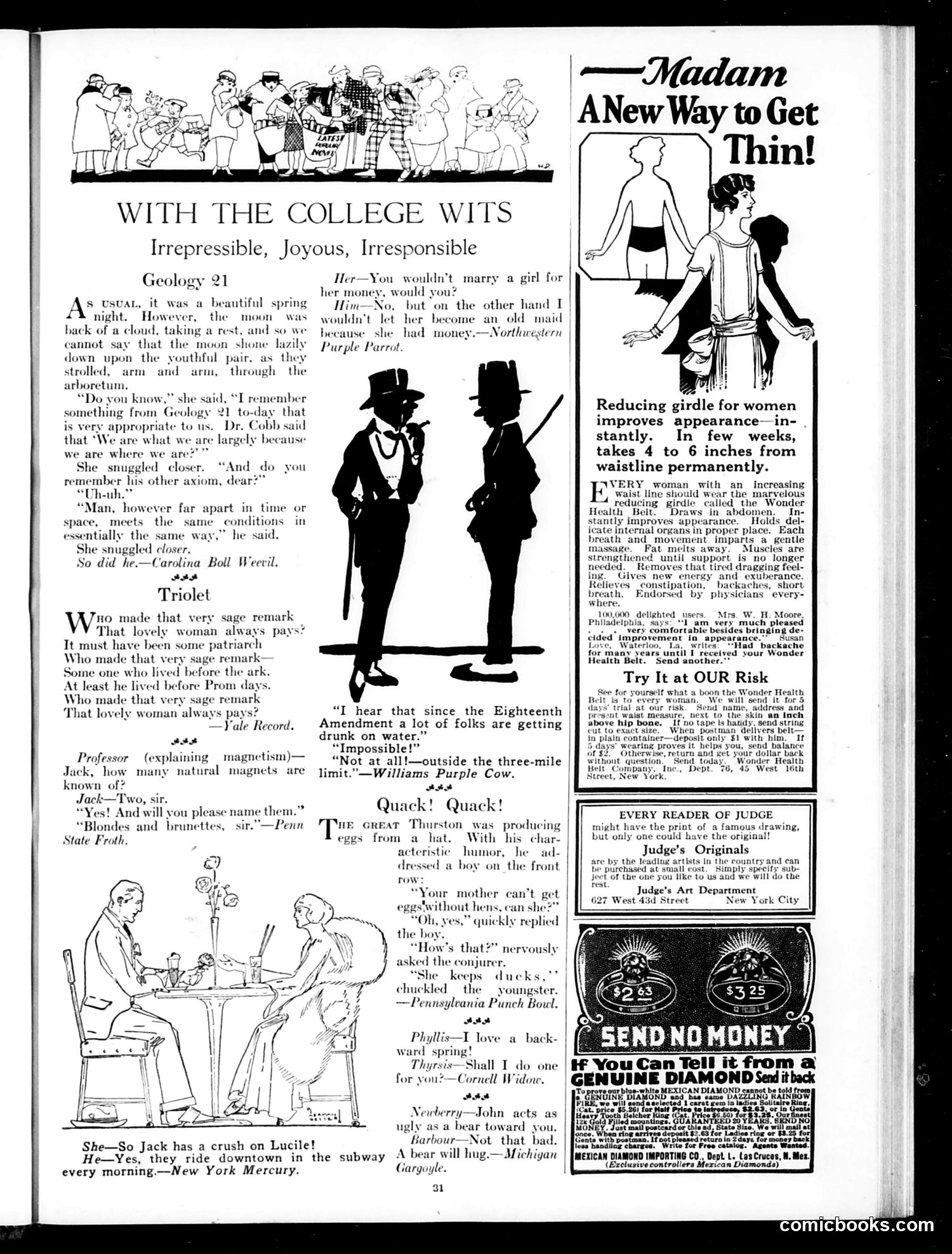
This page collects humorous anecdotes from college newspapers, presenting satirical observations on courtship and student life. The "college wits" section mocks romantic pretension through brief comedic exchanges: couples discussing philosophy while walking, witty rejections about marrying for money, and clever wordplay about magnets and women. The sidebar advertisement for a "reducing girdle" reflects 1920s-30s body standards—promoting corset-like devices to slim waistlines "instantly." The endorsement quotes and medical claims are typical of period weight-loss marketing, often exaggerated and dubious. Below that, "Judge's Originals" advertises the magazine's artwork, while a diamond company advertisement appears at the bottom, claiming to sell genuine diamonds. The overall page satirizes college romance as performatively intellectual while selling contemporary consumer solutions to beauty anxieties—the ads undercut the intellectual pretense of the "college wits" above them.
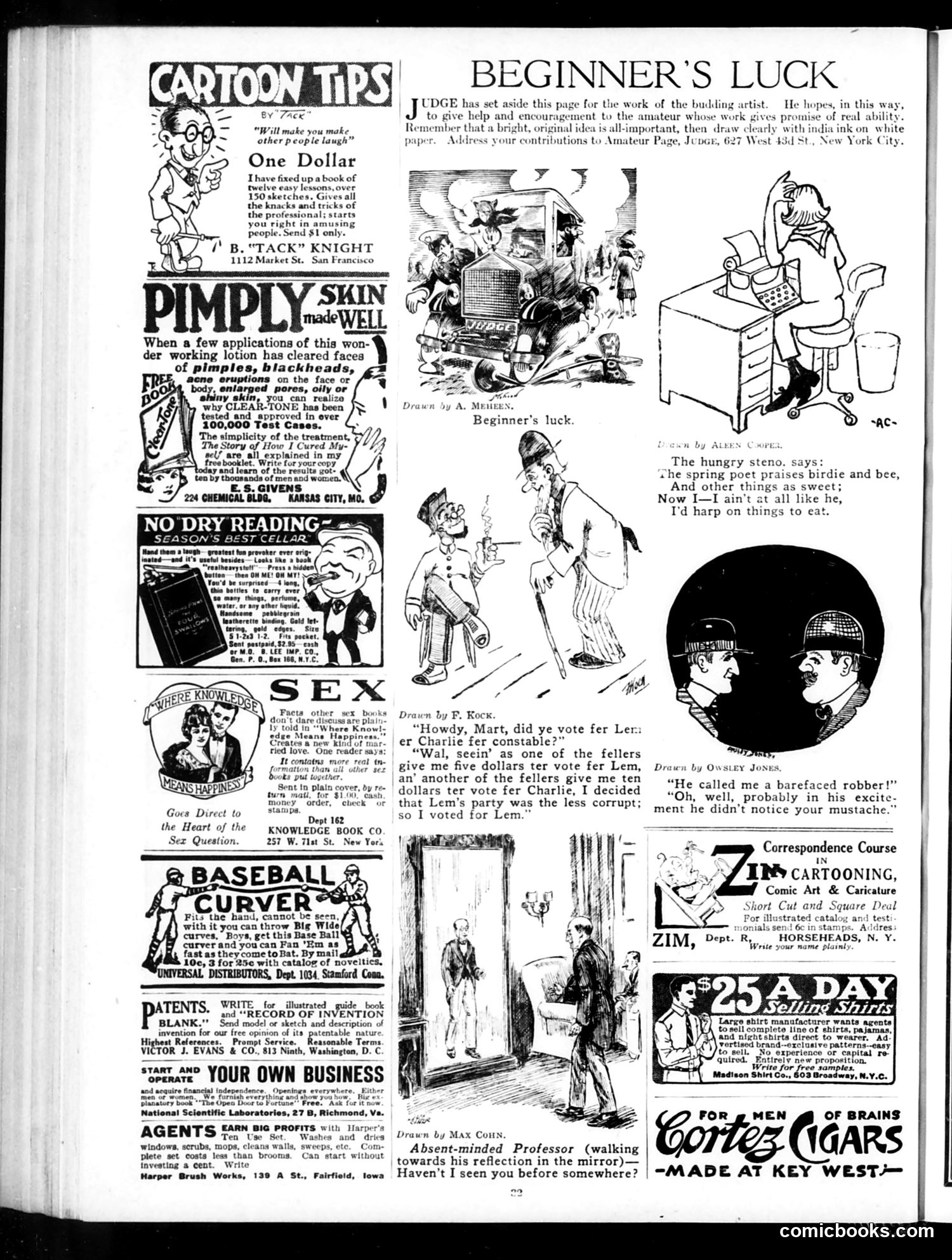
This page from *Judge* magazine features several standalone cartoons and advertisements typical of early 20th-century American humor publications. The main cartoon "Beginner's Luck" (drawn by A. Meneen) depicts a chaotic auto accident scene, illustrating the ironic notion that newcomers sometimes succeed through sheer chance rather than skill. A second cartoon by P. Kock satirizes electoral corruption: two men discuss voting, with one admitting he accepted bribes from *both* candidates—but voted for the "less corrupt" party because one briber gave more money than the other. The joke exposes how voters rationalized accepting kickbacks. Another cartoon by Owsley Jones shows a mugger calling someone a "barefaced robber," with the punchline that the victim's prominent mustache made him unrecognizable—absurdist humor playing on disguise. The "Absent-minded Professor" cartoon depicts a man addressing his own mirror reflection, asking if they've met before. The page is predominantly advertising—skin treatments, business opportunities, and correspondence courses—reflecting *Judge*'s commercial nature.
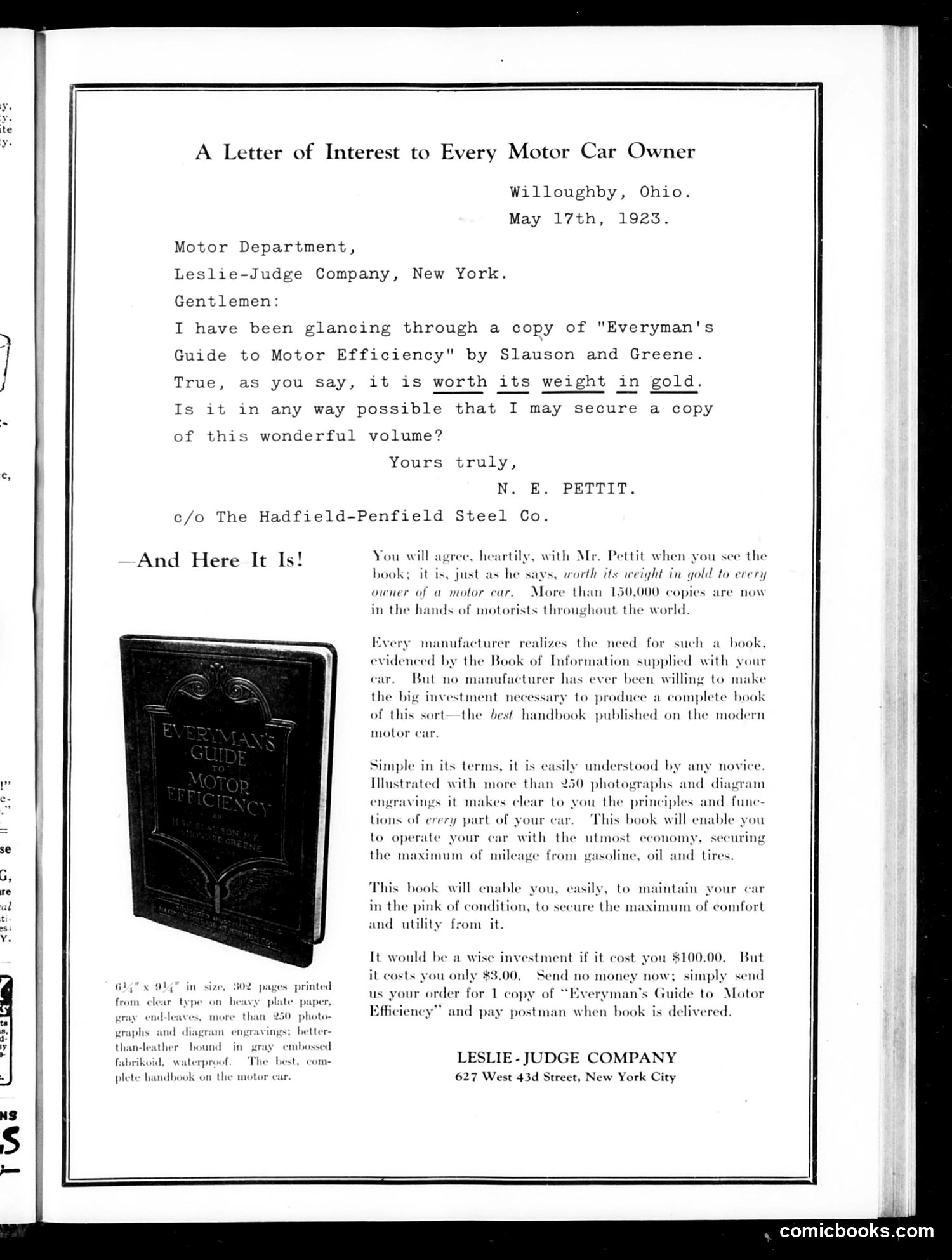
This is primarily an **advertisement**, not a satirical cartoon. The page features a mock letter praising "Everyman's Guide to Motor Efficiency" by Slauson and Greene, presented as genuine reader testimonial. The "satire" is subtle: the letter from N.E. Pettit appears authentic, creating social proof for the book's value. The ad then claims over 150,000 copies are in circulation worldwide and that manufacturers have never invested in such comprehensive manuals before—positioning this as uniquely valuable. The pitch is straightforward consumer advertising for the 1920s: a $3 how-to book about car maintenance and efficiency, illustrated with 250+ photographs. The testimonial format was a standard advertising technique of the era. There are **no political cartoons or caricatures** on this page—it's a straight sales pitch leveraging the credibility of Judge magazine to sell automotive instruction manuals to motorists of the period.
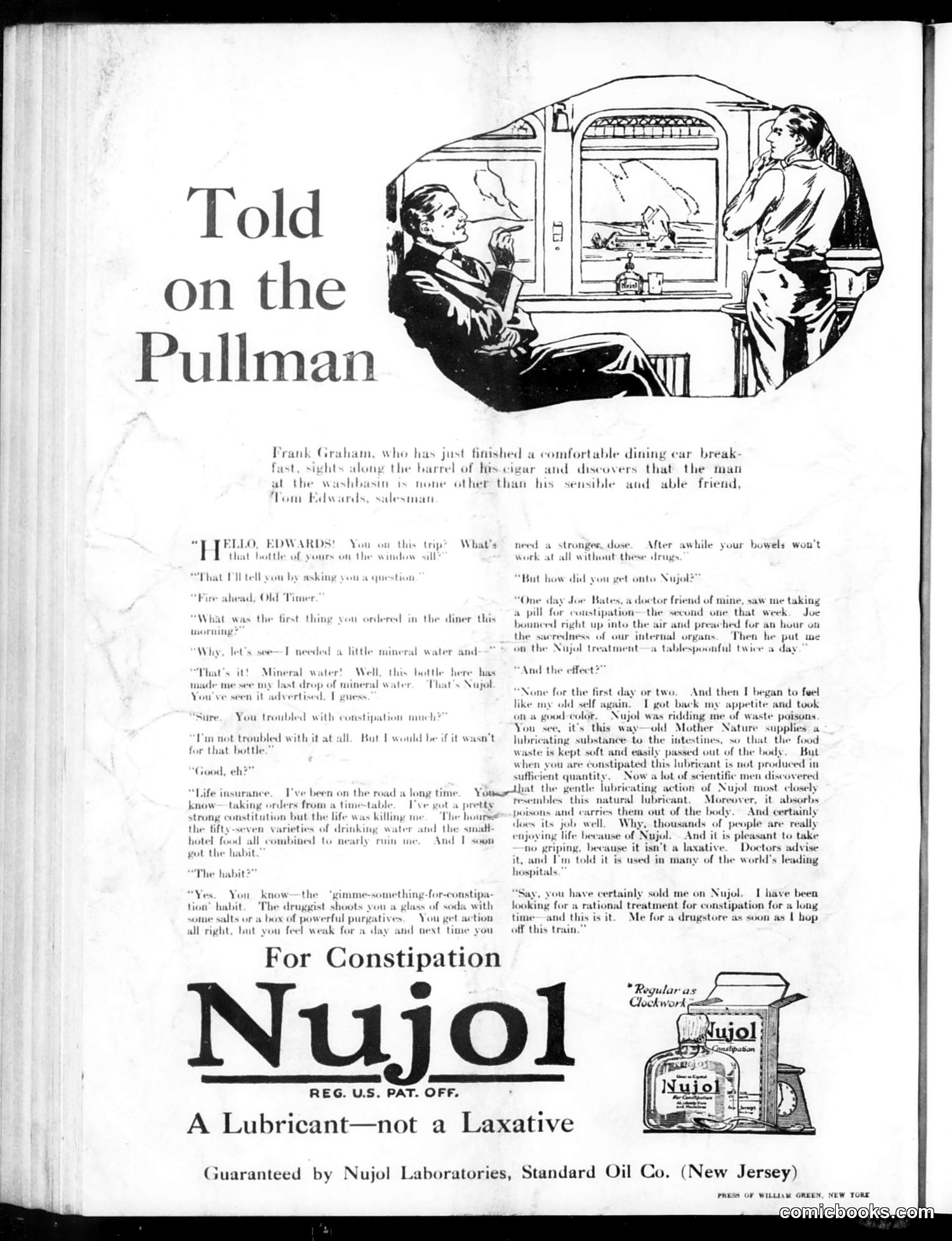
This is primarily a **Nujol laxative advertisement** disguised as editorial content—a common early 20th-century advertising technique. The framing story ("Told on the Pullman") features two salesmen having a conversation in a dining car. Frank Graham discovers his colleague Tom Edwards using a bottle and asks about it. Edwards launches into a testimonial about how Nujol solved his chronic constipation problem caused by the stressful traveling salesman lifestyle. **The pitch:** Unlike harsh purgatives that create dependency and weakness, Nujol is a "lubricant—not a laxative"—a gentler solution using natural lubrication rather than drugs. Edwards claims it restored his health, appetite, and digestion without the debilitating side effects of traditional remedies. The ad targets white-collar male readers (businessmen/traveling salesmen), a demographic concerned with maintaining respectability and vigor. The Pullman train setting authenticates the message through relatable circumstance. This represents early pharmaceutical marketing's shift toward testimonial-based persuasion and the medicalization of common digestive issues.