
Judge, 1923-06-16 · page 23 of 36
Judge — June 16, 1923 — page 23: what you’re looking at
What you’re looking at
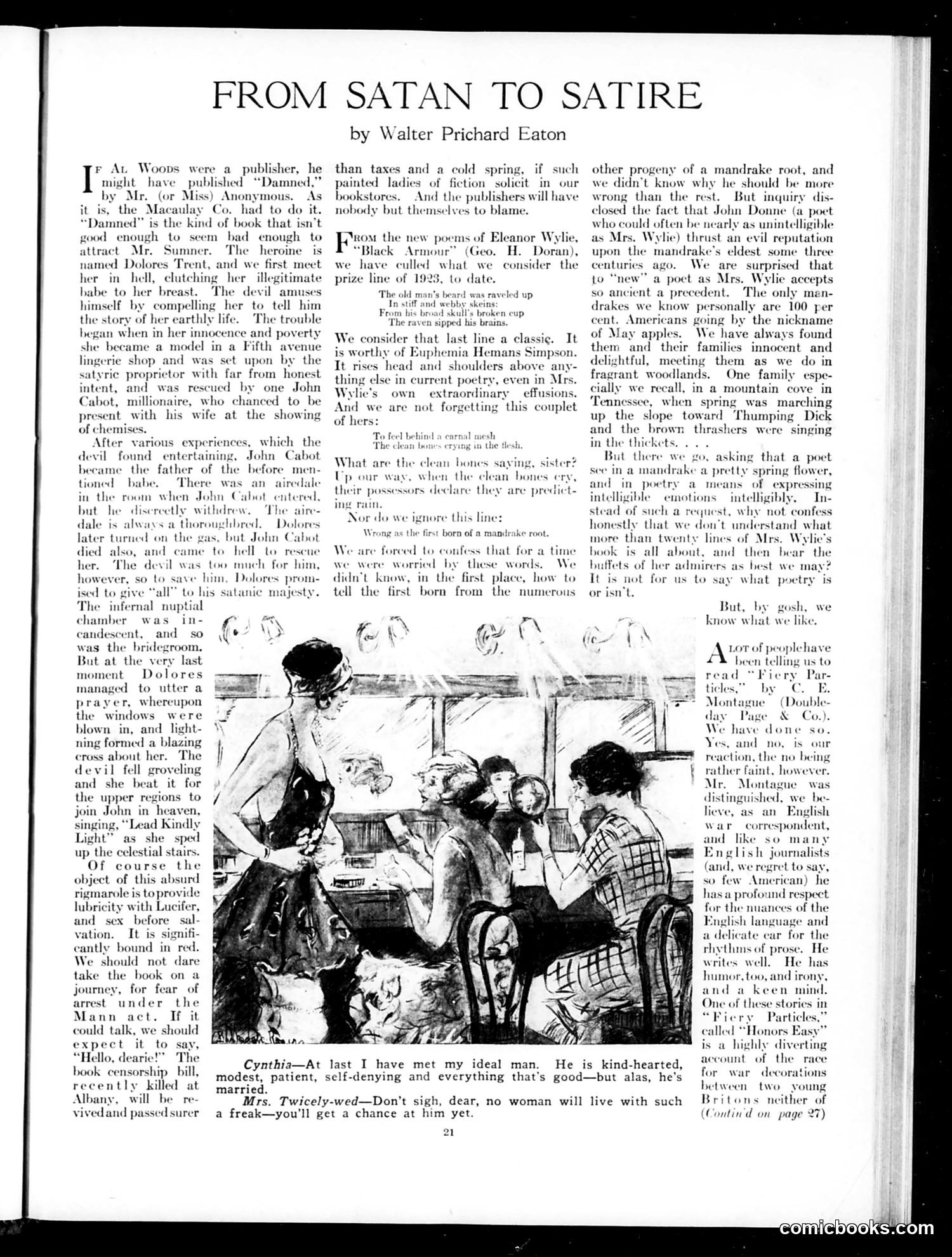
This page from *Judge* magazine contains two separate satirical pieces by Walter Prichard Eaton. **Top section ("From Satan to Satire"):** Eaton mocks a scandalous novel called *"Damned"* by an anonymous author, published by Macaulay Co. The plot—featuring a woman named Dolores Trent who becomes a model, has an illegitimate child with a wealthy man (John Cabot), and ends in hell before redemption—is criticized as sensationalist trash. Eaton sarcastically notes the book is "bound in red" and jokes it could be prosecuted under the Mann Act (federal law against transporting women across state lines for immoral purposes), treating the novel as dangerously obscene. **Bottom section:** Eaton critiques poet Eleanor Wylie's collection *"Black Armour"* (1923), mocking her deliberately obscure, difficult imagery—particularly her references to mandrakes' "first born" and other bizarre poetic conceits. He compares her to 19th-century poet Felicia Hemans. **The cartoon** depicts a domestic scene, accompanying a brief dialogue about an ideal but married man—typical *Judge* humor about infidelity and marriage.
📄 Transcribed text from this page (OCR, searchable)
Machine-transcribed from the original scan — historical spelling and the odd misread are preserved.
FROM SATAN TO SATIRE Fr At Woops were a_ publisher, he I might have published “Damned,” by Mr. (or Miss) Anonymous. As it is, the Macaulay Co. had to do it. “Damned” is the kind of book that isn’t good enough to seem bad enough to attract’ Mr. Sumner. The heroine is named Dolores Trent, and we first meet her in hell, clutching her illegitimate babe to her breast. The devil amuses: himself by compelling her to tell him the story of her earthly life. The trouble an when in her innocence and poverty became a model in a Fifth avenue shop and was set upon by the satyrie proprietor with far from honest intent, and was rescued by one John Cabot, millionaire, who chanced to be present. with his wife at the showing of chemises. After various experiences, which the devil found entertaining, John Cabot became the father of the before men- tioned babe. There was an aii in the room when John Cabot entered, but he elly withdrew. The dale is always a thoroughbred. Dolo but John Cabot to reseue later turned on the gas, died also, and came to hell her. The devil was too much for him, however, so to save him, Dolores prom- ised to give “all” to his satanic majesty. The infernal nuptial chamber was in- candescent, and so was the bridegroom. But at the very last moment Dolores managed to utter a prayer, whereupon the windows were blown in, and light- ning formed a blazing cross about her. The devil fell groveling and she beat it for the upper regions to / join John in heaven, singing, “Lead Kindly 7 she sped § up the tial stairs. Of course the object of this absurd rigmarole is toprovide lubricity with Lucifer, and sex before sal- vation. It is signifi- cantly bound in red. We should not dare take the book on a journey, for fear of arrest under the Mann act. If it could talk, we shoulc expect it to y “Hello, dearie!” book censors recently killed Albany, will be re- viv and passed surer yp x MAleaar kein Cynthia—At modest, patient, self-denying and everything that’s good—but alas, he’s married. . Mrs. Twicely-wed—Don't sigh, dear, no woman will live with such a freak—you'll get a chance at him yet. 21 by Walter Prichard Eaton than taxes and a cold spring, if such painted ladies of fiction solicit in our bookstores. And the publishers will have nobody but themselves to blame. Fes the new poems of Eleanor Wylie, “Black Armour” (Geo. H. Doran), we have culled what we consider the prize line of 1923, to date. n’s beard was raveled up ‘en sipped his brains. We consider that last line a classic. It is worthy of Euphemia Hemans Simpson. It rises head and shoulders above any- thing else in current poetry, even in Mrs. Wylie’s own extraordinary effusions. And we are not forgetting this couplet of hers: To feel The What are tH Up our way, th hind clean bones saying, sister? when the clean bones ery, r possessors declare they are predict- or do we ignore this line Wr first born of a mandrake root. We are forced to confess that for a time we were worried by these words. We didn’t know, in the first’ place, how to tell the first born from the numerous (\ last I have met my ideal man. = He is kind-hearted, other progeny of a mandrake root, and we didn’t know why he should be more wrong than the rest. But inquiry dis- closed the fact that John Donne (a poet who could often be nearly as unintelligible as Mrs. Wylie) thrust an evil reputation upon the mandrake’s eldest some three centuries ago. We are surprised that to “new” a poet as Mrs. Wylie accepts so ancient a precedent. The only men- drakes we know personally are 100 per cent. Americans going by the nickname of May apples. We have always found them and their families innocent and delightful, meeting them as we do in fragrant woodlands. One family es; cially we recall, in a mountain cove in ‘Tennessee, when spring was marching up the slope toward humping Dick and the brown thrashers were singing in the thickets... . But there we go, asking that a poet see ina mandrake a pretty spring flower, and in poetry a means of expressing intelligi motions intelligibly, — In- stead of such juest, why not confess honestly that we don’t understand what more than twenty lines of Mrs. Wylie’s book is all about, and then bear the buffets of her admirers as best we may? It is not for us to say what poetry is or isn’t. But, by gosh, we know what we like. Lor of peoplehave been telling us to d “Fiery. Par- Montague —(Double- ge & Co.) have done so. nd is our reaction, the ne tint, however. Mor distinguishes lieve, as an war correspondent, and_ like English jour id, we regret to say, few American) he has a profound respect for the nuances of the English language and a delicate car for the rhythms of prose. He writes well. He has humor, too, and irony, and a keen mind. One of these stories in Fiery Particles,” uled “Honors rting account of the race for war de ions between two young Britons neither of (Contin'd on page 27)