
Judge, 1923-06-16 · page 15 of 36
Judge — June 16, 1923 — page 15: what you’re looking at
What you’re looking at
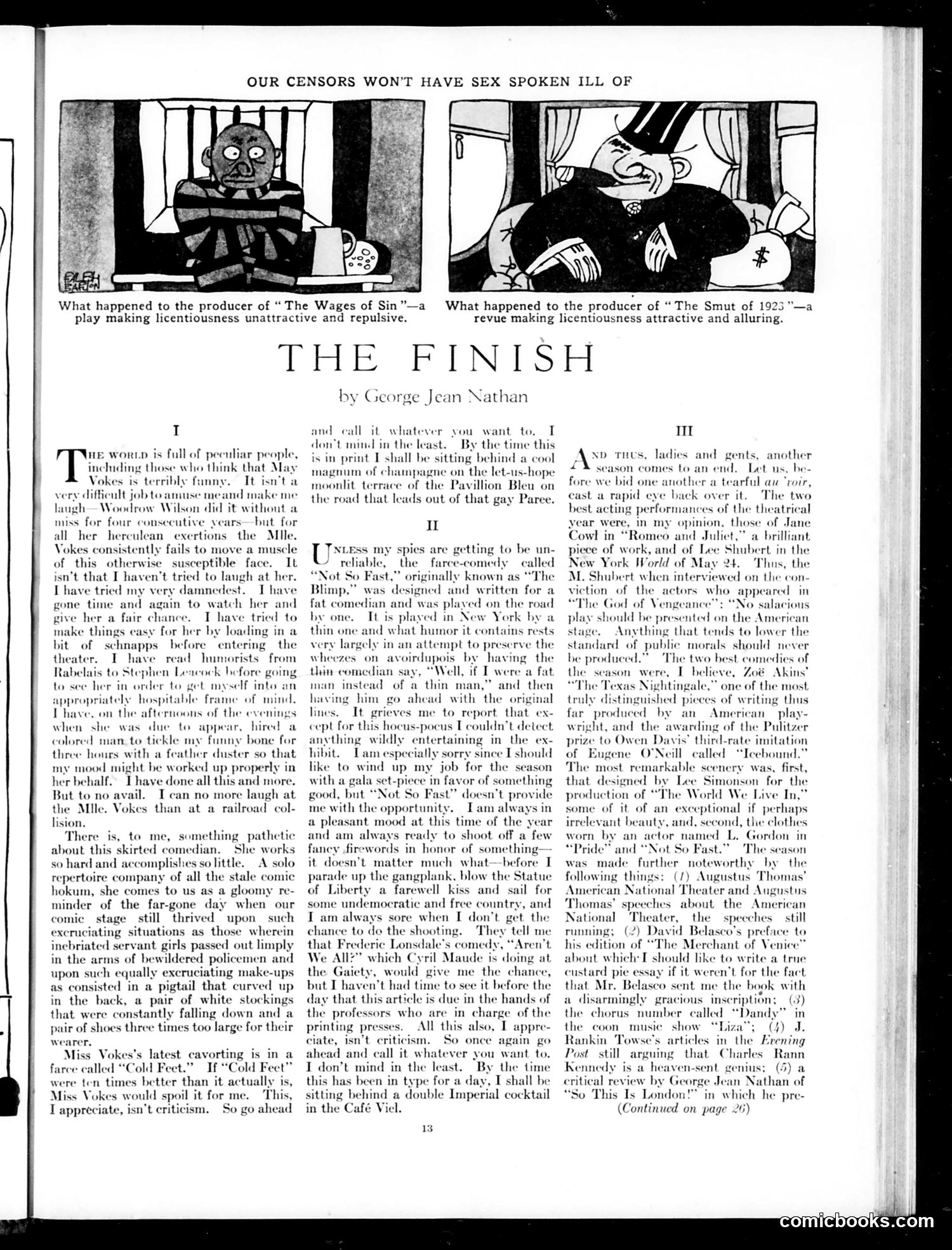
This page contains theatrical criticism disguised as satire. The header cartoons mock **theatrical censorship**: the left panel shows a producer jailed for presenting "The Wages of Sin" (depicting licentiousness as repulsive), while the right shows another jailed for "The Smut of 1923" (depicting it as attractive). The joke criticizes inconsistent moral policing—censors punish opposite messages equally. Nathan's essay attacks **Miss Vokes**, a stage comedian he finds unfunny and dated, describing her work as stale hokum evoking an earlier era of theatrical slapstick (exaggerated physical comedy with props like feather dusters and oversized shoes). He dismisses two recent Broadway productions: a farce called "Cold Feet" and a thin-man adaptation of a fat-comedian farce called "Not So Fast." Nathan, preparing to leave New York for Paris, critiques both shows as lacking genuine entertainment value, particularly the latter's reliance on weak verbal gags about body size rather than actual humor. The piece reflects 1920s Broadway criticism and contemporary debates over theatrical standards and censorship.
📄 Transcribed text from this page (OCR, searchable)
Machine-transcribed from the original scan — historical spelling and the odd misread are preserved.
OUR CENSORS WON'T HAVE SEX SPOKEN ILL OF What happened to the producer of “ The Wages of Sin”—a play making licentiousness unattractive and repulsive. What happened to the producer of “ The Smut of 1923 "—a revue making licentiousness attractive and alluring. THE FINISH I ne wortp is full of peculiar people, inchiding those who think that M Vokes is terribly fanny. It isn’t very difficult job to amuss and make me laugh — Woodrow Wilson did it without a miss for four consecutive years—but for all her herculean exertions the Mlle. Vokes consistently fails to move a muscle of this otherwise susceptible face. It isn’t that I haven't tried to laugh at her. Thave tried my very damnedest. gone time and again to watch he give her a fair chance. T have trie make things casy for her by loading in a bit of schnapps before ‘entering the theater. I have read humorists from Rabelais to Stephen Leacock before going her in order to get myself into an riately hospitable frame of mind. Thave, on the afternoons of the evenings when she was due to hire L colored man.to tickle my funny bone for three hours with a feather duster so that my mood might be worked up properly in her behalf. [have done all this and more. But to no ava T can no more laugh at the Mlle. Vokes than at a railroad col- lision. There is, to me, something pathetic about this skirted comedian. She works so hard and accomplishes so little. A solo repertoire company of all the stale comic hokum, she comes to us as a gloomy re- minder of the far-gone day when our still thrived upon such ations as those wherein servant girls passed out limply in the arms of bewildered policemen and upon such equally excru as consisted in a pigtail that curved up in the back, a pair of white stockings that were constantly falling down and a pair of shoes three times too large for their wearer. Miss Vokes’s latest cavorting is in a farce called “Cold Feet.” If “Cold Feet ten times better than it actually is, +s would spoil it for me. ‘Th isn't criticism. So go ahea to s appro} appear, by George Jean Nathan dcall it’ whatever you want to. T don't mind in the least. By the time this is in print I shall be sitting behind a cool magnum of champagne on the let-us-hope moonlit terrace of the Pavillion Bleu on the road that leads out of that gay Paree. Il JNLEss my spies are getting to be un- the farce-comedy led ” originally known as “The was designed and written for a fat comedian and was played on the road by one. It is played in New York by a thin one and what humor it contains rests very largely in an attempt to preserve the wheezes on avoirdupois by having the thin comedian say, “Well, if I were a fat man instead of a thin man,” and then having him go ahead with the original lines. It grieves me to report that ex- cept for this hocus-pocus T couldn't detect anything wildly entertaining in the ex- hibit. [am especially sorry since I should like to wind up my job for the season with a gala set-piece in favor of something good, but “Not So Fast” doesn’t provide me with the opportunity. [am always in a pleasant mood at this time of the yea and am always ready to shoot off a few fancy firewords in honor of something- it doesn’t matter much what—before I parade up the gangplank. blow the Statue of Liberty a farewell kiss and sail for some undemocratic and free country, and always sore when [ don’t get the > to de the shooting. They tell me deric Lonsdale’s comedy, “Aren't which Cyril Maude is doing at would give me the chance, *t had time to see it before the day that this article is due in the hands of the professors who are in charge of the printing presses. All this also, I appre- ciate, isn’t criticism. So once again go ahead and call it whatever you want to. I don’t mind in the By the time this has been in type for a day, I shall be sitting behind a double Imperial cocktail in the Café Viel. Blimp least. 13 Tr Ax rus, ladies and gents, another . Let us, be- fore we bid one another a tearful au ‘voir, cast a rapic back over it. The two best acting performances of the theatrical year ¥ in my opinion, those of Jane Cowl in “Romeo and Juliet,” a brilliant piece of work, and of Lee Shubert in the New York World of May 24. Thus, the M. Shubert when interviewed on the con- viction of the actors who appeared in “The God of Ver ious play should be presented on the American Anything that tends to lower the standard of public morals should never be produced.” ‘The two best comedies of the season were, [ beli v6 Akins? “The Texas Nightingal ome of the most truly distinguished pieces of writing thus far produced by an American play- wright, and the awarding of the Pulitzer prize to Owen Davis’ third-rate imitation of Eugene O'Neill called s season comes to an end. “Teebound.” The most remarkable scenery was, first, that designed by Simonson for the production of “The World We Live In,” some of it of an exceptional if perhaps irrelevant beauty, and, second, the clothes worn by an actor ned L. Gordon in “Pride “Not So Fast.” The season was made further noteworthy by the following things: (/) Augustus Thomas’ American ional Theater and Augustus ‘Thomas’ speeches about the American National Theater, the still running; (2) David Belaseo’s preface to his edition of “The Merchant of Venice” about which T should like to write a true custard pie essay if it weren't for the fact that Mr. Belasco sent me the book with a disarmingly gracious inscription: (3) the chorus number called “Dandy” in the coon music show “Liza”; (4) J. Rankin Towse’s articles in the Evening Post still arguing that Charles Rann Kennedy is a heaven-sent genius: (5) a critical review by George Jean Nathan of “So This Is London!” in which he pre- (Continued on page 26)