
Judge, 1923-06-16 · page 24 of 36
Judge — June 16, 1923 — page 24: what you’re looking at
What you’re looking at
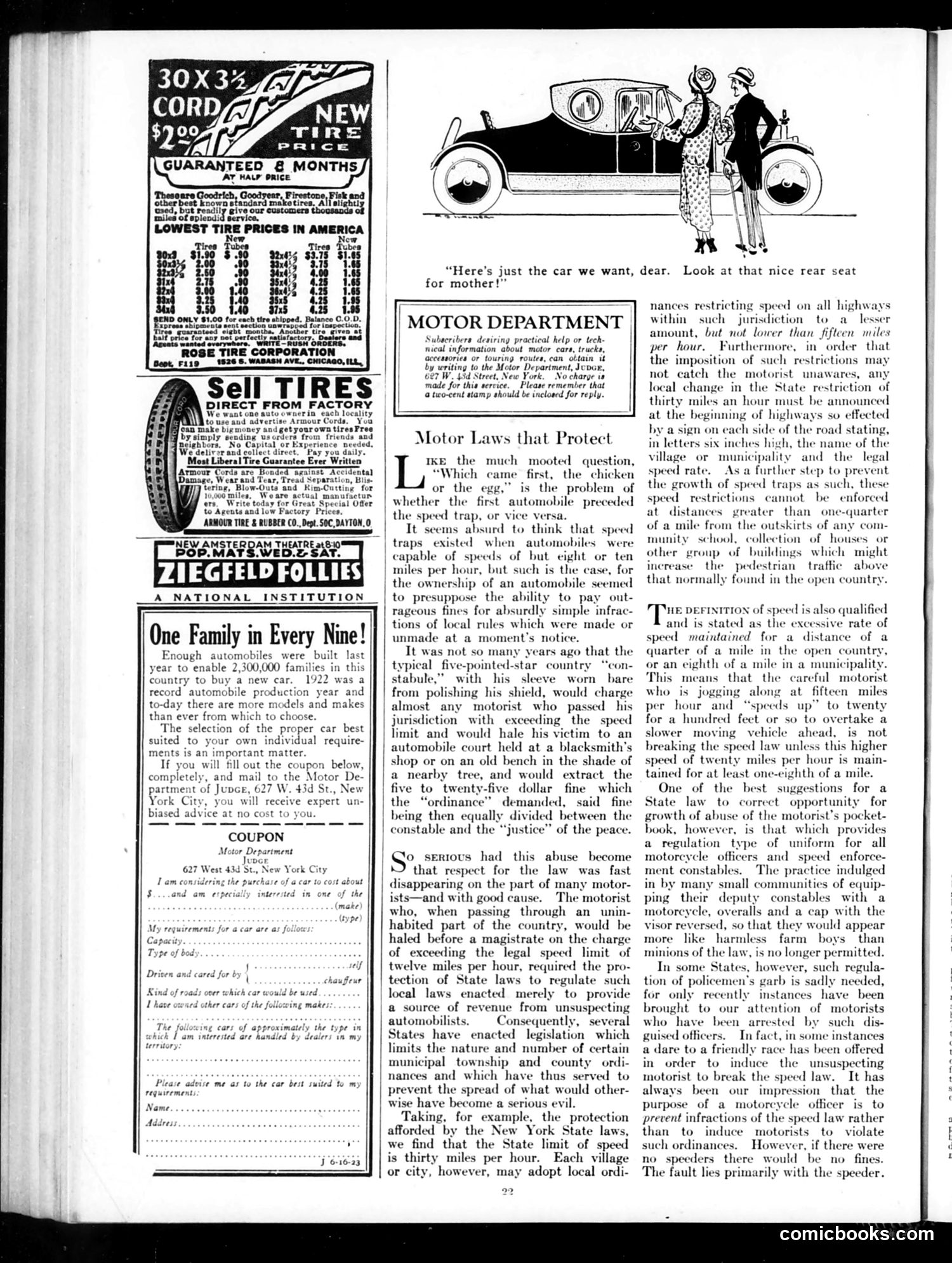
This page from Judge (circa 1922, based on automobile references) contains primarily **advertisements and practical advice rather than political satire**. The main cartoon shows a couple admiring a car, with the caption "Here's just the car we want, dear. Look at that nice rear seat for mother!"—a gentle domestic humor joke about family automobile shopping, not political commentary. The substantive content is the **"Motor Department" editorial** addressing speed traps and traffic laws. It discusses the historical absurdity of early speed-trap enforcement: local constables would fine motorists for exceeding arbitrary speed limits (sometimes 8-10 mph) in rural areas, pocketing fines alongside corrupt local magistrates. The article advocates for state-level regulation to prevent this revenue-driven abuse of motorists. The satire is **social rather than political**—mocking corrupt small-town law enforcement that exploited automobile owners. The article argues New York State speed laws (30 mph limit) represent legitimate reform protecting citizens from predatory local authorities. Surrounding content includes tire and automotive advertisements targeting the newly mobile middle class.
📄 Transcribed text from this page (OCR, searchable)
Machine-transcribed from the original scan — historical spelling and the odd misread are preserved.
JARANTEED & MONTHS AT HAL BRICE Giher best keow Fey Creeyallatgeay ROSE Buty ‘CORPORATION /AVE., CHICAGO, TLL, Sell TIRES DIRECT FROM FACTORY We wantone auto ownerin each locality Armour Cords, Yoo Joan make big money and getyour own tiresF: By simply acudiny ua ortera from frien direct. Pay you dally. ntee Ever Written fare actual manufactur Write today for Great al Offer to Agents and low Factory ARMOUR TIRE & RUBBER (0, Dept. SOC, DAYTON, 0 | NEW AMSTERDAM THEATRE. BP . MAT S.WED.Z S. A_NATIONAL_ INSTITUTION One Family in Every Nine! Enough automobiles were built last year to enable 2,300,000 families in this country to buy a new car. 1922 was a record automobile production year and to-day there are more models and makes than ever from which to choose. The selection of the proper car best suited to your own individual require- ments is an important matter If you will fill out the coupon below. and mail to the Motor De- of Jupce, 627 W. 43d St., New su will receive expert un- biased advice at no cost to you. COUPON completely ‘ Lb hich cai be used ther cars of t ing makes cars of approximately the type in wrested are handled by dealers in my je me as to the car best suited to m “Here’s just the car we want, dear. for mother!” | MOTOR DEPARTMENT Subscribers desiring practical help or tech- nical information about motor cars, trucks, accessories or touring routes, can obtain it writing to the Motor Department, Jove 627 W. 43d Street, New York. No charge i made for this service. Please remember that @ two-cent stamp should be inclosed for reply. Motor Laws that Protect IkE the much mooted question, “Which ne first, the chicken or the egg,” is the problem of | whether the first automobile preceded the speed trap, or vice versa. It seems absurd to think that speed traps existed when automobiles we capable of speeds of but eight or ten miles per hour, but such is the case, for the ownership of an automobile seemed to presuppose the ability to pay out- rageous fines for absurdly simple infrac- tions of local rules which were made or unmade at a moment's notice. It was not so many years ago that the typical five-pointed-star country ‘con- stabule,” with his sleeve worn bare from polishing his shield, would charge | almost any motorist who passed his jurisdiction with exceeding the speed limit and would hale his victim to an automobile court held at a blacksmith’s shop or on an old bench in the shade of a nearby tree, and would extract. the | five to twenty-five dollar fine which the “ordinance” demanded, said fine being then equally divided between the constable and the “justice” of the peace. sto sertous had this abuse become that respect for the law was fast disappearing on the part of many motor- ists—and with good cause. The motorist who, when passing through an unin- habited part of the country, would be haled before a magistrate on the charge of exceeding the legal speed limit of twelve miles per hour, required the pro- tection of State laws to regulate such local laws enacted merely to provide a source of revenue from unsuspecting automobilists. Consequently, several States have enacted legislation which limits the nature and number of certain municipal township and county ordi- nances and which have thus served to prevent the spread of what would other- wise have become a serious evil. Taking, for example, the protection afforded by the New York State laws, we find that the State limit of speed is thirty miles per hour. Each village or city, however, may adopt local ordi- Look at that nice rear seat nances restricting speed on all highways within such jurisdiction to a lesser amount, but not lower than fifteen miles per hour, Furthermore, in’ order that the imposition of such restrictions may not catch the motorist unawares, any al change in the State restriction of thirty miles an hour must be announced beginning of highways so effected by a sign on each side of the road stating, in letters six inches high, the name of the village or municipality and the legal speed rate. As a further step to prevent the growth of speed traps as such, these speed restrictions cannot be enforced at distanc er than one-quarter of a mile from the outskirts of any com- munity school, collection of houses or other group of buildings which might increase the pedestrian traffic above that normally found in the open country. HE DEFINITION of speed is also qualified and is stated as the excessive rate of speed maintained for a distance of a quarter of a mile in the open country, or an eighth of a mile in a municipality. This means the careful motorist who is jogging along at fifteen miles per hour and “speeds up” to twenty for a hundred feet or so to overtake a slower moving vehicle ahead, is not breaking the speed law unless this higher speed of twenty miles per hour is main- tained for at least one-eighth of a mile. One of the best suggestions for a State law to correct’ opportunity for growth of abuse of the motorist’s pock book, however, is that which provides a regulation type of uniform for all motorcycle officers and speed enforce- ment constables. The practice indulged in by many small communities of equip- ping their deputy constables with a motorcycle, over: and a cap with the visor reversed, so that they would appear m¢ like harmless farm boys than minions of the law, is no longer permitted. In some States, however, such regula- tion of policemen’s garb is sadly needed, for only recently instances have been brought to our attention of motorists who have been arrested by such dis- guised officers. In fact, in some instances a dare to a friendly race has been offered in order to induce the unsuspecting motorist to break the speed law. It has always been our impression that the purpose of a motorcycle officer is to prevent infractions of the speed law rather than to induce motorists to violate such ordinances. However, if there were no speeders there would be no fines. The fault lies primarily with the speeder. comicbooks.com