
Judge, 1923-06-16 · page 22 of 36
Judge — June 16, 1923 — page 22: what you’re looking at
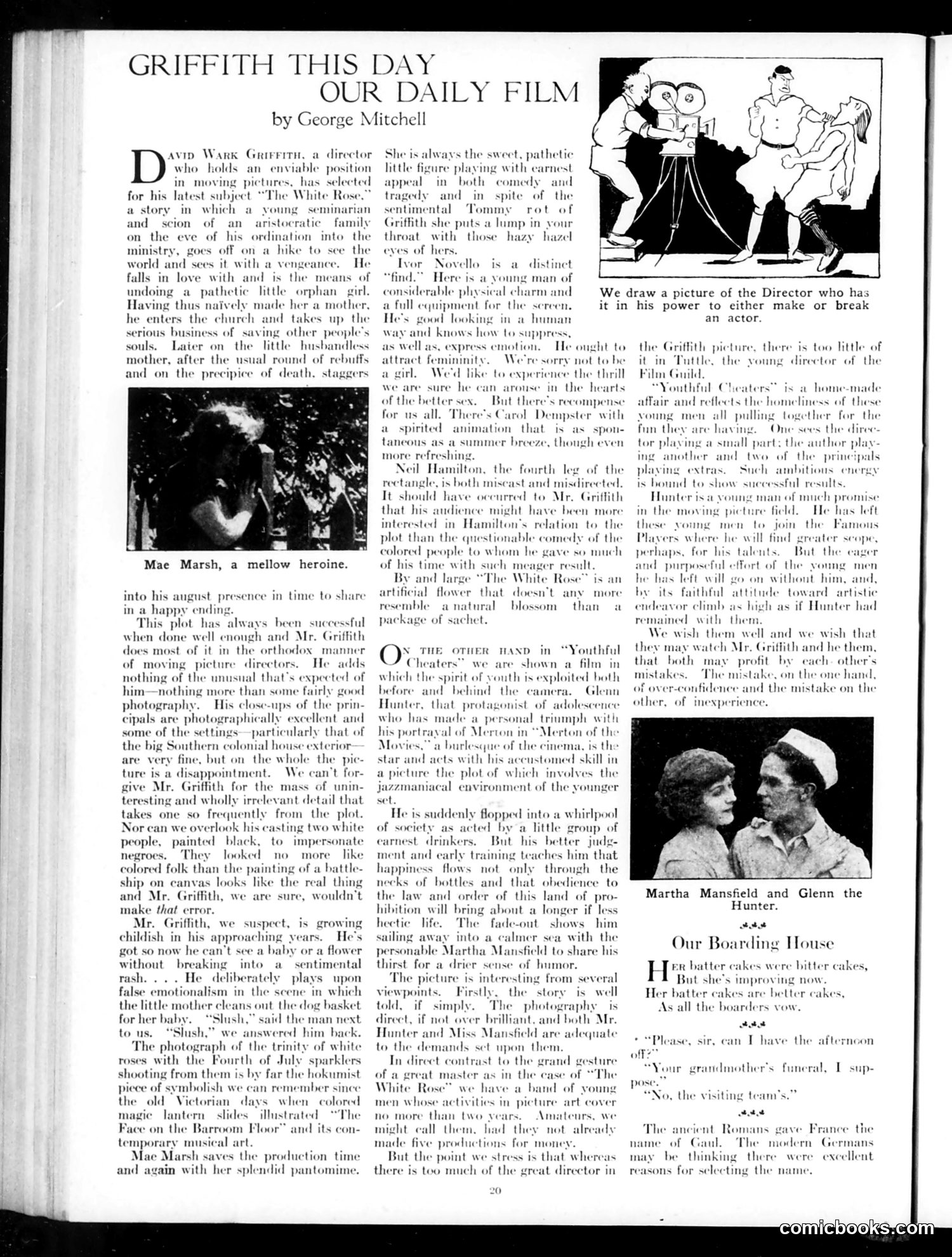
A restored page from Judge, 1923-06-16. Page through the whole issue in the reader above.
📄 Transcribed text from this page (OCR, searchable)
Machine-transcribed from the original scan — historical spelling and the odd misread are preserved.
avip Wark Grirritn, a director who holds an enviable position in moving pictures, has selected for his latest subject “The White Ros a story in which a young seminarian and scion of an aristocratic family on the eve of his ordination into the ministry, goes off on a hike to see the ance. He means of world and sees it with a ven falls in love with and is t undoing a pathetic little orphan girl. Having thus naively made her a mother, he enters the church and takes up. the serious business of saving other people's souls. Later on the little husbandless mother, after the usual round of rebuffs and on the precipice of death, stag; ~ Mae Marsh, a mellow heroine. into his august presence in time to share in a happy ending. This plot has always been successful when done well enough and Mr. Griffith does most of it in the orthodox manner of moving picture directors. He nothing of the unusual that’s expected of adds him—nothing more than some fairly good photography. His close-ups of the prin- cipals are photographically excellent. and some of the settings-—particularly that of the big Southern colonial house exterior. are very fine, but on the whole the pie- ture is a disappointment. We can’t for- give Mr. Griffith for the mass of unin- teresting and wholly irrelevant detail that takes one so frequently from the plot. Nor can we overlook his casting two white people, painted black, to impersonate negroes. They looked more colored folk than the painting of a ship on can looks like the re: and Mr. Griffith, we are sure, wouldn't make that error. Mr. Griffith, we suspect, is growing childish in his approaching years. He's got so now he can’t see a baby or a flower without breaking into a sentimental rash... . He deliberately plays upon false emotionalism in the scene in which the little mother cleans out the dog basket for her baby. “Slush,” said the man next tous. “Slush,” we answered him back. The photograph of the trinity of white roses with the Fourth of July. sparklers shooting from them is by far the hokumist piece of symbolish we can remember since the 1 Victorian days when colored i lantern illustrated “The ce on the Barroom Floor” and its con- temporary musical art Mae Marsh saves the production time and again with her splendid pantomime. no GRIFFITH THIS DAY OUR DAILY FILM by George Mitchell She is always the sweet, pathetic little figure playing with earnest appeal in’ both comedy and tragedy and in spite of the sentimental Tommy rot of Griffith she puts a lump in your throat with those hazy hazel eyes of hers. Ivor Novello is a distinct “find.” Here is a young man of considerable physical charm and a full equipment for the He's good looking in a human way and knows how to suppress, as well as, express emotion. Te ought to attract femininity. We're sorry not to be a girl We'd like to experience the thrill are sure he can arouse in the hearts of the better sex. But there's recompense for us all. There's Carol Dempster with a spirit animation that is taneous as a summer breeze, though even more refreshi Neil Hamilton, the rectangle, is both miseast and misdirected. It should have occurred to Mr. Griffith that his audience might have been more interested in Hamil plot than the questior colored people to whom he of his time with such meager result By and large “The White Rose artificial flower that doesn’t any emble anatural blossom than a package of sachet. O* THE OTHER HAND in “Youthful Cheaters” we are shown a film in youth is exploited both sereen, as spon- fourth leg of the m’s relation to the ble comedy of the ave so much san more which the spirit of before and behind the came Glenn Hunter, that protagonist of adolescence who has made a personal triumph with his px yal of Merton in Merton of th Movies,” a burlesque of the cinema, is the star and acts with his accustomed skill in a picture the plot of which involves the jazzmaniacal environment of the younger set. He is suddenly flopped into a whirlpool of society as acted by a little group of earnest drinkers. But his better judg- ment and early training teaches him that s flows not only through the bottles and that obe to happin necks of the law and order of this land of pro- hibition will bring about a longer if less hectic life. The’ fade-out shows him sailing away into a calmer sea with the personable Martha Mansfield to share his thirst for a drier sense of humor. The picture is interesting from sever viewpoints. Firstly. the story is. well told, if simply. ‘The photography is direct, if not over brilliant, and both Mr. Hunter and Miss Mansfield are adequate to the demands sct upon them: In direct contrast to the grand gesture a great master as in th qi The White Rose” we have a band of young men whose activities in picture art cover no more than two years. Amateurs, we hit call them, had they not already le five productions for money But the point we stress is that whereas there is too much of the great director in We draw a picture of the Director who has it in his power to either make or break an actor. the Griffith picture, there is too little of it in Tuttle, the young director of the Im Guild. Youthful Cheaters” is a home-made affair and reflects the homeliness of these young men all pulling together for the fun they are having. One sees the direc tor playing a small part; the author 5 mn the prit Such ambitious energy another two of playing extr is bound to shy Hunter is a young man of much promise field. He has left men to join. the ill find greater se perhaps, for his talents. But the e and purposeful « the young m he has left will go on without him, and, by its faithful tude toward: artistic onde vigh as if Hunter had remained with them We wish them well and we they may watch Mr. Griffith a that both may profit” by mistakes. The mistake, on the one hand, of over-confidence and the mistake on the other, of wv sucessful results in the moving picture these Players where lie vor climb as wish that ad he them, ich. other's rexperience, Mansfield and Glenn the Hunter. Martha ae Our Boarding I [' Rk batter cakes were bitter cakes, But she’s improving now Her batter cak As all the boarders vow. TTouse are better cakes, ttt * “Please, sir, can T have the afternoon of? “Your pos “No, the visiting ttt funeral, I grandmother's sup- cam’s.” the France Germ: excellent ancient’ Romans gave ni of Gaul ‘The modern may be thinking there reasons for selecting the name. Th wer