
A complete issue · 36 pages · 1923
Judge — March 24, 1923
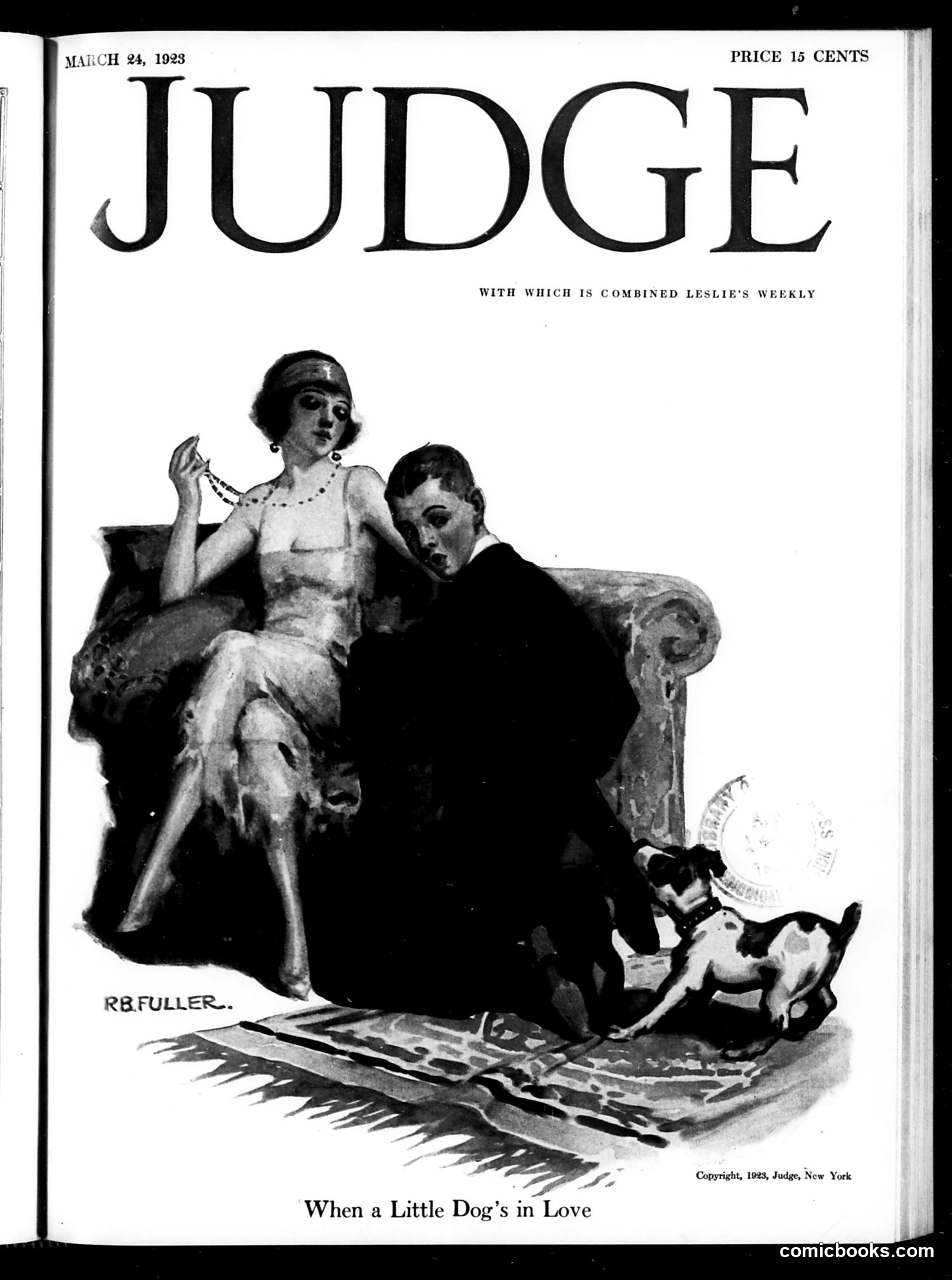
This cover illustration by R.B. Fuller depicts a domestic comedy scene. A well-dressed man watches as a woman sits on an ornate chair, flirting with a small dog on her lap—the dog appears to be offering her a flower or similar object. A second small dog at the bottom of the composition shows jealous or competitive interest. The satire plays on the Victorian/1920s trope of romantic courtship and flirtation, here absurdly applied to dogs performing human social rituals. The title suggests a lighthearted commentary on animal behavior mimicking human love and jealousy. The joke relies on anthropomorphizing the dogs' actions as romantic rivalry, treating their interactions as mock-serious drama.
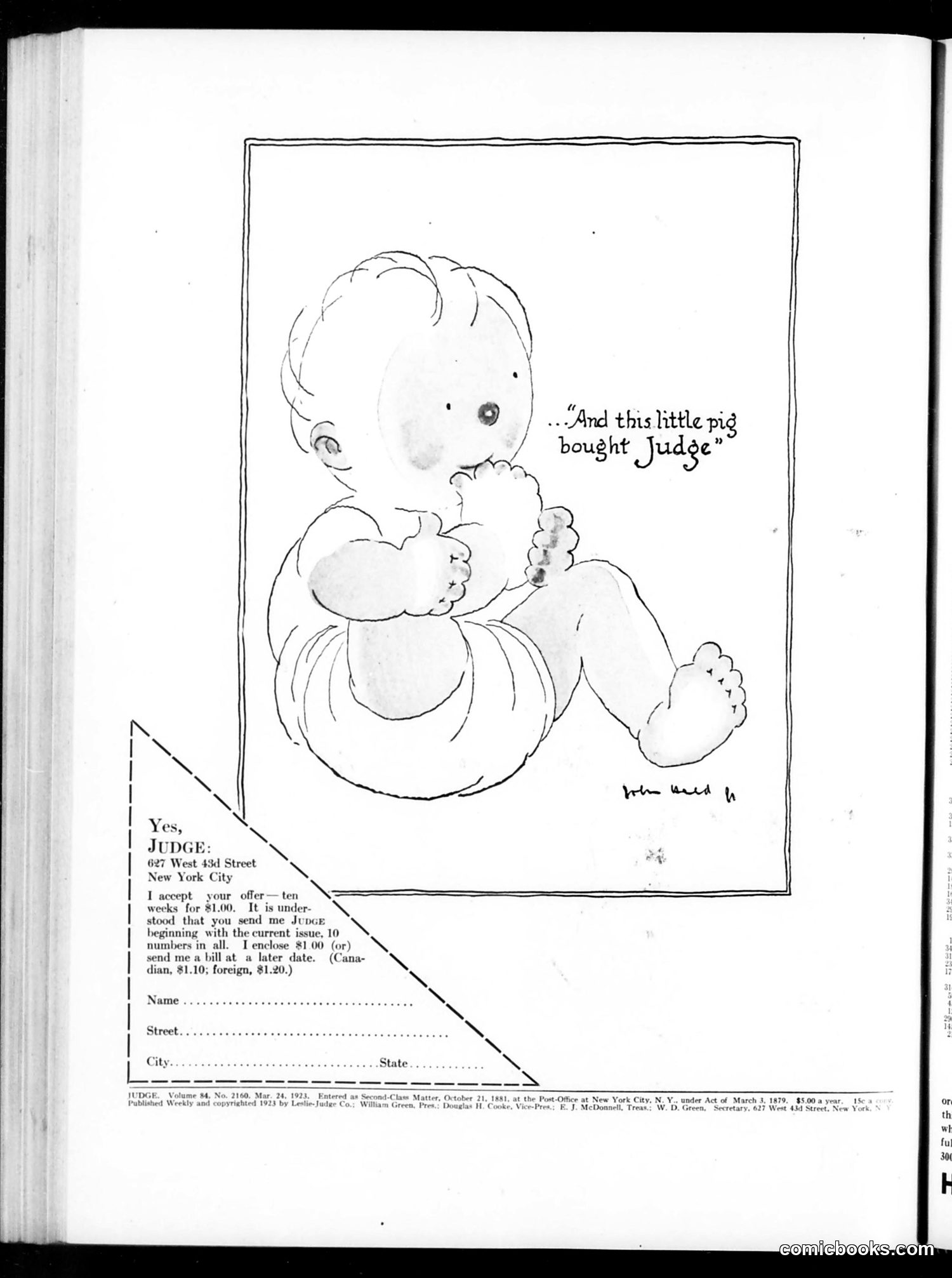
This page features a single cartoon with accompanying subscription offer. The illustration shows a baby holding what appears to be a large object labeled "Judge," referencing the magazine itself. The caption reads: "And this little pig bought 'Judge'"—a play on the nursery rhyme "This Little Piggy Went to Market." The joke appears to be a self-promotional advertisement, suggesting that even infants/the very young should subscribe to Judge magazine. The subscription offer below indicates Judge cost $1.00 for ten weeks, with various payment options listed for different regions (U.S., Canadian, foreign rates). This is primarily an advertisement masquerading as editorial content, using humor to encourage magazine subscriptions from the publication's readers. The cartoon itself contains no obvious political satire—it's simply promotional material using a familiar nursery rhyme as its hook.
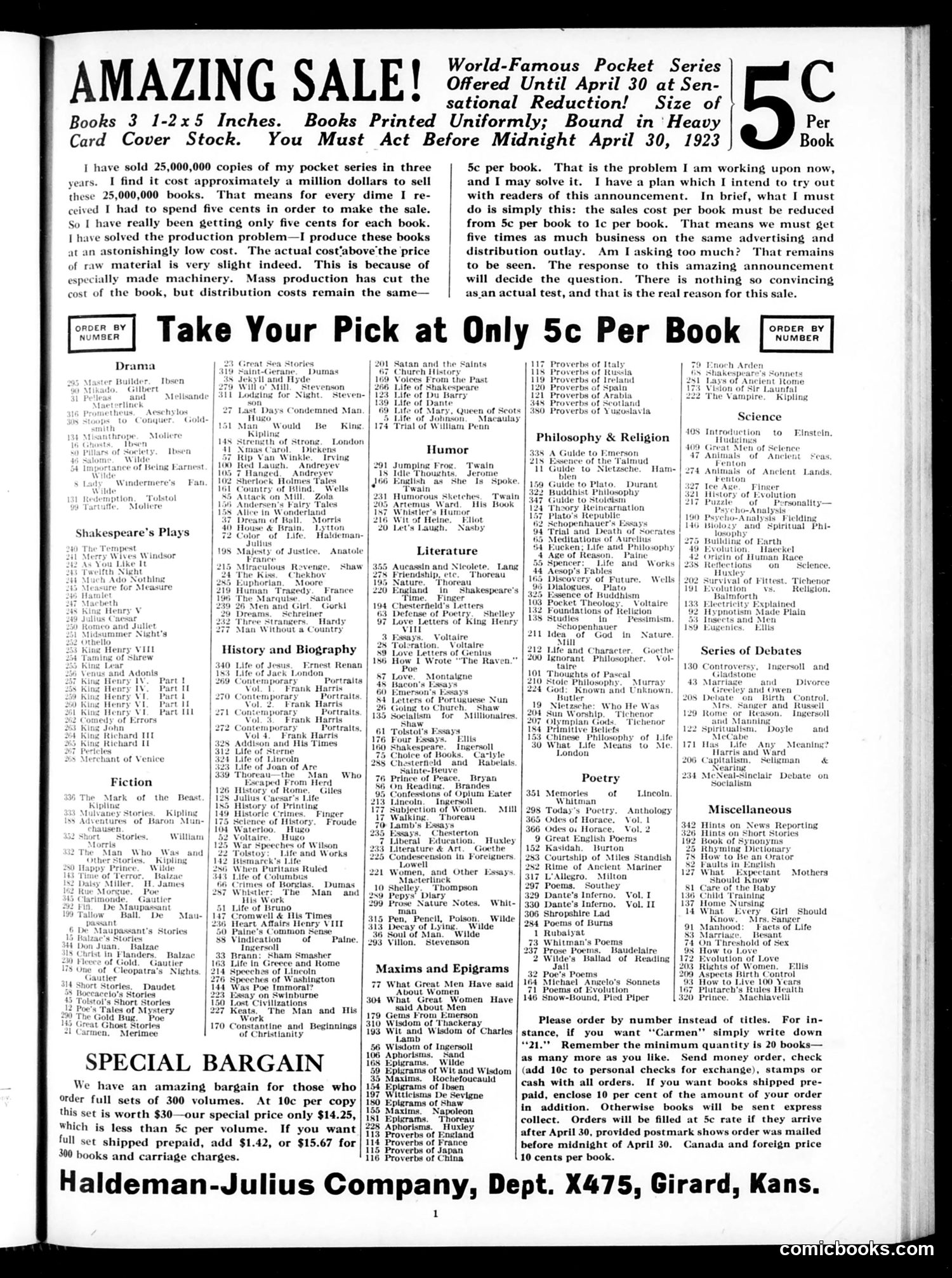
This page is **entirely advertising**, not editorial content or cartoons. It's a mail-order catalog advertisement from the Haldeman-Julius Company selling their "World-Famous Pocket Series" — cheap paperback books (5 cents each) offered until April 30, 1923. The ad lists hundreds of titles across categories: Shakespeare's plays, fiction, history, humor, literature, philosophy, poetry, and miscellaneous works. A secondary "Special Bargain" section offers full 300-volume sets at 10 cents per book. There are no political cartoons, caricatures, or satirical commentary on this page. It's a straightforward commercial pitch emphasizing the affordability and distribution success of these pocket books—a significant democratization of literature in the early 20th century.
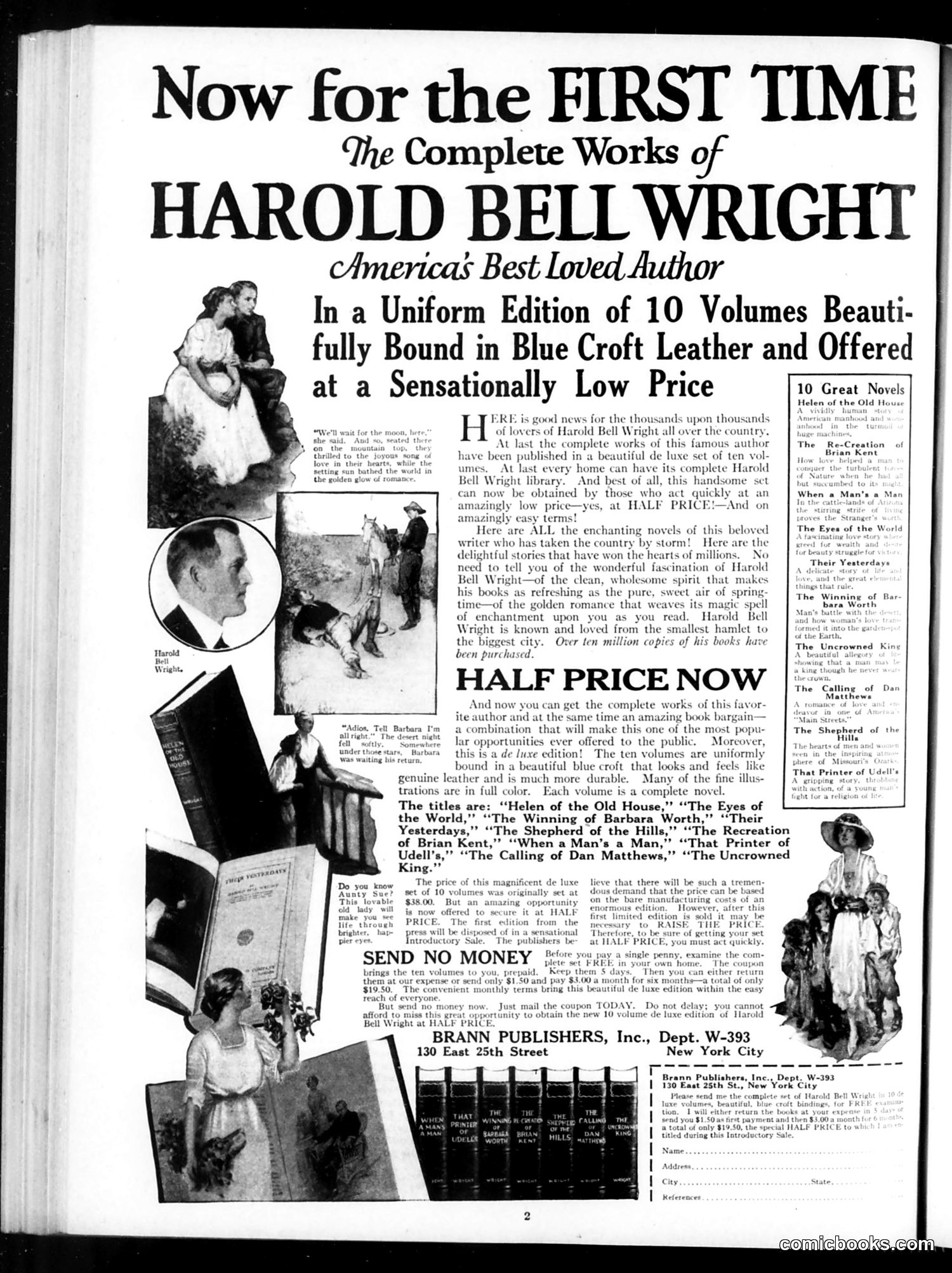
This page is **primarily an advertisement**, not editorial content or satire. It promotes a complete 10-volume set of Harold Bell Wright novels in blue croft leather binding, offered at "half price" by Brann Publishers. The imagery shows romantic scenes typical of Wright's fiction—couples embracing, domestic moments—reflecting his reputation as "America's Best Loved Author" known for wholesome romance and adventure stories. The advertisement emphasizes accessibility ("half price," "easy terms," "send no money") and quality (full-color illustrations, durable binding). While *Judge* magazine was satirical, **this page contains no cartoon or political satire**—it's a straightforward commercial appeal targeting middle-class readers seeking affordable classics for their home libraries.
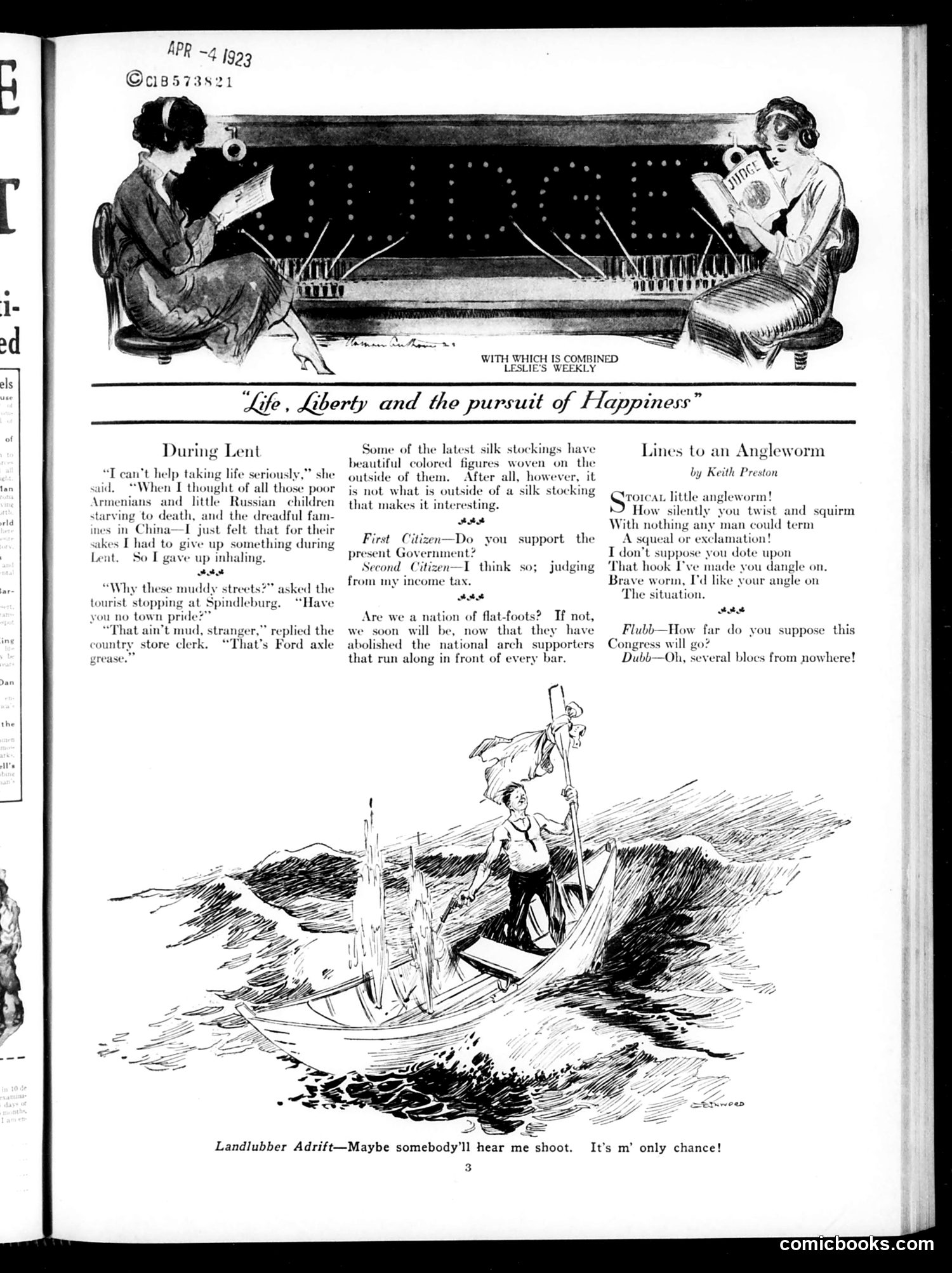
This 1923 *Judge* magazine page satirizes post-WWI American concerns. The top illustration shows two women operating what appears to be a telephone switchboard, labeled "WITH WHICH IS COMBINED LESLIE'S WEEKLY." The text below includes social commentary: "During Lent," discussions of government support, and jokes about national finances ("flat-foots," "abolished the national arch supporters"). The bottom cartoon depicts a "Landlubber Adrift" in a sinking boat, captioned "Maybe somebody'll hear me shoot. It's m' only chance!"—likely satirizing economic desperation or financial crisis following the war and 1920s economic instability. The overall tone mocks both political governance and contemporary American anxieties about economic security and social stability in the post-war period.
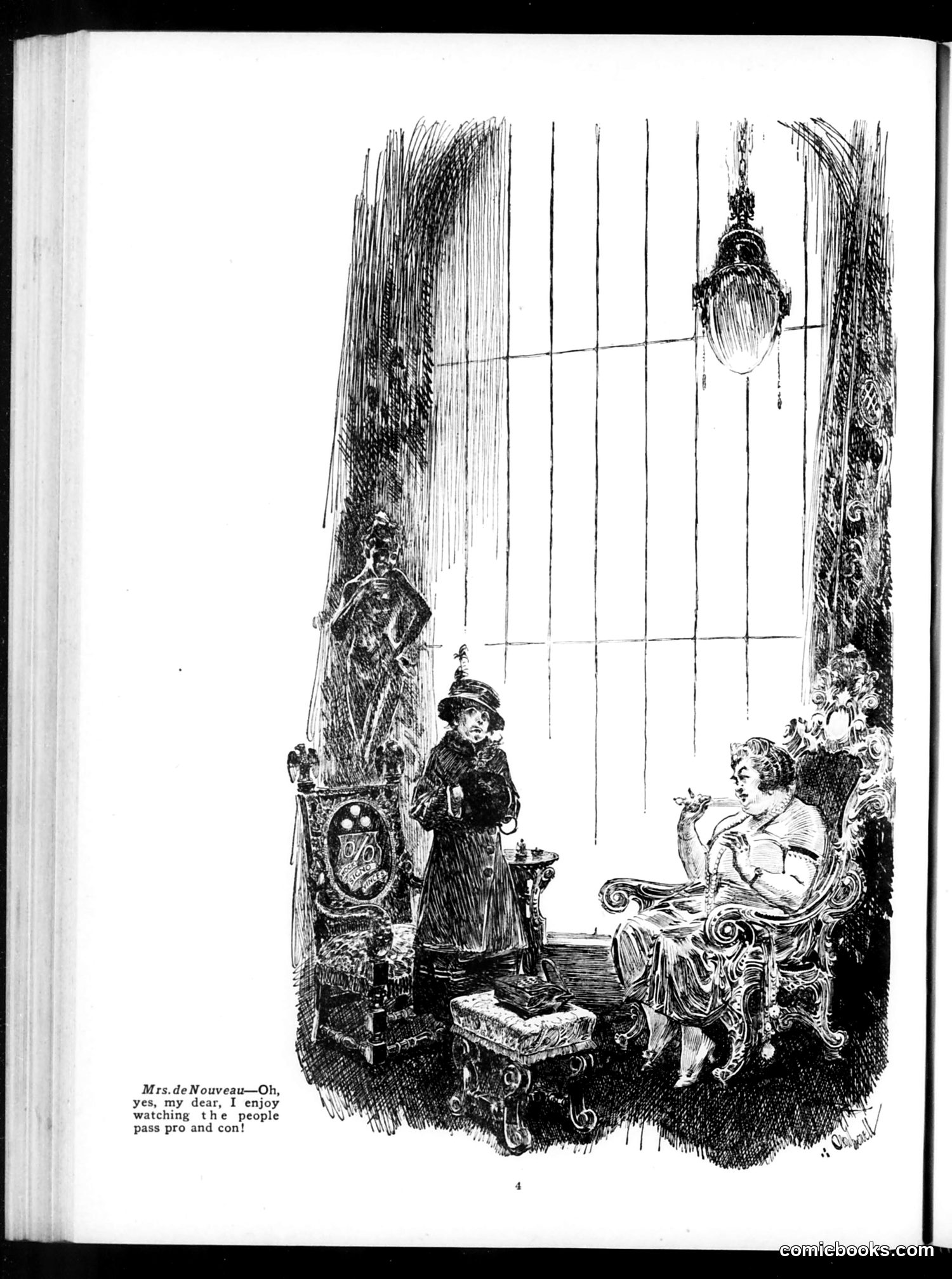
This appears to be a satirical illustration from Judge magazine depicting a scene of high society observation. A well-dressed woman sits in an ornate chair while a man in formal attire (wearing a hat) stands nearby. The caption reads: "Mrs de Nouveau—yes, my dear, I enjoy watching the people pass pro and con!" The satire targets the pretentious nouveau riche (newly wealthy class). "Mrs de Nouveau" is a mocking French-inflected name suggesting affected sophistication. The joke mocks wealthy newcomers who position themselves to observe and judge the passing crowds—implying they see themselves as arbiters of taste and propriety while being socially insecure themselves. The ornate furnishings and formal dress emphasize their conspicuous consumption. Judge frequently ridiculed the social climbing and affectations of America's newly wealthy classes during the Gilded Age.
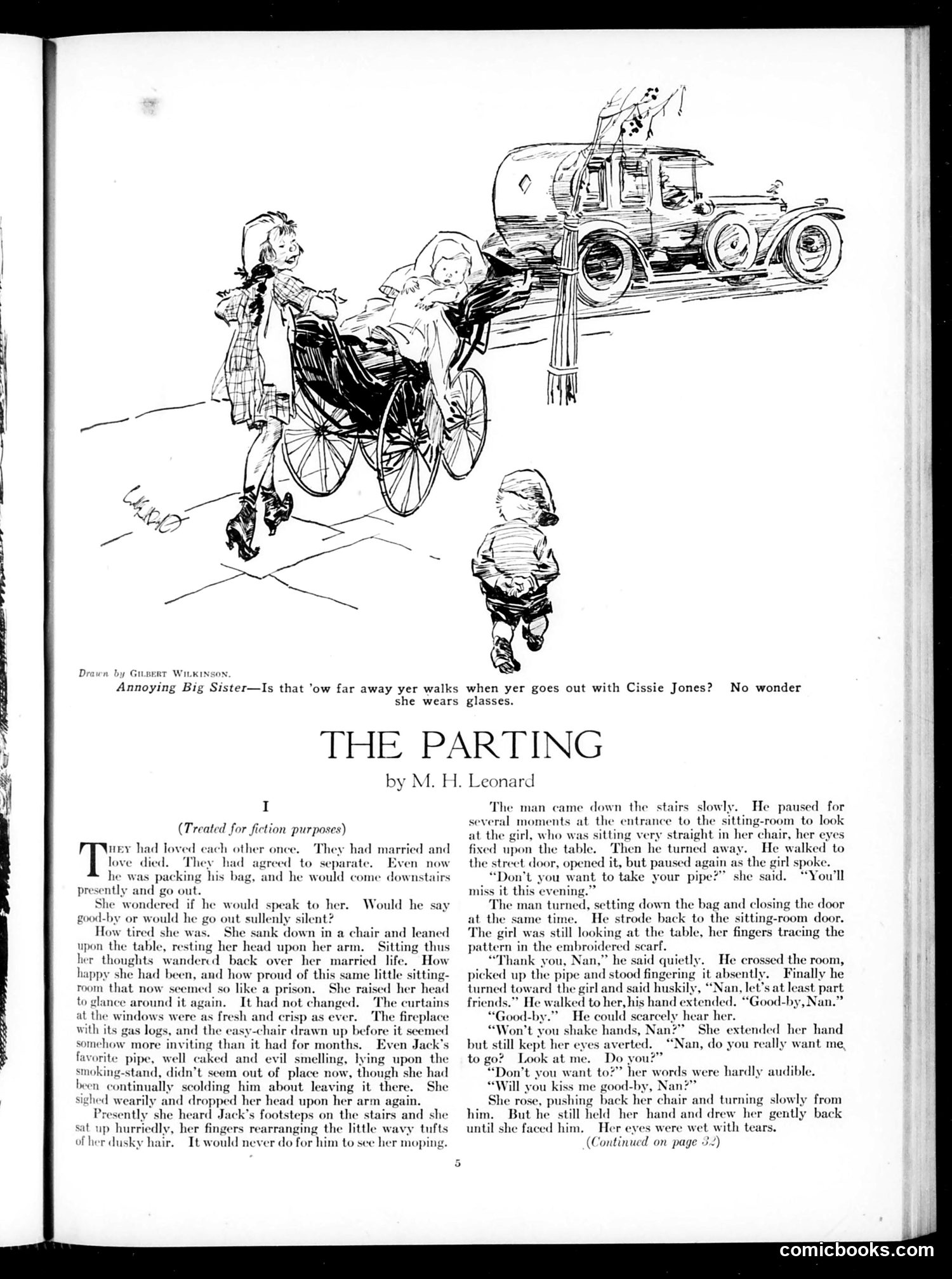
This page contains two distinct pieces: **The Cartoon** (top): A simple joke about a girl named "Cissie Jones" who apparently walks far away from her annoying big sister when they go out together. The punchline suggests Cissie's poor eyesight (hence the glasses) explains the distance—she can't see her sister properly to stay close. **The Story** (main content): "The Parting" by M. H. Leonard is a sentimental domestic drama about a married couple separating. The wife sits alone contemplating their failed relationship while her husband packs to leave. When he comes downstairs, a brief emotional exchange occurs—she reminds him of his pipe, they nearly reconcile through a charged moment of hand-holding and near-kiss, but ultimately the separation proceeds. The story explores themes of lost love, regret, and the pain of marital dissolution—serious melodrama typical of early 20th-century magazine fiction, treating emotional rupture as tragedy worthy of extended narrative treatment.
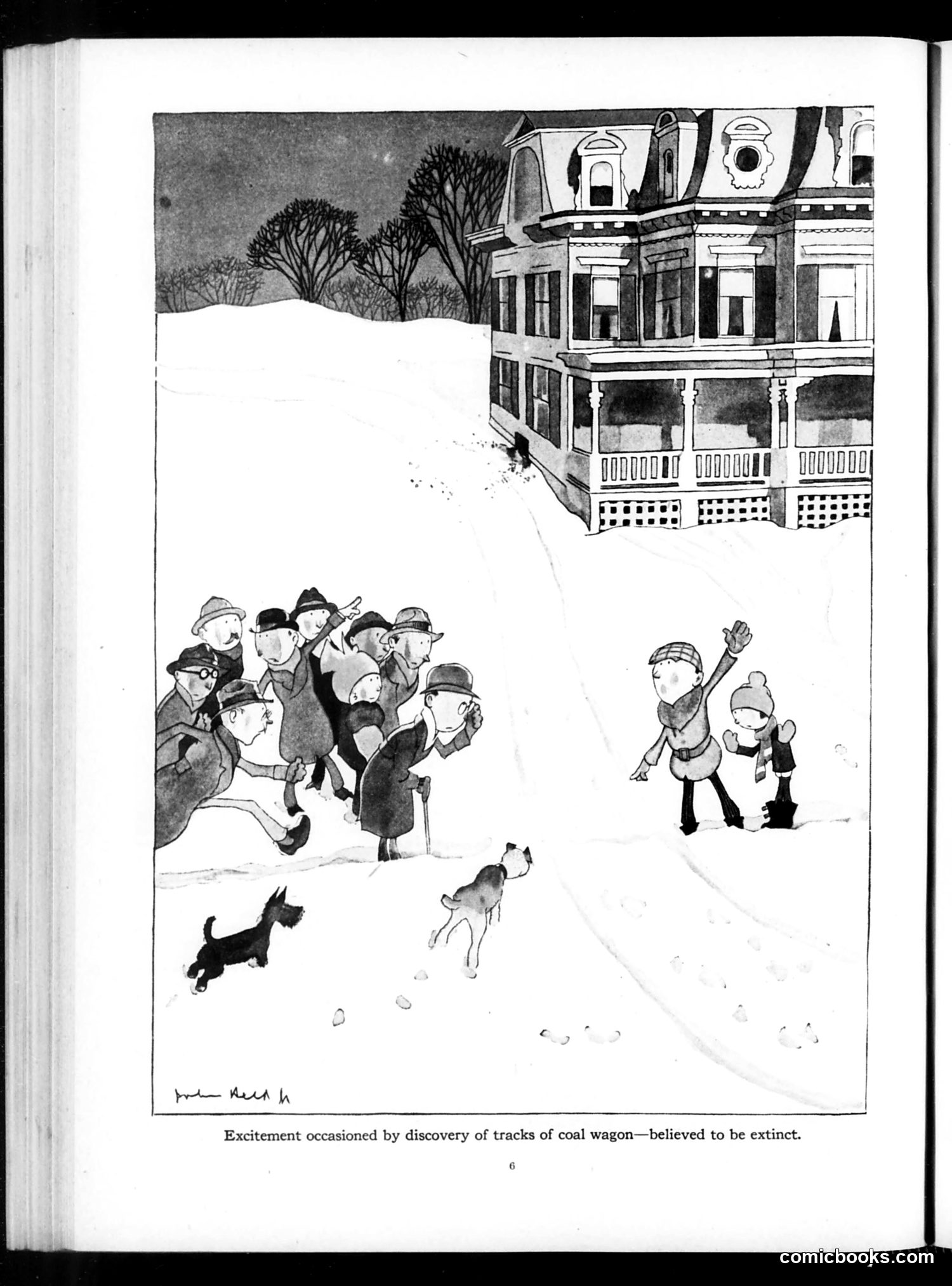
This cartoon depicts a humorous winter scene satirizing economic hardship, likely from the post-WWI era or Great Depression period. A group of men and boys in a snowy landscape excitedly discover tracks from a coal wagon—a vehicle for delivering heating fuel that has apparently become so scarce it's "believed to be extinct." The joke plays on severe fuel shortages affecting working-class families who depend on coal for heat. The men's animated reaction to finding evidence of a coal delivery underscores how desperate the situation has become: even *tracks* from such wagons now warrant celebration. The illustration critiques both the scarcity itself and society's indifference to the suffering it causes.
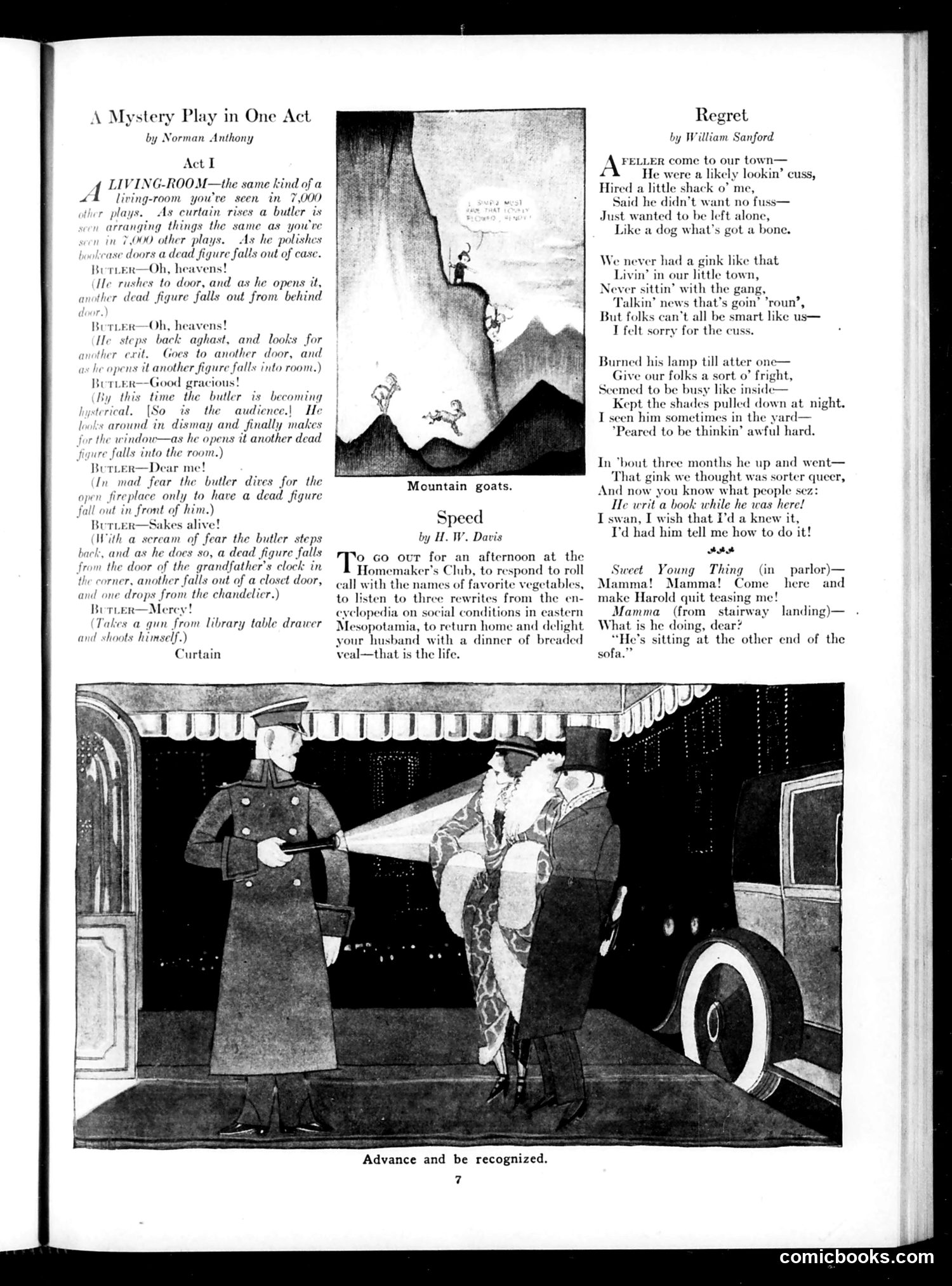
This page contains three distinct satirical pieces typical of early 20th-century American humor: **"A Mystery Play in One Act"** parodies the overwrought conventions of stage melodrama—specifically the absurd tradition of bodies mysteriously appearing from every possible location (doors, fireplaces, clocks, chandeliers). The joke escalates to absurdity: a butler, driven mad by endless corpses, shoots himself. This mocks both the melodramatic theater genre and its predictable, contrived plotting. **"Speed"** satirizes the tedious social obligations of women's clubs—attending meetings to recite vegetable names and recycled encyclopedia entries on obscure topics, then returning home to prepare dinner. The satire targets both the pretentiousness of such organizations and the limited intellectual engagement they offered women. **"Regret"** presents a rural dialect poem about a mysterious stranger who turns out to have been a writer all along—suggesting small-town regret at not recognizing or nurturing talent when it was present. It reflects broader anxieties about missed opportunities and unrecognized genius. The page represents Judge's characteristic blend of theatrical parody, domestic satire, and sentimental Americana humor.
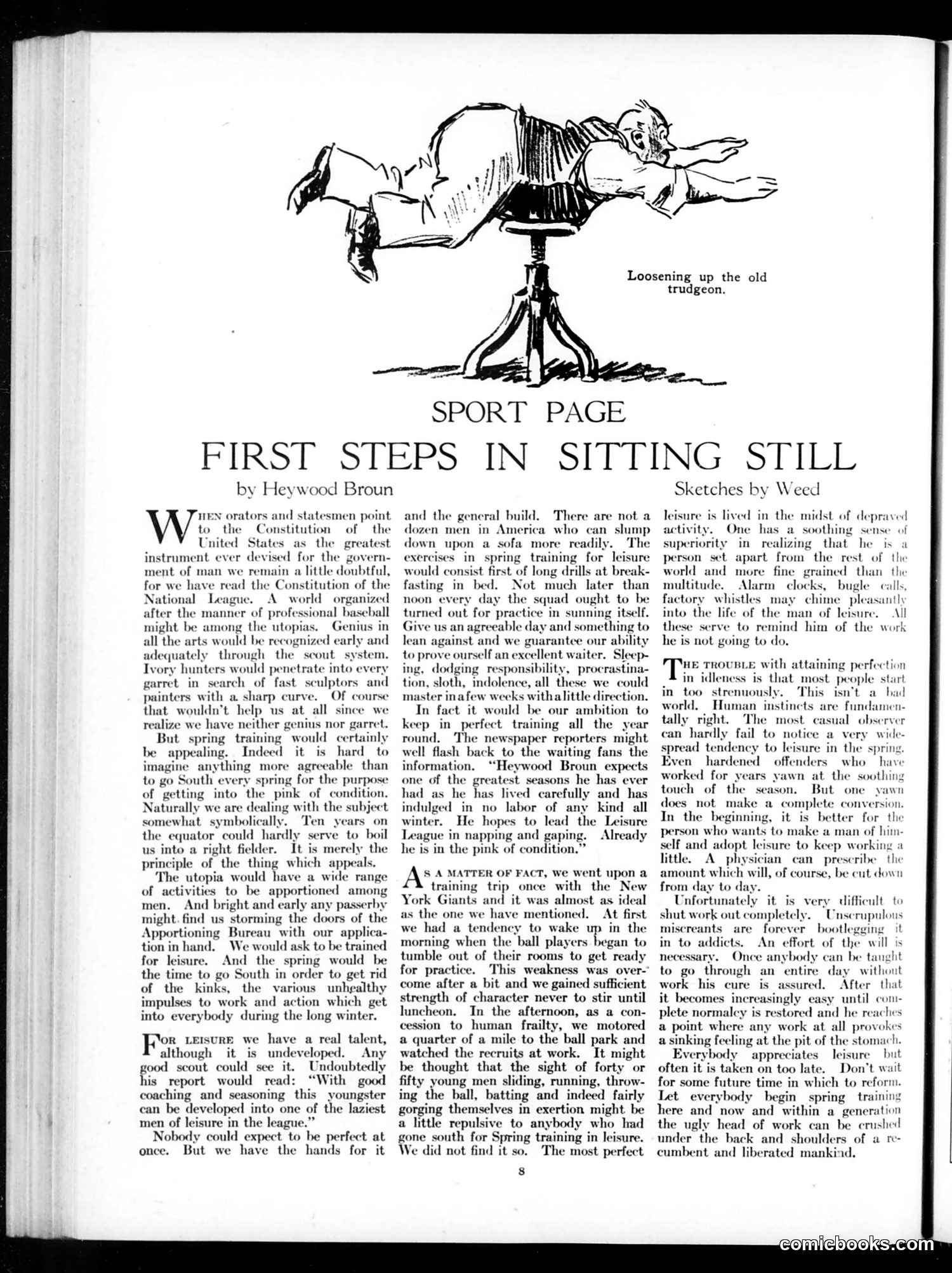
This is a humorous sports column by Heywood Broun satirizing American leisure culture and work ethic. The accompanying cartoon shows a man lounging horizontally on what appears to be gymnastics equipment—a visual joke about "loosening up" an old swimming stroke (the trudgeon) by depicting someone doing the opposite of athletic exertion. Broun's piece proposes an absurd "spring training" system for learning how to be idle—treating laziness as a skill requiring coaching, like baseball. He mocks both the American obsession with self-improvement and the era's Protestant work ethic by suggesting that people need formal training to master relaxation. The satire targets the pretentiousness of the period's "scientific" approach to every aspect of life, from sports to culture. By proposing a "Leisure League" with scouts identifying talented loafers, Broun highlights the absurdity of applying industrial-era optimization logic to human leisure.
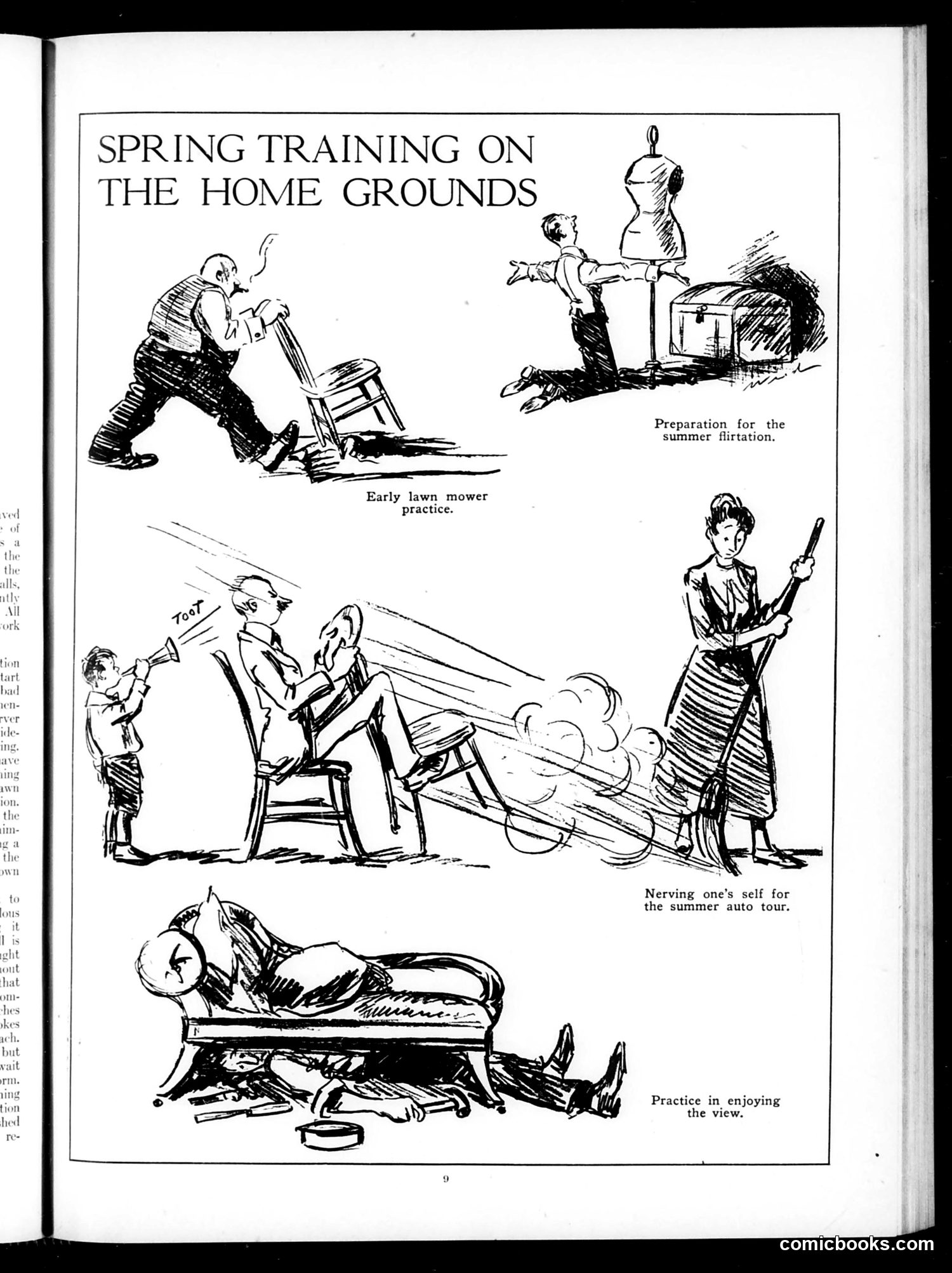
This humorous page presents five vignettes depicting spring domestic activities as comedic "training" for summer leisure. The jokes satirize both household chores and romantic/social expectations: 1. **"Early lawn mower practice"**: A man struggles with a manual push mower, portrayed as athletic preparation. 2. **"Preparation for summer flirtation"**: A couple practices courtship with props (dress form, furniture). 3. **"Nerving one's self for the summer auto tour"**: People in chairs simulate the anxiety of upcoming automobile travel—then-novel and anxiety-inducing. 4. **"Practice in enjoying the view"**: A man reclines outdoors, suggesting leisure as a skill requiring practice. The satire reflects early 20th-century gender roles and anxieties: domestic labor, courtship rituals, and the then-thrilling novelty of automobile ownership. The comedic framing treats ordinary spring activities as earnest preparation for summer's social season.
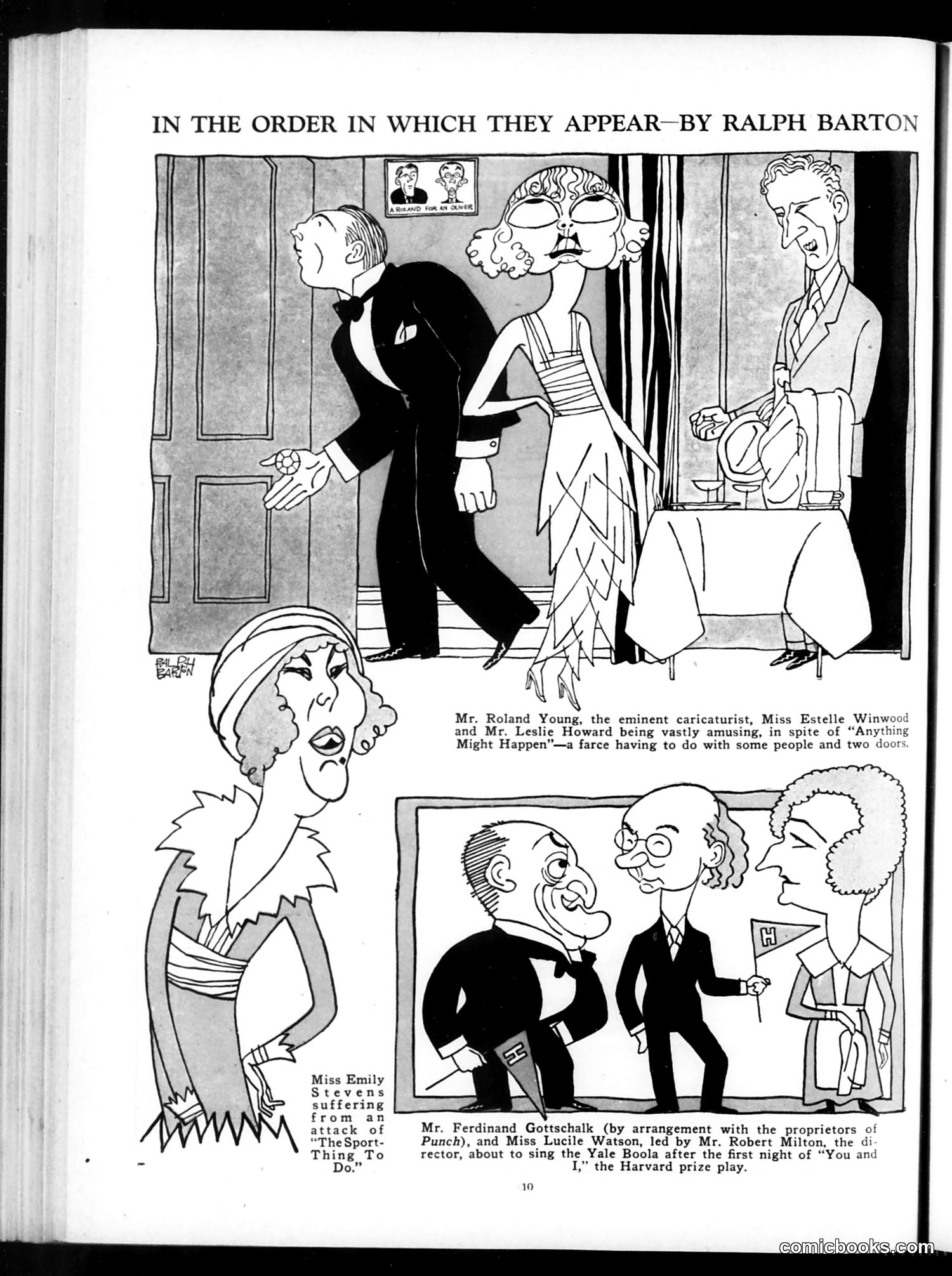
This page by Ralph Barton satirizes theatrical performances of the era. The top cartoon mocks the farce "Anything Might Happen," featuring actors Roland Young, Estelle Winwood, and Leslie Howard—suggesting their comedic talents couldn't salvage a thin plot involving "some people and two doors." The bottom cartoon ridicules a musical performance at what appears to be a Harvard/Yale theatrical event. It depicts Ferdinand Gottschalk and Lucile Watson, directed by Robert Milton, performing the "Yale Boola" after a Harvard prize play premiere ("You and I"). The exaggerated caricatures emphasize the performers' physical features for comedic effect. Barton's satire targets both theatrical productions themselves and the pretentiousness of college dramatic societies. The cartoons suggest that even talented actors cannot redeem poorly-conceived material, and that amateur/collegiate theater often produces awkward or overwrought performances.
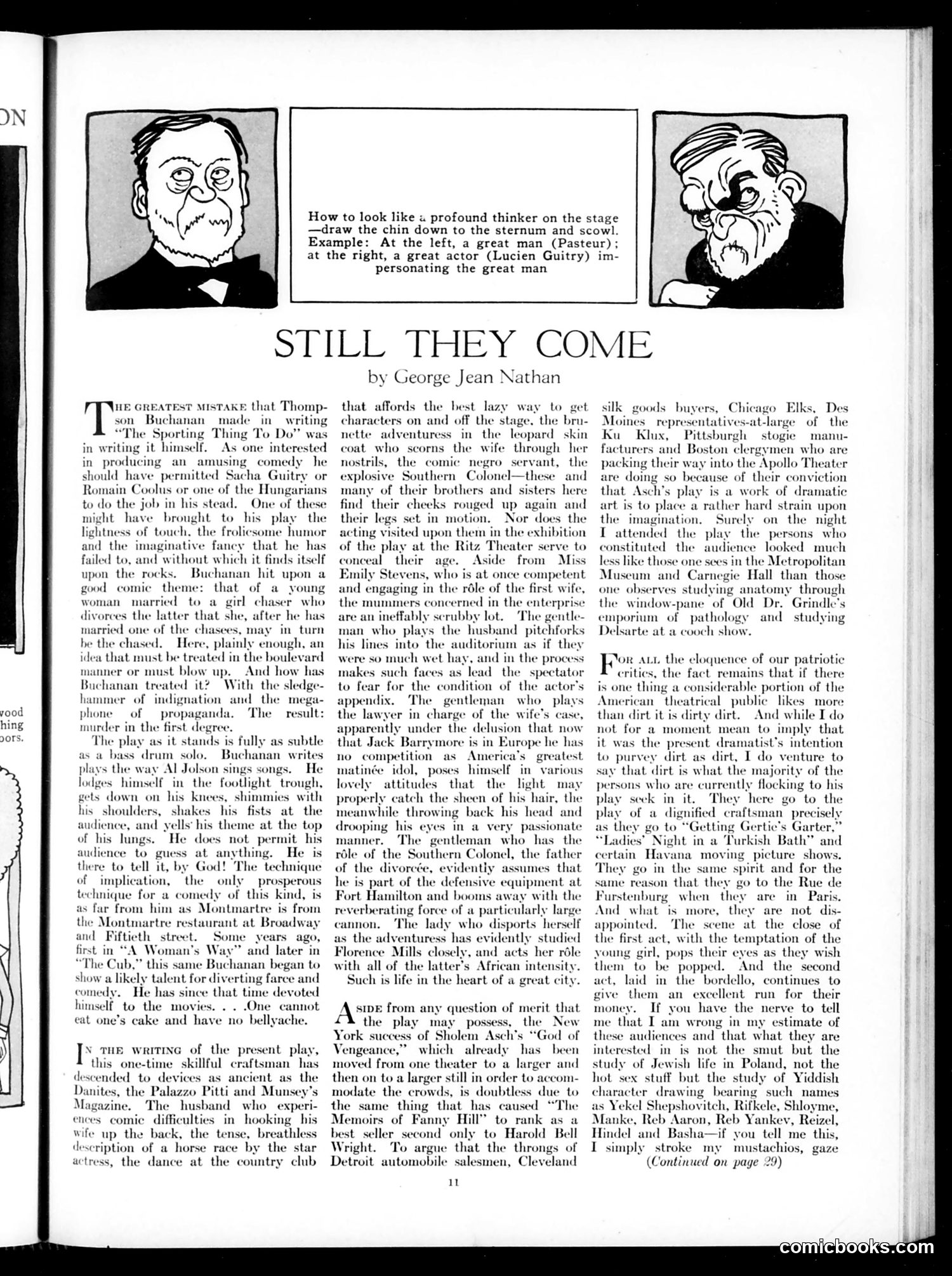
This page contains two elements: a **visual gag** about theatrical acting and a **theater review** by George Jean Nathan. The cartoon at top mocks how actors portray "profound thinkers" on stage—simply by drawing the chin down and scowling. It contrasts Louis Pasteur (the actual scientist, at left) with actor Lucien Guitry impersonating him, suggesting actors use exaggerated physical mannerisms rather than genuine intellect. The review below critiques playwright Thompson Buchanan's "The Sporting Thing To Do," performed at the Ritz Theater. Nathan argues Buchanan writes with a "sledgehammer" of obvious moralizing rather than the subtle technique required for good comedy. He derides the supporting cast as "scrubbily" performed—particularly criticizing the male leads for overacting: one delivers lines "like wet hay" while another imitates Jack Barrymore's theatrical posing. Nathan implies these actors, lacking real talent, resort to empty physical theatricality. The satire targets both playwright and performers for substituting bombastic delivery and clichéd stage business for genuine craft.
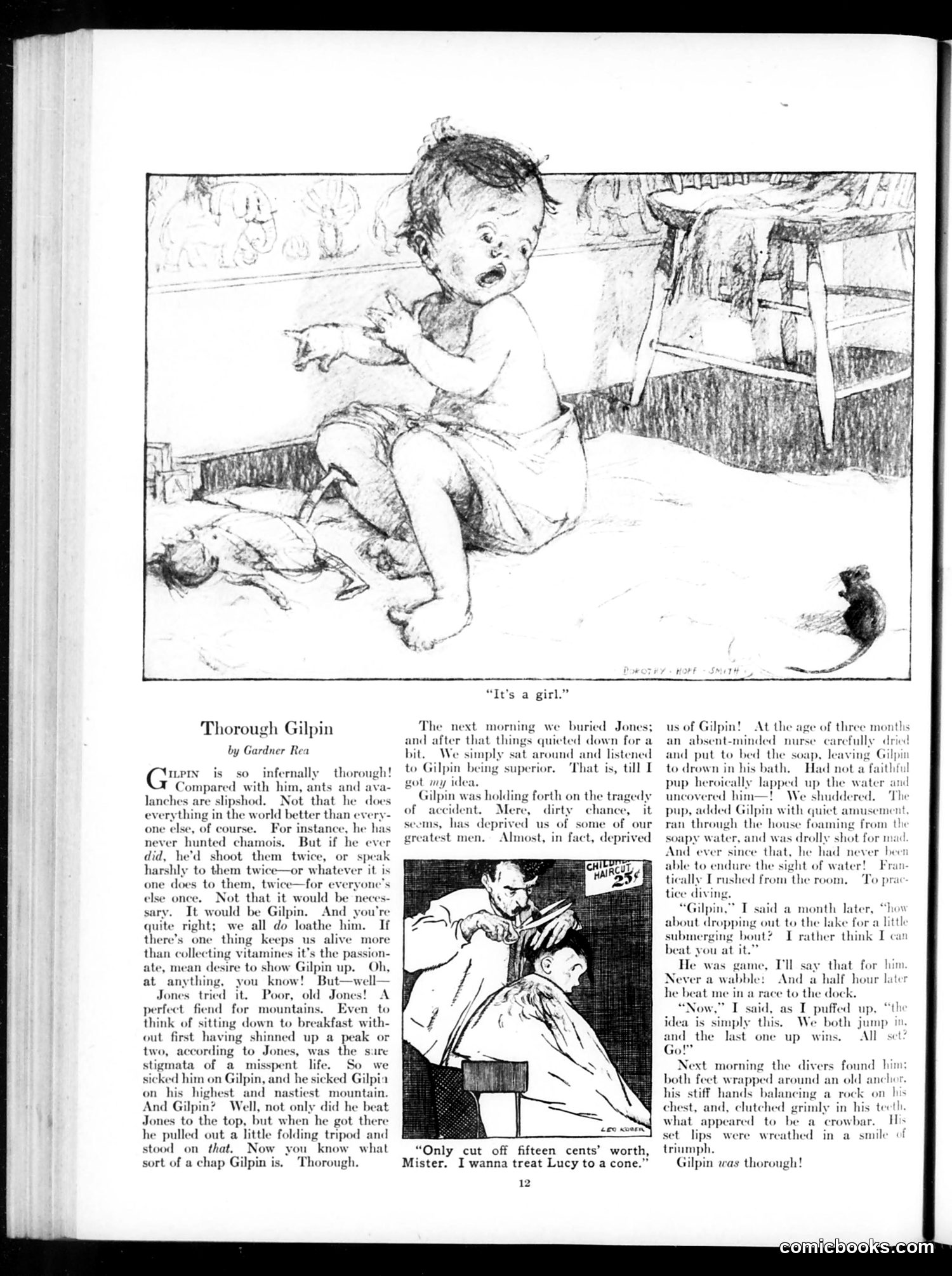
This is a humorous short story about an insufferably meticulous man named Gilpin who takes everything to absurd extremes. The narrator and his friends repeatedly try to "show Gilpin up" by challenging him, but Gilpin's compulsive thoroughness always defeats them—ultimately fatally. The satire targets a personality type: the obsessively detail-oriented person who cannot enjoy life or accept reasonable limits. Jones dies mountain-climbing because Gilpin won't stop after reaching the peak. Gilpin's "rescue" of a drowning puppy causes him neurotic water-phobia. Finally, in a diving race, Gilpin's determination to win so completely—anchoring himself to the bottom—results in his drowning. The accompanying illustrations show a toddler and a barber scene, likely supporting vignettes of Gilpin's excessive behavior applied to domestic situations. The humor relies on escalating consequences for pathological perfectionism.
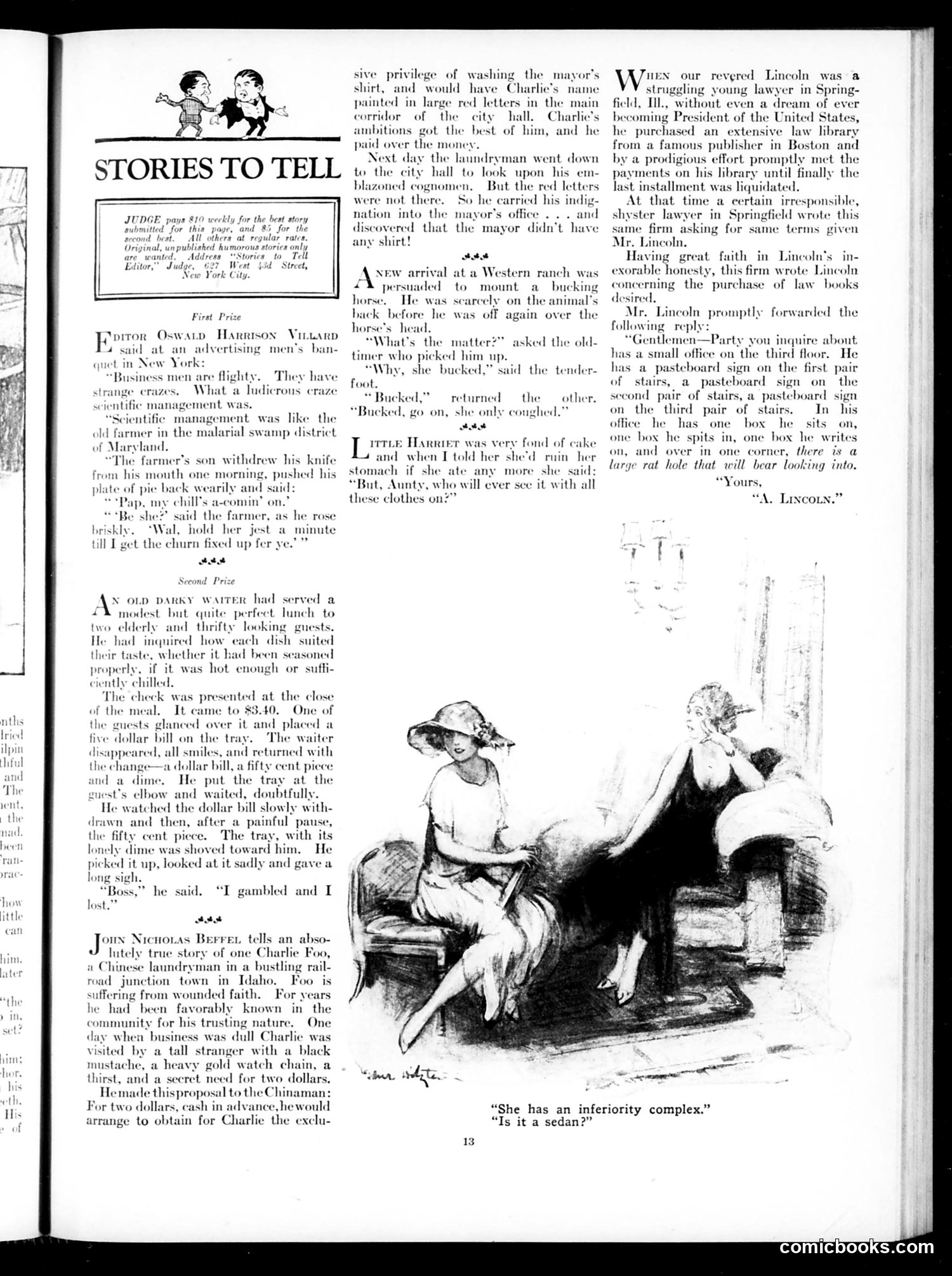
This page from *Judge* contains five humorous stories mocking various absurdities of American business and social life, circa early 1900s. The **Lincoln anecdote** (right column) ironically contrasts Lincoln's scrupulous financial integrity—he repaid his law library debt "promptly"—with a contemporary "irresponsible, shyster lawyer" seeking the same favorable terms. The satire targets dishonest contemporaries exploiting Lincoln's legendary honesty to justify their own credit requests. The other stories mock **scientific management craze** (portrayed as ridiculous as rural ignorance), a **waiter's disappointment** receiving only a dime tip despite excellent service, and a **Chinese laundryman's gullibility** when swindled by a con man offering fake privilege to wash the mayor's shirt. Throughout, the humor targets **gullibility, dishonesty in business, and the gap between pretense and reality** in Gilded Age America. The illustrated cartoon shows two women, with the caption "'She has an inferiority complex.' 'Is it a sedan?'"—a joke about newfangled automobiles and psychology terms.
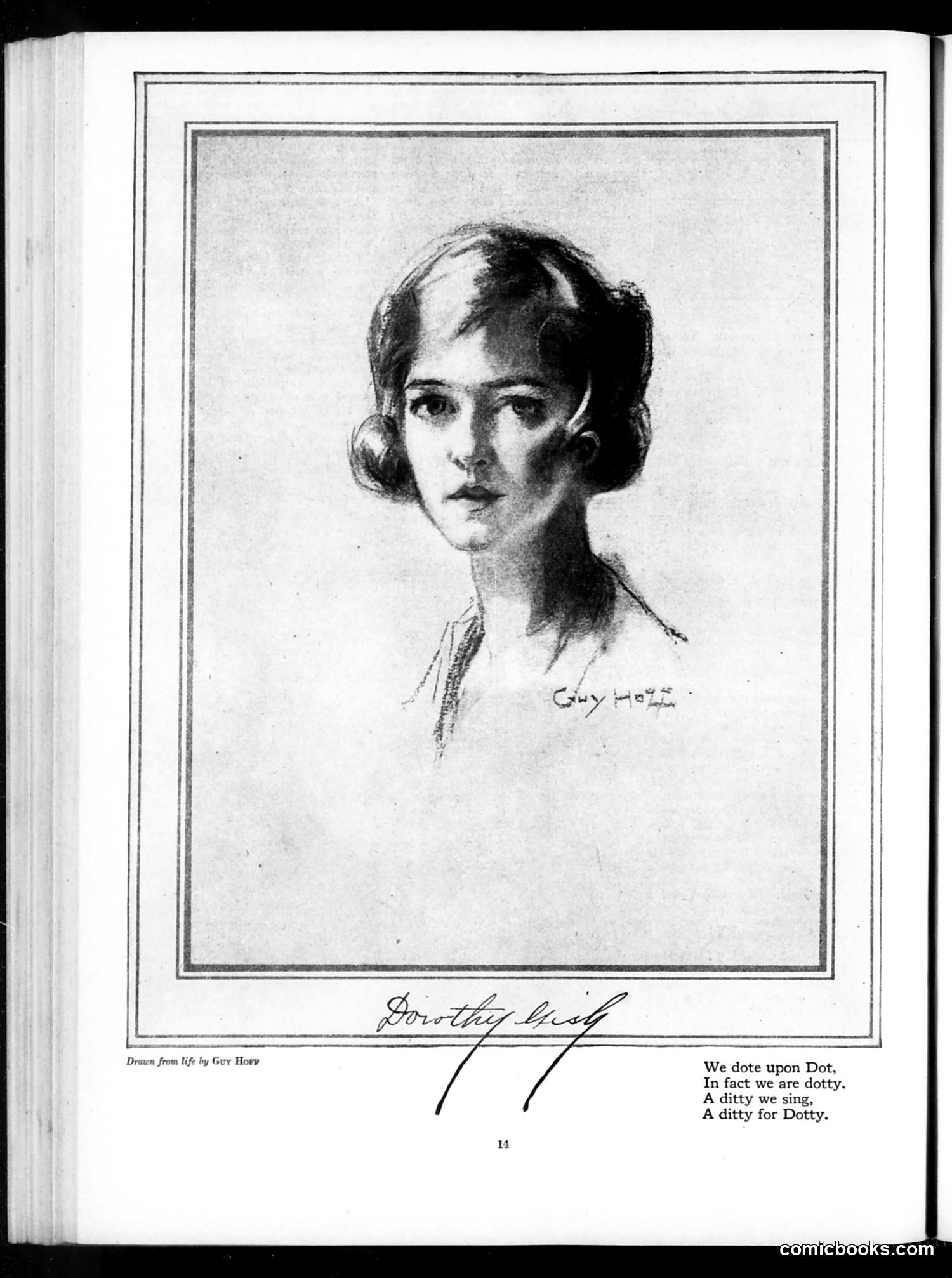
This page features a portrait sketch titled "Dorothy Gish" (signed by artist Guy Hose), accompanied by a playful verse. The subject appears to be a woman from the early 20th century with a distinctive short, wavy hairstyle typical of that era. The accompanying rhyme is a lighthearted pun based on her first name "Dorothy" (nicknamed "Dot" or "Dotty"). The joke plays on the word "dotty" (British slang meaning scatterbrained or eccentric) while also meaning to be infatuated with someone named Dot. Without additional context identifying who Dorothy Gish was, the exact satirical target remains unclear—whether she was a public figure, actress, or society personality of Judge magazine's readership. The humor appears social rather than strictly political, poking gentle fun at the subject through clever wordplay.
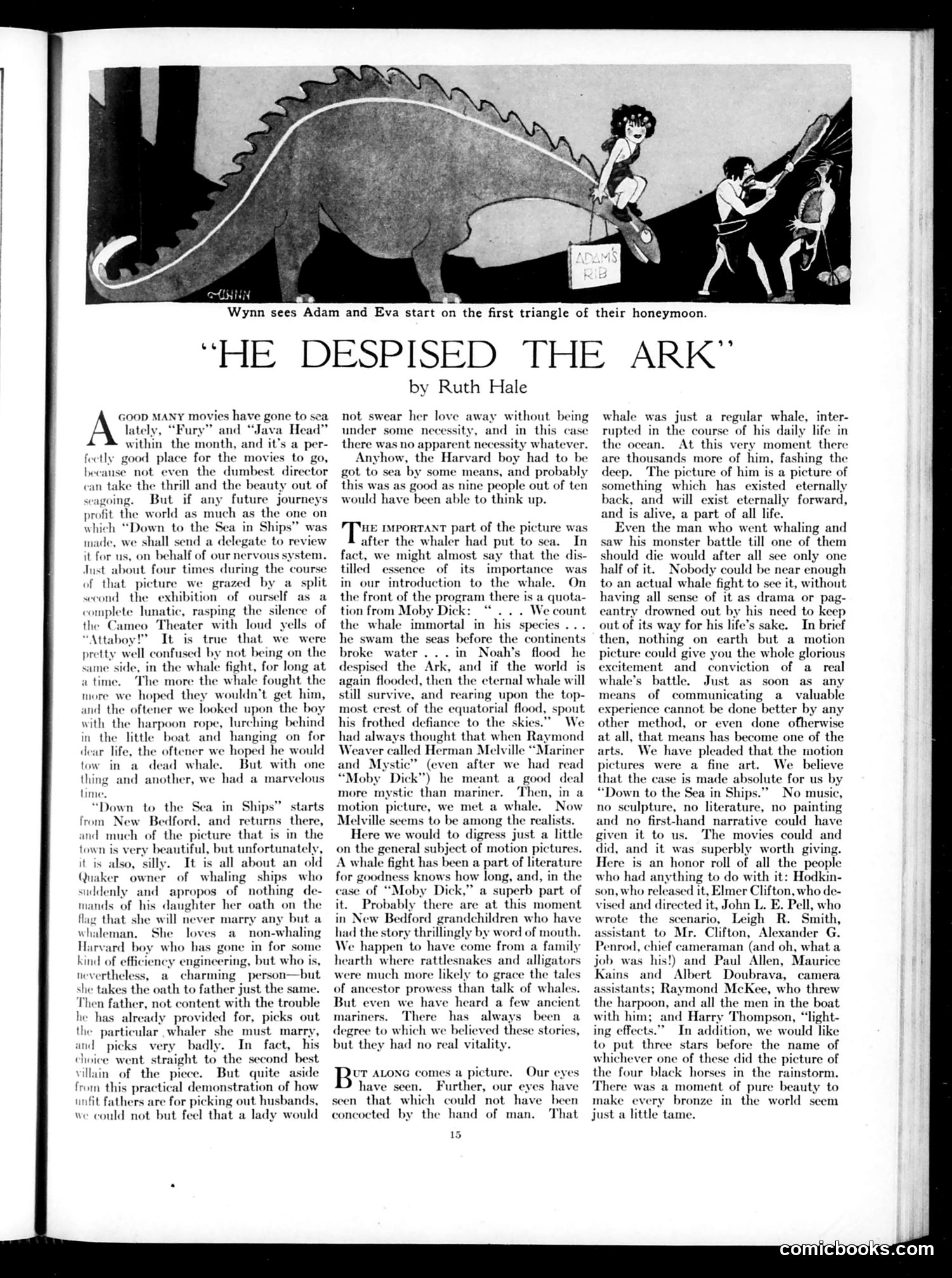
This 1921 *Judge* magazine piece reviews "Down to the Sea in Ships," a silent film about New Bedford whalers. The cartoon at top shows a dinosaur (labeled to suggest a whale) with tiny people beside it—a visual joke about the film's whale appearing absurdly oversized or unconvincing on screen. Critic Ruth Hale satirizes the film's melodramatic plot: an overbearing Quaker ship-owner forces his daughter to swear she'll marry only a whaleman, though she loves a Harvard engineering student. Hale mocks this contrived setup as typical of sentimental cinema. The review's centerpiece is Hale's witty deflation of Melville's grandiose whale mythology (quoting *Moby-Dick*'s cosmic descriptions) against the reality of seeing an actual whale in motion pictures—which apparently looked ridiculous. She argues that after watching the film, Melville's romantic "mystic" whaling prose now reads as straightforward realism: the real whale wasn't impressive enough to match literature's grandeur. The satire targets both the film's plot contrivances and cinema's inability to capture literary imagination.
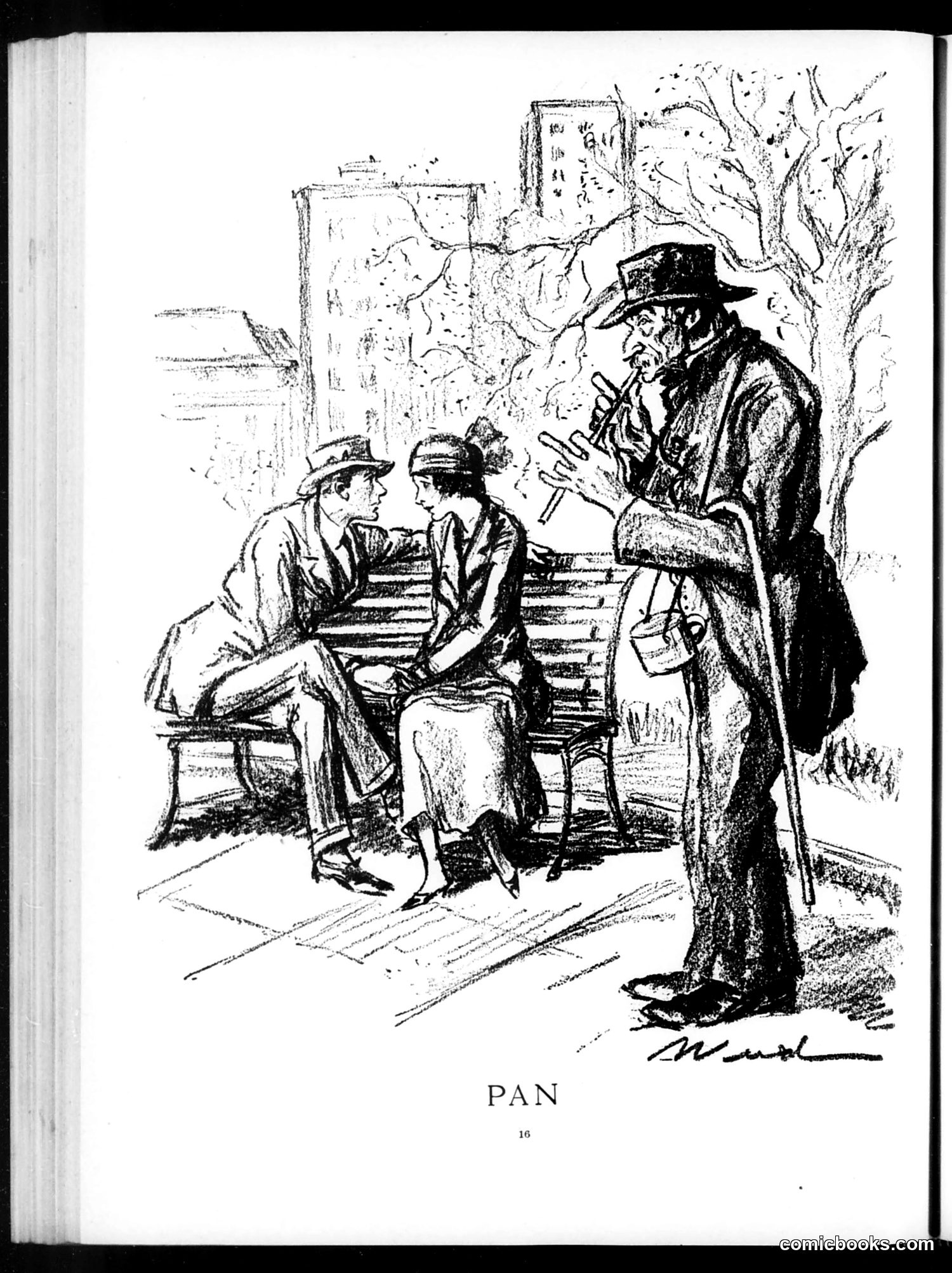
This appears to be a satirical illustration titled "PAN" from *Judge* magazine. The cartoon shows three men in late 19th or early 20th-century dress: two seated on a bench conversing, and a tall figure standing nearby playing what appears to be a pipe or musical instrument. The title "PAN" references the Greek mythological figure—a god associated with wild nature, music, and mischief. The satirical point likely involves social commentary on urban life, leisure, or character types of the era, though the specific political or social reference is unclear without additional context from surrounding articles or the magazine's date. The artist's signature appears in the lower right corner.
**The "Judge" Masthead:** Shows the magazine's satirical mascot—a mischievous jester character—establishing the tone for political commentary. **Main Editorial Content** addresses three topics: 1. **"The Almost Perfect State"** satirizes American legislative overreach. The author catalogs absurd state prohibition laws (banning cigarettes, teaching evolution, standardizing dance positions, etc.), mocking the idea that legislatures are micromanaging citizens' behavior to achieve utopian control. The sarcasm suggests Americans are surrendering personal freedom to government overreach. 2. **"Propaganda and Propaganda"** critiques French efforts to spend money on U.S. propaganda to improve French sentiment after WWI. Judge suggests France would better serve itself by paying war debts to America and negotiating the contentious Ruhr occupation reasonably, rather than relying on propaganda and military force—which might trigger another world war. 3. **Brief satirical notes** on current events (spring equinox, spiritualism, political activity, Congress "junketing"). The overall theme: American and European governments are engaging in misguided, expensive, or freedom-restricting policies.
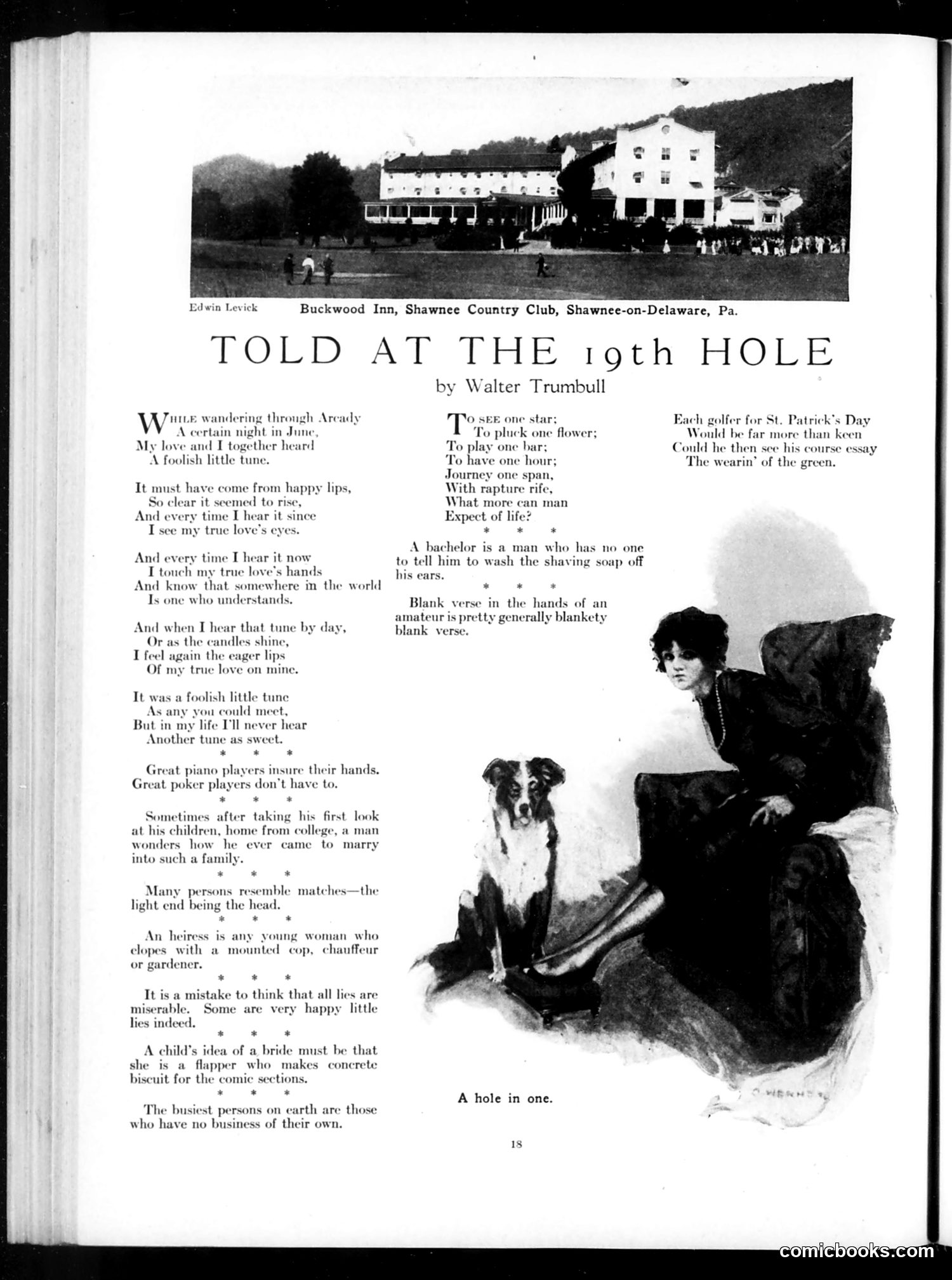
This page presents **humorous observations** supposedly exchanged at a golf club's 10th hole, a common framing device in *Judge* magazine. The content mixes sentimental poetry with satirical quips about contemporary social life. The main illustration shows **a woman and man with a dog**, captioned "A hole in one"—a golf pun playing on the phrase's double meaning (both a golf achievement and a romantic "success"). The text targets familiar subjects: **bachelors** (lacking wives to manage them), **heiresses** (women marrying working-class men for status), **college-educated children** (disappointing their parents), and **flappers** (modern women). There are also jabs at **amateur poets** and generally busy-bodies. The sentimental opening poem contrasts sharply with these cynical, worldly observations—typical of *Judge*'s mix of romance and social satire. The setting (Shawnee Country Club, Pennsylvania) establishes an elite, leisured audience for these jokes about marriage, wealth, and modern morality.
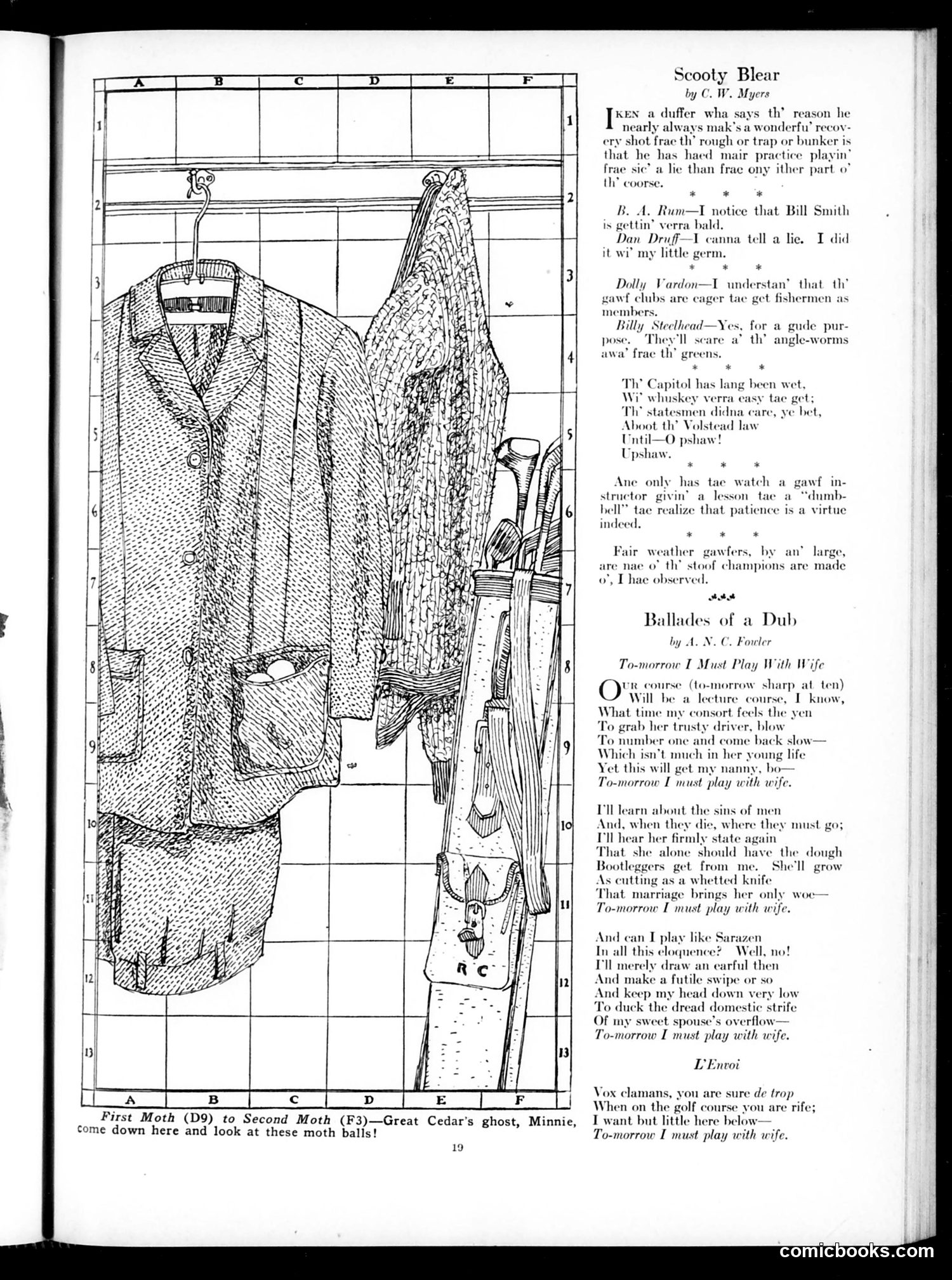
The page contains a **moth illustration** (left) depicting clothing/fabric, with a caption joking that moths are attracted to "moth balls"—a visual pun. The right side features **"Scooty Blear,"** Scottish dialect golf humor mocking duffers who excuse poor play by claiming practice in rough conditions. The brief jokes use Scottish vernacular to discuss golf, baldness, fishing, and political wetness (likely Prohibition-era whiskey references about Capitol politicians). **"Ballades of a Dub"** is a satirical poem about a man dreading mandatory golf with his wife tomorrow. It mocks domestic obligation, suggesting he'd rather learn sin's consequences or hear his wife's complaints than spend time with her on the course. The satire targets both nagging wives and reluctant husbands forced into unwanted leisure activities. The overall tone reflects early 20th-century gender stereotypes: wives as controlling nags, husbands as perpetually henpecked, and golf as a male refuge from marriage.
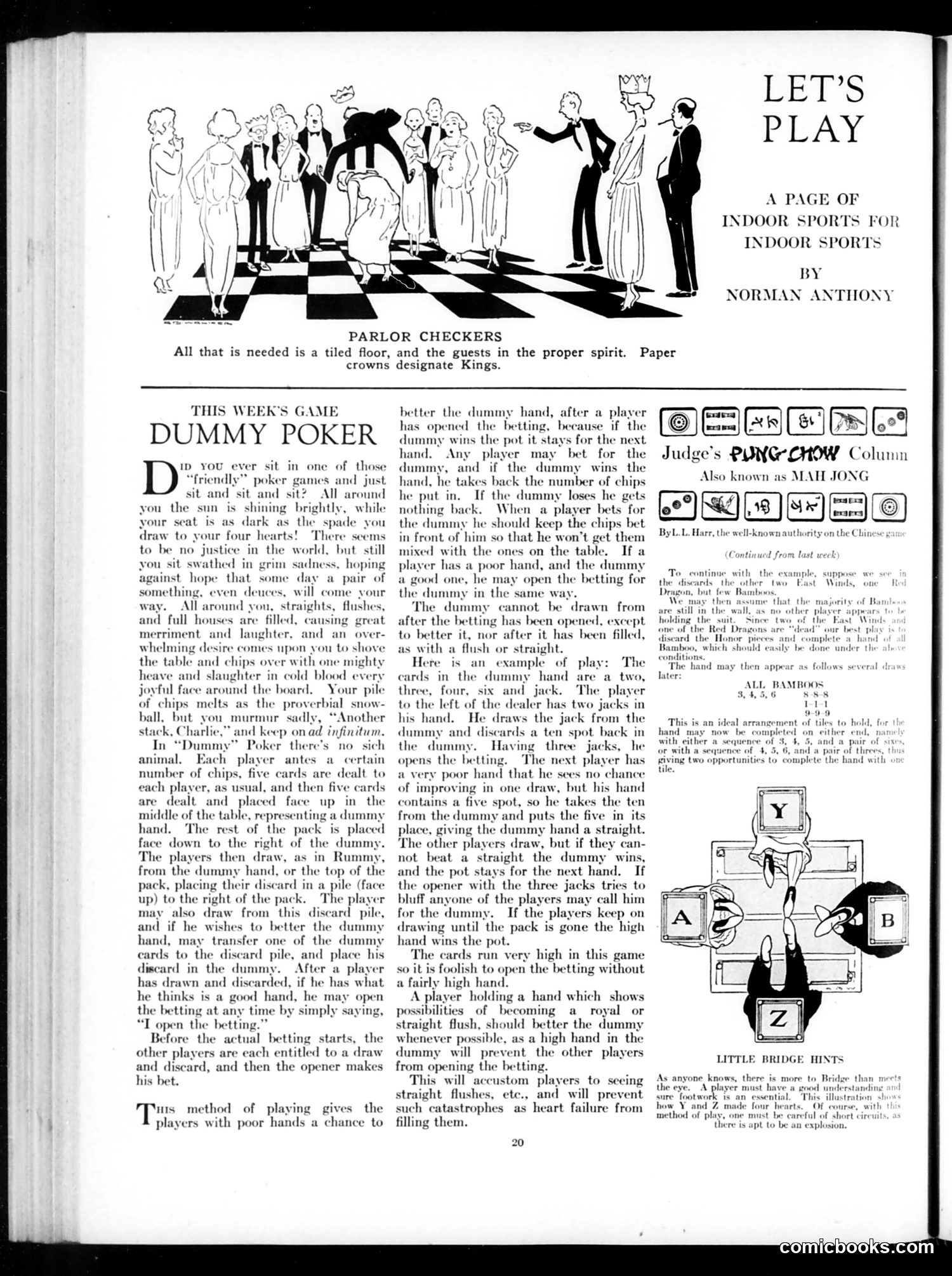
This page from Judge magazine presents entertainment content for readers, not political satire. It features two parlor games by Norman Anthony designed for indoor social gatherings: **"Parlor Checkers"** uses a tiled floor and human guests as living chess pieces, with paper crowns designating kings—a novelty game for hosts. **"Dummy Poker"** is the main feature, a poker variant designed to give players with poor hands better chances by introducing a communal "dummy" hand that can be manipulated during play. The article explains rules through extended narrative and examples. The illustration shows well-dressed guests in 1920s attire playing checkers on a checkered floor, capturing the lighthearted social atmosphere. This is entertainment journalism rather than commentary—typical of Judge's "leisure lifestyle" content alongside its satirical cartoons.
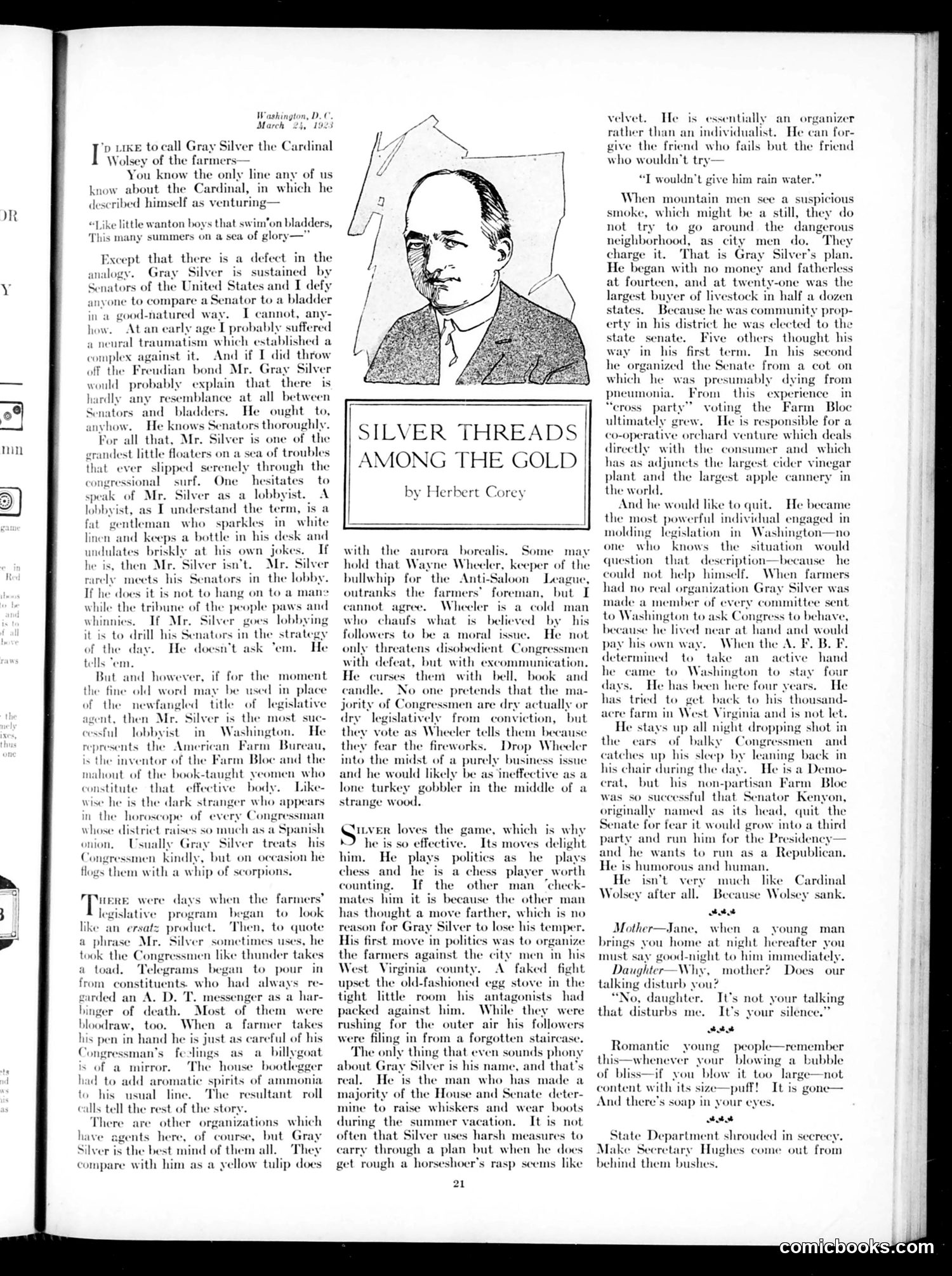
This article celebrates **Gray Silver**, the Farm Bureau's influential Washington lobbyist (the portrait shows him). The piece compares him to Cardinal Wolsey, praising his political effectiveness while gently mocking his methods. The satire targets Silver's power over Congressional farm-state representatives. The text describes him as inventor of the "Farm Bloc"—a coalition that pressures legislators through constituent mail campaigns ("Telegrams began to pour in"). Unlike Wayne Wheeler of the Anti-Saloon League, who appeals to moral conviction, Silver operates through pure political leverage and organization. The author contrasts Silver favorably with other lobbyists, but the underlying message is clear: Silver exemplifies how special interests control Congress through grassroots pressure and political calculation rather than principle. The "chess player" metaphor suggests calculated strategy over genuine legislative debate. This reflects 1920s Progressive-era anxieties about lobbying power and agricultural special interests shaping national policy.
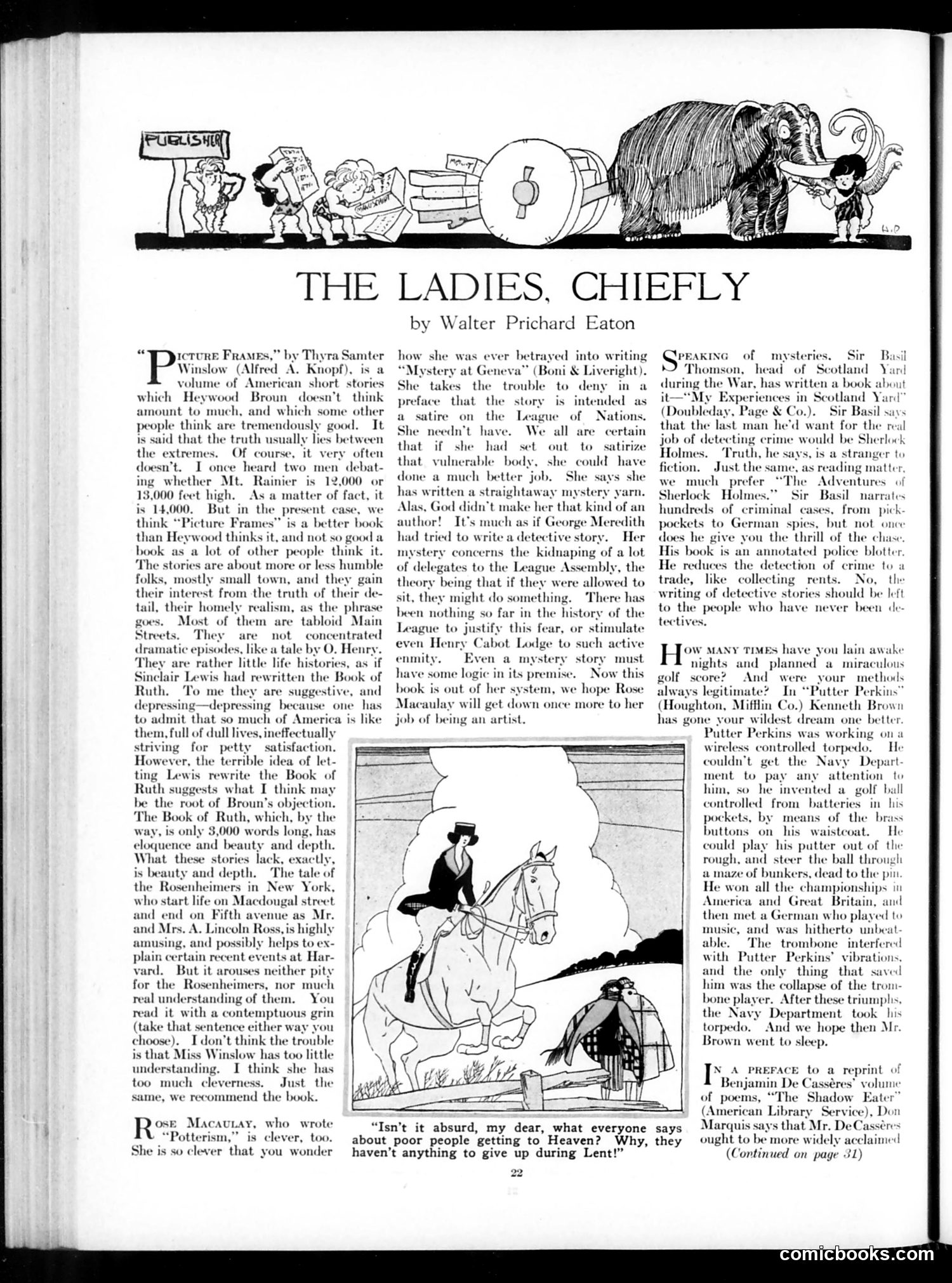
This page reviews literary works, primarily focusing on "Picture Frames" by Thyra Samter Winslow. The main cartoon depicts a woman on horseback, illustrating a humorous dialogue below it about the absurdity of poor people giving up things for Lent. The literary critique discusses Winslow's short story collection, comparing her work unfavorably to biblical depth (the Book of Ruth) while acknowledging her clever observations of American small-town life. The reviewer notes her mystery novel about kidnapped League of Nations delegates is unconvincing—a satirical jab at the League's ineffectiveness. The page also references Rose Macaulay's "Potterism" and Sir Basil Thomson's Scotland Yard memoir, critiquing detective fiction versus real crime-solving. The cartoon's joke critiques wealth inequality and religious hypocrisy: wealthy people wonder why poor people object to Heaven, when the poor have "nothing to give up during Lent" anyway—a biting comment on economic disparity and class assumptions about sacrifice.
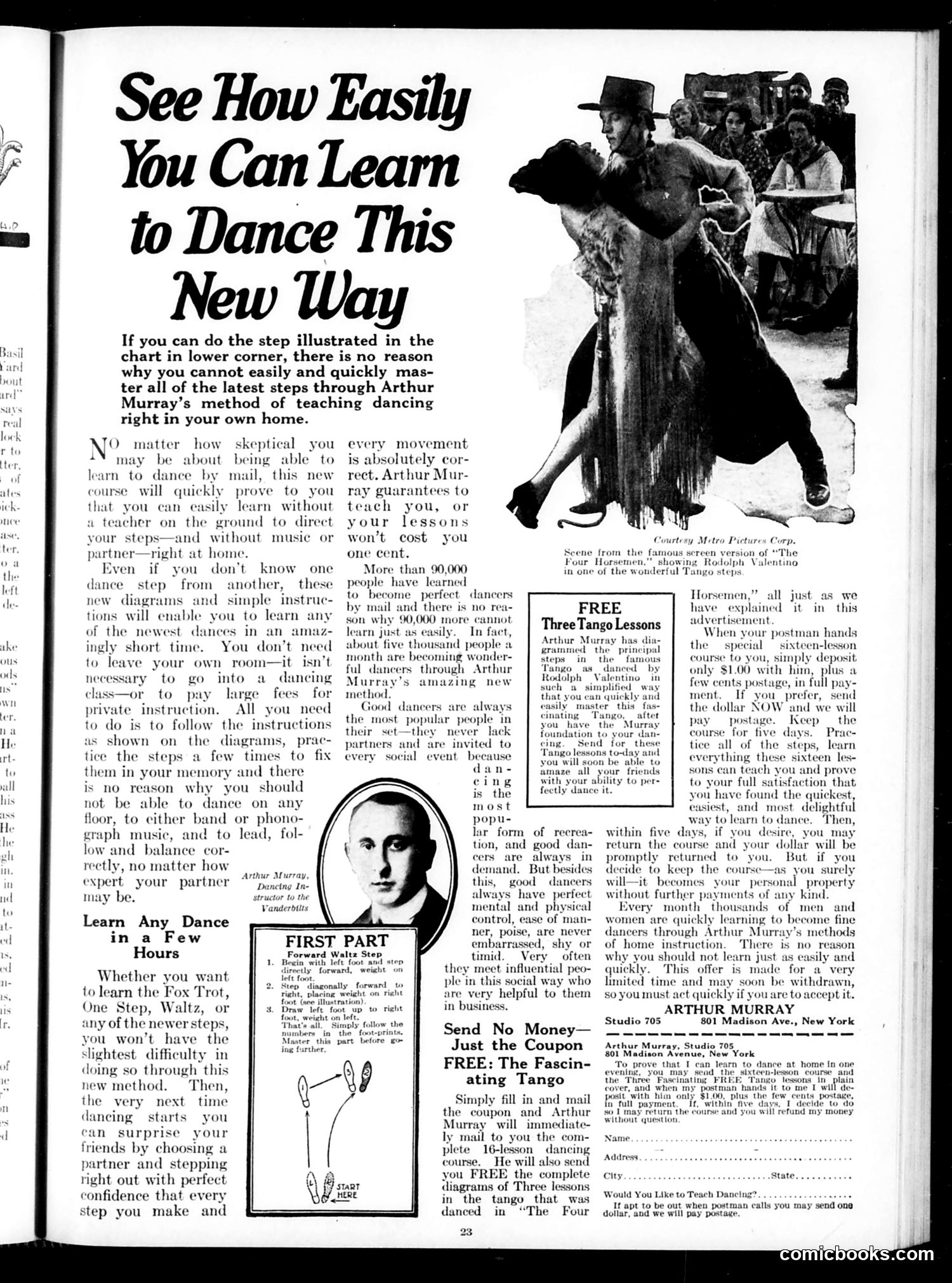
This page is primarily a **commercial advertisement** for Arthur Murray's mail-order dance instruction course, not a political cartoon or satire. The ad promotes learning popular ballroom dances (Fox Trot, Waltz, Tango) through mailed diagrams and instructions, without needing an in-person instructor. It emphasizes accessibility and affordability—costing only $1.00 plus postage, learnable at home without a partner or music. The ad features Arthur Murray himself (identified in the text as "Dancing Instructor to the Vanderbilts") and includes a photograph of what appears to be a dance scene, likely from a film adaptation of *The Four Horsemen* (referencing Rudolph Valentino's famous 1921 silent film). The appeal is straightforward: democratizing dance instruction for ordinary people by mail, presented as modern, convenient, and socially advantageous (implying dance partners lead to business connections). This reflects 1920s consumer culture and direct-mail marketing practices.
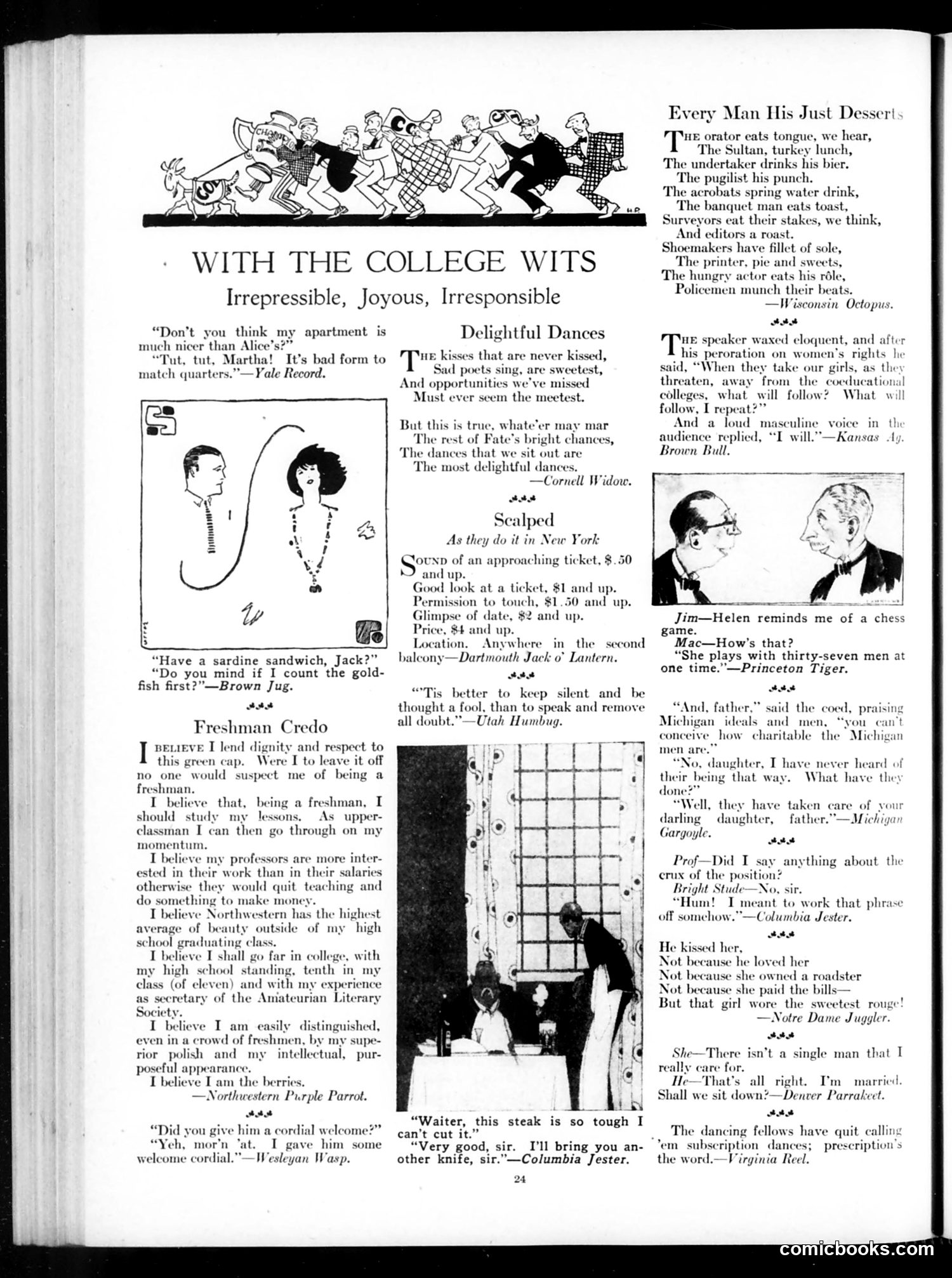
This page collects humorous anecdotes and jokes from college newspapers, mocking undergraduate pretension and social conventions of the era (appears to be 1920s). **Main content:** The "Freshman Credo" satirizes pompous first-year students who overestimate their sophistication—claiming superior intellect, appearance, and social standing while admitting to ranking tenth in a class of eleven. **Other jokes target:** - Competitive apartment-bragging among young people - Absurd dating economics ("permission to touch, 50 cents") - Fake intellectualism and misquotation - Coeducational college anxieties (women's rights speech) - Shallow romance (the "sweetest rouge" kiss) The header cartoon shows exaggerated, dancing college types in checkered patterns—emphasizing youthful chaos and frivolity. The satire's point: college students are comically self-deluded, pursuing shallow social status while pretending depth. The humor relies on recognizing genuine undergraduate behavior.
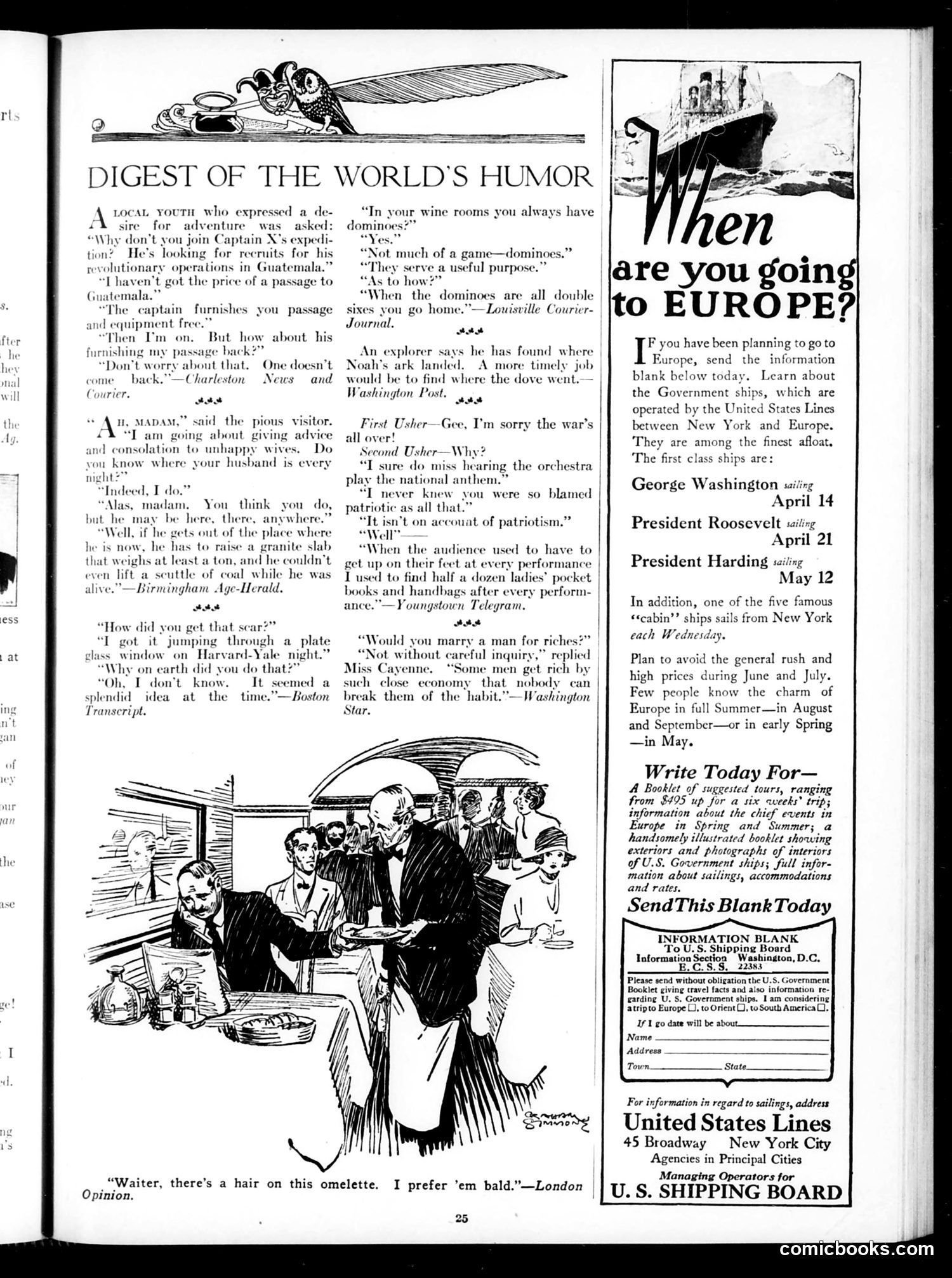
This page combines humor columns with a government shipping advertisement. The left side collects brief jokes from various American newspapers about marriage, adventure, and social mishaps—typical early 20th-century newspaper humor. The jokes mock unhappy marriages, foolish decisions (like jumping through Harvard windows), and domestic absurdities. The right side is an advertisement for U.S. government ships sailing to Europe, promoting travel on the *George Washington*, *President Roosevelt*, and *President Harding*. The ad urges readers to book passage to Europe, offering travel packages and suggesting off-season travel (May, August-September) to avoid crowds. **Historical context**: This appears post-WWI, given the ship names honoring recent presidents and the casual reference to "the war" in one joke. The government actively promoted transatlantic travel on American vessels during the 1920s-30s as part of economic policy. The juxtaposition of lighthearted domestic humor with patriotic shipping promotion is typical of *Judge* magazine's advertiser-supported format.
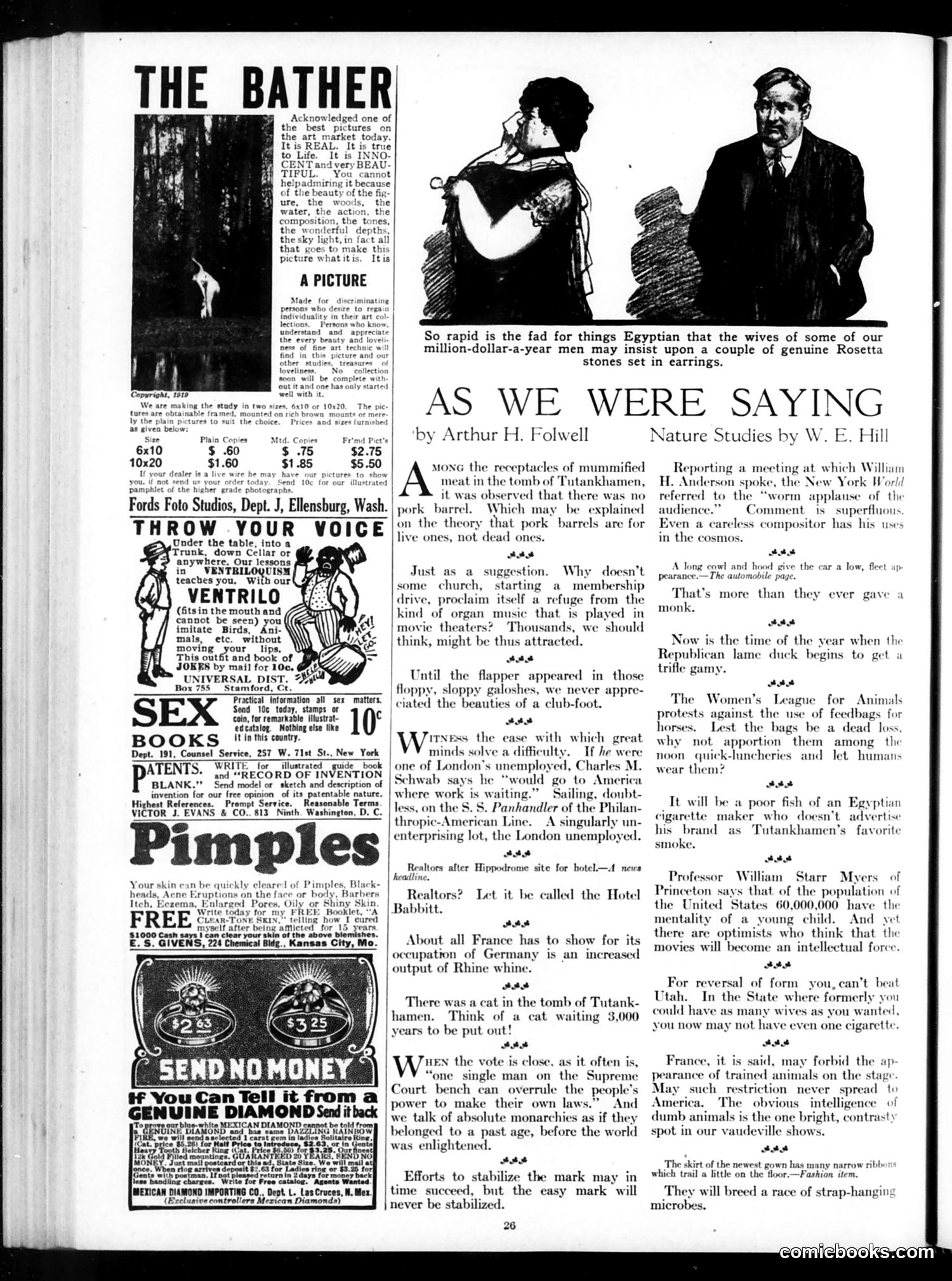
This is a satirical commentary page mixing short observations on current events with period advertisements. The main content, "As We Were Saying" by Arthur H. Folwell, offers brief, witty social critiques: **Key satirical points:** - **Tutankhamun references**: Multiple jokes about King Tut's recent tomb discovery (1922), mocking the Egyptian craze gripping wealthy Americans—wives wanting "genuine Rosetta stones" as earrings, absurdity of a cat waiting 3,000 years in the tomb. - **Charles Schwab quip**: Mocks the wealthy industrialist's claim he'd easily find work in America, suggesting the "London unemployed" are lazy. - **Supreme Court power**: Critiques how a single justice can overrule popular will, ironically comparing democracy to "absolute monarchies." - **Church membership drive**: Suggests churches could attract members by avoiding organ music. The page reflects 1920s concerns: wealth disparity, unemployment, judicial power, and cultural fads. The surrounding advertisements (ventriloquism lessons, pimple cures, diamond sales) are typical period mail-order offerings, contrasting lowbrow commerce with middlebrow satire.
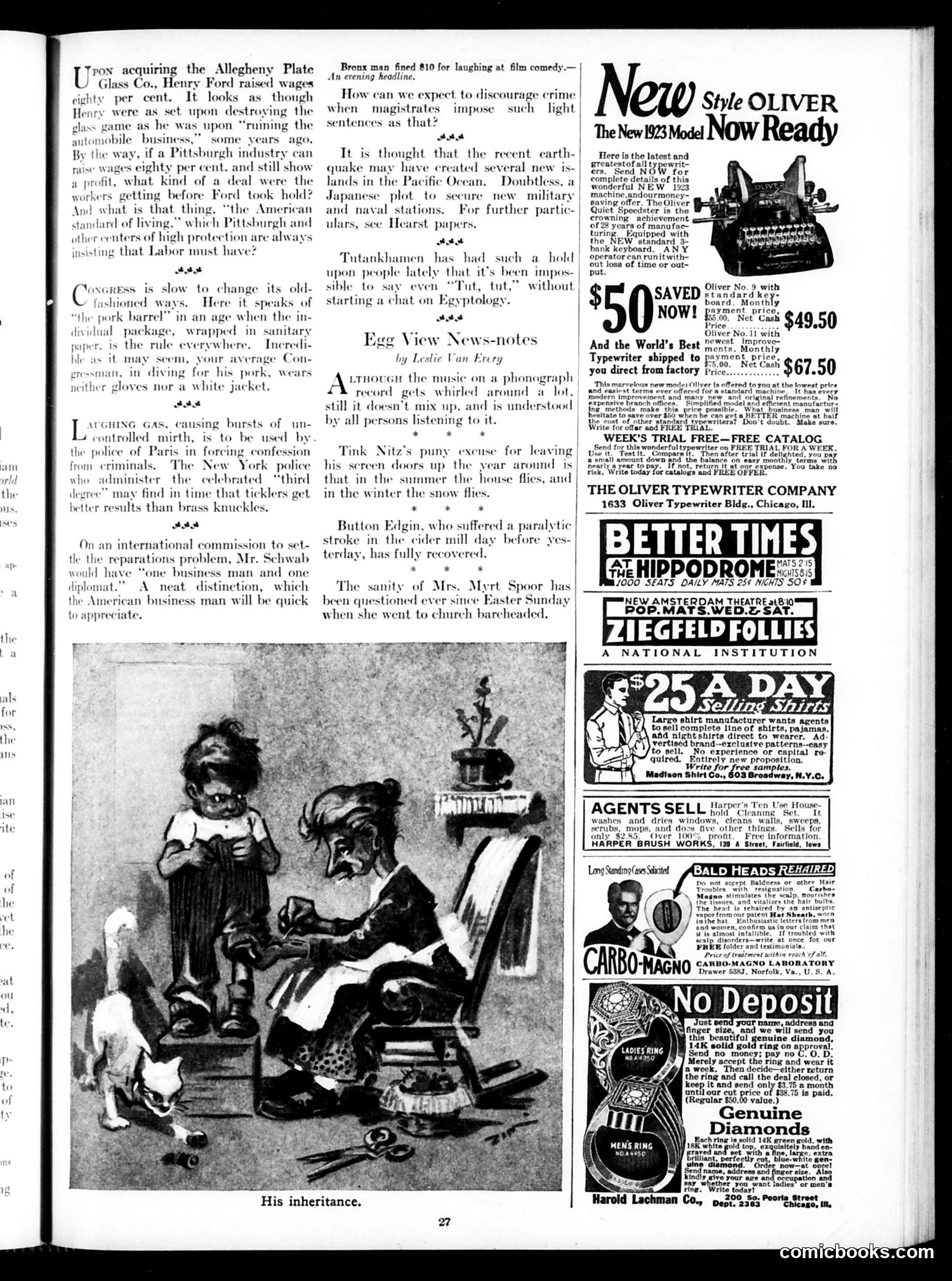
This page contains primarily **advertisements and humor columns** rather than political cartoons. The main illustration shows a humorous domestic scene labeled "His inheritance"—depicting a child inheriting an elderly relative's possessions, likely a joke about meager inheritances. The text includes satirical commentary on contemporary issues: Henry Ford's wage increases at glass companies (questioning labor standards), Paris police using laughing gas for confessions (mocking "modern" interrogation methods), and the recent Tutankhamen discovery's cultural obsession. The "Egg View News-notes" column contains light rural humor about phonograph records and screen doors. The page is dominated by period **advertisements**: Oliver typewriters, theatrical productions, a shirt sales opportunity, hair treatment products, and genuine diamonds with "no deposit" payment plans—typical early 1920s business pitches targeting readers seeking income or consumer goods during the post-WWI economic boom.
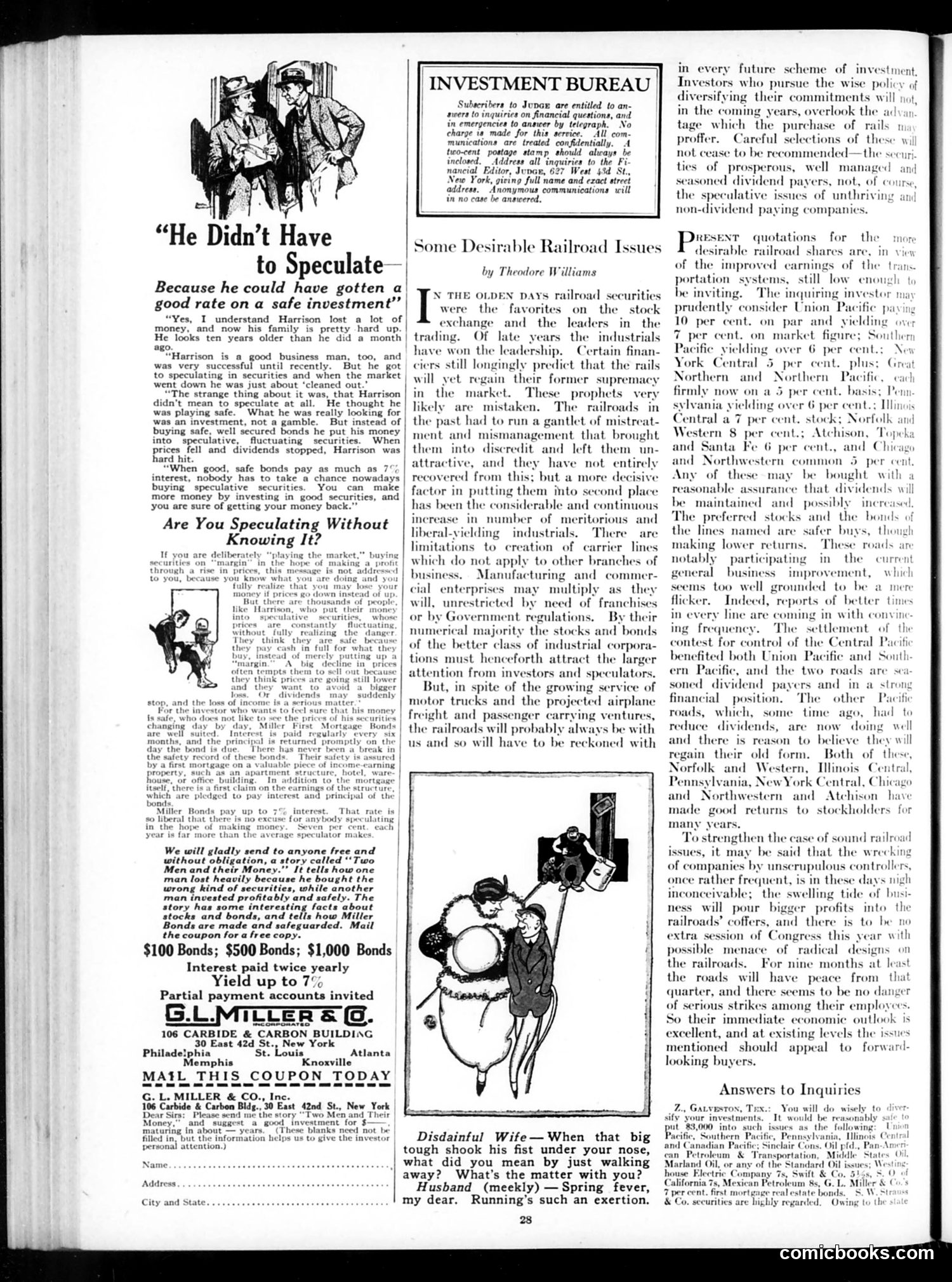
This page combines financial advice advertising with satirical commentary on investment behavior. The main narrative, "He Didn't Have to Speculate," tells of a man named Harrison who lost his fortune pursuing speculative securities rather than safe bonds—the satire being that he *thought* he was investing safely but wasn't. The cartoon illustrations show concerned men, emphasizing the anxiety such losses caused. The page is dominated by **G.L. Miller & Co. advertising**, promoting their bonds (yielding up to 7%) as the prudent alternative to risky stock speculation. The accompanying story "Two Men and Their Money" serves as persuasive testimonial advertising disguised as editorial content. Theodore Williams's article on "Desirable Railroad Issues" discusses how industrial stocks have outperformed traditional railroad securities, reflecting the economic shift from railroad dominance to manufacturing-era growth. The satire targets both foolish investors who mistake speculation for safety, and implicitly the financial institutions that profit from their confusion. This reflects broader Progressive-era skepticism about unregulated securities markets.
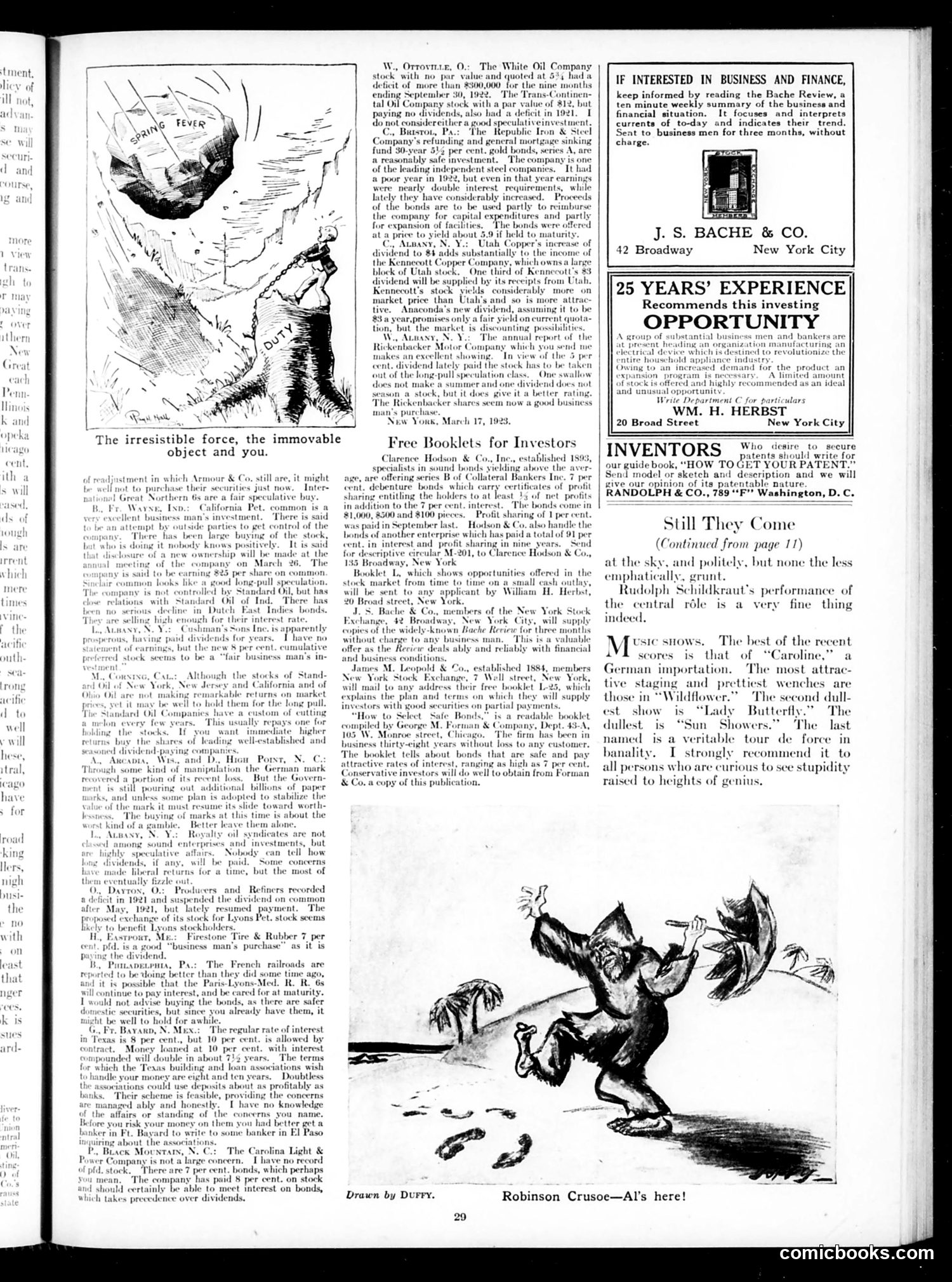
This cartoon depicts the classic paradox through personified economic forces. The "irresistible force" and "immovable object"—likely representing competing market or financial pressures of the post-WWI era—are shown colliding, with an ordinary person caught between them, labeled "you." Given the page's context (March 1923, filled with investment advice and stock tips), this appears to be satirizing the average investor's precarious position amid volatile financial markets. The accompanying financial column discusses risky securities, failed companies, and speculative ventures—suggesting that ordinary people investing in stocks face unpredictable, potentially destructive forces beyond their control. The satire warns readers that no matter how carefully one invests, external market forces create unavoidable risk.
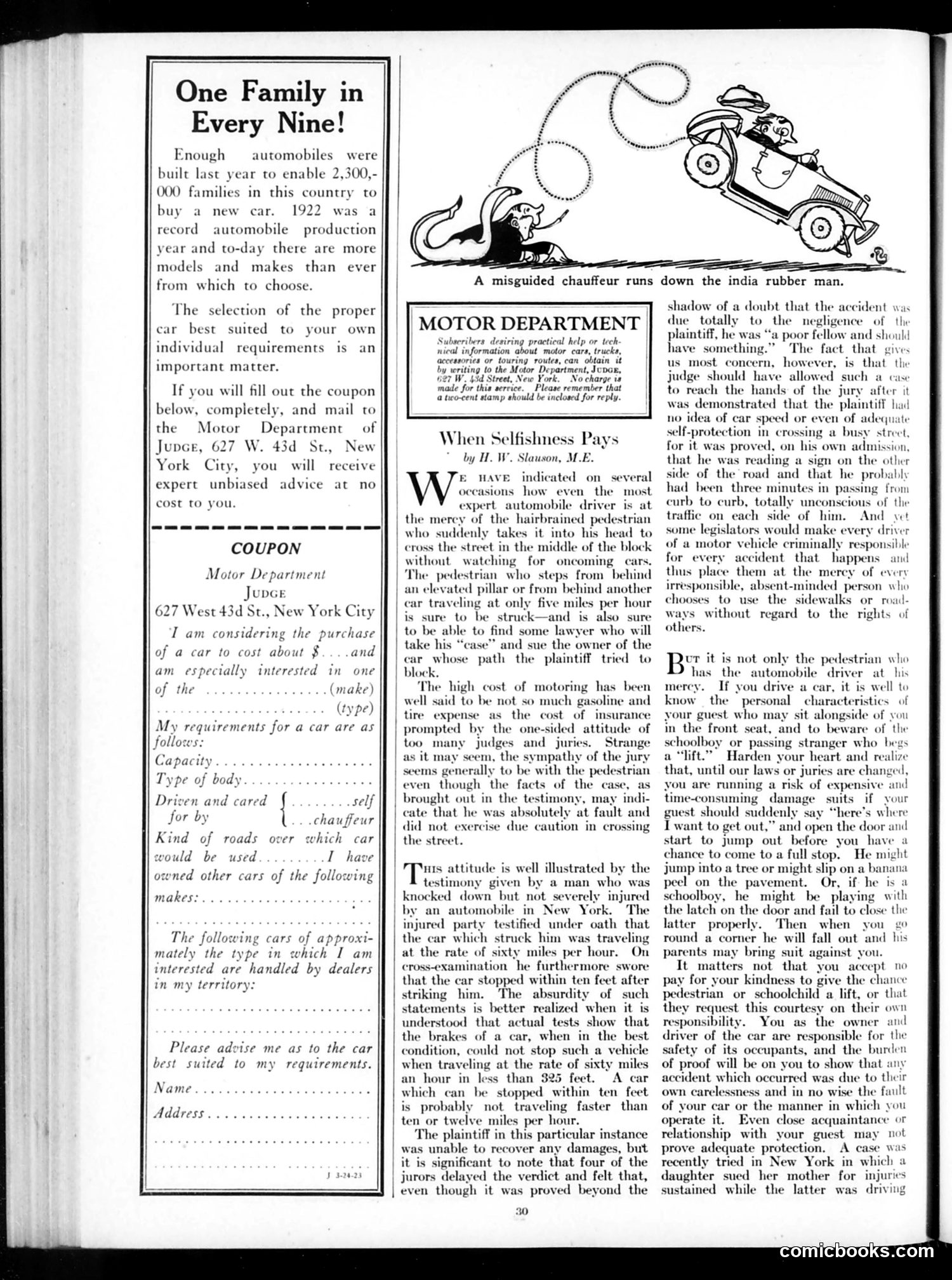
## The Cartoon The small illustration depicts a chauffeur (driver) in an early automobile striking a figure labeled "the india rubber man"—a satirical personification of pedestrians who, despite being hit by cars, seem to bounce back unharmed and ready to sue. The cartoon's title, "A misguided chauffeur," ironically blames the driver rather than the reckless pedestrian. ## The Article's Point H.W. Slauson's accompanying article, "When Selfishness Pays," argues that pedestrians bear responsibility for automobile accidents. He provides testimony from a hit-and-run victim claiming the car traveled at 60 mph yet stopped within 10 feet—physically impossible, exposing the pedestrian's dishonesty. ## The Satire The piece satirizes juries' sympathy for injured pedestrians regardless of evidence. Four jurors wanted to award damages to someone "a poor fellow" despite proven guilt, illustrating how emotional appeals trump facts. The "india rubber man" represents this phenomenon: careless pedestrians who cause accidents, escape injury, and exploit sympathetic courts.
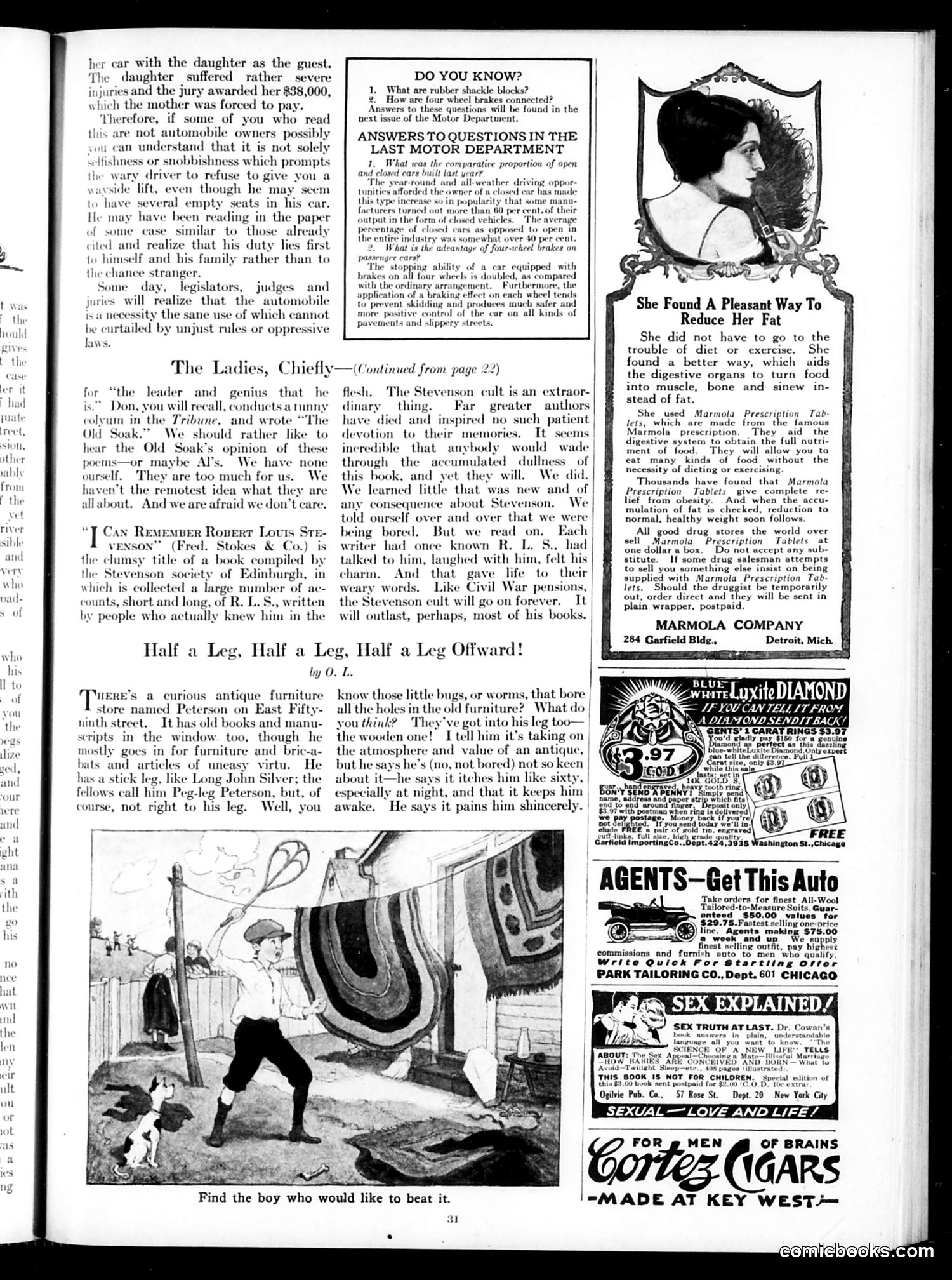
This page combines editorial commentary with advertisements typical of early 20th-century American magazines. **Main Content:** The top section discusses automobile liability and social responsibility—arguing that car owners' reluctance to give rides reflects legitimate legal concerns, not selfishness, after a jury awarded $38,000 damages to a passenger injured in an accident. This defends cautious driving behavior against moral judgment. **"The Ladies, Chiefly"** section reviews Robert Louis Stevenson literary criticism, praising Don Marquis's wit while critiquing a Stevenson biography as tediously dull despite its author's access to firsthand accounts. **The Cartoon:** "Half a Leg, Half a Leg Offward!" depicts furniture-boring insects (woodworms) in an antique Peterson furniture store. The visual pun plays on the Tennyson poem "Charge of the Light Brigade." **Advertisements** promote patent medicines (Marmola weight-loss tablets), jewelry, automobiles, and cigars—typical commercial content of the era. The page reflects early 1920s concerns: automobile safety litigation, literary taste, and consumer products marketed with health claims now considered dubious.
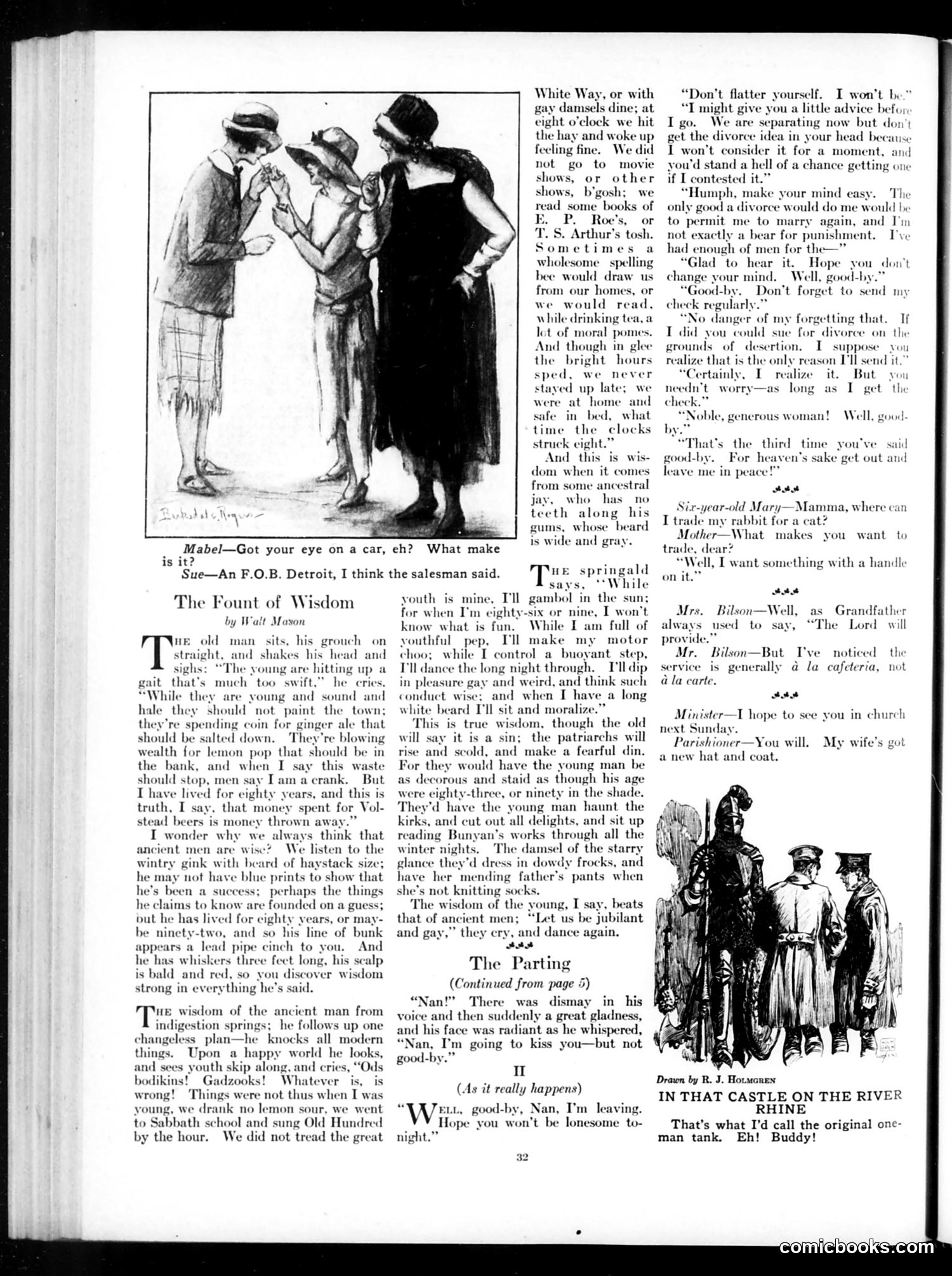
This page satirizes the clash between elderly moralists and youth during the 1920s. The main cartoon features an old man complaining that young people waste money on cars, movies, and pleasures instead of saving—he recalls his virtuous youth of Sabbath schools and moral reading. The satire attacks not elderly wisdom itself, but the *assumption* that age automatically confers wisdom. The poet notes the old man's credentials are hollow: he may have no real accomplishments, only longevity and a long beard. Meanwhile, the young respond that life is for living—dancing, driving, and enjoying "pleasure gay and weird"—not grim self-denial. This reflects 1920s generational anxiety: automobiles, cinema, and Jazz Age culture represented modernity that alarmed traditional America. The piece mocks both sides: sanctimonious elders *and* young people's dismissal of any restraint. The opening joke about "F.O.B. Detroit" references mass-produced cars disrupting society—a central concern of the era.
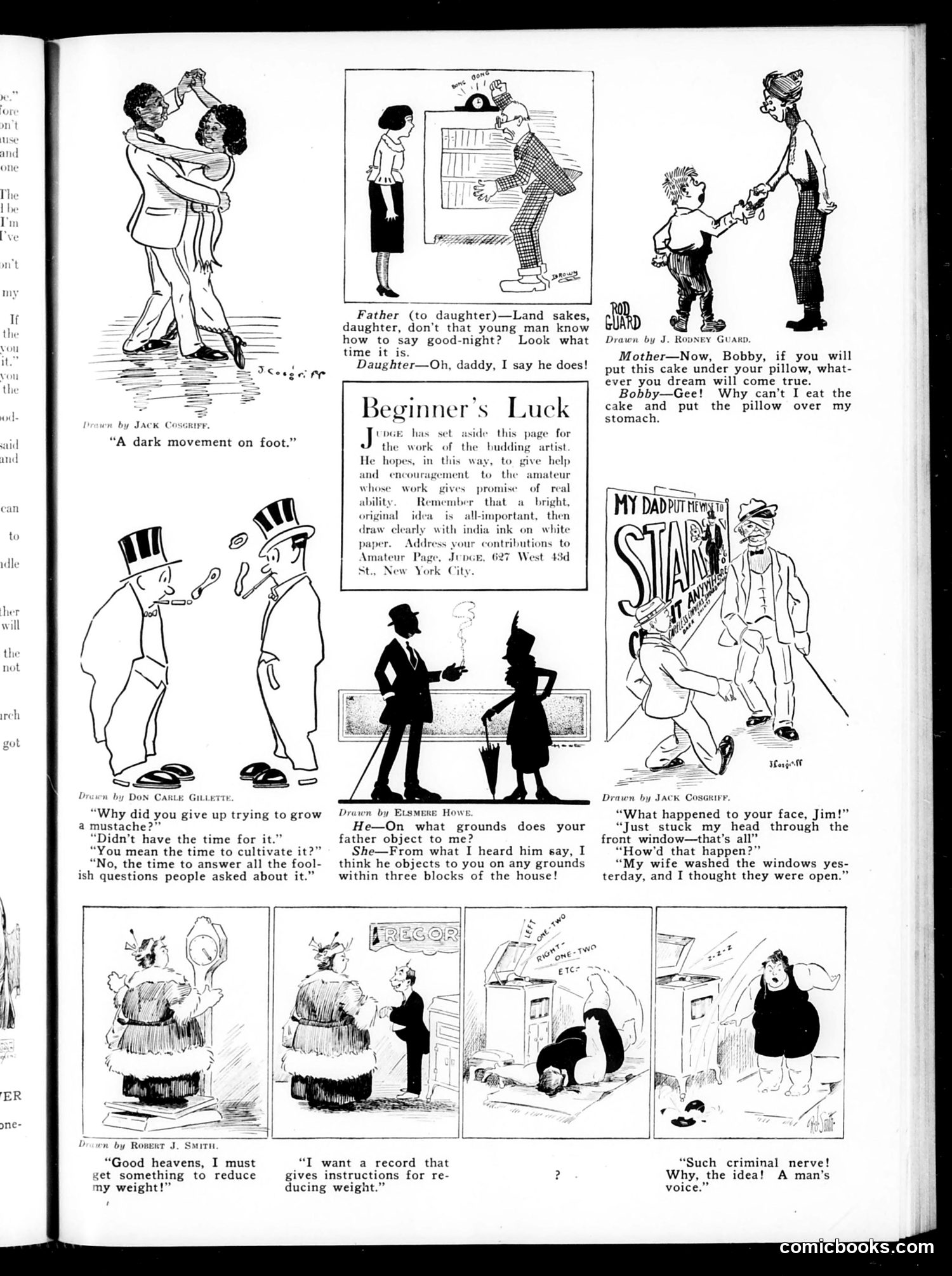
This page collects humor cartoons and jokes typical of early-20th-century American comedy. The cartoons satirize everyday social situations rather than politics: **Key content:** - "A dark movement on foot" mocks men's fashion anxiety about mustaches - A father-daughter scenario jokes about courting etiquette and prolonged goodbyes - "Beginner's Luck" announces a section for amateur artists - A courtship joke: a young man is unwelcome "within three blocks" of the girl's home - Bobby's cake-and-pillow joke mocks children's literal thinking - Jim's window mishap plays on domestic miscommunication - The weight-loss record joke satirizes vanity and gender assumptions—a woman is offended that a *man's voice* provides reducing instructions The humor targets courtship customs, domestic life, and emerging consumer products (phonograph records). These were relatable middle-class preoccupations of the era, not political commentary.
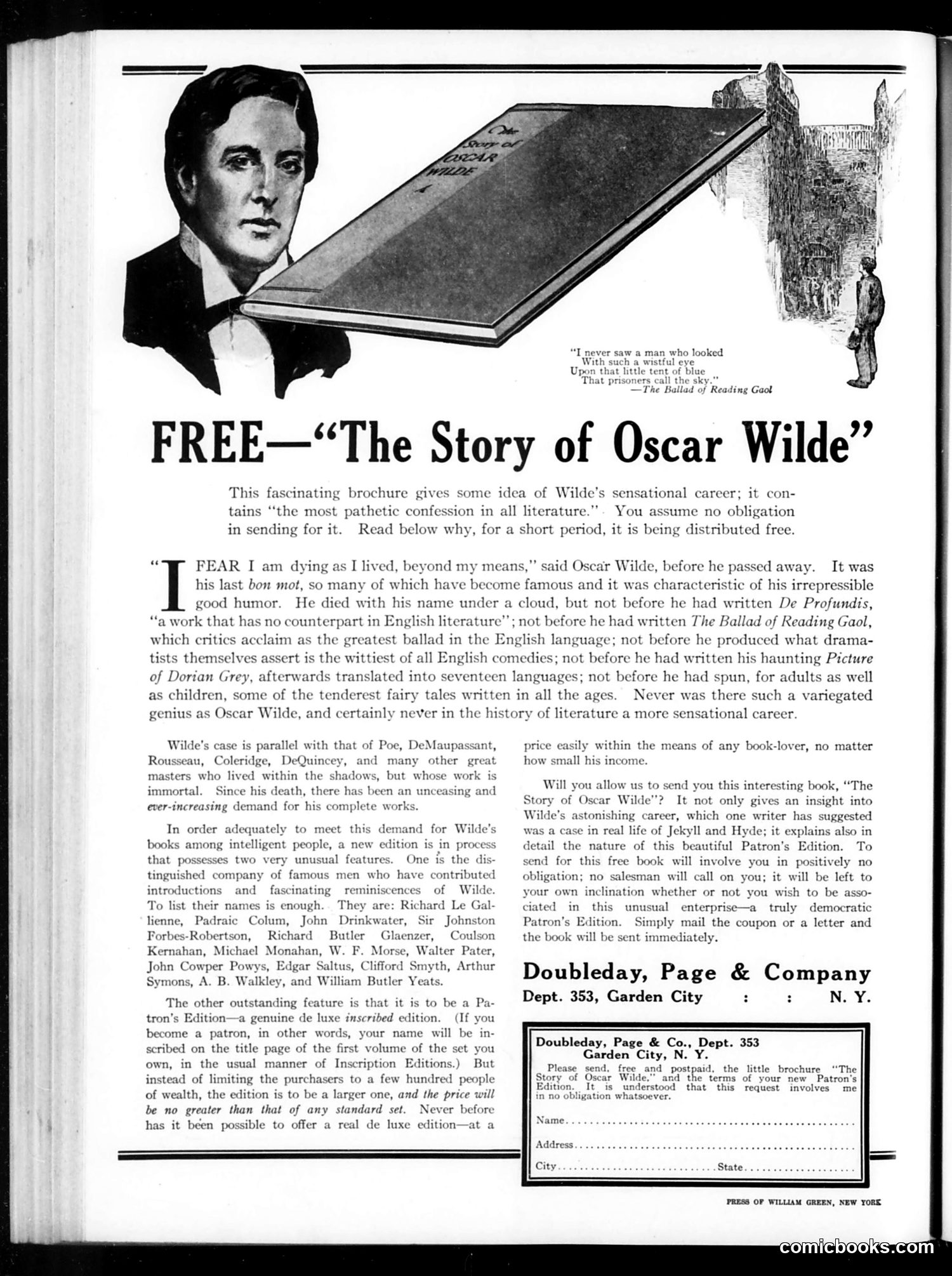
This is primarily a **book advertisement**, not political satire. Doubleday, Page & Company promotes a free brochure about Oscar Wilde's life and works. The page emphasizes Wilde's literary genius despite his personal disgrace—he died "under a cloud" (a reference to his 1895 imprisonment for homosexuality, though not explicitly stated). The text compares him to other celebrated but troubled figures: Poe, Baudelaire, Coleridge, and DeQuincey. The accompanying portrait shows Wilde; the small engraving appears to depict a prison scene, alluding to his Reading Gaol incarceration (referenced in his famous poem *The Ballad of Reading Gaol*, quoted at top). The advertisement highlights a deluxe "Patron's Edition" with introductions by famous literary figures (Yeats, Synge, etc.), positioning Wilde's rehabilitation as worthy of serious cultural attention. The satire is subtle: Judge, a humor magazine, legitimizes Wilde's legacy while acknowledging the scandal that defined his later life.