
Judge, 1923-03-24 · page 13 of 36
Judge — March 24, 1923 — page 13: what you’re looking at
What you’re looking at
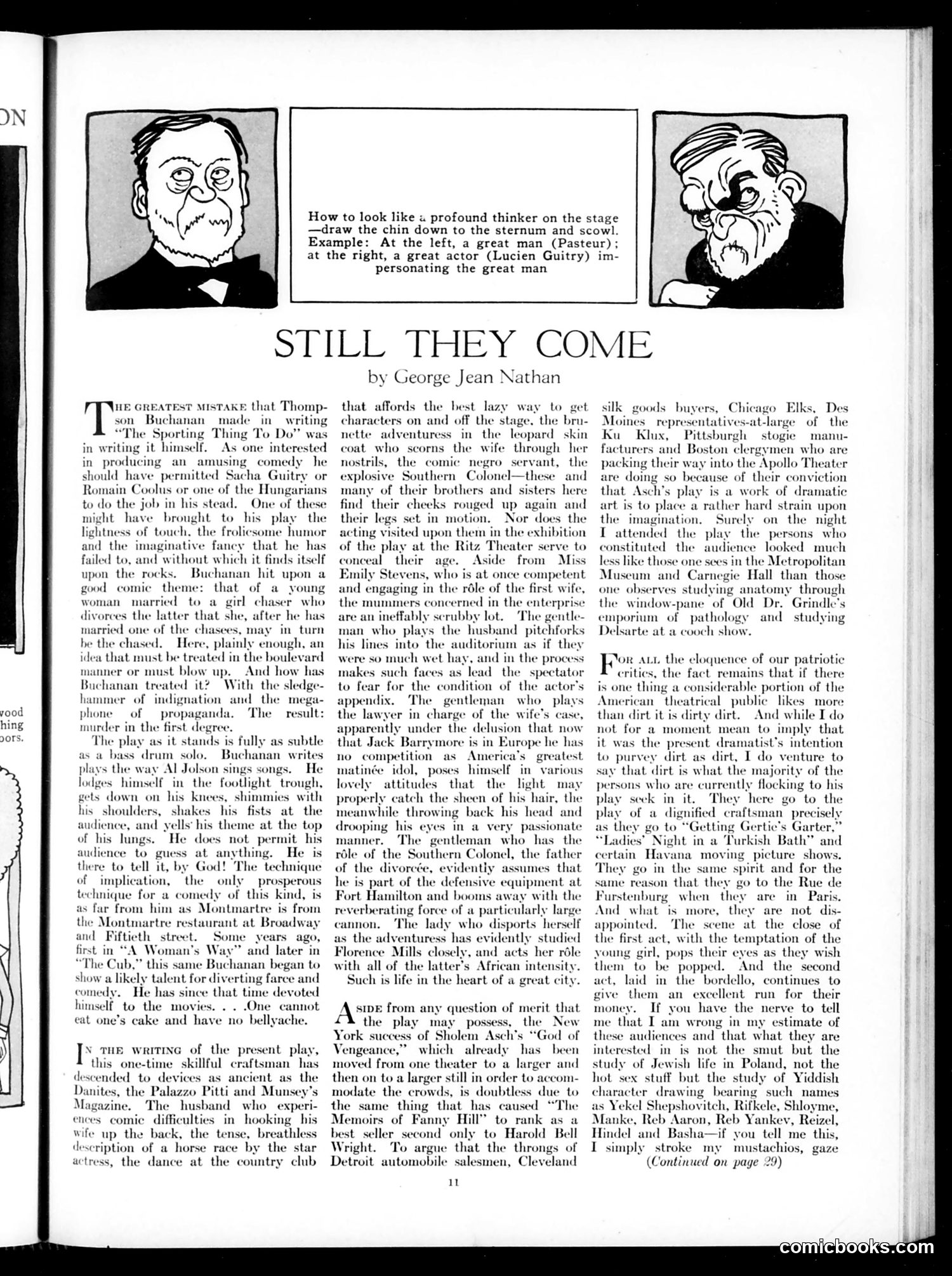
This page contains two elements: a **visual gag** about theatrical acting and a **theater review** by George Jean Nathan. The cartoon at top mocks how actors portray "profound thinkers" on stage—simply by drawing the chin down and scowling. It contrasts Louis Pasteur (the actual scientist, at left) with actor Lucien Guitry impersonating him, suggesting actors use exaggerated physical mannerisms rather than genuine intellect. The review below critiques playwright Thompson Buchanan's "The Sporting Thing To Do," performed at the Ritz Theater. Nathan argues Buchanan writes with a "sledgehammer" of obvious moralizing rather than the subtle technique required for good comedy. He derides the supporting cast as "scrubbily" performed—particularly criticizing the male leads for overacting: one delivers lines "like wet hay" while another imitates Jack Barrymore's theatrical posing. Nathan implies these actors, lacking real talent, resort to empty physical theatricality. The satire targets both playwright and performers for substituting bombastic delivery and clichéd stage business for genuine craft.
📄 Transcribed text from this page (OCR, searchable)
Machine-transcribed from the original scan — historical spelling and the odd misread are preserved.
How to look like « profound thinker on the stage —draw the chin down to the sternum and scowl. Example: At the left, a great man (Pasteur); at the right, a great actor (Lucien Guitry) im- personating the great man STILL THEY COME iE GREATES? MISTAKE that Thomp- son Buchanan made in writing “The Sporting Thing To Do” was in writing it himself. As one interested in producing an amusing comedy he should have permitted Sacha Guitry or Romain Coolus or one of the Hungarians to do the job in his stead. One of these might have brought to his play the lightness of touch, the frolicsome humor and the imaginative fancy that he has failed to, and without which it finds itself upon the rocks. Buchanan hit upon a good comic theme: a young woman miu er who divorces the he has married one y in turn he the chased. ly enough, an idea that must be treated in the boulevard manner or must blow up. And how has Buchanan treated it? With the sledge- hammer of indignation and the mega- phone of propaganda. The result: murder in the first degree. The play as it stands is full as a bass drum so! Bucl plays the way Al Jolson sings songs. lodges himself in the footlight trough, gets down on his knees, shimmies with his shoulders, shakes his fists at the audience, and yells his theme at the top of his lungs. “He does not permit his audience to guess at anything. He is there to tell it, by God! The technique of implication, ‘the only — prosperous technique for a comedy of this kind, is as far from him as Montmartre is from the Montmartre restaurant at Broadway and Fiftieth street. Some years ago, first in “A Woman's Way” and |: i “The Cub,” this same Buch: show a likely talent for diverting farce and He has since that time devoted to the movies... .One cannot eat one’s cake and have no bellyache. I THE WRITING of the present play, this one-time skillful craftsman has ces as ancient as the zzo Pitti and Munsey’s descended to. de Danites, the Pa Magazine. The husband who experi- ences comic difficulties in hooking his wife up the back, the tense, breathless description of a horse ra the star actress, the dance at the country club by George Jean Nathan affords the best laz y to. get ‘ters on and off the s . the bru- adventuress in the leopard skin coat who scorns the wife through her nostrils, the comic negro servant, the »xplosive Southern Colonel—these and many of their brothers and sisters here find their cheeks rouged up again and their legs set in motion. Nor does the acting visited upon them in the exhibition of the play at the Ritz Theater serve to conceal their age. Aside from Miss Emily Stevens, who is at once competent and engaging in the réle of the first wife, the mummers concerned in the enterprise are an ineffably serubby lot. The gent man who plays the husband pitchforks his lines into the auditorium as if they were so much wet hay, and in the process makes such faces as lead the spectator to fear for the condition of the actor's appendix. ‘The gentleman who plays the lawyer in charge of the wife’s case, apparently under the delusion that now that Jack Barrymore is in Europe he has no competition as America’s greatest matinée idol, poses himself in’ various lovely attitudes that the light) may properly catch the sheen of his hair, the meanwhile throwing back his head and drooping his eyes in a very passionate manner. ‘The gentleman who has the role of the Southern Colonel, the father of the divorcée, evidently assumes that he is part of the defensive equipment at milton and booms y with the verberating force of a par annon. The lady who disports herself as the adventures has evidently stuc Florence Mills closely, and acts her réle with all of the latter’s African intensity. Such is life in the heart of a great city. sive from any question of merit that the . the New h’s “God of has been er and com- Vengeanc i moved from one theater to a | then on to a larger still in order t modate the crowds, is doubtless due to the same thing that has caused “The Memoirs of Fanny Hill” to rank as a best seller second only to Harold Bell Wright. To argue that the thro f Detroit automobile salesmen, Cle 1 silk goods buyers, Elks, Des Moines representative: » of the Ku Klux, Pittsburgh je manu- facturers and Boston clergymen who are packing their way into the Apollo Theater are doing so because of their conviction that Asch’s play is a work of dramatic art is to place a rather hard strain upon the imagination. Surely on the night I attended the play the persons who constituted the audience looked much less like those one sees in the Metropolitan Museum and Carnegie Hall than those one observes studying anatomy through the window-pane of Old Dr. Grindle’s emporium of pathology and studying Delsarte at a cooch show. Fre ALL the eloquence of our patriotic the fact remains that if there is one thing a considerable portion of the American theatrical. public likes) more than dirt it is dirty dirt. And while I do not for a moment mean to imply that it was the present dramatist’s intention to purvey dirt as dirt, I do venture to say that dirt is what the majority of the persons who are currently flocking to his play seek in it. They her to the play of a dignified craftsman’ precise! s they go to “Getting Gertie’s Garter, i zht in a ‘Turkish Bath” and ana moving picture shows. - go in the same spirit and for the same reason that they go to the Rue de Furstenburg when they are in’ Paris. And what is more, the e not dis- appointed. ‘The scene at the close of the first act, with the temptation of the young girl, pops their eyes as they wish them to be popped. ‘And the second act, laid in the bordello, continues to give them an excellent: run for their money. If you have the nerve to tell me that I am wrong in my estimate of these audiences and that what they are interested in is not the smut but the study of Jewish life in Poland, not the hot sex stuff but the study of Yiddish character drawing bearing such names as Yekel Shepshovitch, Rifkele, Shloyme, Manke, Reb Aaron, Reb Yankev, Reizel, Hindel and Basha—if you tell me this, I simply stroke my mustachios, g (Continued on page 29)