
Judge, 1923-03-24 · page 24 of 36
Judge — March 24, 1923 — page 24: what you’re looking at
What you’re looking at
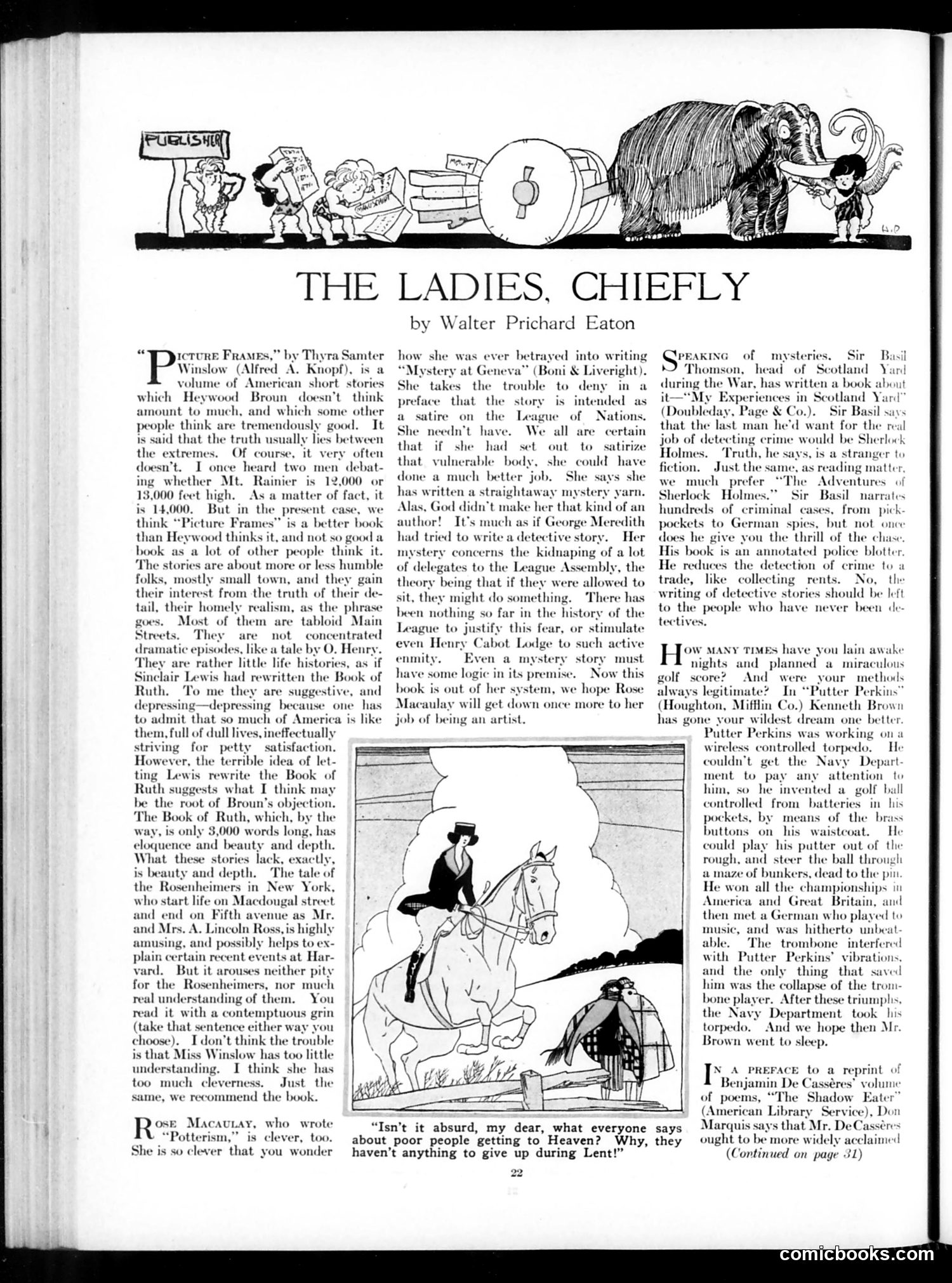
This page reviews literary works, primarily focusing on "Picture Frames" by Thyra Samter Winslow. The main cartoon depicts a woman on horseback, illustrating a humorous dialogue below it about the absurdity of poor people giving up things for Lent. The literary critique discusses Winslow's short story collection, comparing her work unfavorably to biblical depth (the Book of Ruth) while acknowledging her clever observations of American small-town life. The reviewer notes her mystery novel about kidnapped League of Nations delegates is unconvincing—a satirical jab at the League's ineffectiveness. The page also references Rose Macaulay's "Potterism" and Sir Basil Thomson's Scotland Yard memoir, critiquing detective fiction versus real crime-solving. The cartoon's joke critiques wealth inequality and religious hypocrisy: wealthy people wonder why poor people object to Heaven, when the poor have "nothing to give up during Lent" anyway—a biting comment on economic disparity and class assumptions about sacrifice.
📄 Transcribed text from this page (OCR, searchable)
Machine-transcribed from the original scan — historical spelling and the odd misread are preserved.
THE LADIES, CHIEFLY bes ICTURE Frames,” by Thyra Samter Pints (Alfred A. Knopf), is a volume of American short stories which Heywood Broun doesn’t think amount to much, and which some other people think are tremendously good. It is said that the truth usually lies between the extremes. Of course, it very often doesn’t. I once heard two men debat- ing whether Mt. Rainier is 00° or 13,000 feet high. As a matter of fact, it is 14,000, But in the present case, we think “Picture Frames” is a better book Heywood thinks it, and not so good a a lot of other people think it. are about more or less humble folks, mostly small town, and they gain their interest from the truth of their de- tail, their homely realism, as the phrase goes. Most of them are tabloid Main Streets. They are not concentrated dramatic episodes, like a tale by O. Henry. They are rather little life histories, as if Sinclair Lewis had rewritten the Book of Ruth. To me they are suggestive, and depressing—depressing because one has to admit that so much of America is like them, full of dull lives, ineffectually striving for petty isfaction. However, the terrible idea of let- ting Lewis rewrite the Book of Ruth suggests what I think may be the root of Broun’s objection. The Book of Ruth, which, by the way, is only 3,000 words long, has eloquence and beauty and dept What tk stories lack, exactl is beauty and depth. ‘The tale the Rosenheimers in New York, who start life on Macdougal street and end on Fifth avenue as Mr. and Mrs. A. Lincoln Ross, is high! amusing, and possibly helps to ex- plain certain recent events at Har- vard. But it arouses neither pity for the Rosenheimers, nor much real understanding of them. You read it with a contemptuous grin (take that sentence either way you choose). I don’t think the trouble is that Miss Winslow has too little understanding. I think she has too much cleverness. Just the by Walter Prichard Eaton how she was ever betrayed into writing at eva” (Boni & Liveright). s takes the trouble to deny in a preface that the story is intended as a satire on the League of Nations. She n n't have. We all ai i that if she had out to that vulnerable body, she could hav She says she set done a much better job. has written a straightaway mystery yarn. Alas, God didn’t make her t kind of an thor! It's much as if George Meredith had tried to write a detective story. Her mystery concerns the kidnaping of a lot of delegates to the League Assembly, the theory being that if they were allowed to sit, they might do something. ‘There has been nothing so far in the history of the League to justify this fear, or stimulate even Henry > to such active ity. E story must have some log Now this book is out of her system, we hope Rose Macaulay will get down once more to her job of being an artist. vot Lodg a mystery n its premise. same, we recommend the book. Y, who wrote R= Macau “Potterism,” is clever, too. She is so clever that you wonder “Isn't it absurd, my dear, what everyone says about poor people getting to Heaven? haven’t anything to give up during Lent!” Why, they PEAKING of — mysteric Sir Basil J Thomson, head of Scotland Yard during the War, has written a book about it—My Experiences in Scotland Yard (Doubleday, Page & Co.). Sir Basil says that the last man he'd want for the real job of detecting crime would be Sherlock Holmes. ‘Truth, he says, is a st fiction. Just the sam iding 1 we much prefer “The Adventures of Sherlock Holmes. Sir Basil narrates hundreds of criminal cases, from. pick- pockets to German spies, but not onc does he give you the thrill of the chas His book is an annotated police blotter He reduces the detection of crime to a trade, like collecting rents. No, the writing of detective stories should be left to the people who have never been de- tectives. OW MANY TIMES have you lain awake ights and planned a miraculous were your methods In “Putter Perkins” Mifflin Co.) Kenneth Brown your wildest dream one better Putter Perkins was working on a wireless controlled torpedo. He couldn't get the Navy Depart- ment to pay any attention t him, so he invented a golf ball controlled from batteries in his pockets, by means of the brass buttons on his waistcoat. He could play his putter out of the rough, and steer the through amaze of bunkers. » the pin He won all the championships in America and Britain, and then met a German who played to music, and was hitherto unbeat able. The trombone interfered with Putter Perkins’ vibrations. and the only thing that saved im was the collapse of the trom- r. After these triumphs, » Navy Department took his torpedo. And we hope then Mr. Brown went to sleep. I A PREFACE to a reprint of Be enjamin De Casséres’ volunic of poems, “The Shadow . (American Library. Servi Marquis says that Mr. DeC ought to be more wic 7 (Continued on page 31)