
Judge, 1923-03-24 · page 32 of 36
Judge — March 24, 1923 — page 32: what you’re looking at
What you’re looking at
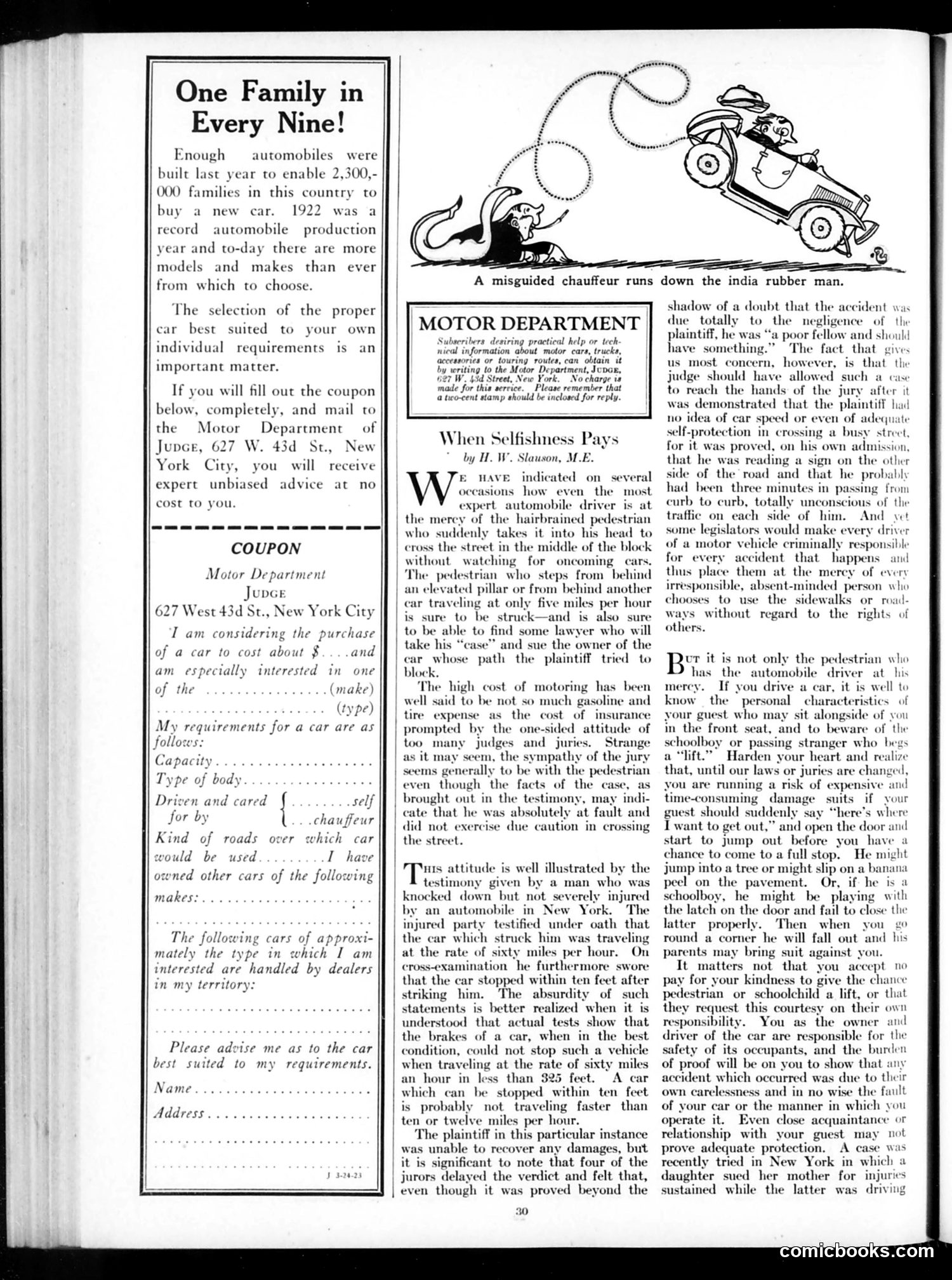
## The Cartoon The small illustration depicts a chauffeur (driver) in an early automobile striking a figure labeled "the india rubber man"—a satirical personification of pedestrians who, despite being hit by cars, seem to bounce back unharmed and ready to sue. The cartoon's title, "A misguided chauffeur," ironically blames the driver rather than the reckless pedestrian. ## The Article's Point H.W. Slauson's accompanying article, "When Selfishness Pays," argues that pedestrians bear responsibility for automobile accidents. He provides testimony from a hit-and-run victim claiming the car traveled at 60 mph yet stopped within 10 feet—physically impossible, exposing the pedestrian's dishonesty. ## The Satire The piece satirizes juries' sympathy for injured pedestrians regardless of evidence. Four jurors wanted to award damages to someone "a poor fellow" despite proven guilt, illustrating how emotional appeals trump facts. The "india rubber man" represents this phenomenon: careless pedestrians who cause accidents, escape injury, and exploit sympathetic courts.
📄 Transcribed text from this page (OCR, searchable)
Machine-transcribed from the original scan — historical spelling and the odd misread are preserved.
One Family in Every Nine! Enough automobiles were built last year to enable 2,300,- 000 families in this country to buy a 1922 record production new car. was a automobile year and to-day there are more models and than from which to choose. The of the car best suited to your own individual i important matter. makes ever selection proper requirements is an If you will fill out the coupon below, completely, and mail to the Motor Department — of Jupce, 627 W. 43d St, New York City, will receive expert unbiased advice at no cost to you. you COUPON Motor De partment JupceE 627 West 43d St., New York City I am considering the purchase of a car to cost about $ and am especially interested in one (make) (type) of the My requirements for a car are as follows: Capacity Type of bods for by chauffeur Kind of roads over which car would be used I have owned other cars of the following makes: The following cars of approxi- mately the type in which I am interested are handled by dealers in my territory: e me as to the car my requirements. Please ad: best suited to Name Address... | an elevated pills tire | A misguided chauffeur runs down the india rubber man. MOTOR DEPARTMENT Subscribers desiring practical help or tech: nical information about motor cars, trucks, ‘accessories or touring routes, can obtain it by writing to the Motor Department, Jvvae, 027 W, 43d Street, New York. No charge i made for thia sercice. Please remember that @ tico-cent stamp should be inclosed for reply. When Selfishness Pay by H.W. Slauson, M.E. HAVE indicated on several asions how even the most xpert automobile driver is at the merey of the hairbrained pedestrian who suddenly kes it into his head to cross the street in the middle of the block without watching for oncoming cars. The pedestrian who steps from behind or from behind another car traveling at only five miles per hour is sure to be struck—and is also sure to be able to find some lawyer who will take his “case” and sue the owner of the car whose path the plaintiff tried to block. The high cost of motoring has been well said to be not so much gasoline and expense as the cost of insurance prompted by the one 1 attitude of too many jud 1 juries. St as it ms ympathy of the seems generally to be with the pedestr even though the facts of the case, | brought out in the testimony, may ind ate that he was absolutely at fault and did not exercise due caution in crossing the stre is well illustrated by the | Toss attitud testimony given by a man who was injured The knocked down but not severe by an automobile in New York. | injured party testified under oath that the car which struck him was traveling at the rate of sixty miles per hour. On cross-examination he furthermore swore at the car stopped within ten feet after ig him. The absurdity of such statements is better realized when it is | understood that actual tests show that | the brakes of a . when in the best condition, could not stop such a vehicle when traveling at the rate of sixty miles an hour in less than $25 feet. A car which can be stopped within ten feet is probably not traveling faster than ten or twelve miles per hour. he plaintiff in this particular instance unable to recover any damages, but it is significant to note that four of the jurors delayed the verdict and felt that, even though it was proved beyond the 20 shadow of a doubt that the accident was due totally to the negligence of th: plaintiff, he was “a poor fellow and should have something.” The fact that gives us most concern, however, is that the judge should have allowed such a cas to reach the hands of the jury after it was demonstrated that the plaintiff had no idea of car speed or even of adequ self-protection in crossing a busy street, for it was proved, on his own admission, that he was reading a sign on the other side of the road and that he probably had been three minutes in passing from of a motor vehicle criminally for every accident that happens and thus place them at the merey of every irresponsible, absent-minded person who chooses to use the sidewalks or road- ways without regard to the rights of others. vr it is not only the pedestrian who has the automobile dri mercy. If you drive i know the personal your guest who may sit alongside of you in the front seat, and to beware of the schoolboy or passing stranger who be “lift.” Harden your heart and that, until our laws or juries are changed, uu are running a risk of expensive and time-consuming damage suits if your guest should suddenly say “here’s where I want to get out,” and open the door and start to jump out before you have chance to come to a full stop. He n jump into a tree or might slip on a banana peel on the pavement. Or, if he is a schoolboy, he might be playing with the latch on the door and fail to close the latter properly. Then when you go round a corner he will fall out and his parents may bring suit against you. It matters not that you accept no pay for your kindness to give the chance pedestrian or schoolchild a lift, or that they request this courtesy on their own responsibility. You as the owner driver of the car are responsible for the safety of its occupants, and the burden of proof will be on you to show that any accident which occ Jue to their own carelessne: the fault of your car or the manner in which you operate it. Even close acquaintance or relationship with your guest may not prove adequate protection. A case was recently tried in New York in which daughter sued her mother for injuries sustained while the latter was driving