
Judge, 1923-03-24 · page 17 of 36
Judge — March 24, 1923 — page 17: what you’re looking at
What you’re looking at
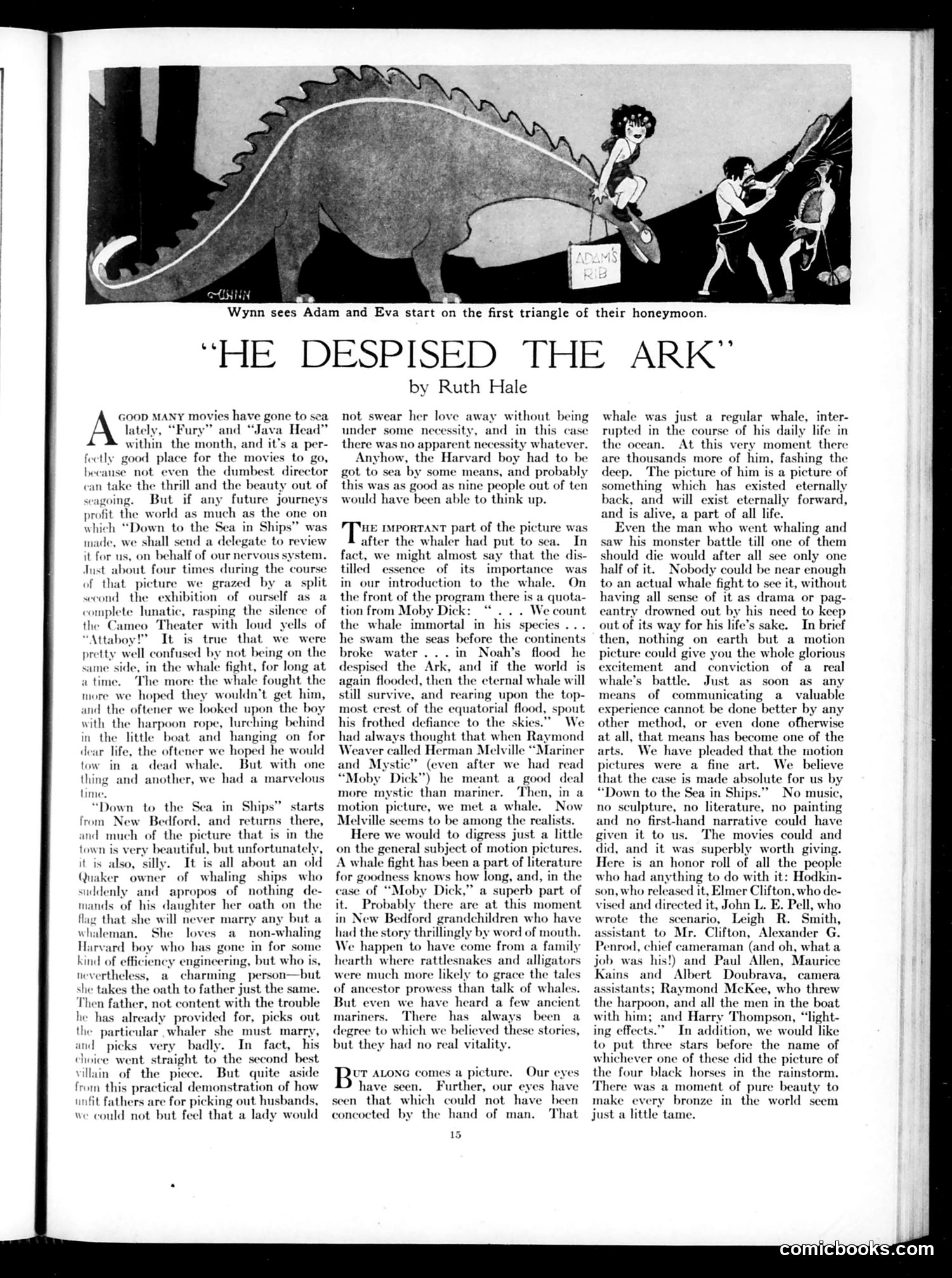
This 1921 *Judge* magazine piece reviews "Down to the Sea in Ships," a silent film about New Bedford whalers. The cartoon at top shows a dinosaur (labeled to suggest a whale) with tiny people beside it—a visual joke about the film's whale appearing absurdly oversized or unconvincing on screen. Critic Ruth Hale satirizes the film's melodramatic plot: an overbearing Quaker ship-owner forces his daughter to swear she'll marry only a whaleman, though she loves a Harvard engineering student. Hale mocks this contrived setup as typical of sentimental cinema. The review's centerpiece is Hale's witty deflation of Melville's grandiose whale mythology (quoting *Moby-Dick*'s cosmic descriptions) against the reality of seeing an actual whale in motion pictures—which apparently looked ridiculous. She argues that after watching the film, Melville's romantic "mystic" whaling prose now reads as straightforward realism: the real whale wasn't impressive enough to match literature's grandeur. The satire targets both the film's plot contrivances and cinema's inability to capture literary imagination.
📄 Transcribed text from this page (OCR, searchable)
Machine-transcribed from the original scan — historical spelling and the odd misread are preserved.
Wynn sees Adam and Eva start on mn the first triangle of their honeymoon. “HE DESPISED THE ARK” GOOD MANY movies have gone to sea lately, “Fury” and “Java Head” within the month, and it’s a per- fectly good place for the movies to go, because not even the dumbest director can take the thrill and the beauty out of seagoing. But any future journeys profit the world as muc sh as the one on ‘Down to the Sea in Ships” was made, we shall send a delegate to review it for us, on behalf of our nervous system. Just about four times during the course of that picture we grazed by a_ split second the exhibition of ourself as a complete hiatic, rasping the silence of the Cameo Theater with loud yells of “Attaboy!” It is true that we were I confused by not being on the same side, in the whale fight, for long at atime. The more the whale fought the more we hoped they wouldn't get him, and the oftener we looked upon the boy with the harpoon rope, lurching behind in the little boat and hanging on for dear life, the oftener we hoped he would tow in a dead whale. But with one thing and another, we had a marvelous time, “Down to the Sea in Ships” starts from New Bedford, and returns ther and much of the picture that is in the town is very beautiful, but unfortunately, it is also, silly. It is all about an old Quaker owner of whaling ships who suddenly and apropos of nothing de- mands of his daughter her oath on the flag that she will never marry any but a whaleman. She loves a non-whaling Harvard boy who has gone in for some kind of efficiency engineering, but who is, nevertheless, a charming person—but she takes the oath to father just the same. Then father, not content with the trouble he has already provided for, piel the particular whaler she must and picks very badly. In_ fact, choice went straight to the se villain of the piece. But quite aside from this practical demonstration of how unfit fathers are for picking out husbands, we could not but feel that a lady would hie! h * pretty by Ruth Hale vay without being , and in this : there 'y whatever. Anyhow, the Harvard boy had to b got to sea by some means, and probably this was as good as nine people out of ten would have been able to think up. not swear her lov under Neca IMPORTANT part of the picture was after the whaler had put to sea. In fact, we might almost say that the dis- tilled essence of its importance was in our introduction to the whale. On the front of the program there is a quota- tion from Moby Di count the whale nortal in his speci ies he swam the seas before the continents broke water... in Noah’s flood he despised the Ark, and if the world is again flooded, then the eternal whale will still survive, and rearing upon the top- most crest of the equatorial flood, spout his frothed defiance to the skies.” We had always thought that when Raymond Weaver called Herman Melville “Mariner and \ ic” (even after we had read “Moby Di he meant a good deal more mystic than mariner. Then, in a motion picture, we met a whale. Now Melville seems to be among the realists. Here we would to digress just a little on the general subject of motion pictures. A whale fight has been a part of literature for goodness knows how long, and, in the of “Moby Dick,” a superb part of it. Probably there are at this moment in New Bedford grandchildren who have had the story thrillingly by word of mouth. We happen to have come from a family hearth where rattlesnakes and alligators were much more likely to grace the of ancestor prowess than talk of wh But even we have heard a few a mariners. There has always been degree to which we believed these stories, but they had no real vitality. UT ALONG comes a picture. Our eyes have seen. Further, our eyes have seen that which could not have been concocted by the hand of man. That 15, whale was just a regular whale, enter rupted in the course of his daily life the ocean. At this very moment bier are thousands more of him, fashing the deep. ‘The picture of him is a picture of something which has ex eternally nd will exist eternally forward, alive, a part of all life. en the man who went whaling and saw his monster battle till one of them should die would after all see only one half of it. Nobody could be near enough to an actual whale fight to see it, without having all sense of it as drama or pag- eantry drowned out by his need to keep out of its way for his life’s sake. In brief then, nothing on earth but a motion picture could give you the whole glorious excitement and conviction of a real whale’s battle. Just as soon as any means of communicating a valuable experience cannot be done better by other method, or even done otherwise at all, that means has become one of the arts. We have pleaded that the motion pictures were a fine art. We beli that the case is made absolute for us by “Down to the Sea in Ships.” No music, no sculpture, no literature, no painting and no first-hand narrative could have given it to us. The movies could and did, and it was superbly worth giving. Here is an honor roll of all the people who had anything to do with it: Hodkin- son, who released it, Elmer Clifton, who de- vised and directed it, John L, E. Pell, who wrote the scenario, Leigh R. Smith, assistant to Mr. Clifton, Alexander G. Penrod, chief cameraman (and oh, what a s his!) and Paul Allen, Maurice Albert Doubrava, camera assistants; Raymond McKee, who threw the harpoon, and all the men in the boat with him; and Harry Thompson, “light- ing effects.” In addition, we would like to put three stars before the name of whichever one of these did the picture of the four black horses in the rainstorm. There was a moment of pure beauty to make every bronze in the world seem just a little tame.