
A complete issue · 36 pages · 1922
Judge — November 11, 1922
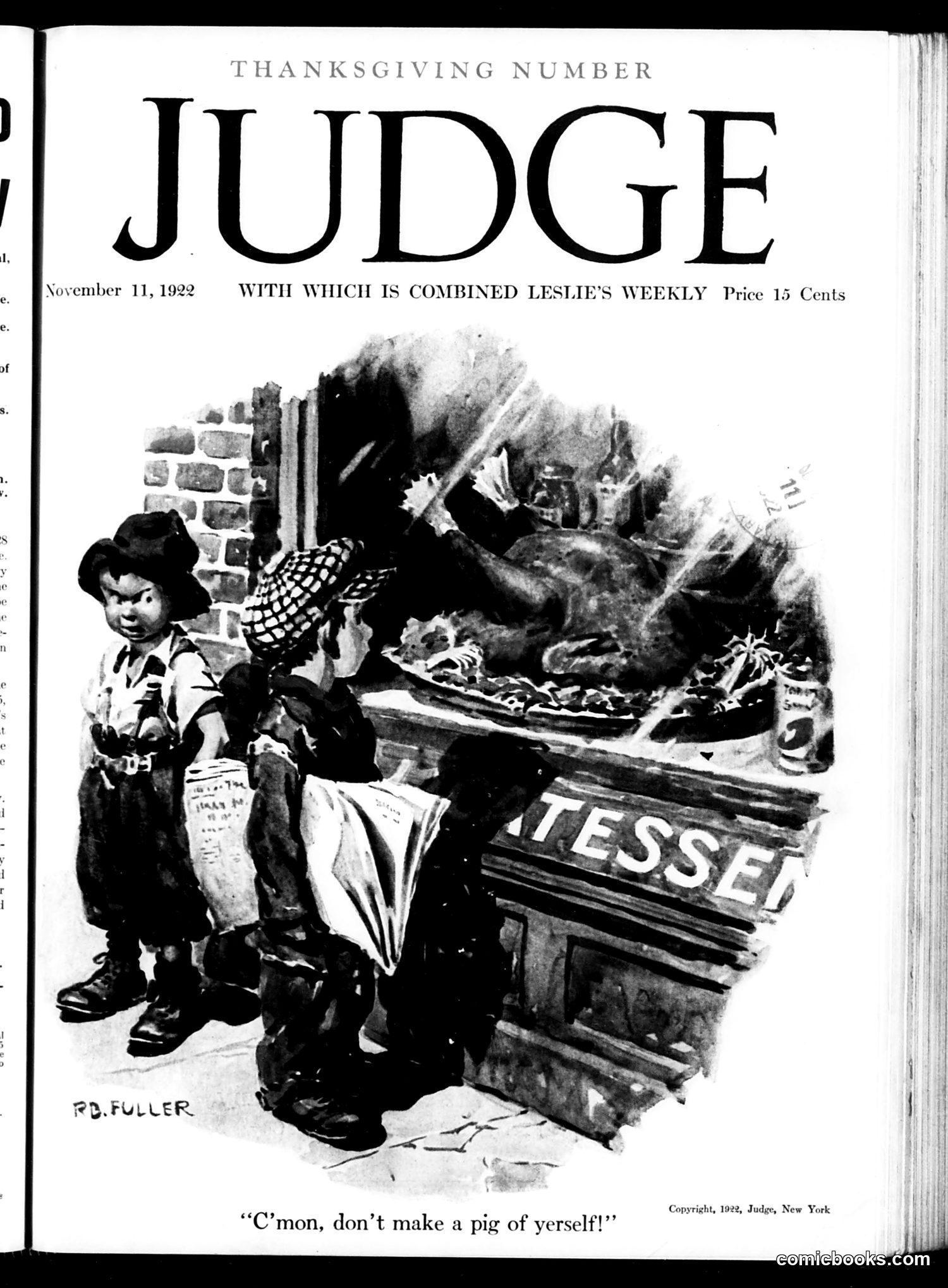
This Thanksgiving-themed cover by artist F.B. Fuller depicts a child standing before a messy, chaotic kitchen scene with food scraps and a trash bin labeled "JESSEN." The caption reads: "C'mon, don't make a pig of yourself!" The satire appears to reference overconsumption or waste during holiday feasting. The "JESSEN" marking on the trash suggests this may target a specific contemporary figure or topic, though the precise reference is unclear from available context. The child's admonition against gluttony—ironically set against abundant food waste—likely critiques American excess during the prosperous 1920s, or possibly food waste during an era of rationing or economic concern.
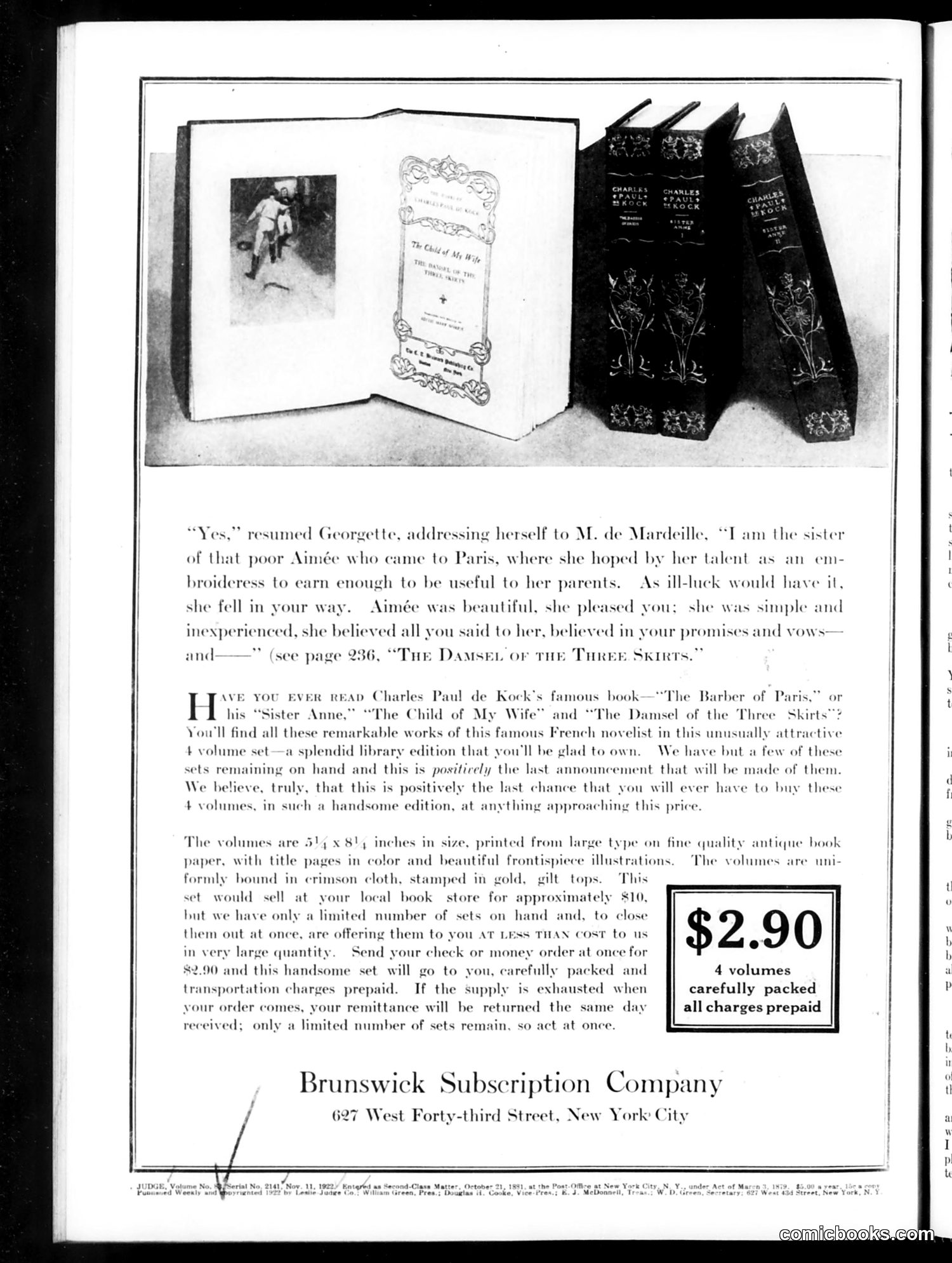
This page is **primarily advertising**, not political satire or editorial content. The upper portion shows a photograph of four books by Charles Paul de Kock, a French novelist, with the Brunswick Subscription Company promoting a four-volume set of his works at $2.90. The only narrative element is a quoted passage featuring characters "Georgette" and "M. de Mardeille," discussing a character named "Aimée" who came to Paris with hopes of using her talents as an embroiderer—apparently a euphemism referencing the author's reputation for risqué French fiction. There is **no political cartoon** on this page. It represents Judge magazine's commercial content rather than its satirical editorial purpose.
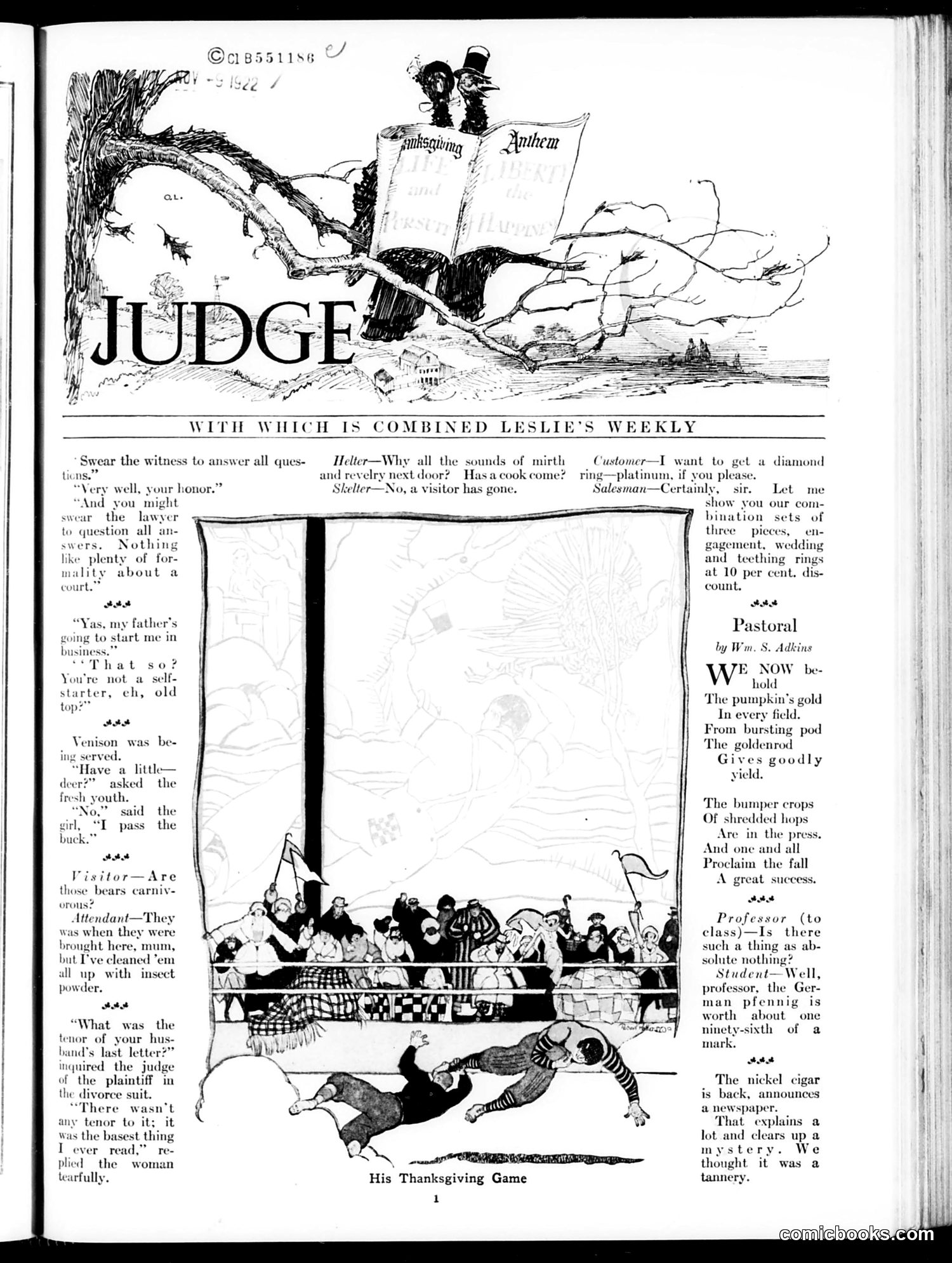
This page combines humor columns with a cartoon titled "His Thanksgiving Game." The main illustration shows people in a crowded stadium or grandstand watching what appears to be a football game below, where players are depicted in exaggerated physical positions. The surrounding text consists of brief jokes and witticisms typical of Judge's satirical format—including courthouse humor, a dialogue about bearing witness, and commentary on German professors and nickel cigars. The cartoon likely satirizes American Thanksgiving football traditions and the spectacle of stadium crowds. Without clearer identifying details, I cannot definitively name specific historical figures or events referenced. The humor appears to target early 20th-century social conventions around holiday celebrations and public entertainment rather than specific political commentary.
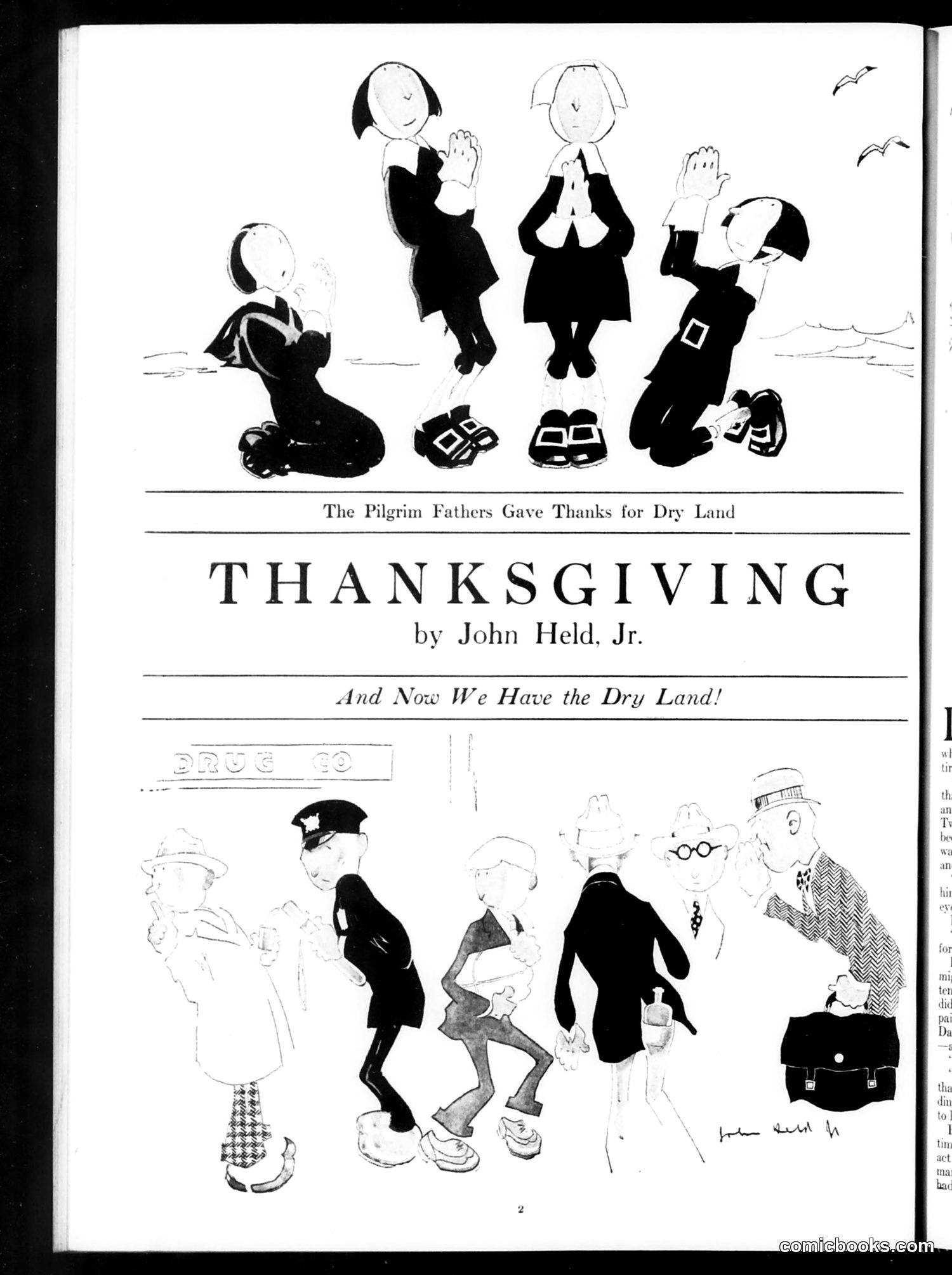
This page from *Judge* magazine contains two cartoons by John Held Jr. satirizing Thanksgiving. The **top cartoon** depicts children in Pilgrim clothing giving thanks for "dry land"—a straightforward historical reference to the Pilgrims' arrival and survival. The **bottom cartoon**, titled "And Now We Have the Dry Land!" appears to mock contemporary (1920s-era) American society. It shows various adult figures representing different social types—businessmen, workers, and wealthy individuals—apparently squabbling or competing over resources. The satire suggests irony: while Pilgrims were grateful for basic survival, modern Americans exploit and fight over the prosperity that "dry land" (America) has provided. The cartoon critiques materialism and social inequality in Jazz Age America, contrasting historical gratitude with contemporary greed.
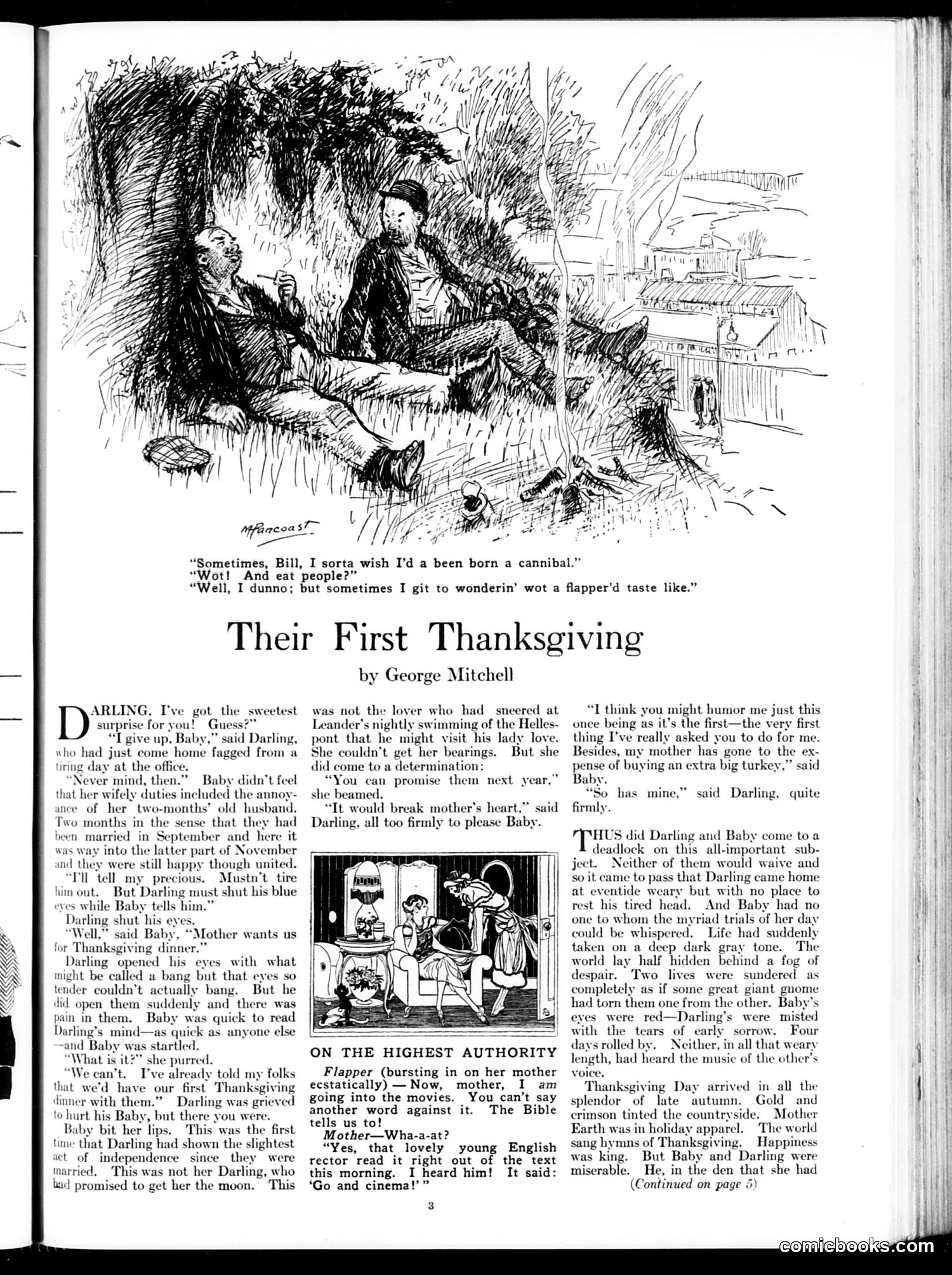
This story page satirizes newlywed domestic life through the comic tension between Darling and Baby (his wife). The humor centers on Baby's nagging about Thanksgiving dinner preparations—she wants an "extra big turkey"—while Darling, exhausted from work and marriage, fantasizes about escape. The cartoon's opening joke references cannibalism darkly: Darling jokes he wishes he'd been born a cannibal to avoid "flapper'd taste" complaints. This reflects 1920s anxiety about modern women's (particularly "flappers'") assertiveness and consumer demands. The embedded illustration labeled "On the Highest Authority" depicts a mother teaching her daughter about going to movies, satirizing how cinema was becoming a dominant cultural force that even mothers couldn't oppose. The overall piece gently mocks both marital discord and emerging consumer culture.
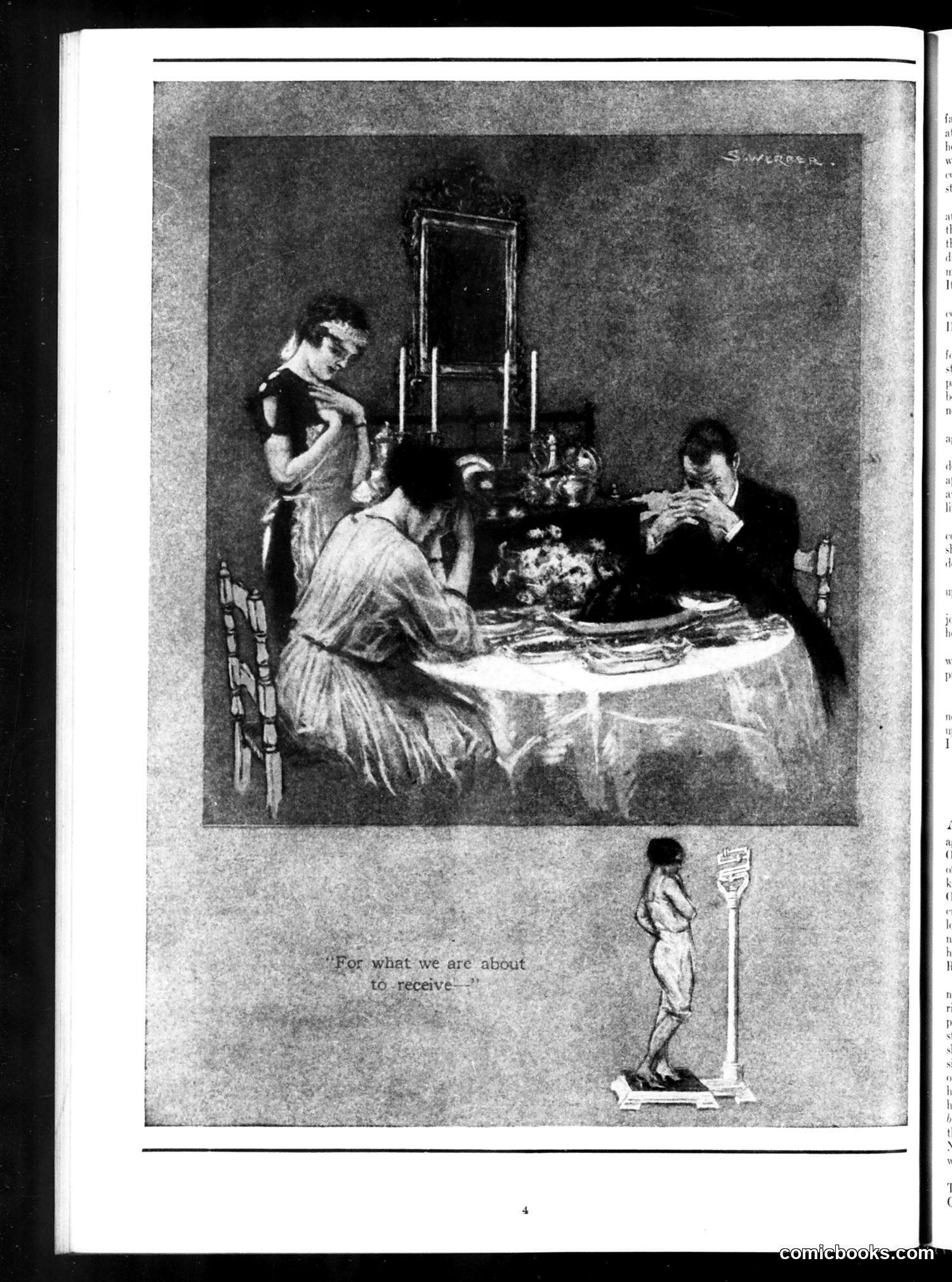
This page from *Judge* magazine contains a satirical illustration depicting a séance or spiritualist gathering. Three figures sit around a table with a mirror mounted on the wall behind them, while a cherub figure at bottom holds a scale, captioned "For what we are about to receive—" The satire appears to target spiritualism—a popular but controversial practice of the era. The phrase "for what we are about to receive" (echoing mealtime grace) suggests the cartoon mocks spiritualists as fraudsters who "receive" money from gullible clients. The scale hints at weighing or judging their moral character. The mirror likely references the deceptive tricks spiritualists employed. Without clearer identifying details, specific figures remain unclear, but the overall point lampoons spiritualism as a con exploiting the bereaved and credulous.
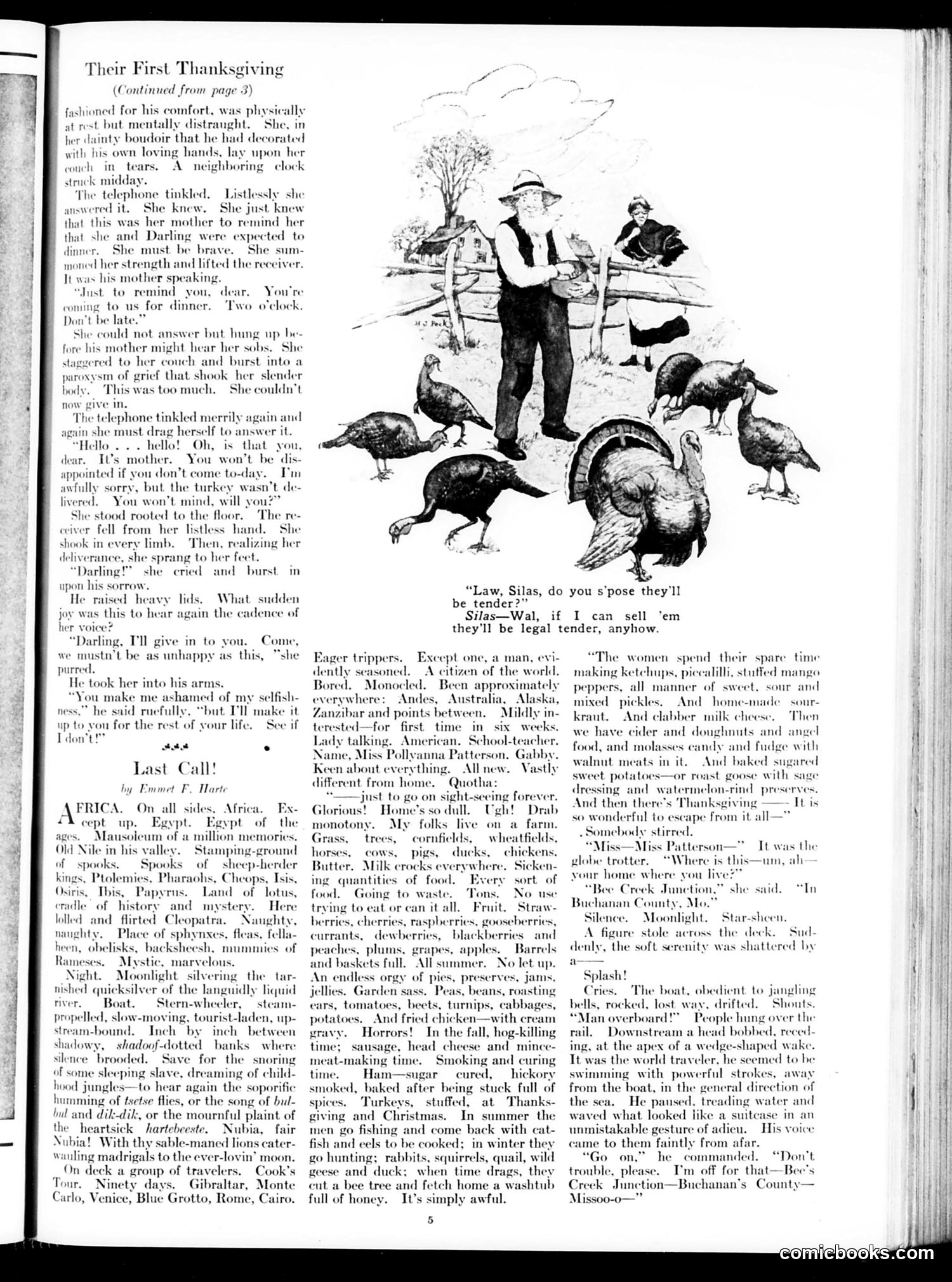
This page contains two separate stories from *Judge* magazine, a satirical publication. **"Their First Thanksgiving"** (top) is a domestic melodrama about a newlywed couple in conflict. The husband is upset; his mother calls to remind them of dinner plans. The wife, devastated, must compose herself. When the mother calls again with news the husband won't attend, the wife is relieved—they reconcile. The satire mocks sentimental domestic fiction and marital discord over trivial matters. **"Last Call!"** (bottom) is a travel narrative set on a Nile River steamer. It satirizes American tourists on a "Cook's Tour" (a package tour company). The humor centers on crude Americans encountering exotic Africa: notably, two rural characters (Silas and Law) discuss eating turkeys, with a pun about "legal tender." A schoolteacher character gushes enthusiastically about the exotic sights while complaining her farm life is dull—mocking American tourism's superficiality and the gap between rustic domesticity and cosmopolitan pretension. Both pieces target American social types and romantic/travel clichés.
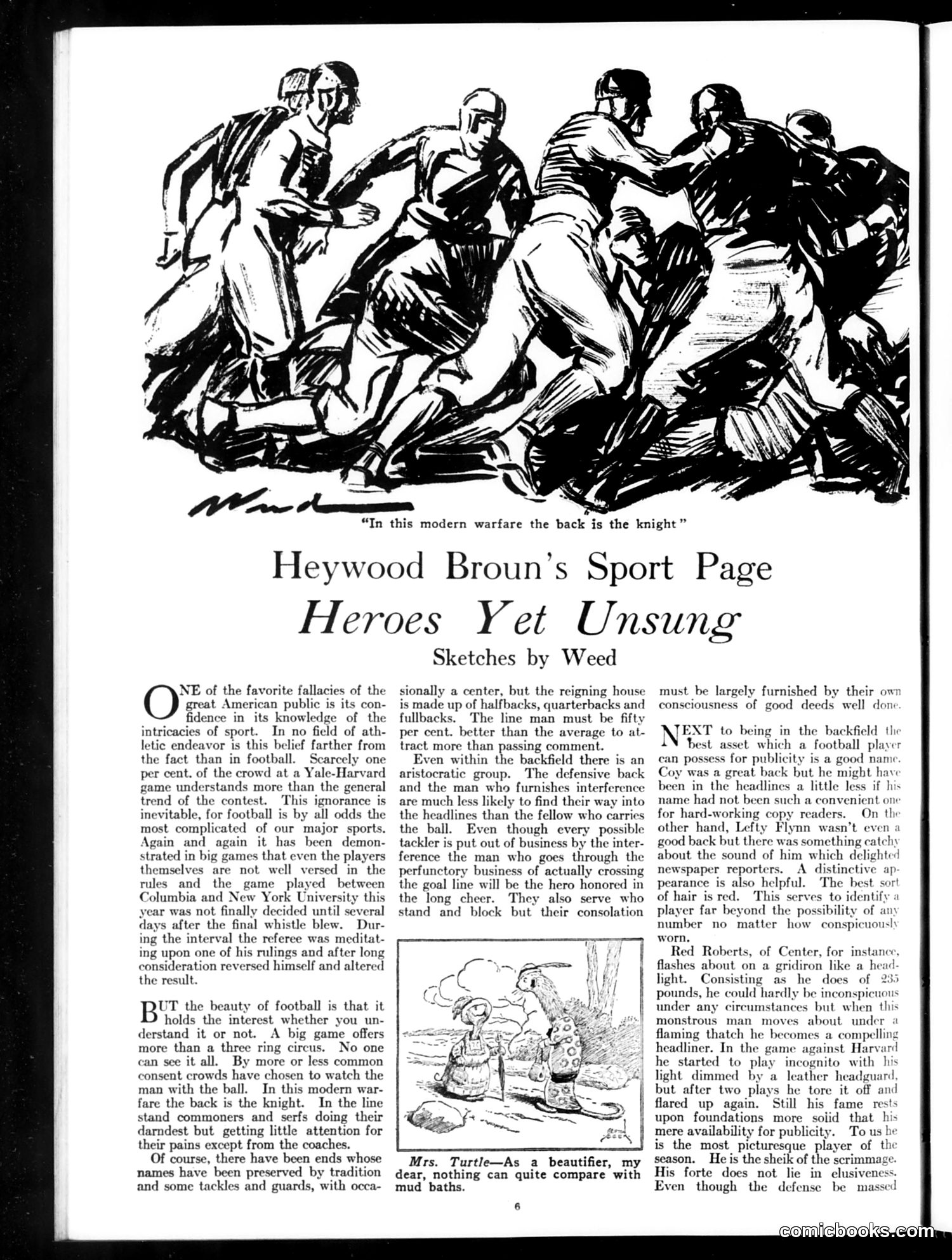
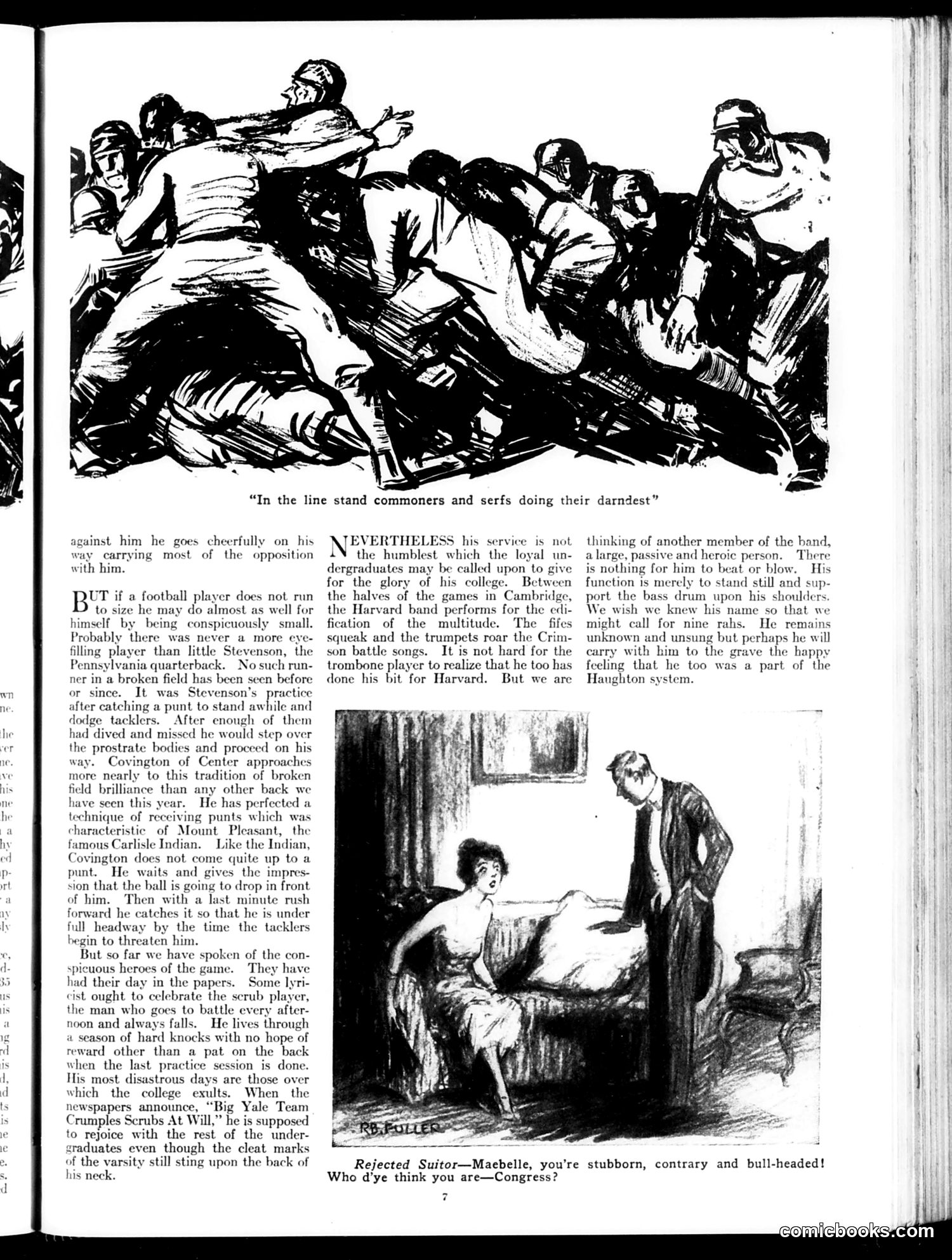
This is a sports column by Heywood Broun, a famous sportswriter, illustrated by cartoonist Weed. The main article critiques how American football fans and media misunderstand the sport's true dynamics. **The Core Argument:** Broun argues that football's "knights" are the backfield players (halfbacks, quarterbacks, fullbacks) who get headlines and glory, while linemen—the commoners doing essential blocking and tackling—receive no recognition despite being crucial to plays. He notes even within the backfield, players who actually carry the ball receive disproportionate credit compared to those providing interference. **Secondary Points:** He observes that publicity depends on factors beyond skill: distinctive names (like "Coy"), distinctive appearance (especially red hair), and public recognition matter as much as performance. Red Roberts gets attention partly because his striking appearance makes him visible. **The Cartoon:** The sketch (by Weed) depicts a rugby/football scrum, emphasizing the collective effort and violence of line play—work largely invisible to spectators focused on ball carriers.
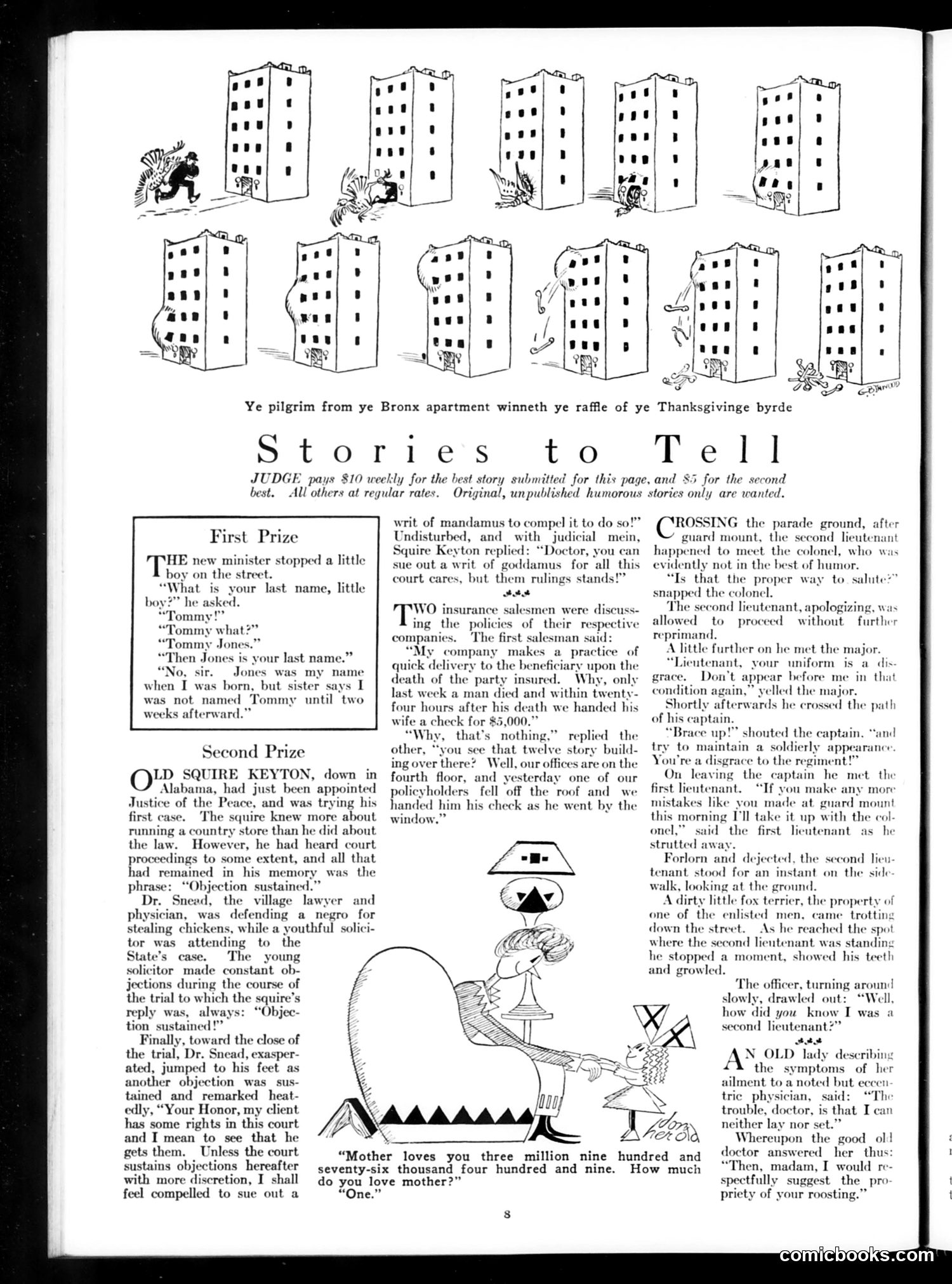
This page from *Judge* magazine contains humorous short stories competing for prizes ($10 for first place, $5 for second). **First Prize story**: A minister asks a boy his name. The boy explains "Tommy Jones" is his current name, but he wasn't called "Tommy" until two weeks after birth—a joke about the arbitrary nature of naming conventions. **Second Prize story**: An incompetent rural justice of the peace, "Squire Keyton," knows courtroom procedure only through the phrase "Objection sustained," which he repeats mechanically regardless of context. A frustrated lawyer threatens legal action; the squire dismissively replies with invented legal jargon ("goddamus," "them rulings stands"). The satire mocks rural judicial incompetence and malapropisms. **Other stories** include jokes about insurance salesmen and military protocol. The cartoon strip at top shows Bronx apartment residents winning a holiday turkey in a raffle—visual humor about urban apartment life. The humor relies on wordplay, malapropisms, and social observation typical of early 20th-century American comedy.
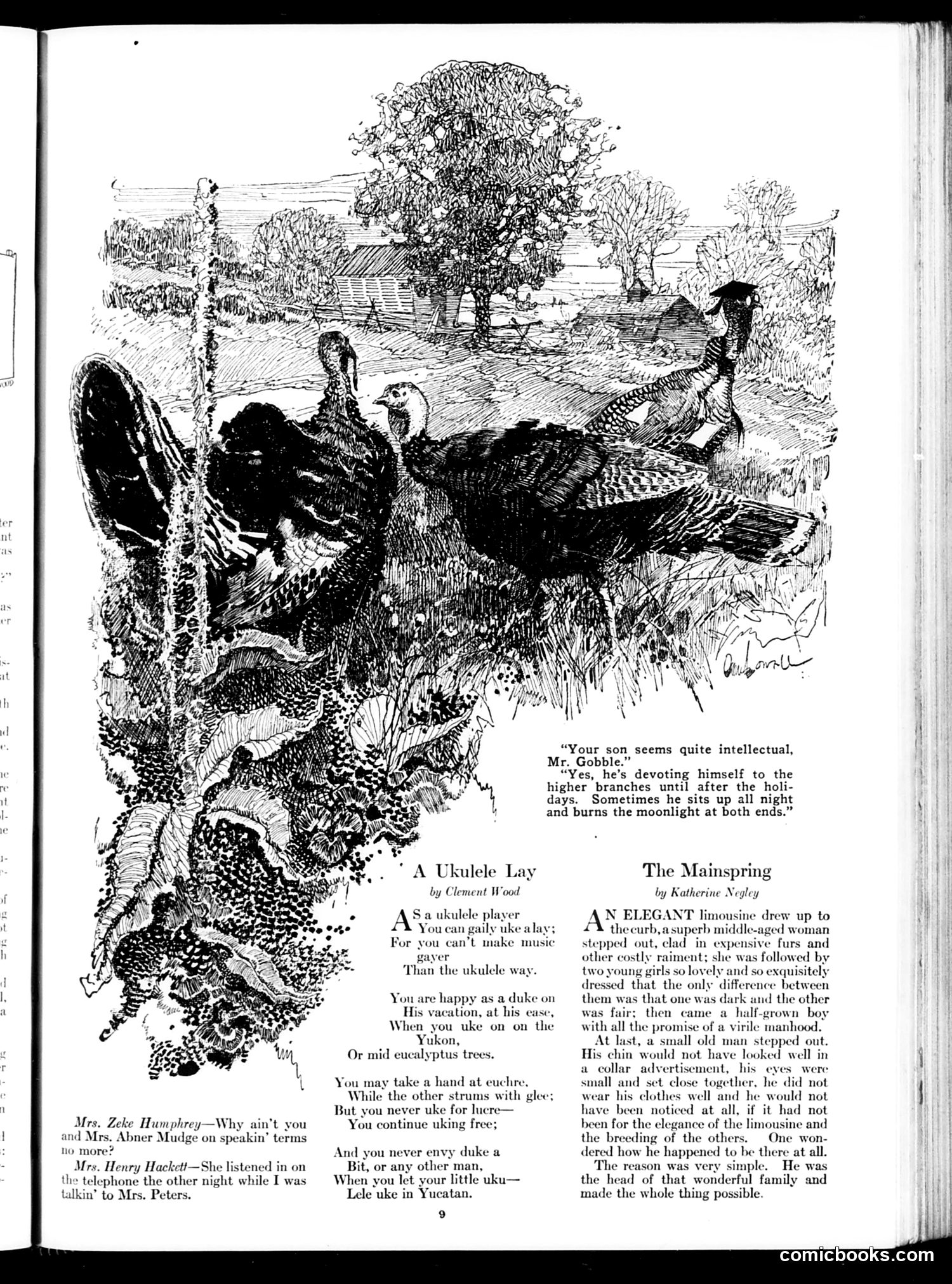
This page contains two literary pieces with accompanying illustration, not political cartoons: **"A Ukulele Lay"** by Clement Wood is a humorous poem celebrating the ukulele as an instrument of carefree leisure—played on vacation in the Yukon or among eucalyptus trees, never for profit, embodying freedom and contentment. The ukulele's popularity peaked in the 1920s-30s, making this timely entertainment satire. **"The Mainspring"** by Katherine Negley is a short story about class and appearance. An elegantly dressed woman and two fashionable girls are accompanied by an unprepossessing small man in an expensive limousine. The twist: he's wealthy and "the head of that wonderful family," suggesting that beneath plain appearance lies actual power and worth—a commentary on surface judgments and hidden economic realities. The illustrations depict rural farmyard scenes with poultry, unrelated to the text content below them, suggesting layout filler or a separate removed cartoon.
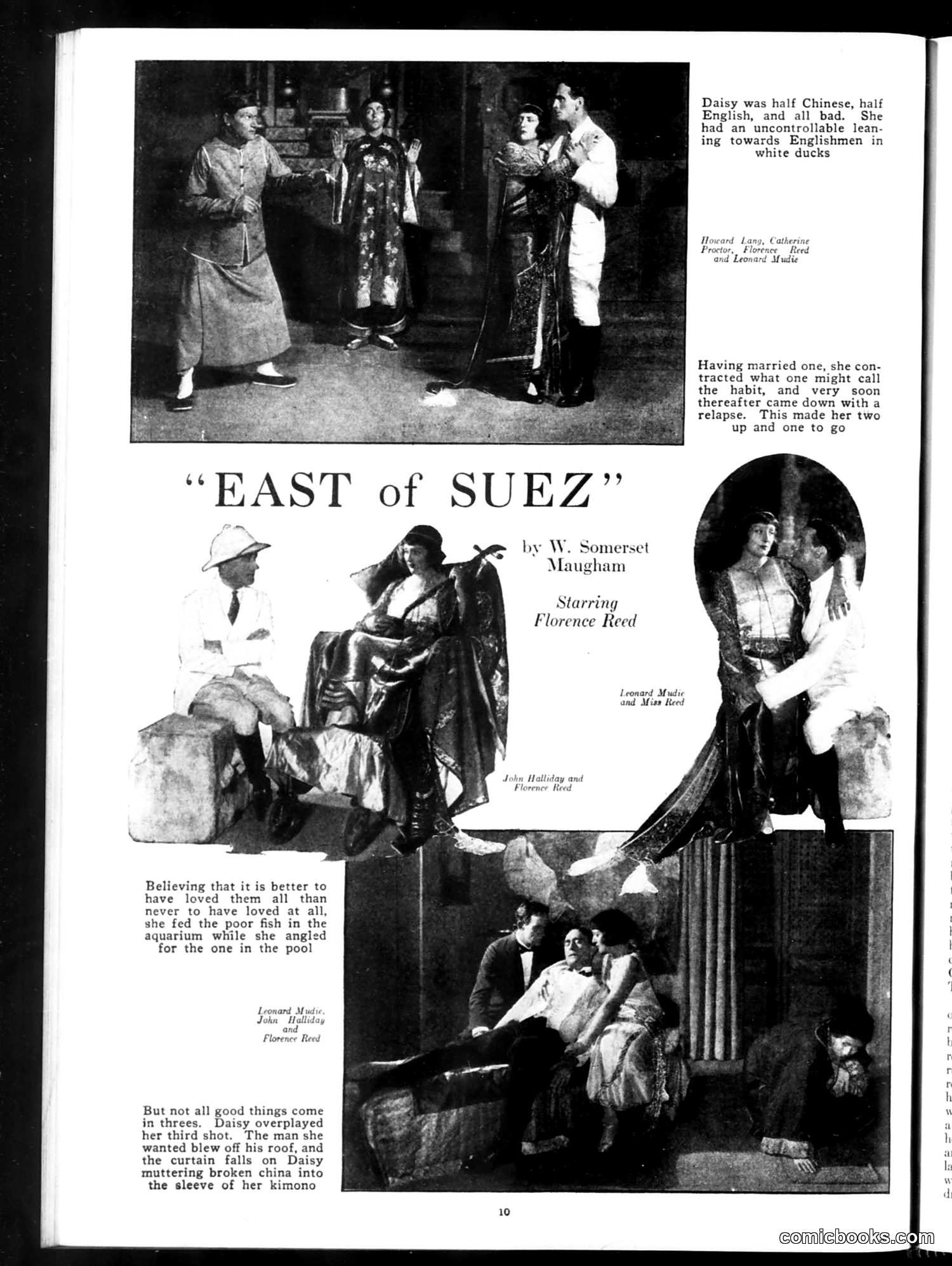
This page promotes W. Somerset Maugham's play "East of Suez," starring Florence Reed. The content is a plot synopsis rather than satire. The story concerns "Daisy," a mixed-race (half-Chinese, half-English) character described as morally corrupt with a predatory attraction to Englishmen. The synopsis follows her serial seduction of multiple men—presented as a comedic pattern of infidelity ("two up and one to go"). The crude humor relies on racist and sexist stereotypes: the "immoral mixed-race woman" trope and the femme fatale archetype. Her eventual downfall (a man "blew off his roof," ending in her breakdown) reinforces period attitudes about female promiscuity as destructive. This reflects early 20th-century theatrical entertainment's casual deployment of racist caricatures and misogynistic narratives as comedy. Modern readers should recognize this as reflecting deeply problematic period attitudes now recognized as offensive.
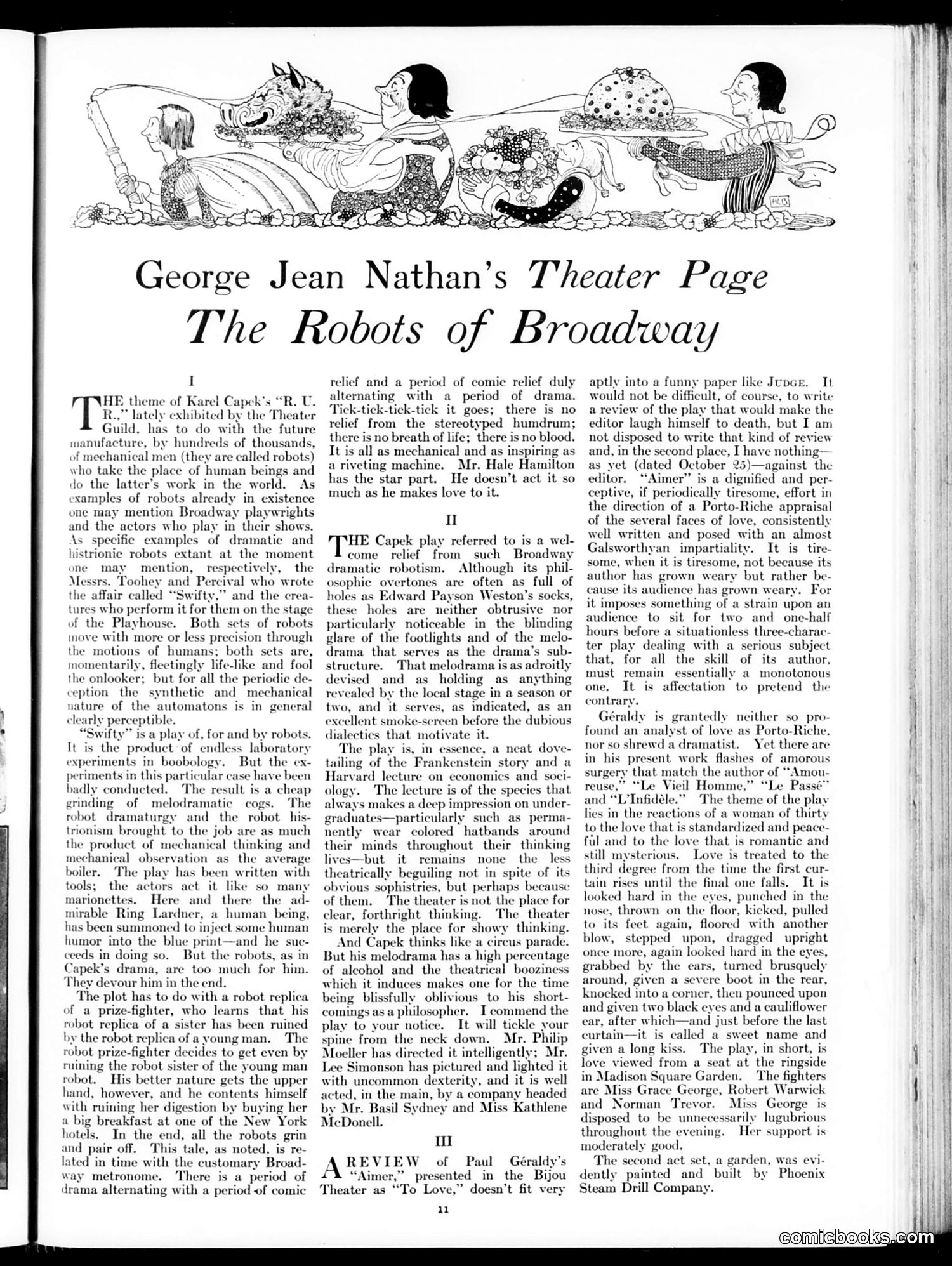
This is **theater criticism, not a political cartoon**. George Jean Nathan reviews Karel Capek's play "R.U.R." (about manufactured mechanical workers) and satirizes Broadway's actual dramatic "robots"—particularly a play called "Swifty." Nathan's central joke: Broadway playwrights and actors are themselves mechanical automatons. He sarcastically compares "Swifty" (written by Toohey and Percival, performed by actors) to actual robots—both move predictably, both lack genuine life or emotion. The play operates like a "riveting machine": tick-tick-tick formula of drama, then comic relief, then drama again, with no spontaneity. The critique praises Capek's work as genuinely engaging despite philosophical flaws, contrasting it with Broadway's lifeless machinery. Ring Lardner is the rare "human being" injecting actual humor into the robotic system. The headpiece illustration shows surreal mechanical creatures—visualizing Nathan's metaphor of Broadway as an assembly line of artificial performers.
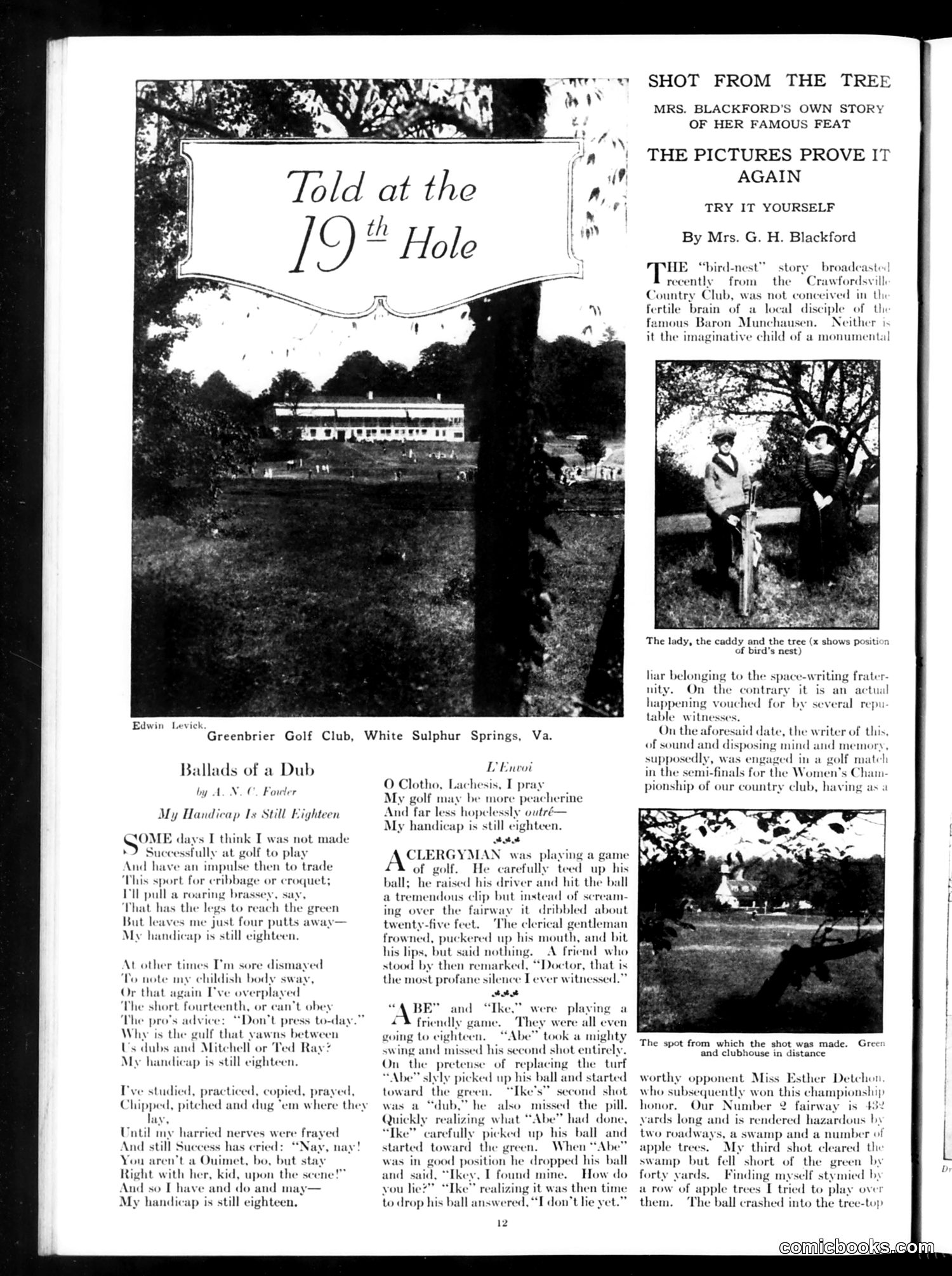
This page from **Judge** magazine contains golf-themed humor rather than political satire. It includes: 1. **"Ballads of a Dub"** — A poem by A.N.C. Fowler about an amateur golfer frustrated by his persistent eighteen-handicap despite practice and effort. The humor lies in the relatable complaint that some players can't improve regardless of dedication. 2. **Golf anecdotes** — Short humorous stories about clerical golfers and cheating players ("Abe" and "Ike"), featuring the classic joke format where players catch each other's rule violations mid-game. 3. **"Shot from the Tree"** — Mrs. G.H. Blackford's account of allegedly hitting a golf shot from a tree at Greenbrier Golf Club, Virginia, with photographs as "proof." The page reflects early-20th-century leisure culture and golf's popularity among American middle and upper classes. The humor is genteel and situational rather than satirical—aimed at club members who would recognize themselves in these golfing mishaps.
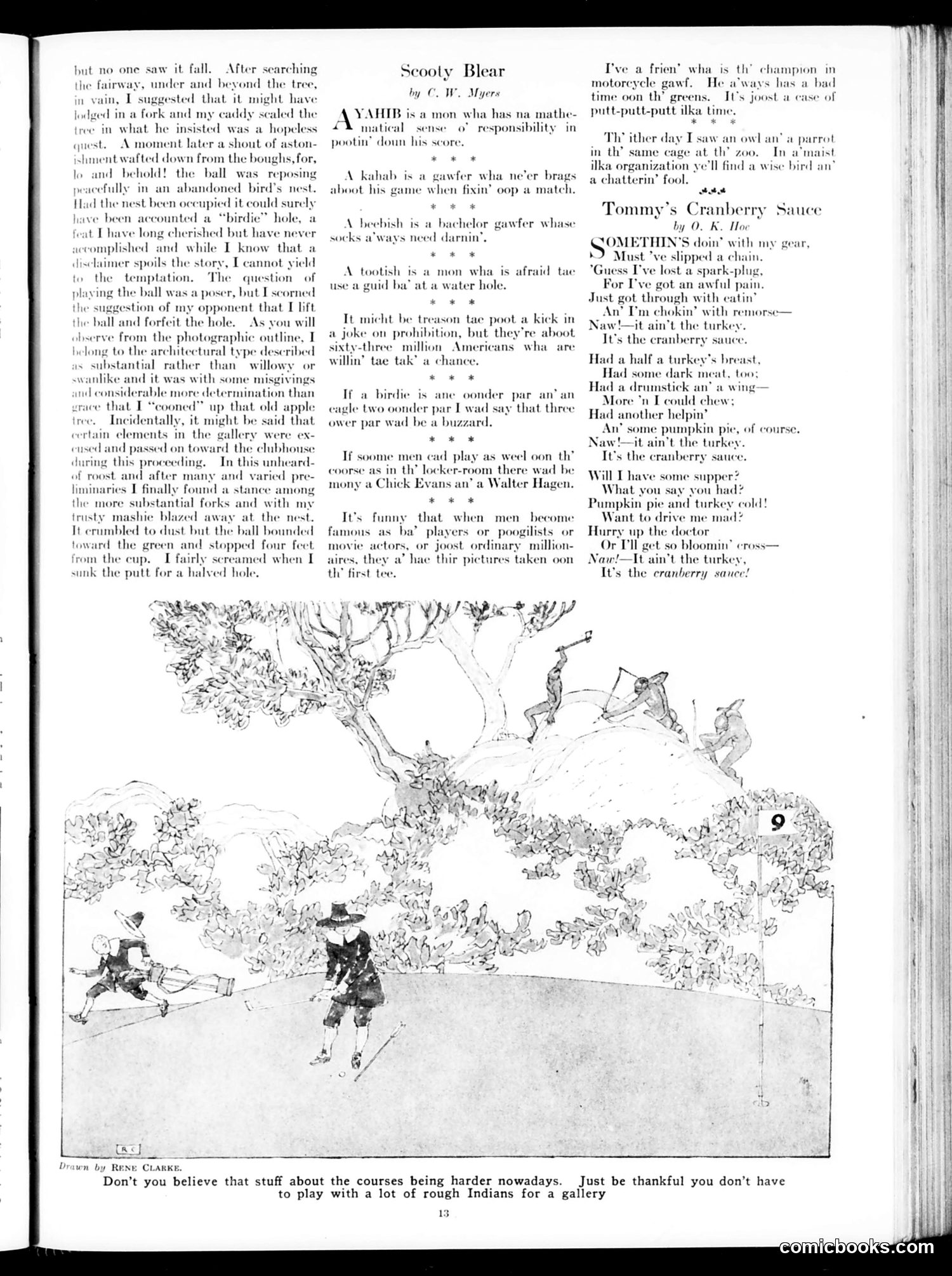
This page presents two humorous golf-themed pieces. The main story "Scooty Blear" (by C.W. Myers) defines golfing archetypes in Scottish dialect—types like the "yahib" (irresponsible scorer) and "tootish" (coward at water hazards). The satirical definitions mock common golfer behaviors and vanities, including a joke about prohibition-era Americans willing to risk breaking the law. The bottom cartoon by René Clarke depicts a golf scene with a caption mocking Native Americans as gallery spectators, using a racist trope common to early-20th-century American humor. The accompanying "Tommy's Cranberry Sauce" poem is a lighthearted complaint about overindulgence during a holiday meal. The page reflects Judge's satirical focus on upper-class leisure activities (golf) while casually incorporating the casual racism typical of 1920s-era American magazines—material now considered deeply offensive.
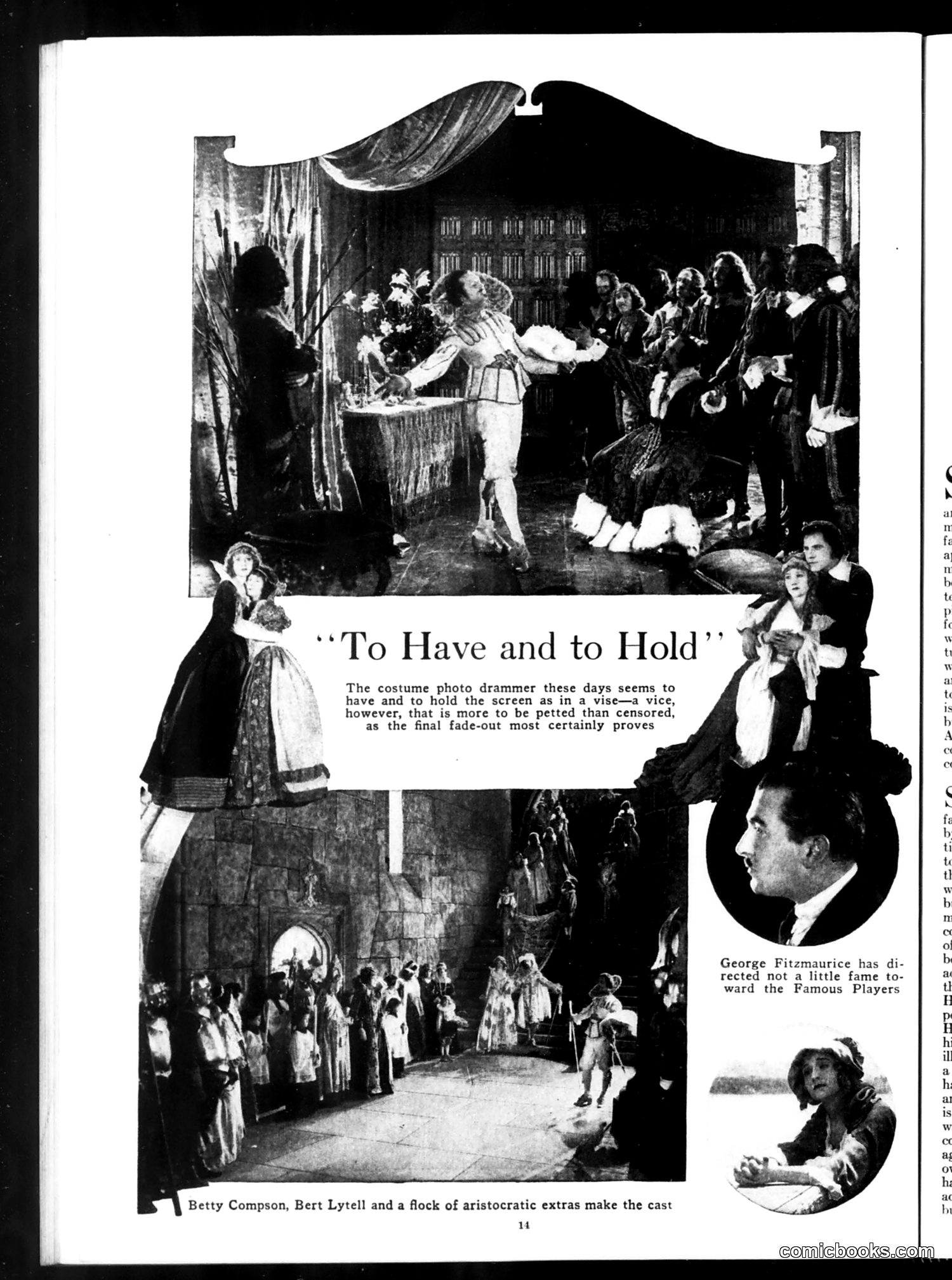
This page reviews a film adaptation of the novel "To Have and to Hold," directed by George Fitzmaurice for Famous Players studio. The accompanying photos show elaborate period costume drama scenes. The satirical text plays on the film's title, suggesting that costume pictures "have and to hold the screen" like a vice—gripping audiences tightly. The joke implies these lavish historical dramas are so entertaining that censorship concerns (common during the silent era) become irrelevant by the final fade-out. The critic is praising Fitzmaurice's direction and the cast, including Betty Compson and Bert Lytell, along with numerous extras in aristocratic costumes, for delivering escapist spectacle that justifies the genre's popularity despite periodic moral objections to film content.
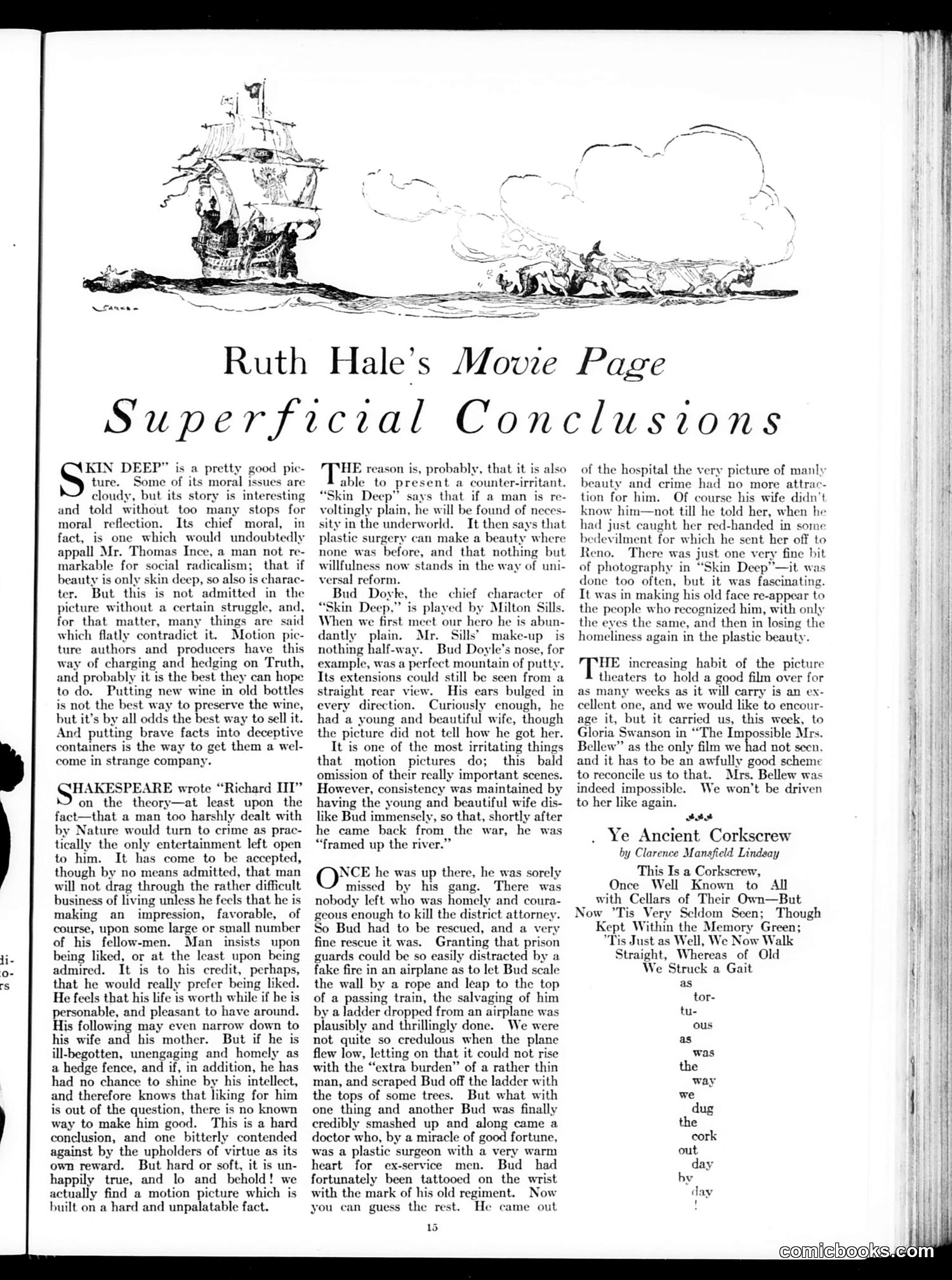
This is a film review column by Ruth Hale discussing the movie "Skin Deep," starring Milton Sills. The page critiques how motion pictures handle moral and social themes. The central argument concerns a philosophical point: the film suggests that physical ugliness drives men to crime, but plastic surgery can reform them. Hale finds this both morally interesting and contradictory—the film preaches that appearance shouldn't matter while simultaneously proving it does. The review notes the film's protagonist, Bud Doyle, is deliberately made grotesquely ugly (with an exaggerated nose and protruding ears), yet inexplicably has a beautiful wife who dislikes him. Hale criticizes motion pictures generally for logical inconsistencies and for using "brave facts" in "deceptive containers"—packaging difficult truths in entertainment that ultimately compromises their message. The overall tone suggests skepticism about Hollywood's ability to handle serious social commentary authentically.
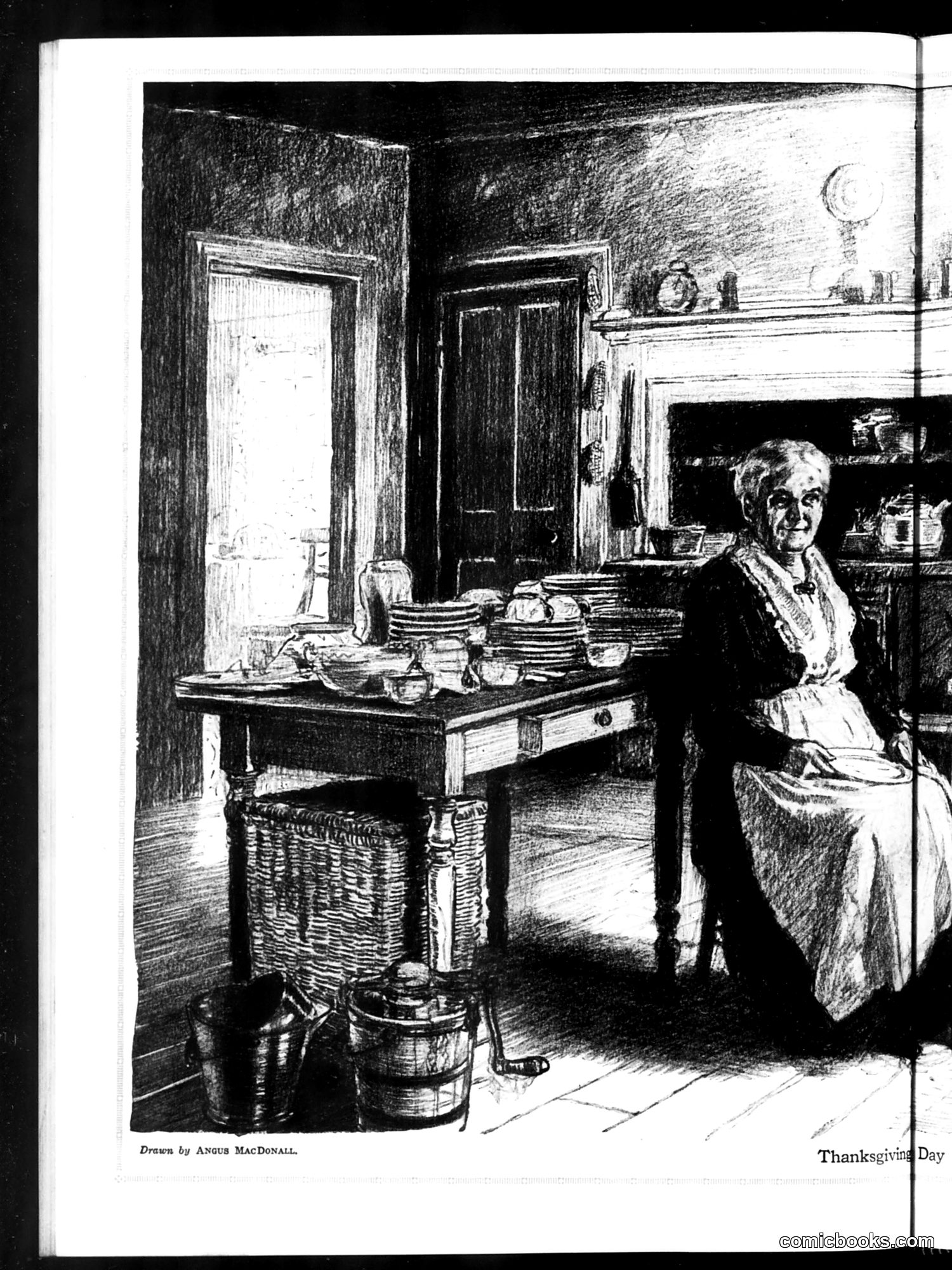
This appears to be an illustration titled "Thanksgiving Day," drawn by Angus MacDonald for *Judge* magazine. The image depicts a domestic kitchen scene with an older woman in servant's attire (apron and cap) sitting in the kitchen while dishes and cookware are arranged on a table. The fireplace and multiple doors suggest a well-appointed home's kitchen area. The satire likely comments on class dynamics and domestic labor during Thanksgiving—a holiday emphasizing family gratitude. The composition contrasts the woman's weary pose with the abundant dishware, possibly satirizing servant labor and the burden of holiday meal preparation falling on working-class domestic help rather than being shared communally. The work required "behind the scenes" to produce the holiday celebration is made visible and somewhat dignified through her central placement in the composition.
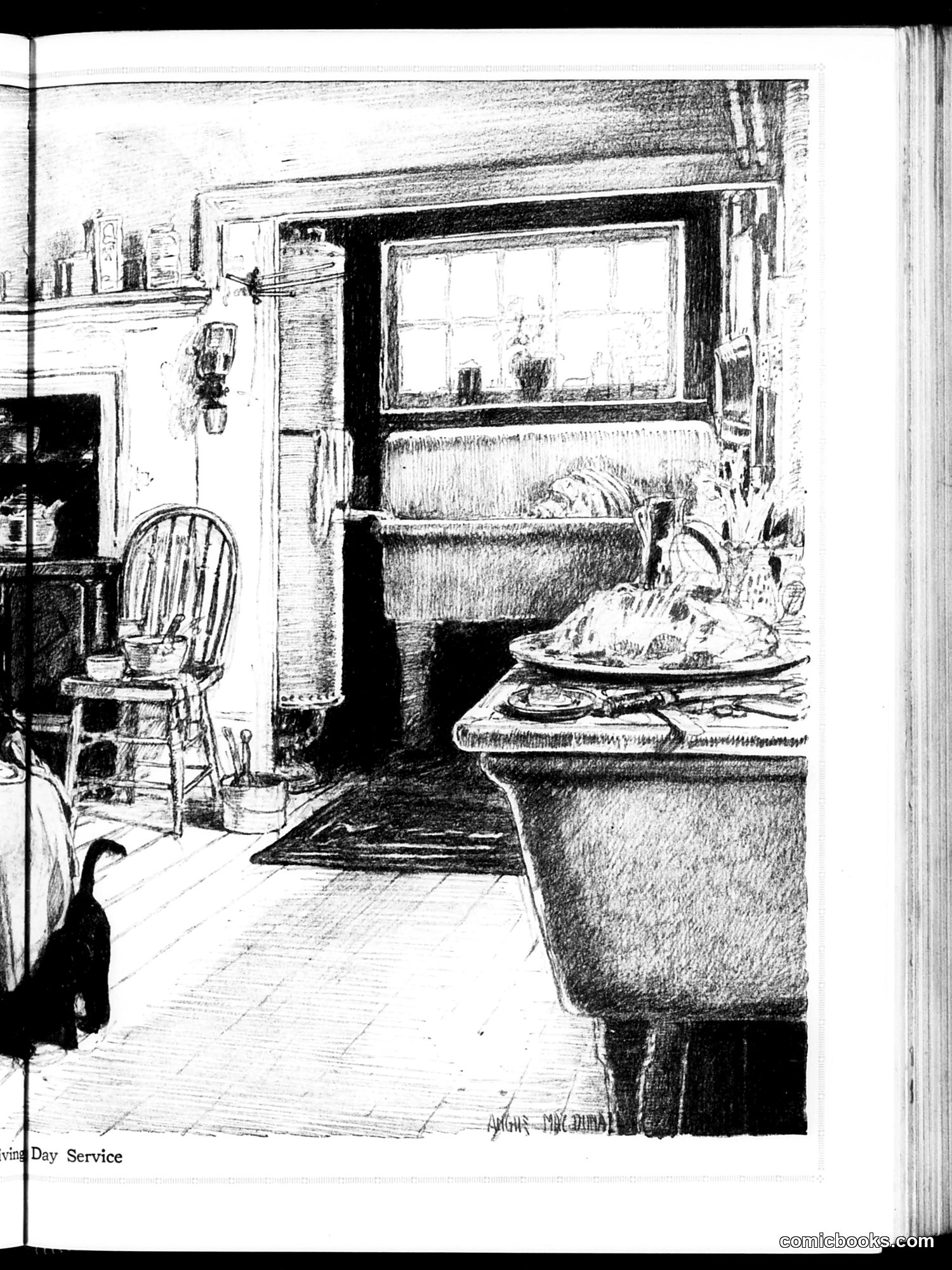
This appears to be a domestic interior sketch, likely from Judge magazine's satirical commentary on American home life. The illustration depicts a modest kitchen scene with simple furnishings—a Windsor chair, cooking implements, dishes, and a window. The title "Loving Day Service" suggests ironic commentary on domestic labor or housework. The sketch's style and subject matter indicate satire about working-class or middle-class domestic life, possibly critiquing the romanticization of homemaking or the reality of household drudgery. The somewhat cramped, cluttered kitchen contrasts with any idealized notion of domestic bliss the title might suggest. Without additional context or visible byline, the specific political or social target remains unclear, though the tone suggests typical Judge-era commentary on everyday American life and gender roles.
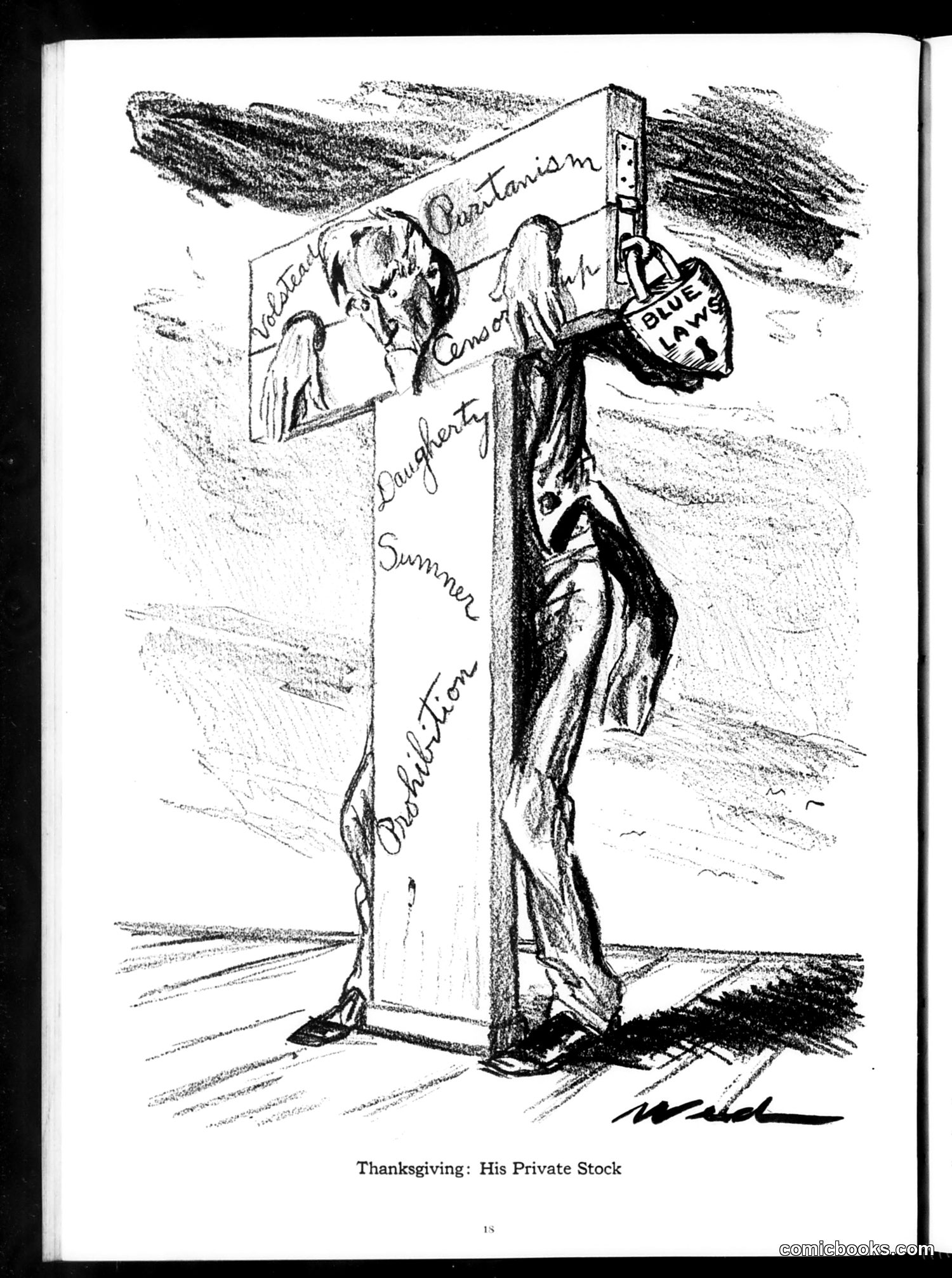
This cartoon satirizes a man—likely a wealthy businessman or politician—who has stockpiled resources (labeled "Obstruction," "Summer," "Laughter," "Consent of the Governed," and "Blue Laws") like personal property rather than sharing them with the public good. The figure clutches these items protectively while appearing miserly. The satire critiques the hoarding mentality during Thanksgiving, traditionally a holiday emphasizing generosity and shared abundance. The "Blue Laws" reference suggests regulations the figure wants to control or suppress. By framing public goods as his "private stock," the cartoon mocks the selfishness of those who monopolize what should benefit society broadly—a common Progressive-era critique of concentrated wealth and power.
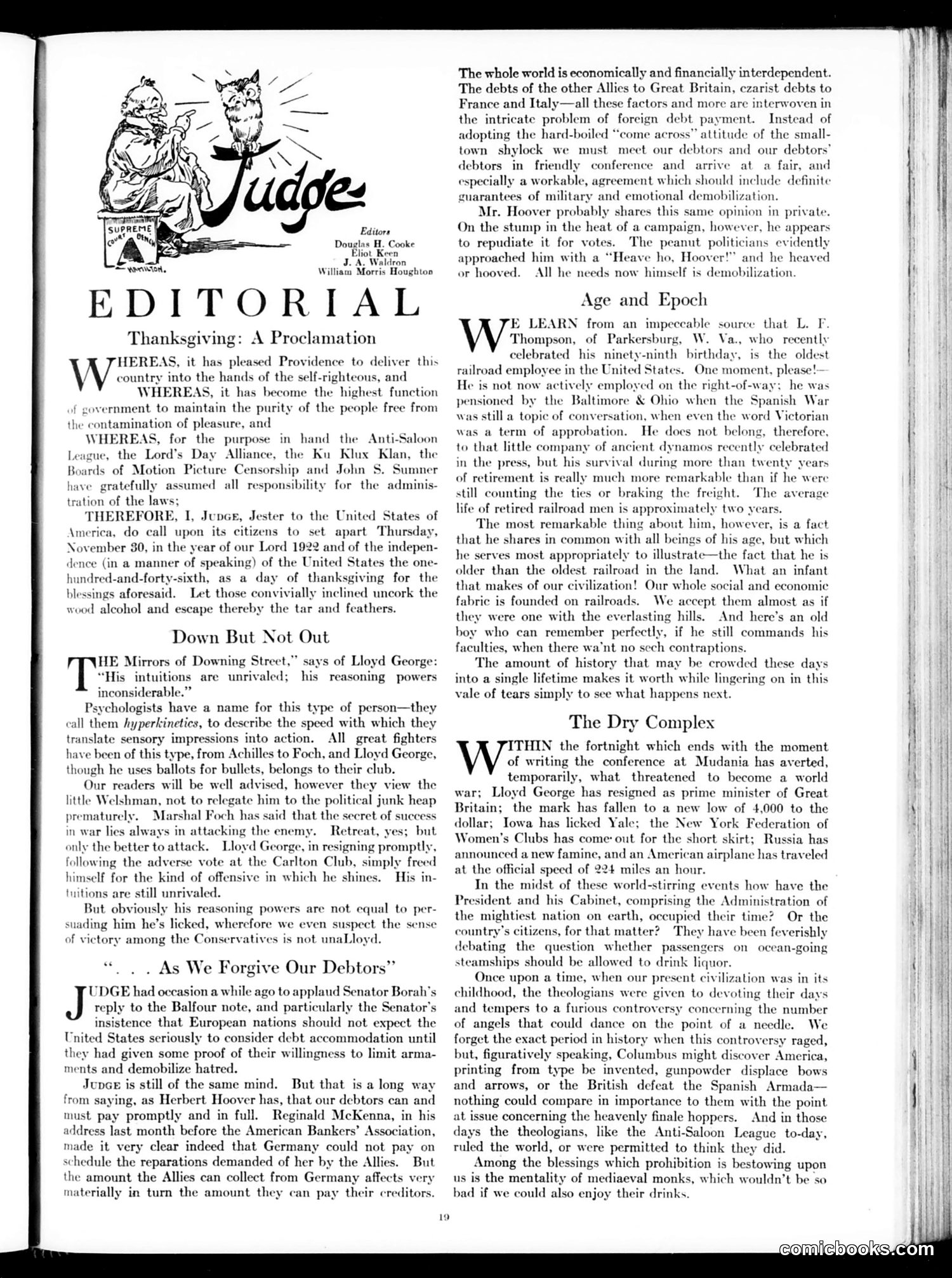
The masthead cartoon depicts "Judge" as a jester figure, establishing the magazine's satirical voice. The editorials mock American moral reformism and post-WWI politics. **"Thanksgiving: A Proclamation"** sarcastically celebrates Prohibition-era "self-righteousness," naming actual reform organizations (Anti-Saloon League, Lord's Day Alliance, KKK, motion picture censors) as having taken governmental control. The joke warns readers to drink illicit "wood alcohol" or face violent punishment—dark humor about Prohibition's unintended consequences. **"Down But Not Out"** defends Lloyd George, Britain's Prime Minister who recently resigned, arguing his impulsive nature ("hyperkinetics") suits warfare but not reasoned governance. The piece suggests he'll mount a political comeback. **"As We Forgive Our Debtors"** criticizes Herbert Hoover's hardline stance on Allied war debts to America. Judge argues international debts form an interconnected system requiring negotiated solutions rather than aggressive collection—a pragmatic position against isolationist debt-collecting. The page reflects 1922 concerns: Prohibition enforcement, British politics, and post-WWI economic reconstruction.
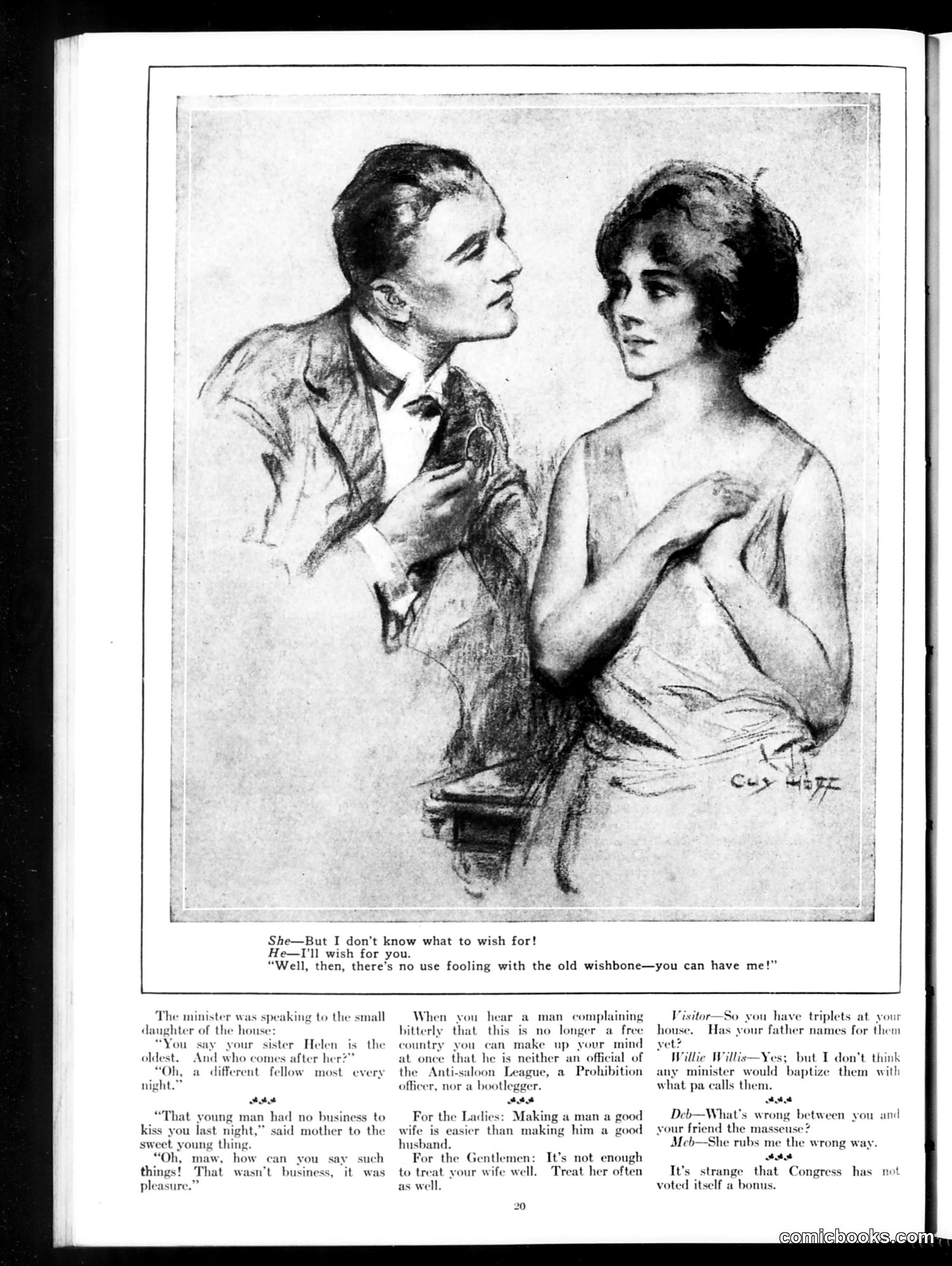
This page from Judge magazine contains several brief satirical jokes and one illustrated cartoon, all targeting early 20th-century social conventions and politics. The main illustration depicts a flirtatious couple at a wishbone, with the man offering himself as a "wish"—satirizing courtship rituals and male presumption. The text jokes mock: - **Parental hypocrisy**: A minister questions a daughter about suitors while parents overlook their own indiscretions - **Prohibition-era politics**: A quip about Anti-Saloon League officials and bootleggers—contemporary references to 1920s alcohol enforcement and its corruption - **Gender relations**: Jokes about wives, husbands, and romantic pursuit reflecting period attitudes - **Congress**: A final jab suggesting congressmen are self-interested and undeserving of bonuses The humor relies on recognizing contemporary social anxieties (courtship propriety, Prohibition enforcement, marital dynamics) that readers of the era would immediately understand as targets of satirical critique.
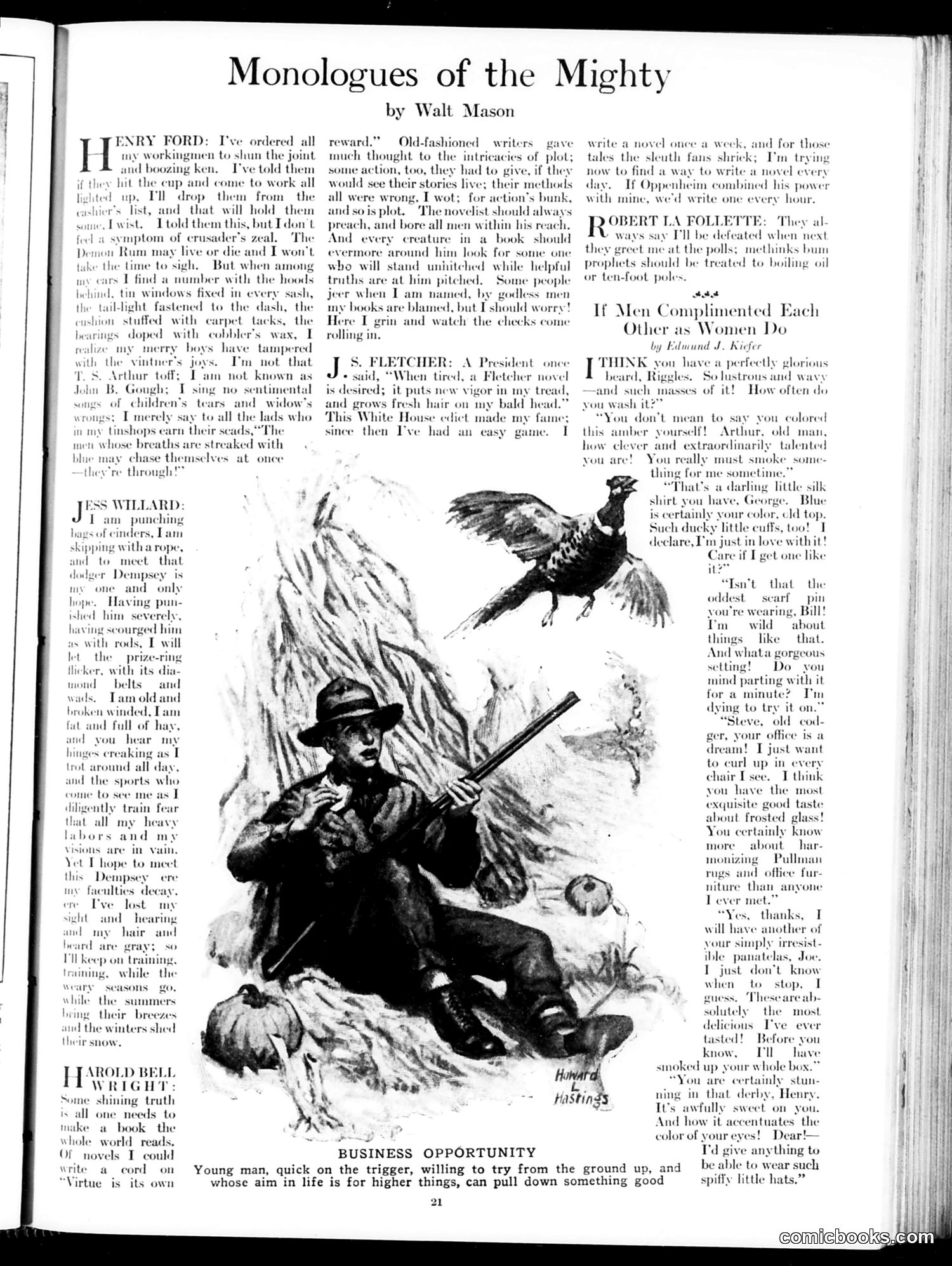
This page from Judge magazine features satirical monologues by Walt Mason mocking prominent public figures of the era. **The cartoons and monologues:** The central illustration shows a boxer training, accompanying **Jess Willard's monologue**—Willard was the heavyweight boxing champion. He boasts of his training regimen while admitting his age and decline, creating comic irony. **Henry Ford's monologue** satirizes his well-known temperance crusade (banning alcohol at Ford factories) while hypocritically admitting his workers secretly drink. The joke: Ford's moral preaching rings hollow. **Harold Bell Wright** discusses writing bestsellers based on simple moral truths—a swipe at his sentimentality. **Robert La Follette's brief monologue** references political opposition (being "defeated at the polls"). The bottom feature, **"If Men Complimented Each Other as Women Do,"** is social satire mocking exaggerated flattery—contrasting gentlemen's supposed restraint with women's supposedly excessive compliments about appearance and possessions. The page satirizes American celebrity, hypocrisy, and gender stereotypes typical of 1920s Judge content.
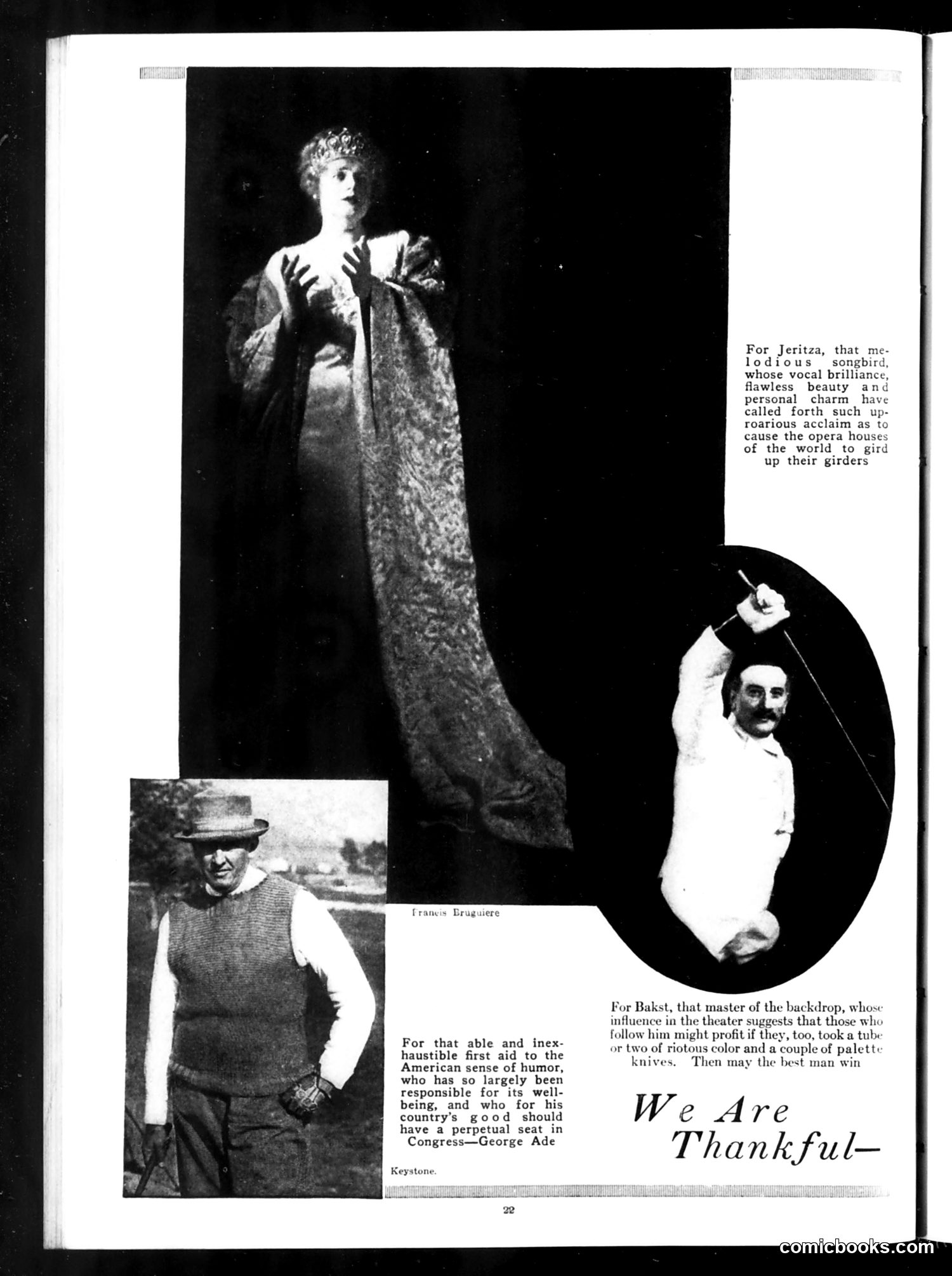
This page presents **gratitude tributes** to theatrical figures, illustrated with three photographs: 1. **Jeritza** (large central image): An opera singer whose "vocal brilliance" and beauty caused such acclaim that "opera houses of the world" had to "gird up their girders"—a humorous exaggeration suggesting her performances were so powerful they physically strained the buildings. 2. **Bakst** (right oval portrait): A theater set designer ("master of the backdrop") whose influence on theater design is being acknowledged. 3. **George Ade** (left rectangular photo, credited "Keystone"): An American humorist praised as "first aid to the American sense of humor" and jokingly deserving "a perpetual seat in Congress." The page's title, "We Are Thankful," frames these as expressions of gratitude to entertainers and cultural figures who enriched American public life. The tone is affectionate mockery—exaggerating their importance while genuinely celebrating their contributions to theater and comedy.
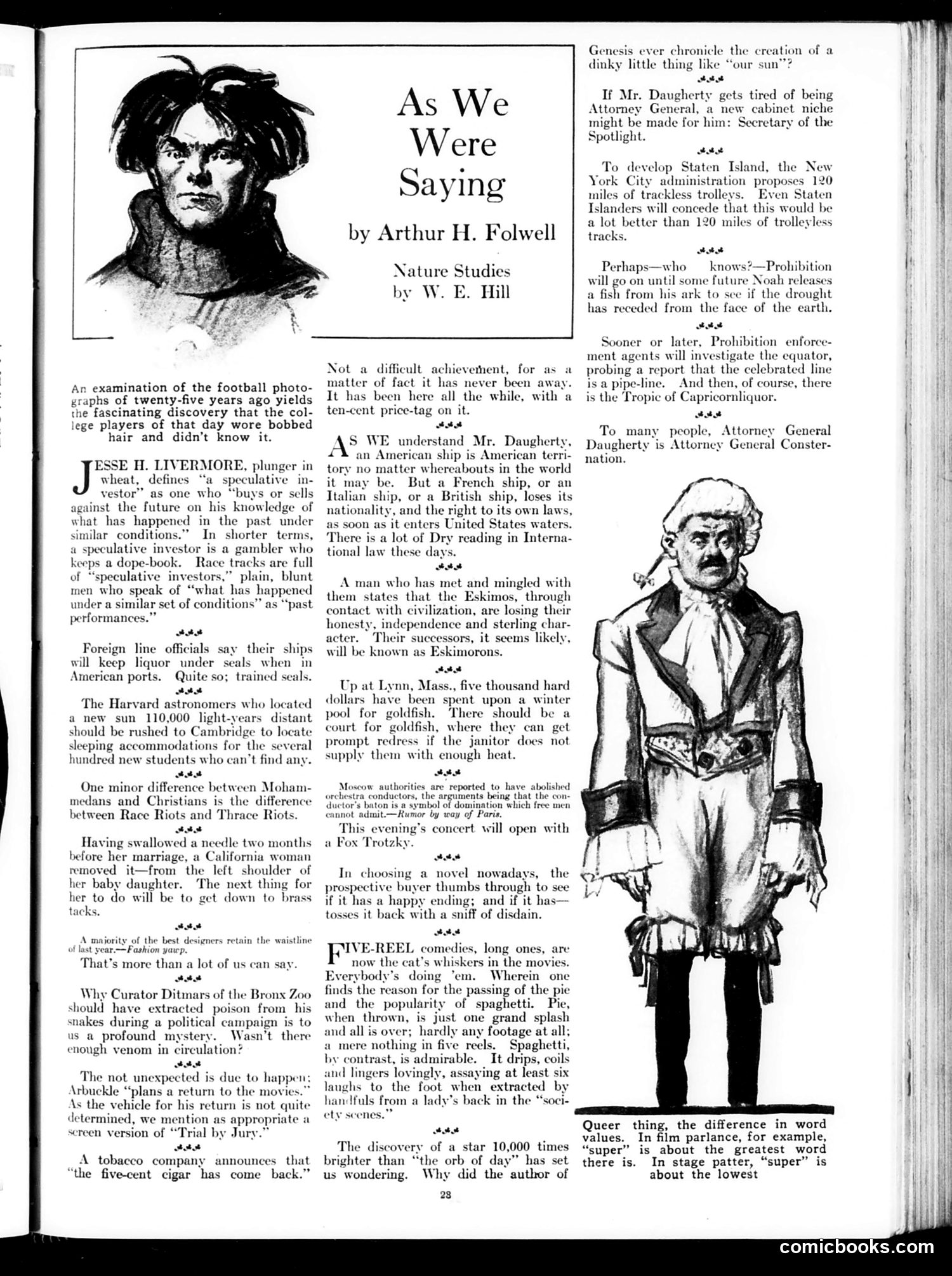
This page contains several short satirical commentary pieces by Arthur H. Folwell with nature illustrations by W.E. Hill. The humor targets contemporary (1920s) American absurdities: **Key Targets:** - **Attorney General Daugherty**: His legal interpretation that American ships maintain U.S. jurisdiction anywhere, while foreign ships lose their rights in American waters—mocked as "dry reading" in international law - **Prohibition enforcement**: Multiple jabs at alcohol policy inconsistencies - **Speculative finance**: Jesse Livermore (a real speculator) defined as a gambler using past performance to predict futures - **Miscellaneous social commentary**: Harvard housing shortages, Moscow abolishing orchestra conductors as "symbols of domination," five-cent cigars returning with inflated prices The cartoon illustrations (two portrait sketches visible) appear to accompany these pieces, though their specific subjects remain unclear from the image alone. The overall tone: witty, cynical observation of government overreach, economic folly, and cultural pretension.
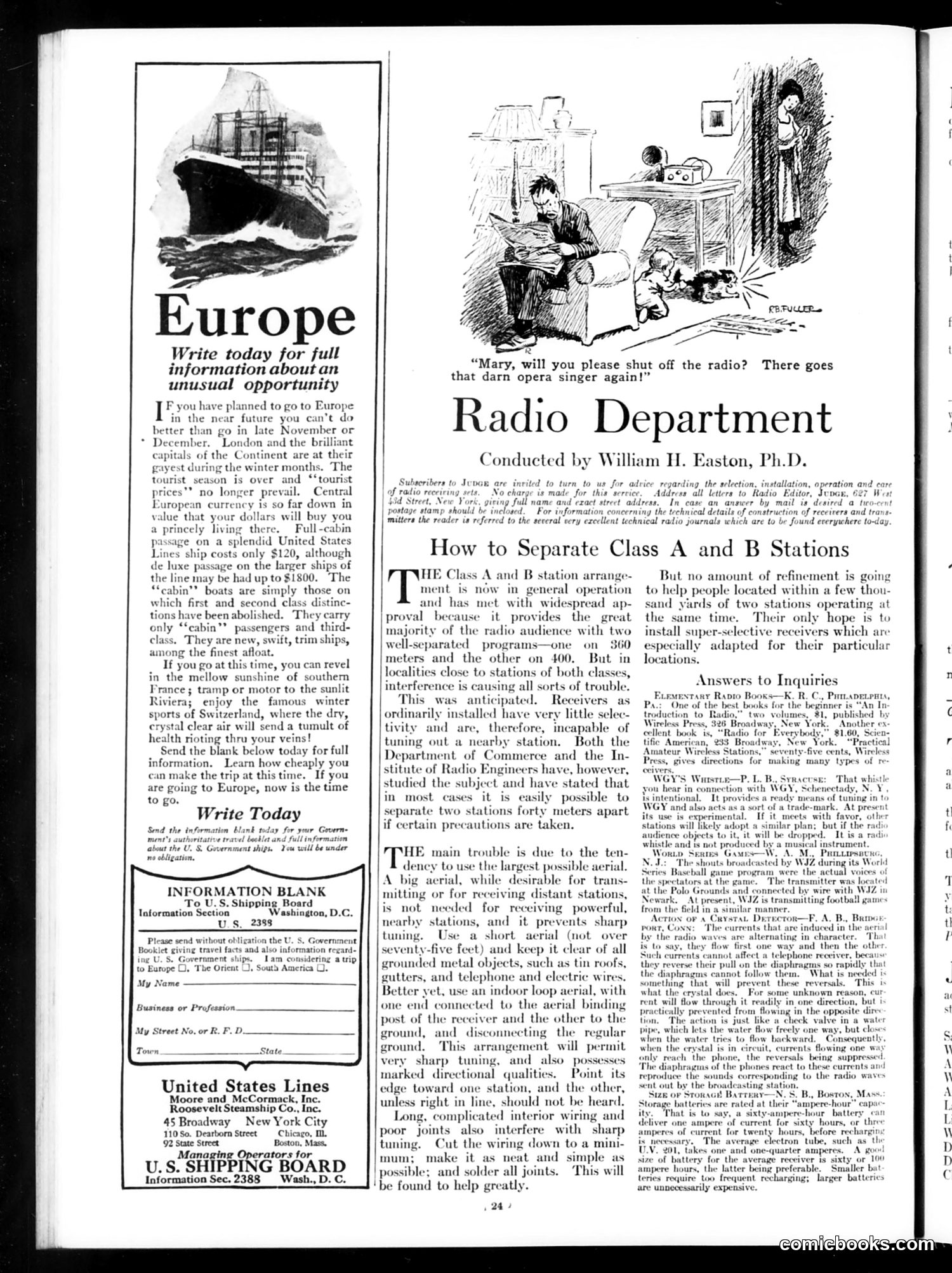
This page contains primarily **advertisements and technical content** rather than political satire. The main cartoon depicts a domestic scene: a man reading while a woman (presumably Mary) peeks from behind a curtain, complaining about an "opera singer" on the radio—likely a joke about the early radio broadcast quality or popular programming. The humor is gentle domestic comedy rather than satire. The bulk of the page consists of **commercial advertisements** for U.S. shipping lines promoting European travel, capitalized on favorable currency exchange rates and lower winter prices. A second section provides technical advice on radio reception, addressing the newly emerging problem of **radio station interference** on Class A and B frequencies. This reflects the **1920s context**: the era of early commercial broadcasting, when radio interference was a genuine technical problem, and transatlantic travel was a luxury marketed to affluent Americans. The page captures the period's commercial enthusiasm for both modern technologies and leisure travel.
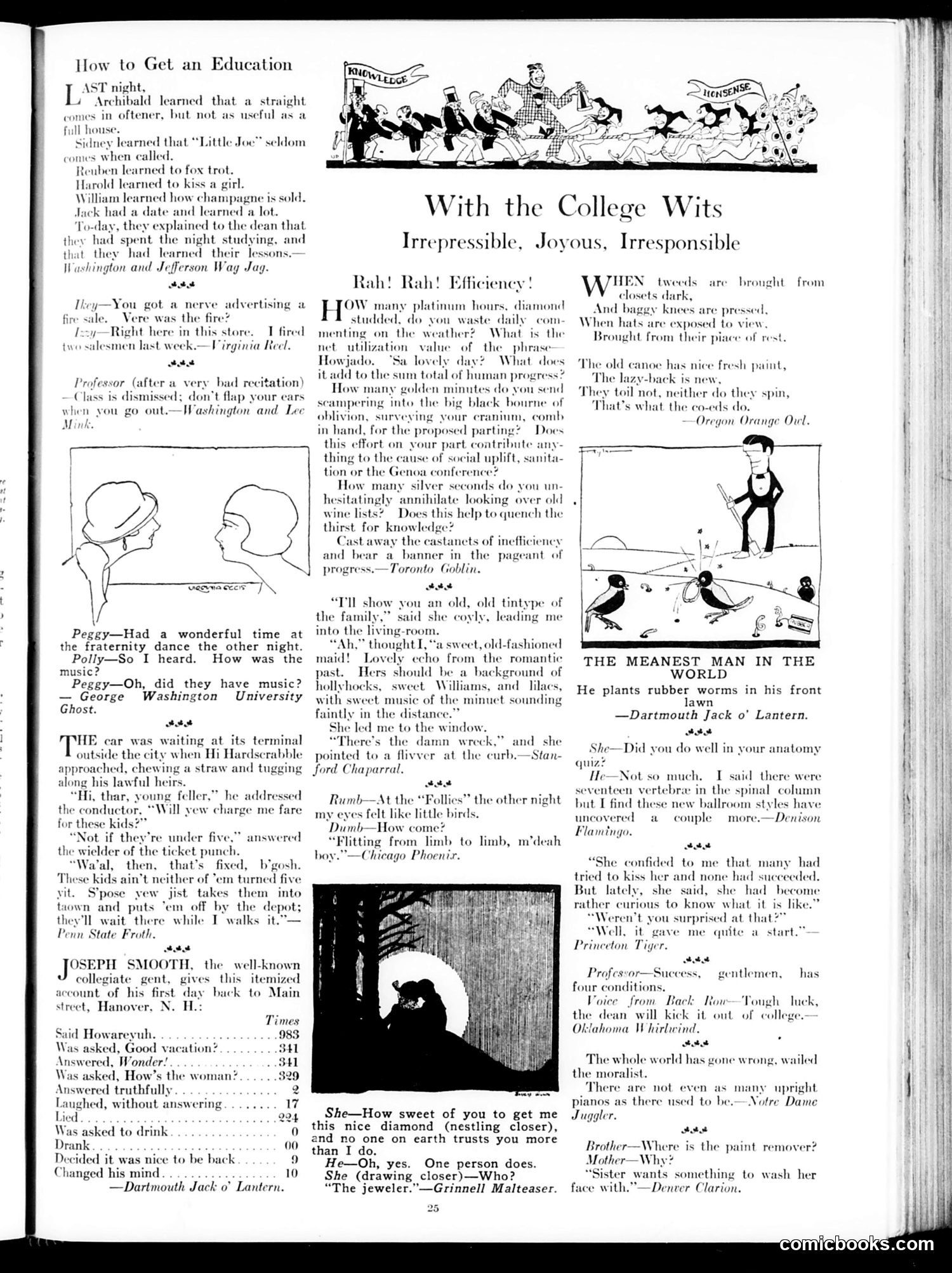
This page from Judge satirizes college life through humor pieces and a cartoon titled "The Meanest Man in the World," showing a man planting rubber worms on a lawn to trick birds. The main content mocks student behavior and academic pretense: **"How to Get an Education"** ridicules students who spend nights gambling, dancing, and drinking, then lie to deans about "studying." It's satire on the gap between claimed academics and actual collegiate pursuits. **The college wit sections** parody overly earnest efficiency-obsession, with professors obsessing about "net utilization value" of small talk and time-wasting. This mocks both academic pretentiousness and emerging early-20th-century efficiency movements. **Anecdotes** include a rural character avoiding train fares by claiming his children aren't five (they apparently are), and a student's itemized account of returning to campus (saying "hello," drinking, changing his mind about liking it back). The humor targets: student hypocrisy, pompous academic language, rural vs. urban class differences, and the disconnect between college's stated mission and actual student behavior.
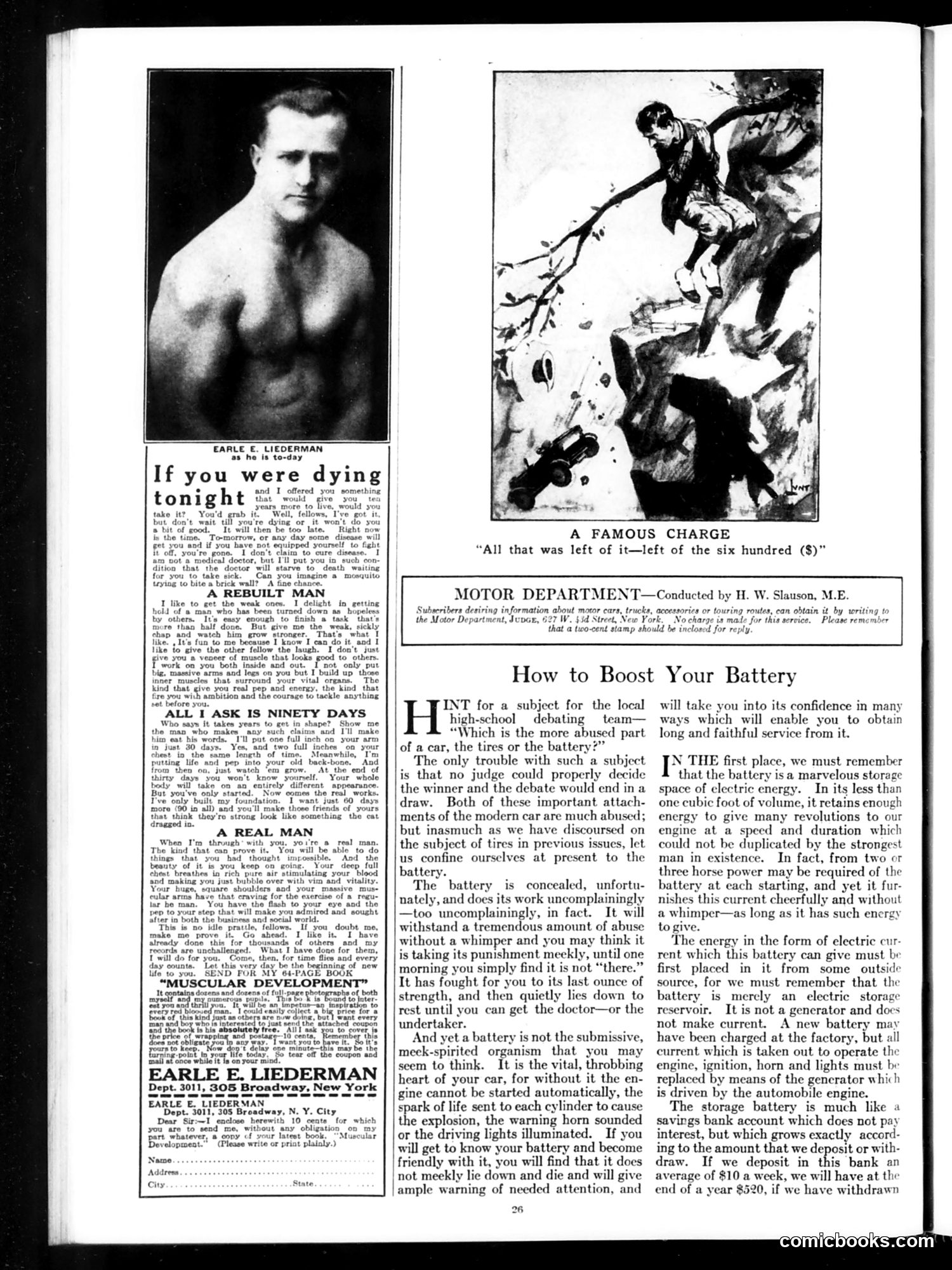
This page mixes advertising with automotive content. The left side features **Earle E. Liederman**, a real bodybuilding promoter from this era, advertising his physical training methods through hyperbolic testimonials ("A REBUILT MAN," "MUSCULAR DEVELOPMENT"). These ads promise rapid transformation—strength, vitality, and masculine confidence—typical early-20th-century fitness marketing targeting insecure men. The cartoon titled **"A FAMOUS CHARGE"** (top right) references Tennyson's "Charge of the Light Brigade," a poem about a military disaster. The caption "All that was left of it—left of the six hundred ($)" appears to satirize financial loss or mismanagement—likely a contemporary scandal or business failure—by darkly joking that only money remains from a catastrophe. The **"Motor Department"** section is a genuine advice column about car maintenance, specifically battery care, contrasting sharply with the melodramatic advertising copy surrounding it.
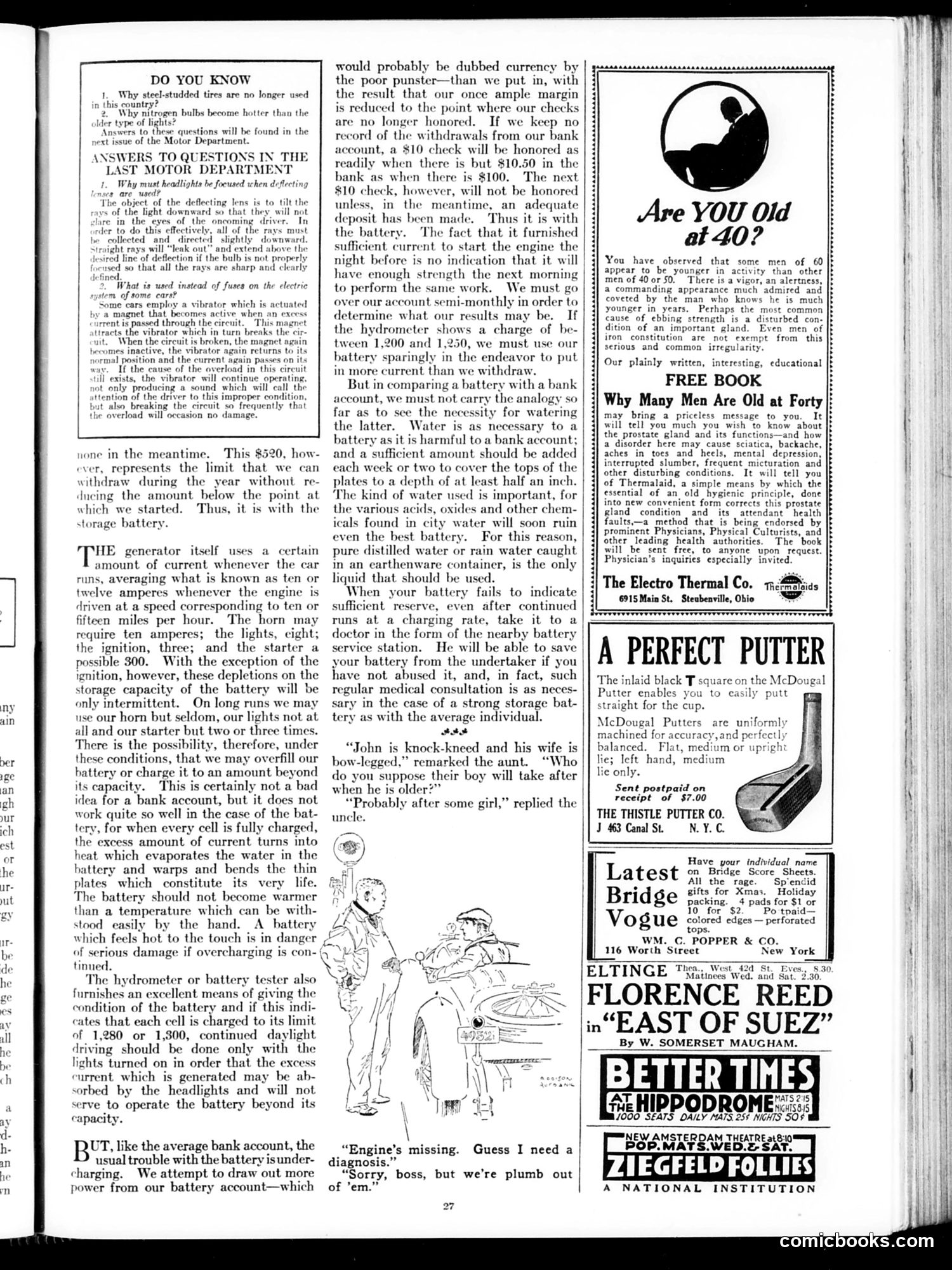
This page is **primarily instructional/educational content about automobile maintenance**, not satirical. The main feature is a "Motor Department" Q&A addressing technical questions about car batteries, generators, and electrical systems—presented as a serious guide for motorists. The **one cartoon visible** shows two men on a motorcycle or bicycle, with the caption "Engine's missing. Guess I need a diagnosis, Sports, boss, but we're plumb out of 'em." This is a straightforward visual joke: the rider is asking for a mechanical diagnosis while their engine is literally missing from the vehicle. The page includes numerous **period advertisements** (for books on aging, a golf putter, bridge score sheets, and theatrical shows) typical of Judge's commercial content. There is **no political satire on this page**. The humor is mechanical/practical rather than social commentary. The battery information uses banking metaphors as teaching tools, not satirical critique.
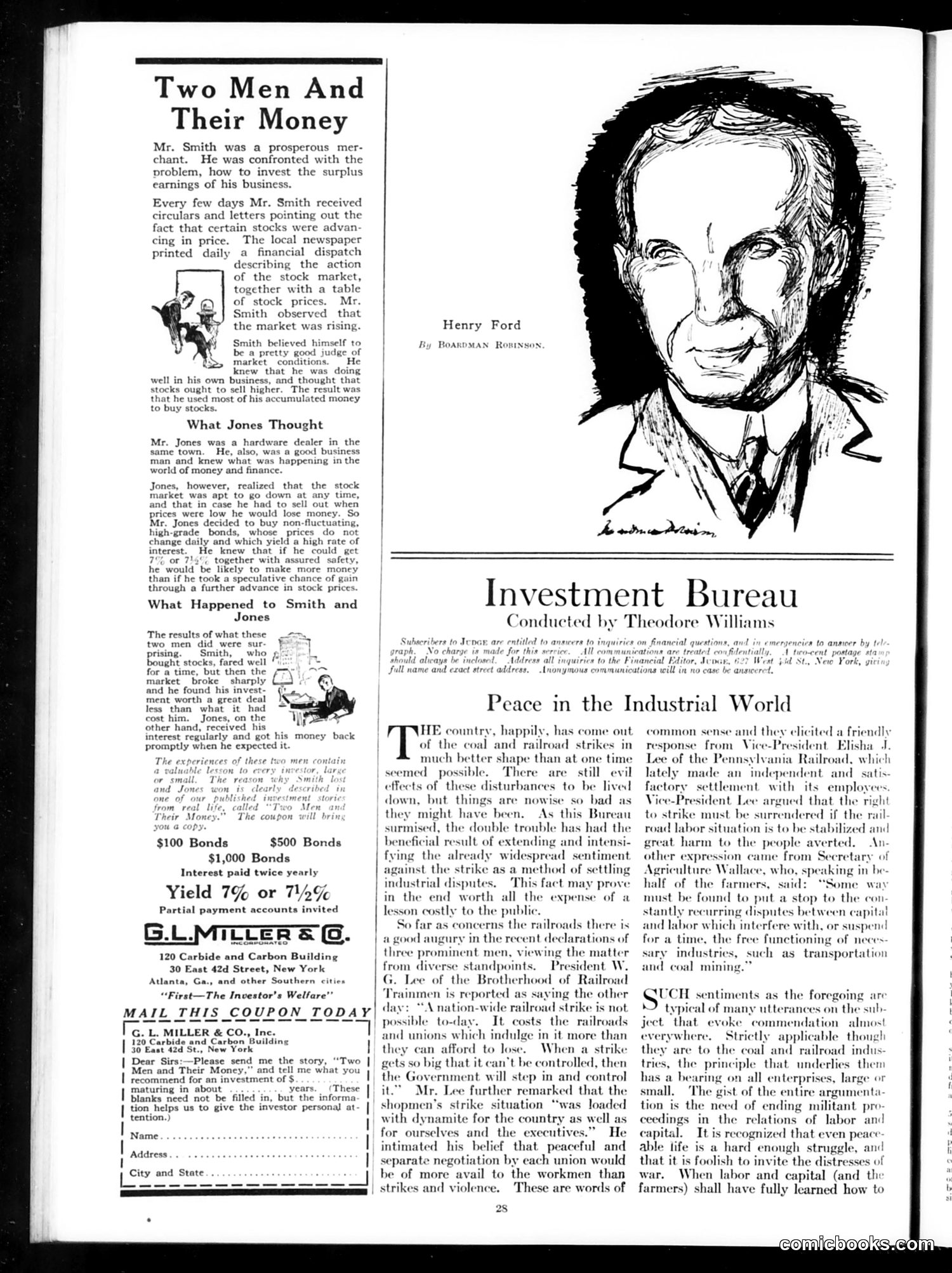
This page combines financial advice with portraiture and commentary on labor relations. **"Two Men and Their Money"** is a cautionary tale contrasting two investment approaches: Smith, a merchant, speculates in stocks (which rise then crash), losing money; Jones, a hardware dealer, invests conservatively in high-yield bonds and preserves his wealth. The moral is clear: prudent, stable investments beat speculative gambling. **The portrait** shows Henry Ford, captioned "By Boardman Robinson." His inclusion likely connects to the adjacent article on labor peace. **"Peace in the Industrial World"** discusses recent railroad strikes, noting they've subsided and created public sentiment *against* strikes as dispute-resolution methods. The piece cites President W.G. Lee of the Brotherhood of Railroad Trainmen arguing that massive strikes are economically impossible—they cost too much for both railroads and unions. **Context for modern readers**: This reflects early-20th-century class tensions. Judge presents strikes negatively while promoting conservative capitalism and financial prudence as virtues. The pairing suggests strikes damage the economy that "prudent men" like Jones depend upon.
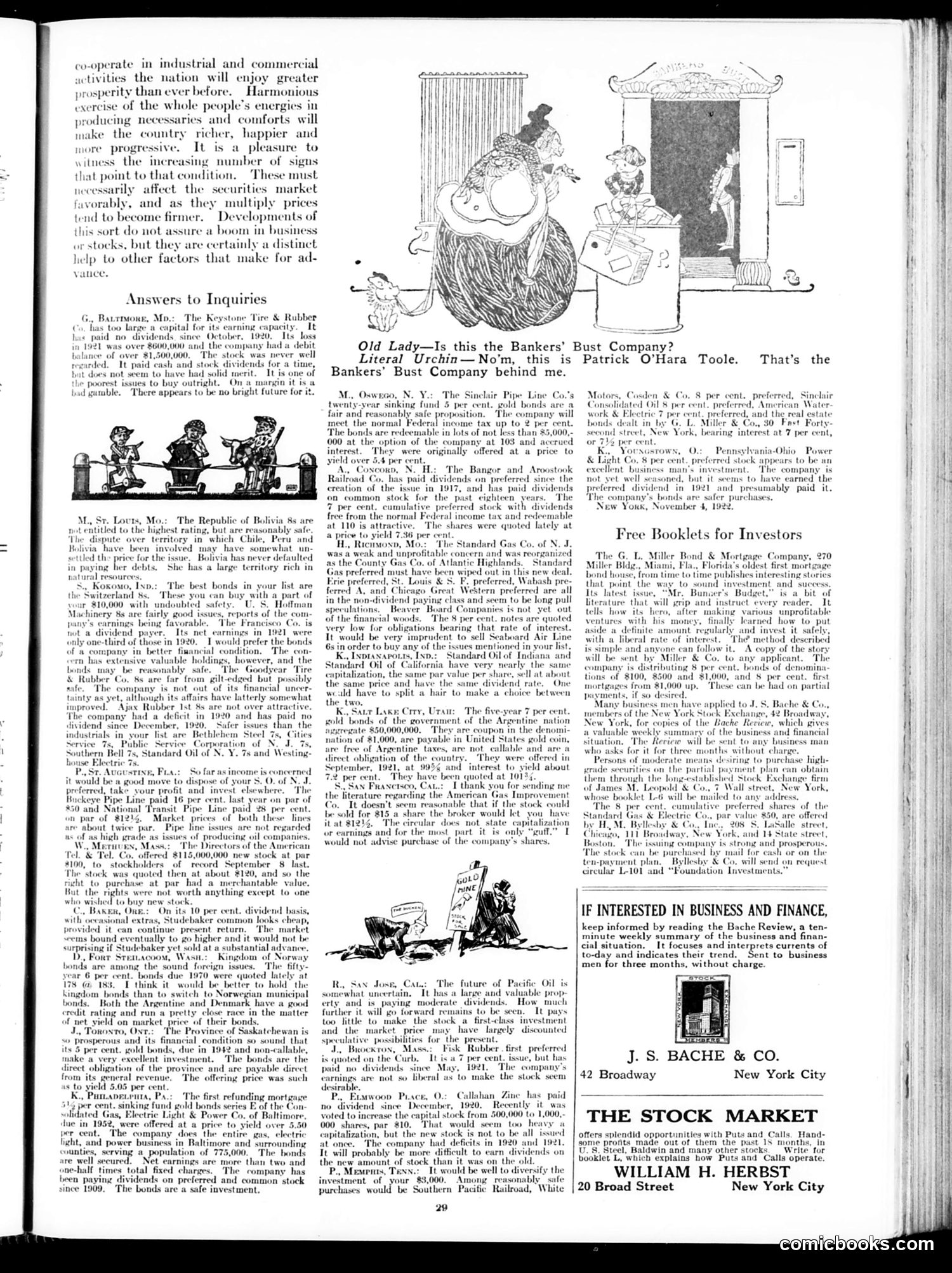
This cartoon depicts an elderly woman confronting a man labeled as representing the "Bankers' Bust Company." The joke plays on the double meaning of "bust"—both financial collapse and a sculptural head portrait. The woman appears to be accusing bankers of being responsible for economic hardship (literal "busting" of finances), while the man behind her claims this is Patrick O'Hara Toole's "Bankers' Bust Company"—presumably a business selling busts (sculptures) of bankers. The satire targets public frustration with bankers during the 1920s post-war period, suggesting that banking institutions were destroying ordinary people's finances. The cartoon's humor derives from the wordplay and the visual irony of mistaken identity—the woman expects financial villainy but finds only sculptural merchandise.
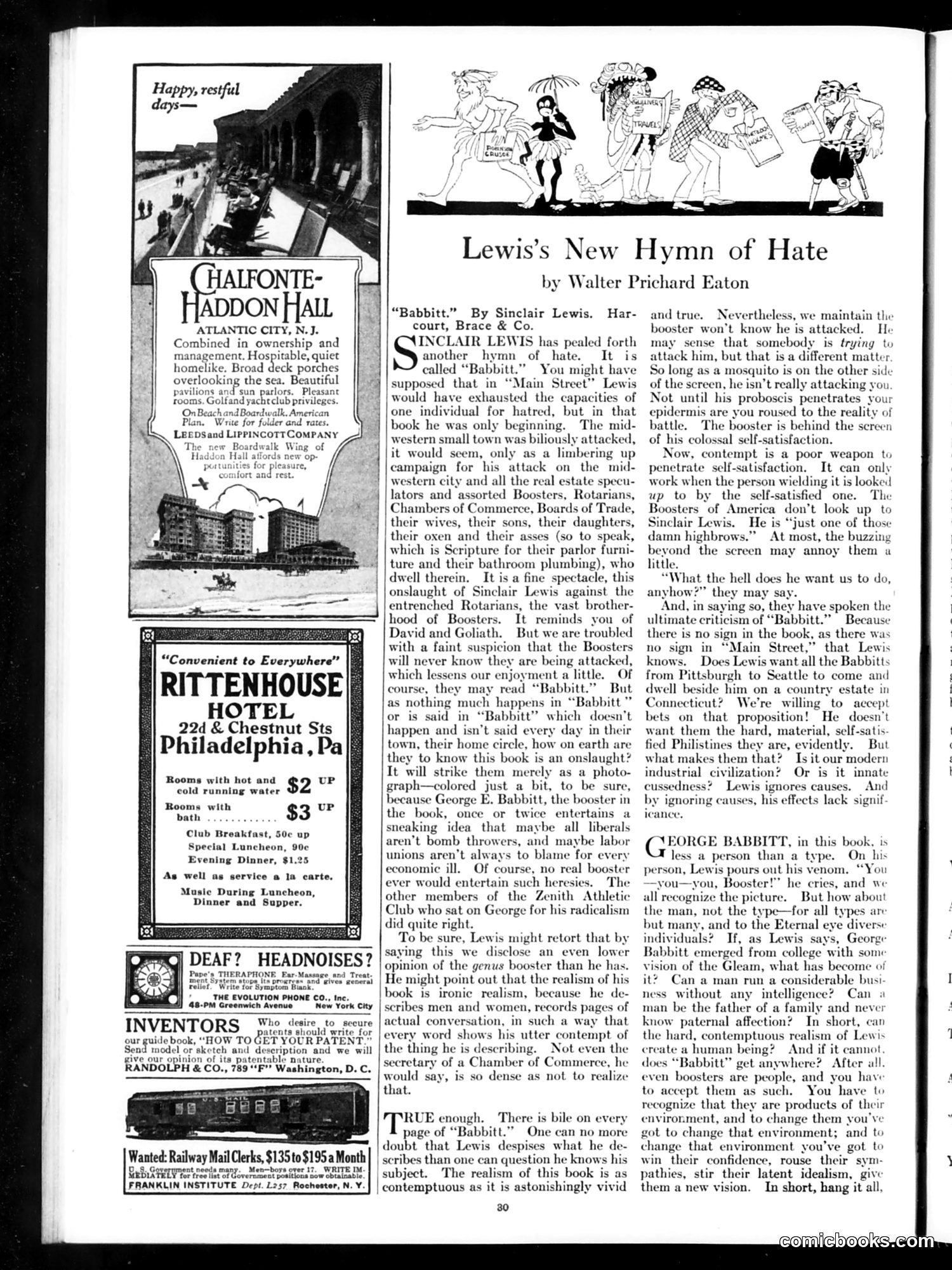
This page reviews Sinclair Lewis's novel *Babbitt*, a 1922 satirical attack on American middle-class materialism and conformity. The reviewer, Walter Prichard Eaton, argues that Lewis's book is a scathing indictment of Midwestern businessmen—real estate speculators, Rotarians, Chamber of Commerce members, and their families—whom Lewis portrays with contempt through meticulous, realistic detail. The reviewer suggests Lewis's satire may be ineffective precisely because *Babbitt* reads like photographed reality rather than obvious caricature. The boosters Lewis attacks won't recognize themselves as targets because such shallow materialism and conformity are simply their daily reality. The irony: Lewis's contemptuous realism is so accurate to actual booster behavior that the subjects of his scorn may miss they're being mocked at all.
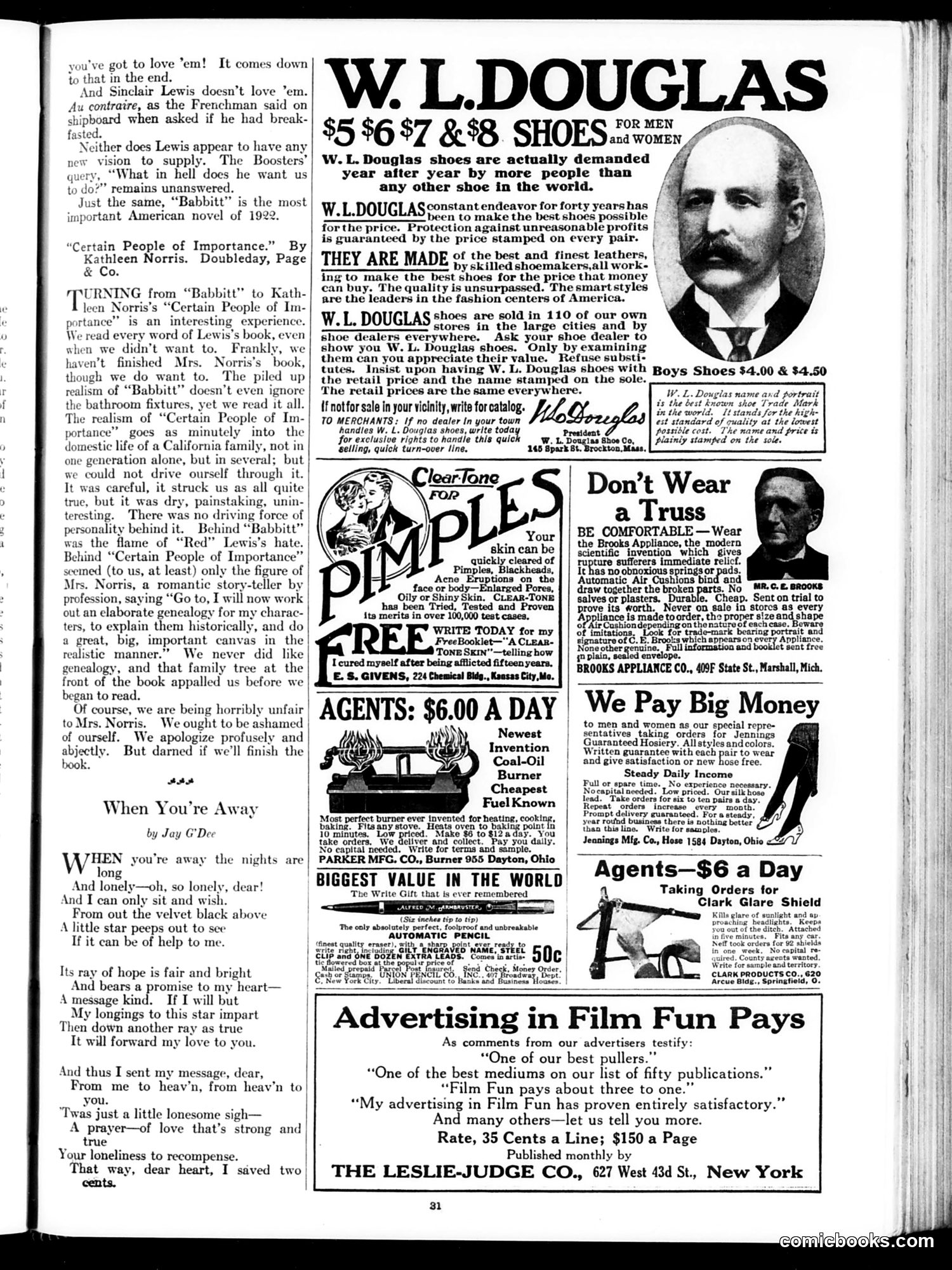
This page is primarily **advertising-heavy**, typical of 1920s magazines. However, the left column contains book reviews discussing Sinclair Lewis's *Babbitt* (1922) and Kathleen Norris's *Certain People of Importance*. The reviewer praises *Babbitt* as "the most important American novel of 1922," crediting Lewis's satirical portrayal of American middle-class conformity and commercialism. Lewis "doesn't love 'em"—the boosters and conventional businesspeople he depicts. The review contrasts this with Norris's more earnest, genealogical family saga, which the reviewer finds dry and uninspiring despite its technical competence. The poem "When You're Away" is sentimental verse about romantic longing. The remaining content is product advertising—W.L. Douglas shoes, skincare treatments (Clear-Tone), coal-oil burners, and employment solicitation—representing typical early-1920s marketing directed at middle-class readers.
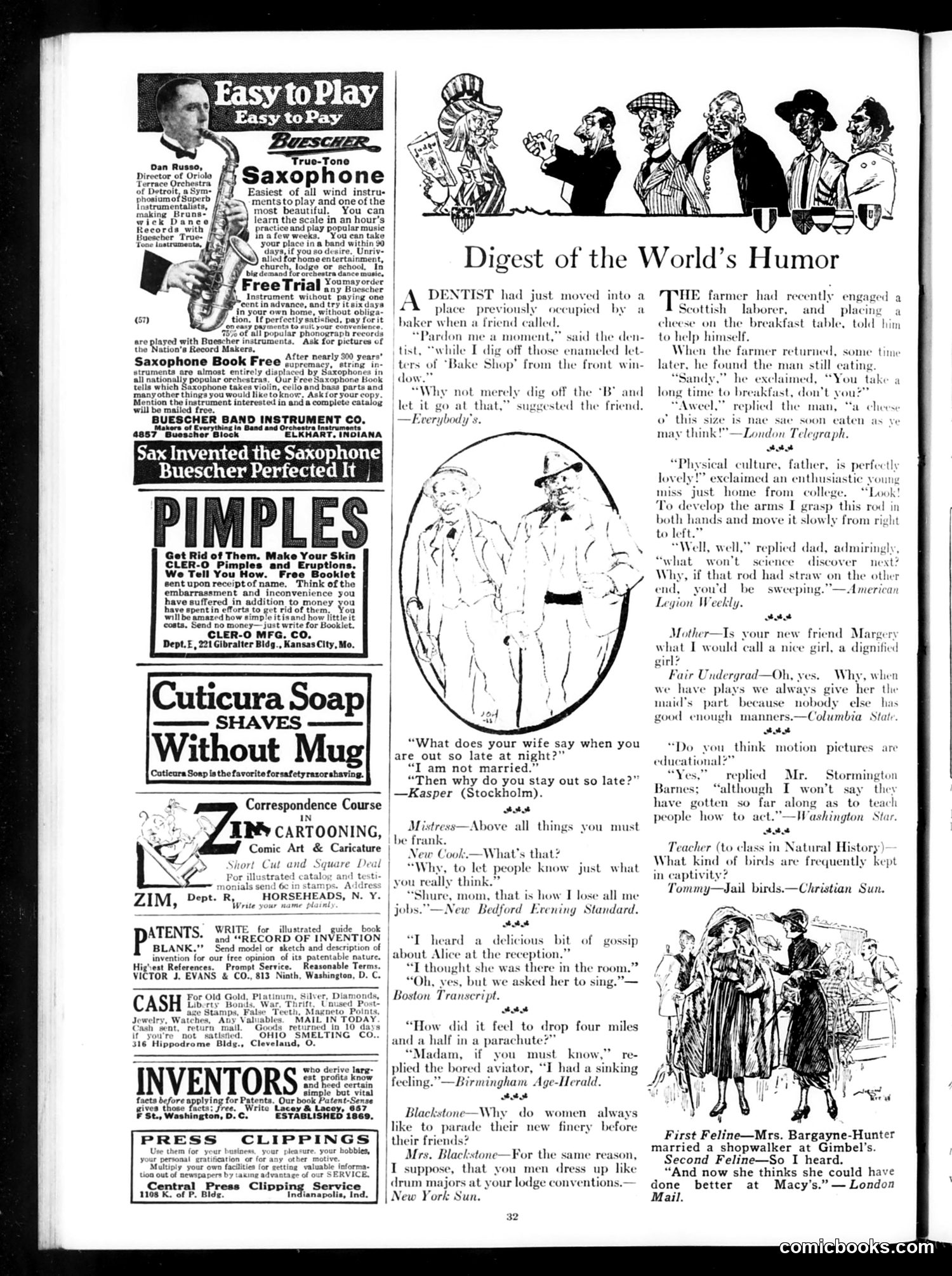
This page is primarily **advertising and humor content** from Judge magazine. The top section features a "Digest of the World's Humor"—reprinted jokes from various publications organized by topic. The cartoons are modest single-panel sketches accompanying brief anecdotes, including: - A dentist who discovers a previous patient left dentures in the chair - A father teaching physical culture to his son - Various social humor about marriage, gossip, and courtship The page is dominated by **advertisements** for saxophones, pimple remedies, soap, cartooning courses, and patent services—typical of early 20th-century magazine monetization. No specific political figures or controversial satire appears. The humor is mild, domestic, and aimed at middle-class readers.
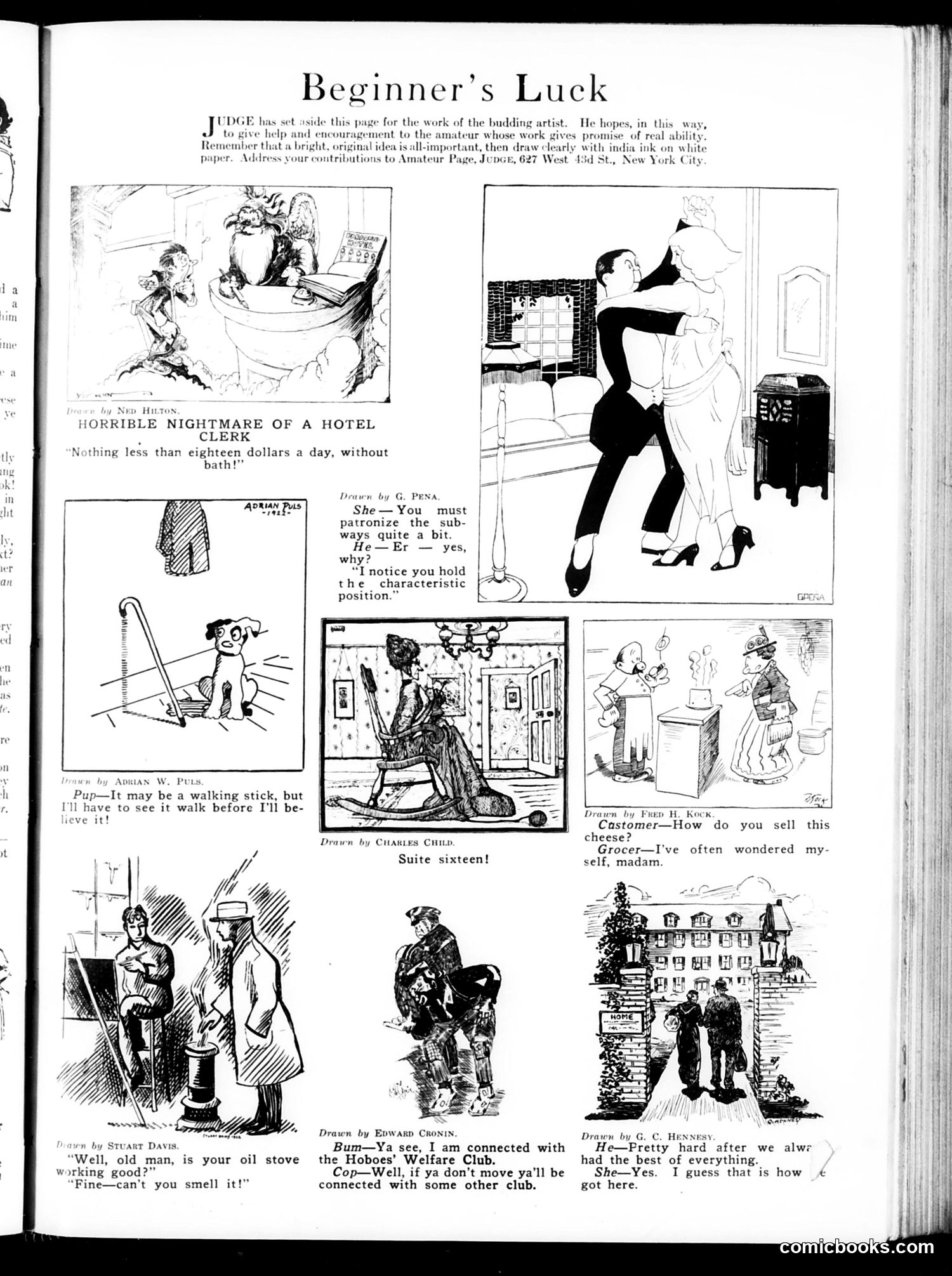
This is a submissions page encouraging amateur cartoonists to contribute work. The header explains that Judge reserves space for promising new artists, requesting original ideas drawn in india ink on white paper. The six comic vignettes satirize working-class struggles and social awkwardness of the early 20th century: - A hotel clerk's nightmare about low wages and no bathing facilities - A woman noticing a man's subway commuter posture - A skeptical owner questioning whether a walking stick actually works - A woman being pressured to patronize subways for "characteristic position" - A vagrant claiming connection to a "Hoboes' Welfare Club" to avoid arrest - A grocer bewildered by how he sells cheese, and a couple reflecting that wealth has made them less appreciative The humor relies on period-specific details: hotel working conditions, subway culture, class anxiety, and vagabond social structures. These sketches capture everyday urban frustrations and class-conscious humor typical of Judge's satirical approach.
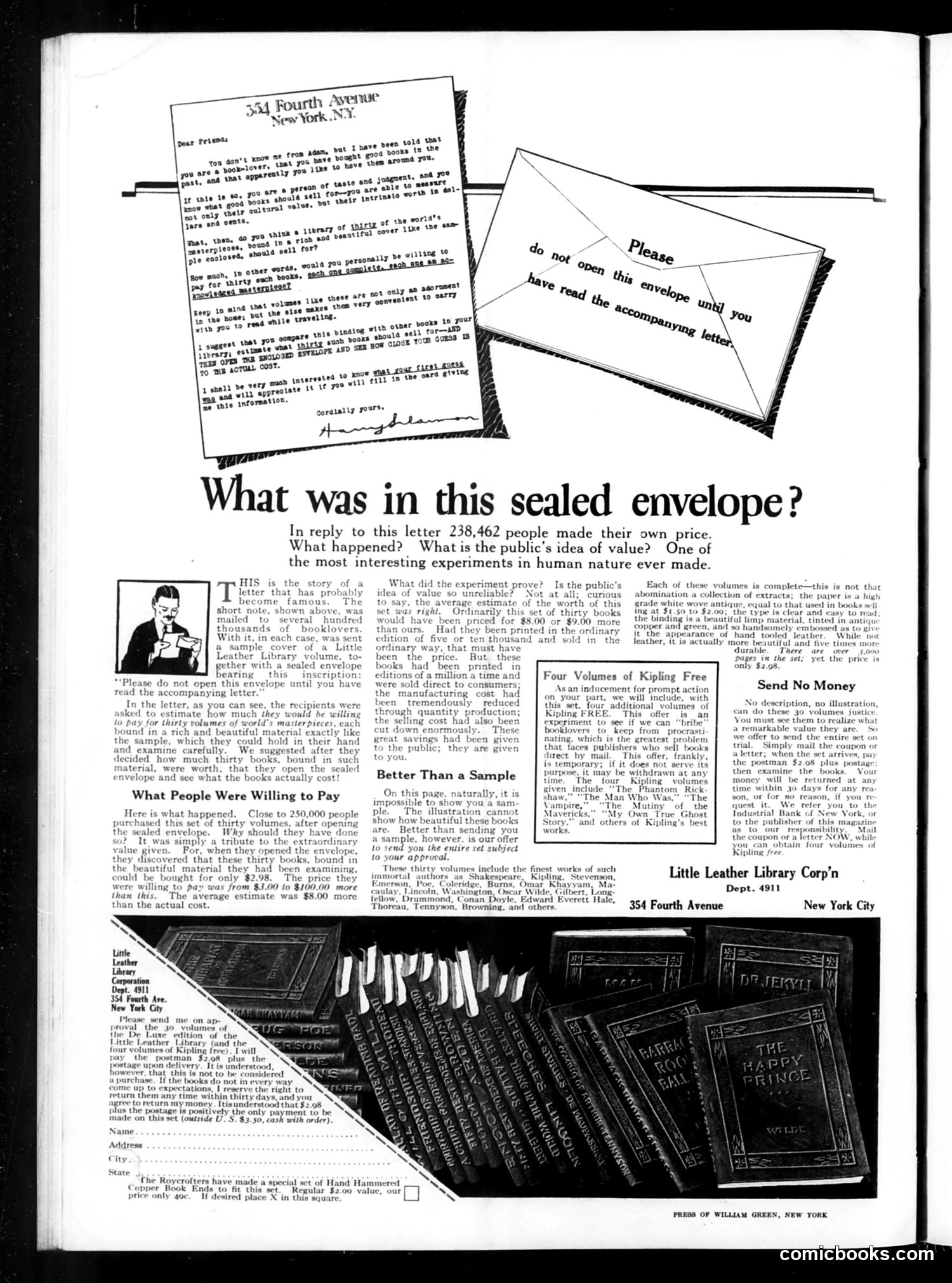
This page documents a marketing experiment by the Little Leather Library Corporation. The company mailed sealed envelopes containing sample volumes of classic literature to approximately 250,000 people, asking them to estimate the value of a 30-volume set without opening it. The satire targets human psychology and the public's concept of value. When people couldn't see the actual product, they estimated prices ranging from $3 to $100—averaging $8 more than the actual $2.98 cost. Once they opened the envelope and examined the quality materials (antique paper, decorative binding), they discovered the books were worth far less than their blind estimates. The joke exposes how perception, mystery, and expectation artificially inflate perceived value. It's presented as "one of the most interesting experiments in human nature ever made"—a tongue-in-cheek commentary on consumer behavior and how people assign worth based on imagination rather than reality.