
Judge, 1922-11-11 · page 8 of 36
Judge — November 11, 1922 — page 8: what you’re looking at
What you’re looking at
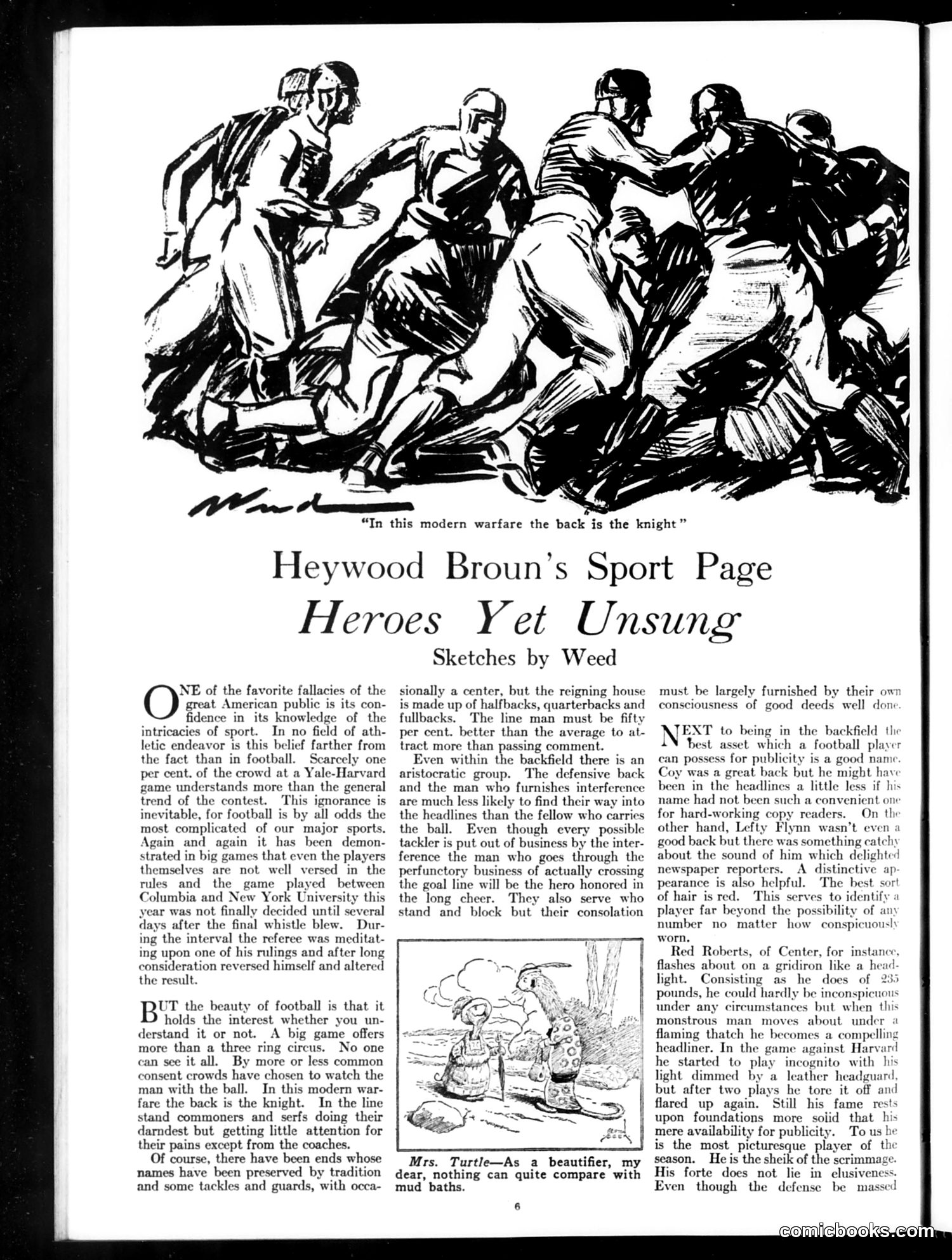
This is a sports column by Heywood Broun, a famous sportswriter, illustrated by cartoonist Weed. The main article critiques how American football fans and media misunderstand the sport's true dynamics. **The Core Argument:** Broun argues that football's "knights" are the backfield players (halfbacks, quarterbacks, fullbacks) who get headlines and glory, while linemen—the commoners doing essential blocking and tackling—receive no recognition despite being crucial to plays. He notes even within the backfield, players who actually carry the ball receive disproportionate credit compared to those providing interference. **Secondary Points:** He observes that publicity depends on factors beyond skill: distinctive names (like "Coy"), distinctive appearance (especially red hair), and public recognition matter as much as performance. Red Roberts gets attention partly because his striking appearance makes him visible. **The Cartoon:** The sketch (by Weed) depicts a rugby/football scrum, emphasizing the collective effort and violence of line play—work largely invisible to spectators focused on ball carriers.
📄 Transcribed text from this page (OCR, searchable)
Machine-transcribed from the original scan — historical spelling and the odd misread are preserved.
“In this modern warfare the back is the knight” Heywood Broun’s Sport Page Heroes Yet Unsung NE of the favorite fallacies of the O great American public is its con- fidence in its knowledge of the intricacies of sport. In no field of ath- letic endeavor is this belief farther from the fact than in football. Scarcely one per cent. of the crowd at a Yale-Harvard game understands more than the gen trend of the contest. This ignorance is inevitable, for football is by all odds the most complicated of our major sports. Again and again it has been demon- strated in big games that even the players themselves are not well versed in the rules and the game played between Columbia and New York University this year was not finally decided until several days after the final whistle blew. Dur- ing the interval the referee was meditat- ing upon one of his rulings and after long nsideration reversed himself and altered the result. UT the beauty of football is that it holds the interest whether you un- derstand it or not. A big game offers more than a three ring circus. No one can see it all. By more or less common consent crowds have chosen to watch the man with the ball. In this modern war- fare the back is the knight. In the line stand commoners and serfs doing their darndest but getting little attention for their pains except from the coaches. Of course, there have been ends whose names have been preserved by tradition and some tackles and guards, with occa- Sketches by Weed sionally a center, but the reigning house is made up of halfbacks, quarterbacks and fullbacks. The line man must be fifty per cent. better than the average to at- tract more than passing comment. Even within the backfield there is an aristocratic group. The defensive back and the man who furnishes interference are much less likely to find their way into the headlines than the fellow who carries the ball. Even though every possible tackler is put out of business by the inter- ference the man who goes through the perfunctory business of actually crossing the goal line will be the hero honored in the long cheer. They also serve who stand and block but their consolation Mrs. Turtle—As a beautifier, my dear, nothing can quite compare with mud baths. 6 must be largely furnished by their own consciousness of good deeds well don JEXT to being in the backfield the Hest asset which ootball player can possess for publicity is a good nam Coy was a great back but he might ha been in the headlines a little less if his name had not been such a convenient one for hard-working copy readers. On the other hand, Lefty Flynn wasn’t even a good back but there was something catch) about the sound of him which delighted newspaper reporters. A. distinctive pearance is also helpful. The best sort of hair is red. This serves to identify a player far beyond the possibility of any number no matter how conspicuous! worn, Red Roberts, of Center, for instance, flashes about on a gridiron like a he: light. Consisting as he does of 235 pounds, he could hardly be inconspicuous under any circumstances but when this monstrous man moves about under « flaming thatch he becomes a compelling headliner. In the game against Harvard he started to play incognito with his light dimmed by ‘a leather headguard but after two plays he tore it off and flared up again. Still his fame rests upon foundations more soiid that his mere availability for publicity. To us he is the most picturesque player of the season. He is the sheik of the scrimmage. His forte does not lie in elusivenc Even though the defense be massed