
Judge, 1922-11-11 · page 28 of 36
Judge — November 11, 1922 — page 28: what you’re looking at
What you’re looking at
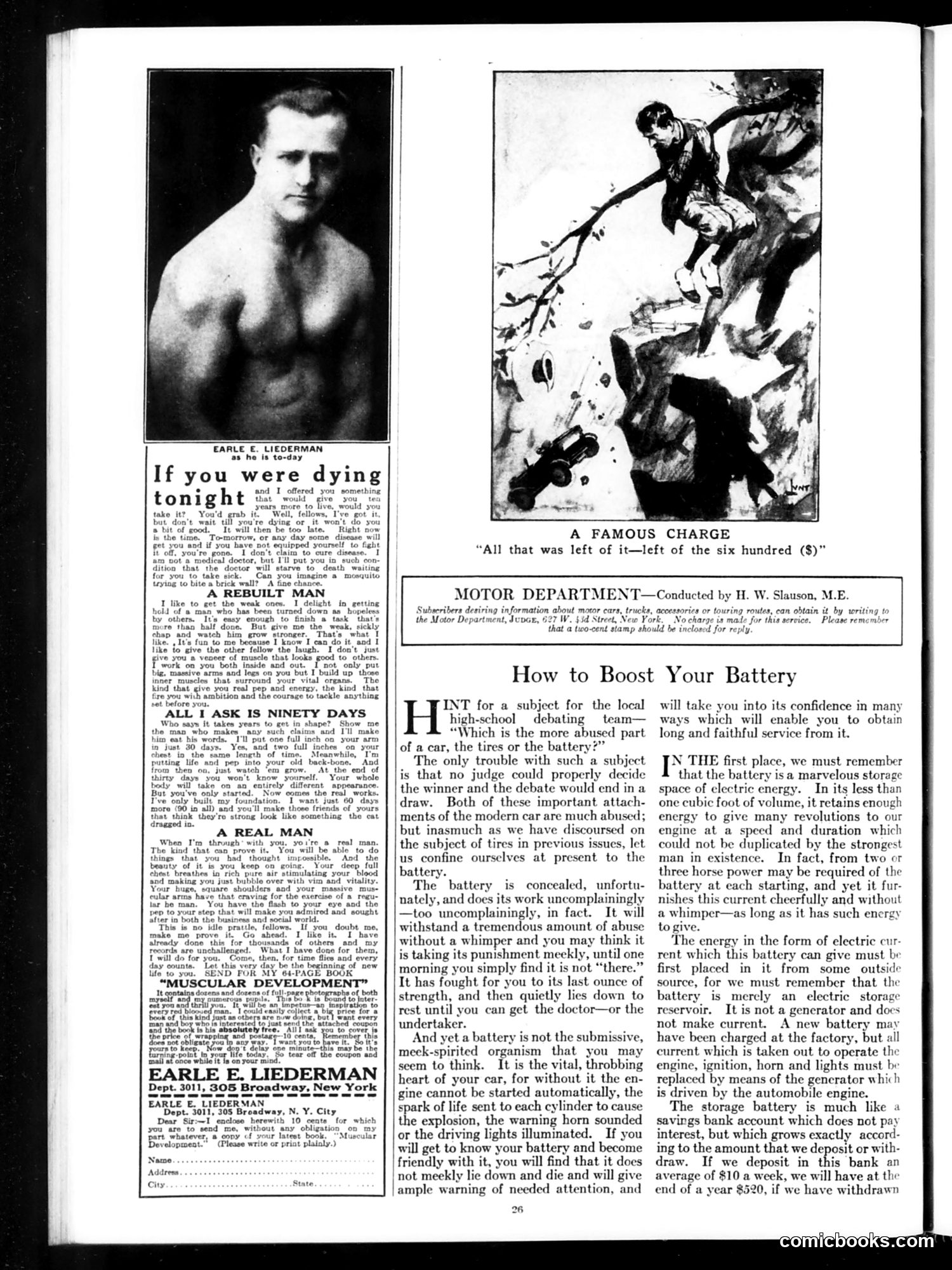
This page mixes advertising with automotive content. The left side features **Earle E. Liederman**, a real bodybuilding promoter from this era, advertising his physical training methods through hyperbolic testimonials ("A REBUILT MAN," "MUSCULAR DEVELOPMENT"). These ads promise rapid transformation—strength, vitality, and masculine confidence—typical early-20th-century fitness marketing targeting insecure men. The cartoon titled **"A FAMOUS CHARGE"** (top right) references Tennyson's "Charge of the Light Brigade," a poem about a military disaster. The caption "All that was left of it—left of the six hundred ($)" appears to satirize financial loss or mismanagement—likely a contemporary scandal or business failure—by darkly joking that only money remains from a catastrophe. The **"Motor Department"** section is a genuine advice column about car maintenance, specifically battery care, contrasting sharply with the melodramatic advertising copy surrounding it.
📄 Transcribed text from this page (OCR, searchable)
Machine-transcribed from the original scan — historical spelling and the odd misread are preserved.
EARLE E. LIEDERMAN as he is to-day If you were dying tonight 255 fake jt? by get you end if you have Holt, you're gone. 1 don’t claim to cure a medical doctor, but I'l that the for you to take sick. trying to bite a brick wall? A A REBUILT MAN I like to get the weak ones. I delight in getting ap and wateh him grow stronger. That's what I A to me because I know I can do it, and I e the other fellow the laugh. I don't just give you a veoeer of muscle that looks good to others T work on you both inside and out. I not only put ms and legs on you but I build up those 4 your vital organs. The ep and energy, the kind that fire you with ambition and the courege to tackle anything set before you, ALL I ASK IS Bee DAYS Who sayy it takes years just 60 iriends of yours that think they're strong look like something the cat dragged in. A REAL MAN you're a real man. will be able to do ‘You had. thought impossible.” And the keop joing. Your deep full re air stimulating your blood ius lo over with vim and vitality. uare © shoulder and your massive mus- If you doubt me, like it, I have js of others and my What I have done for them, fe , T delay ope minutethis may be pois ir life today. ‘So tear off the coupon all af once while It fe on your mi EARLE E. LIEDERMAN Dept, 2011, SOS Brondyray, New York EARLE E. LIEDERMAN Dept. 3011, 305 Broadway, N. Y. City A FAMOUS CHARGE “All that was left of it—left of the six hundred ($)” MOTOR DEPARTMENT—Conducted by H. W. Slauson, M.E. information about motor ca uDGE, 827 W. $id Stree that a two-cen: Subscribers desi the Motor Department, Ji rucks, accessorit or touring routes, can obtain it by wri rge ix made for this service. Please remember How to Boost Your Battery INT for a subject for the local high-school debating team— “Which is the more abi sed part of a car, the tires or the battery?’ The only trouble with such a subject is that no judge could properly decide the winner and the debate would end in a draw. Both of these important attach- ments of the modern car are much abused; but inasmuch as we have discoursed on the subject of tires in previous issues, let us confine ourselves at present to the battery. The battery is concealed, unfortu- nately, and does its work uncomplainingly —too uncomplainingly, in fact. It will withstand a tremendous amount of abuse without a whimper and you may think it is taking its punishment meekly, until one morning you simply find it is not “there.” It has fought for you to its last ounce of strength, and then quietly lies down to rest until you can get the doctor—or the : is not the submissive, meck-spirited organism that you may seem to think. It is the vital, throbbing heart of your car, for without it the en- gine cannot be started automatically, the spark of life sent to each cylinder to cause the explosion, the warning horn sounded or the driving lights illuminated. If you | will get to know your battery and become | friendly with it, you will find that it does | not meekly lie down and die and will give |ample warning of needed attention, and will take you into its confidence in many ways which will enable you to obtain long and faithful service from it. N THE first place, we must remember that the battery is a marvelous storage space of electric energy. In its less than one cubic foot of volume, it retains enough energy to give many revolutions to our engine at a speed and duration which could not be duplicated by the strongest man in existence. In fact, from two or three horse power may be required of the batte each starting, and yet it fur- nishes this current cheerfully and without a whimper—as long as it has such energy to 5 The energy in the form of electric cur rent which this battery can give must be first placed in it from some outside source, for we must remember that the battery is merely an electric storage reservoir. It is not a generator and does not make current. A new battery may have been charged at the factory, but all current which is taken out to operate the engine, ignition, horn and lights must be replaced by means of the generator which is driven by the automobile engine. The storage battery is much like savings bank account which does not pay interest, but which grows exactly accord- ing to the amount that we deposit or with- draw. If we deposit in this bank an average of $10 a week, we will have at the end of a year $520, if we have withdrawn