
Judge, 1922-11-11 · page 9 of 36
Judge — November 11, 1922 — page 9: what you’re looking at
A restored page from Judge, 1922-11-11. Page through the whole issue in the reader above.
📄 Transcribed text from this page (OCR, searchable)
Machine-transcribed from the original scan — historical spelling and the odd misread are preserved.
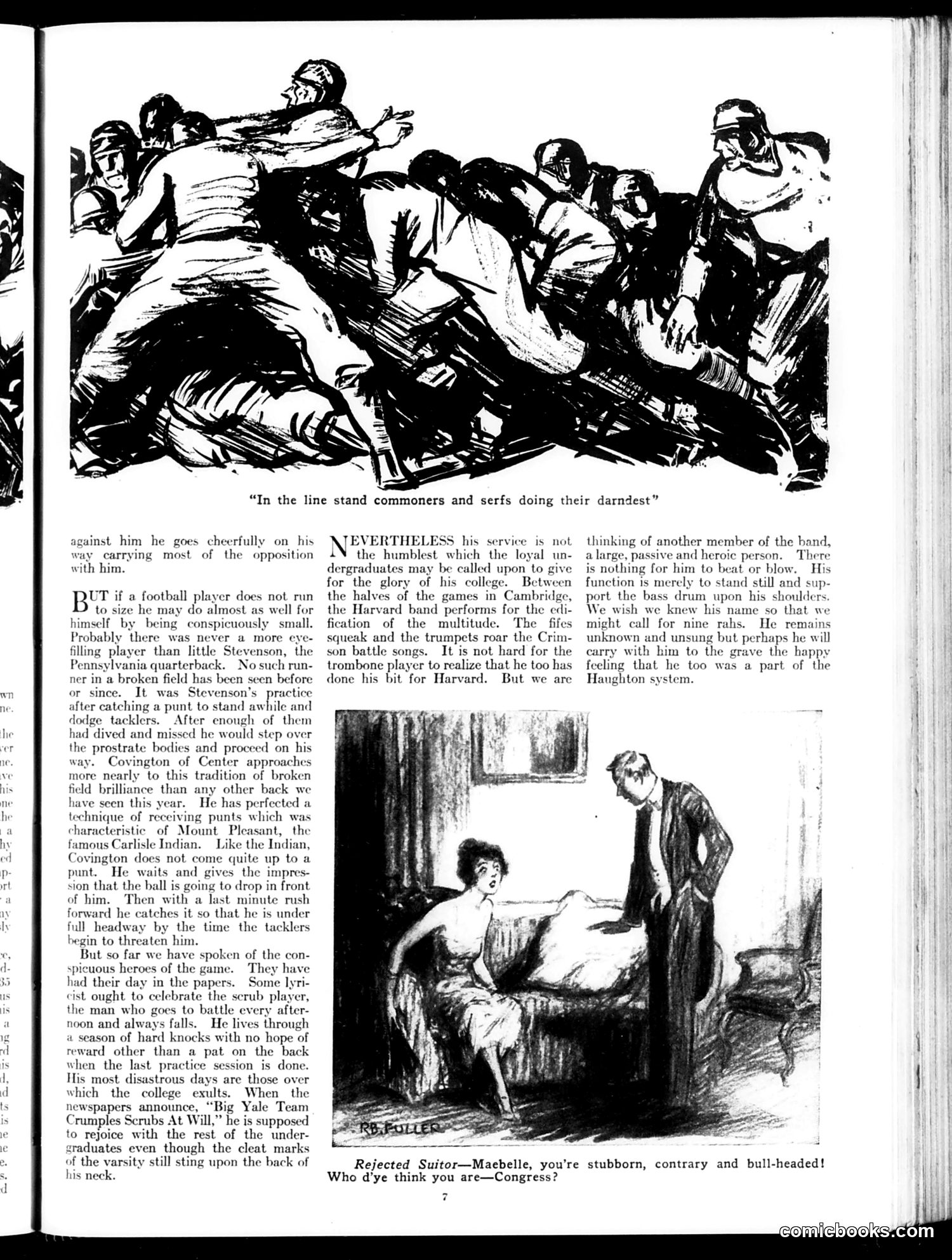
inst him he goes cheerfully on his way carrying most of the opposition with him. JT if a football player does not run to size he may do almost as well for himself by being conspicuously small. Probably there was never a more eye: filling player than little Stevenson, the Pennsylvania quarterback. No such run- ner in a broken field has been seen before or since. It was Stevenson's practice after catching a punt to stand aw Rite dodge tacklers. After enough of them had dived and missed he would step over the prostrate bodies and proceed on his way. Covington of Center approaches more nearly to this tradition of broken field brilliance than any other have seen this year. He has perf technique of receiving punts which was characteristic of Mount Pleasant, the famous Carlisle Indian. Like the Indian, Covington does not come quite up to a punt. He waits and gives the impres- sion that the ball is going to drop in front of him. Then with a last minute rush forward he catches it so that he is under full headway by the time the tacklers begin to threaten him. But so far we have spoken of the con- spicuous heroes of the game. They have had their day in the papers. Some lyri- cist ought to celebrate the scrub player, the man who goes to battle every after- noon and always falls. He lives through a season of hard knocks with no hope of reward other than a pat on the back when the last practice session is done. His most disastrous days are those over which the college exults. When_ the newspapers announce, “Big Yale Team Crumples Scrubs At Will,” he is supposed to rejoice with the rest of the under- graduates even though the cleat marks of the varsity still sting upon the back of his neck. “In the line stand commoners and serfs doing their darndest” TEVERTHELESS his service is not 1N the humblest which the loyal un- dergraduates may be called upon to give for the glory of his college. Between the halves of the games in Cambridge, the Harvard band performs for the edi- fication of the multitude. The _fifes squeak and the trumpets roar the Crim- son battle songs. It is not hard for the trombone player to realize that he too has done his bit for Harvard. But we are Rejected Suitor—Maebelle, you're Who d’ye think you are—Congress? thinking of another member of the band, a large, passive and heroic person. There is nothing for him to beat or blow. His function is merely to stand still and sup- port the bass drum upon his shoulders We wish we knew his name so that we might call for nine rahs. He remains unknown and unsung but perhaps he will carry with him to the grave the happy feeling that he too was a part of the Haughton system.