
Judge, 1922-11-11 · page 32 of 36
Judge — November 11, 1922 — page 32: what you’re looking at
What you’re looking at
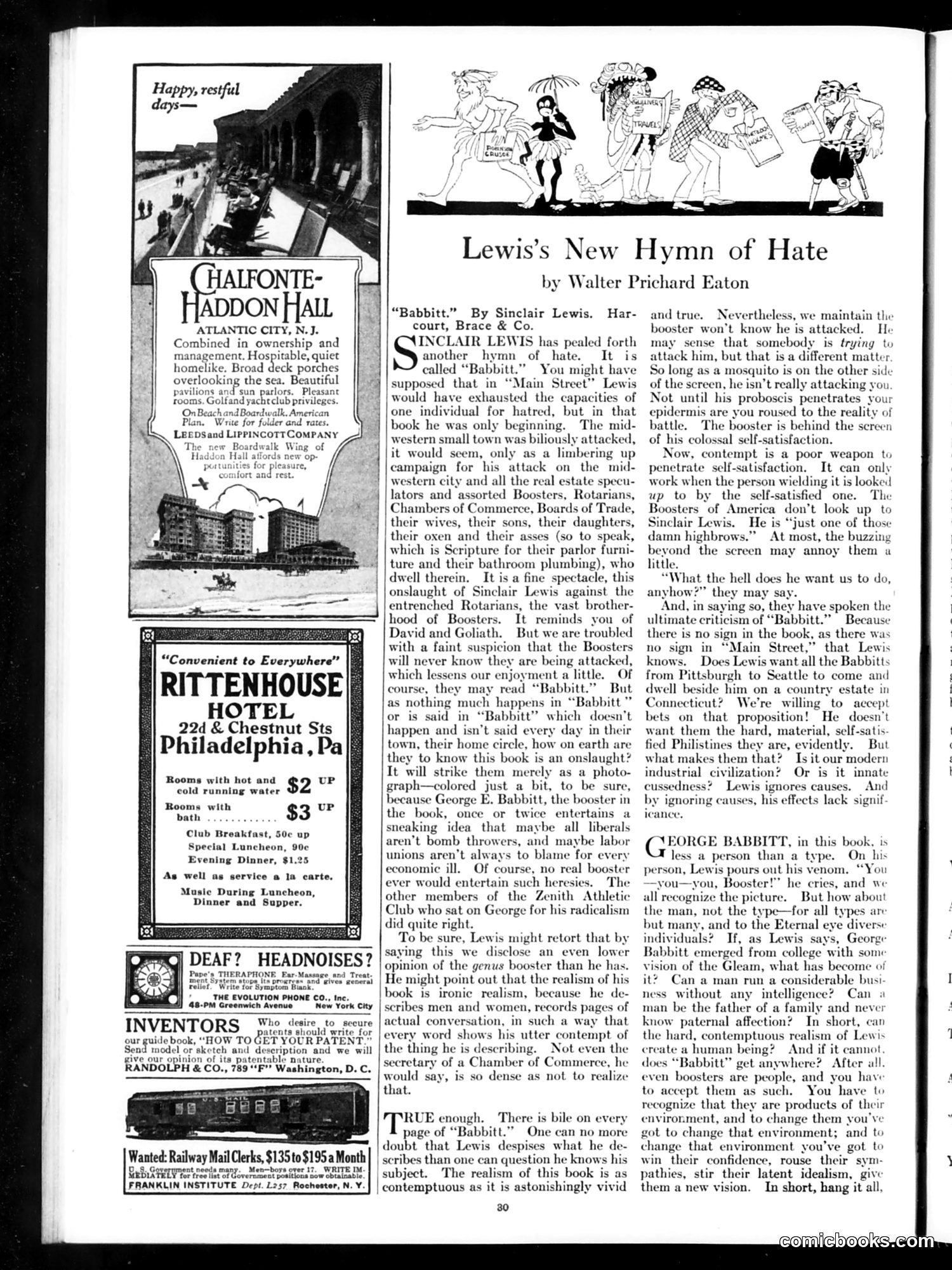
This page reviews Sinclair Lewis's novel *Babbitt*, a 1922 satirical attack on American middle-class materialism and conformity. The reviewer, Walter Prichard Eaton, argues that Lewis's book is a scathing indictment of Midwestern businessmen—real estate speculators, Rotarians, Chamber of Commerce members, and their families—whom Lewis portrays with contempt through meticulous, realistic detail. The reviewer suggests Lewis's satire may be ineffective precisely because *Babbitt* reads like photographed reality rather than obvious caricature. The boosters Lewis attacks won't recognize themselves as targets because such shallow materialism and conformity are simply their daily reality. The irony: Lewis's contemptuous realism is so accurate to actual booster behavior that the subjects of his scorn may miss they're being mocked at all.
📄 Transcribed text from this page (OCR, searchable)
Machine-transcribed from the original scan — historical spelling and the odd misread are preserved.
Happy, restful days— ATLANTIC CITY, N. J. Combined in ownership and management. Hospitable, quiet homelike. Broad deck porches overlooking the sea. Beautiful pavilions and sun parlors. Pleasant rooms. Golfand yacht club privileges. a d Boardwalk. American “Convenient to Everywhere” RITTENHOUSE} HOTEL 22d & Chestnut Sts Philadelphia, Pa Rooms with hot and UP cold running water $2 Club Breakfast, 50¢ up Special Luncheon, 90¢ Evening Dinner, $1.25 As well as service a la carte, Music During Luncheon, Dinner and Supper. | DEAF? Fellet _HEADNOISES? + THE EVOLUTION PHONE CO., Inc. 48-PM Greenwich Avenue New York City Who desire to secure INVENTORS pica shoud write tor ATENT.” our guidebook, “HOW TO GET YOUR P. Send model or'sketch and description and we will e our opinion of its p: ple nature. RANDOLPH & Co., 78 Wi Wanted: Railway Mail Clerks, $135to$195.a Month Goveryment needs many. Men—bors over 17. WRITE IM Sebi XPRLW Yor'rreslisrot Woversnant pollens sow cbuleabie FRANKLIN INSTITUTE Dept. L257 Rochester, N.Y. “Babbitt.” By Sinclair Lewis. Har- court, Brace & Co. CLAIR LEWIS has pealed forth hymn of hate. It is called “Babbitt.” You might have upposed that in “Main Street” Lewis ve exhausted the capacities of one individual for hatred, but in that book he was only beginning. The mid- western small town was biliously attacked, it would seem, only as a limbering up campaign for his attack on the mid- western city and all the real estate specu- lators and assorted Boosters, Rotarians, Chambers of Commerce, Boards of Trade, } | their wives, their sons, their daughters, their oxen and their asses (so to speak, pture for their parlor furni- ture and their bathroom plumbing), who dwell therein. It is a fine spectacle, this onslaught of Sinclair Lewis against the entrenched Rotarians, the vast brother- hood of Boosters. It reminds you of David and Goliath. But we are troubled with a faint suspicion that the Boosters will never know they are being attacked, which lessens our enjoyment a little. Of course, they may read “Babbitt.” But as nothing much happens in “Babbitt ” or is said in “Babbitt” which doesn’t happen and isn’t said every day in their town, their home circle, how on earth are they to know this book is an onslaught? It will strike them merely as a photo- graph—colored just a bit, to be sure, because George E. Babbitt, the booster in the book, once or twice entertains a sv ing idea that maybe all liberals aren’t bomb throwers, and maybe labor unions aren't always to blame for every economic ill. Of course, no real booster ever would entertain such heresies. The other members of the Zenith Athletic Club who sat on George for his radicalism did quite right. To be sure, Lewis might retort that by saying this we disclose an even lower opinion of the genus booster tha He might point out that the r |book is ironic realism, because he de- scribes men and women, records pages of actual conversation, in such a way that ry word shows his utter contempt of the thing he is describing. Not even the secretary of a Chamber of Commerc would say, is so dense as not to re that. RUE enough. There is bile on every page of “Babbitt.” One can no more doubt that Lewis despises what he scribes than one can question he knows subject. The realism of this book contemptuous as it is astonishingly vi 30 Lewis’s New Hymn of Hate by Walter Prichard Eaton and true. Nevertheless, we maintain thi booster won't know he is attacked. He may sense that somebody is trying to attack him, but that is a different matter So long as a mosquito is on the other sid of the screen, he isn’t really attacking you Not until his proboscis penetrates your epidermis are you roused to the reality of battle. The booster is behind the screen of his colossal self-satisfaction. Now, contempt is a poor weapon to penetrate self-satisfaction, It can only work when the person wielding it is looked up to by the self-satisfied one. Thi Boosters of America don’t look up to Sinclair Lewis. He is “‘j 2 damn highbrows.” At most, the buzzing ond the screen may annoy them a “What the hell does he want us to do, anyhow?" they may say. ing so, they have spoken the ultimate criticism of “Babbitt.” Because there is no sign in the book, as there was no sign in “Main Street,” that Lewis knows. Does Lewis want all the Babbitts from Pittsburgh to Seattle to come and dwell beside him on a country estate in Connecticut? We're willing to accept bets on that proposition! He doesn’t want them the hard, material, self-satis fied Philistines they are, evidently. But es them that? Is it our modern civilization? Or is it innate Lewis ignores causes. And s effects lack signif cussedness? by ignoring causes, icance. EORGE BABBITT, in this book, less a person than a type. On person, Lewis pours out his venom. “You —you—you, Booster!” he cries, and w« all recognize the picture. But how about 1, not the type—for all types ar y, and to the Eternal eye diverse individuals? If, as Lew George Babbitt emerged from college with son vision of the Gleam, what become of it? Can a man run a considerable busi ness without any intelligence? Can a man be the father of a family and never know paternal affection? In short, can the hard, contemptuous realism of Lewis sate a human being? And if it cannot get anywhere? After all. even boosters are people, and you hav: to accept them as such, You have to recognize that they are products of their environment, and to change them you'v« got to change that environment; and to change that environment you've got to win their confidence, rouse their sym- pathies, stir their latent idealism, giv: them a new vision. In short, hang it all,