
Judge, 1922-11-11 · page 21 of 36
Judge — November 11, 1922 — page 21: what you’re looking at
What you’re looking at
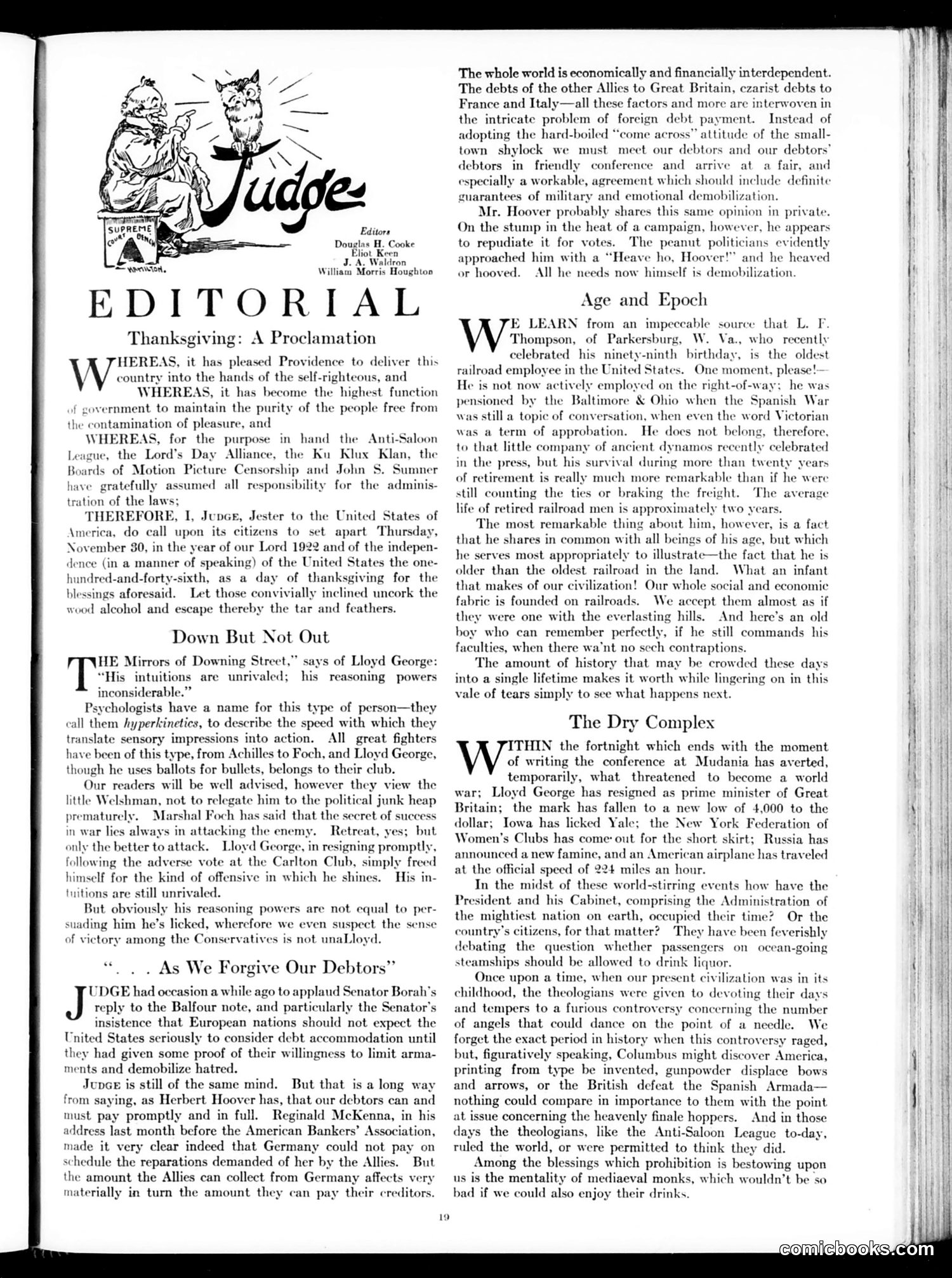
The masthead cartoon depicts "Judge" as a jester figure, establishing the magazine's satirical voice. The editorials mock American moral reformism and post-WWI politics. **"Thanksgiving: A Proclamation"** sarcastically celebrates Prohibition-era "self-righteousness," naming actual reform organizations (Anti-Saloon League, Lord's Day Alliance, KKK, motion picture censors) as having taken governmental control. The joke warns readers to drink illicit "wood alcohol" or face violent punishment—dark humor about Prohibition's unintended consequences. **"Down But Not Out"** defends Lloyd George, Britain's Prime Minister who recently resigned, arguing his impulsive nature ("hyperkinetics") suits warfare but not reasoned governance. The piece suggests he'll mount a political comeback. **"As We Forgive Our Debtors"** criticizes Herbert Hoover's hardline stance on Allied war debts to America. Judge argues international debts form an interconnected system requiring negotiated solutions rather than aggressive collection—a pragmatic position against isolationist debt-collecting. The page reflects 1922 concerns: Prohibition enforcement, British politics, and post-WWI economic reconstruction.
📄 Transcribed text from this page (OCR, searchable)
Machine-transcribed from the original scan — historical spelling and the odd misread are preserved.
Editors Douglas H. Cooke Willian: Morris Houghton EDITORIAL Thanksgiving: A Proclamation ,' YHEREAS, it has pleased Providence to deliver this \ country into the hands of the self-righteous, and WHEREAS, it has become the highest function { government to maintain the purity of the people free from the contamination of pleasure, and WHEREAS, for the purpose in hand the Anti-Saloon League, the Lord’s Day Alliance, the Ku Klux Klan, the Boards of Motion Picture Censorship and John S. Sumner have gratefully assumed all responsibility for the adminis- tration of the laws; THEREFORE, I, Jupce, Jester to the United States of \merica, do call upon its citizens to set apart Thursday, November 90, in the year of our Lord 1922 and of the indepen- dence (in a manner of speaking) of the United States the one- hundred-and-forty-sixth, as a day of thanksgiving for the blessings aforesaid. Let those convivially inclined uncork the wood alcohol and escape thereby the tar and feathers. Down But Not Out HE Mirrors of Downing Street,” says of Lloyd George: “His intuitions are unrivaled; his reasoning powers inconsiderable.” Psychologists have a name for this type of person—they call them hyperkinetics, to describe the speed with which they translate sensory impressions into action. All great fighters have been of this type, from Achilles to Foch, and Lloyd George, though he uses ballots for bullets, belongs to their club. Our readers will be well advised, however they view the little Welshman, not to relegate him to the political junk heap premature Marshal Foch has said that the secret of success in war lies always in attacking the enemy. Retreat, yes; but only the better to atta Lloyd George, in resigning promptly, following the adverse vote at the Carlton Club, simply freed himself for the kind of offensive in which he shines. His in- tuitions are still unrivaled. But obviously his reasoning powers are not equal to per- suading him he’s licked, wherefore we even suspect the sense of victory among the Conservatives is not unaLloyd. . As We Forgive Our Debtors” 'DGE had occasion a while ago to applaud Senator Borah’s reply to the Balfour note, and particularly the Senator's insistence that European nations should not expect the United States seriously to consider debt accommodation until they had given some proof of their willingness to limit arma- ments and demobilize hatred. June is still of the same mind. But that is a long way from saying, as Herbert Hoover has, that our debtors can and must pay promptly and in full. Reginald McKenna, in his address last month before the American Bankers’ Association, made it very clear indeed that Germany could not pay on schedule the reparations demanded of her by the Allies. But the amount the Allies can collect from Germany affects very materially in turn the amount they can pay their creditors. The whole world is economically and financially interdependent. The debts of the other Allies to Great Britain, czarist debts to France and Italy—all these factors and more are interwoven in the intricate problem of foreign debt payment. Instead of adopting the hard-boiled “come across” attitude of the small- town shylock we must meet our debtors and our debtors’ debtors in friendly conference and arrive at a fair, and especially a workable, agreement which should include definite guarantees of military and emotional demobilization. Mz: Hoover probably: shares: this same opinion invprivale. On the stump in the heat of a campaign, however, he appears to repudiate it for votes. The peanut politicians evidently approached him with a “Heave ho, Hoover!” and he heaved All he needs now himself is deme or hooved. ization Age and Epoch E LEARN from an impeccable source that L. F Thompson, of Parkersburg, W. Va., who recently celebrated his ninety-ninth birthday, is the oldest railroad employee in the United States. One moment, please!— He is not now actively employed on the right-of-way; he was pensioned by the Baltimore & Ohio when the Spanish War ion, when even the word Victorian was a term of approbat He does not belong, therefore, to that little company of ancient dynamos recently celebrated in the press, but his survival during more than twenty years of retirement is really much more remarkable than if he were still counting the ties or braking the freight. life of retired railroad men is approximately two years. The most remarkable thin: t him, however, is a fact that he shares in common with all | of his age, but which he serves most appropriately to illustrate—the fact that he is older than the oldest railroad in the land. What an infant that makes of our civ ion! Our whole social and economic fabric is founded on railroads. We accept them almost as if they were one with the everlasting hills. And here’s an old boy who can remember perfectly, if he still commands his faculties, when there wa'nt no sech contraptions. The amount of history that may be crowded these days into a single lifetime makes it worth while lingering on in this vale of tears simply to see what happens next. The Dry Complex THIN the fortnight which ends with the moment of writing the conference at Mudania has averted, temporarily, what threatened to become a world war; Lloyd George has resigned as prime minister of Great Britain; the mark has fallen to a new low of 4,000 to the dollar; Towa has licked Yale; the New York Federation of Women’s Clubs has come: out for the short skirt; Russia has announced a new famine, and an American airplane has traveled at the official speed of 224 miles an hour. In the midst of these world-stirring events how have the President and his Cabinet, comprising the Administration of the mightiest nation on earth, occupied their time? Or the country’s citizens, for that matter? They have been feverishly debating the question whether passengers on ocean-going steamships should be allowed to drink liquor. Once upon a time, when our present civilization was in its childhood, the theologians were given to devoting their days and tempers to a furious controversy concerning the number of angels that could dance on the point of a needle. We forget the exact period in history when this controversy raged, but, figuratively speaking, Columbus might discover America, printing from type be invented, gunpowder displace bows and arrows, or the British defeat the Spanish Armada— nothing could compare in importance to them with the point at issue concerning the heavenly finale hoppers. And in those days the theologians, like the Anti-Saloon League to-day, tuled the world, or were permitted to think they did. Among the blessings which prohibition is bestowing upon us is the mentality of mediaeval monks, which wouldn’t be so bad if we could also enjoy their drinks. was still a topic of conv: The average