
Judge, 1922-11-11 · page 30 of 36
Judge — November 11, 1922 — page 30: what you’re looking at
What you’re looking at
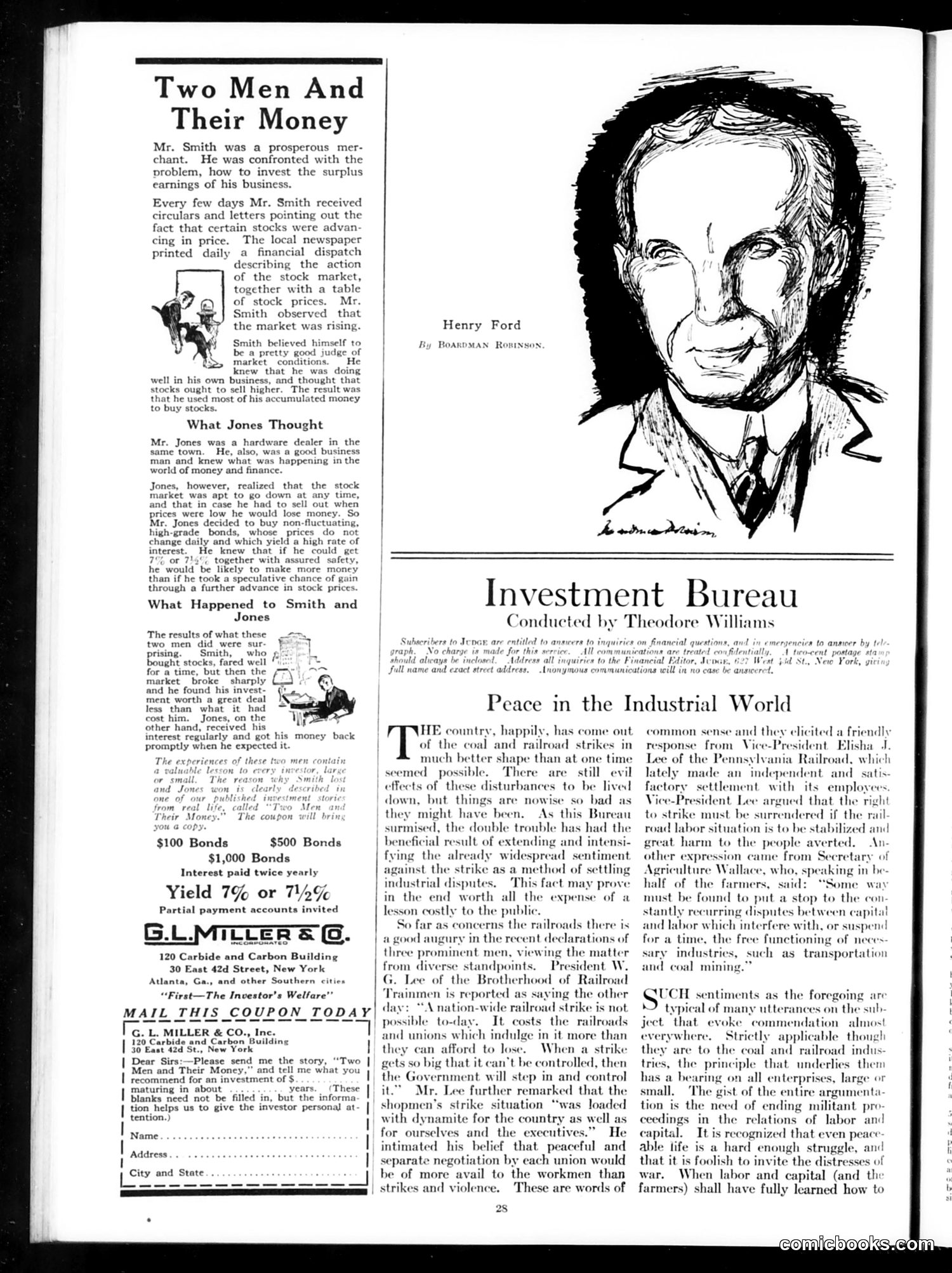
This page combines financial advice with portraiture and commentary on labor relations. **"Two Men and Their Money"** is a cautionary tale contrasting two investment approaches: Smith, a merchant, speculates in stocks (which rise then crash), losing money; Jones, a hardware dealer, invests conservatively in high-yield bonds and preserves his wealth. The moral is clear: prudent, stable investments beat speculative gambling. **The portrait** shows Henry Ford, captioned "By Boardman Robinson." His inclusion likely connects to the adjacent article on labor peace. **"Peace in the Industrial World"** discusses recent railroad strikes, noting they've subsided and created public sentiment *against* strikes as dispute-resolution methods. The piece cites President W.G. Lee of the Brotherhood of Railroad Trainmen arguing that massive strikes are economically impossible—they cost too much for both railroads and unions. **Context for modern readers**: This reflects early-20th-century class tensions. Judge presents strikes negatively while promoting conservative capitalism and financial prudence as virtues. The pairing suggests strikes damage the economy that "prudent men" like Jones depend upon.
📄 Transcribed text from this page (OCR, searchable)
Machine-transcribed from the original scan — historical spelling and the odd misread are preserved.
Two Men And Their Money Mr. Smith was a prosperous mer- chant. He was confronted with the problem, how to invest the surplus earnings of his business. Every few days Mr. Smith received circulars and letters pointing out the fact that certain stocks were advan cing in price. The local ne per printed daily financial dispatch describing the action of the stock market, together with a table of stock prices. Mr. Smith observed that the market was rising. Smith believed himself to be a pretty good judge of t> market conditions. He “knew that he was doing well in his own business, and thought t stocks ought to sell higher. The result that he used most of his accumulated money to buy stocks. What Jones Thought Mr. Jones was a hardware dealer in the same town. He. was a good business man and knew wha‘ happening in the world of money and finance. Jones, however, realized that the stock et was apt to go down at any time, and that in case he had to sell out when prices were low he would lose money. So Mr. Jones decided to buy non-fluctuat high-grade bonds, who do nc change daily and whic! a high interest. He knew could get 7% of 74°; together with a he would be likely to than if he took a specul: 2 through a further advance in stock prices. What Happened to Smith and Jones The results of what these two men did were sur prising. Smith, who bought stocks, fared well for a time, but then the market broke sharply and he found his i: ment worth a gr less than what it cost him. Jones, on the other hand, received his interest regularly and got his money promptly when he expected it. $100 Bonds $500 Bonds $1,000 Bonds Interest paid twice yearly Yield 7% or 12% Partial payment accounts invited G.LMiLcER=G. 120 Carbide and Carbon Building 30 East 42d Street, New York Atlanta, Ga., and other Southern cities ‘irst—The Investor's Welfare”’ MAIL THIS COUPON TODAY G. L. MILLER & CO., Inc. 120 Carbide and Carbon Building 30 East 42d St., New York | Dear Sirs:—Please send me the story, “Two | Men and Their Money,” and tell me what you recommend for an investment of $ maturing in about years blanks need not be filled in, but the infor tion helps us to give the investor personal at tention.) Name Address i and State. . Henry Ford By BoanDMAN Rowinson. Investment Bureau Conducted by Theodore Williams * for this serrice. All com closet. “Address all i et address. Anonym No ¢ full name and exact a at ¥ quiries to the Financial Edit communications will in n Peace in the Industrial World HE country, happily, has come out f the coi id railroad strikes in much better shape than at one time seemed possible. There are still evil effects of these disturbances to be lived down, but things are nowise so bad as they might have been. As this Bureau surmised, the double trouble has had the | beneficial result of extending and intensi- | fying the ly widespread sentiment against the strike as a method of settling | industrial disputes. ‘This fact may prove | in the end worth all the expense of a lesson costly to the public. So far as concerns the railroads there is | a good augury in the recent declarations of three prominent men, viewing the matter from diverse standpoints. President W. G. Lee of the Brotherhood of Railroad Trainmen is reported as saying the other | day: “A nation-wide railroad strike is not possible to-day. It costs the railroads and unions which indulge in it more than they can afford to lose. When a strike gets so big that it can’t be controlled, then the Government will step in and control it.” Mr. Lee further remarked that the shopmen’s strike situation “was loaded with dynamite for the country as well as for ourselves and the executives.” He intimated his belief th peaceful and separate negotiation by each union would be of more il to the workmen than strikes and violenc These are words of 28 sited a friendly ident. Elisha J i common sense and they response from. Vice-P Lee of the Pennsylvania Railroad, whi lately made an independent and. s factory settlement with its employees Vice-President Lee argued that the right to strike must be surrendered if the rail road labor situation is to be stabilized and great harm to the people averted. An- other expression came from Secretary. of Agriculture Wallace, who, speaking in be- half of the farmers, said: “Some wa must be found to put a stop to the con stantly recurring disputes between capital and labor which interfere with, or suspend for a time, the free functioning of neces sary industries, such as transportation and © mining. gtci sentiments as the foregoing are pical of many utterances on the sub ject ‘that evoke ‘commendation almost everywhere. Strictly applicable though they are to the coal and railroad indus tries, the principle that underlies then has a bearing on all enterprises, large ot small. ‘The gist of the entire argumenta tion is the need of ending militant pro ceedings in the relations of labor and capital. It is recognized that even peac« able life is a hard enough struggle, that it is foolish to invite the distresses of When labor and capital (and th farmers) shall have fully learned how to