
Judge, 1922-11-11 · page 13 of 36
Judge — November 11, 1922 — page 13: what you’re looking at
What you’re looking at
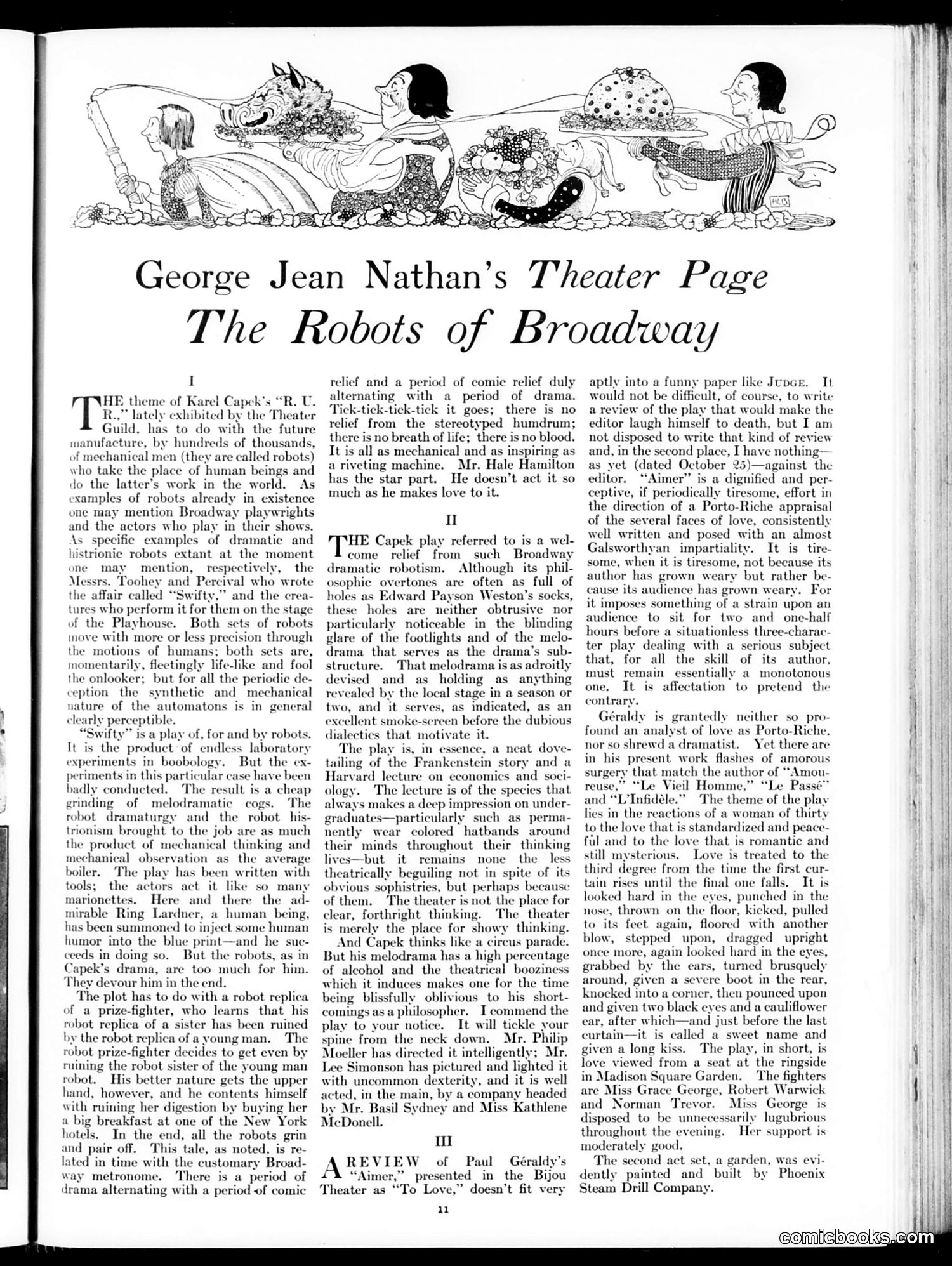
This is **theater criticism, not a political cartoon**. George Jean Nathan reviews Karel Capek's play "R.U.R." (about manufactured mechanical workers) and satirizes Broadway's actual dramatic "robots"—particularly a play called "Swifty." Nathan's central joke: Broadway playwrights and actors are themselves mechanical automatons. He sarcastically compares "Swifty" (written by Toohey and Percival, performed by actors) to actual robots—both move predictably, both lack genuine life or emotion. The play operates like a "riveting machine": tick-tick-tick formula of drama, then comic relief, then drama again, with no spontaneity. The critique praises Capek's work as genuinely engaging despite philosophical flaws, contrasting it with Broadway's lifeless machinery. Ring Lardner is the rare "human being" injecting actual humor into the robotic system. The headpiece illustration shows surreal mechanical creatures—visualizing Nathan's metaphor of Broadway as an assembly line of artificial performers.
📄 Transcribed text from this page (OCR, searchable)
Machine-transcribed from the original scan — historical spelling and the odd misread are preserved.
— George Jean Nathan’s Theater Page The Robots of Broadway HE theme of Karel Capek’s “R. U. [ R.,” lately exhibited by the Theater Guild, has to do with the future manufacture, by hundreds of thousands, of mechanical men (they are called robots) who take the place of human beings and do the latter’s work in the world. As examples of robots ¢ y in existence one may mention Broad rights and the actors who pl \s specific examples of dramatic and histrionic robots extant at the moment one may mention, respectively, the Messrs. Toohey and Percival who wrote the affair called “Swifty,” and the crea- tures who perform it for them on the stage of the Playhouse. Both sets of robots move with more or less precision through the motions of humans; both sets are, momentarily, fleetingly life-like and fool the onlooker; but for all the periodic de- ception the synthetic and mechanical nature of the automatons is in general clearly perceptible. “Swifty” is a play of, for and by robots. It is the product of endless laborat feiaernn in hoobok But the ments in this particular case have bee badly conducted. The result is a cheap grinding of melodramatic cogs. The robot dramaturgy and the robot his- trionism brought to the job the product of mechanical thinking and mechanical observation as the average boiler. The play has been written with tools; the actors act it like so many marionettes. Here and there the ad- mirable Ring Lardner, a human being, has been summoned to inject some human humor into the blue print—and he suc- ceeds in doing so. But the robots, as in Capek’s drama, are too much for him. ‘They devour him in the end. The plot has to do with a robot replica of a prize-fighter, who learns that his robot replica of a sister has been ruined by the robot replica of a young man. The robot prize-fighter decides to get even by ruining the robot sister of the young man robot. His better nature gets the upper hand, h ne contents himself swith euintag her digestion by buying her a big breakfast at one of the New York hotels. In the end, all the robots grin and pair off. This tale, as noted, is re- lated in time with the customary Broad- way metronome. There is a period of drama alternating with a period of comic relief and a period of comic relief duly alternating with a period of drama. Tick-tick-tick-tick it goes; there is no relief from the stereotyped humdrum; there is no breath of life; there is no blood. It is all as mechanical and as inspiring as a riveting machine. Mr. Hale Hamilton has the star part. He doesn’t act it so much as he makes love to it. I pee Capek play referred to is a wel- come relief from such Broadway dramatic robotism. Although its phil- osophic overtones are often as full of holes as Edward son Weston’s socks, these holes are neither obtrusive nor particularly noticeable in the blinding glare of the footlights and of the melo- drama that serves as the drama’s sub- structure. That melodrama is as adroitly devised and as holding as anything revealed by the local stage in a season or two, and it serve indicated, as an excellent smoke-screen before the dubious dialectics that motivate it. The play is, in essence, a neat dove- tailing of the Frankenstein story and a Harvard lecture on economics and soci- ology. The lecture is of the species that always makes a deep impression on under- graduates—particularly such as perma- nently y colored hatbands around their minds throughout their thinking lives—but it remains none the less theatrically beguiling not in spite of its obvious sophistries, but perhaps because of them. The theater is not the place for clear, forthright thinking. The theater is merely the place for showy thinking. And Capek thinks like a circus parade. But his melodrama has a high percentage of alcohol and the theatrical booziness which it induces makes one for the time i - oblivious to his short- comings as a philosopher. I commend the play to your notice. It will tickle your spine from the neck down. Mr. Philip Moeller has directed it intelligently; Mr. Lee Simonson has pictured and lighted it with uncommon dexterity, and it is well ted, in the main, by a company headed Mr. Basil Sydney and Miss Kathlene McDonell. Ti REVIEW of Paul Géraldy’s “Aimer,” presented in the Bijou Theater as “To Love,” doesn’t fit very 1. aptly into a funny paper like Jupce. It would not be difficult, of course, to write a review of the play that would make the editor laugh himself to death, but I am not disposed to write that kind of review and, in the second place, I have nothing— as yet (dated October gainst the editor. “Aimer” is a dignified and per- ceptive, if periodically tiresome, effort in the direction of a Porto-Riche appraisal of the several faces of love, consistently well written and posed with an almost Galsworthyan impartial It is tire- some, when it is tiresome, not because its author has grown weary but rather be- cause its audience has grown weary. For it imposes something of a strain upon an audience to sit for two and one-half hours before a situationless three-charac- ter play dealing with a serious subject that, for all the of its author, must remain essentially a monotonous one. It is affectation to pretend the contrary. Géraldy is grantedly neither so_pro- found an analyst of love as Porto-Riche, nor so shrewd a dramatist. Yet there are in his present work flashes of amorous surgery that match the author of “Amory reuse,” “Le V and “L'Infidél lies in the reactions of a woman of thirts to the love that is standardized and peace- ful and to the love that is romantic and still mysterious. Love is treated to the third degree from the time the first cur- tain rises until the final one falls. It is looked hard in the eyes, punched in the nose, thrown on the floor, kicked, pulled to its feet again, floored with another blow, stepped upon, dragged upright once more, again looked hard in the eyes, grabbed the ears, turned brusquely around, given a re boot in the rear, knocked into a corner, then pounced upon and given two black eyes and a cauliflower ear, after which—and just before the last curtain—it is called a sweet name and iven a long kiss. The play, in short, is 1 from a seat at the ringside in Madison Square Garden. The fighters are Miss Grace George, Robert Warwick and Norman Trevor. Miss George is disposed to be unnecessarily lugubrious throughout the evenir Her support is moderately good. The second act set, a garden, was evi- dently painted and built by Phoenix Steam Drill Company.