
A complete issue · 36 pages · 1922
Judge — September 9, 1922
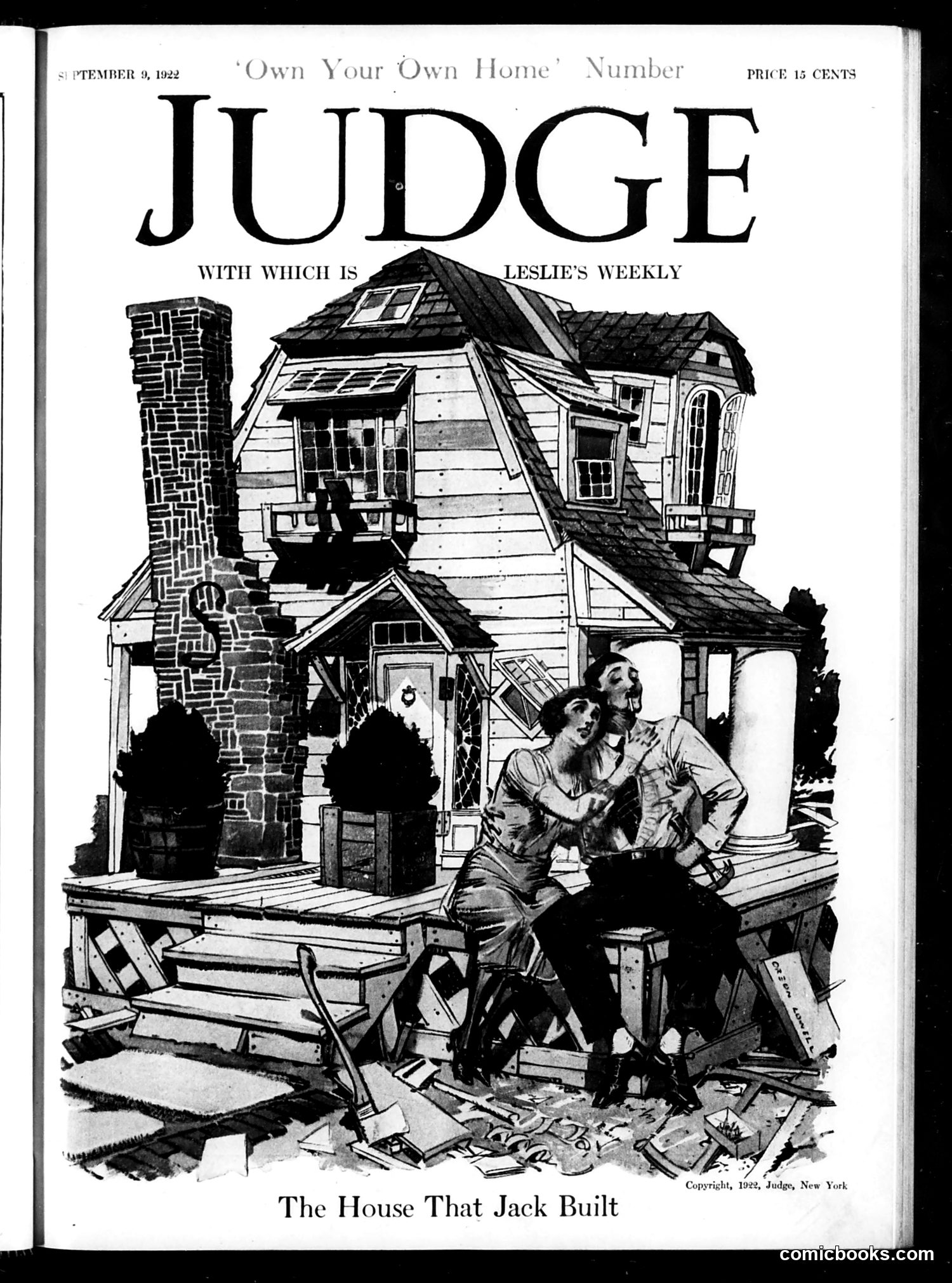
This Judge magazine cover from September 9, 1922, illustrates the nursery rhyme "The House That Jack Built" through a home construction scene. A couple examines their new house while surrounded by building materials, tools, and debris. The title references the famous cumulative nursery rhyme where each verse adds elements to a structure. The satire likely comments on post-WWI housing challenges or the costs of homeownership during the 1920s—evident from the scattered, chaotic materials surrounding the couple. The subtitle indicates this connects to "Leslie's Weekly," suggesting cross-publication content. Without additional context, the specific social commentary remains unclear, though it appears to mock the complications of building or affording one's own home during this period.
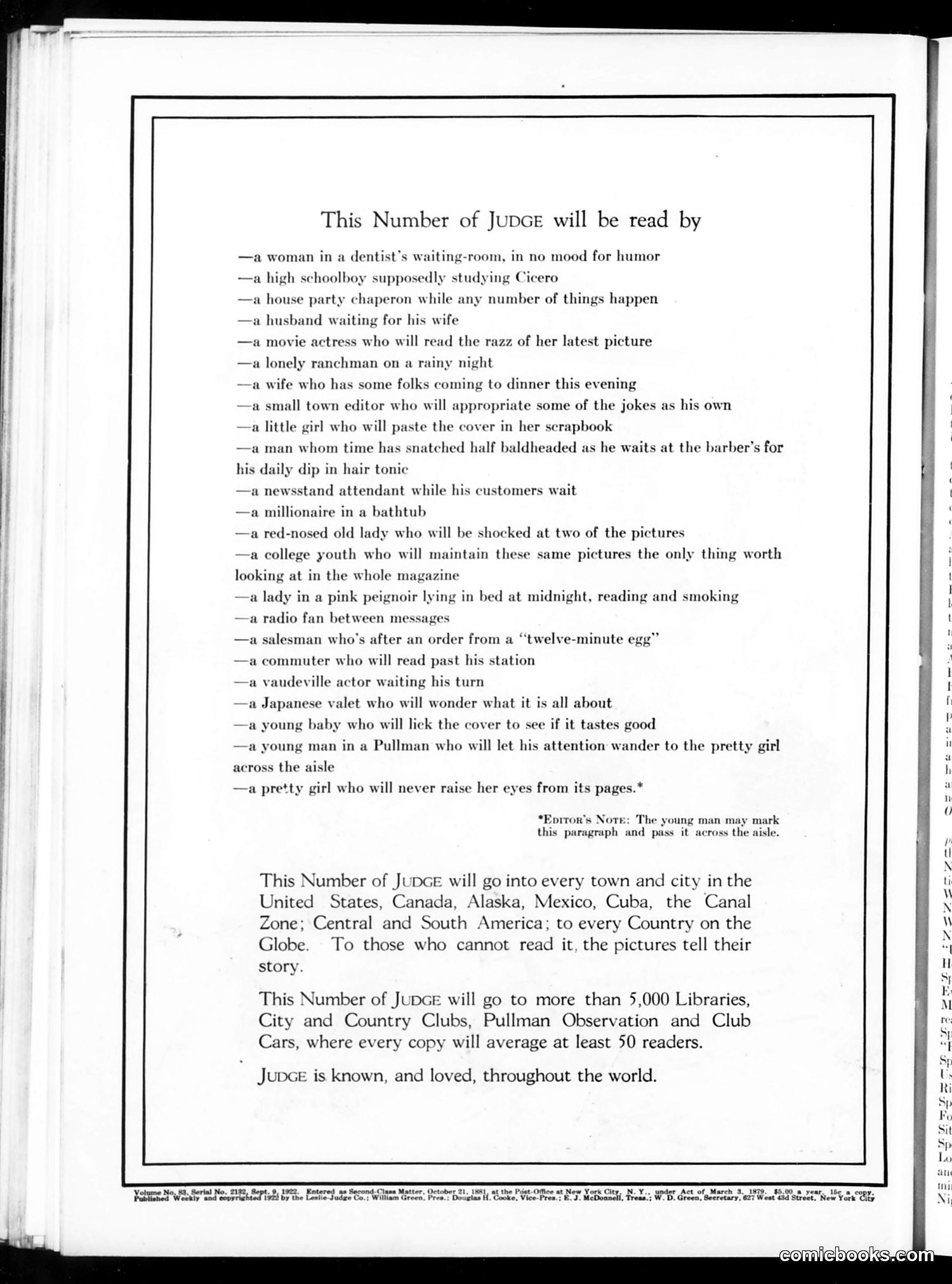
This page is a **promotional piece for Judge magazine itself**, not a political cartoon. It lists the diverse readership who will encounter this particular issue—from dentists' waiting rooms to Pullman cars to libraries—emphasizing Judge's broad circulation across American society and beyond. The humor lies in the **specific character vignettes**: a woman avoiding jokes at the dentist, a high schoolboy pretending to study Cicero, a small-town editor stealing jokes for his newspaper, and notably, a Japanese valet puzzled by American content. The final section boasts Judge's **international reach** to 5,000+ libraries and clubs across North America and beyond, claiming 50+ readers per copy. The overall message: Judge is ubiquitous, culturally significant, and read by everyone from millionaires to schoolchildren—a self-congratulatory statement of the magazine's importance and influence.
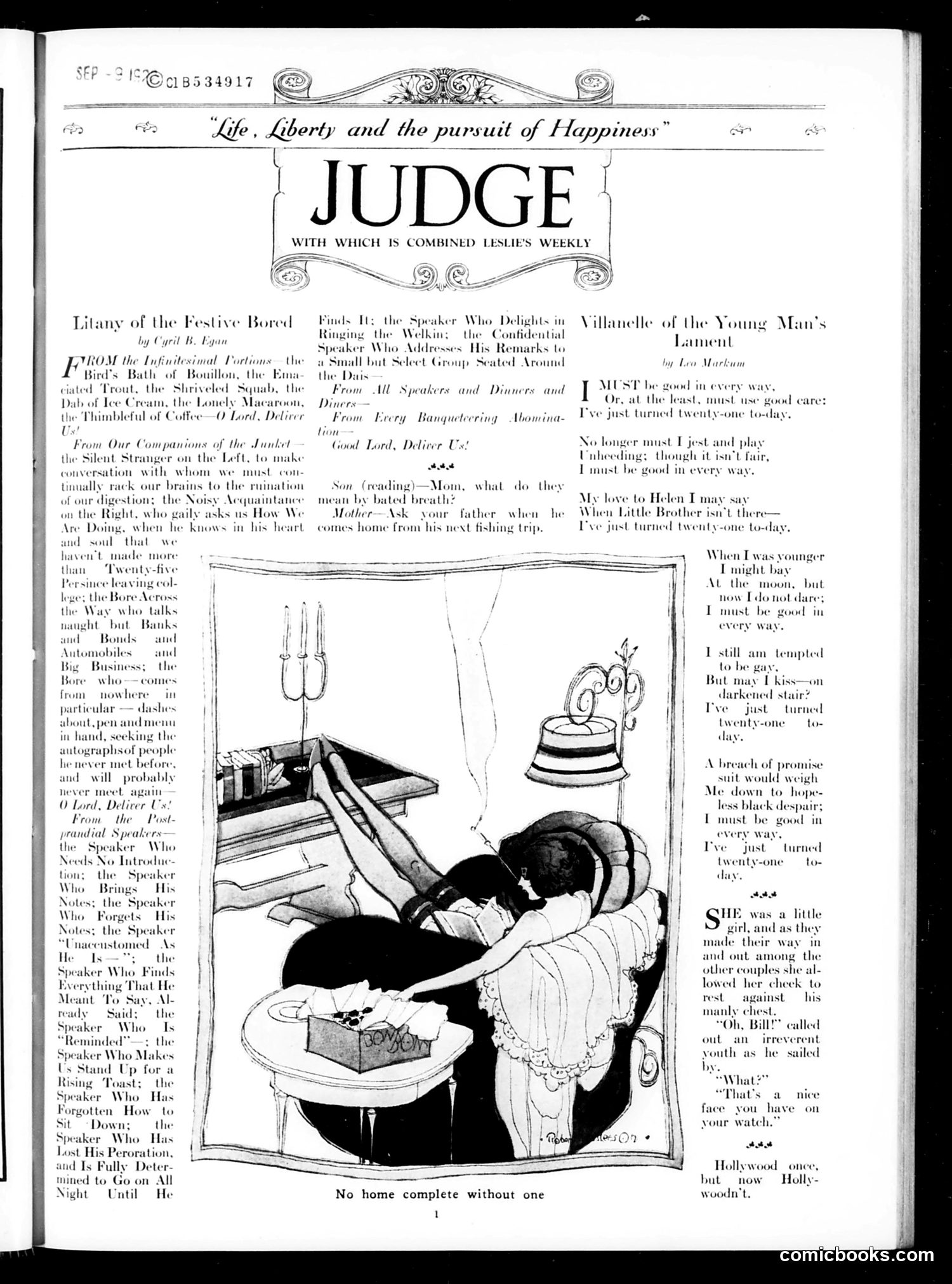
This page from *Judge* magazine contains two distinct pieces: **Left column:** A humorous short story titled "Litany of the Festive Bored" satirizing tedious social conversation—complaints about weather, boring dinner guests, and repetitive small talk at parties. It's social satire about the monotony of upper-class social obligations. **Central illustration & right column:** "Villanelle of the Young Man's Lament"—a poem accompanying an illustration of a young man lounging in a hammock surrounded by leisure items (phonograph, beer, watch). The poem expresses ambivalence about romance and commitment, repeatedly stating "I must be good in every way." It's satirizing young men torn between desires for freedom/pleasure and social expectations of responsibility and morality. Both pieces mock early 20th-century social conventions and romantic expectations through humor and verse.
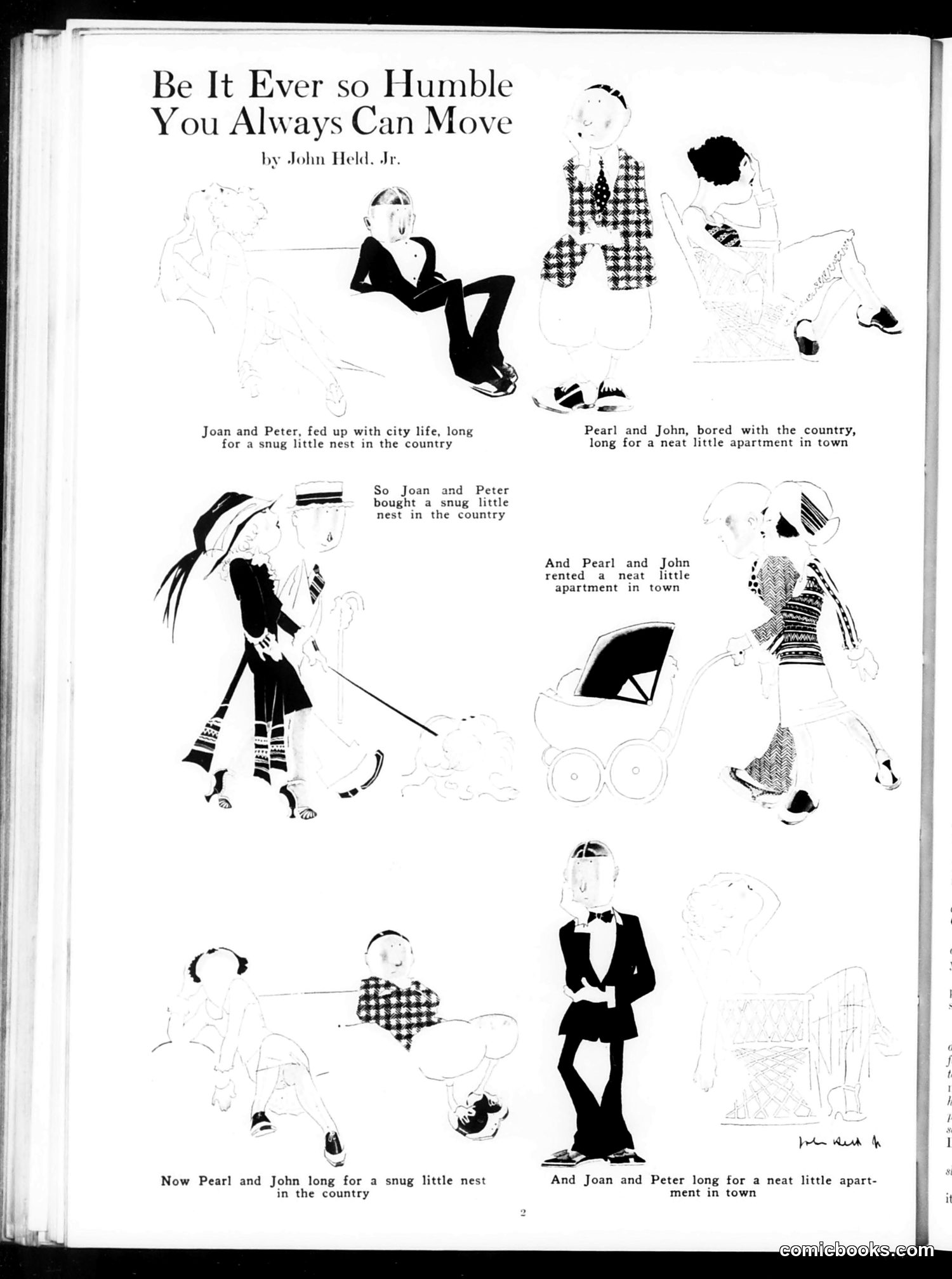
This satirical piece by John Held Jr. contrasts two couples with opposing lifestyle preferences. Joan and Peter, "fed up with city life," purchase a country home. Meanwhile, Pearl and John, "bored with the country," rent a city apartment. The joke hinges on the grass-is-always-greener theme: both couples simultaneously long for what the other has abandoned. The cartoon mocks the restlessness and dissatisfaction of 1920s urban professionals, suggesting that neither rural nor urban life fully satisfies them—they perpetually chase an idealized alternative. Held Jr.'s minimalist, fashionable illustration style captures the era's modern sensibility while satirizing the era's consumer culture and lifestyle aspirations.
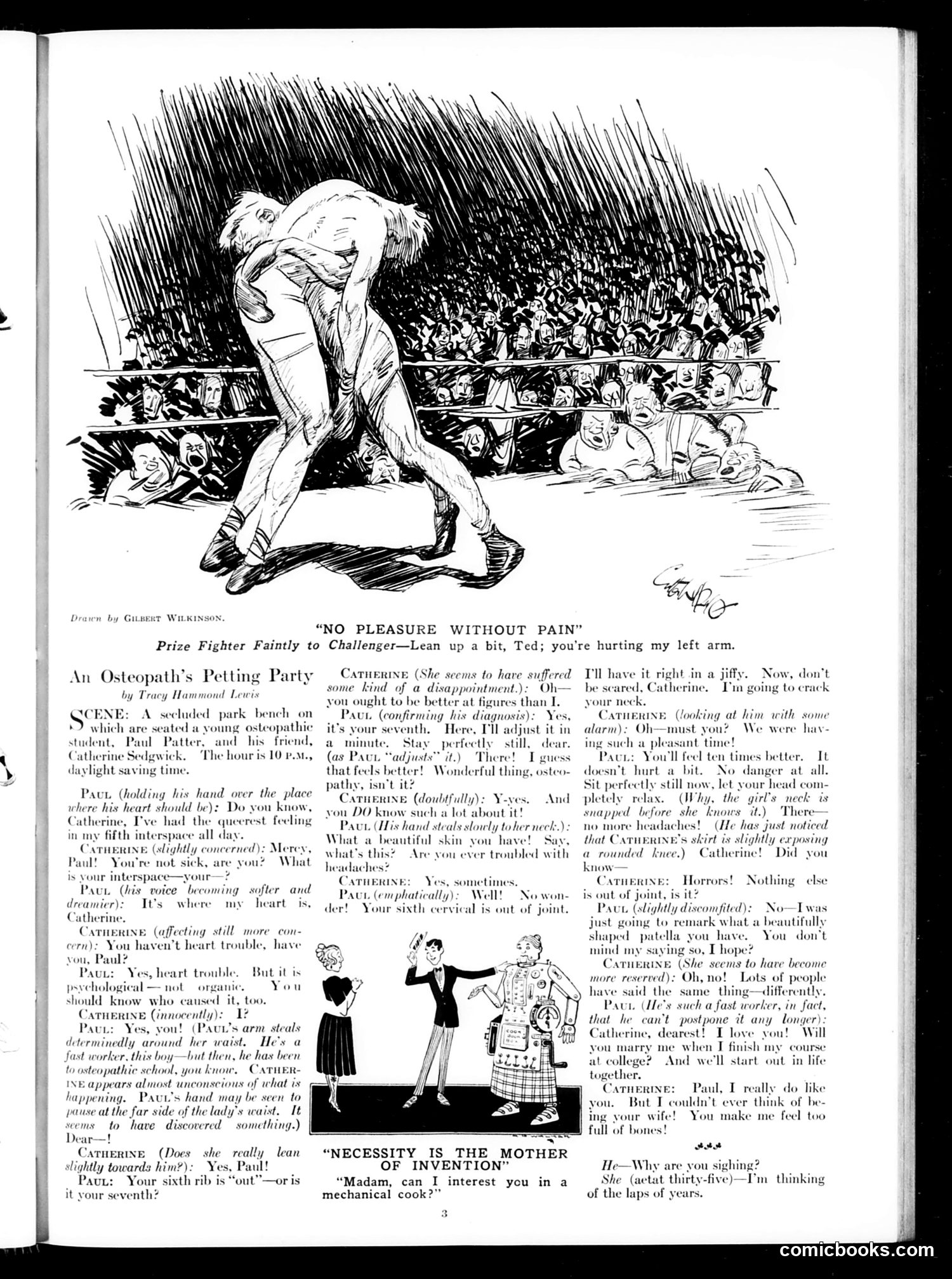
This page contains two distinct pieces: **Top Cartoon:** "No Pleasure Without Pain" depicts a prize fighter bent over in apparent agony before a crowd. The caption suggests the fighter is injured during a match, with his opponent telling him to "lean up a bit, Ted; you're hurting my left arm." This satirizes boxing culture and the physical toll on athletes. **Lower Section:** "An Osteopath's Petting Party" is a comedic dialogue between Paul, a young man, and Catherine, a woman Paul is courting. The humor relies on double entendres about her physical ailments and treatments. The osteopath character diagnoses her with various complaints, leading to awkward romantic banter about her body and posture—typical early 20th-century humor playing on pseudo-medical pseudoscience and courtship customs.
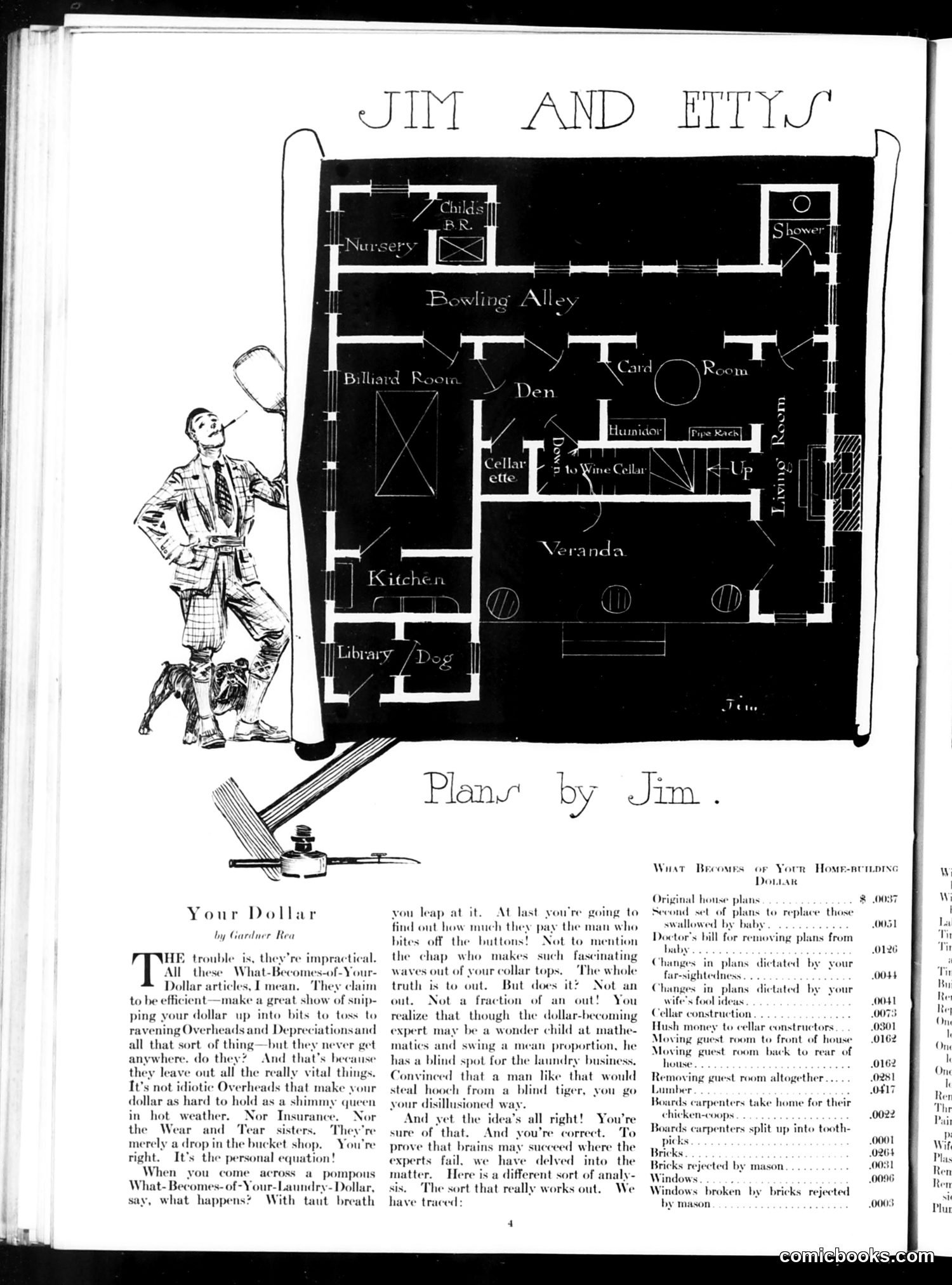
This page features an architectural floor plan titled "Plans by Jim" alongside an article called "Your Dollar" by Gardner Rea. The cartoon satirizes impractical home-building advice. A sketched figure (likely representing the fictional "Jim") poses confidently beside an elaborate floor plan including a bowling alley, billiard room, card room, and numerous luxurious features—clearly absurd for average homeowners. The accompanying article mocks the disconnect between architectural ideals and financial reality, arguing that elaborate house plans ignore practical costs. The satire suggests that home-design experts and magazines promote unrealistic visions of domesticity that ordinary people cannot afford, making their dollar-building advice fundamentally flawed and out of touch with actual working families' circumstances.
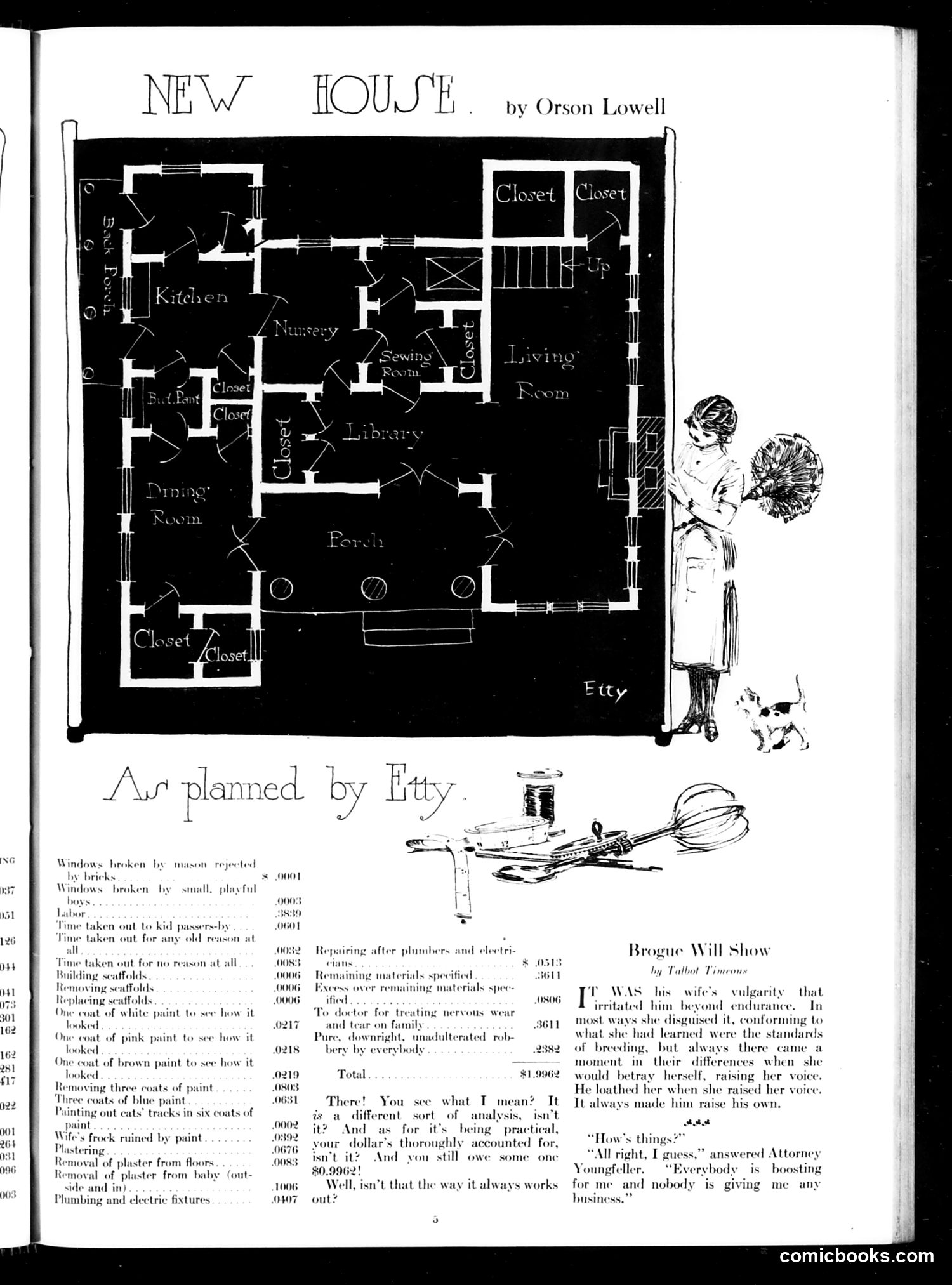
This page contains two distinct pieces: **"New House by Orson Lowell"** (left): A satirical architectural floor plan with accompanying cost breakdown. The humor targets the absurdity of home construction expenses—a detailed itemization shows numerous line items for wasteful or redundant work: windows broken by masons then rejected, paint applied multiple times just "to see how it looked," and labor spent on pranks like "time taken out to kid passers-by." The punchline is that despite meticulous accounting, costs still exceed the budget by nearly a dollar ($0.9962 overrun), illustrating the frustration of construction cost overruns and contractor inefficiency—a relatable complaint for early 20th-century homeowners. **"Brogue Will Show by Talbot Timeous"** (right): A brief domestic sketch about class and manners. A wife's inability to maintain refined speech—particularly raising her voice—betrays her lower-class origins despite otherwise conforming to social standards. Her husband despises this "vulgarity." The satire mocks both rigid class consciousness and the performative nature of social respectability in the era.
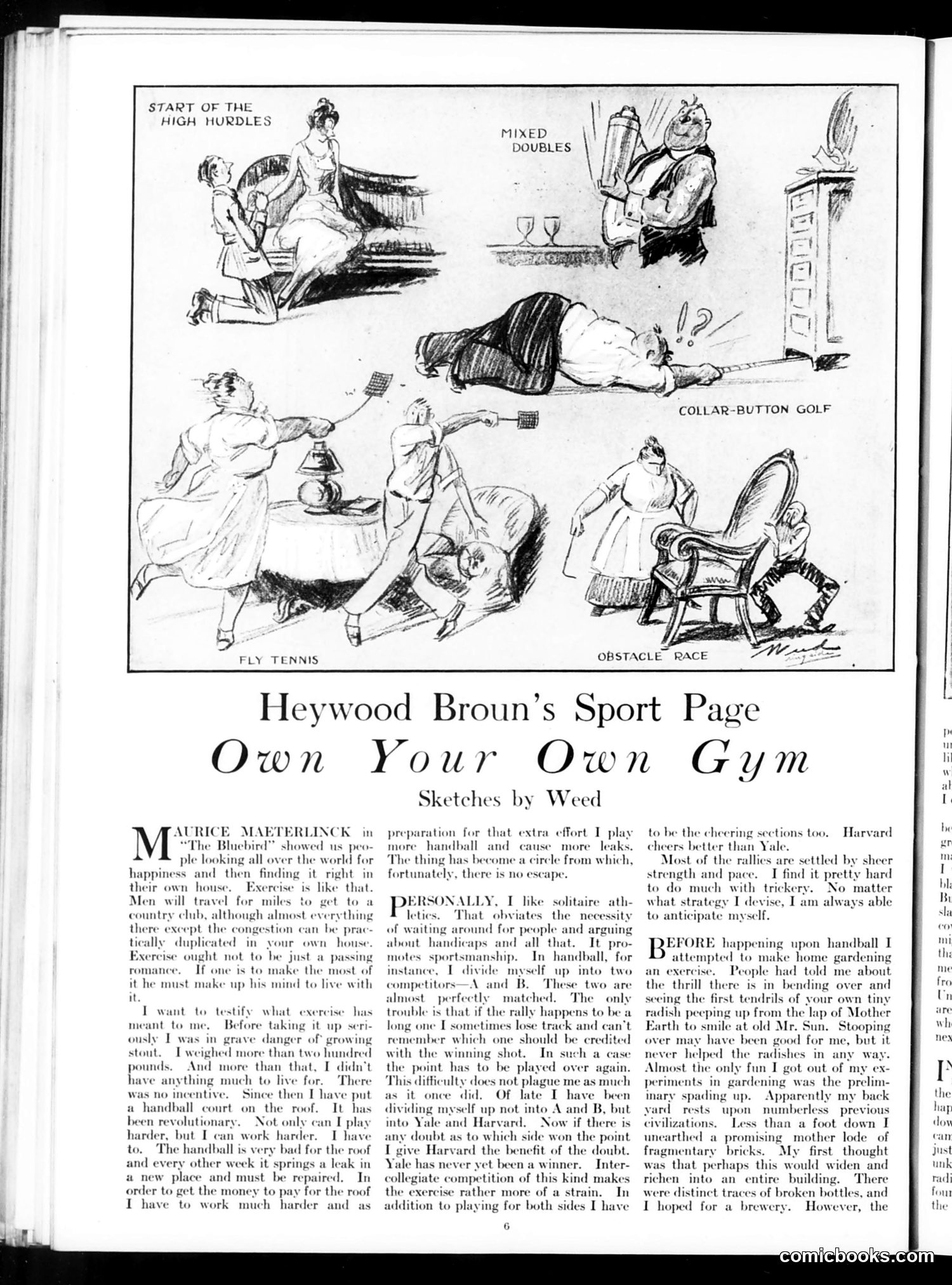
This is a humorous essay by sports columnist Heywood Broun, illustrated with comic sketches by Weed showing absurd "home exercises": high hurdles (with someone crashing), mixed doubles (two men tangled together), fly tennis (women swinging wildly), collar-button golf, and an obstacle race involving furniture. Broun argues for exercise at home rather than expensive country clubs—but the joke is that his "solution" creates as many problems as it solves. His handball court on the roof springs leaks, forcing him to work harder to pay for repairs, creating a circular trap. He even divides himself into "Yale and Harvard" competitors to play against himself, yet can't track who's winning. The satire mocks both the era's fitness craze and self-deluding rationalization: Broun presents himself as logical while describing increasingly absurd scenarios (finding "previous civilizations" of bricks in his garden). The sketches visualize the ridiculous outcomes of amateur home athletics. The piece reflects 1920s anxiety about leisure, class, and self-improvement through sports.
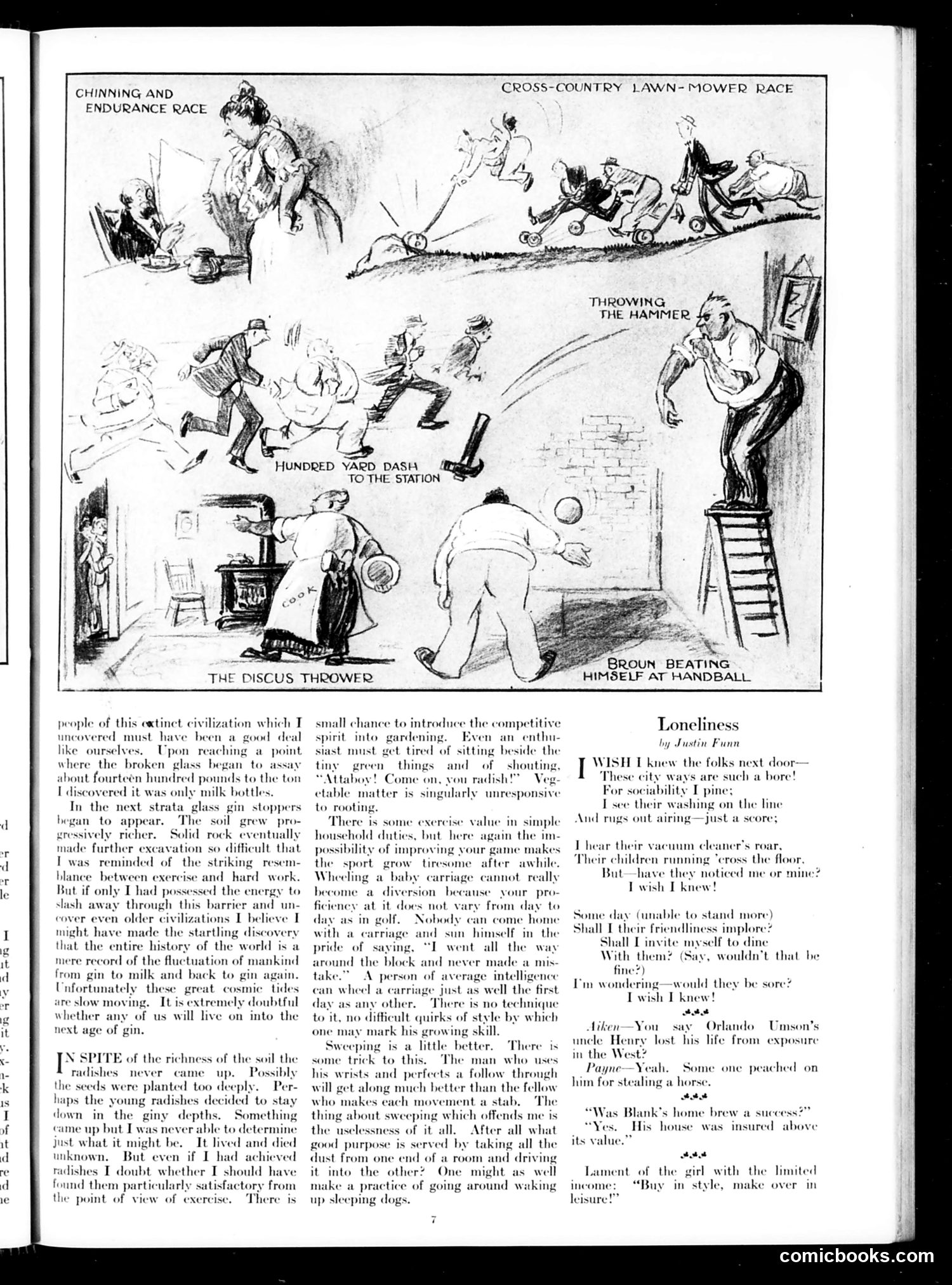
This page satirizes American suburban life and leisure pursuits circa the 1910s-1920s. **Top cartoon**: "Cross-Country Lawn-Mower Race" mocks the absurdity of treating mundane household chores as competitive sports. The illustrations show people frantically performing ordinary tasks—mowing lawns, throwing hammers, playing handball, dashing to the station—as if they were Olympic events. The satire targets the era's growing obsession with fitness and "scientific" exercise: Americans are so desperate for physical activity and competition that they've invented contests around housework. **Text below**: A humorous essay reinforces this theme, arguing that household duties fail as exercise because they lack the competitive element and skill-building that make sports engaging. Wheeling a baby carriage or sweeping offer no "technique" to master or measurable improvement. **Poem "Loneliness"**: Shifts tone to urban isolation—a neighbor yearning for connection with people they can hear but never meet, separated by modern city apartment life. **Brief jokes**: Unrelated vignettes mocking Prohibition-era "home brew" and dishonesty. The page overall critiques how modern American life leaves people simultaneously overscheduled and deeply isolated.
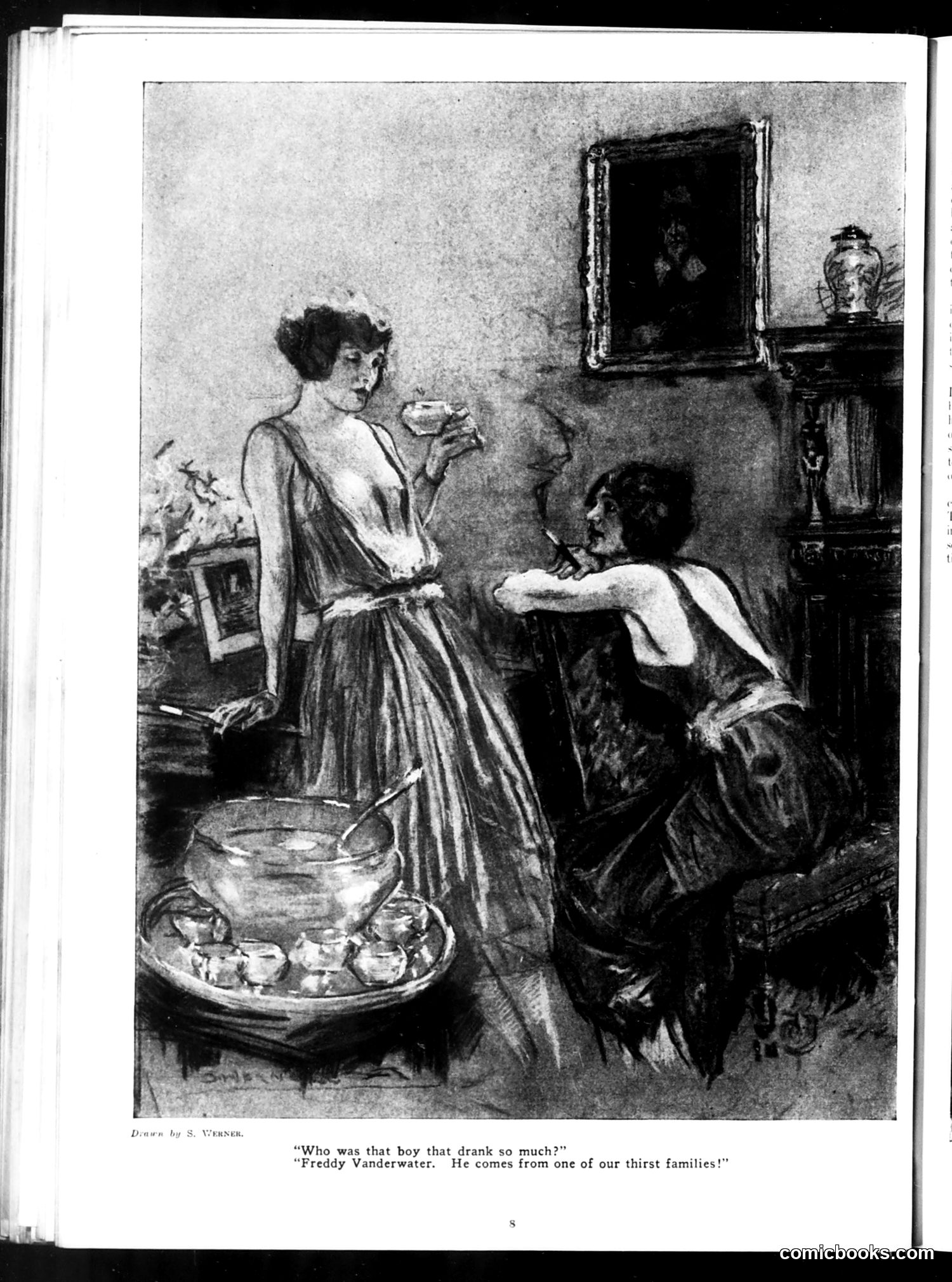
This is a social satire cartoon drawn by S. Werner. It depicts an elegantly dressed woman speaking to a seated man in what appears to be an upscale interior, with a prominent punch bowl in the foreground. The joke plays on a pun: "thirst families" (suggesting wealthy, prominent families) sounds like "thirst" as in excessive drinking. The humor mocks both upper-class pretension and alcoholism among the wealthy elite. By identifying the drunk boy as "Freddy Vanderwater"—a deliberately pompous, WASP-ish surname—the cartoon suggests that even the most socially prominent families cannot escape the shame of having members with drinking problems. It's satirizing the contradiction between genteel respectability and actual behavior among the leisure class.
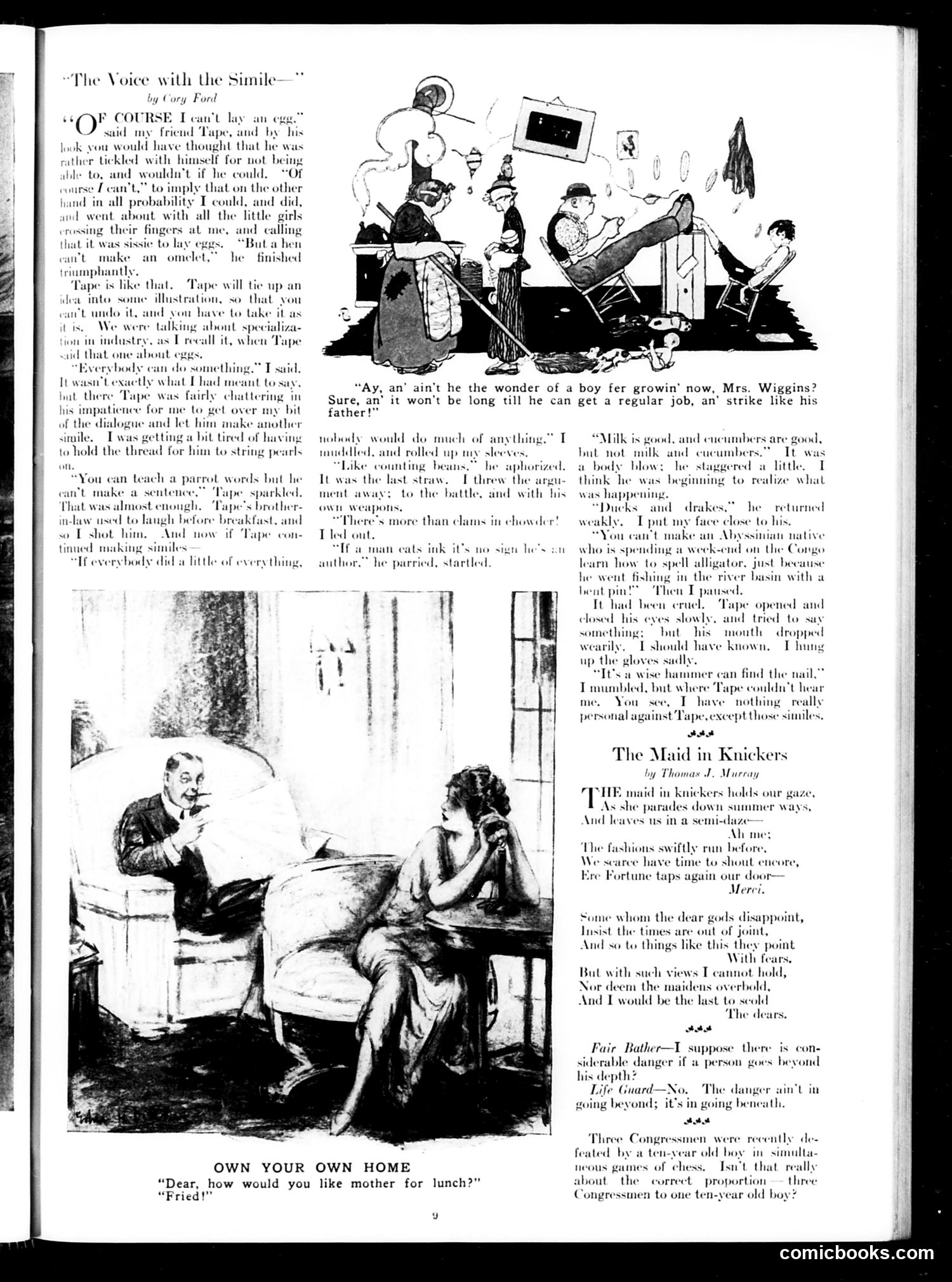
This Judge page contains three separate humorous pieces satirizing everyday social awkwardness and changing mores circa the 1920s. **"The Voice with the Simile"** by Cory Ford mocks a character named Tape who compulsively relies on hackneyed similes and analogies in conversation, rendering his points incomprehensible rather than clever. The narrator grows increasingly exasperated as Tape strings together absurd comparisons (teaching a parrot vs. making a sentence; counting beans; eating ink) to avoid simple discussion. It's satire on affected, pseudo-intellectual speech patterns. **"The Maid in Knickers"** by Thomas J. Murray gently comments on women's changing fashion—specifically the then-shocking sight of young women wearing shorter skirts and knickers (bloomers). While some disapprove of this modern liberalization, the poem playfully endorses it as harmless. **"Own Your Own Home"** is a brief domestic joke about a husband misunderstanding his wife's suggestion about serving his mother for lunch. These pieces collectively reflect 1920s anxieties about changing social conventions, modern speech affectations, and women's evolving public roles.
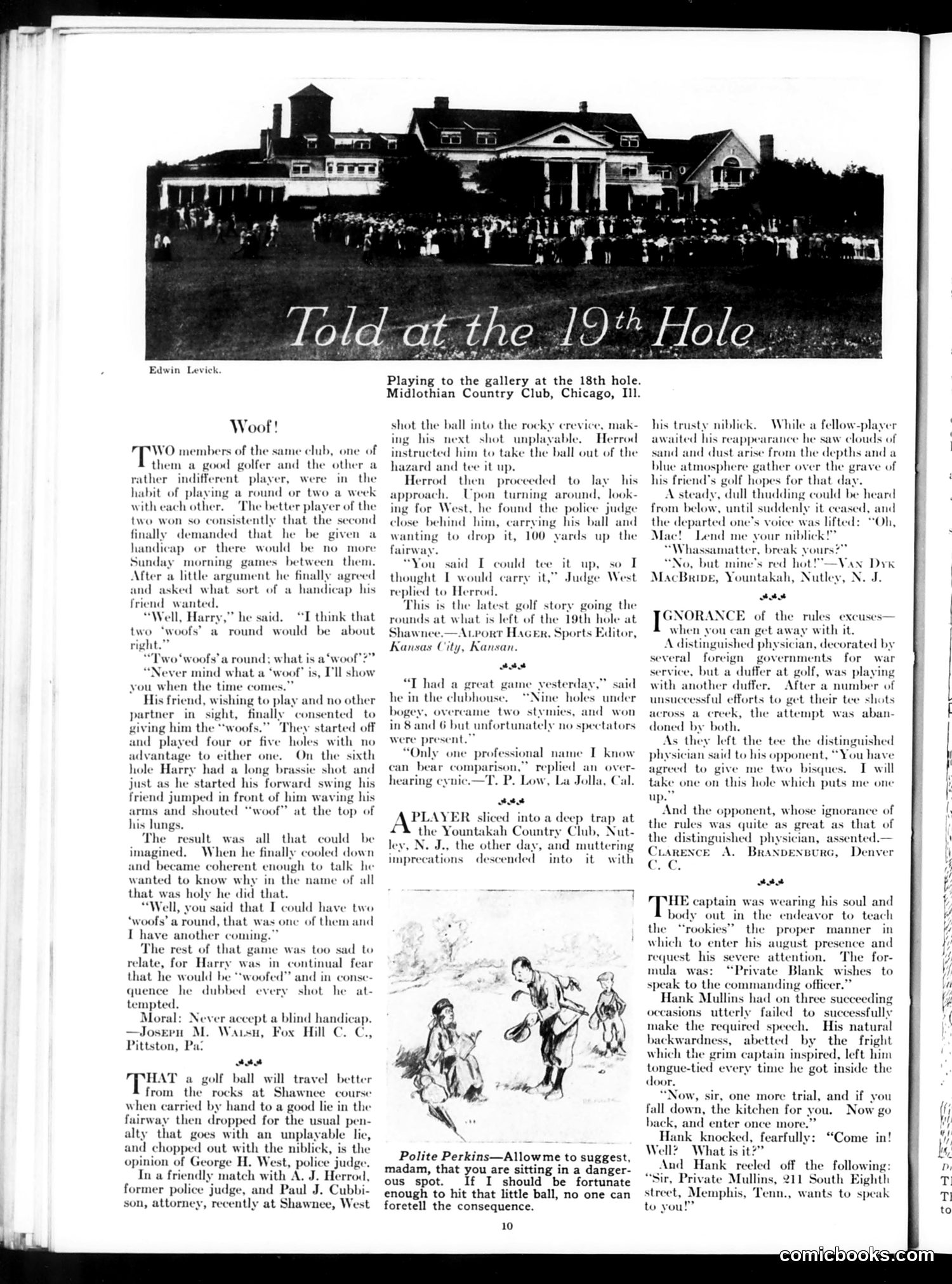
This page collects humorous golf anecdotes, a popular format in early 20th-century magazines. The "19th hole" (the clubhouse bar) is the traditional setting for golf stories. The main cartoons satirize golfers' rule-bending and excuses: 1. **"Woof!"** mocks blind handicaps through a story where a player exploits vague terms, deliberately disrupting his opponent's swing as his agreed "woof" (handicap allowance), ruining the game. 2. **The Shawnee story** ridicules a police judge who literalizes rules: when told he could "tee it up," he carries his ball 100 yards up the fairway rather than dropping it—absurd rule-lawyering presented as humor. 3. **Other anecdotes** joke about golfers fabricating excuses ("no spectators were present" to witness good play) and physical comedy (a player buried in a sand trap asking to borrow a niblick). The humor targets golfers' pretentious rule-knowledge and their tendency to rationalize poor play through technicalities rather than accepting honest defeat.
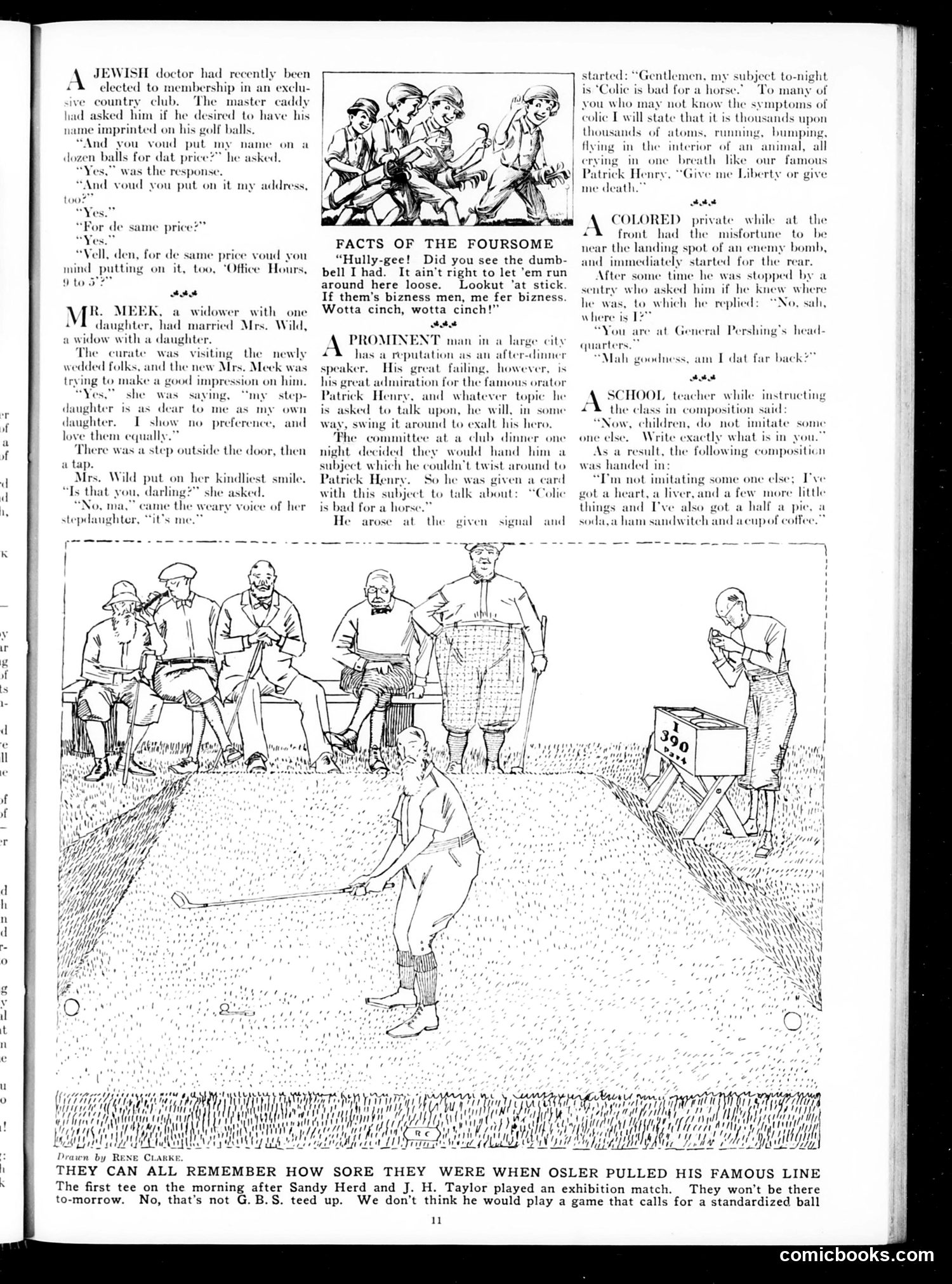
This page contains four separate satirical anecdotes typical of early 20th-century American humor: 1. **Jewish Doctor at Country Club**: Mocks Jewish assimilation anxieties through dialect humor. A newly admitted Jewish doctor requests his office hours printed on golf balls—satirizing both social climbing and practical materialism. 2. **The Remarriage**: A widow marrying a widower each tries to convince a visiting curate they love their new stepchild equally. The satire targets insincere social performance and hypocritical sentimentality. 3. **Patrick Henry Obsession**: A prominent after-dinner speaker is so fixated on Patrick Henry that a club committee attempts to give him a topic—"colic in horses"—he cannot twist toward his hero. He inevitably does anyway through an elaborate Patrick Henry ("Give me Liberty or give me death") analogy. 4. **School Composition**: A teacher instructs students to write what they truly think, not imitate others. A child produces an honest but crude composition—satirizing the gap between adult instructions and actual results. The bottom illustration concerns golf and "G.B.S." (likely George Bernard Shaw), referencing standardized golf balls. These are gentle, class-based humor pieces without overt political content.
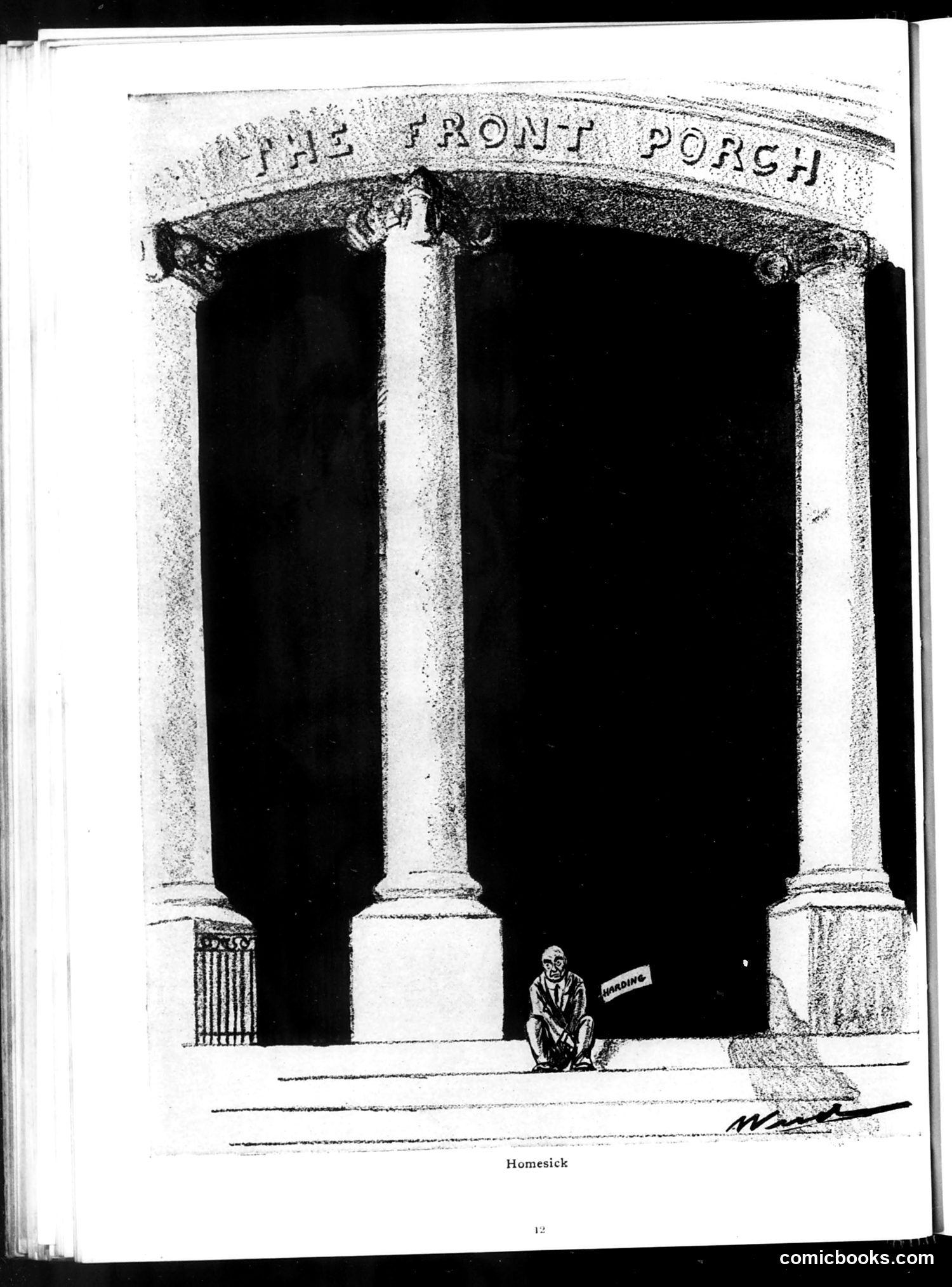
This cartoon depicts a solitary, hunched figure sitting outside "The Front Porch" of what appears to be the White House or similar government building. The figure holds a sign reading "Hardship" and appears dejected and forlorn. The satire likely critiques economic conditions or hardship during a specific period when this *Judge* issue was published. The "Front Porch" reference suggests the seated figure represents the common American citizen or working class, positioned outside the halls of power, suffering from economic difficulty while government officials remain distant within. The title "Homesick" suggests this person—displaced by hardship—yearns to return home, perhaps commenting on poverty, unemployment, or displacement. The contrast between the grand classical architecture and the small, suffering figure emphasizes the gap between governmental institutions and ordinary citizens' struggles.
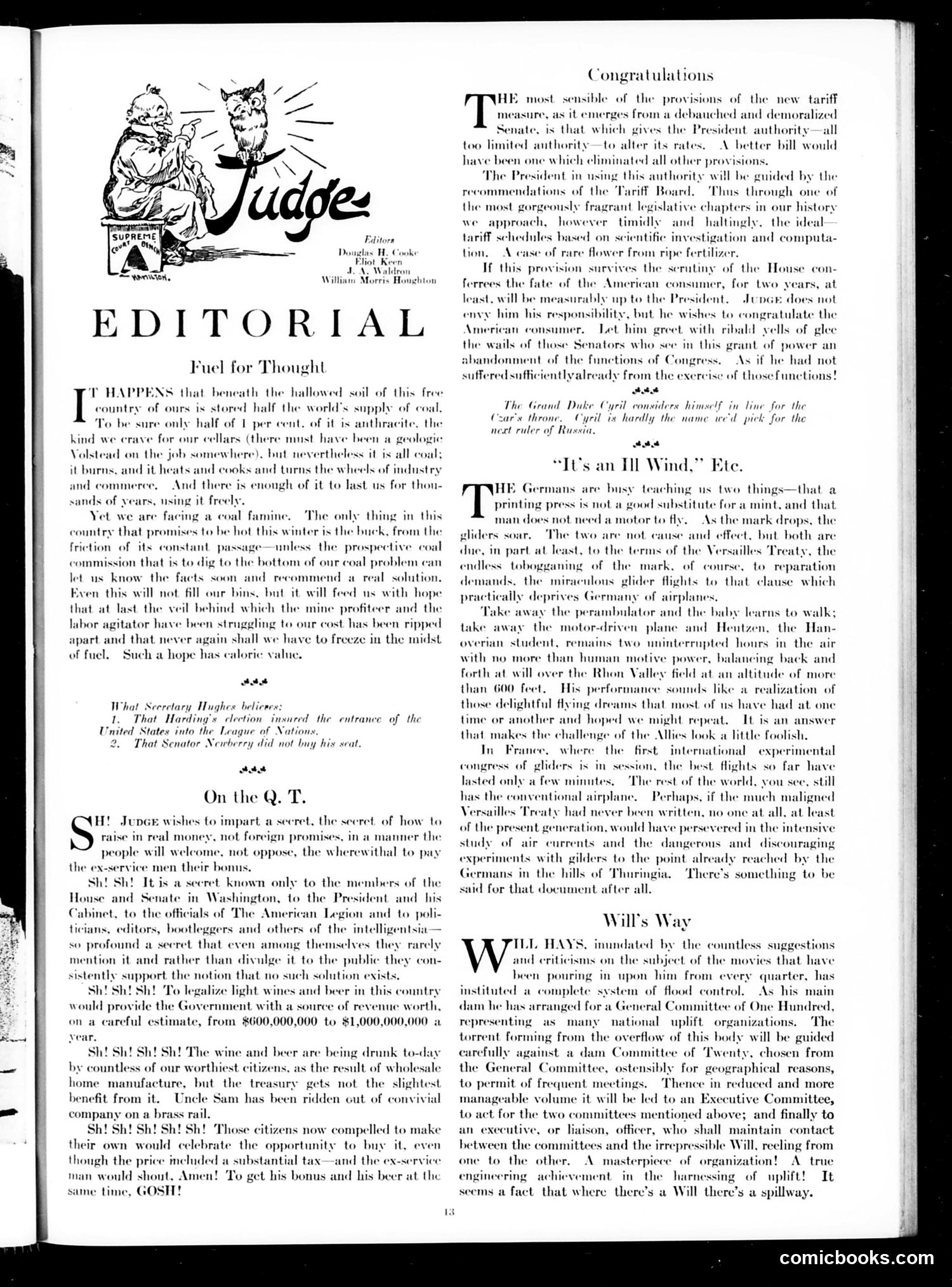
This editorial page contains three satirical pieces attacking Republican leadership post-election: **"Fuel for Thought"** criticizes coal industry profiteering during shortages, suggesting a government commission could solve the problem if politicians weren't protecting corporate interests. **"On the Q.T."** sarcastically mocks a supposed "secret" among Washington elites about funding veterans' bonuses through alcohol legalization. The repeated "Sh! Sh!" emphasizes the hypocrisy: politicians know taxing legal wine and beer could generate $600-1 billion yearly for veterans' benefits, yet publicly claim no solution exists. The piece suggests they suppress this knowledge to maintain control. **"Congratulations"** praises the new tariff measure's provision giving the President limited rate-adjustment authority, though it backhanded-compliments Congress for finally doing something sensible "from ripe fertilizer"—implying legislative excellence only emerges from corruption. Overall, the page attacks governmental secrecy, corporate influence, and politicians' claimed ignorance of readily available solutions to public problems.
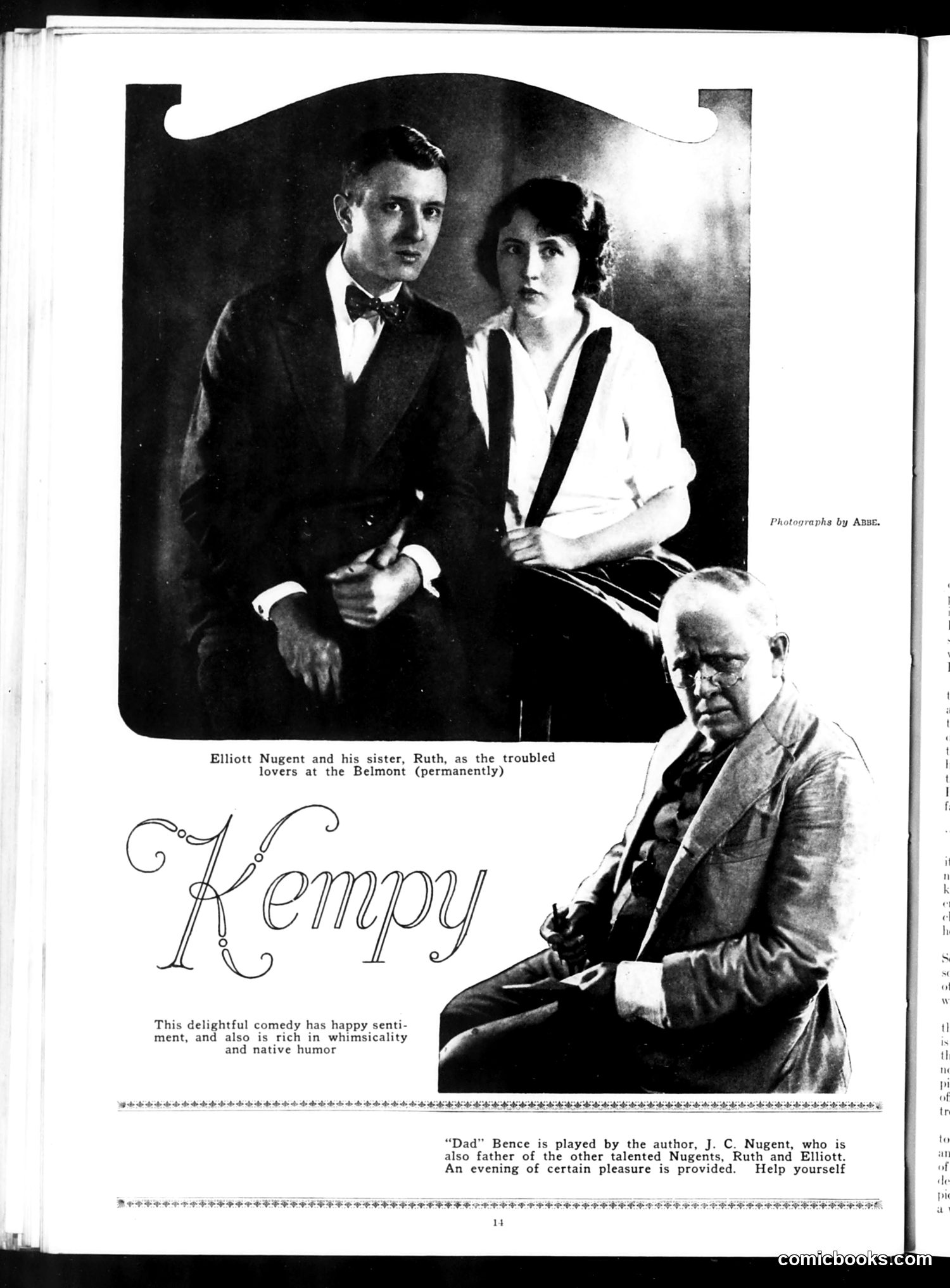
This page promotes **"Kempy,"** a theatrical comedy performed at the Belmont theater. The three photographs show cast members from the production: - **Elliott Nugent and Ruth Nugent** (top) portraying "troubled lovers" - **J.C. Nugent** (bottom right), the author/playwright, who also performs as "Dad" Bence The content is primarily **theatrical promotion** rather than political satire. Judge magazine regularly featured reviews and advertisements for Broadway productions alongside its satirical content. The text emphasizes the play's appeal—described as having "happy sentiment," "whimsicality," and "native humor." The joke appears to be a gentle family-themed one: J.C. Nugent wrote and starred in his own play alongside his talented children, making it a family affair. The phrase "Help yourself" suggests readers should enjoy an evening of entertainment with this talented theatrical family. This represents Judge's lighter, entertainment-focused content rather than its typical political commentary.
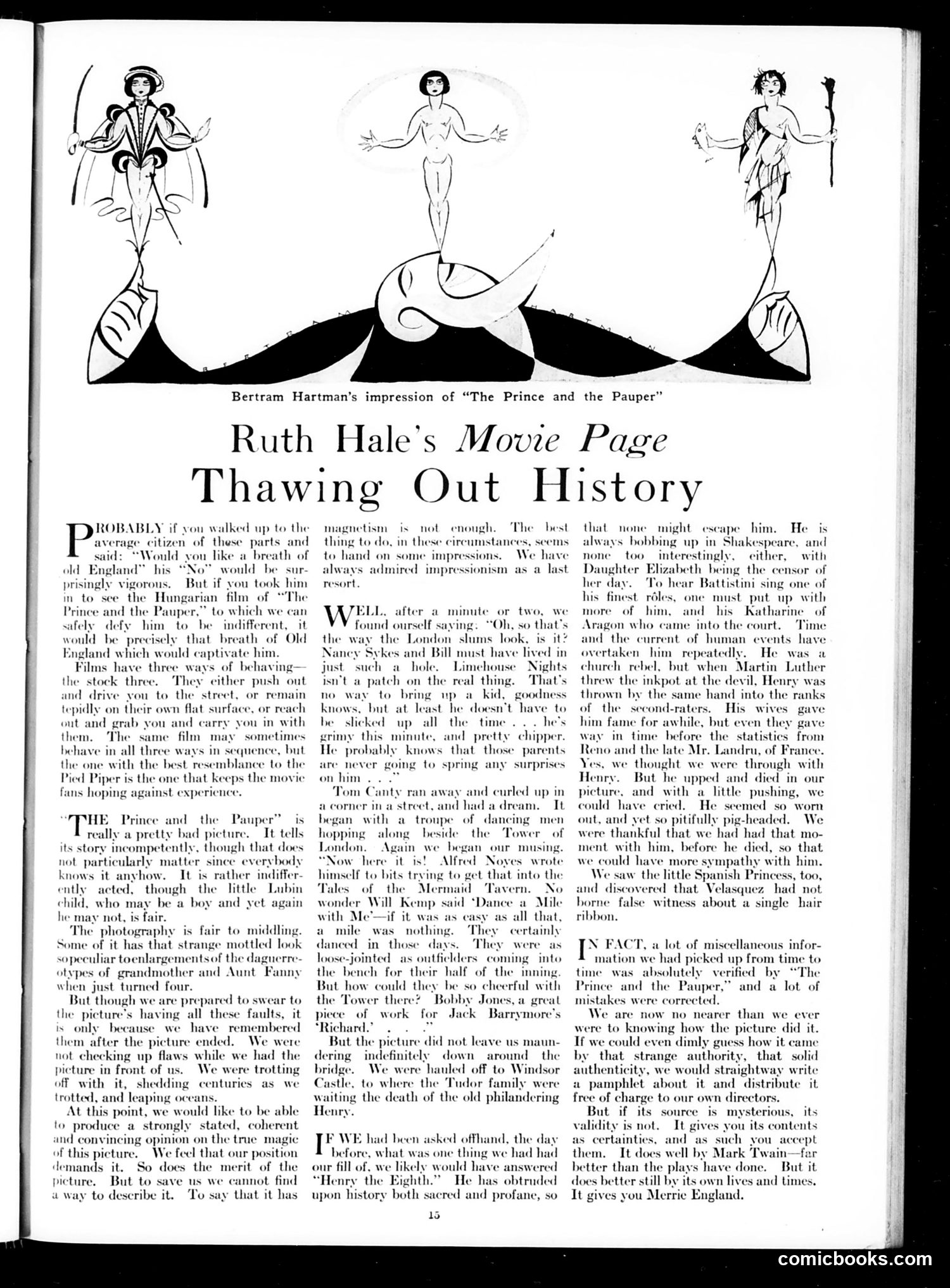
This is Ruth Hale's film review column in Judge magazine. The illustration at top (by Bertram Hartman) depicts a surreal interpretation of Mark Twain's *The Prince and the Pauper* story—showing figures emerging from or related to a large dark shape. Hale reviews a Hungarian film adaptation of *The Prince and the Pauper*. While acknowledging the film's technical flaws (poor photography, incompetent storytelling, indifferent acting), she argues it succeeds through sheer narrative magnetism—it captivates audiences despite itself. The satire targets English historical romanticism: average citizens dismiss "old England," yet this film enchants them with depictions of London slums, Limehouse, and Tudor court intrigue. Hale humorously notes the film's inescapable reliance on Henry VIII—a figure she suggests has been "obtruded upon history" excessively. The review celebrates cinema's power to make even flawed pictures compelling through immersive storytelling.
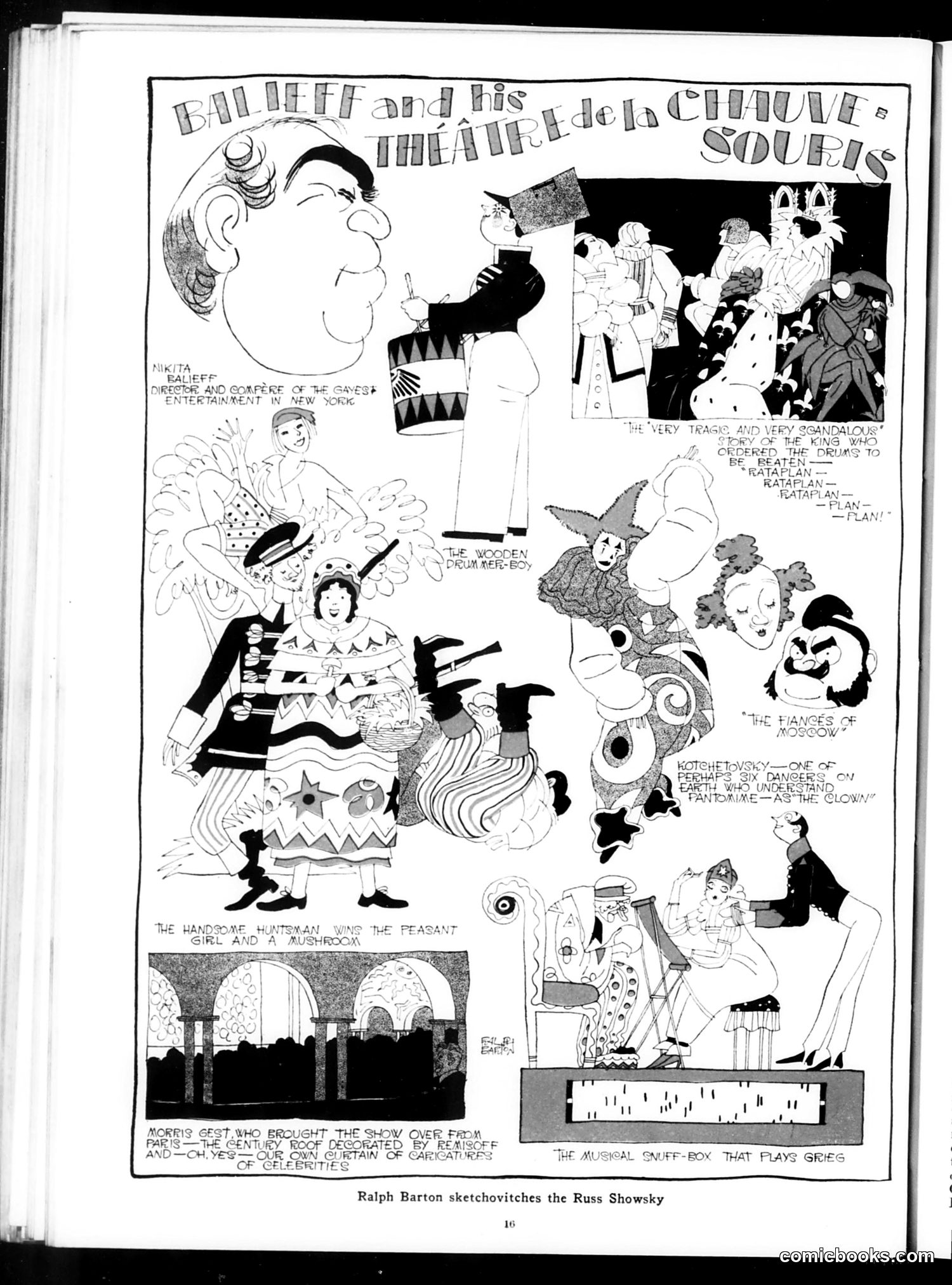
This page by cartoonist Ralph Barton satirizes the Russian-themed entertainment boom in 1920s New York. It mocks Sergei Diaghilev's Ballets Russes and associated Russian cultural imports that captivated American audiences post-WWI. The caricatured figures appear to represent Russian performers and impresarios. Barton ridicules their exotic mystique through exaggerated features and absurdist naming ("Russ Showsky," "Rataplan"). The sketches depict various theatrical elements—dancers, orchestras, sets—all rendered with Barton's characteristic satirical style. The humor targets both the Russian performers' pretensions and wealthy American audiences' fascination with European "high culture." References to Morris Gest (who produced Russian spectacles) and details about imported décor suggest mockery of the commercialized, Americanized version of Russian sophistication that had become fashionable entertainment for New York's elite.
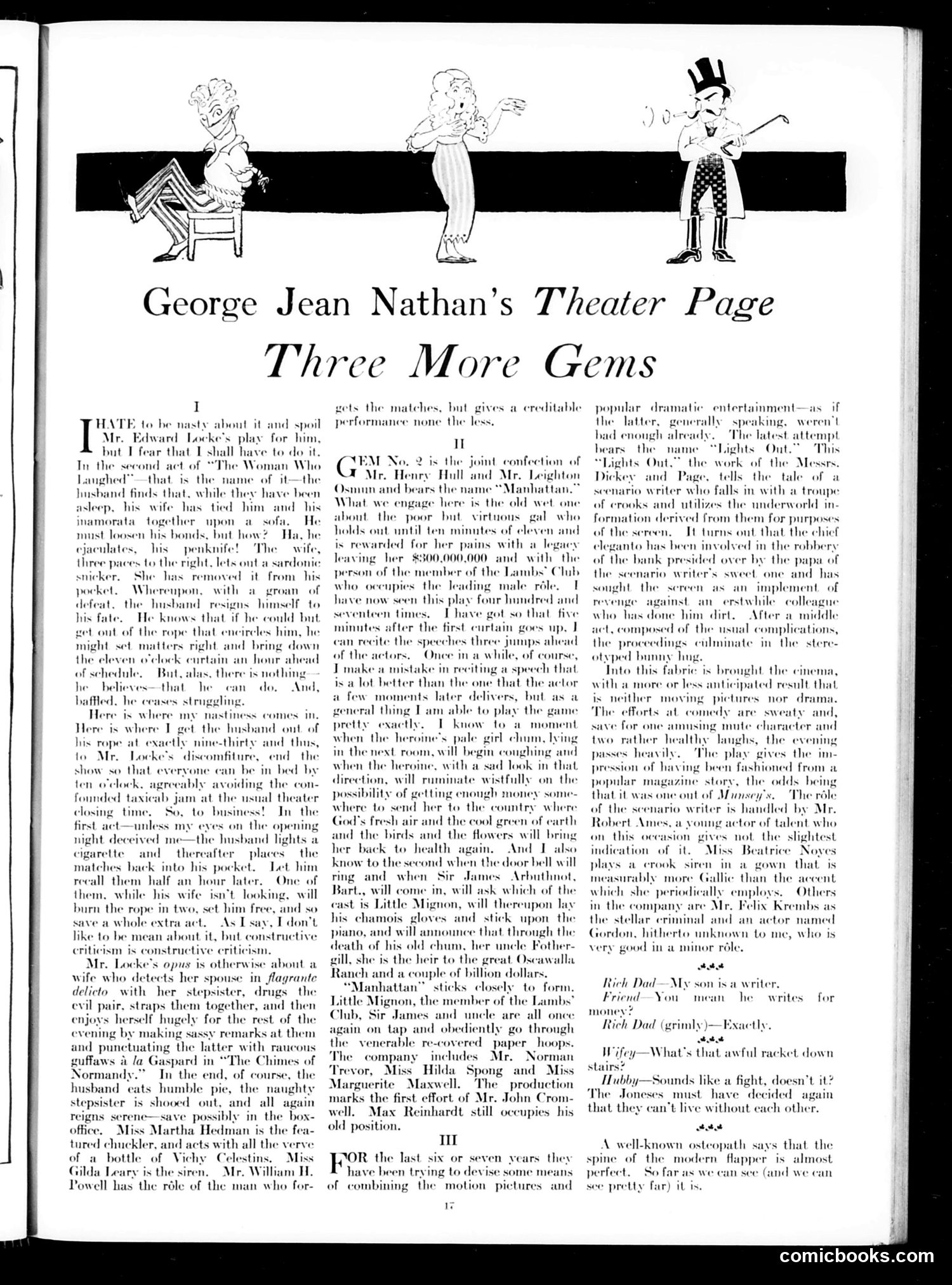
This is theater criticism by George Jean Nathan reviewing three Broadway plays. The three cartoon figures at the top represent theatrical performers or characters from these productions. **The Reviews:** Nathan critiques three plays with sardonic wit: 1. **"The Woman Who Laughed"** - Nathan mocks the plot (a wife ties her unfaithful husband and his mistress together) and points out a logical flaw: matches left in a pocket could easily burn through the rope, solving the problem before the final act. He's being deliberately mean-spirited about spotting this plot hole. 2. **"Manhattan"** - A tired romantic comedy rehashing the old "virtuous poor girl gets legacy and marries rich man" trope. Nathan admits he's seen it so many times he can recite the dialogue ahead of the actors. 3. **A third play** (text cuts off) - Appears to follow similar formulaic plotting. Nathan's tone is that of a jaded, witty critic unimpressed by formulaic theater. The satire targets both the predictable plots Broadway was recycling and Nathan's own cynical expertise in anticipating every dramatic beat.
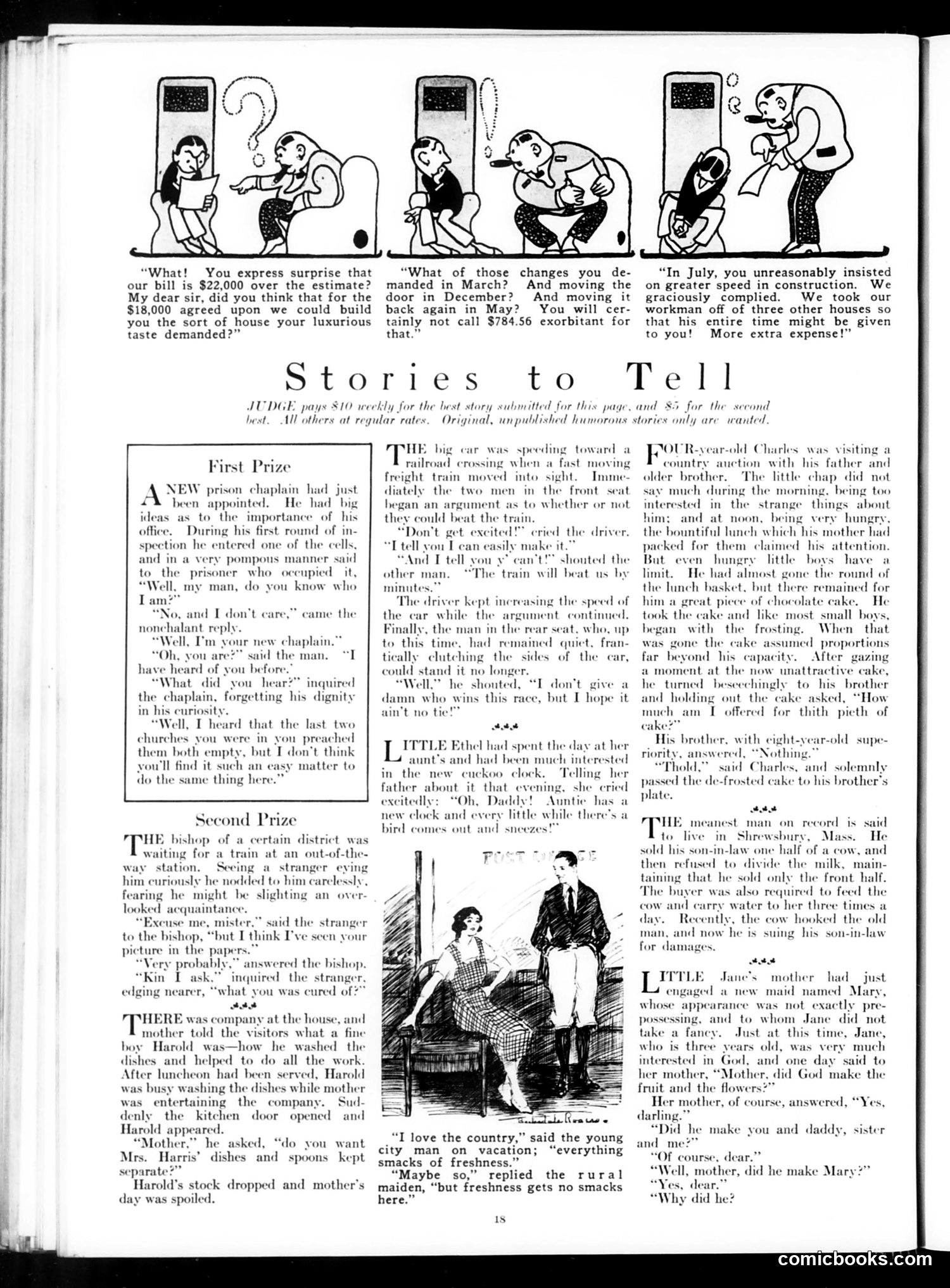
This page from Judge presents three cartoon vignettes satirizing early 20th-century social situations: **Top cartoons**: A contractor defends massive cost overruns by mockingly cataloging the client's own demands—design changes, relocations, and rushed timelines. The satire targets both contractors' excuses and wealthy clients' indecisive extravagance during home construction. **"First Prize" story**: A new prison chaplain's pompous introduction is deflated when an inmate reveals the chaplain emptied churches through poor preaching. The joke mocks self-important clergy. **"Second Prize"**: A bishop is mistaken for someone cured of illness, satirizing the tendency to associate public figures with scandal or ailment. **Other stories**: Additional brief humorous anecdotes about social embarrassment—a child's honesty ruining a mother's boasting, a train-race argument, and rural-versus-urban cultural differences. The page reflects Judge's satirical focus on American social pretension, professional incompetence, and class dynamics during the early-to-mid 20th century.
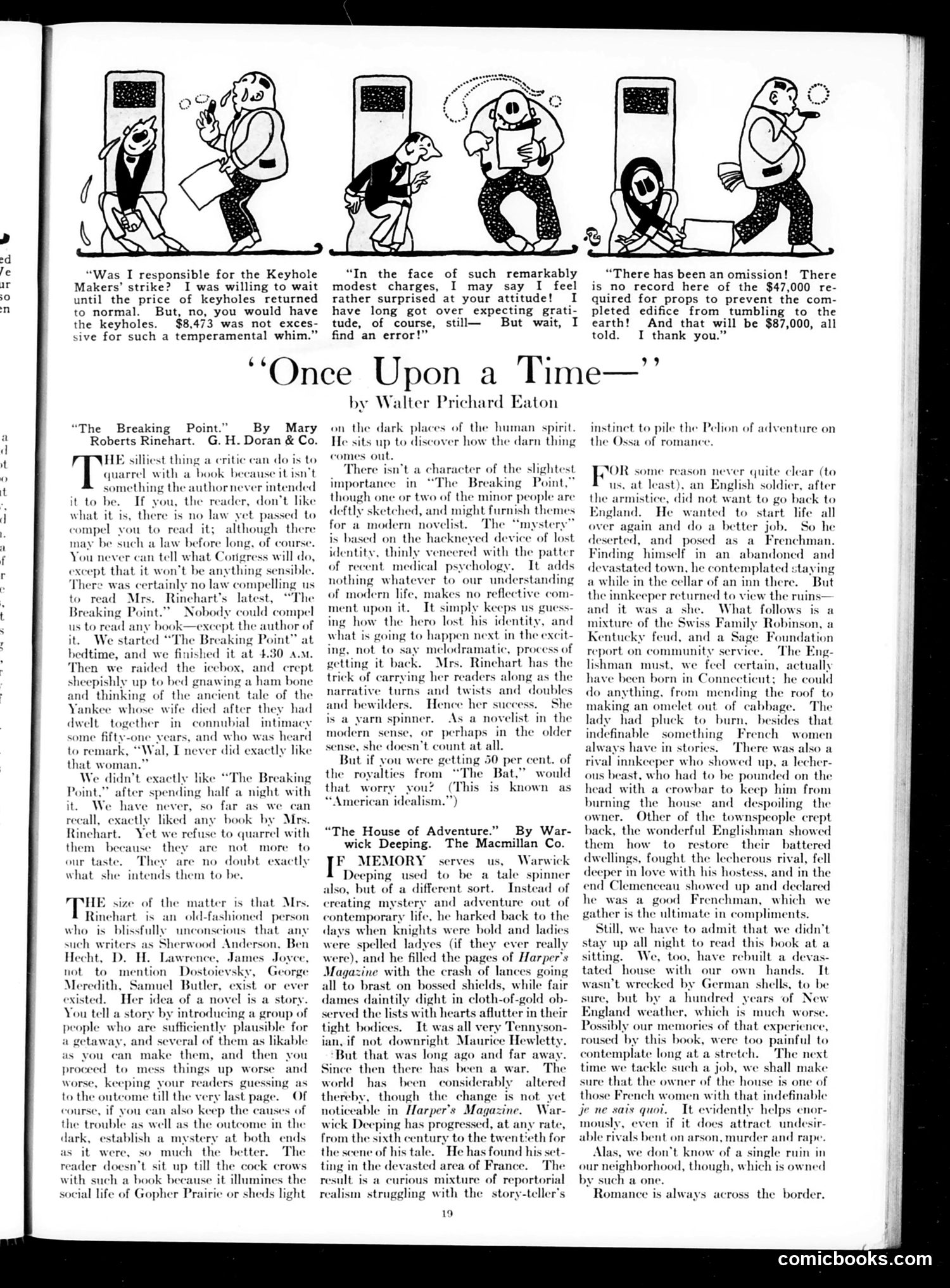
The top cartoon depicts three scenarios of escalating financial deception. In each panel, a man in formal attire extracts money from another figure under false pretenses—first justifying excessive keyhole prices ($8,473), then discovering a conveniently "missed" charge, finally adding another large sum ($47,000, then $87,000 total). The satire targets **contractor or tradesman fraud**, likely referencing post-World War I inflation and profiteering. The repeated pattern—feigned innocence, discovery of "errors," and ever-larger bills—mocks how dishonest service providers exploit clients by presenting inflated costs as reasonable, then conveniently "discovering" additional charges. The figures appear to be an unscrupulous businessman or contractor (left) bamboozling a hapless client (right). The joke relies on recognizing the transparent con: each "discovery" is obviously fabricated, yet presented with mock sincerity. Below is a book review of Mary Roberts Rinehart's *The Breaking Point*, praising her narrative skill while criticizing her old-fashioned, plot-driven approach compared to modernist contemporaries.
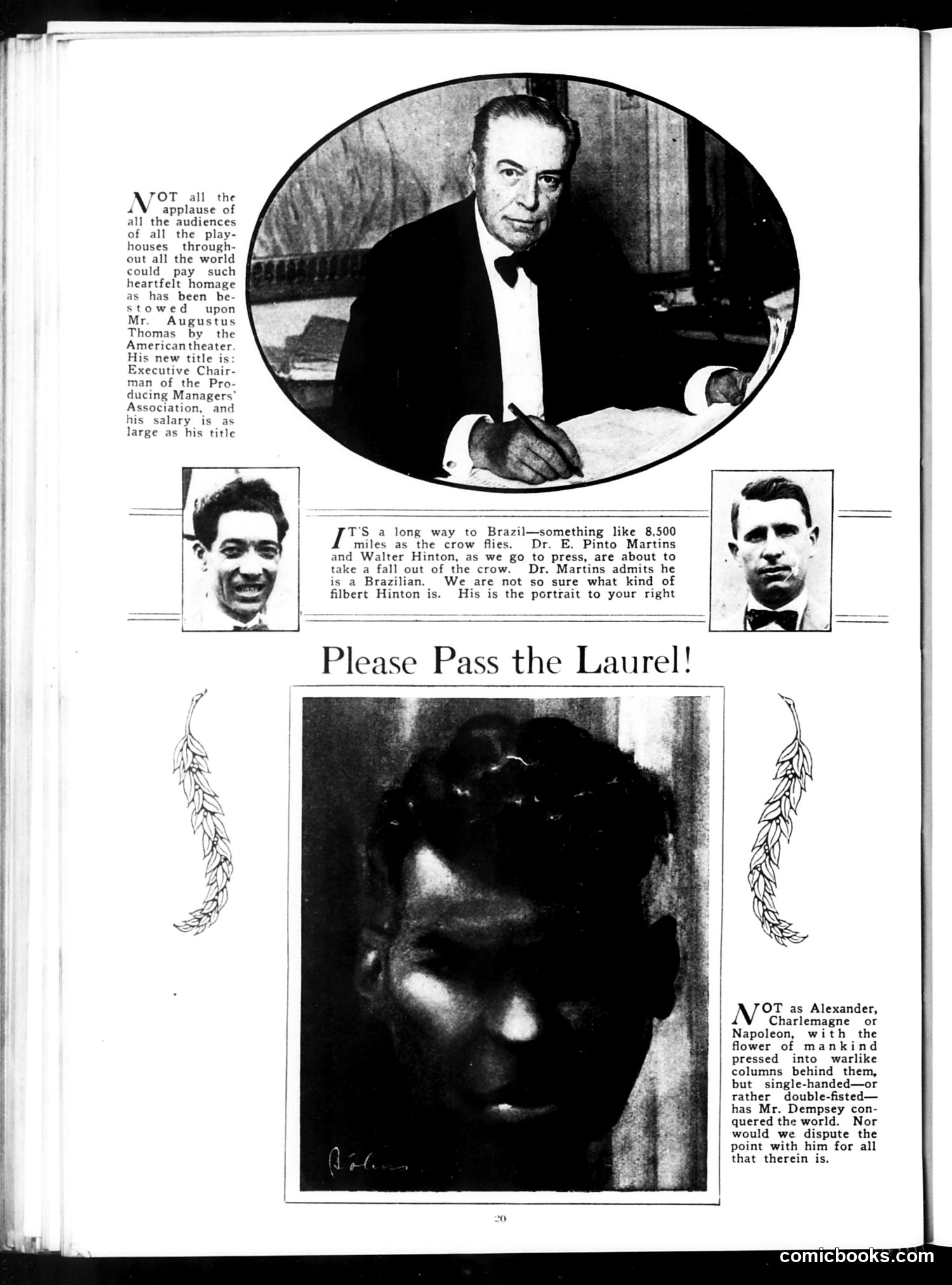
This page celebrates three contemporary figures through mock-heroic praise: **Augustus Thomas** (top): A prominent American playwright honored with an executive chairmanship. The satire applauds his theatrical accomplishments with exaggerated grandeur. **Dr. E. Pinto Martins and Walter Hinton** (middle): About to undertake a flight to Brazil—8,500 miles—described humorously as racing "the crow" (likely a reference to the saying "as the crow flies"). The joke appears to mock their ambition or the difficulty of the journey. **Jack Dempsey** (bottom): The heavyweight boxing champion is compared to historical conquerors (Alexander, Charlemagne, Napoleon), but credited with conquering "the world" through boxing alone—"double-fisted"—rather than military might. The satire is celebratory, conceding Dempsey's dominance while playfully elevating his boxing prowess to world-historical significance. The page's "laurel" motif references victory wreaths, treating contemporary American achievement as deserving classical honor.
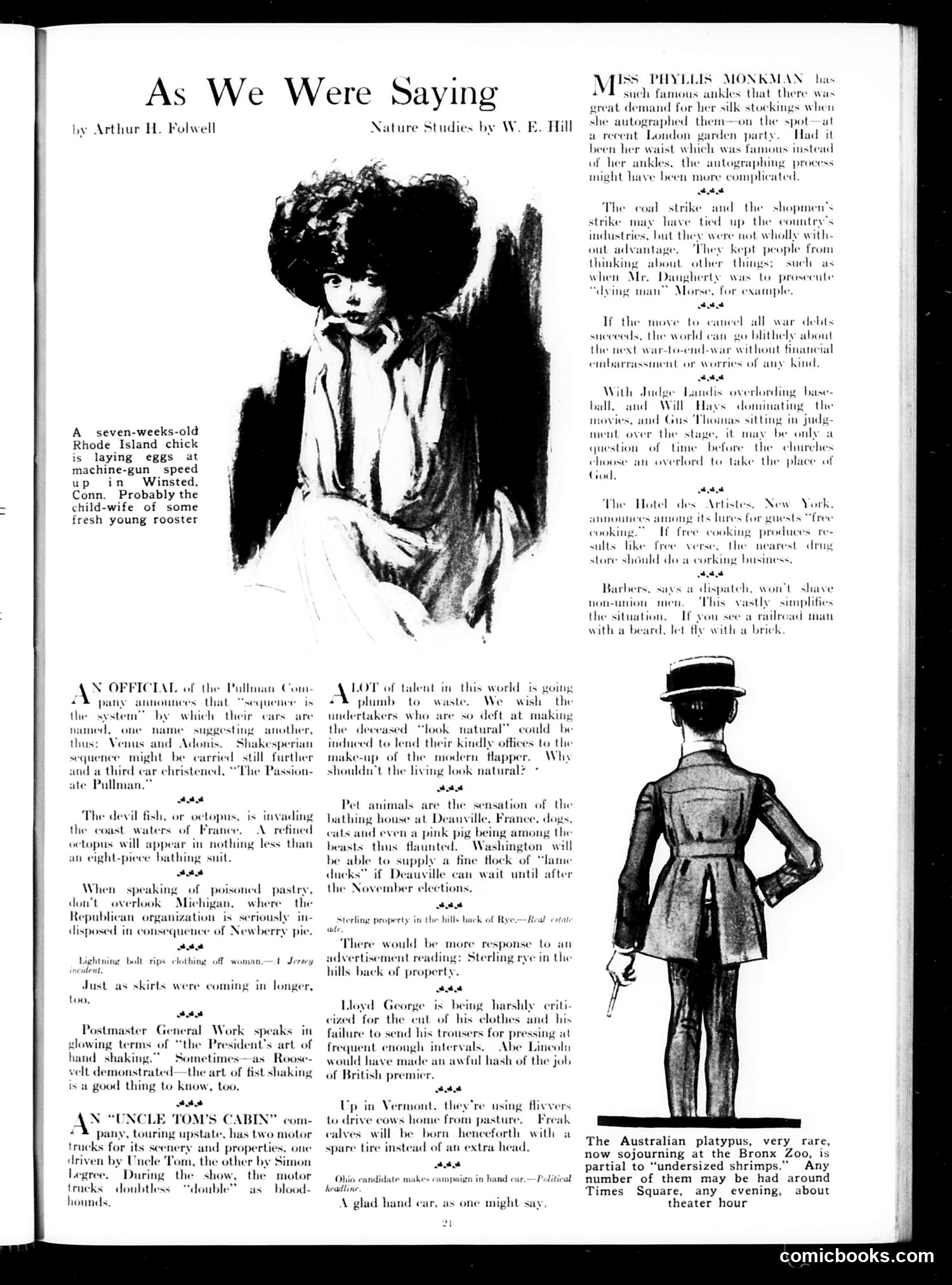
This page contains brief satirical observations on contemporary American social and political issues, typical of Judge magazine's humor format. The content includes jokes about: - **Pullman Company** naming rail cars after Shakespeare works, mocking corporate pretension - **Prohibition-era references**: "Newberry pie" (poisoned pastry in Michigan) and "Sterling rye" jokes allude to illegal alcohol - **Post-WWI politics**: References to war debts, "lame ducks" (failed politicians), and Lloyd George's fashion choices - **1920s social commentary**: Criticism of modern "flappers" for not looking "natural"; Phyllis Monkman's famous ankles (a celebrity footnote) - **Authority figures**: Judge Landis (baseball commissioner), Will Hays (film censor), positioning them as society's new moral arbiters replacing God The illustrations show a woman in fashionable dress and a man in a suit—likely representing contemporary 1920s types being satirized. The overall tone mocks social hypocrisy, corporate culture, and expanding governmental/institutional control over entertainment and morality.
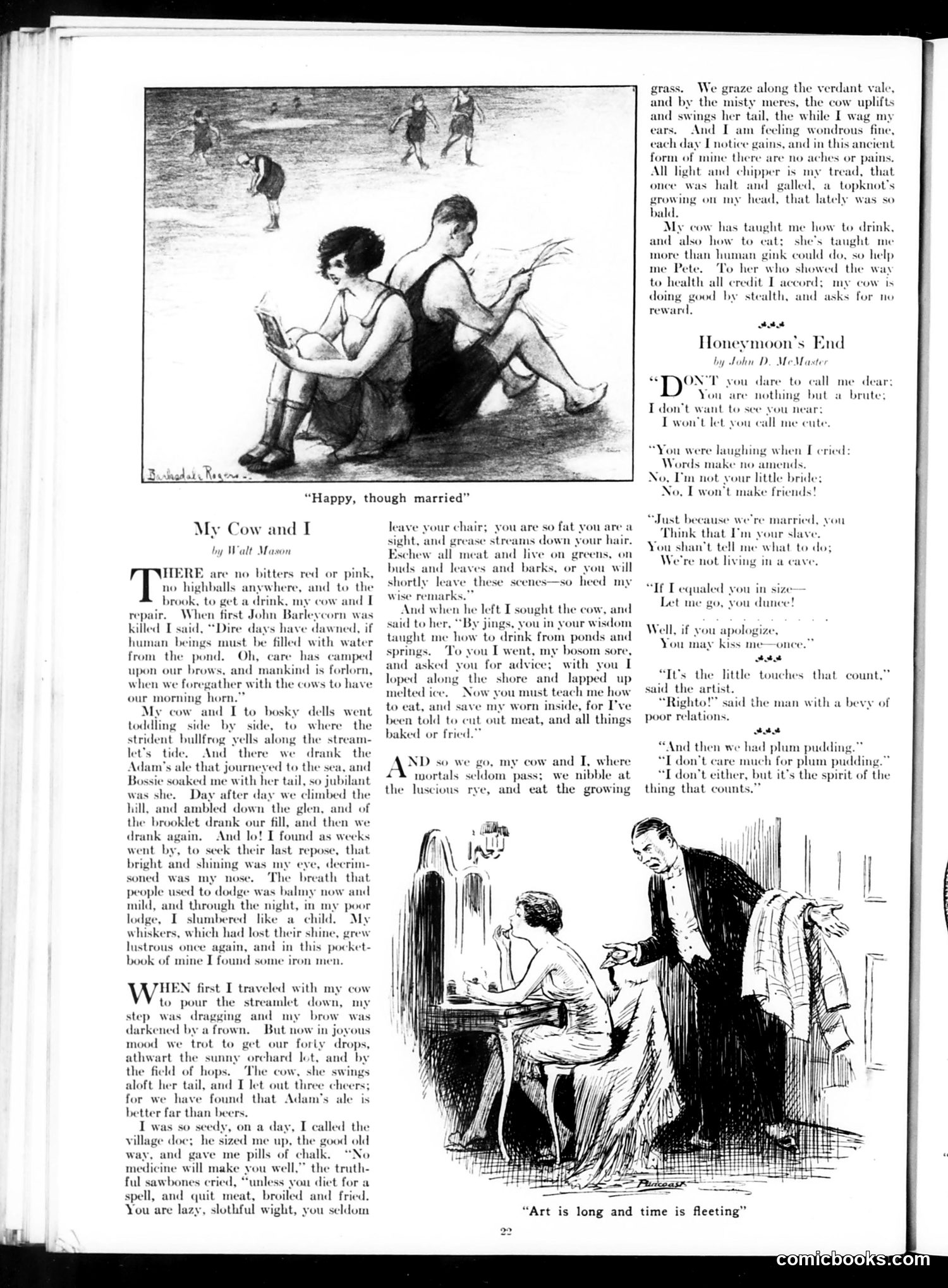
This page contains two satirical pieces from Judge magazine, reflecting early 20th-century American concerns. **"My Cow and I"** by Walt Mason is a humorous poem celebrating temperance (abstaining from alcohol). The narrator, having given up drinking, discovers that living simply—drinking water from streams and eating grass alongside his cow—restores his health, vigor, and finances. His whiskers shine again, he finds money in his pockets, and a doctor confirms his improvement. The satire mocks those dependent on alcohol while praising rural simplicity and animal wisdom. This reflects the Prohibition-era sentiment gaining momentum in America. **"Honeymoon's End"** satirizes early marriage conflict, depicting a newly married woman angrily confronting her husband for his insensitive behavior (laughing while she cried). She resists submission to marital authority, asserting equality and refusing obedience. The humor comes from her rapid mood swings—she'll only forgive him with an apology and kiss. This reflects contemporary debates about women's rights and marital equality in the early 1900s.
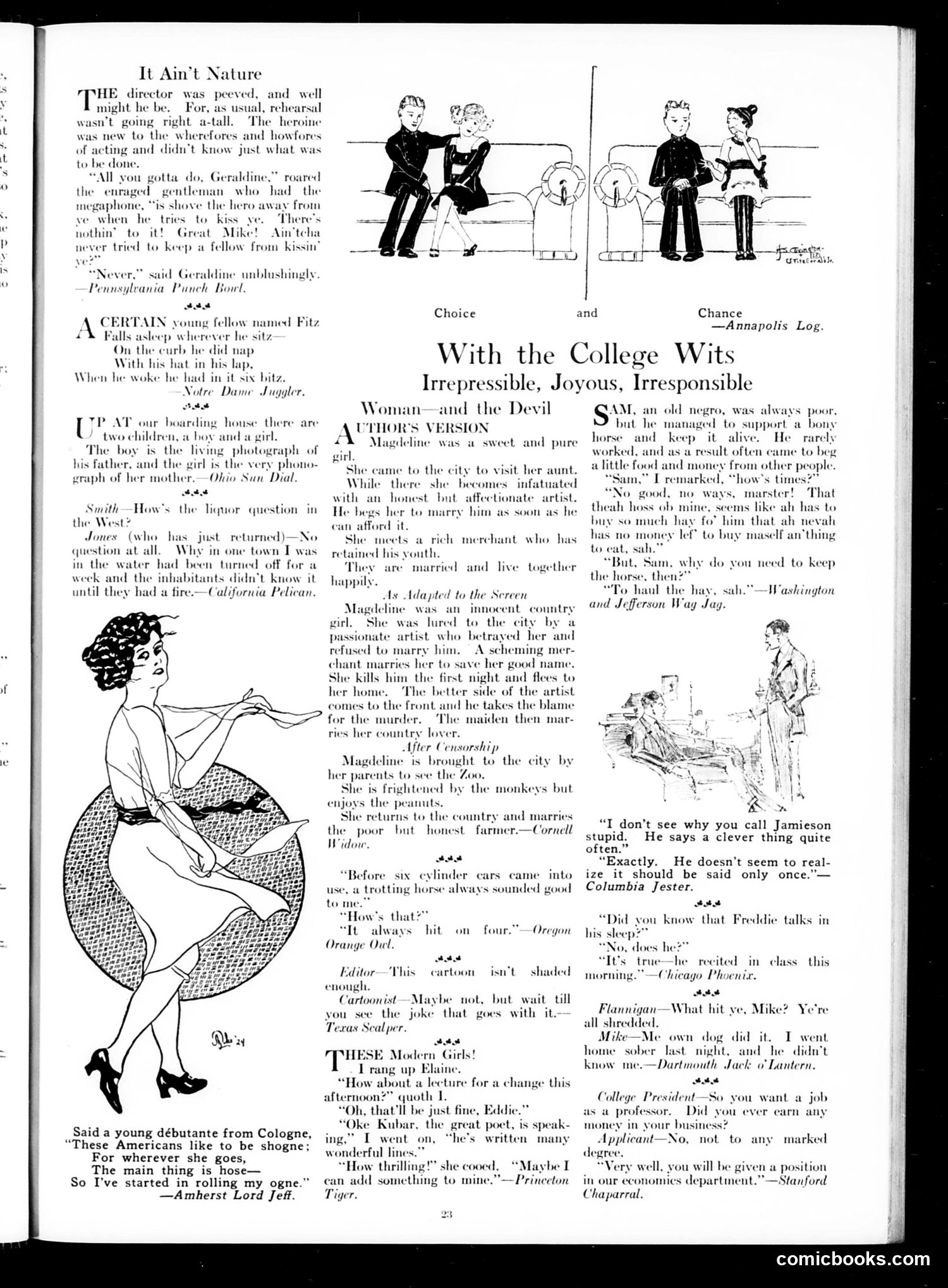
This is a humor magazine page mixing theatrical satire with college jokes typical of 1920s Judge magazine. **Main cartoon ("It Ain't Nature"):** A theater director frustratedly instructs a new actress how to perform a simple scene—pushing away a male actor during a kiss. The joke: the actress claims she's never tried keeping a fellow from kissing her, implying she lacks the experience or inclination for such resistance. The satire mocks both theatrical incompetence and, more pointedly, the "modern girl" of the era for her perceived loose morality. **"Woman and the Devil" feature:** Compares three versions of a story—the author's moral tale, the censored film version (sensational with murder and betrayal), and the post-censorship version (sanitized). The satire targets film censorship boards' inconsistency and absurdity. **College humor pieces:** Brief jokes from university publications mocking various types—from a vain debutante to a poor Black man's circular logic about feeding his horse. The latter perpetuates period racial stereotypes. Overall: Pre-Code era satire targeting censorship, theatrical pretension, and changing gender norms.
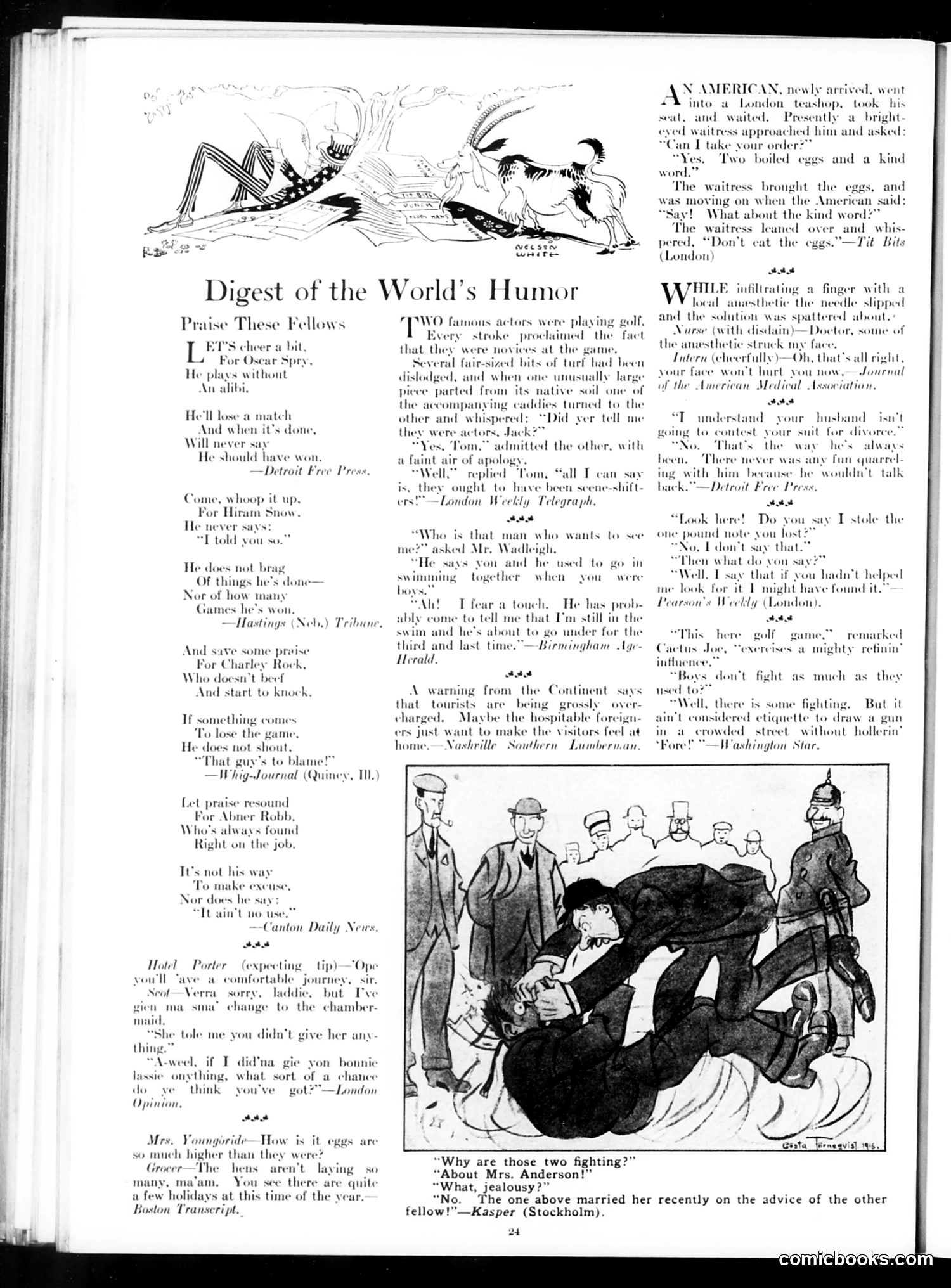
This page from *Judge* magazine contains primarily **humorous anecdotes** rather than political cartoons. The content includes: **Main pieces:** - A column praising men of good character (Oscar Spry, Hiram Snow, Charley Rock, Abner Robb)—ordinary fellows who don't make excuses or brag - Various short jokes about everyday situations: a Scottish hotel porter's transactional logic with a chambermaid; an American tourist in a London teashop expecting kindness but getting sardonic eggs; medical/dental mishaps; golfers losing turf **The cartoon** (bottom) shows two men fighting while bystanders watch, captioned with jealousy over a woman—one man married her on the other's advice, creating conflict. **Satire type:** These are gentle, observational humor pieces mocking human nature—social pretension, marital discord, professional awkwardness. There's **no evident political content**. The humor emphasizes character traits (honesty, industriousness, restraint) valued in early 20th-century American culture. The international datelines (London, Stockholm, Boston) suggest *Judge* reprinted humor from worldwide sources.
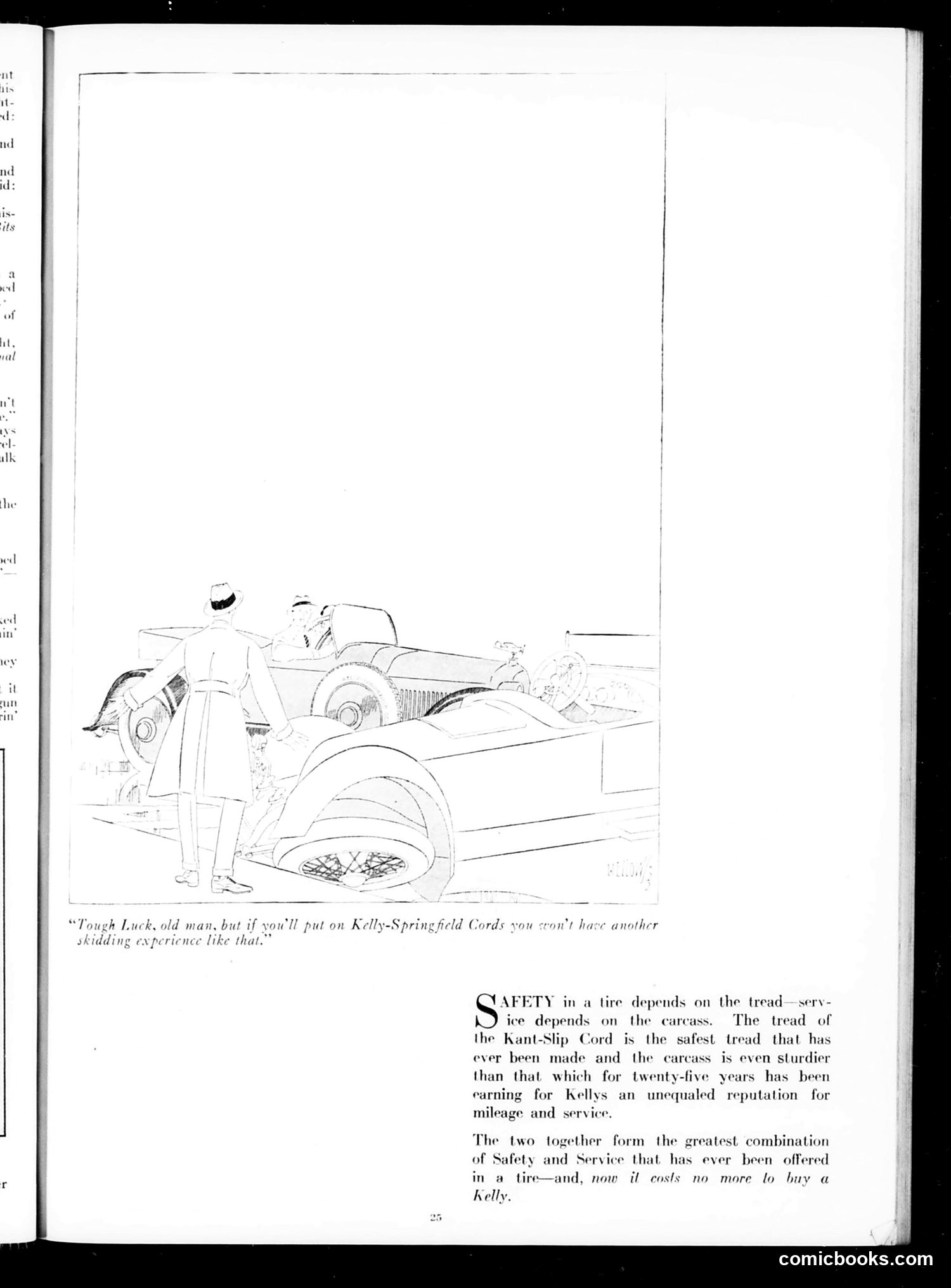
This is a **tire advertisement** disguised as editorial content in *Judge* magazine, not a political cartoon. The sketch depicts a car accident where one vehicle has skidded off the road, with a man commenting on the "tough luck" to the driver. The ad's joke plays on this mishap: it suggests that with Kelly-Springfield Cord tires (specifically their "Kant-Slip Cord" tread), such skidding accidents wouldn't happen. The advertisement emphasizes that Kelly tires have maintained a 25-year reputation for safety and mileage, and that their superior tread design combined with a sturdy carcass provides "the greatest combination of Safety and Service." The punchline is that now consumers get this premium safety "no more to buy a Kelly"—meaning at no extra cost compared to competitors. This is early automotive advertising, appealing to growing concerns about road safety as cars became more common.
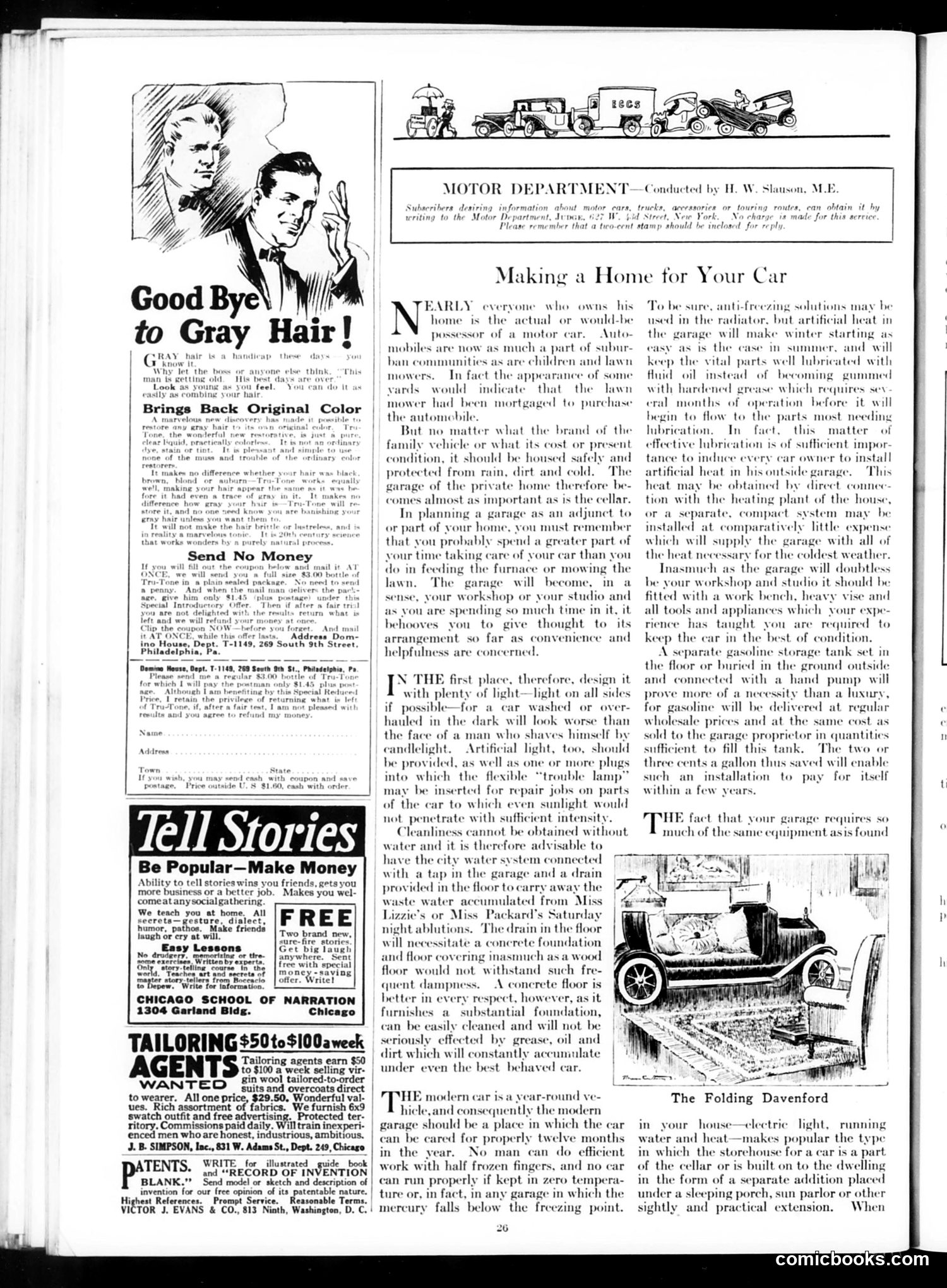
This page contains **mostly advertisements** mixed with practical editorial content about home garages. The top-left cartoon advertises hair dye, showing two men in formal wear with the tagline "Good Bye to Gray Hair!"—a straightforward pitch for a product that promises to restore youthful appearance. The caricature style is typical of early 20th-century advertising. The main content is a **Motor Department article** about building home garages for automobiles, written in the period when car ownership was becoming common among suburban homeowners. The text reflects social attitudes of the era: cars are now as standard as lawn mowers, and the garage deserves as much attention as a cellar. The article emphasizes practical concerns—weatherproofing, lighting, water access, temperature control—that would resonate with new car owners unfamiliar with vehicle maintenance. The remaining space fills with **classified ads** for mail-order products: hair dye, storytelling lessons, tailoring agents, and patent services—typical revenue sources for magazines of this era. There is **no overt political satire** on this page; it reflects consumer culture and automotive domestication of American life circa 1920s.
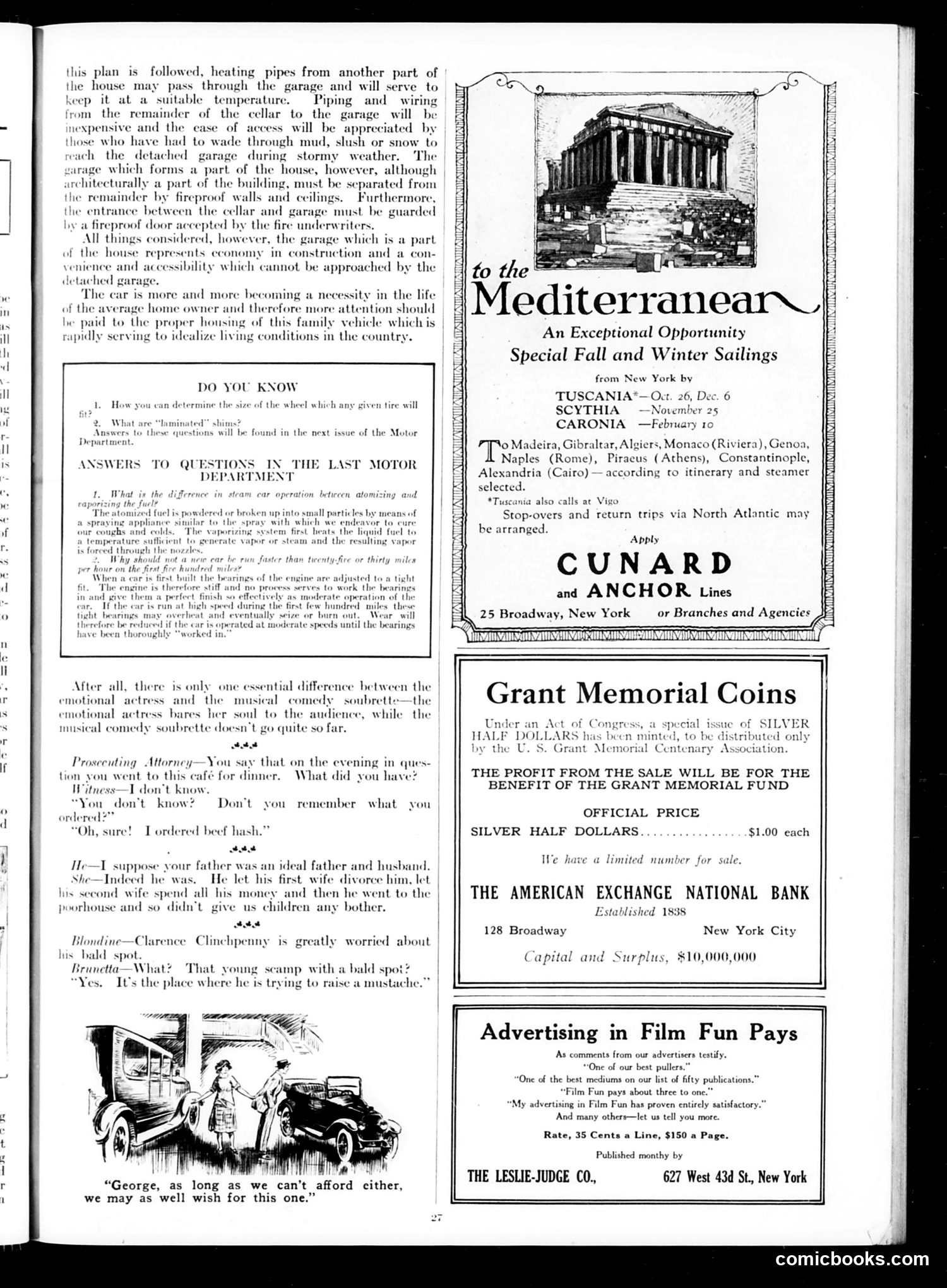
This page is primarily **advertising and filler content** rather than political satire. The main cartoon at bottom-left depicts two men examining cars, with the caption "George, as long as we can't afford either, we may as well wish for this one"—a mild joke about economic hardship during car-shopping, likely reflecting post-WWI economic uncertainty. The other content includes: - **Technical motor advice** answering reader questions about automobile maintenance - **Humor snippets** (prosecuting attorney, father-in-law jokes) offering light social comedy unrelated to politics - **Ship and coin advertisements** for Mediterranean cruises and Grant Memorial silver dollars The page reflects **1920s consumer culture**: automobiles becoming essential, travel aspirations, and commemorative merchandise. The humor is domestic and economic rather than politically pointed—jokes about affordability and family dynamics common to the era's middle-class readership.
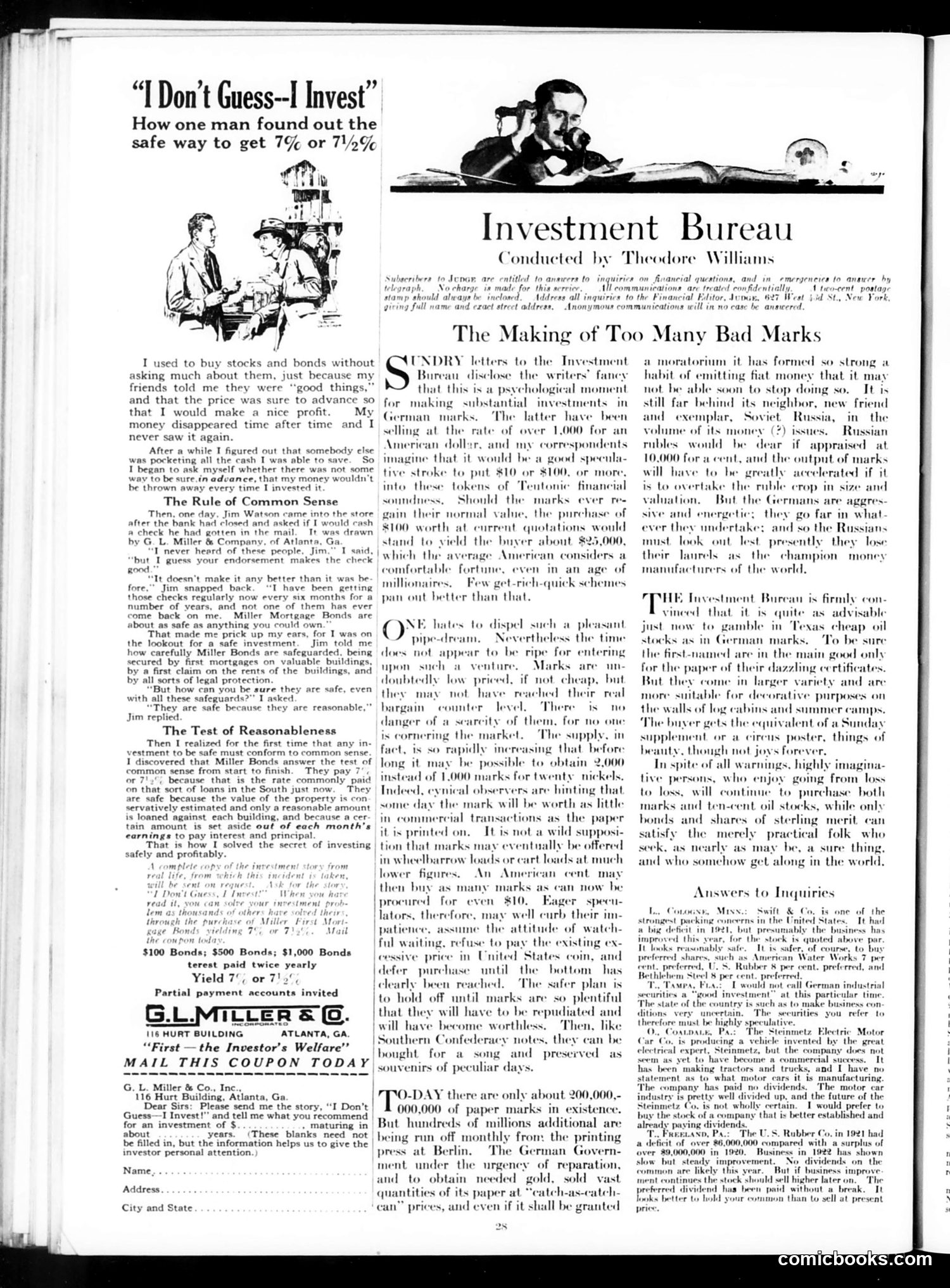
This page combines **advertising with financial satire** from the 1920s. The main narrative ("I Don't Guess—I Invest") is a **sponsored advertorial** for G.L. Miller & Company, a mortgage bond firm in Atlanta. It frames safe investing as common sense: a skeptical investor learns that Miller Bonds are "reasonable" because they pay standard rates (7%), are secured by real estate mortgages, and are backed by legal protections. This was pitched as the opposite of reckless stock gambling. The secondary article, "The Making of Too Many Bad Marks," **satirizes post-WWI German economic chaos**. It mocks Americans tempted to speculate on German marks, which are "selling at the rate of over 1,000 for an American dollar." The satire is that during Germany's hyperinflation crisis, ordinary paper currency became nearly worthless—yet speculators hoped to profit anyway. The piece warns against this "pleasant pipe-dream," cautioning that marks may never recover value. Together, the page contrasts **rational, secured American investment** against **reckless foreign currency speculation**, reflecting 1920s anxieties about European instability.
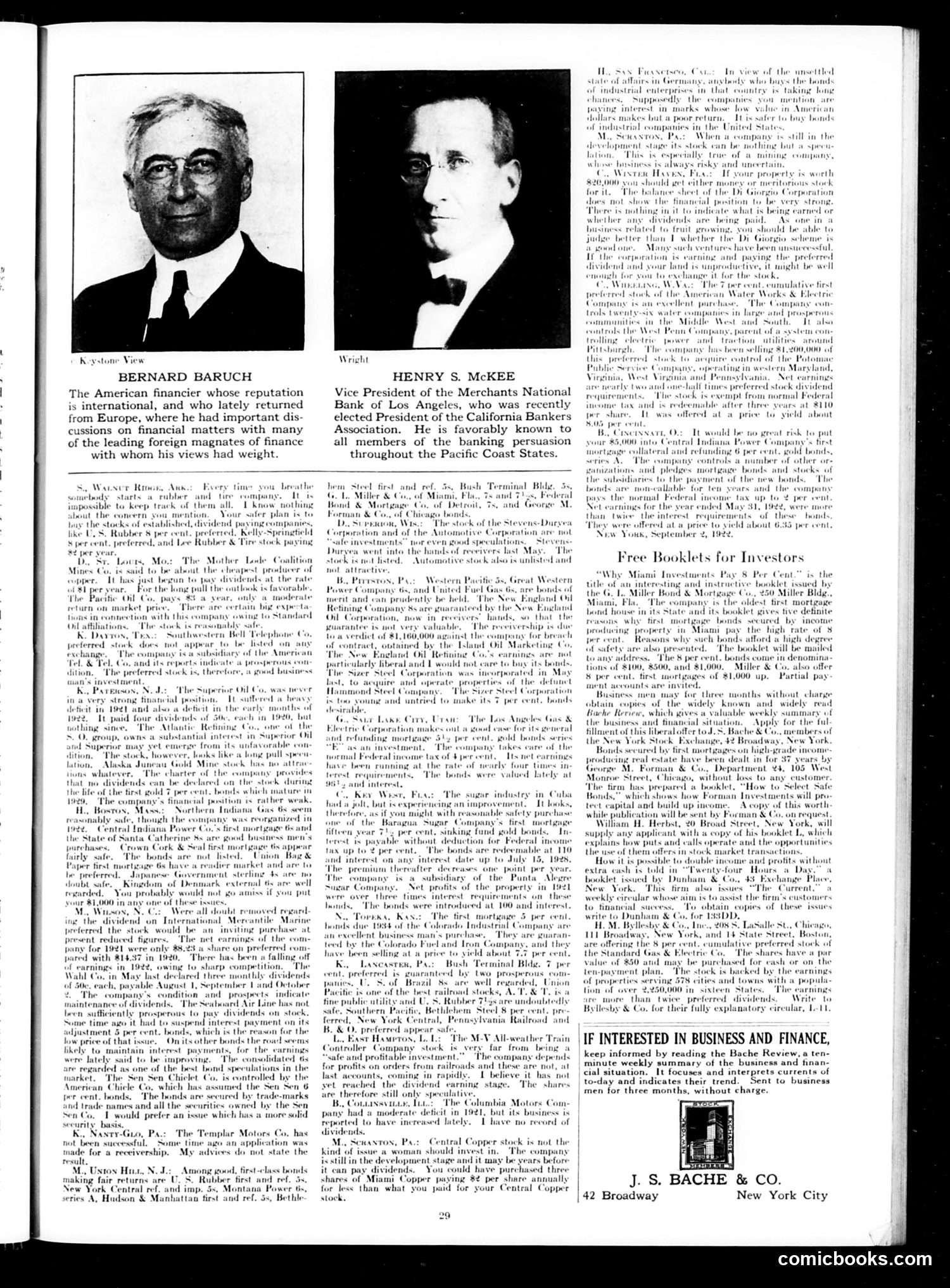
This page from *Judge* magazine features photographs and brief biographical sketches of two prominent financiers—Bernard Baruch and Henry S. McKee—alongside an "investment advice" column addressing reader inquiries about stocks and bonds. The content is not satirical cartooning but rather **financial journalism/advertising**. Baruch, described as an "American financier" recently returned from Europe with influence among foreign financial magnates, and McKee, a California banker, are presented as credible authorities. The advice column recommends various industrial stocks and bonds (railroads, utilities, water companies) while warning against others deemed risky. This reflects the 1920s investment boom era—readers sought guidance navigating the stock market. The page includes a J.S. Bache & Co. advertisement (New York investment firm) offering free investment booklets, suggesting *Judge* served partly as a venue for financial marketing to affluent readers.
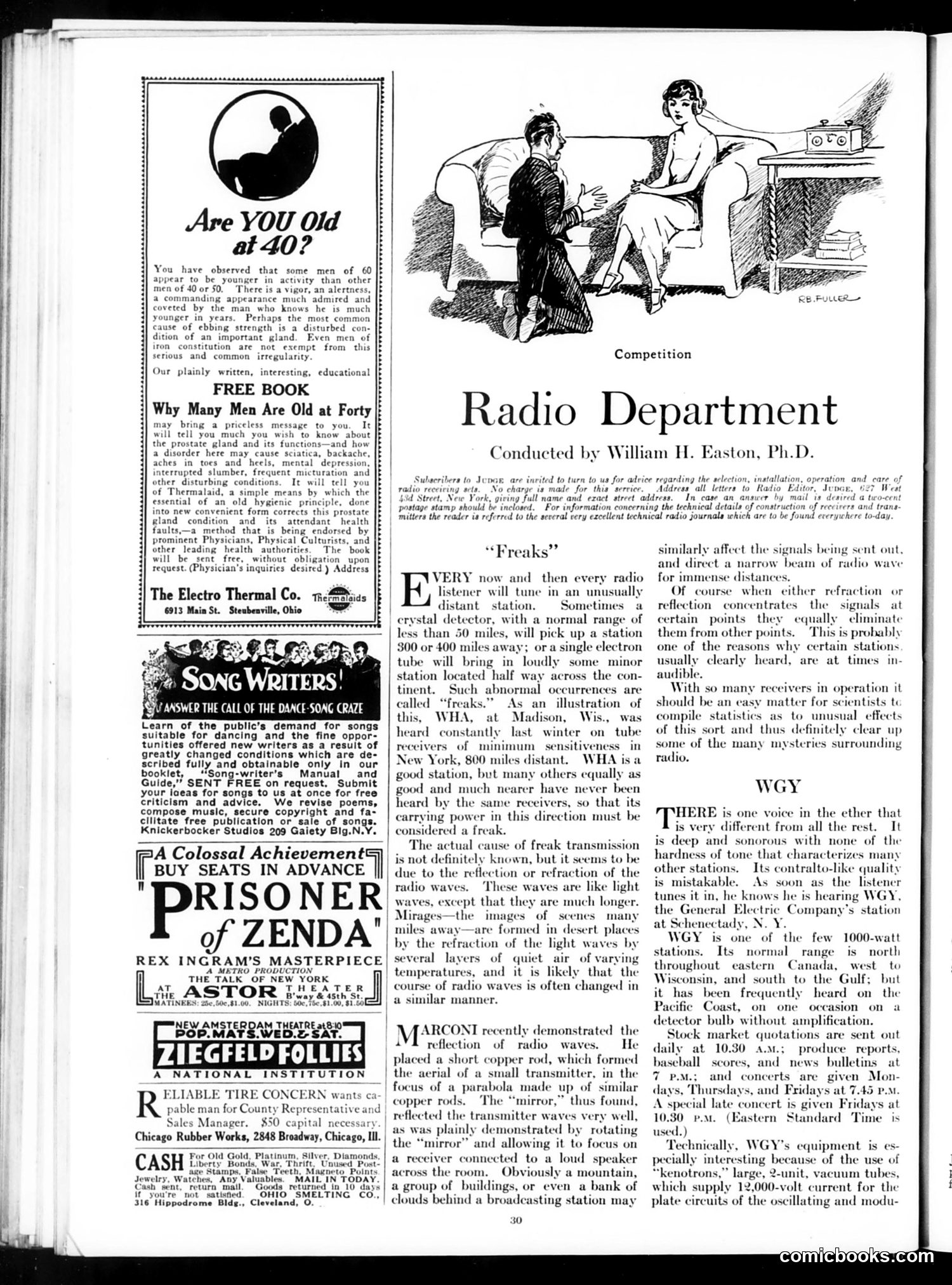
This page primarily contains **advertisements and a radio advice column**—not political satire. The main content includes: **Radio Department**: William H. Easton answers reader questions about radio reception "freaks"—unexplained long-distance transmissions that contradict normal signal range. He explains how WHA (Madison, Wisconsin) was heard 800 miles away in New York, and discusses scientific causes like atmospheric refraction. **Advertisements**: The page is dominated by classified ads for patent medicines (The Electro Thermal Co. selling a "prostate gland" treatment), theatrical promotions ("Prisoner of Zenda"), songwriting opportunities, and employment notices. **The cartoon** (upper right, by K.E. Fuller) shows a man in formal dress kneeling before a seated woman—appears to be a domestic/romantic scenario, likely accompanying nearby marriage or relationship-themed advertising, though its specific context is unclear from this page alone. This is a typical Judge page mixing editorial content with revenue-generating advertisements rather than sharp political commentary.
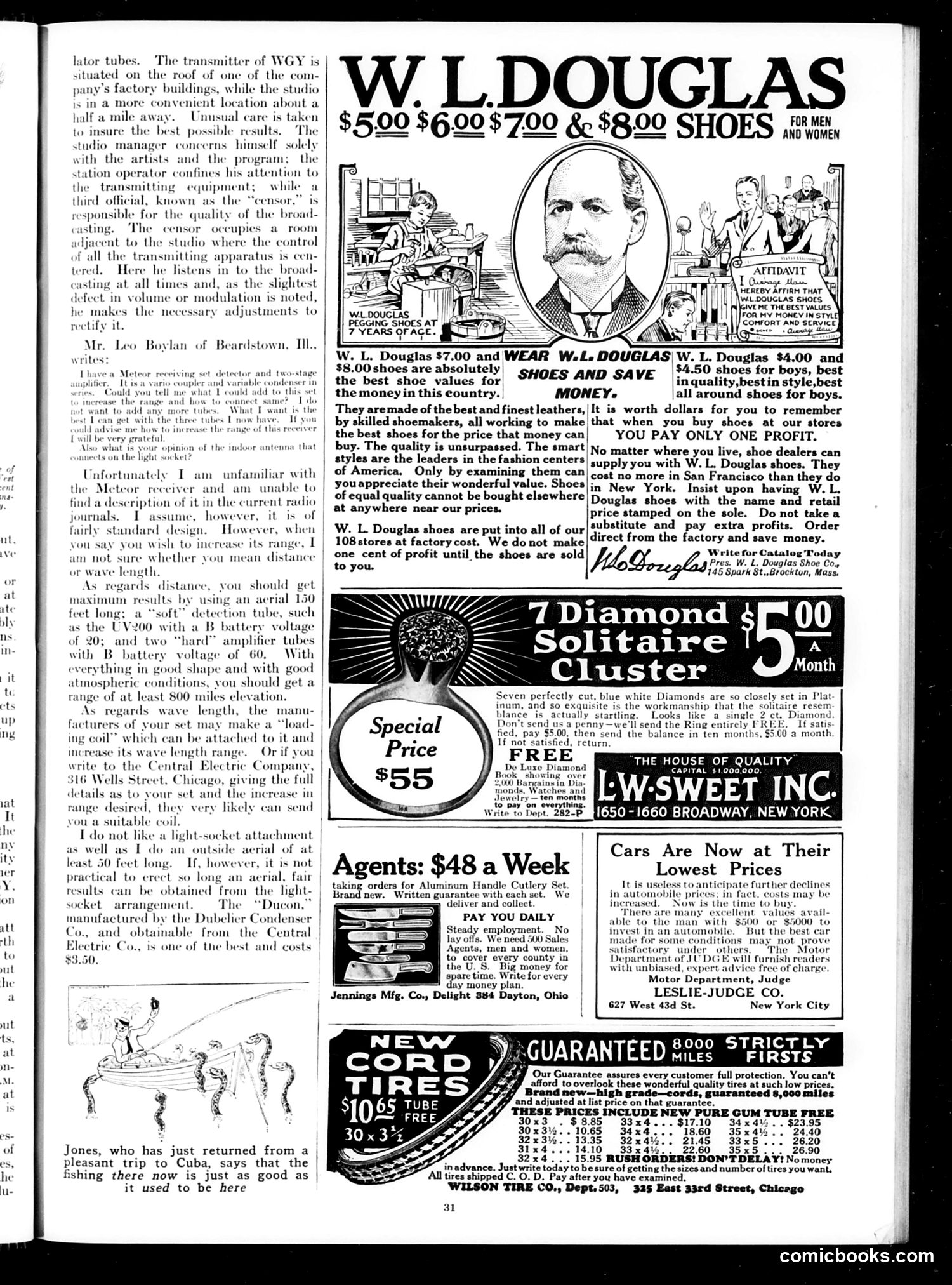
This is primarily an **advertising page** rather than editorial or satirical content. The page features multiple advertisements typical of 1920s-era publications: **Main Content:** - **W.L. Douglas Shoes** (dominant): Large ads promoting shoes at various price points ($5-$8) for men and women, emphasizing factory-direct sales and quality. An affidavit from a satisfied customer and the company president's signature add credibility. - **7 Diamond Solitaire Cluster Ring** ($55): Jewelry advertisement promising quality craftsmanship. - **EW Sweet Inc.**: "House of Quality" jewelry store (New York). - **Agents Wanted** ($48/week): Employment ad for aluminum hand-carts. - **Car Sales and Motor Department**: Automobile dealer advertisement. - **New Cord Tires** ($10.65): Tire advertisement with pricing and warranty information. **The Radio Article** (top-left): Technical discussion about radio transmitter WGY and reader questions about radio receiver modifications—unrelated to advertising content below. No political satire or cartooning is present on this page.
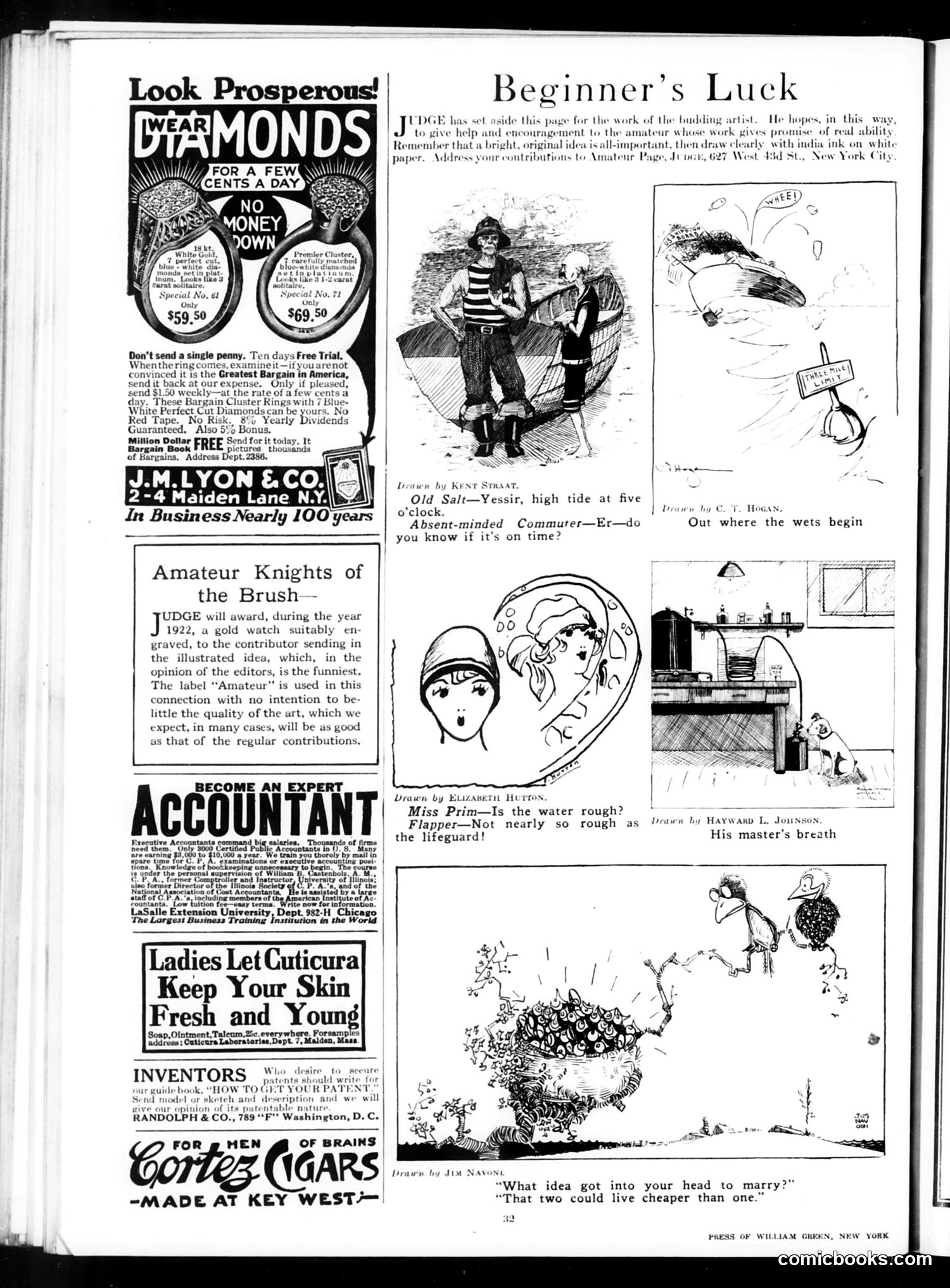
This is primarily a **advertising and humor page** from Judge magazine, circa 1922. The main content includes: **"Beginner's Luck"** section: Judge magazine's offer to aspiring amateur cartoonists—a contest awarding a gold watch for the funniest submitted illustration, encouraging young artists to submit work. **Featured cartoons** include workplace and domestic humor typical of the era: - A sailor and commuter discussing tides and time (seafaring joke) - A "Miss Prim" and "Flapper" exchange about rough water and a lifeguard's drinking problem (the humor lies in implying the lifeguard is an alcoholic—a prohibition-era reference) - A couple discussing marriage economics, joking that two could live cheaper than one **Surrounding advertisements** promote diamonds, accounting courses, skin cream, and cigars—typical 1920s commercial appeals. The page reflects Jazz Age social attitudes: mild satire about work, courtship, and Prohibition-era vices, aimed at middle-class readers.
This is a subscription advertisement for two companion magazines: *Judge* (a satirical weekly) and *Film Fun* (focused on cinema). The ad promotes a $2 offer for four months of *Film Fun* and 17 weeks of *Judge*. The humor employs mock-historical anecdotes claiming *Judge* magazine's influence on famous figures: Napoleon supposedly read it before Waterloo, Columbus distributed it to prevent mutiny, and Shakespeare relied on it for comedic inspiration. These absurd claims humorously exaggerate the magazine's importance and wit. The final section lists celebrity endorsers (Alexander, Jack Dempsey, Charlemagne, various poets and performers) in deliberately grandiose fashion, then mockingly asks readers if they consider themselves greater than these figures—implying they'd be foolish not to subscribe. The tone is characteristic of early 20th-century advertising: hyperbolic, self-congratulatory, and playfully tongue-in-cheek about the magazine's own significance. It's primarily a sales pitch rather than political satire, using humor to promote subscriptions.
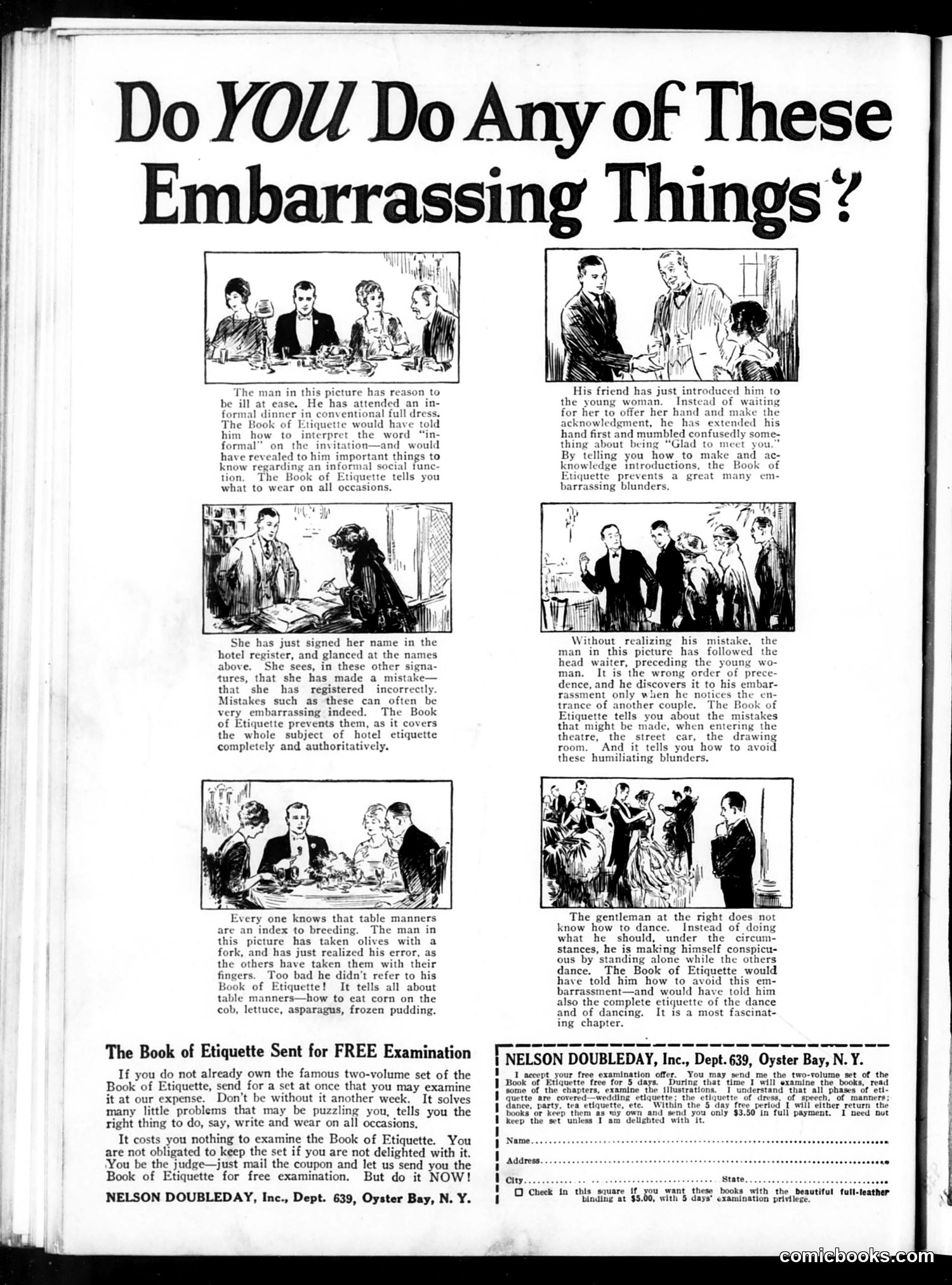
This is an advertisement for "The Book of Etiquette," disguised as satirical social commentary. The page depicts six scenarios of upper-class embarrassment from the 1920s-30s era: 1. Wearing full formal dress to an "informal" dinner 2. Registering incorrectly at a hotel 3. Using a fork instead of fingers to eat olives 4. Awkwardly initiating a handshake with a woman 5. Preceding a woman through a doorway (wrong order of precedence) 6. Standing alone at a dance instead of participating Each "embarrassing blunder" is presented as a cautionary tale that the advertised etiquette book could have prevented. The satire targets anxious middle/upper-class readers worried about social missteps and public shame—a genuine concern in formal-conscious society. The advertisement offers the book for "free examination," exploiting social insecurity to drive sales.