
Judge, 1922-09-09 · page 21 of 36
Judge — September 9, 1922 — page 21: what you’re looking at
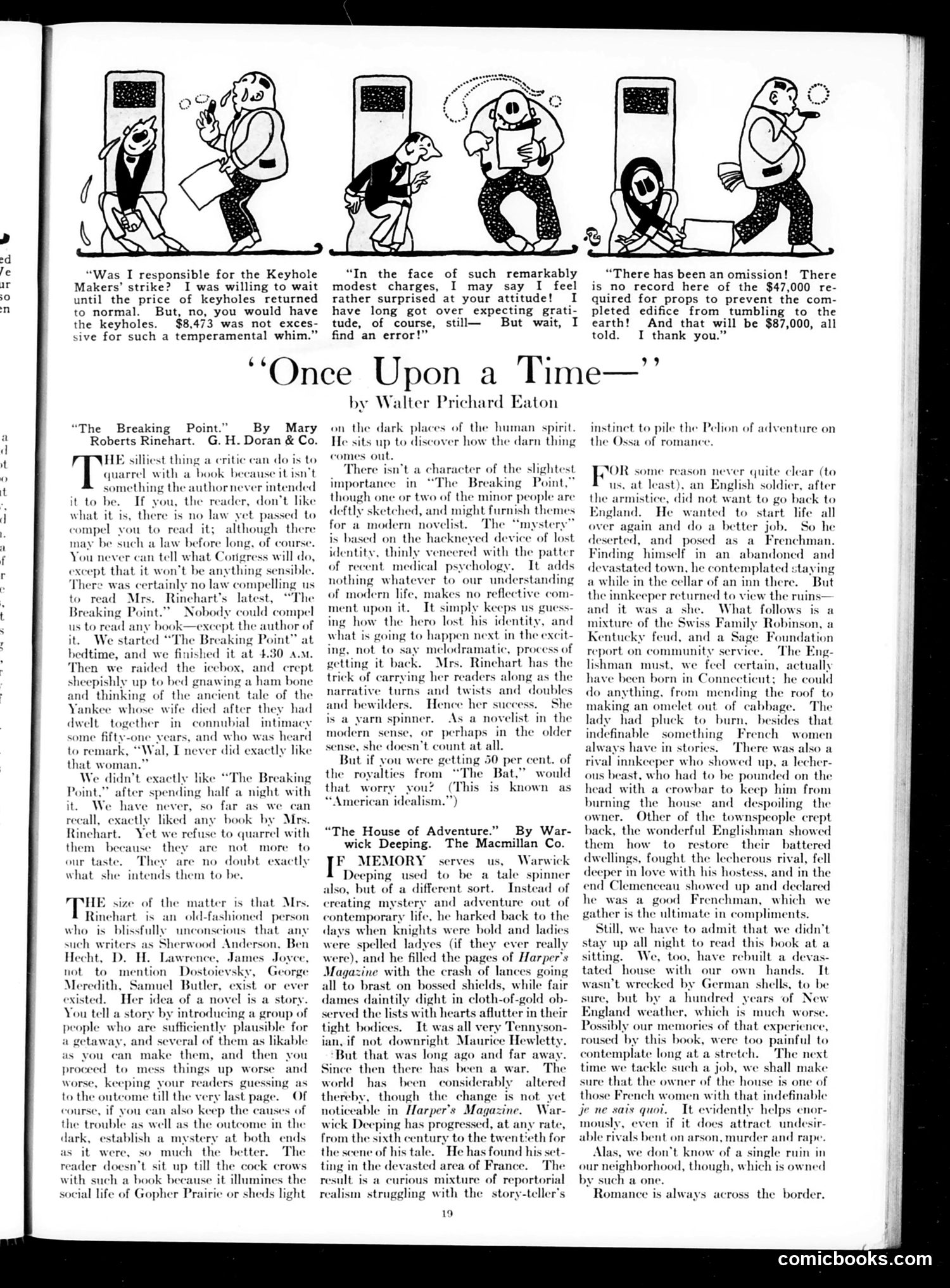
What you’re looking at
The top cartoon depicts three scenarios of escalating financial deception. In each panel, a man in formal attire extracts money from another figure under false pretenses—first justifying excessive keyhole prices ($8,473), then discovering a conveniently "missed" charge, finally adding another large sum ($47,000, then $87,000 total). The satire targets **contractor or tradesman fraud**, likely referencing post-World War I inflation and profiteering. The repeated pattern—feigned innocence, discovery of "errors," and ever-larger bills—mocks how dishonest service providers exploit clients by presenting inflated costs as reasonable, then conveniently "discovering" additional charges. The figures appear to be an unscrupulous businessman or contractor (left) bamboozling a hapless client (right). The joke relies on recognizing the transparent con: each "discovery" is obviously fabricated, yet presented with mock sincerity. Below is a book review of Mary Roberts Rinehart's *The Breaking Point*, praising her narrative skill while criticizing her old-fashioned, plot-driven approach compared to modernist contemporaries.
📄 Transcribed text from this page (OCR, searchable)
Machine-transcribed from the original scan — historical spelling and the odd misread are preserved.
“Was I responsible for the Keyhole Makers’ strike? I was willing to wait until the price of keyholes returned to normal. But, no, you would have the keyholes. $8,473 was not exces- sive for such a temperamental whim.” “In the face of such remarkably modest charges, I may say I feel rather surprised at your attitude! I have long got over expecting grati- tude, of course, still— But wait, I find an error!” _ “There has been an omission! There is no record here of the $47,000 re- quired for props to prevent the com- pleted edifice from tumbling to the earth! And that will be $87,000, all told. I thank you.” “Once Upon a Time—”’ “The Breaking Point.” By Mary Roberts Rinehart. G.H. Doran & Co. HE siliiest thing a critic can do is to quarrel with a book because it isn’t something the author never intended it to be. If you, the reader, don't like what it is, there is no law yet passed to compel you to read it; although there may be such a law before long, of course. You never can tell what Corigress will do, except that it won't be anything sensible. There was certainly no law compelling us to read Mrs. Rinehart’s latest, “The Breaking Point.” Nobody could compel us to read any book—except the author of it. We started “The Breaking Point” at bedtime, and we finished it at 4.30 a.m. Then we raided the icebox, and crept sheepishly up to bed gnawing a ham bone and thinking of the ancient tale of the Yankee whose wife died after they had dwelt’ together in’ connubial inti some fifty-one years, and who v to remark, “Wal, I never did ¢ that woman. We didn’t exactly like “The Breaking Point.” after spending half a night with it. We ve never, so far as we can recall, tly liked any book by Mrs. Rinehart. Yet we refuse to quarrel with them because they are not more to our taste. They are no doubt. exactly what she intends them to be. THE size of the matter is that Mrs. Rinehart is an old-fashioned person who is blissfully unconscious that any such writers as Sherwood Anderson, Ben Hecht, D. H. Lawrence, James Joyce, not to mention Dostoievsky, George Meredith, Samuel Butler, exist. or ever existed. Her idea of a novel is a story. You tell a story by introducing a group of people who are sufficiently plausible for . and several of them as likable as you can make them, and then you proceed to mess things up worse and worse, keeping your readers guessing as to the outcome till the very last Of course, if you can also keep the causes of the trouble as well as the outcome in the dark, establish a mystery at both ends were, so much the better. The reader doesn’t sit up till the cock crows with such ab ause it illumines the social life of Gopher Prairie or sheds light by Walter Prichard Eaton on the dark places of the human spirit. He sits up to discover how the darn thing comes out. There isn’t a character of the slightest importance in “The Breaking Point,” though one or two of the minor people are deftly sketched, and might furnish themes for a modern novelist. The “mystery” is based on the hackneyed device of lost identity, thinly veneered with the patter of recent medical psychology. It adds nothing whatever to our understanding of modern life, makes no reflective com- ment upon it. It simply keeps us guess- ing how the hero lost his identity, and is going to happen next in the excit- not to say melodramatic, process of it b Mrs. Rinehart has the of carrying her readers along as the > turns and twists and doubles and bewilders. Hence her success. She is a yarn spinner. As a novelist in the modern sense, or perhaps in the older sense, she doesn’t count at all. But if you were getting 50 per cent. of the royalties from “The Bat,” would that worry yo (This is known as “America alism. trick narrati “The House of Adventure.” By War- wick Deeping. The Macmillan Co. F MEMORY us, Warwick Deeping used to be a tale spinner also, but of a different sort. Instead of creating mystery and adventure out of contemporary life, he harked back to the days when knights were bold and ladies were spelled ladyes (if they ever really were), and he filled the pages of Harper’ Magazine with the crash of lances going all to brast on bossed shields, while fair dames daintily dight in cloth-of-gold ob- served the lists with hearts aflutter in their tight bodices. It was all very Tennyson- ian, if not downright Maurice Hewletty. But that was long ago and far away. Since then there has been a war. The world has been considerably altered thereby, though the is not yet noti wick Deeping has progressed, at any rate, from the sixth century to the twentieth for the scene of his tale. He has found his set- ting in the devasted area of France. The result. is a curious mixture of reportorial realism struggling with the story-teller’s serves 19 instinet to pile the Pelion of adventure on the Ossa of romance. for some reason never quite clear (to st), an English soldier, after ‘k to us, at le: the armistic England. . did not want to go 1 He wanted to start life all over again and do a better job. So he deserted, and posed as a Frenchman. Finding himself in an abandoned and devastated town, he contemplated staying a while in the cellar of an inn the: But the innkeeper returned to view the ruins— and it was a she. What follows is a mixture of the Swiss Family Robinson, a Kentucky feud, and a Sage Foundation report on community service. The Eng- lishman must, we feel certain, actually have been born in Connecticut; he could do anything, from mending the roof to making an omelet out of cabbage. The y had pluck to burn, besides that something French women always have in stories. There was also a ival innkeeper who showed up, a lecher- ous beast, who had to be pounded on the head with a crowbar to keep him from burning the house and despoiling the owner. Other of the townspeople crept back, the wonderful Englishman showed them how to restore their battered dwellings, fought the lecherous rival, fell deeper in love with his hostess, and in the end Clemenceau showed up and declared he was a good Frenchman, which we gather is the ultimate in compliments. Still, we have to admit that we didn’t stay up all night to read this book at a sitting. We, too, have rebuilt a devas- tated house with our own hands. It wasn’t wrecked by German shells, to be sure, but by a hundred years of New England weather, which is much worse. Possibly our memories of that experience, roused by this book, were too painful to contemplate long at a stretch. The next time we tackle such a job, we shall make sure that the owner of the house is one of neh women with that indefinable helps enor- ct undesir- able rivals bent on arson, murder and rape. Alas, we don’t know of a single ruin in our neighborhood, though, which is owned by such a one. Romance is always across the border. comicbooks.com