
Judge, 1922-09-09 · page 17 of 36
Judge — September 9, 1922 — page 17: what you’re looking at
What you’re looking at
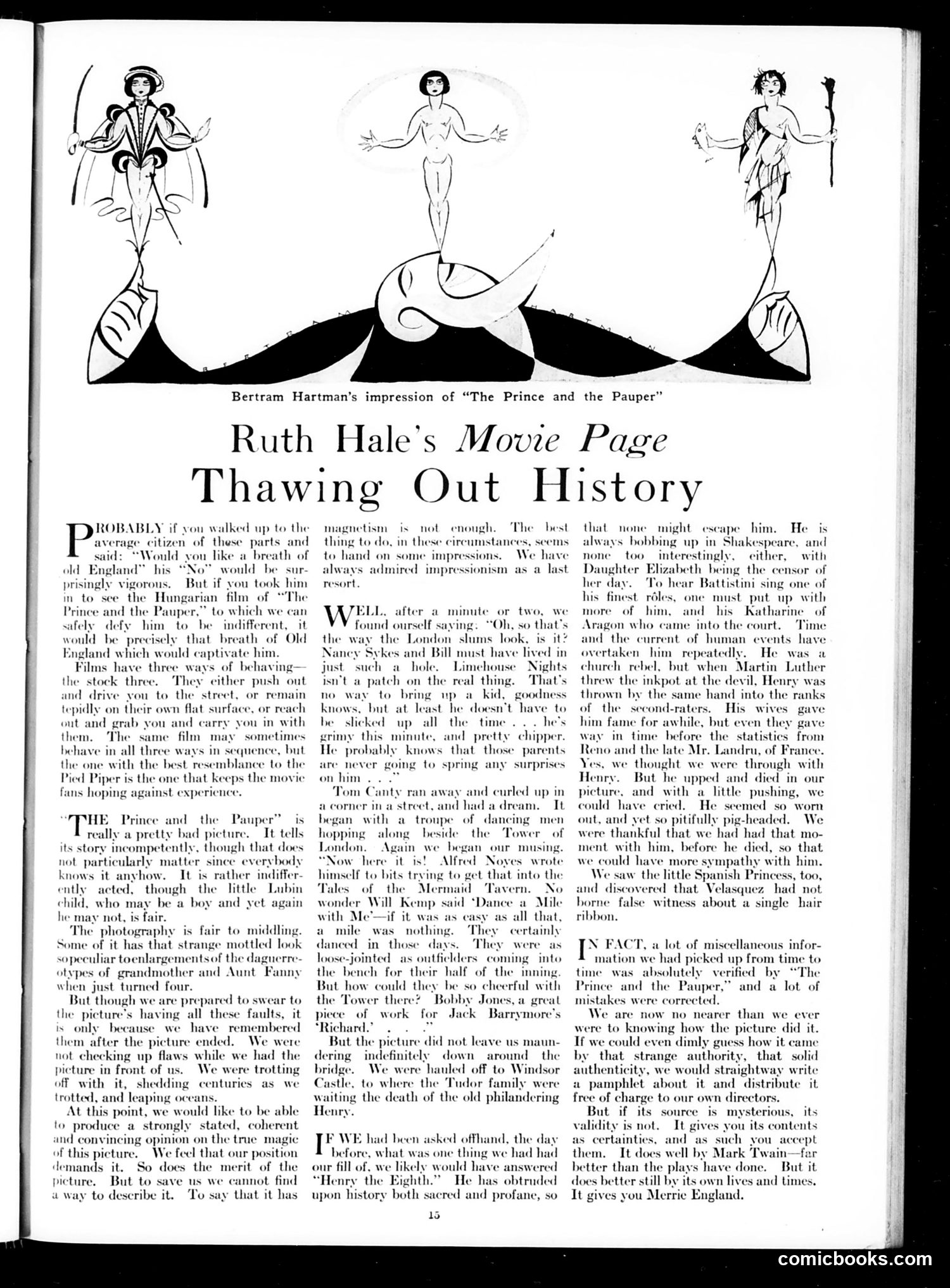
This is Ruth Hale's film review column in Judge magazine. The illustration at top (by Bertram Hartman) depicts a surreal interpretation of Mark Twain's *The Prince and the Pauper* story—showing figures emerging from or related to a large dark shape. Hale reviews a Hungarian film adaptation of *The Prince and the Pauper*. While acknowledging the film's technical flaws (poor photography, incompetent storytelling, indifferent acting), she argues it succeeds through sheer narrative magnetism—it captivates audiences despite itself. The satire targets English historical romanticism: average citizens dismiss "old England," yet this film enchants them with depictions of London slums, Limehouse, and Tudor court intrigue. Hale humorously notes the film's inescapable reliance on Henry VIII—a figure she suggests has been "obtruded upon history" excessively. The review celebrates cinema's power to make even flawed pictures compelling through immersive storytelling.
📄 Transcribed text from this page (OCR, searchable)
Machine-transcribed from the original scan — historical spelling and the odd misread are preserved.
Bertram Hartman’s impression of “The Prince and the Pauper” Ruth Hale's Movie Page Thawing Out History ROBABLY if you walked up to the P rage citizen of these parts and Would you like a breath of old England” his “No" would be sur- prisingly vigorous. But if you took him in to see the Hungarian film of ‘The Prince and the Pauper,” to which we can safely defy him to be indifferent, it would be precisely that breath of Old England which would captivate him. three ways of behaving- They either push out and drive you to the street, or remain tepidly on their own flat surface, or reach out and grab you and carry you in with them. ‘The same. film may’ sometimes behave in all three ways in sequence, but the one with the best resemblance to the Pied Piper is the one that keeps the movic fans hoping against experience. T! Prince and the Pauper” is ally a pretty bad picture. It tells its story incompetently, though that does not particularly matter since everybody knows it anyhow. It is rather indiffer- ently acted, though the little Lubin child, who may be a boy and yet again he may not, is fair. The photography is fair to middling. Some of it has that strange mottled look sopeculiar toenlargementsof the daguerre- otypes of grandmother and Aunt) Fanny when just turned four. But though we are prepared to swear to the picture's having all these faults, it is only because we have remembered them after the picture ended. We were not checking up flaws while we had the picture in front of us. We were trotting off with it, centuries as we trotted, and At this point, we would like to be able a strongly stated, coherent ig opinion on the true magic of this picture. We feel that our position demands it. So does the merit of the picture. But to save us we cannot find a way to describe it. To say that it has Films have the stock three. to produce and convine magnetism is not enough. The best thing to do, in these circumstances, seems to hand on some impressions. We have always admired impressionism as a last resort. V JELL, after a minute or two, we found ourself saying: “Oh, so that’ the way the London slums look, is. it? Naney Sykes and Bill must ha Lin just such a-hole. Limehouse Nights isn’t a patch on the real thing. That's no way to bring up a_ kid, goodness knows, but at least he doesn't have to be slicked up all) the time . . . he’s grimy this minute, and pretty chipper He probably knows that those parents are never going to spring any surprises onhim... Tom Canty ran away and curled up in wand had adream. It of dancing men beside the Tower of Jon. Again we began our musing. where it is! Alfred Noyes. wrote himself to bits trying to get that into the Tales of the Mermaid ‘Tavern. No wonder Will Kemp said ‘Dance a Mile with Me’—if it was as casy all that, a mile was nothing. They certainly danced in’ those « They loose-jointed as outfielders coming into the bench for their half of the inning But how could they be so cheerful with the Bobby Jones, a great piece of for Jack Barrymore's “Richard.” oe But the picture did not leave us maun- dering indefinitely down around the bridge. We were hauled off to Windsor Castle, to where the Tudor family were waiting the death of the old philandering Henry. a corner ina street began with a troupe hopping along I were us ‘Tower there? work F WE had been asked offhand, the day bet what was one thing we had had our fill of, we likely would 1 swered “Henry the Eighth.” He has obtruded upon history both sacred and profane, so 13 that) none might him. He is always bobbing up in Shakespeare, and none too interestingly, either, with Daughter Elizabeth being the censor of her day. To hear Battistini sing one of his finest réles, must put up with more of him, his Kath of Aragon who » into the court. me and the current of human events have overtaken him repeatedly. He church rebel, but when Martin Luther threw the inkpot at the devil, Henry was thrown by the » hand into the ranks of the second-raters. His wives gave him fame for awhile, but even they gave way in time before the statistics from Reno and the late Mr. Landru, of France. Yes, we thought we were through with Henry. But he upped and died in our picture, and with a little pushing, we could have cried. He seemed so worn out, and yet so pitifully pig-headed. We were thankful that we had had that mo- ment with him, before he died, so that we could have more sympathy with him. We saw the little Spanish Princess, too, and discovered that Velasquez had not false witness about a single hair escape was it borne ribbon. N FACT, a lot of miscellaneous infor- mation we had picked up from time to verified by ‘The time was absolutely and a lot of Prince and the Pauper, mistakes were correc! We are now no nearer than we ever were to knowing how the picture ¢ If we could even dimly guess how it by that strange authority, that solid authentic city, we would stra a pamphlet about it and distribute it free of charge to our own directors. But if its source is mysterious, its validity is not. It gives you its contents as certainties, and as such you accept them. It does well by Mark Twain—far better than the plays have done. But it does better still by its own lives and times. It gives you Merrie England. comicbooks.com