
Judge, 1922-09-09 · page 8 of 36
Judge — September 9, 1922 — page 8: what you’re looking at
What you’re looking at
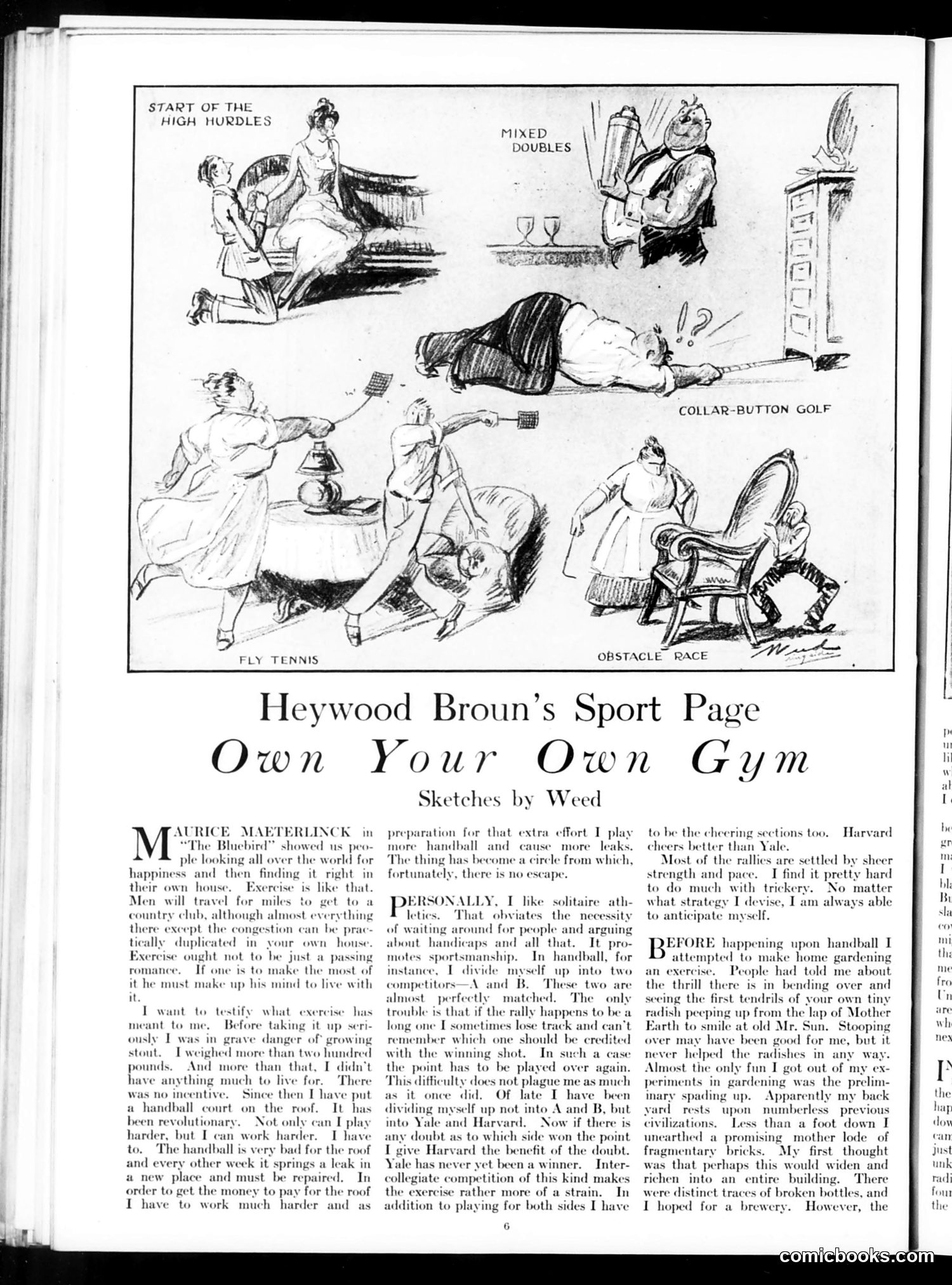
This is a humorous essay by sports columnist Heywood Broun, illustrated with comic sketches by Weed showing absurd "home exercises": high hurdles (with someone crashing), mixed doubles (two men tangled together), fly tennis (women swinging wildly), collar-button golf, and an obstacle race involving furniture. Broun argues for exercise at home rather than expensive country clubs—but the joke is that his "solution" creates as many problems as it solves. His handball court on the roof springs leaks, forcing him to work harder to pay for repairs, creating a circular trap. He even divides himself into "Yale and Harvard" competitors to play against himself, yet can't track who's winning. The satire mocks both the era's fitness craze and self-deluding rationalization: Broun presents himself as logical while describing increasingly absurd scenarios (finding "previous civilizations" of bricks in his garden). The sketches visualize the ridiculous outcomes of amateur home athletics. The piece reflects 1920s anxiety about leisure, class, and self-improvement through sports.
📄 Transcribed text from this page (OCR, searchable)
Machine-transcribed from the original scan — historical spelling and the odd misread are preserved.
START OF THE HIGH HURDLES FLY TENNIS MIXED DOUBLES Heywood Broun’s Sport Page Own URICE MAETERLINCK in “The Bluebird” showed us peo- ple looking all over the world for happiness and then finding it right in their own house. Exercise is like that. Men will travel for miles to get to a country club, although almost everything there except the congestion can be prac- tically duplicated in’ your own house. Exercise ought not to be just a passing romance. If one is to make the most of it he must make up his mind to live with it. T want to testify what exercise has meant to me, Before taking it up seri- ously I was in grave danger of growing stout. [T weighed more than two hundred pounds. And more than that, [ didn't have anything much to live for. There was no incentive. Since then [have put a handball court on the roof. It has been revolutionary. Not only ean I play harder, but I can work harder. I have to. The handball is very bad for t and every other week it springs a new place and must be repaired. In order to get the money to pay for the roof I have to work much harder and as Sketches by Weed aration for that extra effort I play handball and cause more leaks. The thing has become a circle from which, fortunately, t is no escape. JERSONALLY, I like solitaire ath- leties. That obviates the necessity of waiting around for people and arguing vout handicaps and all that. It pro- motes sportsmanship. In handball, for instance, I divide myself up. into two competitors—A and B. These two are almost. perfectly matched. The only trouble is that if the rally happens to be a Jong one [ sometimes lose track and can’t remember which one should be cre with the winning shot. In such the point has to be played over aga This difficulty does not plague me as much as it once did. Of late I 1b been dividing myself up not into A ; into Yale and Harvard. Now if the: any doubt as to which side won the point I give Harvard the benefit of the doubt. er yet been a winner. Inte petition of this kind makes ather more of a strain. In addition to playing for both sides I have Your Own Gym to he the cheering sections too. Harvard cheers better than Y Most of the ral are settled by sheer strength and pace. I find it pretty hard to do much with trickery. No matter what strategy I devise, I am always able to anticipate myself. ‘ORE happening upon handball I tempted to make home gardening an exercise. People had told me about the thrill there is in bending over and cing the first tendrils of your own tiny ish peeping up from the lap of Mother rth to smile at old Mr. Sun. Stooping r may have been good for me, but it never helped the radishes in any w Almost the only fun I got out of my ex- periments in gardening was the prelim- inary spading up. Apparently my back yard rests upon numberless previous civilizations. Less than a foot down I unearthed a promising mother lode of fragment bricks. My first thought was that perhaps this would widen and richen into an entire building. There were distinct traces of broken bottles, and I hoped for a brewery. However, the hay dow can just unk radi fou the