
A complete issue · 36 pages · 1922
Judge — July 1, 1922
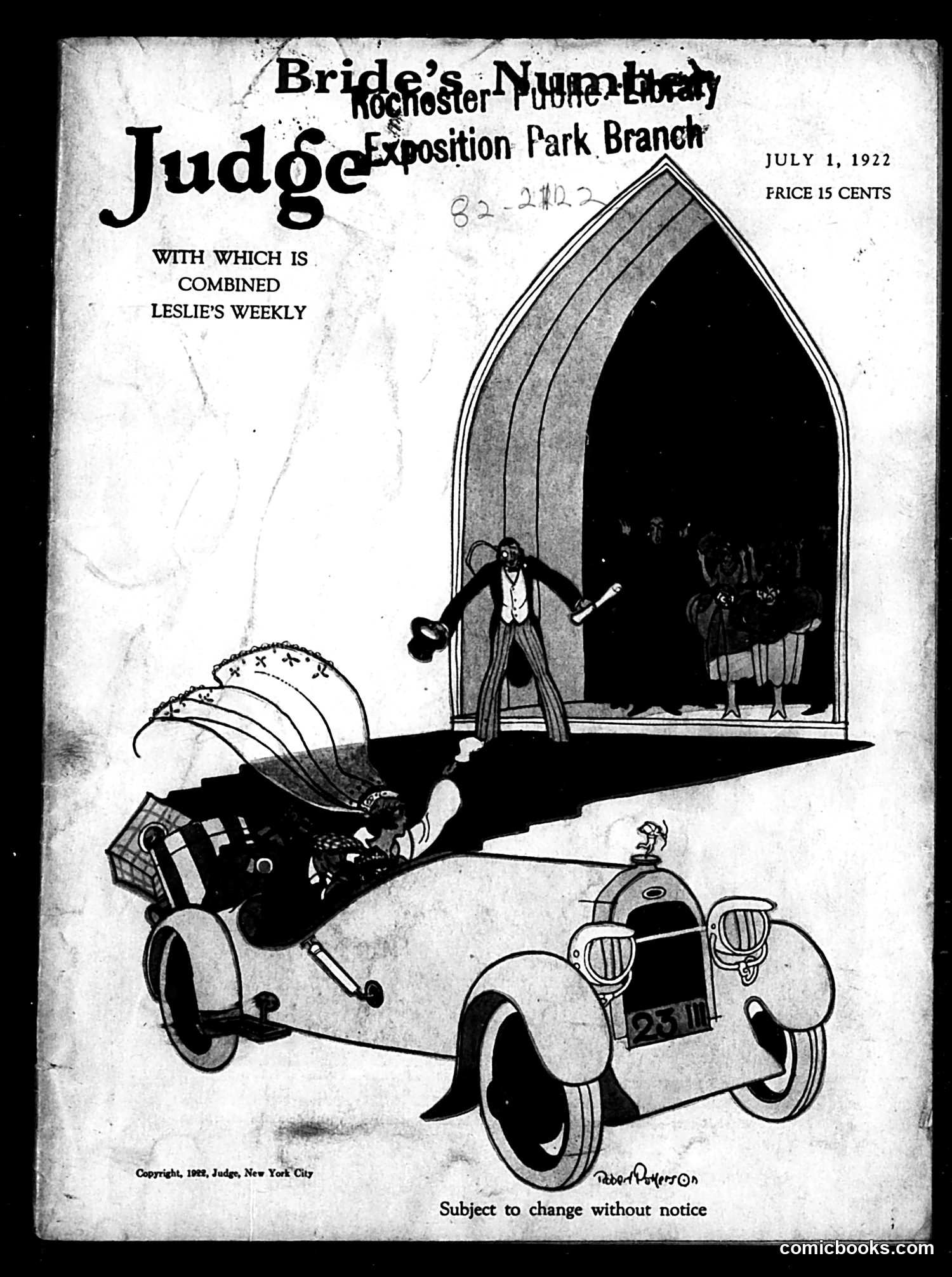
This cover depicts a wedding scene with social satire about modern transportation and courtship customs of the 1920s. A bride in an elaborate dress and veil arrives in a small aircraft (appearing to land at a Gothic church entrance), while a groom in formal wear gestures from the doorway. Below, two men in racing cars appear to be competing—possibly representing suitors or the groom's entrance method. The satire likely mocks the era's obsession with new automotive and aviation technology, suggesting these machines have infiltrated even traditional ceremonies like weddings. It humorously comments on how modernity was disrupting conventional social rituals, with speed and mechanical novelty replacing traditional courtship and ceremony.
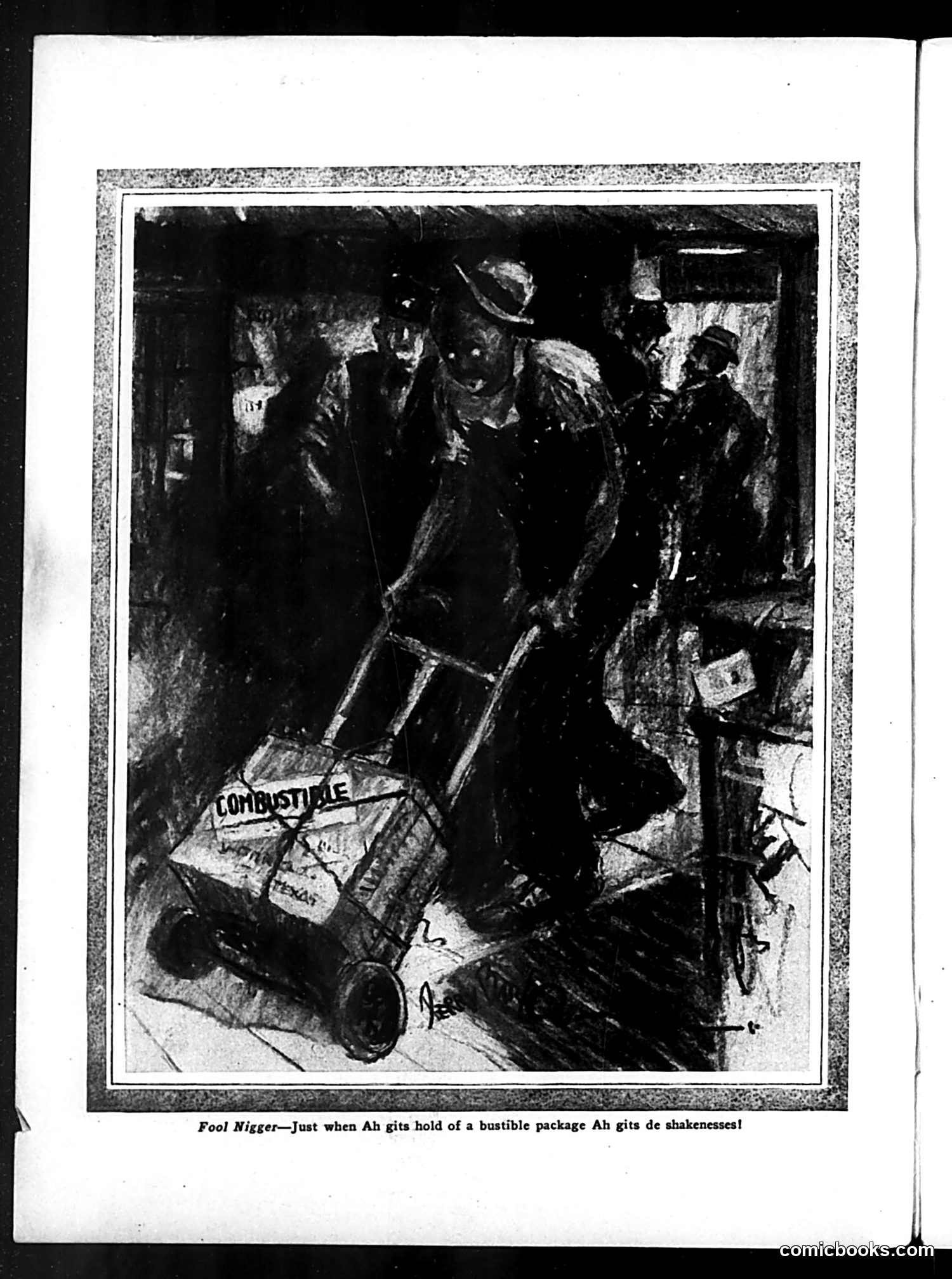
This cartoon uses a racial slur in its caption, which is offensive by modern standards but reflects the publication's historical context. The image depicts what appears to be a street scene with multiple figures in period clothing gathered around a package labeled "COMBUSTIBLE." The caption suggests a comedic scenario involving someone obtaining an unstable or dangerous package, with the punchline playing on dialect humor. The satire likely comments on bootlegging or illegal alcohol distribution during Prohibition, a major social issue of the early 20th century. The "bustible package" reference suggests contraband goods, and the anxious crowd's reaction emphasizes the danger and illegality of such trade. Judge magazine regularly satirized Prohibition-era smuggling and the criminal underworld it spawned.
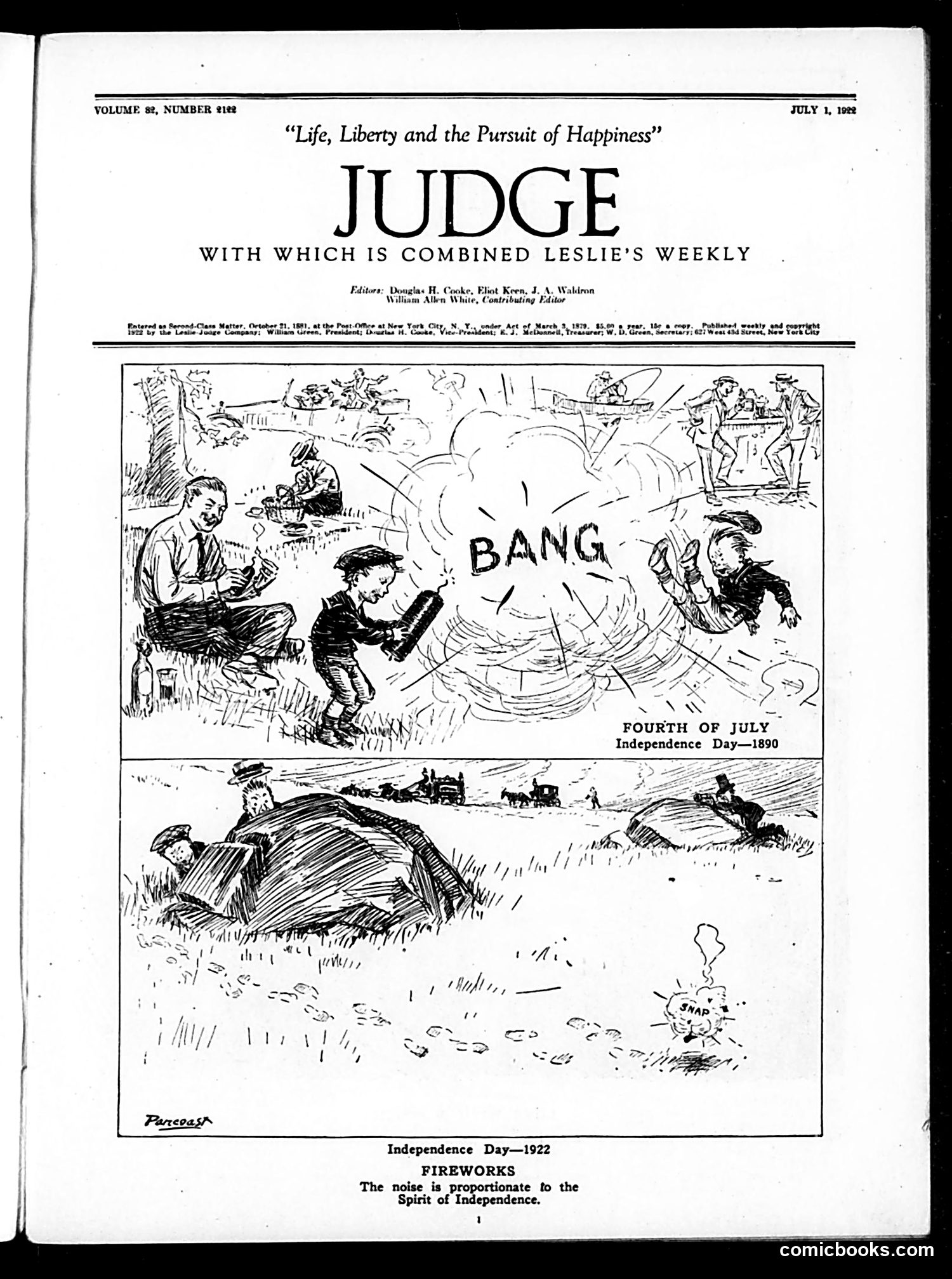
This satirical page presents two Fourth of July scenes contrasting celebrations across time periods. The **top cartoon** depicts children setting off fireworks in an urban setting circa 1890, with adults reacting in alarm to the explosions—capturing nostalgic turn-of-century Independence Day chaos. The **bottom cartoon** (dated 1922) shows a more rural scene where fireworks have caused genuine danger: a man lies injured in grass while others react with concern, and a small explosion continues in the foreground. The caption's message—"The noise is proportionate to the Spirit of Independence"—appears sardonic. The juxtaposition suggests that by 1922, American Independence Day celebrations had become less exuberant or spirited, with the declining festiveness reflected in reduced fireworks displays and public enthusiasm.
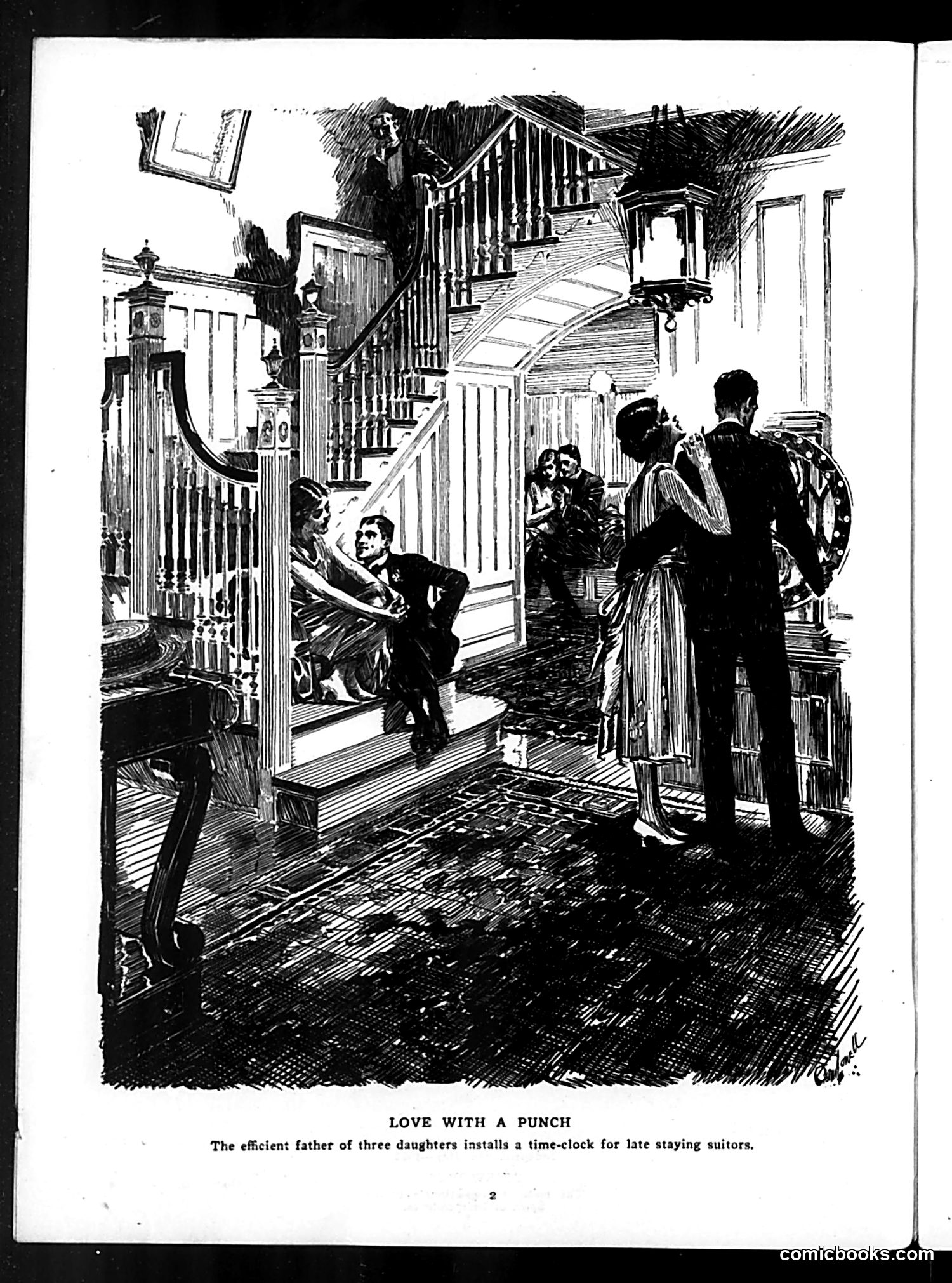
This cartoon, titled "Love with a Punch," satirizes parental discipline and courtship customs of the era. The caption explains: "The efficient father of three daughters installs a time-clock for late staying suitors." The joke plays on the tension between protective fathers and young men courting their daughters. The illustration shows a domestic interior where a father has installed a punch-clock (a timekeeping device used in factories) at the entrance—literally treating the suitors' visits like work shifts with strict time limits. This is social satire about Victorian-era parental control over daughters' romantic interactions. The humor derives from the absurdity of applying industrial workplace technology to domestic courtship, mocking both overprotective fathers and the formalized nature of period dating customs where parental supervision was rigidly enforced.
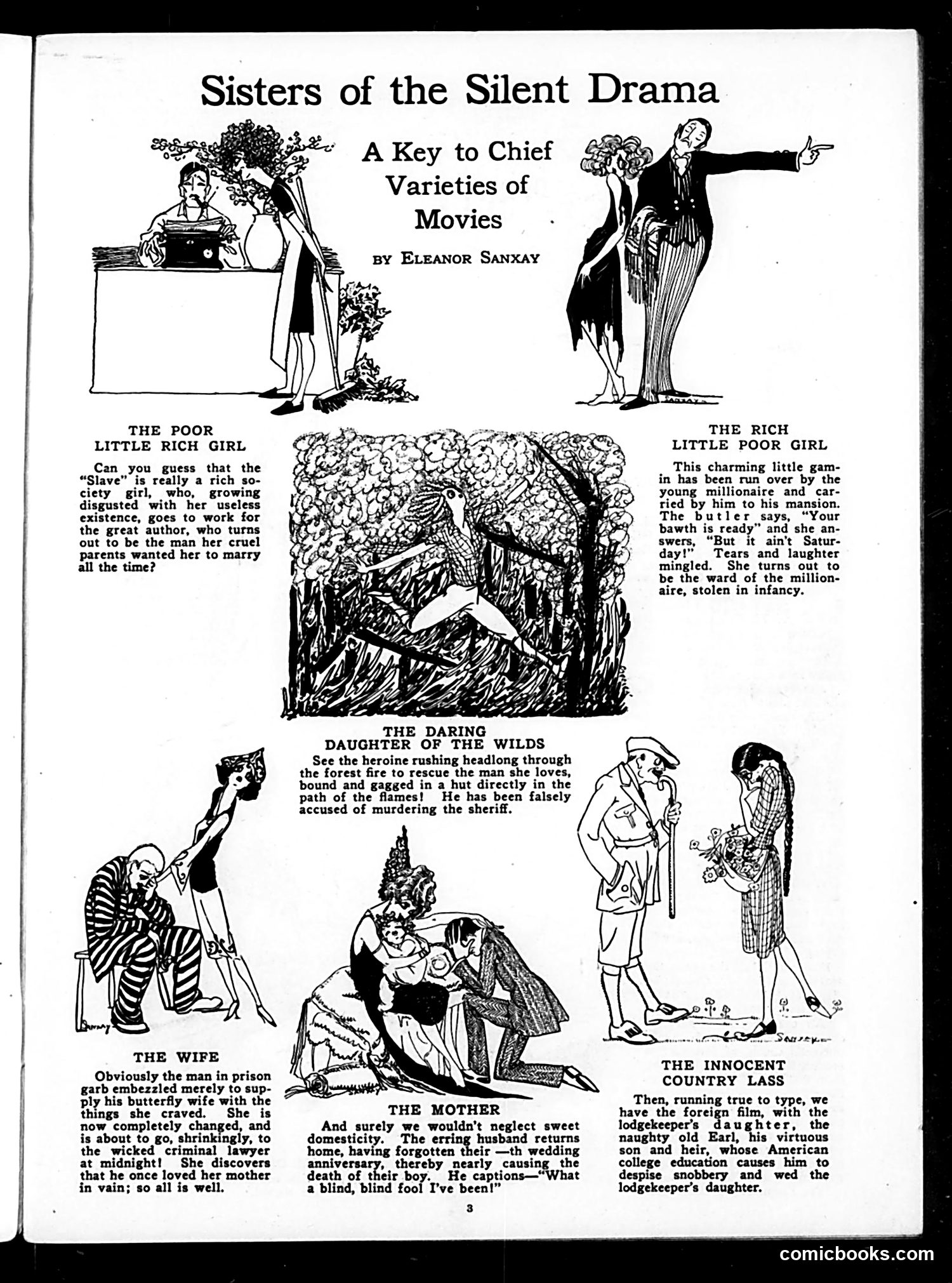
This page by Eleanor Sanxay categorizes silent film genres through satirical character types. Each illustration represents a distinct movie formula: **"The Poor Little Rich Girl"** and **"The Rich Little Poor Girl"** are inverse narratives—society girls discovering hardship or poor girls discovering wealth, reversing their fortunes. **"The Daring Daughter of the Wilds"** depicts melodramatic heroines rescuing loves through dangerous forest scenes. **"The Wife"** shows domesticity's corruption: a devoted spouse discovers her husband is a criminal, causing moral collapse. **"The Mother"** emphasizes sentimentality—errant husbands returning home, triggering emotional reconciliations. **"The Innocent Country Lass"** features foreign film stereotypes: naive peasant girls deceived by sophisticated men. The satire mocks silent cinema's reliance on predictable, emotionally manipulative plotlines and archetypal characters rather than nuanced storytelling.
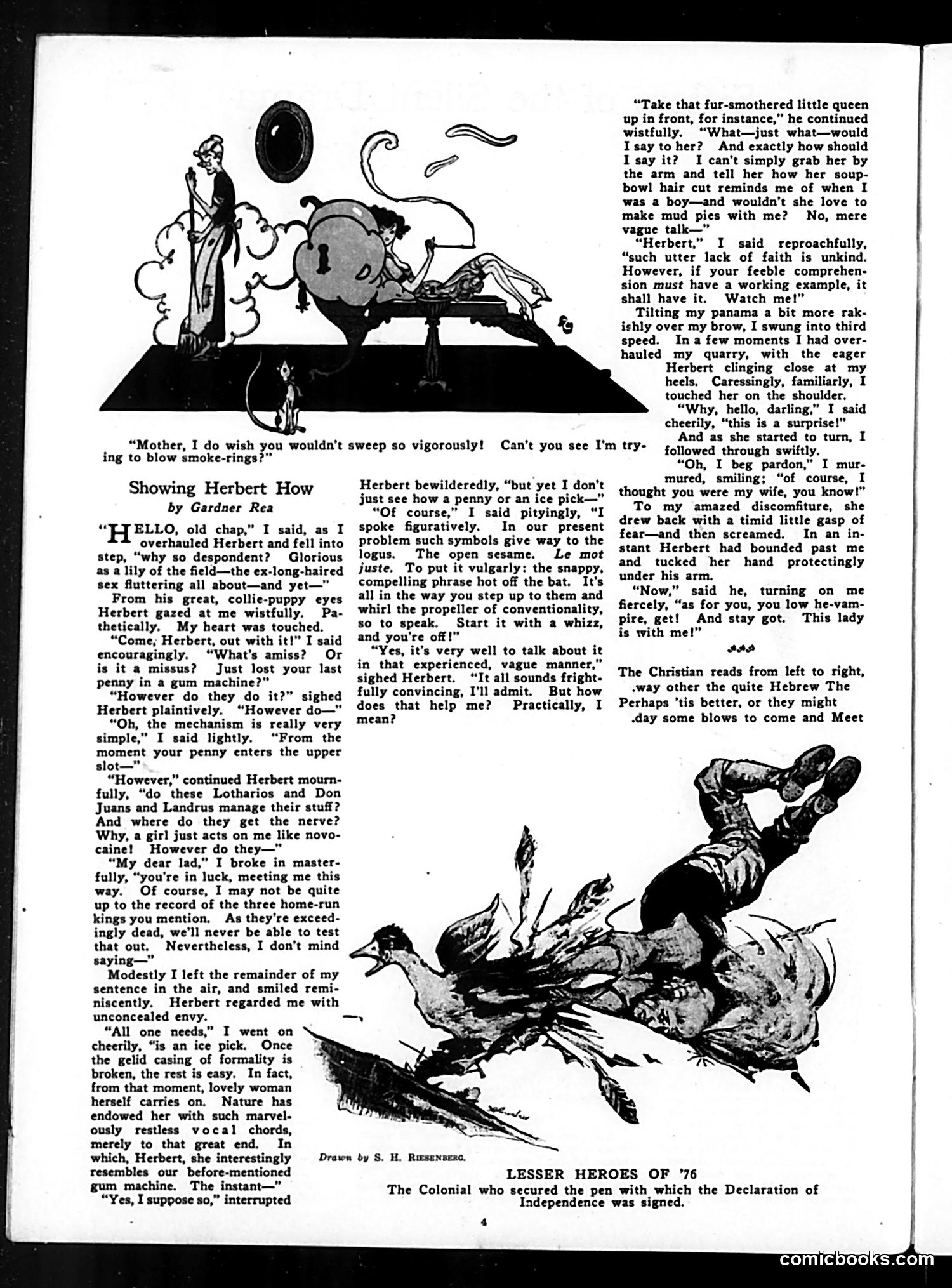
This page satirizes early 20th-century courtship and gender dynamics through a story about a character named Herbert learning romantic behavior from the narrator. **The satire targets:** - Male incompetence in romantic matters (Herbert needs instruction on how to court women) - Victorian social conventions and formal etiquette around courtship - The absurdity of rigid "rules" governing interaction between sexes **Visual humor:** The top cartoon depicts a domestic scene with exaggerated figures representing the "proper" way to approach a woman. The illustration style—with its grotesque proportions and crude linework—emphasizes the ridiculousness of these prescribed behaviors. **The joke:** The narrator essentially must teach Herbert how to seduce or impress women, suggesting men of this era often lacked natural social skills despite society's rigid gender expectations. The underlying satire mocks both masculine inadequacy and the performative nature of courtship rituals.
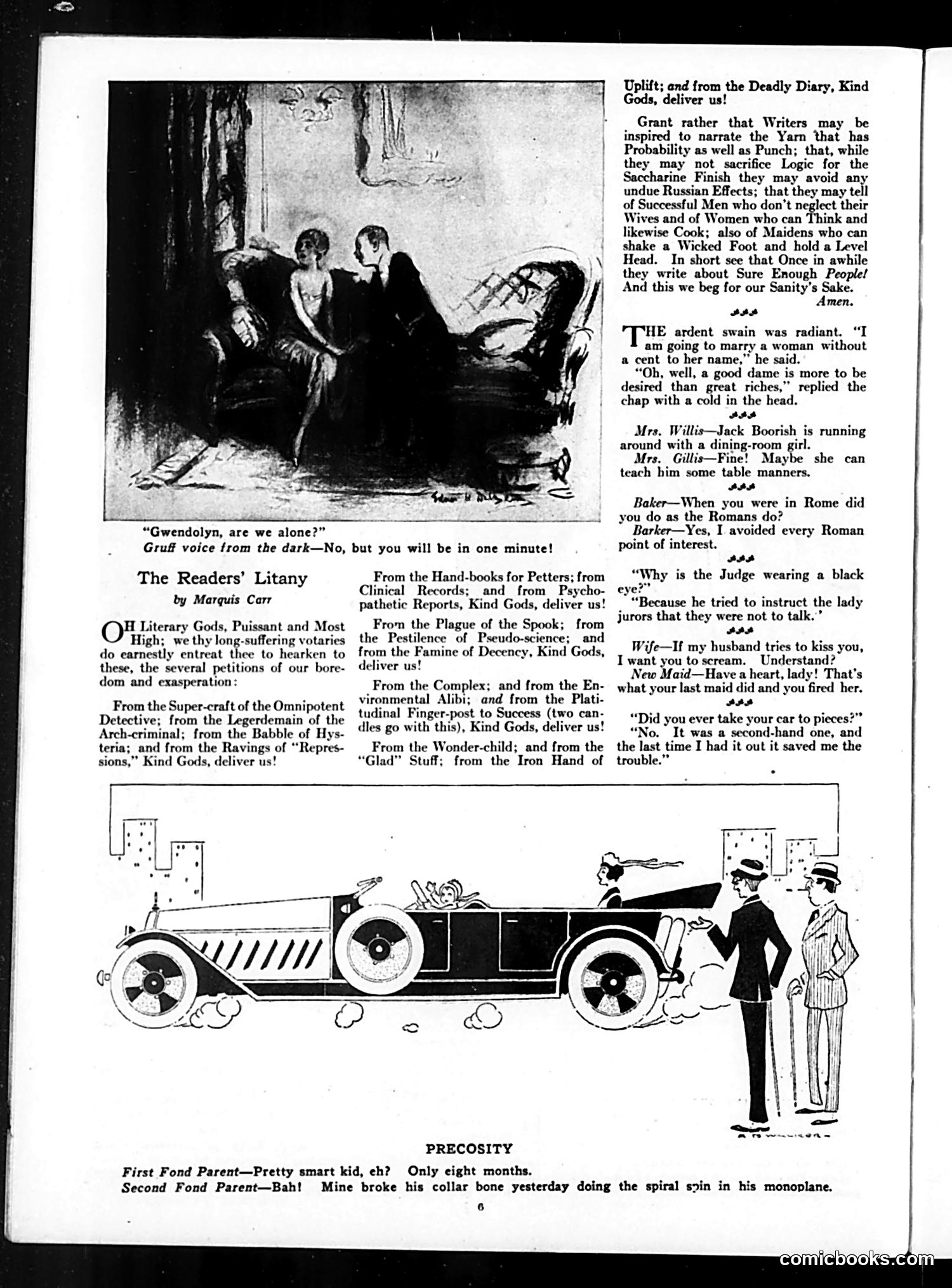
This page contains satirical commentary on early 20th-century literary and social trends. **"The Readers' Litany"** (top left) mocks popular magazine fiction tropes through mock-religious petition: detective stories, criminal narratives, psychological tales, ghost stories, and pseudo-scientific plots. The author pleads for writers to instead depict realistic "Sure Enough People" with actual logic and character depth—satirizing the formulaic, sensational fiction dominating the era. **The cartoon dialogue** ("Gwendolyn, are we alone?") parodies melodramatic seduction scenes common in period literature. **"Precosity"** (bottom) satirizes wealthy parents boasting about precocious children. One parent brags his eight-month-old child broke his collarbone doing aerial stunts in a monoplane—absurdly impossible, mocking parents' exaggerated claims about infant accomplishments and the era's fascination with dangerous aviation technology. The remaining jokes target contemporary social pretensions: bad manners, Roman tourism clichés, judicial pomposity, and automobile unreliability.
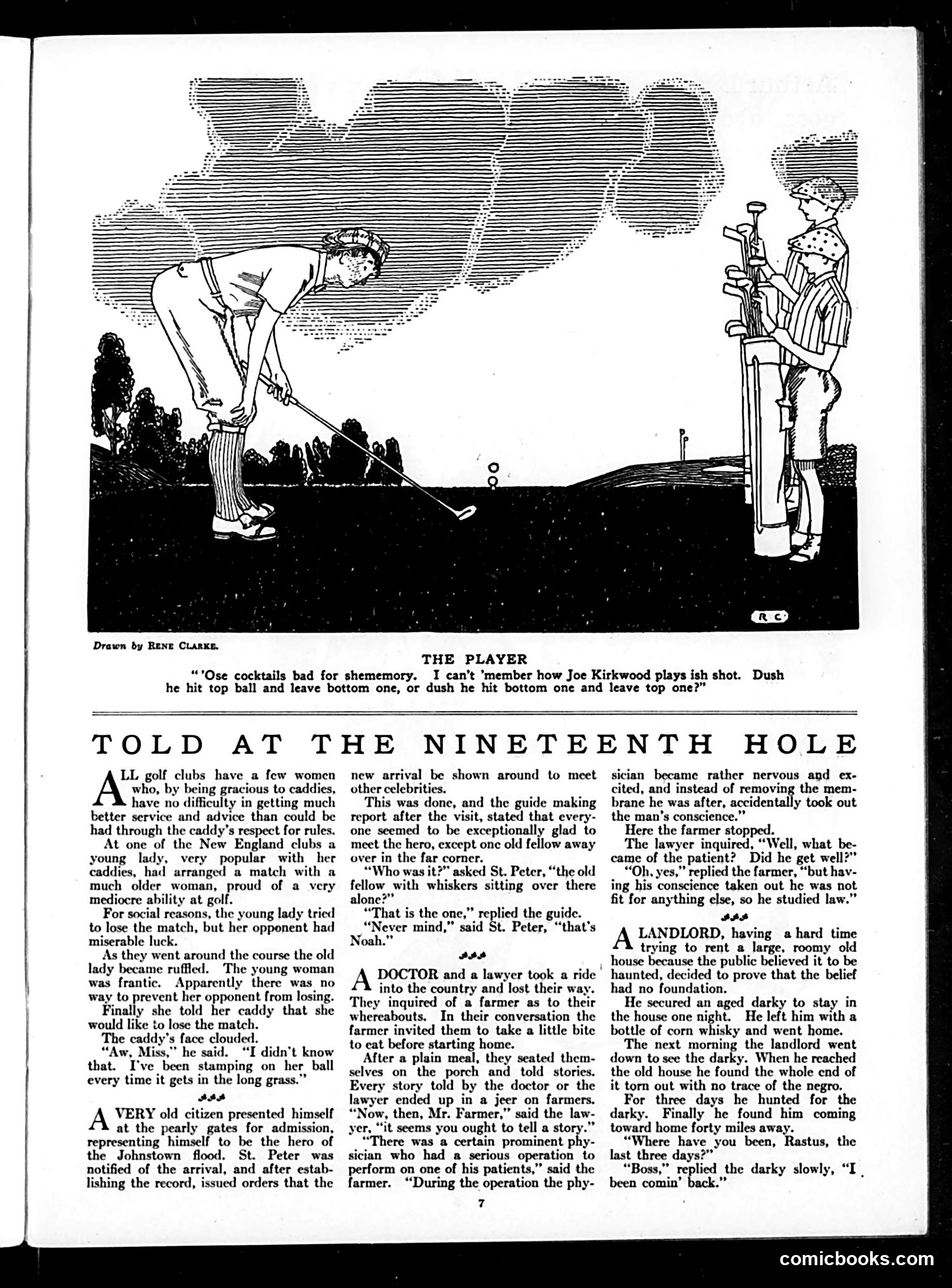
This page collects golf-themed jokes and anecdotes typical of early 20th-century Judge magazine. The cartoon at top depicts a golfer discussing Joe Kirkwood (likely a contemporary professional golfer) while appearing intoxicated—the humor relies on the stereotype of cocktails impairing memory. The four stories below use common period tropes: 1. **The Caddy's Loyalty**: A young woman's caddy sabotages her opponent's game to help her win, subverting her intentional loss. 2. **Noah's Jealousy**: A Johnstown Flood survivor encounters Noah in heaven—the joke being Noah would resent anyone claiming equal disaster fame. 3. **Farmers vs. Professionals**: A farmer retaliates against a doctor and lawyer's jokes by claiming a surgeon accidentally removed a patient's "conscience," then the patient "studied law"—crude anti-lawyer satire. 4. **Haunted House Negro**: A racist caricature where a Black man flees a "haunted" house after 40 miles, claiming he's "been comin' back." The page reflects era-typical attitudes: class mockery, anti-professional sentiment, and racial stereotypes presented as humor for Judge's educated readership.
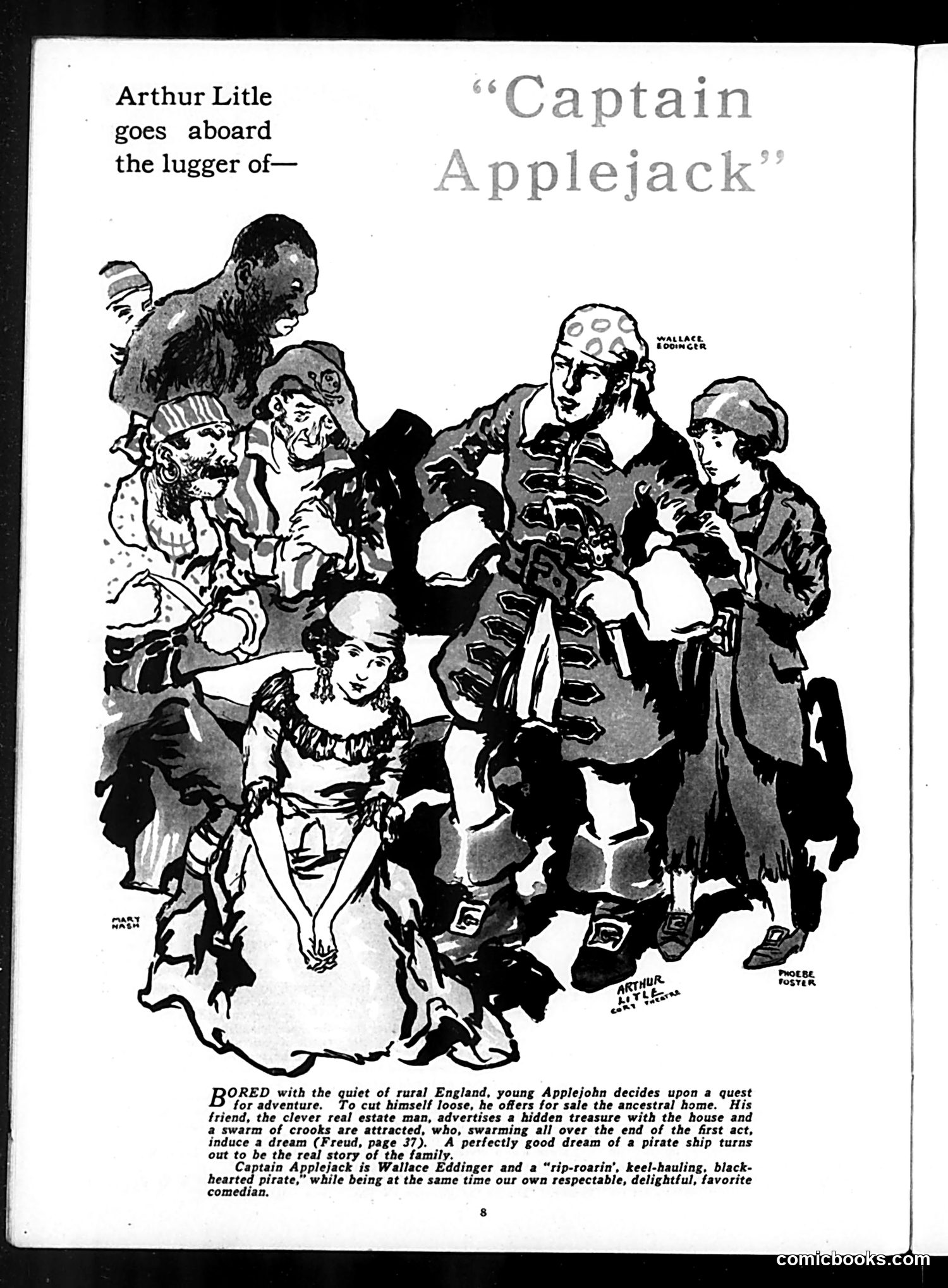
This page promotes a theatrical production starring Wallace Eddinger. The illustration shows various costumed characters gathered around the central figure—Eddinger as "Captain Applejack," depicted in pirate attire. The plot summary describes a comedy about a young Englishman named Applejohn who, bored with rural life, sells his ancestral home. A real estate agent advertises hidden treasure with the property, attracting criminals. Their intrusions trigger a dream sequence—the page humorously references Freud, suggesting psychological interpretation was fashionable—that reveals the family's actual pirate past. The satire appears gentle: Eddinger plays a dual role as both respectable gentleman and "rip-roarin', keel-hauling" pirate, allowing the comedian to perform contrasting comedic personas. The joke relies on the incongruity between polite English society and swashbuckling adventure, typical of 1920s theatrical comedy.
This article reviews contemporary poetry collections, offering satirical literary criticism typical of Judge magazine's cultural commentary. **Key subjects and points:** - **Carl Sandburg**: Criticized for "free verse"—the reviewer finds his latest work ("Slabs of the Sunburnt West") boring, suggesting free verse's popularity is fading and readers prefer traditional meter and "elevation of language." - **Zona Gale**: Praised for intelligence and "profound human sympathy," particularly her poem "News Notes from Portage, Wis." capturing small-town life with emotional depth. - **Prisoner B8266**: A convict publishing "A Tale of a Walled Town"; the reviewer sympathizes with his circumstances but finds his poetry merely mediocre—neither bad enough to justify imprisonment nor good enough to earn release. - **Claude McKay**: A Black poet ("Harlem Shadows") writing serious, non-stereotypical verse without "banjos and mammies and ragtime," expressing "bitter undertone of passionate revolt." The satire gently mocks both the difficulty of poetry reviewing and contemporary literary fashions while acknowledging genuine artistic merit.
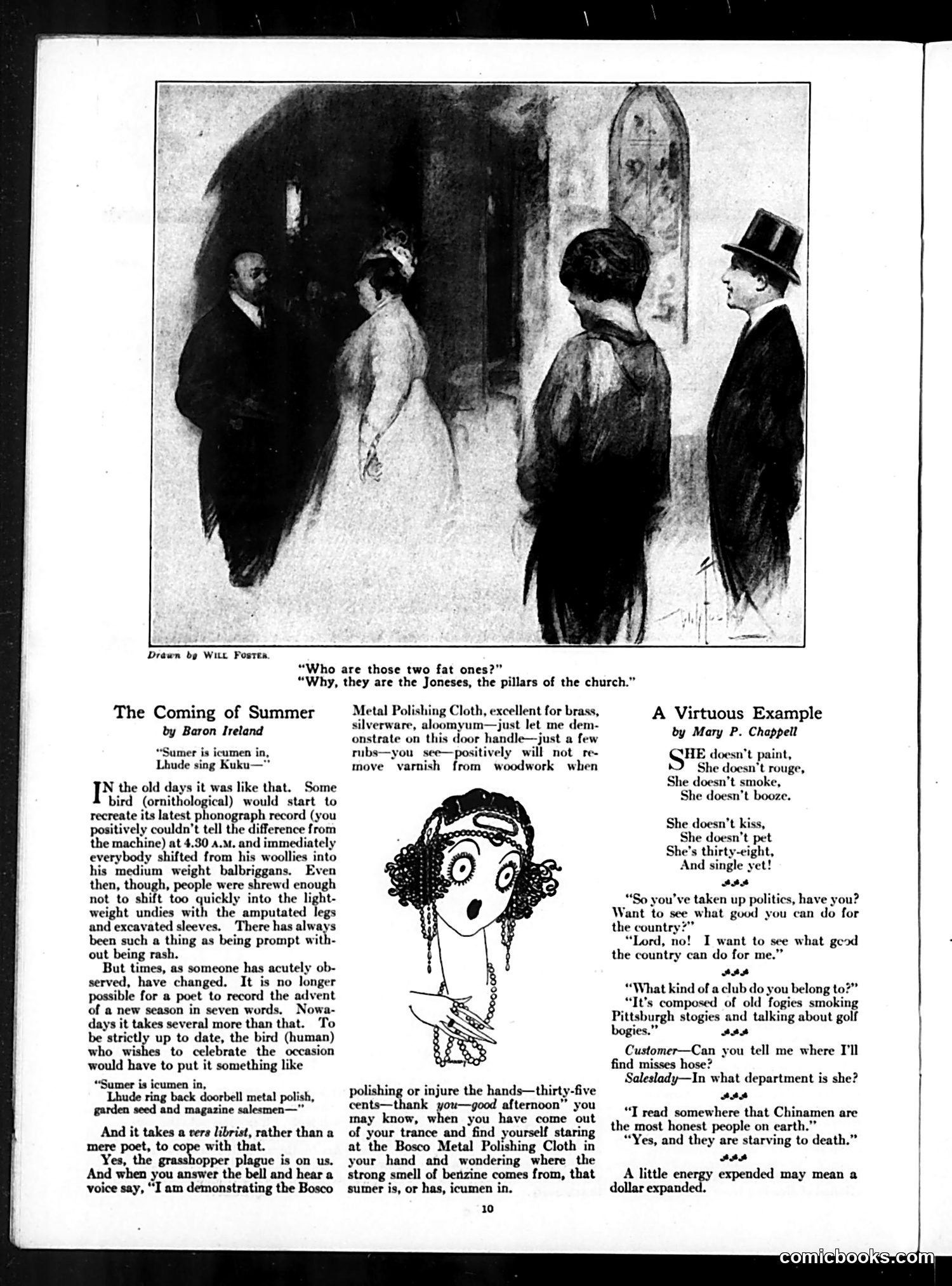
The top cartoon mocks middle-class hypocrisy. Two men are identified as "the Joneses, the pillars of the church"—suggesting they present themselves as morally upstanding community figures while presumably being otherwise (the "fat ones" reference implies gluttony or excess). This satirizes the gap between public piety and private behavior among respectable society. **"The Coming of Summer"** by Baron Ireland critiques modern commercial intrusion into daily life. The poem parodies medieval verse celebrating summer's arrival, but now the "bird (human)" must announce door-to-door salesmen hawking products like metal polish. It's satire on how aggressive advertising and sales culture have invaded even nature's seasonal pleasures—a commentary on early 20th-century consumer capitalism overrunning traditional life. The other short pieces are light humor: "A Virtuous Example" ironically celebrates a woman's rigid propriety that leaves her unmarried; political humor about self-interest; and ethnic jokes typical of the era's casual prejudice.
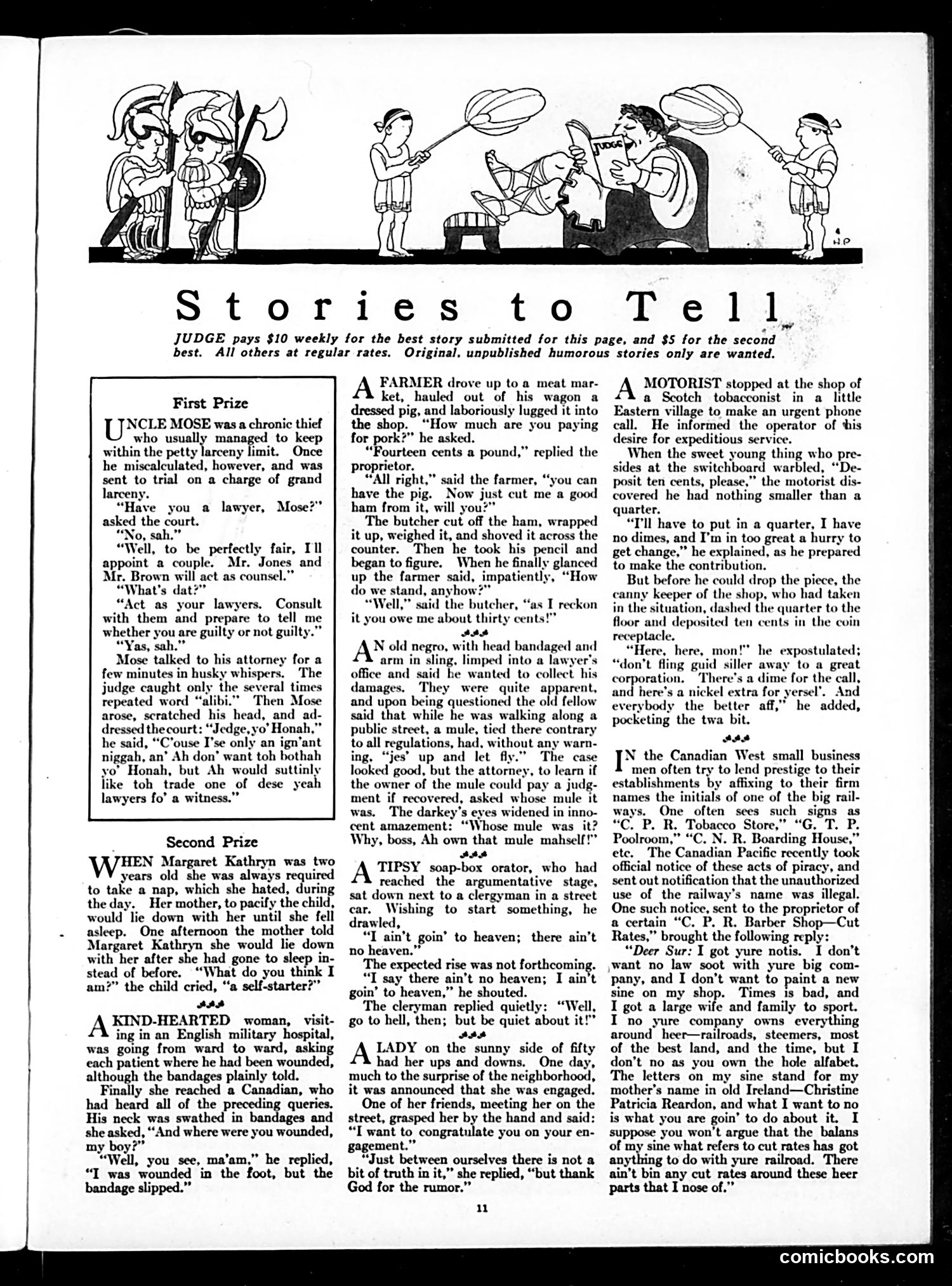
This is a humor submission page from Judge magazine, offering cash prizes for short jokes. The content reflects early 20th-century American attitudes through several crude racial caricatures and stereotypes. The stories use dialect and offensive racial language to depict Black characters as intellectually inferior or foolish—a common comedic trope of the era. "Uncle Mose" wants to trade his lawyer for a witness; an old Black man sues over being kicked by a mule he himself owns, not recognizing the absurdity. Other jokes target women (a child's logic about naps) and religious figures (a drunk heckler silenced by a clergyman's comeback). A farmer attempts to profit by selling a pig for less than its butchered parts cost. **For modern readers:** These jokes rely entirely on ethnic and gender stereotypes that were considered acceptable entertainment in early 20th-century America. They reveal period attitudes toward race, intellect, and social hierarchies rather than offering genuine humor or insight.
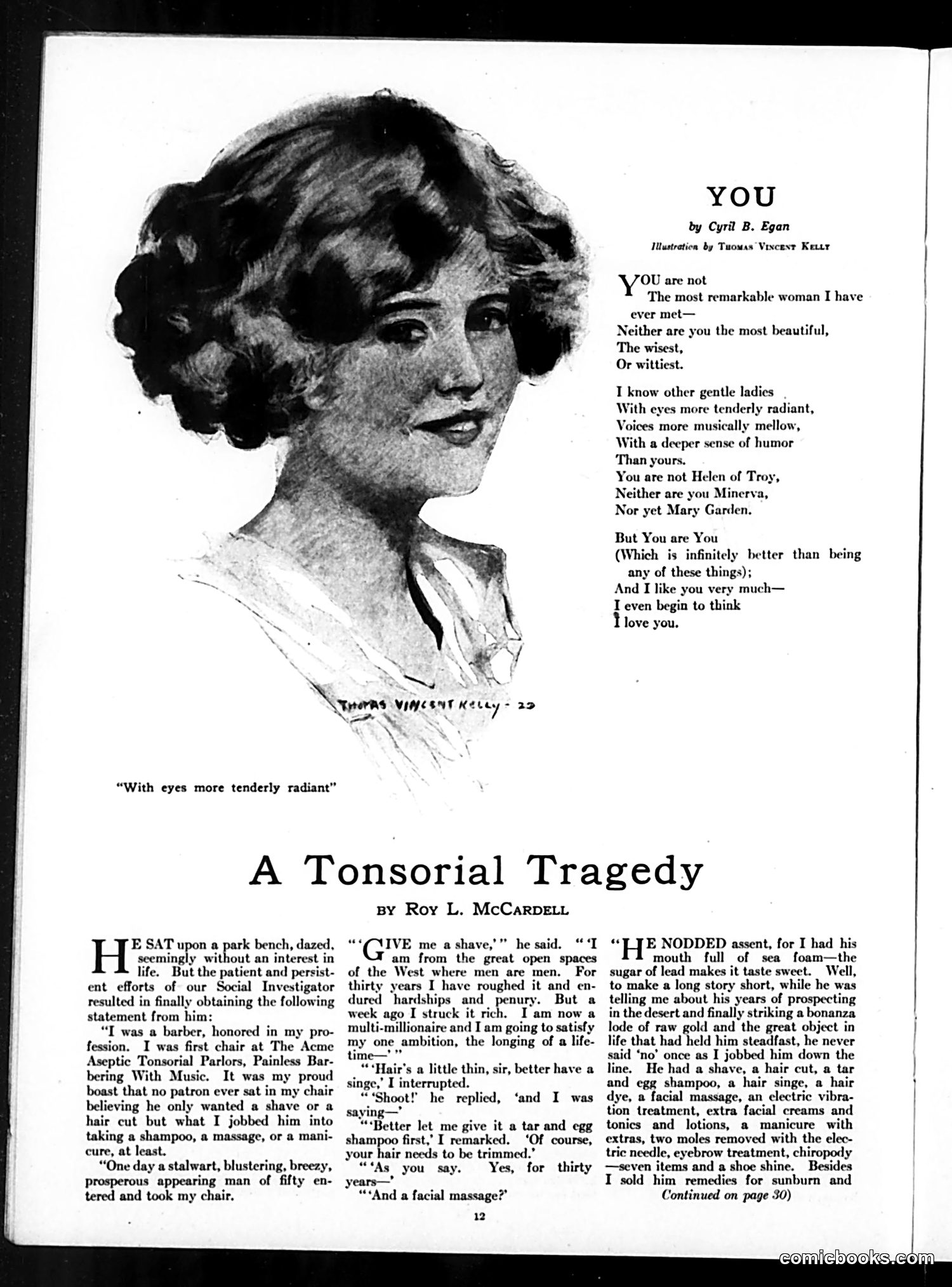
This page contains two distinct pieces from *Judge* magazine: **"You" (top):** A romantic poem by Cyril B. Egan, illustrated by Thomas Vincent Kelly. It's a love declaration asserting that the subject's value lies not in being exceptionally beautiful, wise, or witty—nor in matching famous ideals like Helen of Troy or opera star Mary Garden—but simply in being authentically herself. The satire appears gentle: it mocks grandiose romantic comparisons while celebrating ordinary individuality. **"A Tonsorial Tragedy" (bottom):** A humorous short story by Roy L. McCardelll about a barber's comeuppance. A wealthy, newly-rich prospector from the West—characterized as rough, no-nonsense, and plain-spoken—enters the barber shop. The barber exploits the man's politeness and distraction (filling his mouth with shaving cream) to upsell him on every possible service: shampoos, massages, manicures, treatments, shoe shines, etc. The joke is that the aggressive salesman finally meets his match in an unexpectedly compliant customer, subverting typical barber-shop dynamics.
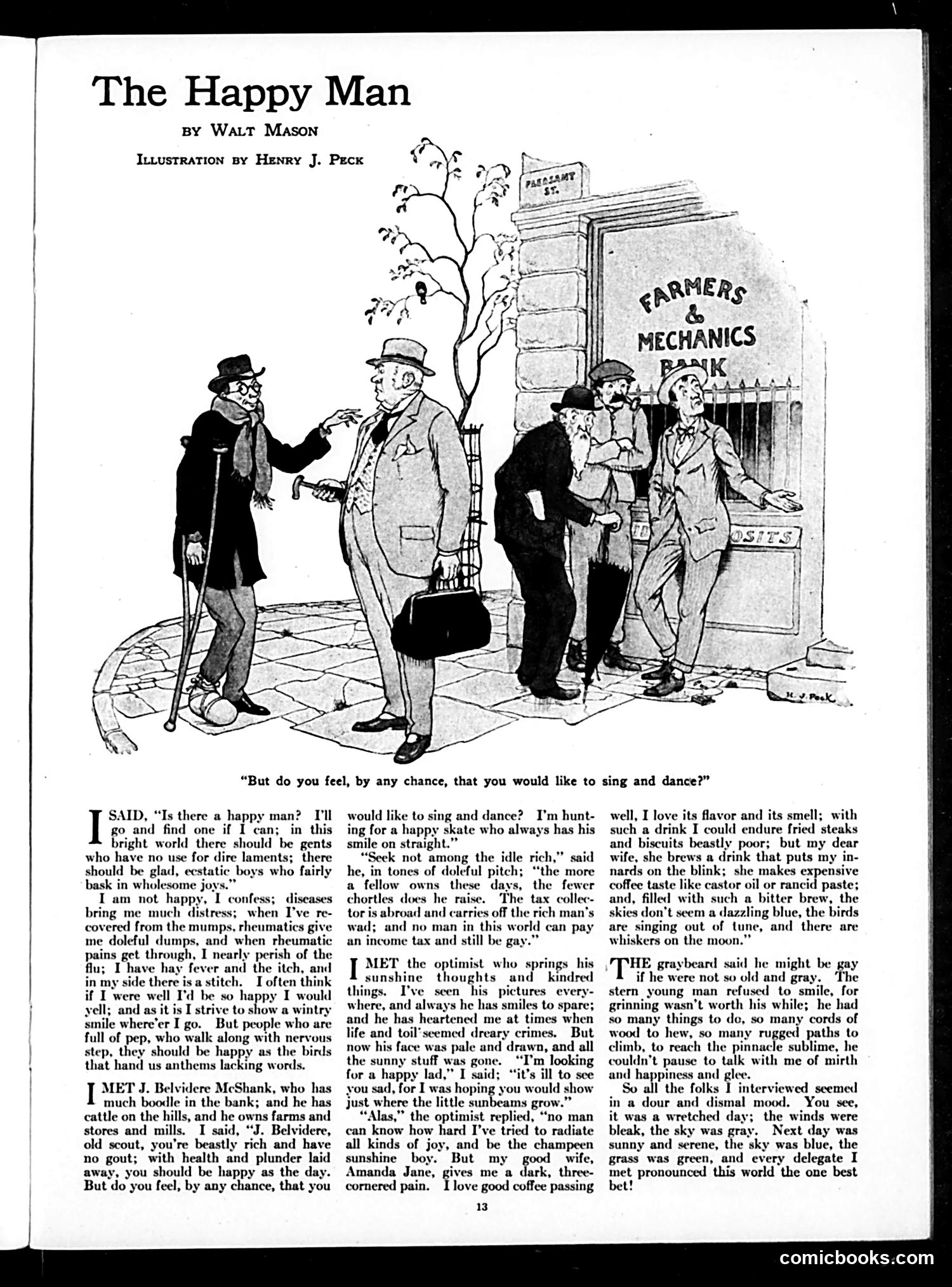
This is a satirical story-poem about the futility of happiness, illustrated with a street scene. Mason interviews various men to find someone genuinely happy: a wealthy banker (J. Belvidere McShank) who complains about taxes; an optimist whose cheerful disposition is undermined by his wife's terrible coffee; an old man frustrated by age; and a young man too busy working. Each finds reasons for misery despite favorable circumstances. The joke's point: happiness isn't about external conditions—wealth, health, or optimism—but rather about individual temperament and life's petty frustrations. Mason notes the interviews occurred on a gray day, then the next sunny day everyone suddenly declared life "the one best bet," suggesting happiness is arbitrary and mood-dependent rather than genuine. The cartoon mocks both American optimism and its frequent failure in practice.
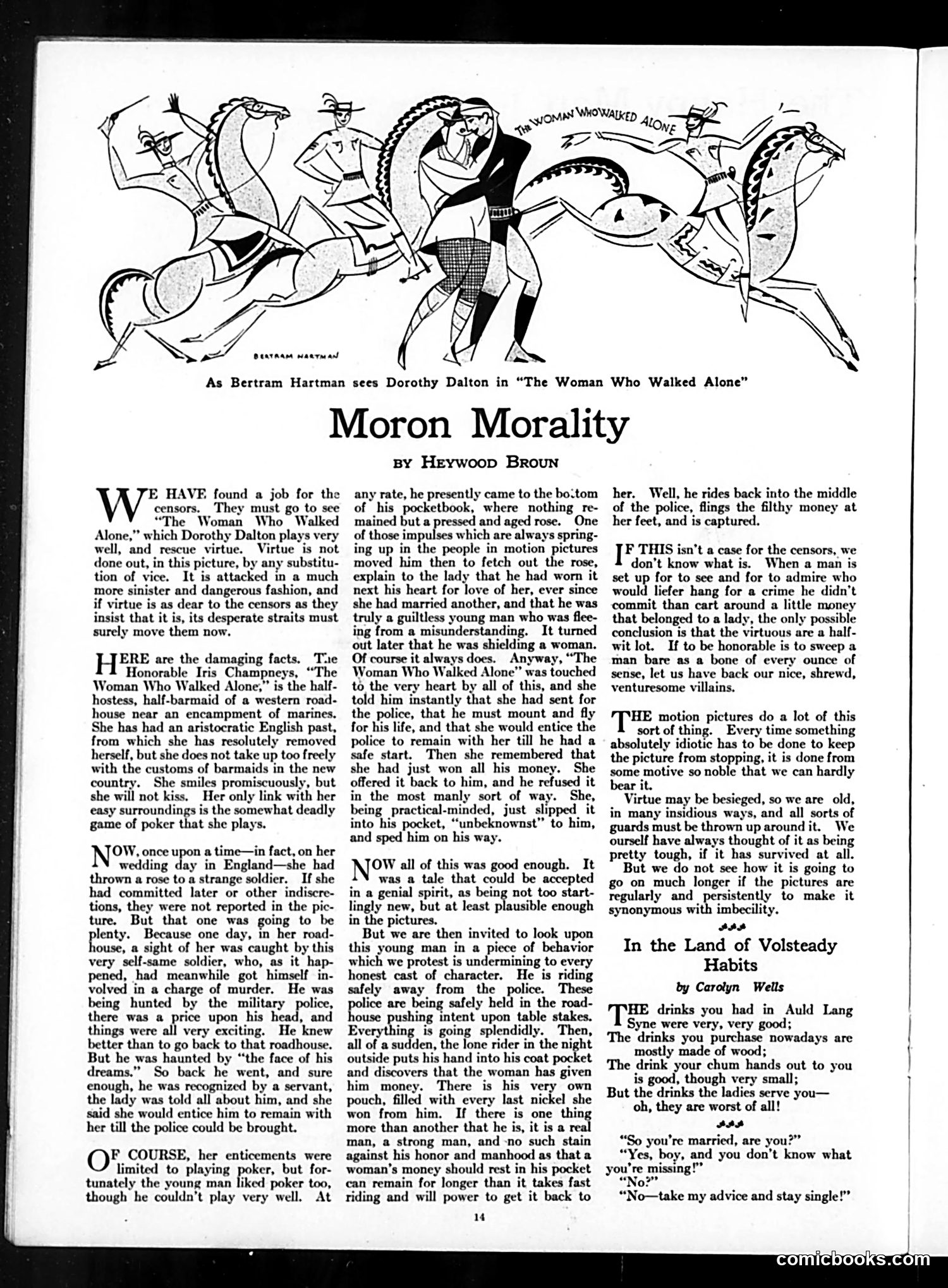
This is a film review by Heywood Broun critiquing the 1927 silent film "The Woman Who Walked Alone" starring Dorothy Dalton. The cartoon illustration shows Hartman's exaggerated, Art Deco-style interpretation of the film's dramatic moments. Broun's satire targets film censors, challenging their selective morality. He describes a melodrama where a virtuous barmaid helps a fugitive soldier escape police—an act of mercy. However, Broun sarcastically notes that when the soldier subsequently fails to return money she secretly placed in his pocket, this constitutes "moron morality"—he prioritizes masculine pride over practical honesty. The satire's point: censors obsess over surface virtue while missing actual moral failures. Broun suggests their standards are hypocritical and shallow, focusing on propriety rather than genuine ethical behavior.
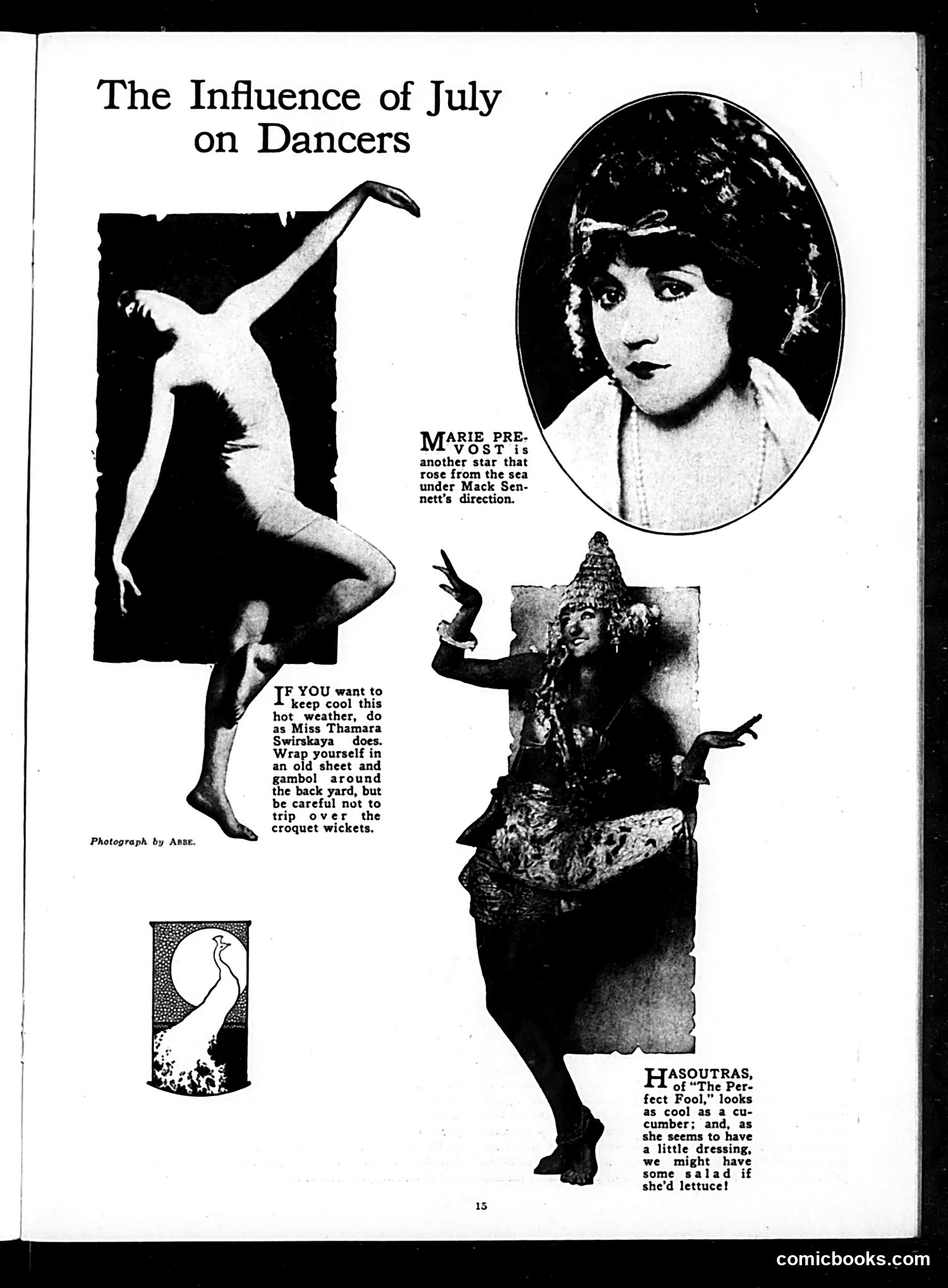
This is a humorous magazine feature about how dancers cope with summer heat. It showcases three performers: 1. **Marie Prevost** (top right portrait) — described as a star who rose under director Mack Sennett's Keystone Studios. 2. **Thamara Swirskaya** (left image) — depicted dancing in minimal clothing (wrapped in a sheet), with a tongue-in-cheek suggestion that wrapping oneself loosely helps beat the heat. 3. **Hasoutras** (bottom right, from "The Perfect Fool") — shown in an ornate costume, with a pun: she looks "cool as a cucumber" and the joke suggests adding "salad if she'd lettuce" (a play on "let us"). The satire plays on the contrast between elaborate stage costumes and the practical absurdity of staying cool during July heat. The puns and visual gags exemplify Judge magazine's lighthearted approach to entertainment and celebrity culture of the era.
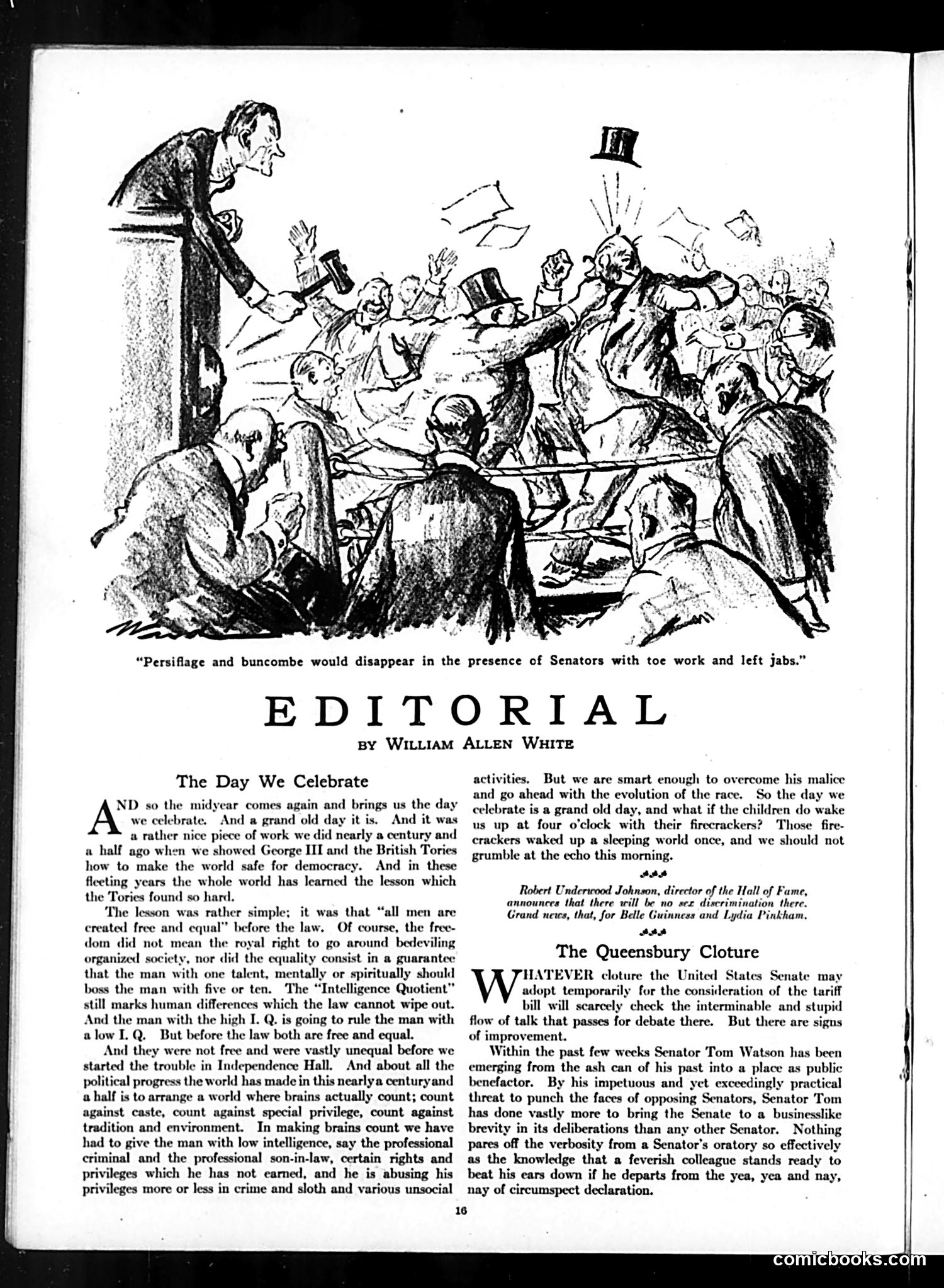
This editorial page contains two distinct pieces of political commentary: **The cartoon** (top) depicts a chaotic crowd of working-class figures attacking wealthy gentlemen in top hats on a platform—likely satirizing populist political agitation. The caption suggests that crude violence ("toe work and left jabs") would replace refined political "persiflage and buncombe" (empty talk) if Senators engaged in actual combat rather than debate. **"The Day We Celebrate"** by William Allen White reflects on Independence Day and American democracy's progress, emphasizing that legal equality has enabled merit-based advancement over inherited privilege, though acknowledging society still tolerates abuse by those with "low intelligence." **"The Queensbury Cloture"** mocks Senate debate procedures by praising Senator Tom Watson's threat to physically fight opponents as more effective at ending pointless speeches than actual parliamentary rules. The satire suggests Senate oratory is so verbose that only fear of violence encourages brevity. Both pieces criticize American political institutions—one through class-conflict imagery, the others through ironic commentary on legislative dysfunction.
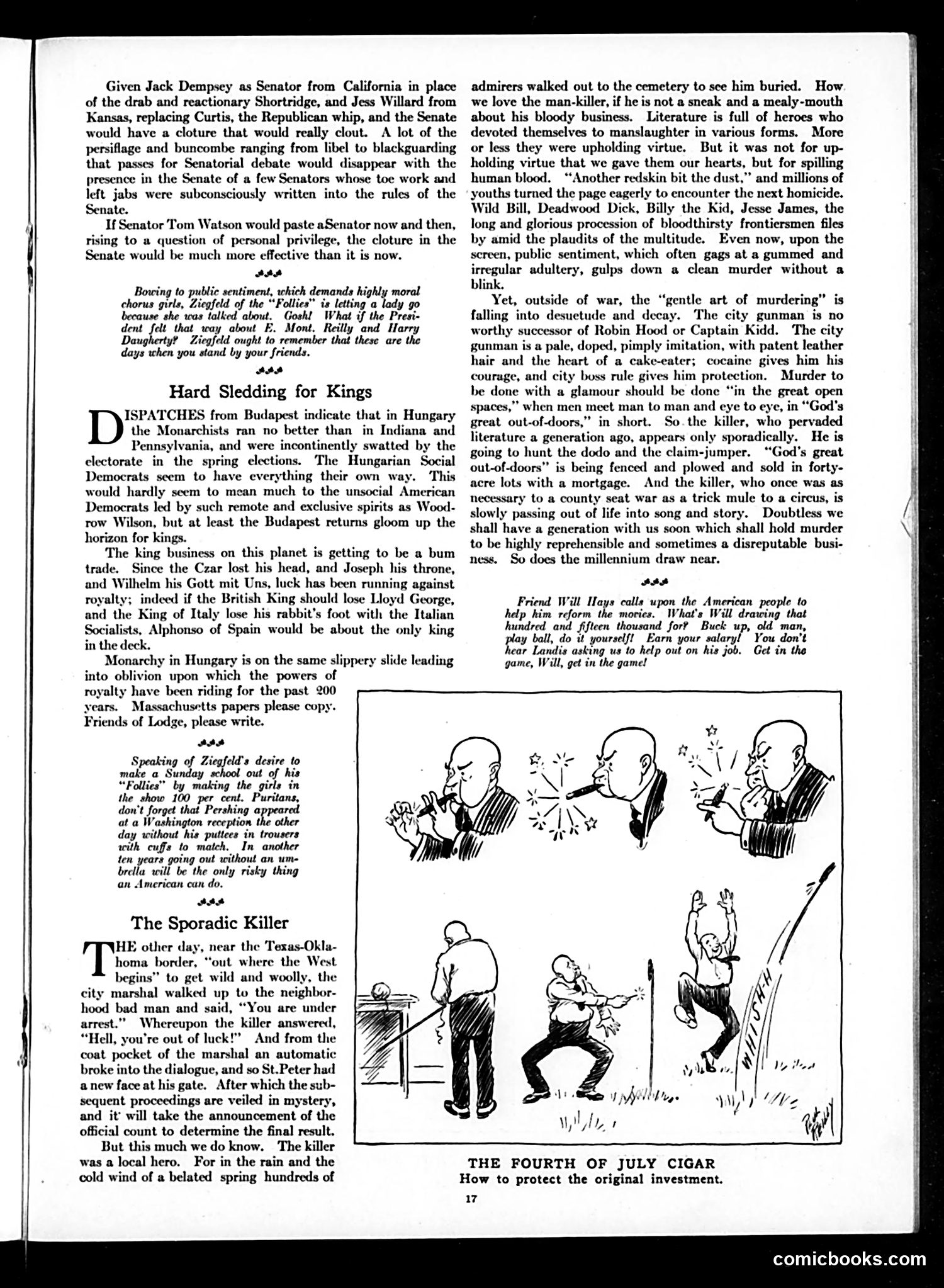
This page satirizes American political and social hypocrisy circa the early 1920s. **Political Content:** The opening section mocks Senate ineffectiveness, suggesting boxers Jack Dempsey and Jess Willard would be better senators than current members—implying politicians lack the vigor needed for debate. **"Hard Sledding for Kings":** Comments on European monarchy's decline (Hungarian elections, Russian/German revolutions) with dark humor that monarchies are a "bum trade." It's a jab at American conservatives (like Senator Lodge) who romanticize kingship. **"The Sporadic Killer":** Criticizes American culture's glorification of violent outlaws. A frontier killer shoots a marshal and becomes a local hero with admirers attending his funeral. The satire condemns how Americans romanticize "man-killers" and blood-spilling as virtue, when it's merely lawlessness dressed up as heroism. The cartoon illustrations (lower right) appear to depict cigar-smoking figures in conflict, likely commenting on Fourth of July excess or political violence.
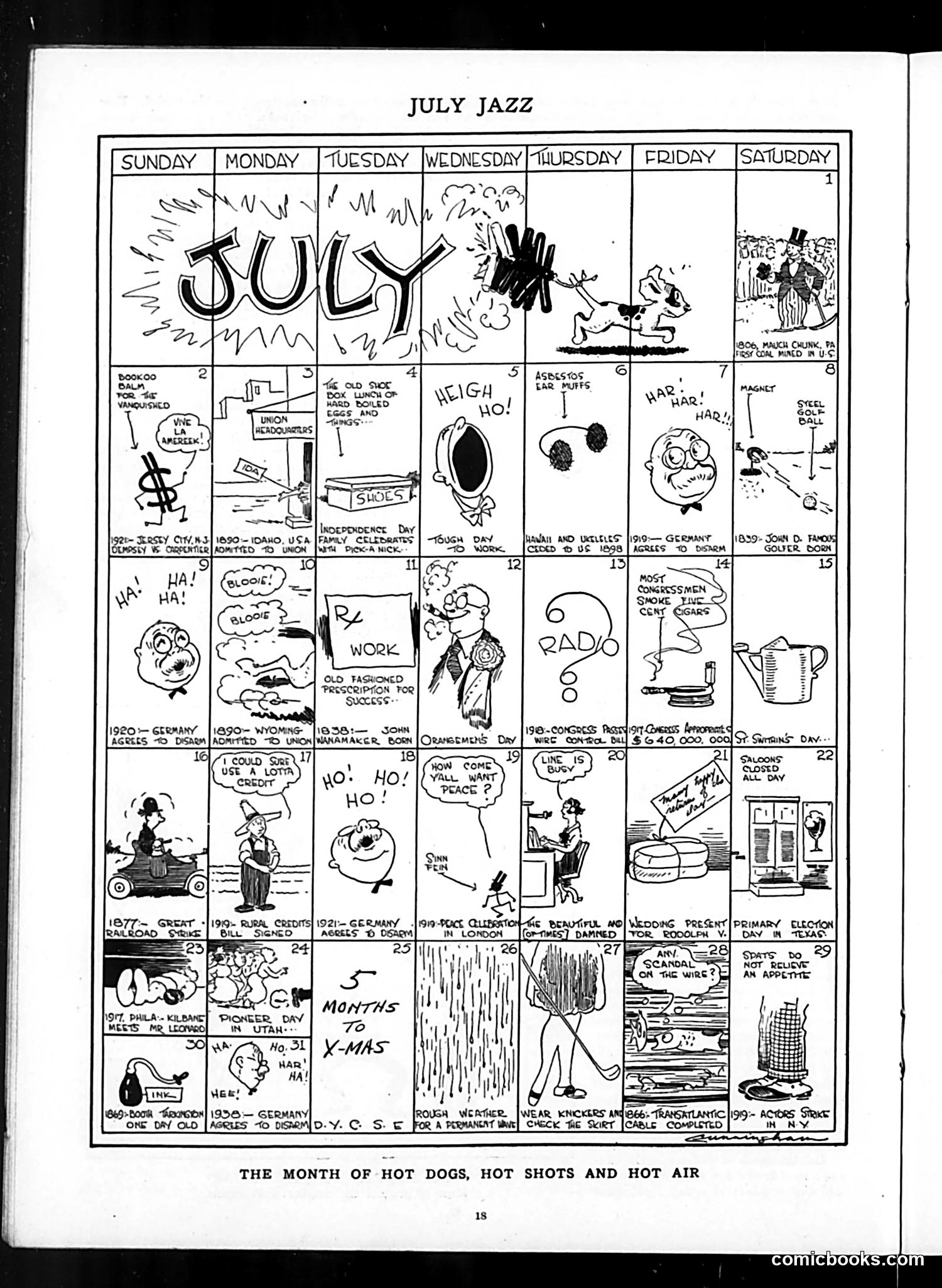
This is a satirical calendar page from Judge magazine titled "The Month of Hot Dogs, Hot Shots and Hot Air." Each day presents a different cartoon commenting on contemporary events and social issues. The page uses historical references to mock current (likely 1920s-era) politics and society. Notable entries include: - **Independence Day imagery** (top) with patriotic references - **Labor/economic commentary**: depictions of work, wages, and labor disputes - **Political figures and events**: references to Germany, Idaho statehood, and various political moments - **Social satire**: hot dogs, radio, elections, and everyday absurdities of American life The subtitle confirms the theme—combining trivial summer indulgences ("hot dogs") with political bombast ("hot air"). Each cartoon offers pointed commentary on contemporary news, politics, and American culture through exaggerated caricature and visual wordplay typical of Judge's satirical style. Without clearer OCR text, specific identifications remain uncertain, but the overall purpose is clear: mock political pretension and social folly through daily satirical vignettes.
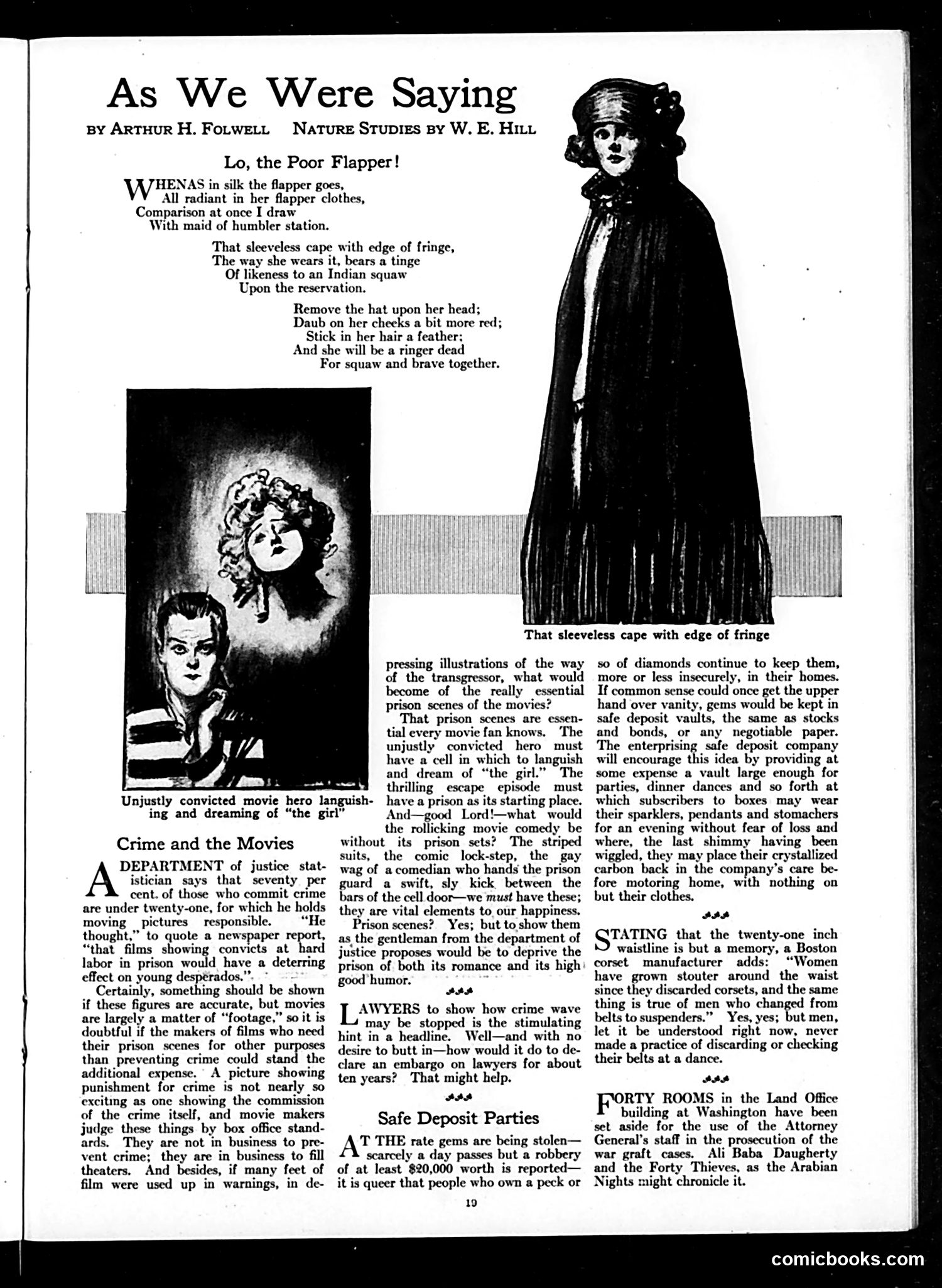
This *Judge* magazine page from the 1920s contains three satirical pieces: **"Lo, the Poor Flapper!"** mocks the fashionable young women ("flappers") of the era—specifically their sleeveless capes with fringed edges—by comparing them to Native American women on reservations. The satire is racist, suggesting that fashionable flapper dress inadvertently mimics "squaw" clothing. **"Crime and the Movies"** critiques Hollywood's priorities. A Department of Justice official proposed showing prison punishment in films to deter youth crime (70% of criminals were under 21). The article sarcastically argues studios won't comply because prison scenes are *essential entertainment*—unjustly convicted heroes languishing for "the girl," dramatic escapes, comic relief with guards. Movies profit from crime drama, not moral instruction. **"Safe Deposit Parties"** ridicules wealthy women who keep valuable gems at home for vanity, risking theft, rather than storing them safely in bank vaults. It suggests safe deposit companies should host fancy parties where socialites can wear their jewels for an evening, then lock them away—combining security with social pleasure. All three pieces satirize contemporary American culture through exaggeration.
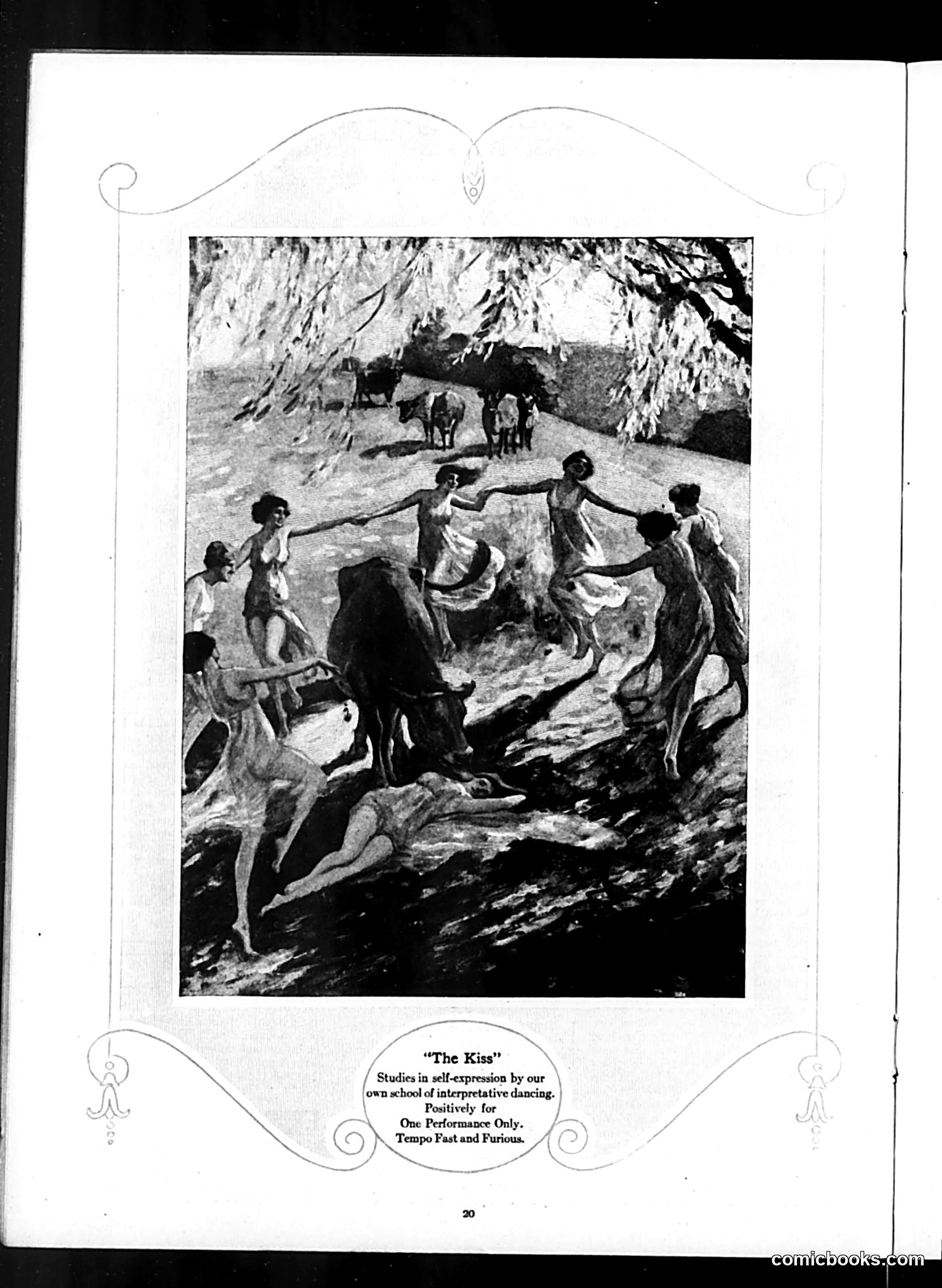
This page advertises a theatrical performance called "The Kiss," presented as a study in interpretative dancing and self-expression. The photograph shows multiple semi-nude figures in an artistic dance pose beneath a willow tree, with horses visible in the background. The satire likely mocks the pretentious artistic movements of early 20th-century modern dance and "interpretative" performance art—which Judge's audience would have viewed as self-indulgent or absurdly experimental. The note specifying "One Performance Only" and "Tempo Fast and Furious" suggests mockery of avant-garde theater's grandiose claims and ephemeral nature. The image presents this as simultaneously artistic and risqué, poking fun at how such performances courted controversy while claiming intellectual legitimacy.
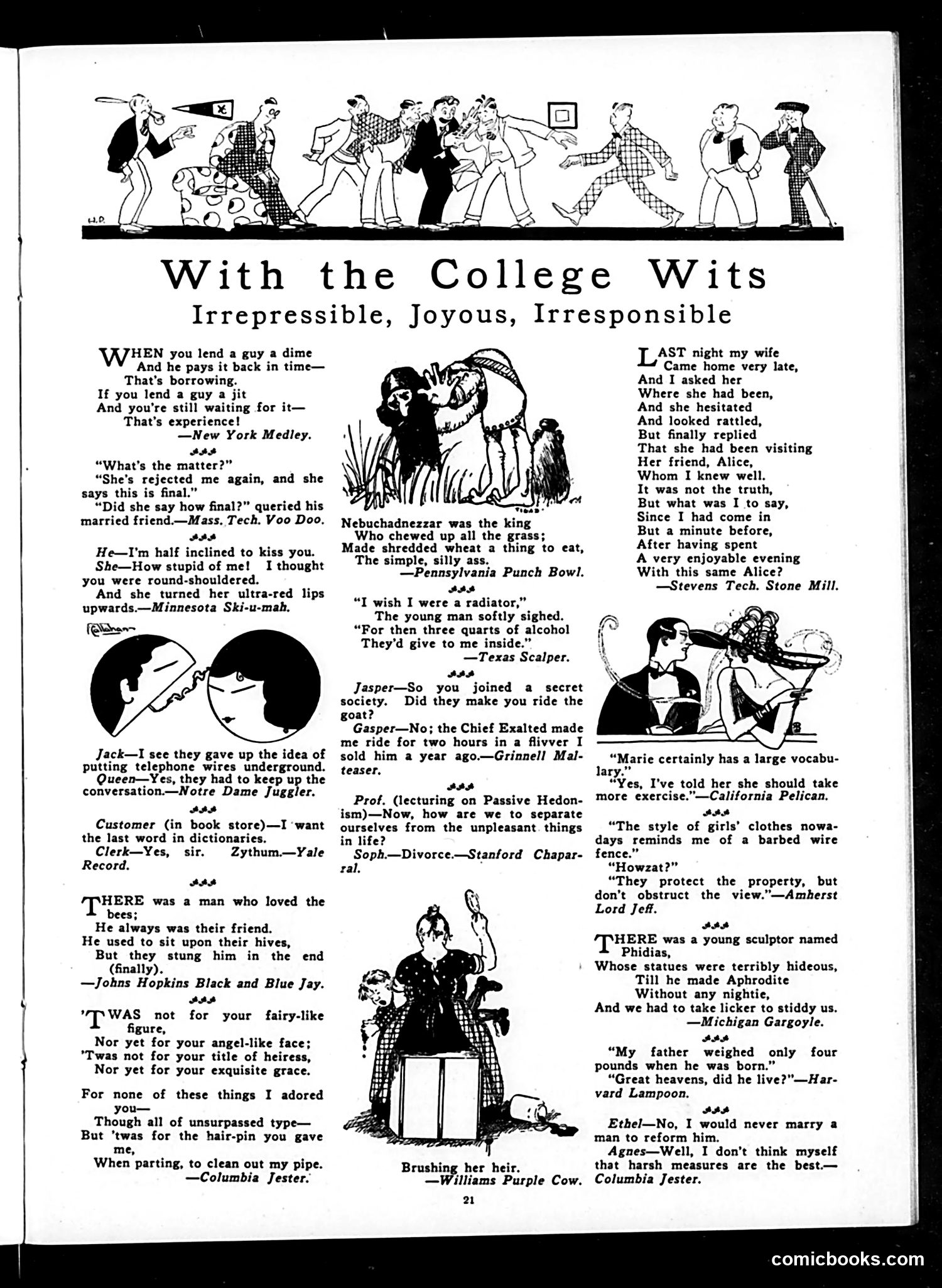
This page collects brief jokes and witticisms sourced from various college humor magazines (Yale Record, Notre Dame Juggler, Stanford Chaparral, etc.). The content reflects early-20th-century college life and attitudes: **Main themes:** - **Romance/rejection**: Multiple quips about dating failures and women's fickleness - **Drinking**: References to alcohol consumption ("three quarts of alcohol," "take licker") - **Gender dynamics**: Jokes portraying women as illogical or materialistic; men as hapless pursuers - **Student life**: Secret societies, professors, dormitory culture **The satire:** These jokes mock the pretensions of college students while celebrating their "irrepressible, joyous" irreverence. References to classical figures (Nebuchadnezzar, Phidias, Aphrodite) create humor through absurd juxtaposition with mundane college concerns. The page illustrates Judge's position as a magazine for educated, urban readers who enjoyed collegiate humor—likely alumni finding their college days reflected in these publications' witticisms.
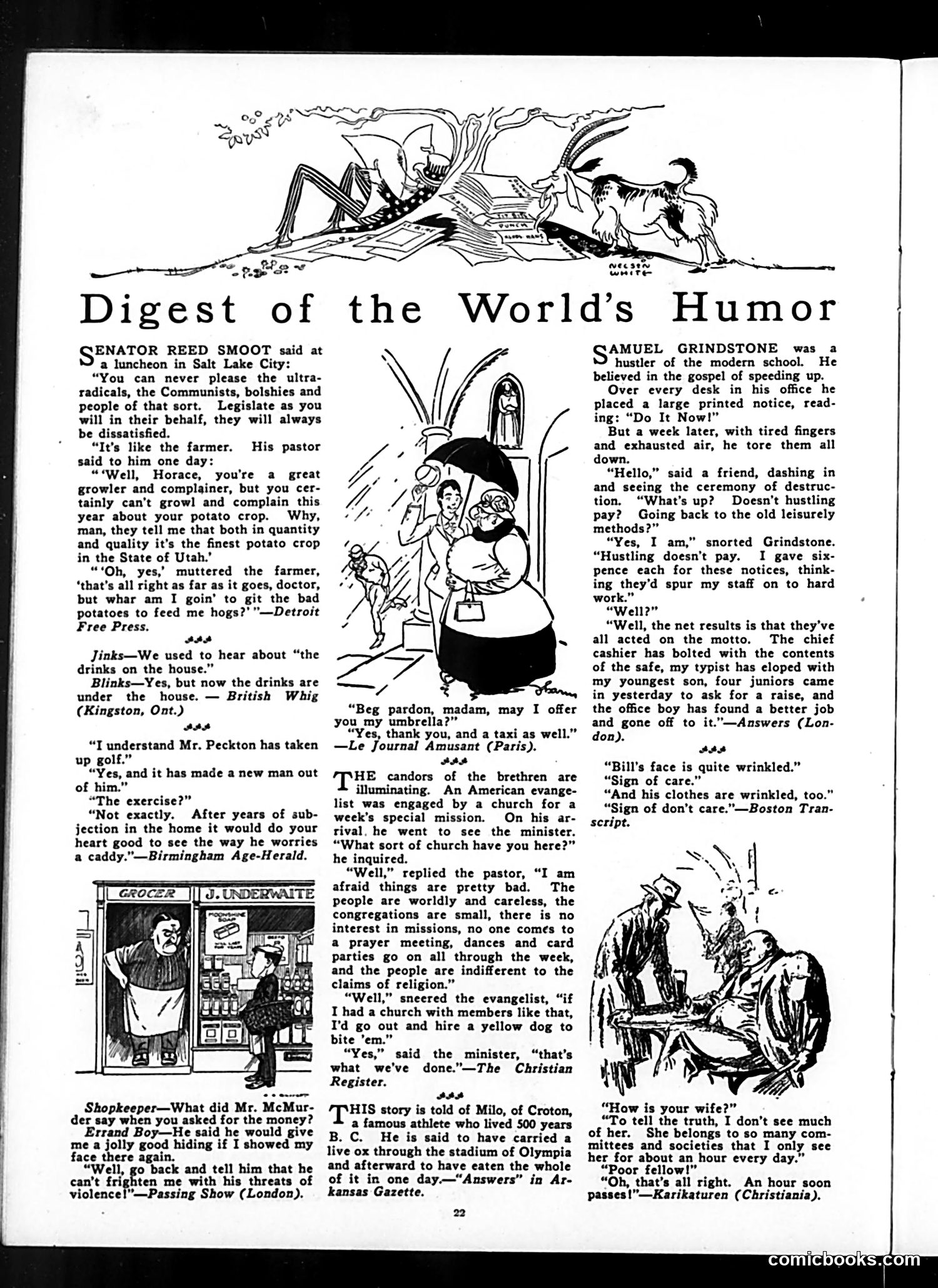
This page collects brief humorous anecdotes from various sources, representing early 20th-century satirical humor. Key pieces include: **Senator Reed Smoot's farmer parable** satirizes perpetual complainers—even when circumstances improve, they find new grievances (the farmer unhappy despite excellent potatoes). **The Grindstone story** mocks corporate "hustle" culture and motivational signs ("Do It Now!"). When employees actually follow the directive, chaos ensues: embezzlement, elopement, salary demands. The satire targets overzealous efficiency movements that backfire. **The evangelist anecdote** uses dark humor about a self-righteous preacher who suggests hiring a dog to bite church members—only to learn the pastor already has, implying the congregation deserves such punishment. Minor jokes address Prohibition ("drinks under the house") and marital discord. The cartoons appear to show a giant grasshopper and domestic scenes, though their specific satirical targets are unclear without captions.
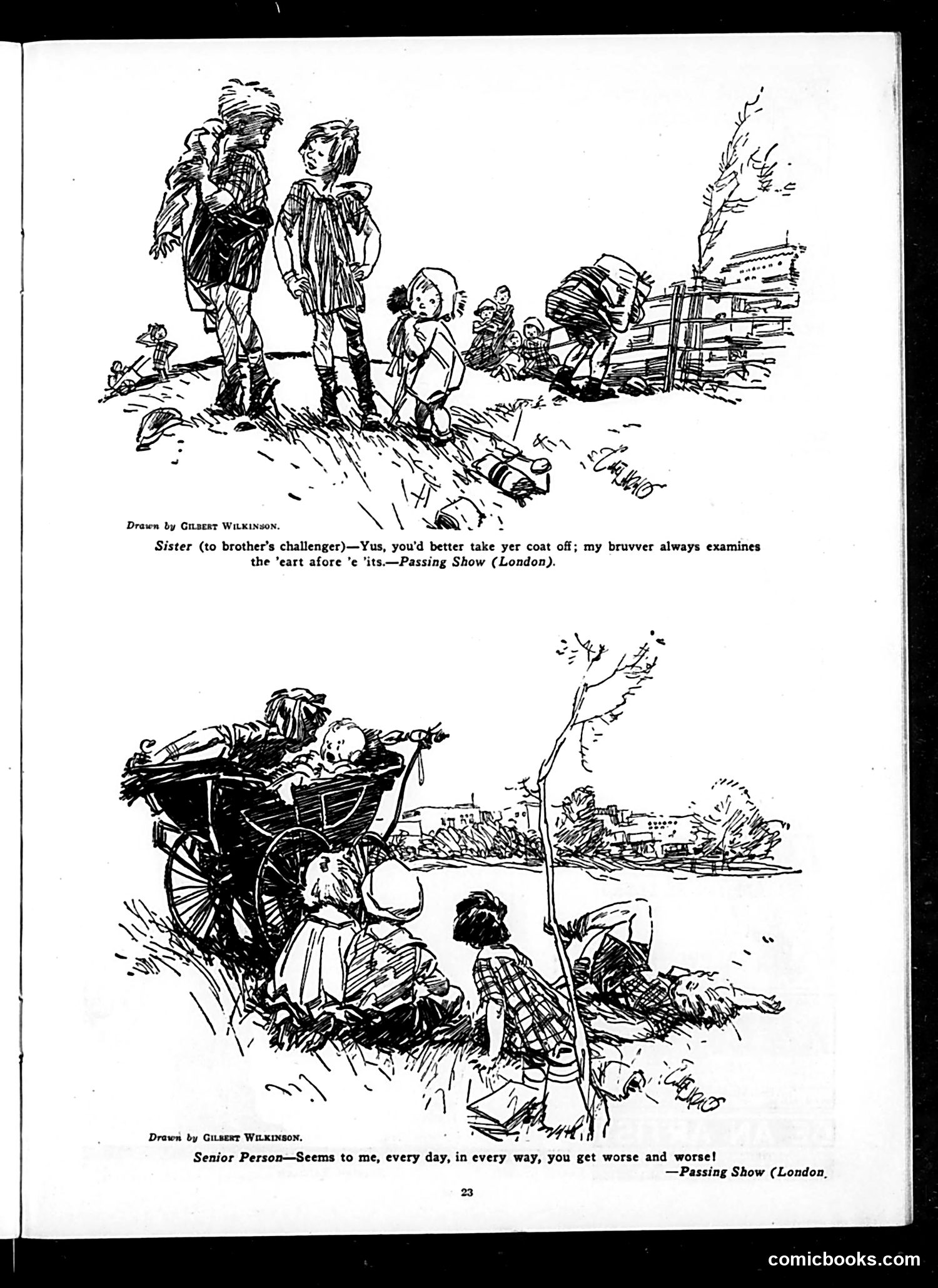
These are two separate satirical cartoons by Gilbert Wilkinson, both sourced from the British magazine *Passing Show* (not originally from Judge, despite the page header). **Top cartoon:** A working-class sister advises her brother's boxing challenger to remove his coat, claiming her brother "always examines the 'eart afore 'e 'its"—a crude joke about examining an opponent's chest/heart before punching. The dialect ("yer," "'eart," "'its") establishes these as lower-class characters. **Bottom cartoon:** A senior person criticizes someone for getting "worse and worse, every day, in every way"—likely a reference to Émile Coué's famous self-help mantra "Every day, in every way, I'm getting better and better," popular in the 1920s. The cartoon mocks this optimistic philosophy by inverting it, suggesting the opposite is happening. Both cartoons use class-specific humor and cultural references to satirize contemporary attitudes and fads.
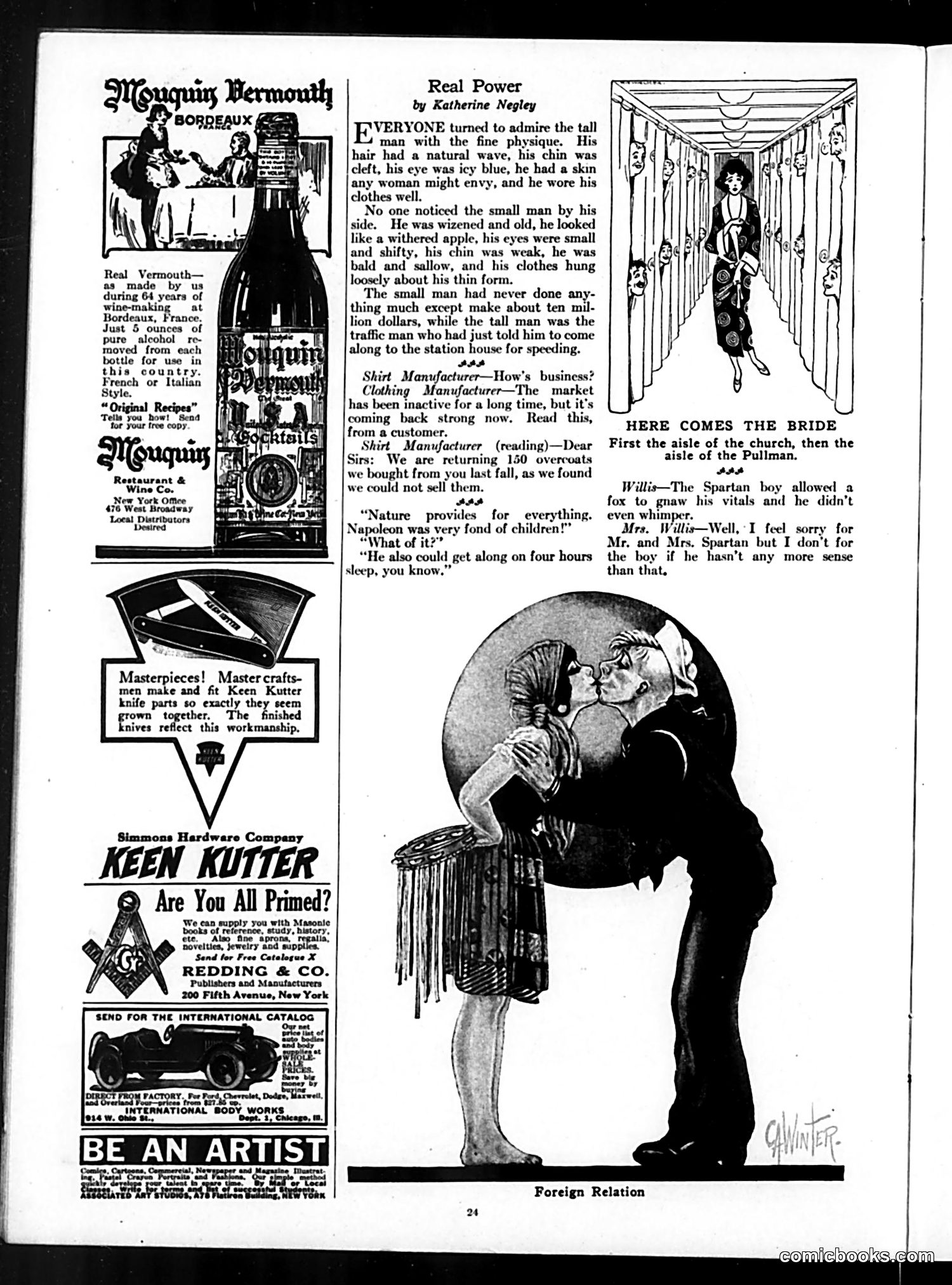
This page contains primarily **advertisements and short humorous anecdotes** rather than political satire. **Main cartoon ("Foreign Relation"):** A large illustration showing a wealthy, physically attractive man in formal dress kissing a young woman in a slip. The caption contrasts this with the "Real Power" story above: a homely, elderly self-made millionaire (who "made about ten million dollars") is more genuinely powerful than a handsome traffic officer, yet society only admires the tall man's appearance. The cartoon illustrates this irony visually—the physically impressive man dominates the frame while the small, rich man goes unnoticed. **Other content:** Brief jokes about Prohibition-era alcohol regulations (Vermouth with alcohol removed), business complaints about unsold overcoats, and domestic humor about Spartan boys and sleep. **Context:** This reflects 1920s concerns about wealth versus appearance, economic conditions post-WWI, and Prohibition's impact on commerce. The satire is gentle social observation rather than sharp political critique.
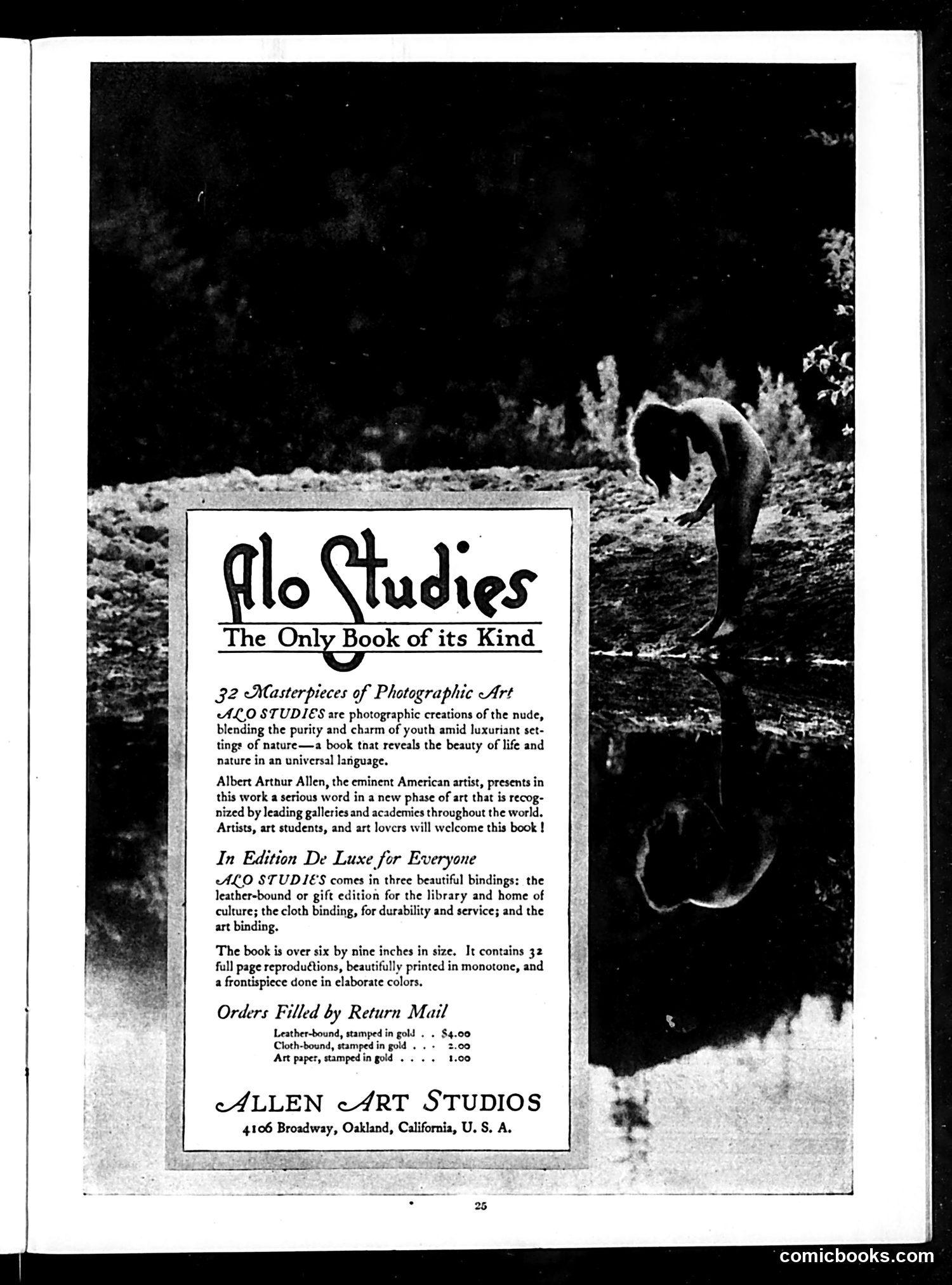
This page is entirely an advertisement, not a cartoon or satirical content. It promotes "Alo Studies," a book of artistic nude photography by Albert Arthur Allen. The ad emphasizes the work's legitimacy by claiming it's "recognized by leading galleries and academies throughout the world" and appeals to "artists, art students, and art lovers." This language suggests the advertiser felt compelled to defend the publication against potential obscenity concerns—a significant social issue of the era when nude photography faced legal and moral opposition. The right-side photograph shows a nude female figure in a natural setting, presented as "artistic" rather than erotic. The three binding options (leather, cloth, art paper) indicate marketing strategies for different social classes and contexts—emphasizing respectability through pricing and presentation. This reflects early-20th-century tensions around artistic freedom and what constituted acceptable depictions of the human form.
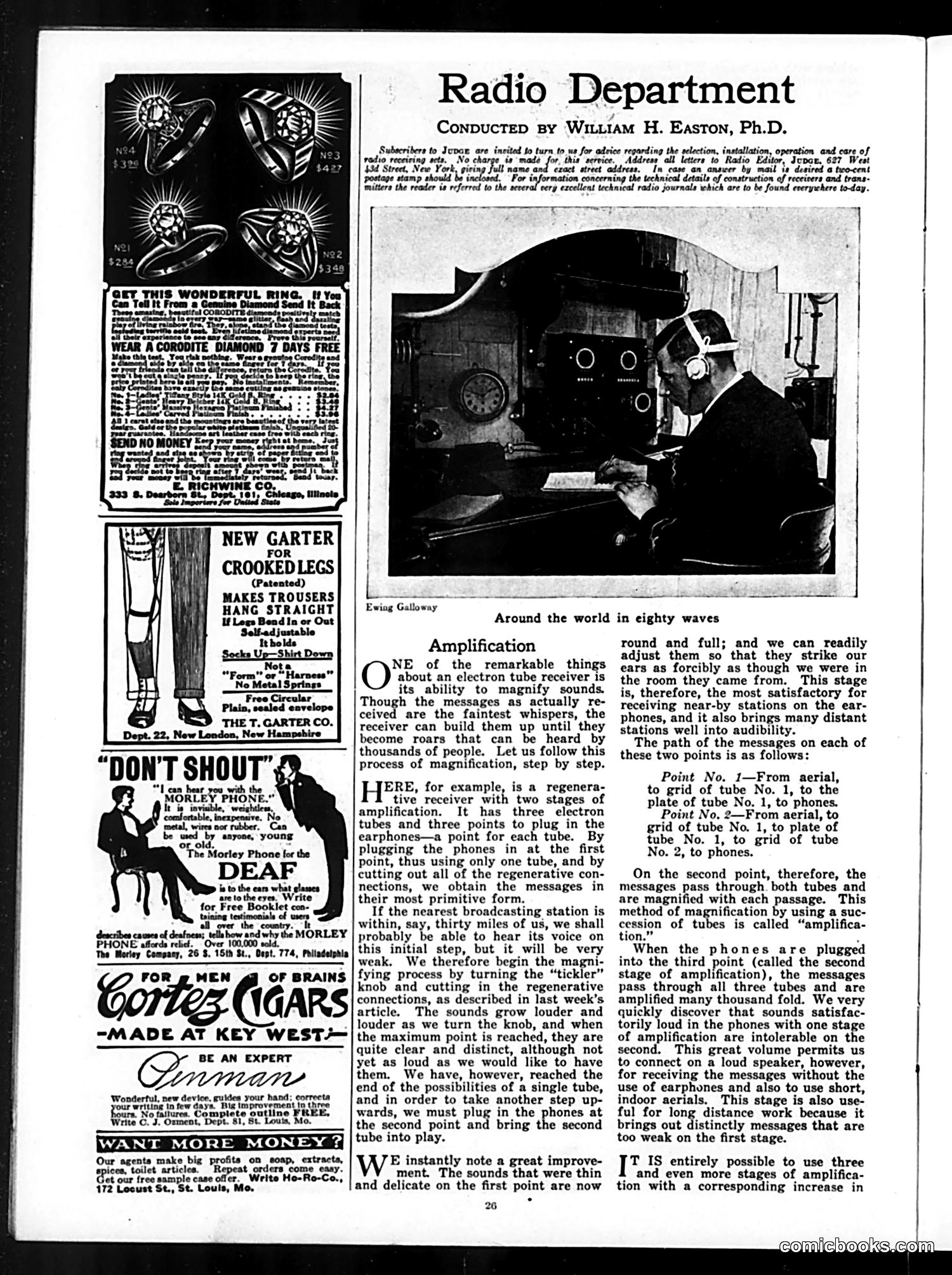
This page is primarily **educational and advertising**, not satirical. The main content is a technical article by William H. Easton explaining how electron tube receivers amplify radio signals through multiple stages—a genuine instructional piece for 1920s radio enthusiasts. The left side contains typical period advertisements: a Corodite diamond ring promotion, a "Carter for Crooked Legs" device, a Morley Phone for deaf users, and various mail-order offers (cigars, handwriting improvement, soap sales). The photograph shows "Ewing Galloway" at radio equipment, captioned "Around the world in eighty waves"—a reference to Jules Verne's famous novel, suggesting radio's revolutionary ability to transmit across vast distances. **No political satire is present.** This reflects Judge magazine's shift toward general-interest content in the 1920s, mixing humor with practical technology coverage for an educated readership fascinated by radio's novelty.
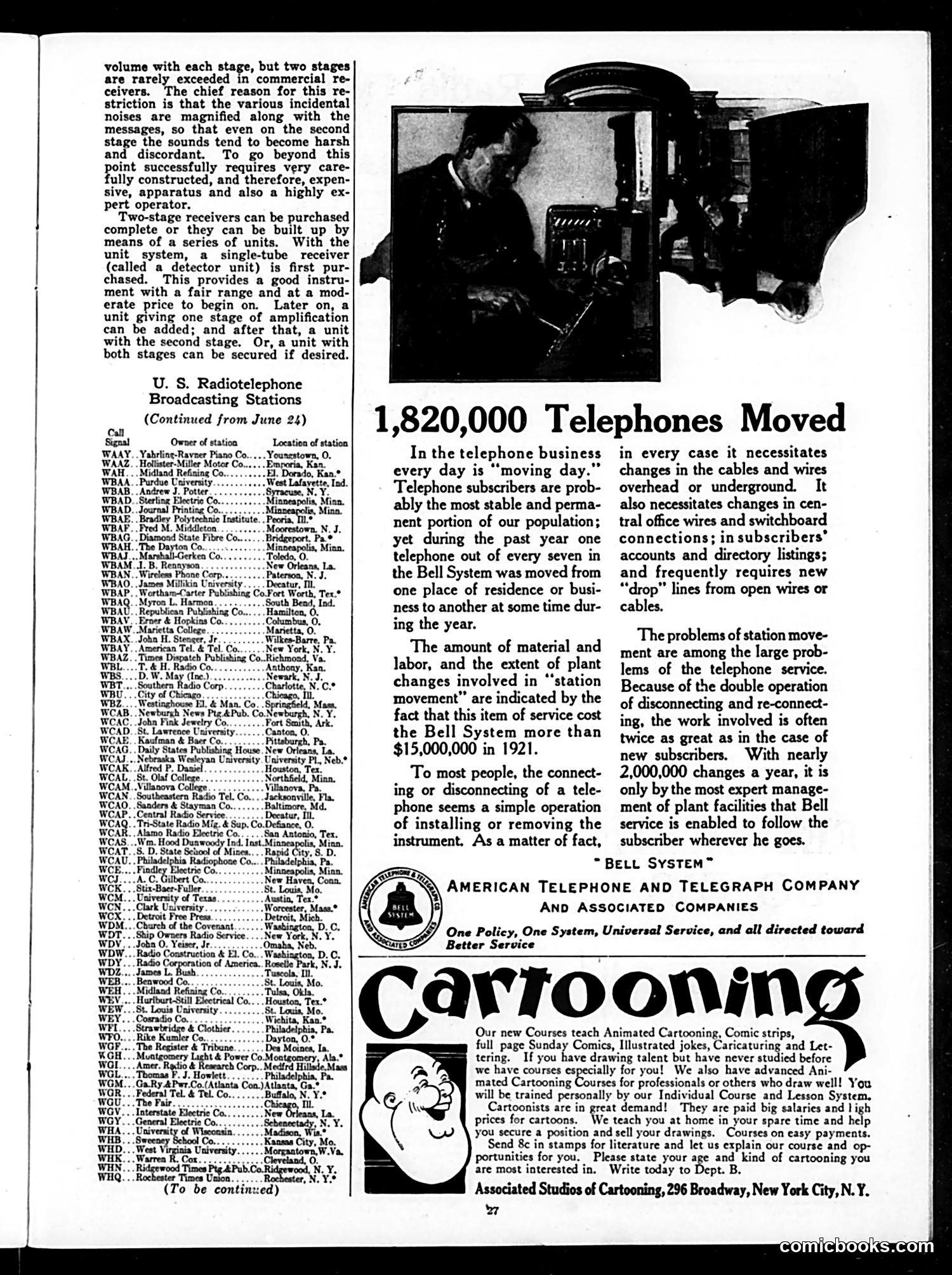
This page is primarily **advertising and industry content**, not political satire. The main feature is a Bell System advertisement about telephone service logistics. It explains that in 1921, the Bell System moved 1.82 million telephones—roughly one out of every seven subscribers—costing over $15 million. The accompanying image shows telephone equipment/apparatus. The advertisement educates readers that moving a phone is more complex than simply relocating an instrument: it requires changes to overhead/underground cables, central office wiring, switchboard connections, directory listings, and "drop" lines. Below this is a directory of U.S. radiotelephone broadcasting stations (continued from a previous issue), listing call letters, station owners, and locations—essentially early radio stations. At the bottom is an advertisement for **cartooning courses** from Associated Studios, recruiting aspiring cartoonists with promises of training and employment. There is **no political cartoon or satire present** on this page—it's business-focused content typical of trade publications of the early 1920s.
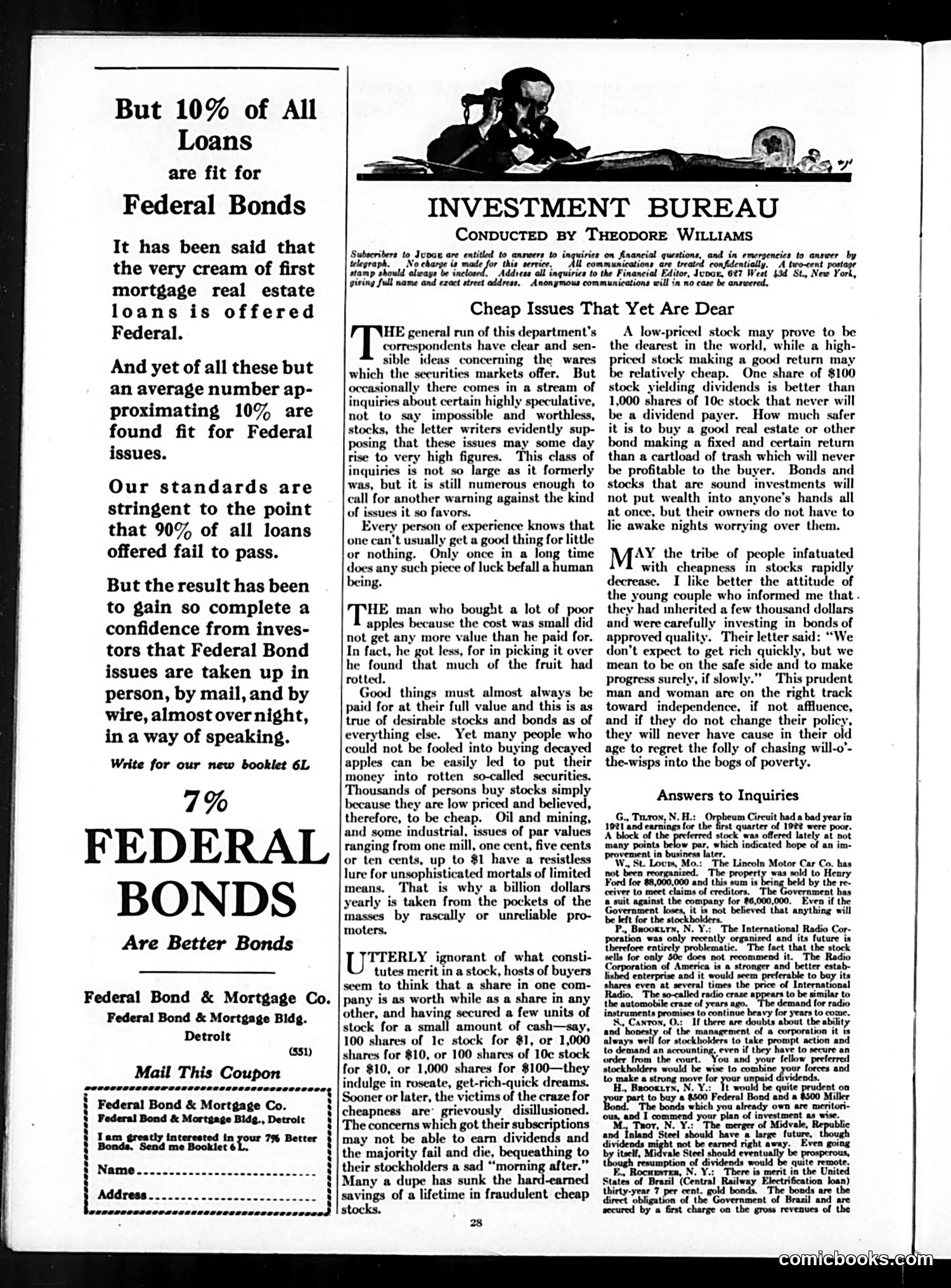
This page contains investment advertising and financial advice from circa 1920s-1930s. **The Advertisement (left):** Federal Bond & Mortgage Co. promotes 7% bonds, claiming rigorous standards—rejecting 90% of loan applications—which supposedly proves their soundness. This is marketing: stringent rejection supposedly equals investor safety and explains why bonds sell "almost overnight." **The Editorial Column (right):** Theodore Williams's "Investment Bureau" warns against penny stocks and "cheap" securities. The satire targets ordinary people lured by low prices into worthless stocks (oil, mining, industrial issues trading at 1¢, 5¢, or 10¢ per share). **The Point:** Williams mocks investors who equate low price with value, comparing them to someone buying rotten apples cheaply. He warns that "rascally promoters" extract "a billion dollars yearly" from "the masses" through such schemes. The column advocates for quality securities at fair prices rather than speculative trash. **Context:** This reflects 1920s speculative excess and warns of fraud targeting unsophisticated retail investors before the 1929 crash.
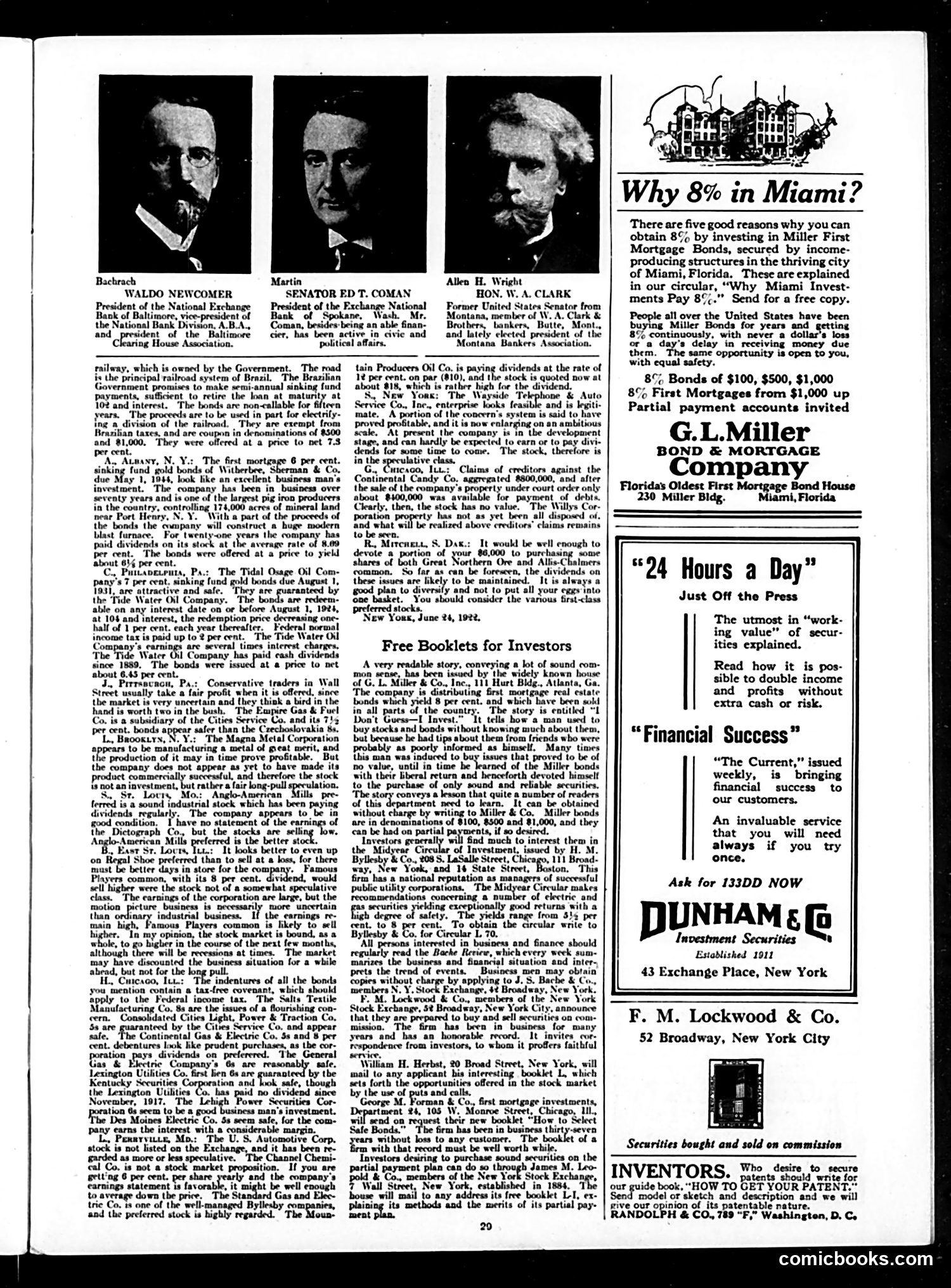
This page is primarily **financial advertising**, not political satire. It features three photographs of prominent businessmen (Waldo Newcomer, Senator Ed T. Coman, and W.A. Clark) promoting Miami real estate investments offering 8% returns through G.L. Miller & Co.'s bond and mortgage company. The content reflects early 20th-century investment culture: the text discusses various corporate bonds (Brazilian railways, pig iron companies, oil firms) with detailed yield percentages and dividend histories. This represents the speculative financial boom preceding economic downturns. The "Free Booklets for Investors" section and advertisements for investment guides indicate targeted marketing to middle-class American investors seeking reliable income. There is **no political cartoon or satire visible**—this is a business-focused page typical of Judge's mixed editorial and advertising content from this era.
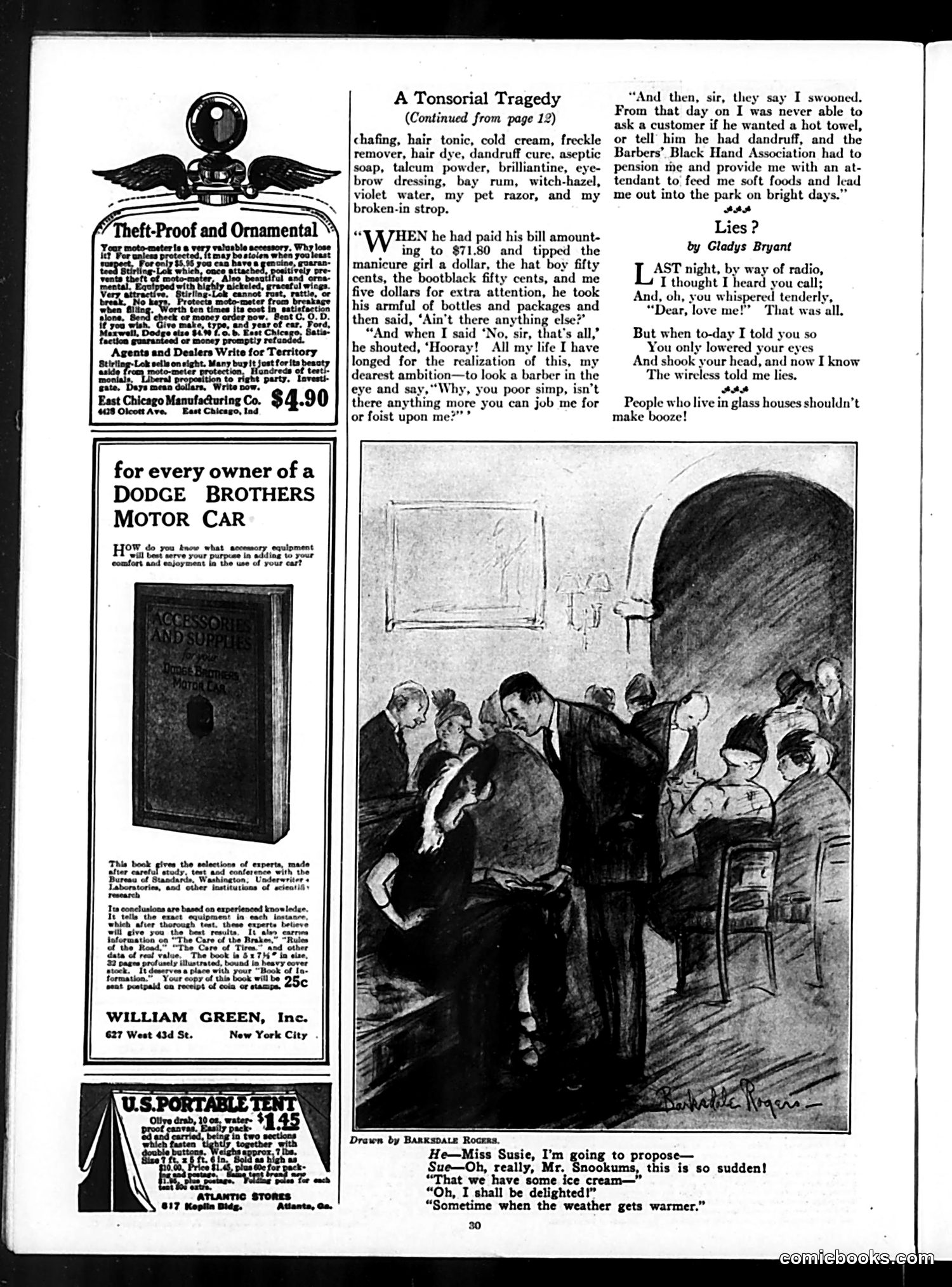
This page contains three distinct pieces of satirical content: **"A Tonsorial Tragedy"** (top): A barber's monologue satirizing customer entitlement and commercialism. The barber recounts a customer who spent $71.80 on grooming services plus tips, then mockingly asked if there was "anything more you can job me for or foist upon me?"—implying the barber nickels-and-dimes clients. The joke critiques both the customer's entitled attitude and the barber industry's nickel-and-diming practices. The barber's claimed breakdown afterward parodies how absurdly he took this comment. **"Lies?" (right)**: A brief romantic poem about wireless radio miscommunication—a girlfriend's radio message seemed like a love confession, but was actually a mundane proposal for ice cream "sometime when the weather gets warmer." It satirizes early radio technology's novelty and misunderstandings. **Bottom cartoon**: A marriage proposal joke where the man proposes having ice cream sometime in the future—a deliberately anti-romantic, deflating punchline. The page is primarily advertising filler with these lighter satirical pieces interspersed.
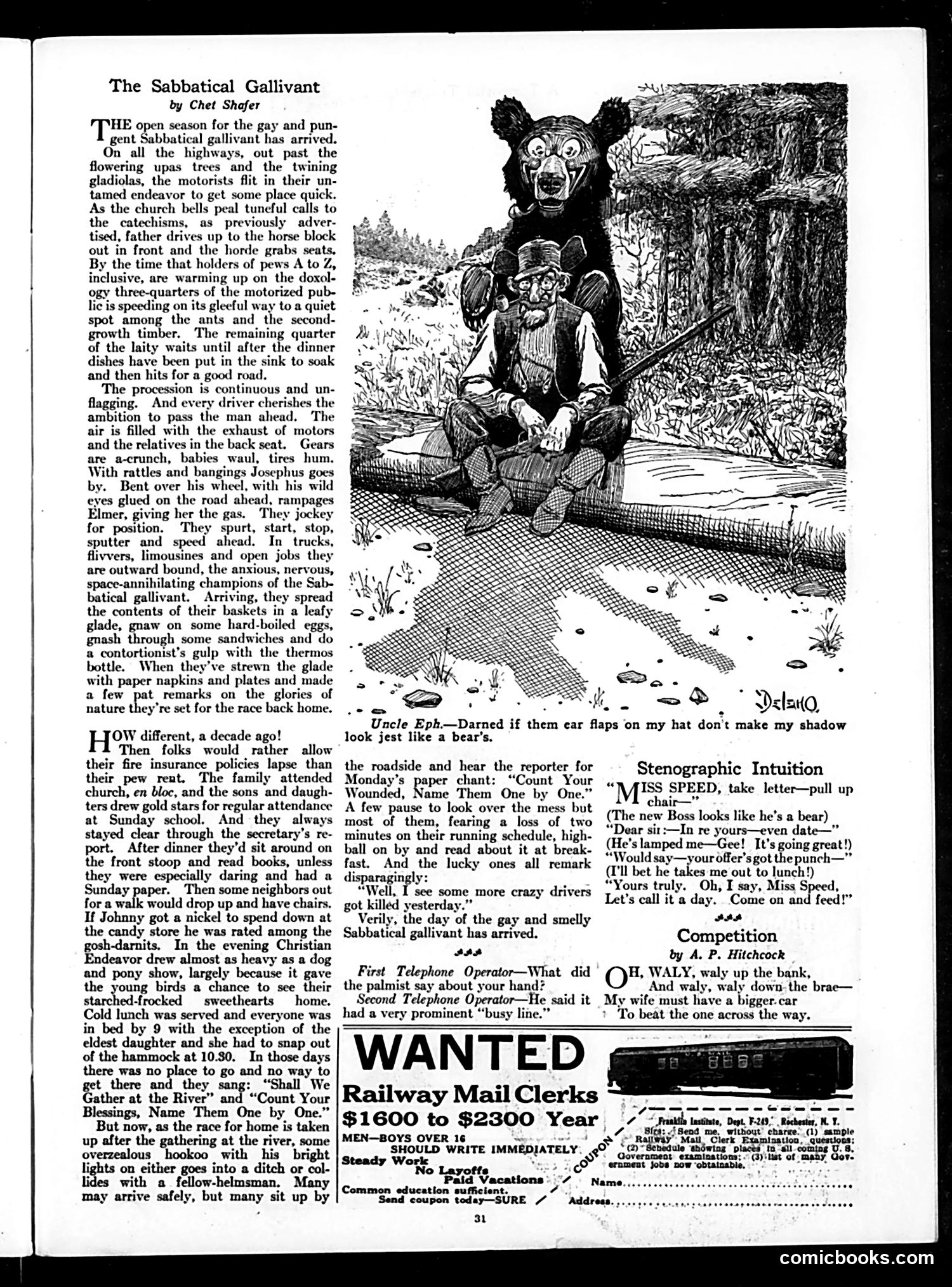
This satirical article by Chet Shafer critiques how American leisure and automobile culture have changed over a decade. "Sabbatical gallivant" refers to weekend recreational driving—a new phenomenon enabled by affordable automobiles. **The Satire:** The piece contrasts contemporary Sunday driving culture (reckless, traffic-clogged, culminating in accidents) with idealized pre-automobile family life (church attendance, wholesome activities, modest pleasures). **Key targets:** - Motor-obsessed drivers competing dangerously for speed - Families abandoning religious observance for driving - Callous attitudes toward traffic fatalities - Consumer culture replacing spiritual values The darkly humorous ending—replacing the hymn "Count Your Blessings" with "Count Your Wounded"—emphasizes how automobile deaths have become commonplace and accepted as inevitable costs of modern mobility. The illustration shows a bear-like motorist, visually reinforcing the "wild," uncivilized nature of drivers.
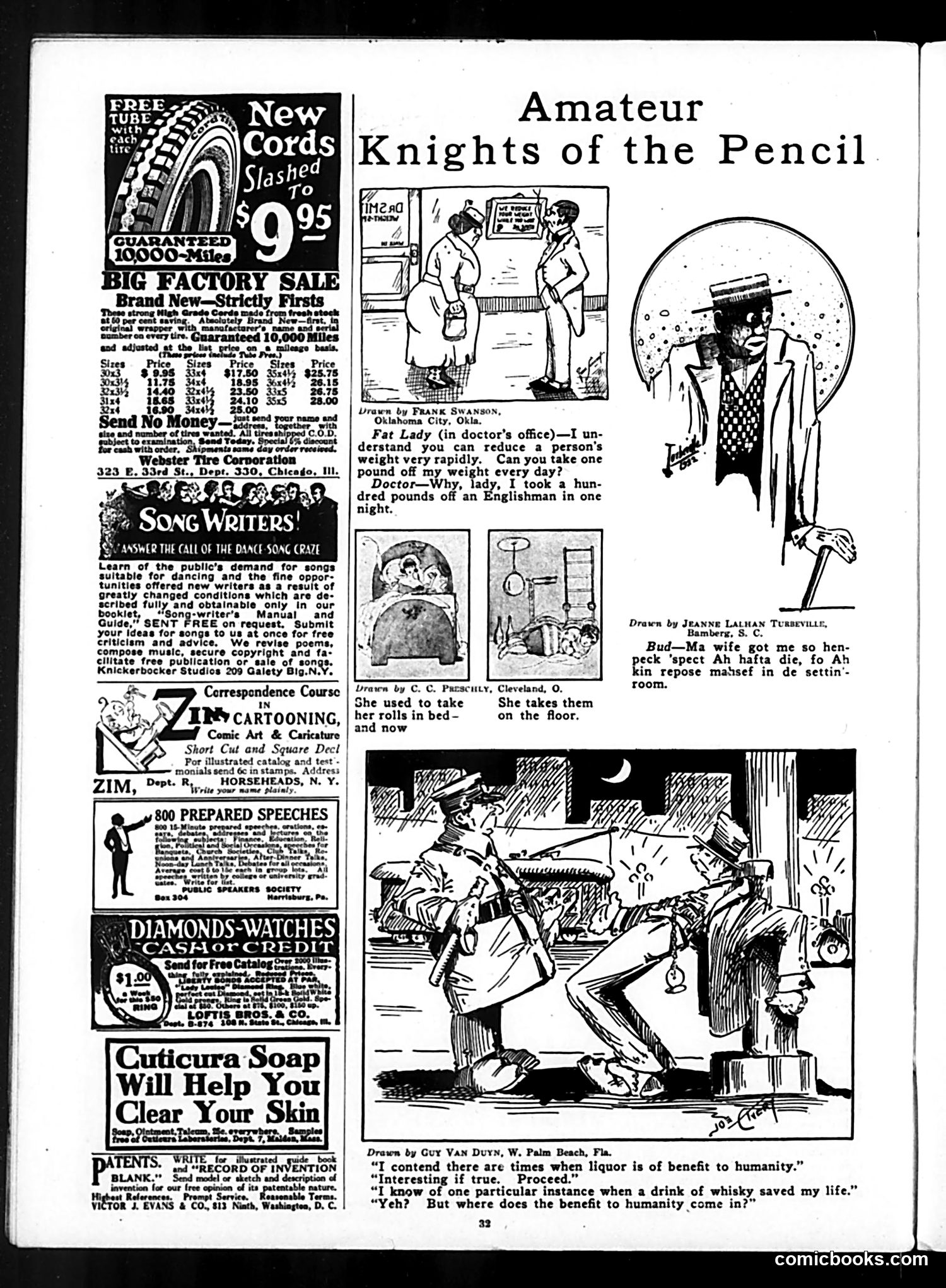
This page collects amateur-submitted jokes and cartoons—the magazine's "Knights of the Pencil" feature. The humor reflects early 20th-century domestic and medical stereotypes: 1. **Fat Lady cartoon**: Jokes about rapid weight loss, playing on period obsessions with reducing diets. 2. **Bread rolls gag**: Visual pun about a woman who formerly kept bread rolls in bed but now keeps them on the floor—likely implying she's lost weight or changed habits. 3. **Whisky debate**: A drunk man argues liquor has health benefits, using a personal anecdote; the other character points out self-interest isn't "humanity's" benefit—satirizing dubious health claims. 4. **"Bud" cartoon**: Uses dialect humor (African American vernacular) about a henpecked husband so dominated by his wife he needs to relax alone—common period comedy trope. The page is primarily **advertisements and reader submissions**, demonstrating Judge's dual role as satirical magazine and platform for amateur cartoonists seeking publication.

This is an advertisement promoting William Allen White's editorial contributions to *Judge* magazine. White was a prominent American journalist and editor (appears to be early 20th century based on style). The ad presents him as fearless and balanced—willing to criticize ("knocks") and praise fairly without favoring anyone. He's described as the "best informed Editorial Writer in the United States," suggesting *Judge* readers should value his perspective. The phrase "liberal education" indicates his writing is informative and intellectually stimulating. This is essentially a house ad designed to encourage readers to engage with White's regular columns, positioning *Judge* as a serious publication featuring respected journalism alongside its satire and humor.
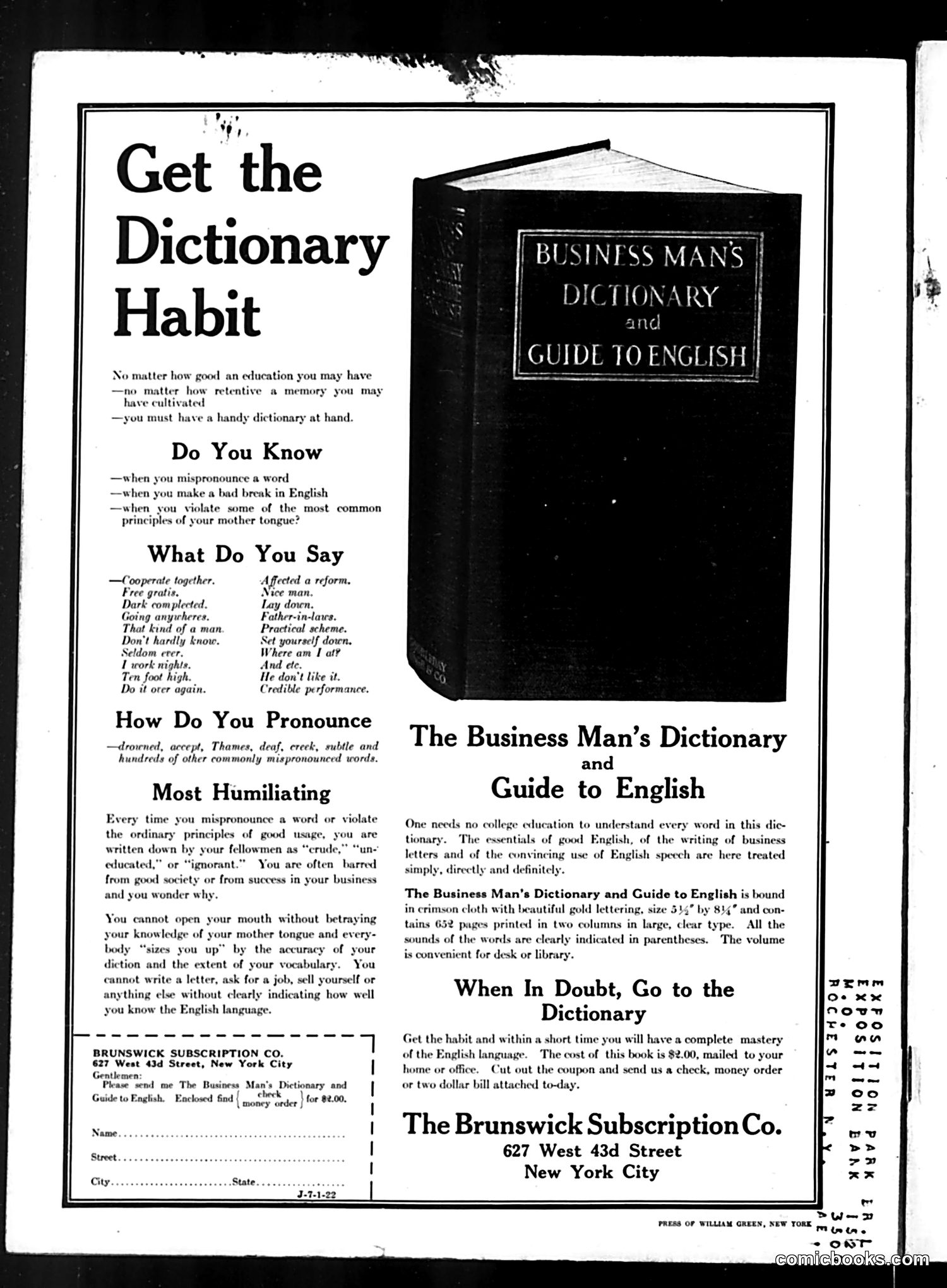
This is primarily a **full-page advertisement** for "The Business Man's Dictionary and Guide to English," not a political cartoon. The ad uses social anxiety as its marketing pitch. It warns readers that mispronouncing words or using poor grammar results in being labeled "crude" or "ignorant" and bars them from "good society" and business success. The accompanying text lists common English errors ("Cooperate together," "Free gratis," "Ten foot high") to make the problem feel urgent and pervasive. The satirical edge—typical of Judge magazine—lies in the *class messaging*: the implication that one's social and professional standing hinges entirely on linguistic correctness, and that a $2 dictionary can remedy this humiliation. The ad exploits middle-class anxieties about refinement and acceptance, selling aspiration rather than mere reference material. This reflects early 20th-century concerns about standardized English as a marker of respectability.