
Judge, 1922-07-01 · page 28 of 36
Judge — July 1, 1922 — page 28: what you’re looking at
What you’re looking at
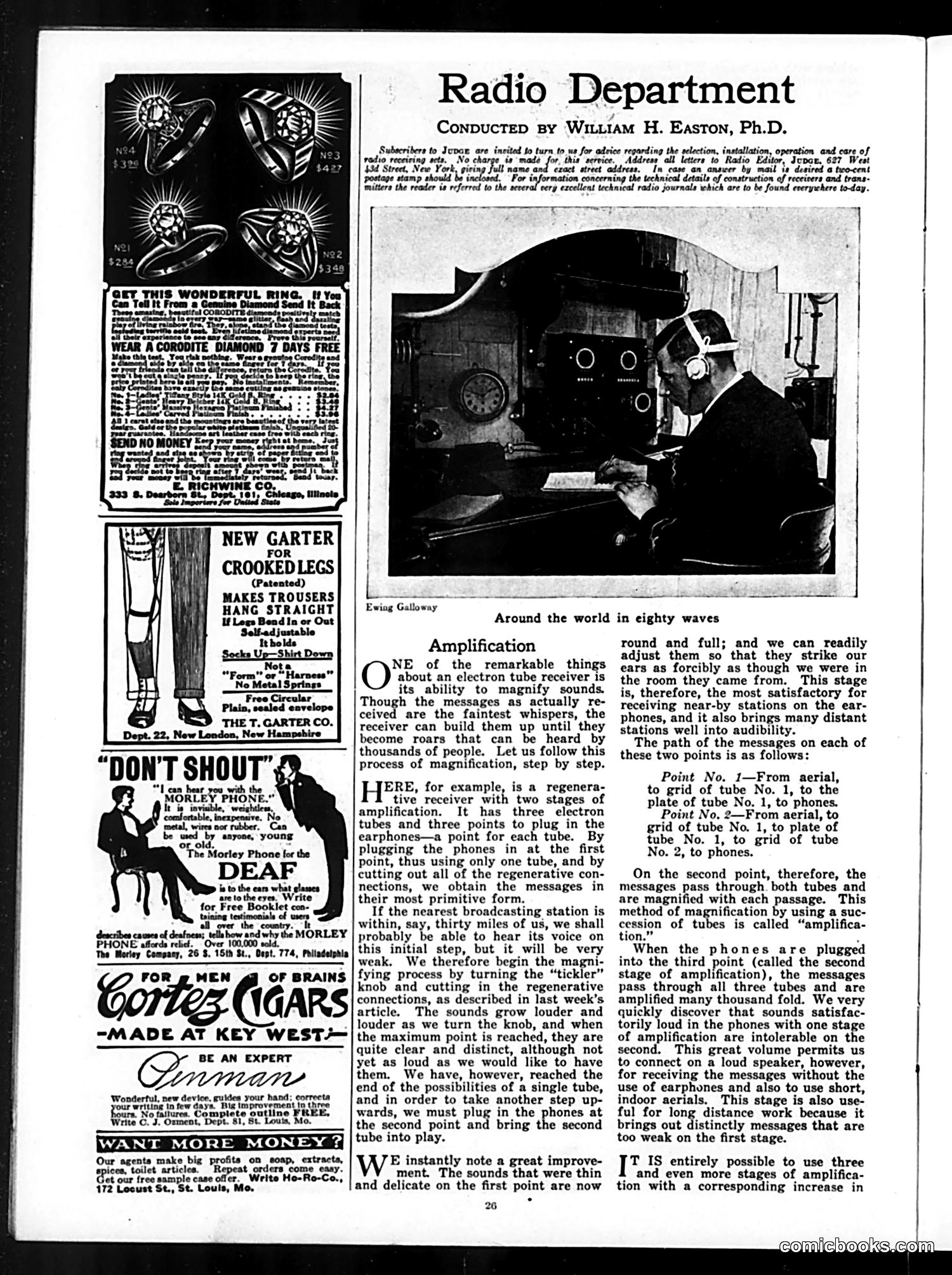
This page is primarily **educational and advertising**, not satirical. The main content is a technical article by William H. Easton explaining how electron tube receivers amplify radio signals through multiple stages—a genuine instructional piece for 1920s radio enthusiasts. The left side contains typical period advertisements: a Corodite diamond ring promotion, a "Carter for Crooked Legs" device, a Morley Phone for deaf users, and various mail-order offers (cigars, handwriting improvement, soap sales). The photograph shows "Ewing Galloway" at radio equipment, captioned "Around the world in eighty waves"—a reference to Jules Verne's famous novel, suggesting radio's revolutionary ability to transmit across vast distances. **No political satire is present.** This reflects Judge magazine's shift toward general-interest content in the 1920s, mixing humor with practical technology coverage for an educated readership fascinated by radio's novelty.
📄 Transcribed text from this page (OCR, searchable)
Machine-transcribed from the original scan — historical spelling and the odd misread are preserved.
Radio Department Conpuctep By Wriitam H. Easton, Ph.D. operation and care of Jopar, 627 West y mail ie desired a two-cent MAKES TROUSERS HANG STRAIGHT Uf Legs Bend In or Out justable belts Nota “Form” or lo “Harness' No Metal Springs for Free Booklet con- taining testimonials of users allover the country. it causes of deafness; telshow and why the MORLEY PHONE affords relief. }00,000 sald. Teo Morley Company, 26 $, 15th St., Dept. 774, Philadelphia FOR g MEN OF BRAINS IGARS “MADE AT KEY WEST— BE AN EXPERT Crimean Wonderful, new device. guides your hand: corrects our writing In few days. Big improvement tn three koura, No failures. Complete outline FREE, ‘Write C. J, Ozment, Dept. 81, St. Louts, Mo. pak Write GJ. Ommant, Devt: 61) 06: Lee eens WANT MORE MONEY ? Our agents make big profits on soap, extracts, ices, toilet articles. Repeet orders come easy. jet our free sample case offer. Write Ho-Ro-Co., 172 Locust St., St. Louls, Mo, a_i eae ee 575 Ewing Galloway oe ia Around the world in eighty waves Amplification NE of the remarkable things O about an electron tube receiver is its ability to magnify sounds. Though the messages as actually re- ceived are the faintest whispers, the receiver can build them up until they become roars that can be heard by thousands of people. Let us follow this process of magnification, step by step. HEE: for example, is a regenera- tive receiver with two stages of amplification. It has three electron tubes and three points to plug in the earphones—a point for each tube. By plugging the phones in at the first point, thus using only one tube, and by cutting out all of the regenerative con- nections, we obtain the messages in their most primitive form. If the nearest broadcasting station is within, say, thirty miles of us, we shall probably be able to hear its voice on this initial step, but it will be very weak. We therefore begin the magni- fying process by turning the “tickler” knob and cutting in the regenerative connections, as described in last week’s article. The sounds grow louder and louder as we turn the knob, and when the maximum point is reached, they are quite clear and distinct, although not yet as loud as we would like to have them. We have, however, reached the end of the possibilities of a single tube, and in order to take another step up- wards, we must plug in the phones at the second point and bring the second tube into play. E instantly note a great improve- ment. The sounds that were thin and delicate on the first point are now 26 round and full; and we can readily adjust them so that they strike our ears as forcibly as though we were in the room they came from. This stage is, therefore, the most satisfactory for receiving near-by stations on the ear- phones, and it also brings many distant stations well into audibility. The path of the messages on each of these two points is as follows: Point No. 1—From aerial, to grid of tube No. 1, to the plate of tube No. 1, to phones. Point No, 2—From aerial, to grid of tube No. 1, to plate of tube No. 1, to grid of tube No. 2, to phones. On the second point, therefore, the messages pass through. both tubes and are magnified with each passage. This method of magnification by using a suc- cession of tubes is called “amplifica- "When the ph lugged en the phones are plug; into the third point (called the second stage of amplification), the messages pass through all three tubes and are amplified many thousand fold. We very quickly discover that sounds satisfac- torily loud in the phones with one stage of amplification are intolerable on the second. This great volume permits us to connect on a loud speaker, however, for receiving the messages without the use of earphones and also to use short, indoor aerials, This stage is also use- ful for long distance work because it brings out distinctly messages that are too weak on the first stage. It IS entirely possible to use three A and even more stages of amplifica- tion with a corresponding increase in