
Judge, 1922-07-01 · page 13 of 36
Judge — July 1, 1922 — page 13: what you’re looking at
What you’re looking at
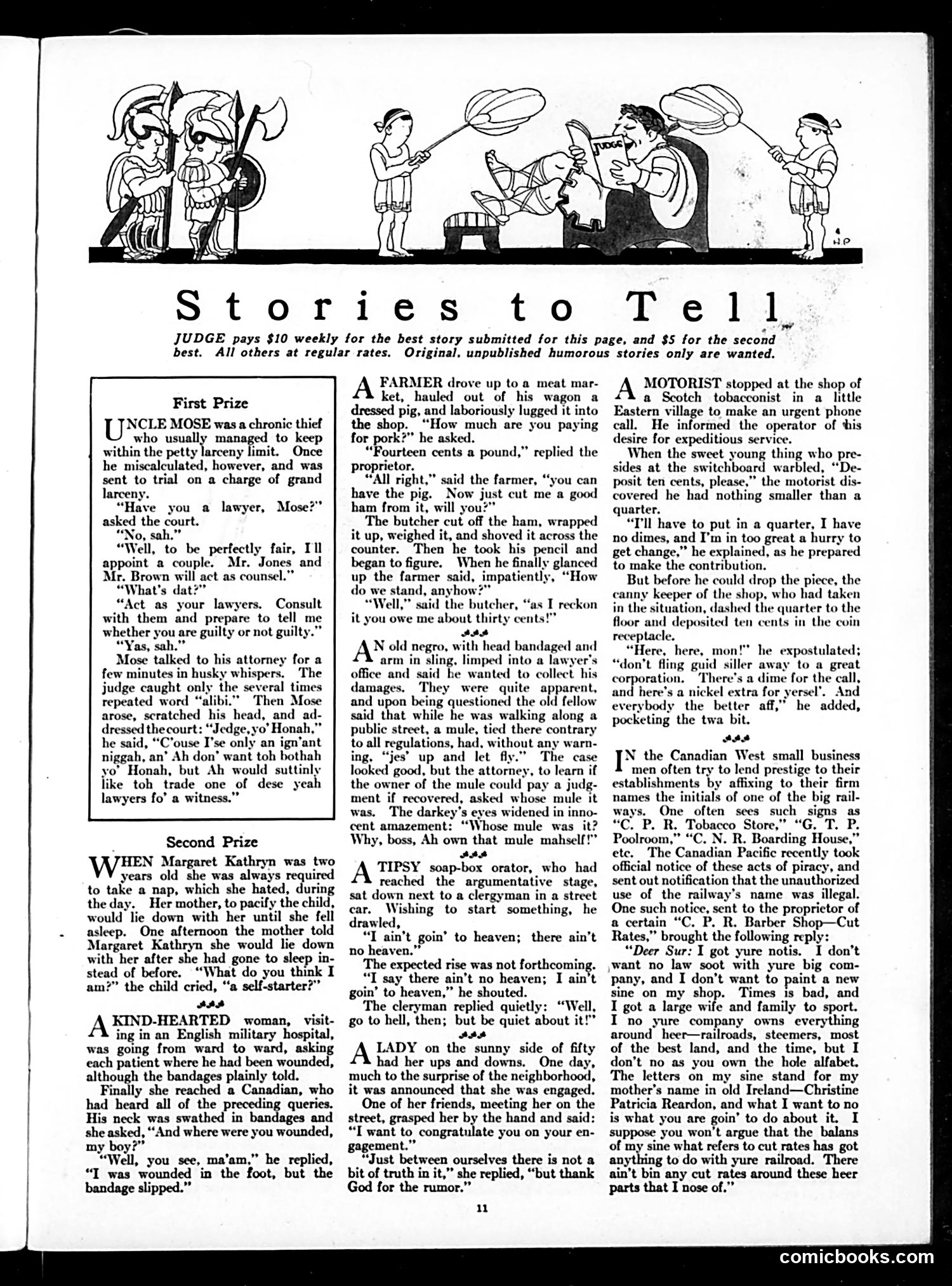
This is a humor submission page from Judge magazine, offering cash prizes for short jokes. The content reflects early 20th-century American attitudes through several crude racial caricatures and stereotypes. The stories use dialect and offensive racial language to depict Black characters as intellectually inferior or foolish—a common comedic trope of the era. "Uncle Mose" wants to trade his lawyer for a witness; an old Black man sues over being kicked by a mule he himself owns, not recognizing the absurdity. Other jokes target women (a child's logic about naps) and religious figures (a drunk heckler silenced by a clergyman's comeback). A farmer attempts to profit by selling a pig for less than its butchered parts cost. **For modern readers:** These jokes rely entirely on ethnic and gender stereotypes that were considered acceptable entertainment in early 20th-century America. They reveal period attitudes toward race, intellect, and social hierarchies rather than offering genuine humor or insight.
📄 Transcribed text from this page (OCR, searchable)
Machine-transcribed from the original scan — historical spelling and the odd misread are preserved.
Stor ies to Tell JUDGE pays $10 weekly for the best story submitted for this page, and $5 for the second best. First Prize NCLE MOSE was a chronic thief who usually managed to keep within the petty larceny limit. Once he miscalculated, however, and was sent to trial on a charge of grand larceny. “Have you a lawyer, Mose?” asked the court. “No, sah.” “Well, to be perfectly fair, Ill appoint a couple. Mr. Jones and Mr. Brown will act as counsel.” “What's dat?” “Act as your lawyers. Consult with them and prepare to tell me whether you are guilty or not guilty.” “Yas, sah. Mose talked to his attorney for a few minutes in husky whispers. The judge caught only the several times repeated word “alibi.” Then Mose arose, scratched his head, and ad- dressed the court: “Jedge,yo’ Honah,” he said, “C’ouse Ise only an ign’ant niggah, an’ Ah don’ want toh bothah yo’ Honah, but Ah would suttinly like toh trade one of dese yeah lawyers fo’ a witness.” Second Prize WEEN Margaret Kathryn was two years old she was always required to take a nap, which she hated, during theday. Her mother, to pacify the child, would lie down with her until she fell asleep. One afternoon the mother told Margaret Kathryn she would lie down with her after she had gone to sleep in- stead of before. ‘‘What do you think I am?” the child cried, “a self-starter?” Raed KIN Dasa emer Sore ing in an English military ital, was going from ward to ward, asking each patient where he had been wounded, although the bandages plainly told. Finally she reached a Canadian, who had heard all of the preceding queries. His neck was swathed in bandages and she asked, “‘And where were you wounded, my boy?” “Well, you see, ma’am,” he replied, “I was wounded in the foot, but the bandage slipped.” All others at regular rates. FARMER drove up to a meat mar- ket, hauled out of his wagon a dressed pig, and laboriously lugged it into the shop. “How much are you paying for pork?” he asked. “Fourteen cents a pound,” replied the proprietor. “All right,” said the farmer, “you can have the pig. Now just cut me a good ham from it, will you?” The butcher cut off the ham, wrapped it up, weighed it, and shoved it across the counter. Then he took his pencil and began to figure. When he finally glanced up the farmer said, impatiently, “How do we stand, anyhow?” “Well,” said the butcher, “as I reckon it you owe me about thirty cents!” ory AN old negro, with head bandaged and arm in sling, limped into a lawyer's office and said he wanted to collect his damages, They were quite apparent, and upon being questioned the old fellow said that while he was walking along a public street, a mule, tied there contrary to all regulations, had, without any warn- ing, “jes’ up and let fly.” The case looked good, but the attorney, to learn if the owner of the mule could pay a judg- ment if recovered, asked whose mule it was. The darkey’s eyes widened in inno- cent amazement: “Whose mule was it? Why, boss, Ah own that mule mahself!” pas TIPSY soap-box orator, who had reached the argumentative stage, sat down next to a clergyman in a street car. Wishing to start something, he drawled, “I ain’t goin’ to heaven; there ain’t no heaven.” The expected rise was not forthcoming. “T say there ain’t no heaven; I ain’t goin’ to heaven,” he shouted. The cleryman replied quietly: ‘Well, go to hell, then; but be quiet about it!” ery A LADY on the sunny side of fifty had her ups and downs. One day, much to the surprise of the neighborhood, it was announced that she was engaged. One of her friends, meeting her on the street, grasped her by the hand and said: “I want to congratulate you on your en- gagement.” “Just between ourselves there is not a bit of truth in it,” she replied, “but thank God for the rumor.” ul Original, unpublished humorous stories only are wanted. MOTORIST stopped at the shop of 4% a Scotch tobacconist in a little Eastern village to make an urgent phone call. He informed the operator of tis desire for expeditious service. When the sweet young thing who pre- sides at the switchboard warbled, “De- posit ten cents, please,” the motorist dis- covered he had nothing smaller than a quarter. “Tl have to put in a quarter, I have no dimes, and I’m in too great a hurry to get change,” he explained, as he prepared to make the contribution. But before he could drop the piece, the canny keeper of the shop, who had taken in the situation, dashed the quarter to the floor and deposited ten cents in the coin receptacle. “Here, here, mon! he expostulated; “don’t fling guid siller away to a great corporation. ‘There’s a dime for the call, and here’s a nickel extra for yersel’.. And everybody the better aff,” he added, pocketing the twa bit. AAD N the Canadian West small business men often try to lend prestige to their establishments by affixing to their firm names the initials of one of the big rail- ways. One often sees such signs as “C. P. R. Tobacco Store,” “G. T. P. Poolroom,” “C, N. R. Boarding House,” ete. The Canadian Pacific recently took official notice of these acts of piracy, and sent out notification that the unauthorized use of the railway’s name was illegal. One such notice, sent to the proprietor of a certain “C. P. R. Barber Shop—Cut Rates,” brought the following reply: “Deer Sur: I got yure notis. I don’t want no law soot with yure big com- pany, and I don’t want to paint a new sine on my shop. Times is bad, and I got a large wife and family to sport. I no yure company owns everything around heer—railroads, steemers, most of the best land, and the time, but I don’t no as you own the hole alfabet. The letters on my sine stand for my mother’s name in old Ireland—Christine Patricia Reardon, and what I want to no is what you are goin’ to do about it. I suppose you won't argue that the balans of my sine what refers to cut rates has got anything to do with yure railroad. There ain’t bin any cut rates around these heer parts that I nose of.” comicbooks.com