
Judge, 1922-07-01 · page 11 of 36
Judge — July 1, 1922 — page 11: what you’re looking at
What you’re looking at
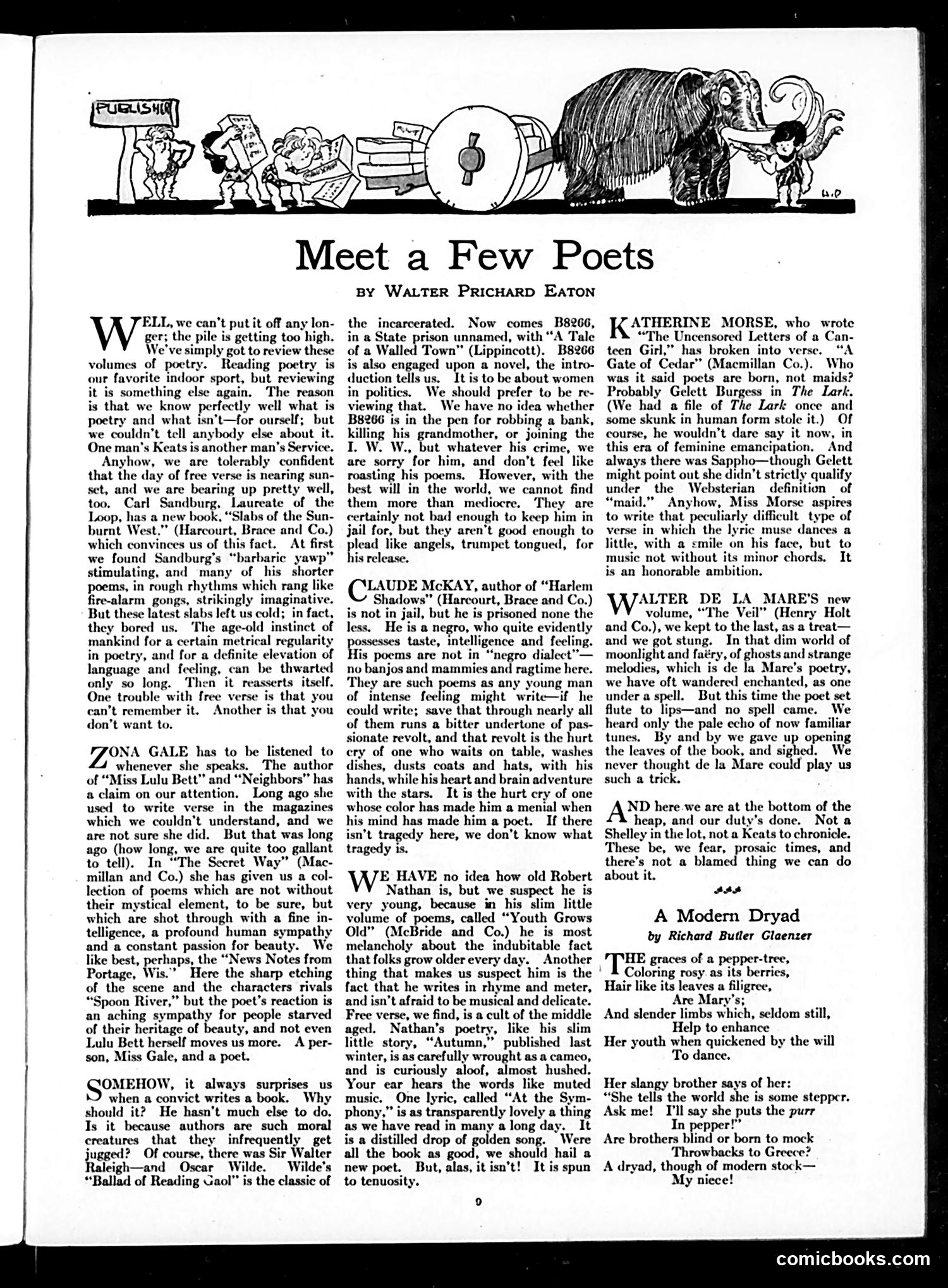
This article reviews contemporary poetry collections, offering satirical literary criticism typical of Judge magazine's cultural commentary. **Key subjects and points:** - **Carl Sandburg**: Criticized for "free verse"—the reviewer finds his latest work ("Slabs of the Sunburnt West") boring, suggesting free verse's popularity is fading and readers prefer traditional meter and "elevation of language." - **Zona Gale**: Praised for intelligence and "profound human sympathy," particularly her poem "News Notes from Portage, Wis." capturing small-town life with emotional depth. - **Prisoner B8266**: A convict publishing "A Tale of a Walled Town"; the reviewer sympathizes with his circumstances but finds his poetry merely mediocre—neither bad enough to justify imprisonment nor good enough to earn release. - **Claude McKay**: A Black poet ("Harlem Shadows") writing serious, non-stereotypical verse without "banjos and mammies and ragtime," expressing "bitter undertone of passionate revolt." The satire gently mocks both the difficulty of poetry reviewing and contemporary literary fashions while acknowledging genuine artistic merit.
📄 Transcribed text from this page (OCR, searchable)
Machine-transcribed from the original scan — historical spelling and the odd misread are preserved.
Meet a Few Poets ELL, we can't put it off any lon- ger; the pile is getting too high. We've simply got to review these volumes of poetry. Reading poetry is our favorite indoor sport, but reviewing it is something else again. The reason is that we know perfectly well what is poetry and what isn’t—for ourself; but we couldn’t tell anybody else about it. One man’s Keats is another man’s Service. Anyhow, we are tolerably confident that the day of free verse is nearing sun- set, and we are bearing up pretty well, too, Carl Sandburg, Laureate of the Loop, has a new book, “Slabs of the Sun- burnt West,” (Harcourt, Brace and Co.) which convinces us of this fact. At first we found Sandburg’s “barbaric yawp” stimulating, and many of his shorter poems, in rough rhythms which rang like fire-alarm gongs, strikingly imaginative. But these latest slabs left us cold; in fact, they bored us. The age-old instinct of mankind for a certain metrical regularity in poetry, and for a definite elevation of language and feeling, can be thwarted only so long. Then it reasserts itself. One trouble with free verse is that you can’t remember it. Another is that you don’t want to. ‘ONA GALE has to be listened to whenever she speaks. The author of “Miss Lulu Bett” and “Neighbors” has a claim on our attention. Long ago she used to write verse in the magazines which we couldn't understand, and we are not sure she did. But that was long ago (how long, we are quite too gallant to tell). In “The Secret Way” (Mac- millan and Co.) she has given us a col- lection of poems which are not without their mystical element, to be sure, but which are shot through with a fine in- telligence, a profound human sympathy and a constant passion for beauty. We like best, perhaps, the “News Notes from Portage, Wis.’ Here the sharp etching of the scene and the characters rivals “Spoon River,” but the poet's reaction is an aching sympathy for people starved of their heritage of beauty, and not even Lulu Bett herself moves us more. A per- son, Miss Gale, and a poet. OMEHOW, it always surprises us \J when a convict writes a book. Why should it? He hasn't much else to do. Is it because authors are such moral creatures that they infrequently get jugged? Of course, there was Sir Walter leigh—and Oscar Wilde. Wilde's “Ballad of Reading Gaol” is the classic of BY WALTER PRICHARD EATON the incarcerated. Now comes B8266, in a State prison unnamed, with “A Tale of a Walled Town” (Lippincott). B8266 is also engaged upon a novel, the intro- duction tells us. It is to be about women in politics. We should prefer to be re- viewing that. We have no idea whether B8266 is in the pen for robbing a bank, killing his grandmother, or joining the I. W. W., but whatever his crime, we are sorry for him, and don’t feel like roasting his poems. However, with the best will in the world, we cannot find them more than mediocre. They are certainly not bad enough to keep him in jail for, but they aren’t good enough to plead like angels, trumpet tongued, for his release, LAUDE McKAY, author of “Harlem Shadows” (Harcourt, Brace and Co.) is not in jail, but he is prisoned none the less. He is a negro, who quite evidently pe ses taste, intelligence and feeling. jis poems are not in “negro dialect”. no banjos and mammies and ragtime here. They are such poems as any young man of intense feeling might write—if he could write; save that through nearly all of them runs a bitter undertone of pas- sionate revolt, and that revolt is the hurt cry of one who waits on table, washes dishes, dusts coats and hats, with his hands, while his heart and brain adventure with the stars. It is the hurt cry of one whose color has made him a menial when his mind has made him a poet. If there isn’t tragedy here, we don’t know what tragedy is. 'E HAVE no idea how old Robert Nathan is, but we suspect he is very young, because in his slim little volume of poems, called “Youth Grows Old” (McBride and Co.) he is most melancholy about the indubitable fact that folks grow older every day. Another thing that makes us suspect him is the ' fact that he writes in rhyme and meter, and isn’t afraid to be musical and delicate. Free verse, we find, is a cult of the middle aged. Nathan’s poetry, like his slim little story, “Autumn,” published last winter, is as carefully wrought as a cameo, and is curiously aloof, almost hushed. Your ear hears the words like muted music. One lyric, called “At the Sym- phony,” is as transparently lovely a thing as we have read in many a long day. It is a distilled drop of golden song. Were all the book as good, we should hail a new poet. But, alas, it isn’t! It is spun to tenuosity. 9 ATHERINE MORSE, who wrote “The Uncensored Letters of a Can- teen Girl,” has broken into verse. “A Gate of Cedar” (Macmillan Co.). Who was it said pocts are born, not maids? Probably Gelett Burgess in The Lark. (We had a file of The Lark once and some skunk in human form stole it.) Of course, he wouldn’t dare say it now, in this era of feminine emancipation. And always there was Sappho—though Gelett might point out she didn’t strictly qualify under the Websterian definition _ of “maid.” Anyhow, Miss Morse aspires to write that peculiarly difficult. type of in which the lyric muse dances a . with a smile on his face, but to music not without its minor chords, It is an honorable ambition, W53LTER DE LA MARE'S new volume, “The Veil” (Henry Holt and Co.), we kept to the last, as a treat— and we got stung. In that dim world of moonlight and faéry, of ghosts and strange melodies, which is de la Mare’s poetry, we have oft wandered enchanted, as one under a spell. But this time the poet set flute to lips—and no spell came. We heard only the pale echo of now familiar tunes. By and by we gave up opening the leaves of the book, and sighed. We never thought de la Mare could play us such a trick, ND here.we are at the bottom of the heap, and our duty’s done. Not a Shelley in the lot, not a Keats to chronicle. These be, we fear, prosaic times, and there’s not a blamed thing we can do about it. sas A Modern Dryad by Richard Butler Glaenzer TH graces of a pepper-tree, Coloring rosy as its berries, Hair like its leaves a filigree, Are Mary’ And slender limbs which, seldom still, Help to enhance Her youth when quickened by the will To dance. Her slangy brother says of her: “She tells the world she is some steppcr. Ask me! I'll say she puts the purr rf” Are brothers blind or born to mock Throwbacks to Greece? A dryad, though of modern stock— My niece! comicbooks.com