
Judge, 1922-07-01 · page 24 of 36
Judge — July 1, 1922 — page 24: what you’re looking at
What you’re looking at
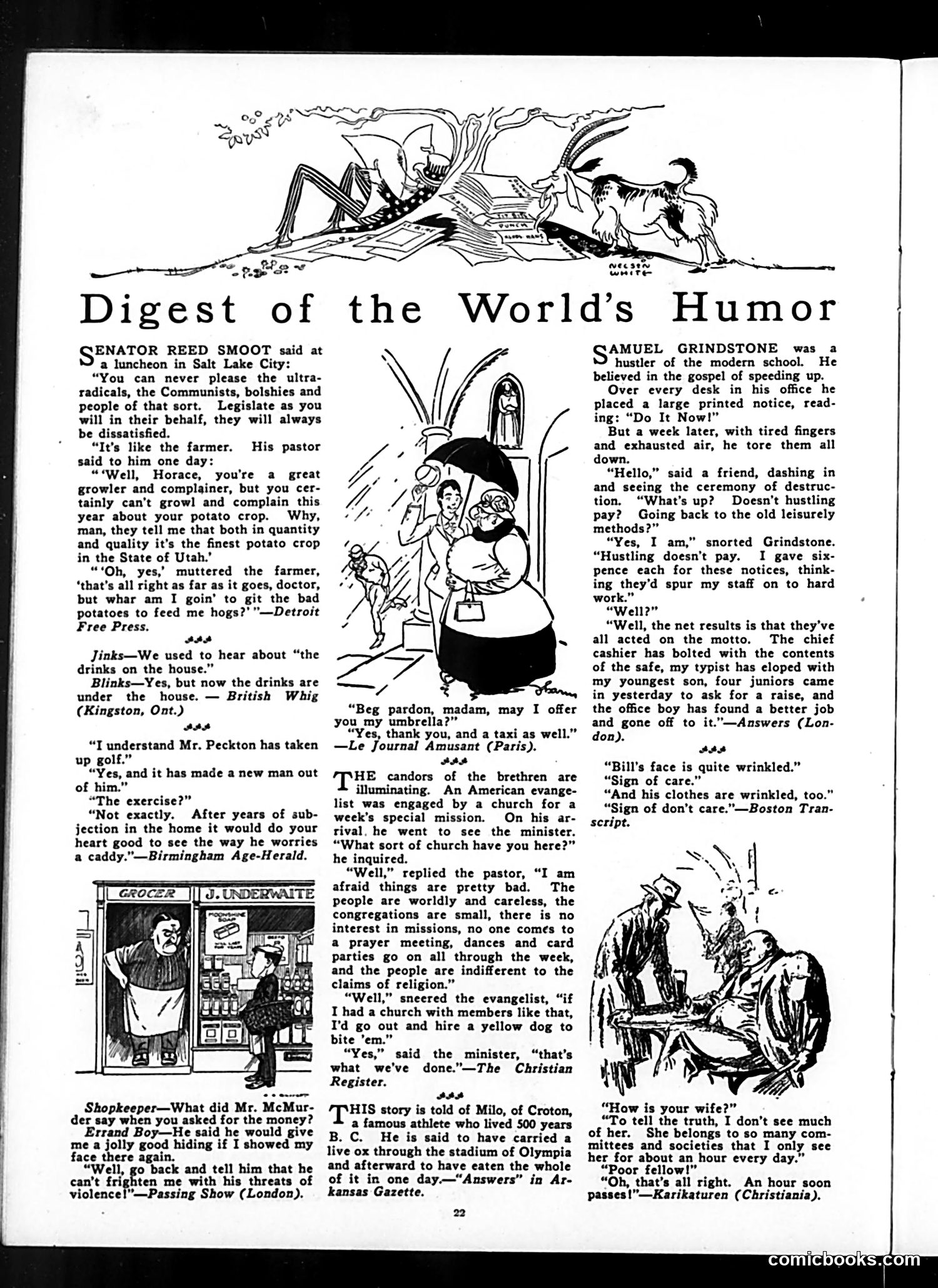
This page collects brief humorous anecdotes from various sources, representing early 20th-century satirical humor. Key pieces include: **Senator Reed Smoot's farmer parable** satirizes perpetual complainers—even when circumstances improve, they find new grievances (the farmer unhappy despite excellent potatoes). **The Grindstone story** mocks corporate "hustle" culture and motivational signs ("Do It Now!"). When employees actually follow the directive, chaos ensues: embezzlement, elopement, salary demands. The satire targets overzealous efficiency movements that backfire. **The evangelist anecdote** uses dark humor about a self-righteous preacher who suggests hiring a dog to bite church members—only to learn the pastor already has, implying the congregation deserves such punishment. Minor jokes address Prohibition ("drinks under the house") and marital discord. The cartoons appear to show a giant grasshopper and domestic scenes, though their specific satirical targets are unclear without captions.
📄 Transcribed text from this page (OCR, searchable)
Machine-transcribed from the original scan — historical spelling and the odd misread are preserved.
Digest of the World’s Humor ENATOR REED SMOOT said at a luncheon in Salt Lake City: “You can never please the ultra- radicals, the Communists, bolshies and people of that sort. Legislate as you will in their behalf, they will always be dissatisfied. “It’s like the farmer. said to him one day: “Well, Horace, you're a great growler and complainer, but you cer- tainly can’t growl and complain this year about your potato crop. Why, man, they tell me that both in quantity and quality it’s the finest potato crop in the State of Utah.’ “‘Oh, yes,’ muttered the farmer, ‘that’s all right as far as it goes, doctor, but whar am I goin’ to git the bad potatoes to feed me hogs?’ "—Detroit Free Press. His pastor sae Jinks—We used to hear about “the drinks on the house.” Blinks—Yes, but now the drinks are under the house. — British Whig (Kingston, Ont.) fae “I understand Mr. Peckton has taken ind it has made a new man out “The exercise?” “Not exactly. After years of sub- jection in the home it would do your heart good to see the way he worries a caddy."—Birmingham Age-Herald. Shopkeeper—What did Mr. McMur- der say when you asked for the money? Errand Boy—He said he would give me a jolly good hiding if I showed my face there again. “Well, f° back and tell him that he can’t frighten me with his threats of violence!”"—Passing Show (London). “Beg pardon, madam, may I offer you my umbrella?” “Yes, thank you, and a taxi as well.” —Le Journal Amusant (Paris). AAs HE candors of the brethren are illuminating. An American evange- list was engaged by a church for a week's special mission. On his ar- rival, he went to see the minister. “What sort of church have you here?” he inquired. “Well,” replied the pastor, “I am afraid things are pretty bad. The people are worldly and careless, the congregations are small, there is no interest in missions, no one comes to a prayer meeting, dances and card parties go on all through the week, and the people are indifferent to the claims of religion.” “Well,” sneered the evangelist, “if T had a church with members lik: at, I'd go out and hire a yellow dog to bite ’em.” “Yes,” said the minister, “that’s what we've done.”"—The Christian Register. pss THs story is told of Milo, of Croton, a famous athlete who lived 500 years B.C. He is said to have carried a live ox through the stadium of Olympia and afterward to have eaten the whole of it in one day.—“Answers” in Ar- kansas Gazette. 22 AMUEL GRINDSTONE was a hustler of the modern school. He believed in the gospel of speeding up. Over every desk in his office he placed a large printed notice, read- ing: “Do It Now!” But a week later, with tired fingers and exhausted air, he tore them all down. “Hello,” said a friend, dashing in and seeing the ceremony of destruc- tion. “What’s up? Doesn't hustling pay? Going back to the old leisurely methods?” “Yes, I am,” snorted Grindstone. “Hustling doesn’t pay. I gave six- pence each for these notices, think- ing they’d spur my staff on to hard “Well?” “Well, the net results is that they've all acted on the motto. The chief cashier has bolted with the contents of the safe, my typist has eloped with my youngest son, four juniors came in yesterday to ask for a raise, and the office boy has found a better job and gone off to it."—Answers (Lon- don). HAs “Bill’s face is quite wrinkled.” “Sign of care.” “And his clothes are wrinkled, too.” “Sign of don’t care.”"—Boston Tran- script. “How is your wife?” “To tell the truth, I don’t see much of her. She belongs to so many com- mittees and societies that I only see her for about an hour every day.” “Poor fellow!” “Oh, that’s all right. An hour soon passes !"—Karikaturen (Christiania),