
Judge, 1922-07-01 · page 16 of 36
Judge — July 1, 1922 — page 16: what you’re looking at
What you’re looking at
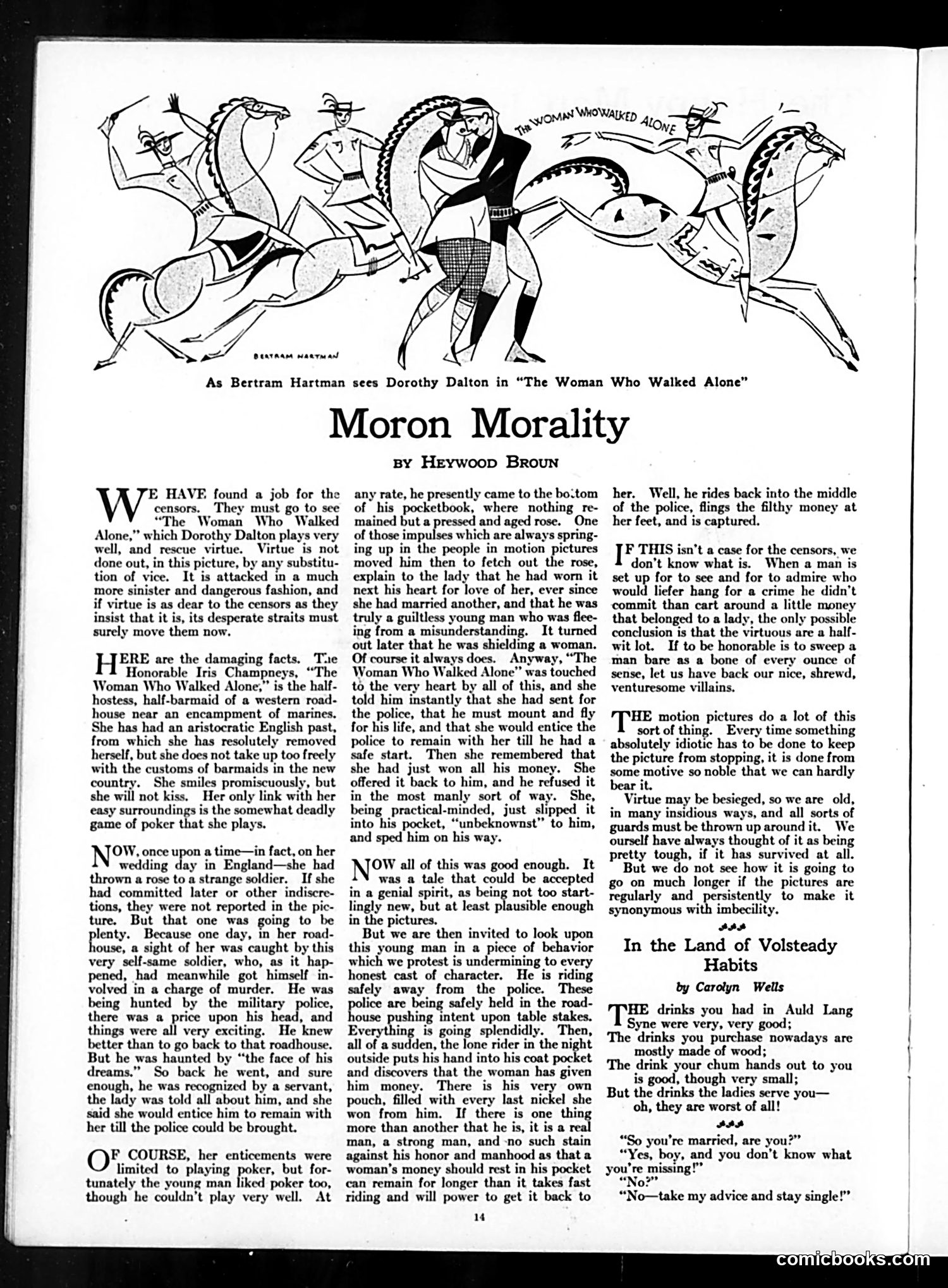
This is a film review by Heywood Broun critiquing the 1927 silent film "The Woman Who Walked Alone" starring Dorothy Dalton. The cartoon illustration shows Hartman's exaggerated, Art Deco-style interpretation of the film's dramatic moments. Broun's satire targets film censors, challenging their selective morality. He describes a melodrama where a virtuous barmaid helps a fugitive soldier escape police—an act of mercy. However, Broun sarcastically notes that when the soldier subsequently fails to return money she secretly placed in his pocket, this constitutes "moron morality"—he prioritizes masculine pride over practical honesty. The satire's point: censors obsess over surface virtue while missing actual moral failures. Broun suggests their standards are hypocritical and shallow, focusing on propriety rather than genuine ethical behavior.
📄 Transcribed text from this page (OCR, searchable)
Machine-transcribed from the original scan — historical spelling and the odd misread are preserved.
tarnan Manrmad As Bertram Hartman sees Dorothy Dalton in “The Woman Who Walked Alone” Moron Morality E HAVF. found a job for the censors. They must go to see “The Woman Who Walked Alone,” which Dorothy Dalton plays very well, and rescue virtue. Virtue is not done out, in this picture, by any substitu- tion of vice. It is attacked in a much more sinister and dangerous fashion, and if virtue is as dear to the censors as they insist that it is, its desperate straits must surely move them now, HERE are the damaging facts, Tue Honorable Iris Champneys, “The Woman Who Walked Alone,” is the half- hostess, half-barmaid of a western road- house near an encampment of marines. She has had an aristocratic English past, from which she has resolutely removed herself, but she does not take up too freely with the customs of barmaids in the new country. She smiles promiscuously, but she will not kiss. Her only link with her easy surroundings is the somewhat deadly game of poker that she plays. NW, once upon a time—in fact, on her wedding day in England—she had thrown a rose to a strange soldier. If she had committed later or other indiscre- tions, they were not reported in the pic- ture. But that one was going to be plenty. Because one day, in her road- house, a sight of her was caught by this very self-same soldier, who, as it hap- pened, had meanwhile got himself in- volved in a charge of murder. He was being hunted by the military police, there was a price upon his head, and things were all very exciting. He knew better than to go back to that roadhouse. But he was haunted by “the face of his dreams,” So back he went, and sure enough, he was recognized by a servant, the lady was told all about him, and she said she would entice him to remain with her till the police could be brought. F COURSE, her enticements were limited to playing poker, but for- tunately the young man liked poker too, though he couldn’t play very well. At By Hreywoop Broun any rate, he presently came to the bo:tom of his pocketbook, where nothing re- mained but a pressed and aged rose. One of those impulses which are always spring- ing up in the people in motion pictures moved him then to fetch out the rose, explain to the lady that he had worn it next his heart for love of her, ever since she had married another, and that he was truly a guiltless young man who was flee- ing from a misunderstanding. It turned out later that he was shielding a woman. Of course it always does. Anyway, “The Woman Who Walked Alone” was touched to the very heart by all of this, and she told him instantly that she had sent for the police, that he must mount and fly for his life, and that she would entice the police to remain with her till he had a safe start. Then she remembered that she had just won all his money. She offered it back to him, and he refused it in the most manly sort of way. She, being practical-minded, just slipped_ it into his pocket, “unbeknownst” to him, and sped him on his way. Now all of this was good enough. It was a tale that could be accepted in a genial spirit, as being not too start- lingly new, but at least plausible enough in the pictures. But we are then invited to look upon this young man in a piece of behavior which we protest is undermining to every honest cast of character. He is riding safely away from the police. These pote are being safely held in the road- jouse pushing intent upon table stakes. Everythin is going splendidly. Then, all of a sudden, the lone rider in the night outside puts his hand into his coat pocket and discovers that the woman has given him money. There is his very own pouch, filled with every last nickel she won from him. If there is one thing more than another that he is, it is a real man, a strong man, and -no such stain against his honor and manhood as that a woman’s moncy should rest in his pocket can remain for longer than it takes fast riding and will power to get it back to 4 her. Well, he rides back into the middle of the police, flings the filthy money at her feet, and is captured. F THIS isn’t a case for the censors, we don’t know what is. When a man is set up for to see and for to admire who would liefer hang for a crime he didn’t commit than cart around a little money that belonged to a lady, the only possible conclusion is that the virtuous are a half- wit lot. If to be honorable is to sweep a man bare as a bone of every ounce of sense, let us have back our nice, shrewd, venturesome villains. TH motion pictures do a lot of this sort of thing. Every time something absolutely idiotic has to be done to keep the picture from stopping, it is done from some motive so noble that we can hardly bear it. Virtue may be besieged, so we are old, in many insidious ways, and all sorts of guards must be thrown up around it. We ourself have always thought of it as being pretty tough, if it has survived at all. But we do not see how it is going to go on much longer if the pictures are regularly and persistently to make it synonymous with imbecility. PID In the Land of Volsteady Habits by Carolyn Wells ‘THE. drinks you had in Auld Lang Syne were very, very good; The drinks you purchase nowadays are mostly made of wood; The drink your chum hands out to you is good, though very small; But the drinks the ladies serve you— oh, they are worst of all! SID “So you're married, are you?” “Yes, boy, and you don’t know what you’re missing!” “No?” “No—take my advice and stay single!”