
A complete issue · 36 pages · 1921
Judge — August 20, 1921
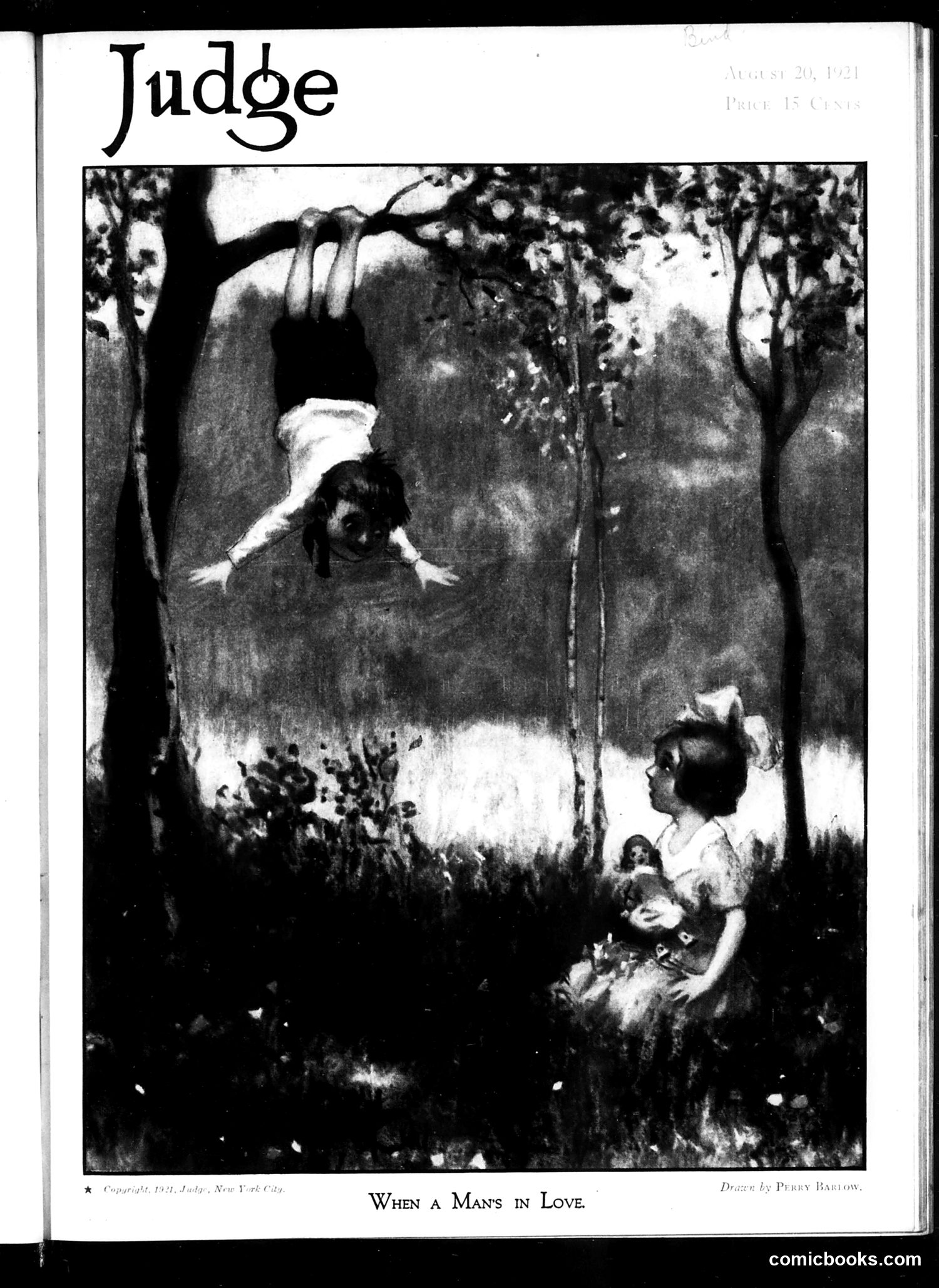
This Judge magazine cover from August 20, 1921 (drawn by Perry Barlow) depicts a romantic woodland scene. A man hangs upside-down from a tree branch while a woman watches below with a child. The title "When a Man's in Love" suggests the image satirizes romantic behavior—specifically, the foolish or undignified antics men supposedly engage in to impress women or entertain children. The upside-down posture emphasizes absurdity and loss of rational judgment. This reflects early 20th-century humor mocking romantic sentimentality and masculine dignity compromised by love or courtship. The woodland setting adds whimsy to what appears to be commentary on how romance makes men behave foolishly or lose their composure.
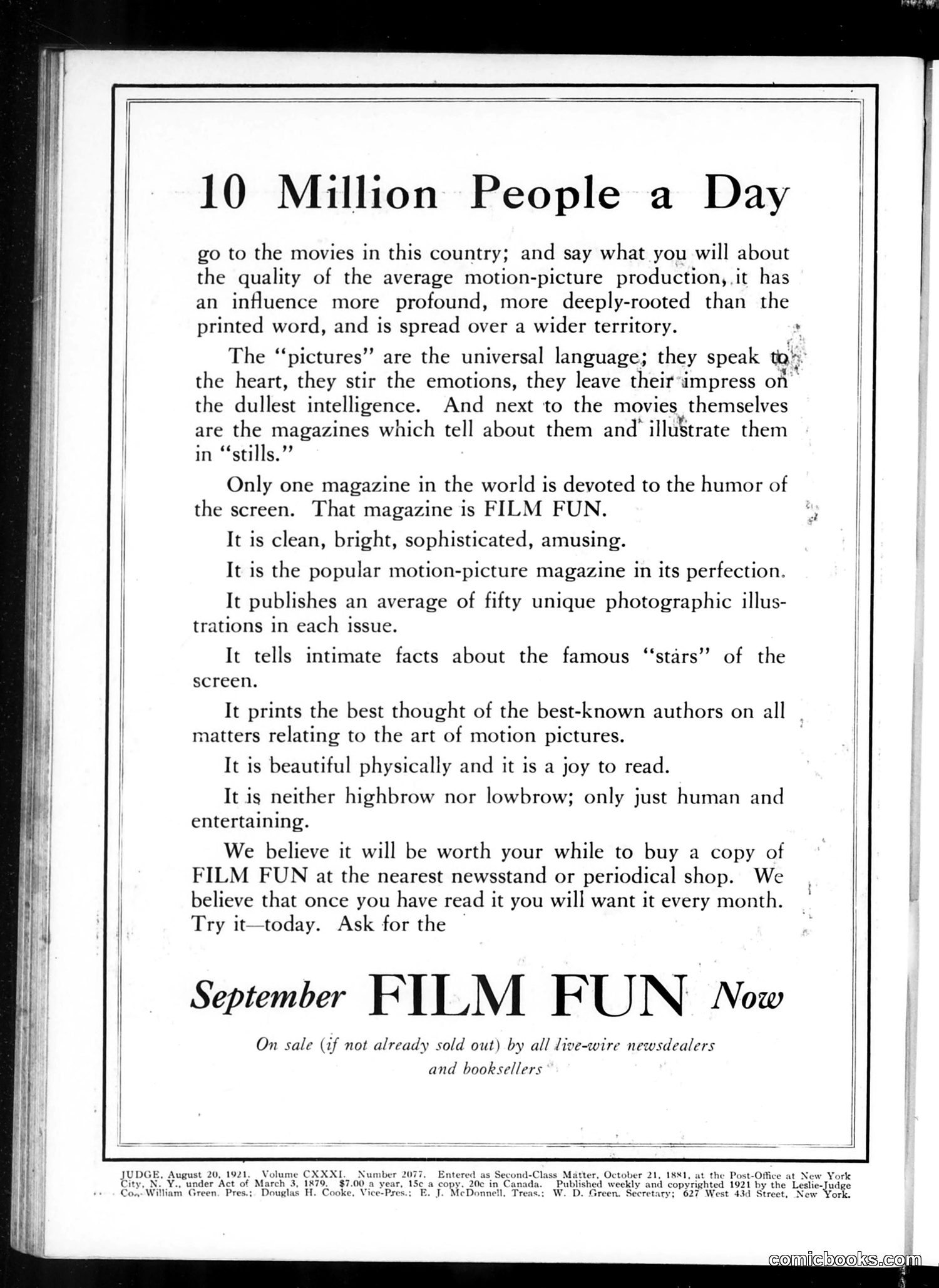
This page is primarily **advertising, not satire or political commentary**. It's a full-page advertisement for *Film Fun* magazine, appearing in *Judge* magazine (August 30, 1921). The ad promotes *Film Fun* as "the only magazine in the world devoted to the humor of the screen," emphasizing its content: humorous film stills, celebrity gossip about movie "stars," and articles by prominent authors about motion pictures. The pitch highlights that cinema reaches "10 Million People a Day" and claims the magazine is sophisticated yet accessible—"neither highbrow nor lowbrow; only just human and entertaining." This reflects the early 1920s film industry's rapid growth and the emergence of fan magazines catering to the enormous popularity of silent movies and movie stars.
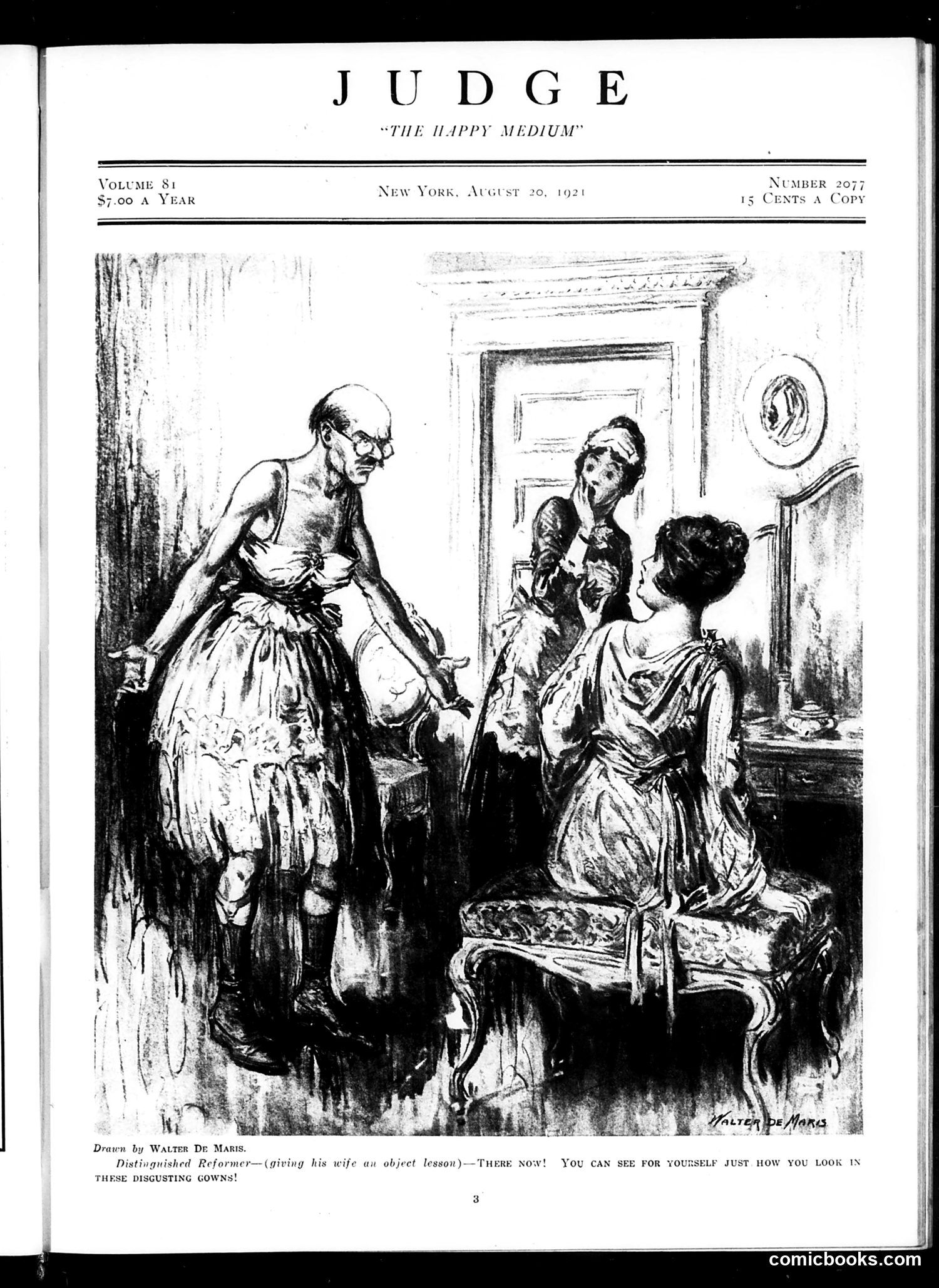
This cartoon by Walter de Maris depicts a domestic dispute about clothing. A thin, disapproving man confronts his wife, showing her what appear to be revealing or scandalous garments. The caption reads: "Distinguished Reformer—(giving his wife an object lesson)—THERE NOW! YOU CAN SEE FOR YOURSELF JUST HOW YOU LOOK IN THESE DISGUSTING GOWNS!" The satire targets a hypocritical "reformer"—likely referencing early 1920s moral crusaders who publicly condemned women's fashion (shorter skirts, looser silhouettes) as immoral while enforcing such standards within their own homes. The cartoon mocks this contradiction: he condemns such clothing as "disgusting" yet compels his wife to wear them as an insulting "object lesson." The humor lies in exposing the reformer's sanctimonious judgment and domestic tyranny.
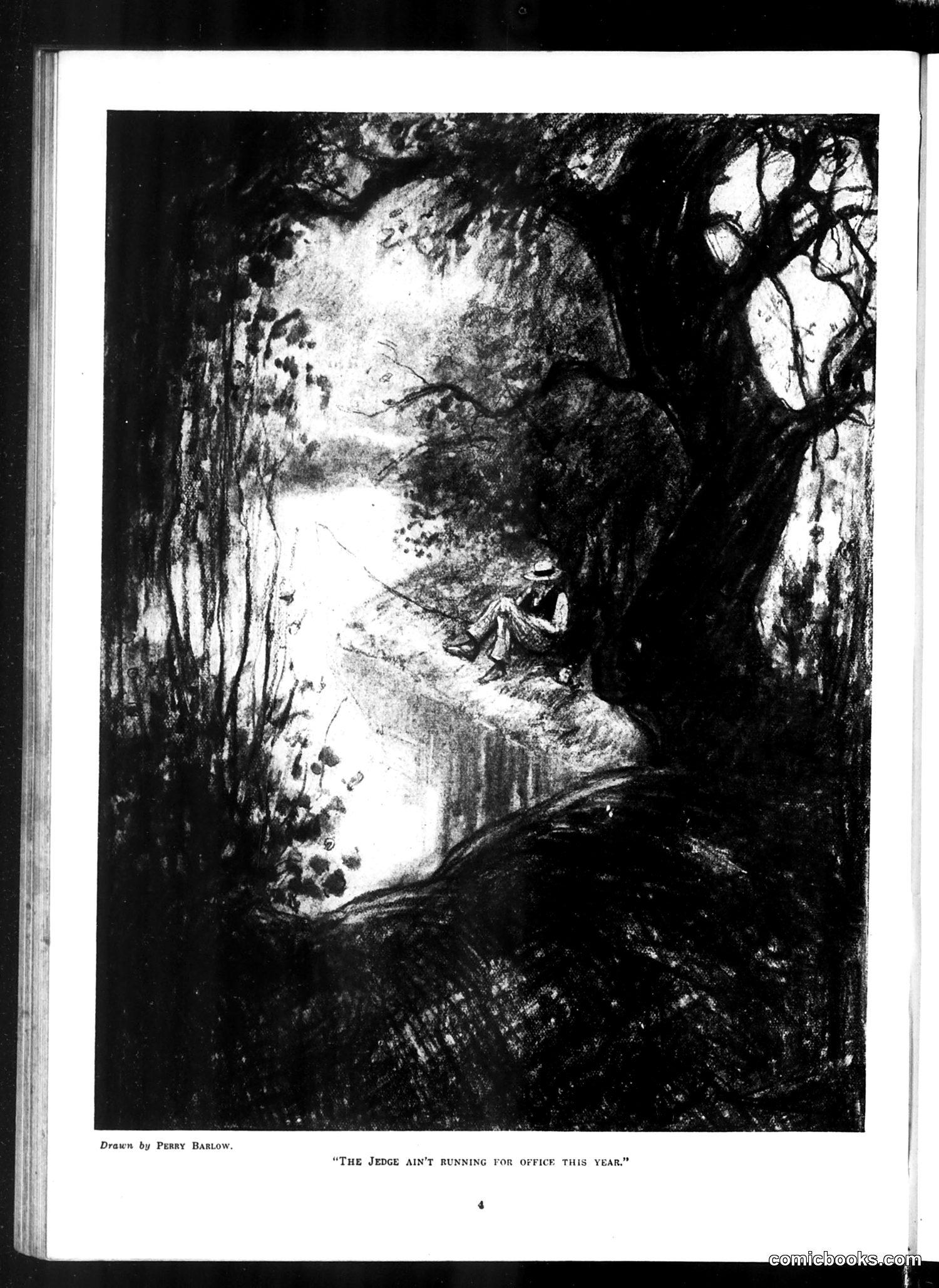
This political cartoon by Perry Barlow depicts a fishing scene where a figure (likely a judge) sits by a stream in a wooded setting. The caption suggests the judge has decided against running for political office during the current election cycle. The satire appears to target the common practice of judges abandoning their judicial duties to campaign for elected positions. By showing the judge peacefully fishing instead—removed from political ambition—Barlow ironically praises this restraint. The rural, serene setting contrasts with the chaos of political campaigns. Without knowing the specific year or which judge is referenced, the cartoon's broader point is clear: *Judge* magazine is applauding a judicial figure's decision to stay out of electoral politics and remain focused on judicial work rather than self-promotion.
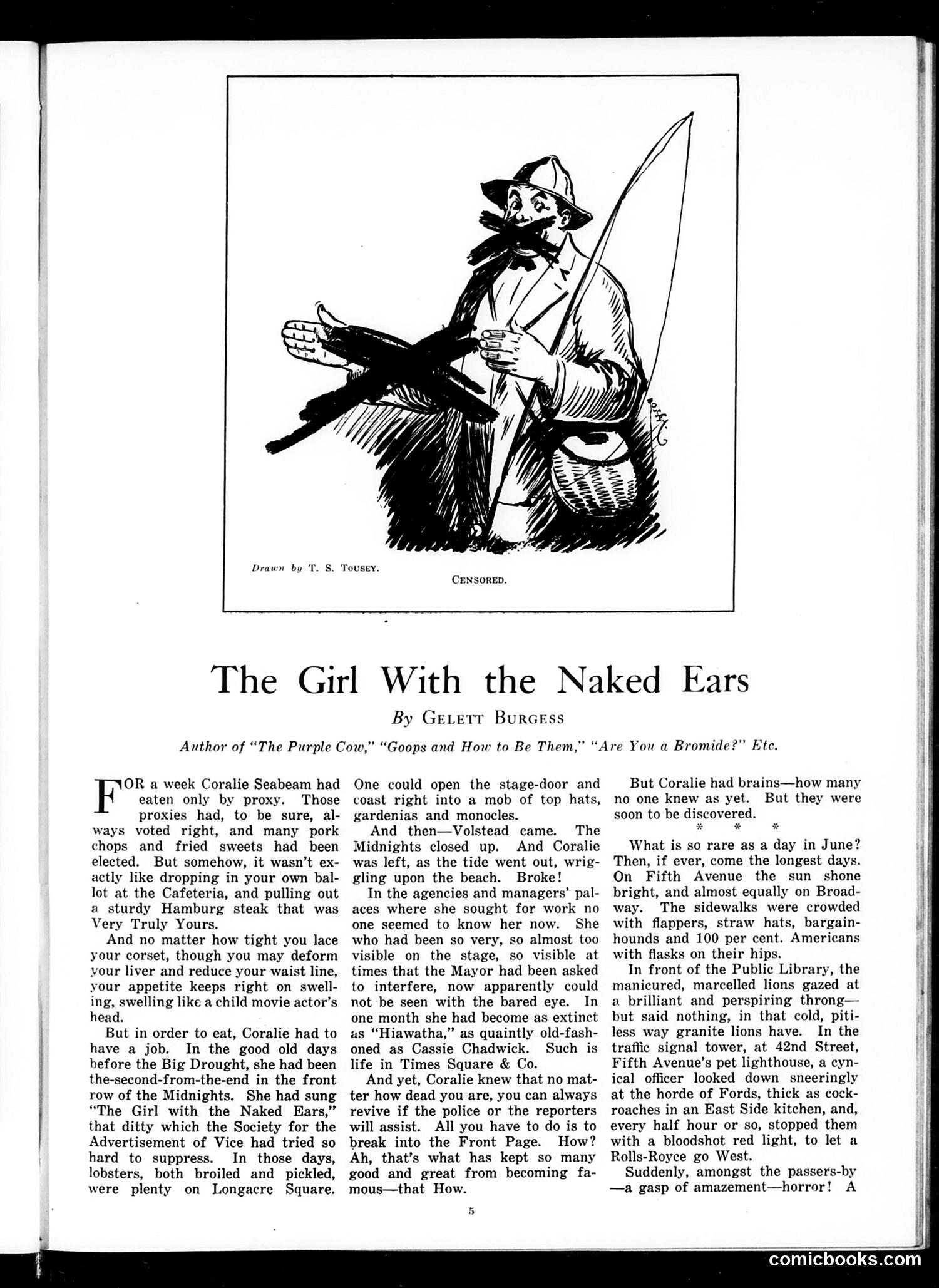
This page presents a short story titled "The Girl With the Naked Ears" by Gelett Burgess, accompanying a cartoon illustration labeled "CENSORED." The cartoon depicts a figure with notably bare ears, holding a fishing rod, with what appears to be censoring marks or black bars obscuring certain content. The caption "CENSORED" suggests the illustration itself was subject to editorial removal or modification. The story describes a struggling actress named Coralie Seabeam working in theater during a period of economic hardship. The narrative references working on Broadway, Times Square, Fifth Avenue, and contemporary social concerns about poverty and employment. The "naked ears" concept appears to be Burgess's satirical commentary on social propriety or appearance standards, though the specific social critique the censorship was meant to highlight remains unclear from the visible text.
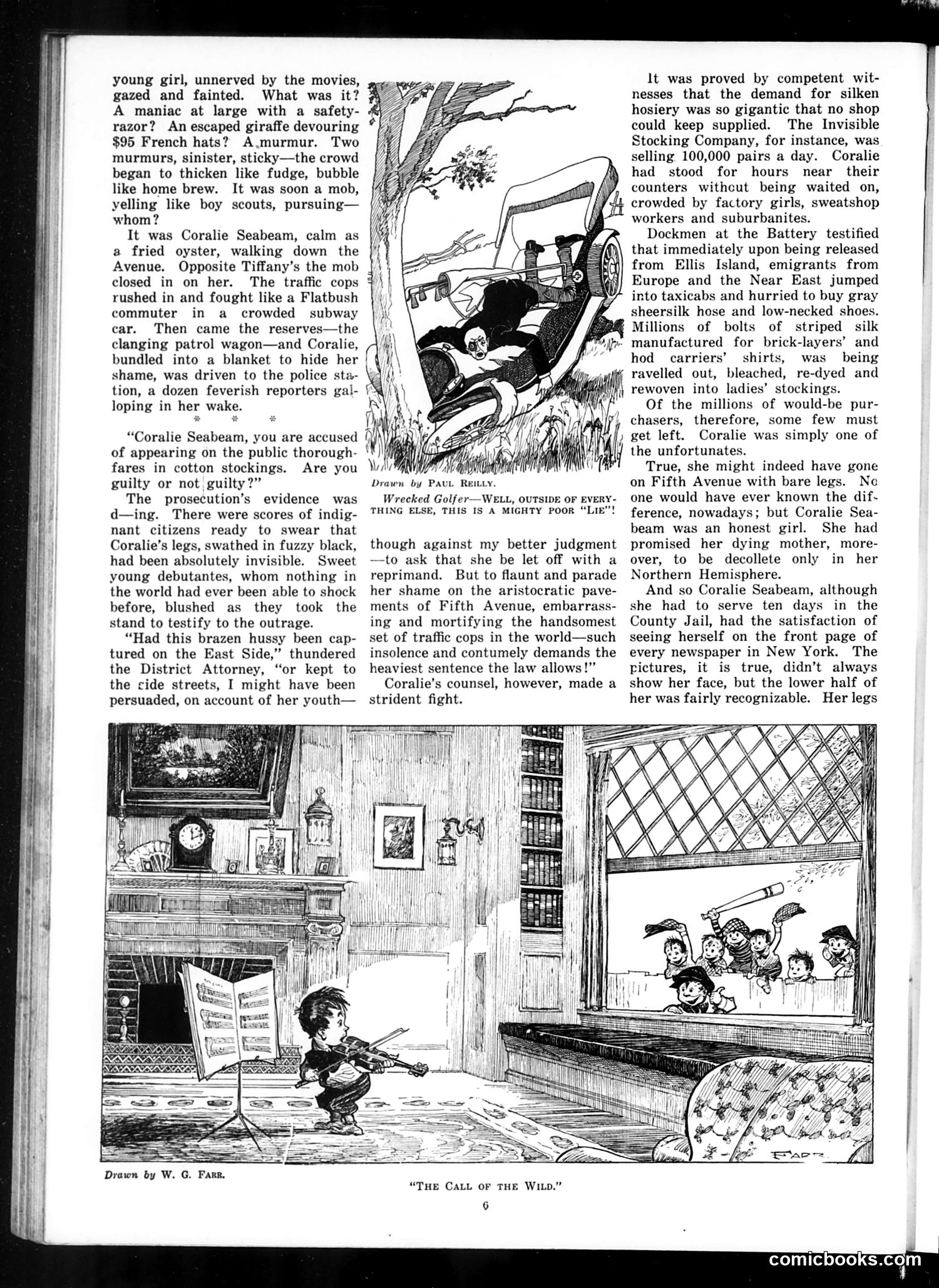
This page satirizes the 1920s fashion for women's silk hosiery through the story of Coralie Seabeam, arrested for indecent exposure on Fifth Avenue. The scandal reveals that women were rolling down their stockings to their ankles to display bare legs—a shocking violation of contemporary modesty standards. The satire targets both the hosiery industry (which created artificial scarcity and massive demand) and working-class women who participated in this trend. The cartoon mocks aristocratic hypocrisy: wealthy citizens expressed outrage while their own servants and factory workers were driving the fashion. The bottom illustration, "The Call of the Wild," humorously depicts children drawn to mischief—paralleling how the "primitive" allure of bare legs supposedly corrupted respectable society.
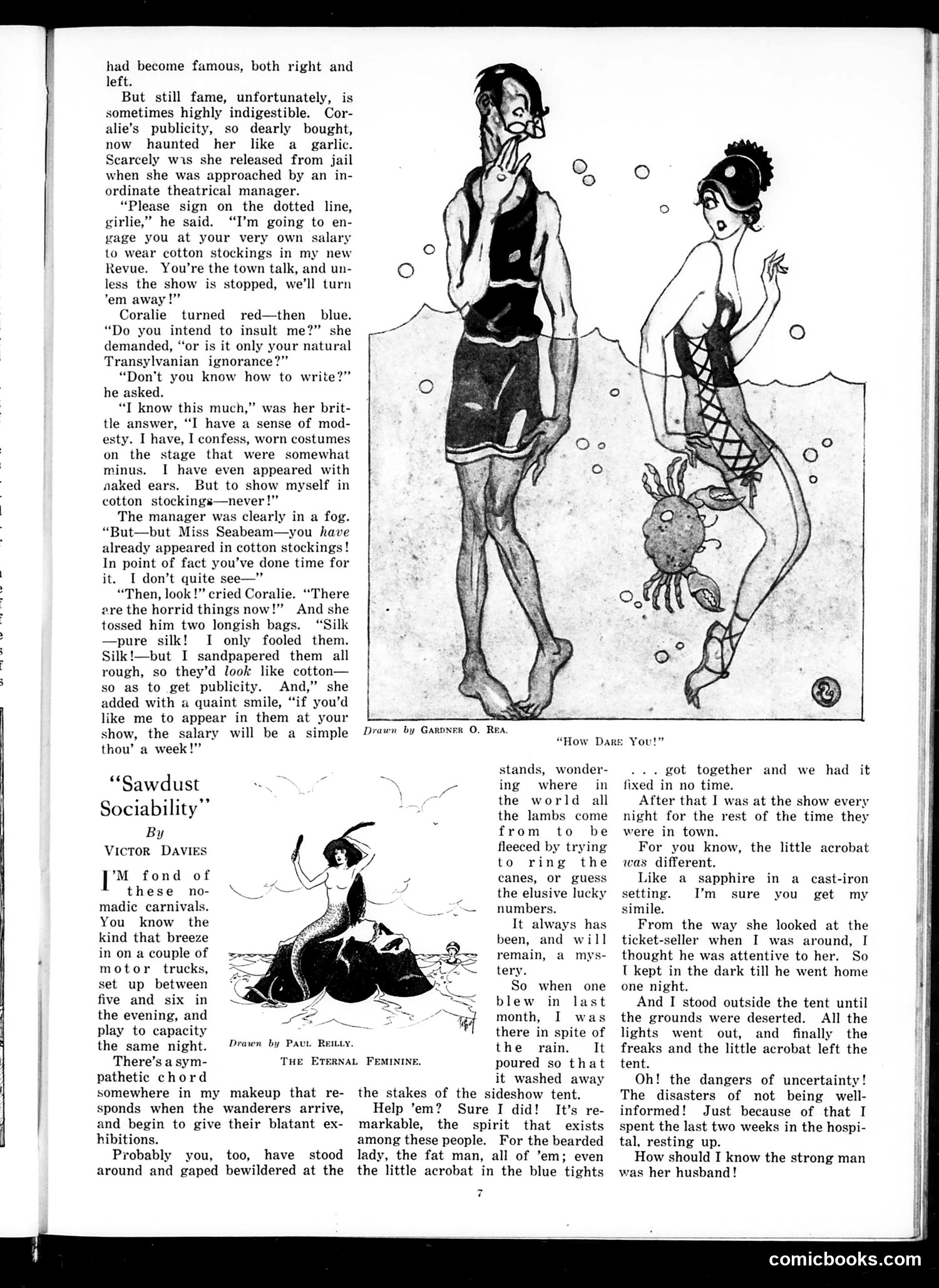
This page contains two separate humorous stories satirizing early 20th-century social pretensions and carnival life. **"How Dare You!"** (top) mocks a theatrical manager's attempt to exploit a woman named Coralie, who has recently gained notoriety (apparently from a jail sentence involving scanty costumes). When he offers her a salary to wear cotton stockings in his revue, she indignantly refuses—not because she's modest, but because she's a *fraud*. She reveals she previously appeared nearly naked while wearing sandpapered silk stockings *disguised* to look like cotton, purely for publicity. The satire targets manufactured celebrity and the absurd contradictions of show-business "respectability." **"Sawdust Sociability"** (bottom) humorously recounts a carnival encounter. The narrator helps stranded carnival performers and becomes infatuated with a young acrobat, assuming a ticket-seller is courting her. He spends two weeks in the hospital after confronting her—only to discover she's the strong man's wife. The joke targets romantic naivety and the dangers of making assumptions without proper information. Both pieces mock social pretense and human folly through exaggerated situations.
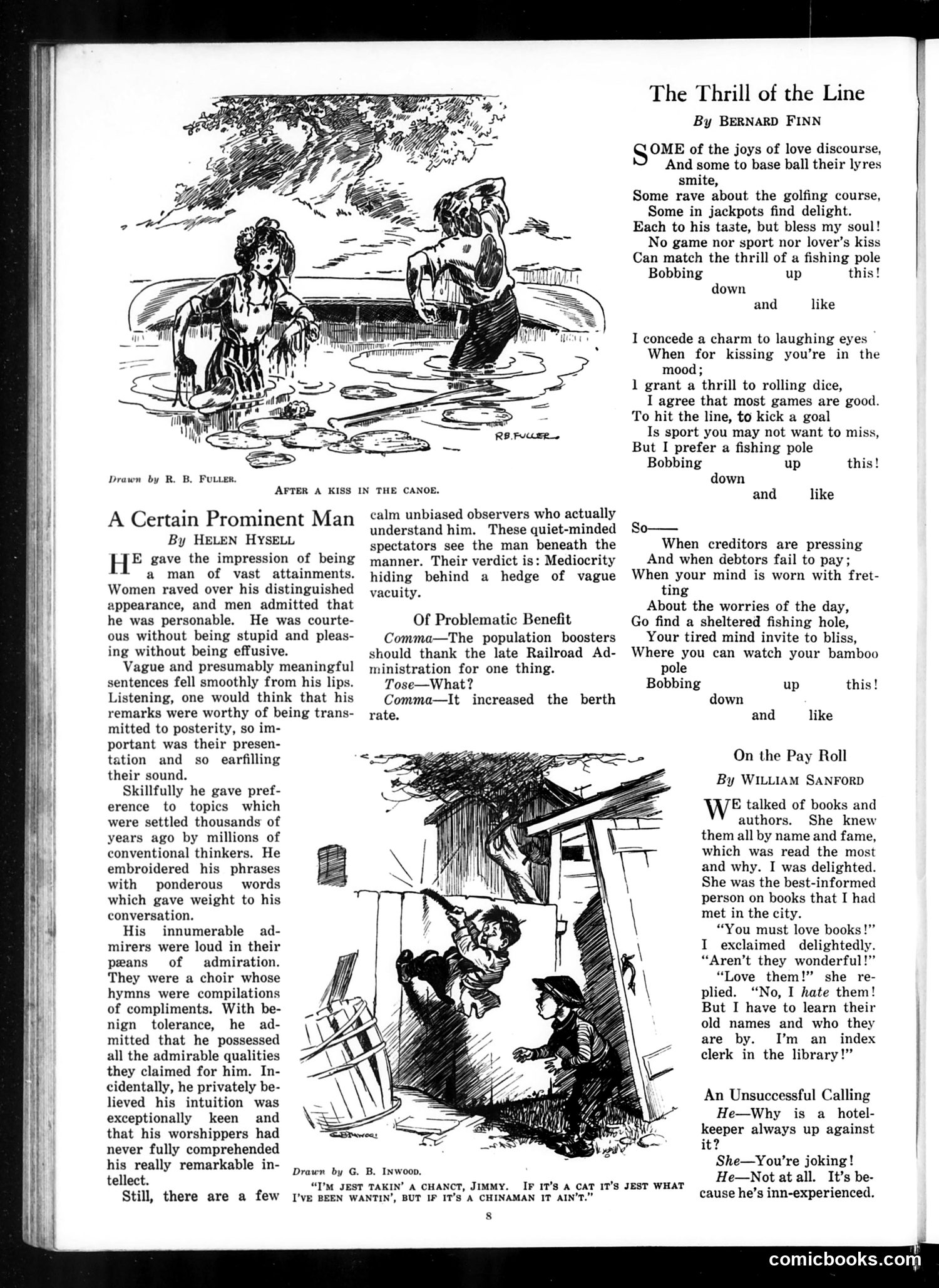
This page contains three satirical pieces typical of early 20th-century American humor: **"A Certain Prominent Man"** satirizes a common social type: the pretentious bore who speaks in grandiose generalities while saying nothing of substance. The piece mocks men who impress through manner rather than intellect—their "vague vacuity" hidden behind elaborate language. It's social satire about affectation and empty rhetoric. **"Of Problematic Benefit"** is a brief joke about the Railroad Administration (likely WWI-era), playing on "berth rate" (ship births) versus "birth rate" (population). It's topical humor about wartime bureaucracy. **"The Thrill of the Line"** is a poem celebrating fishing as life's greatest pleasure, superior to romance or sports—straightforward recreational humor with no political content. The cartoon shows a couple in a canoe after kissing, illustrating romantic leisure. The final piece about the library clerk is a pun: the hotel-keeper is "inn-experienced" (in + inexperienced). These are light, domestic humor pieces rather than political satire.
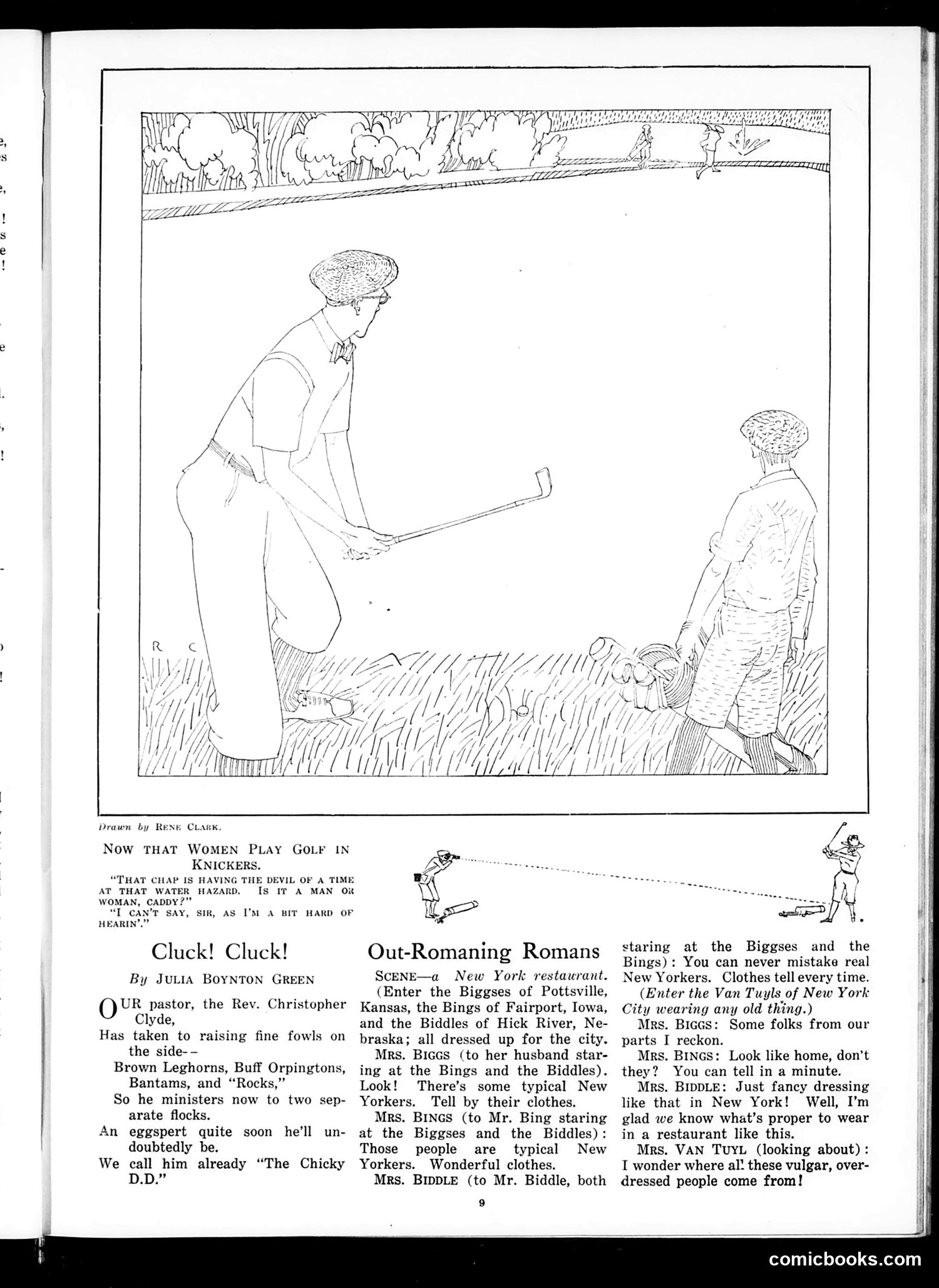
This page contains three distinct pieces of satire: **Top cartoon** (by René Clark): A visual joke about women's newfound golf participation in "knickers" (knee-length pants). A caddy cannot identify the golfer's gender at a water hazard—the satire targets how women's adoption of practical sportswear blurred traditional gender presentations, confusing observers accustomed to strict dress codes. **"Cluck! Cluck!" poem** (by Julia Boynton Green): A lighthearted piece about Reverend Christopher Clyde raising fowl alongside his pastoral duties, punning on "D.D." (Doctor of Divinity) as "Chicky D.D."—gentle humor about clergy dividing their attention. **"Out-Romaning Romans" sketch**: The satire's sharpest piece. Rural visitors from Kansas, Iowa, and Nebraska assume elegantly dressed fellow diners are authentic New Yorkers, while the actual wealthy New Yorker (Van Tuyls) enters wearing casual clothing. The joke mocks both the provincials' assumption that "proper" dress defines sophistication, and by extension, Old Money's indifference to appearances—their true confidence needs no display.
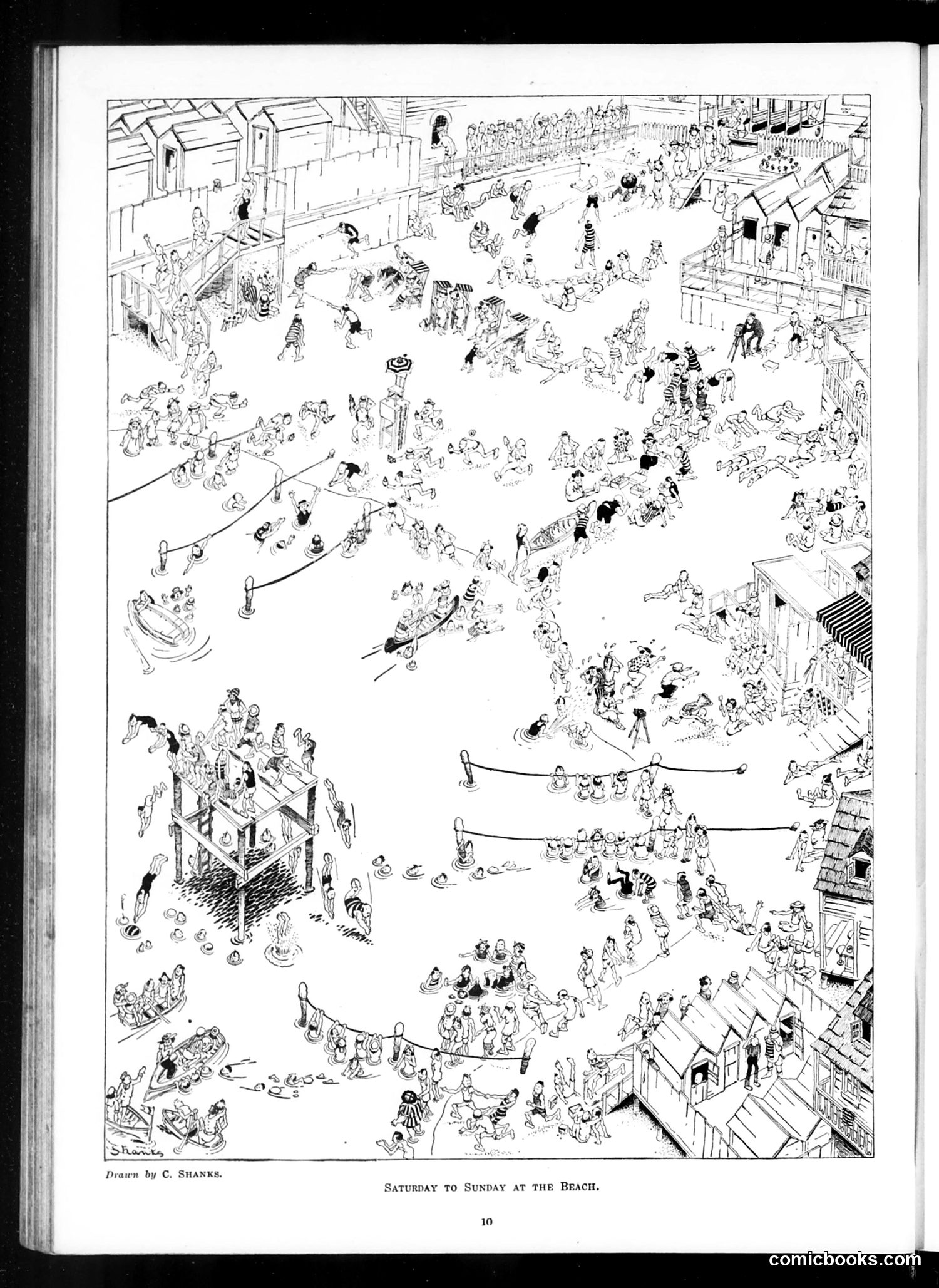
This is a crowded beach scene drawn by C. Shanks showing hundreds of people engaged in various leisure activities—swimming, boating, lounging, and socializing. The cartoon appears to satirize the chaotic mass recreation of the leisure class during what was likely the late 19th or early 20th century. The satire likely targets: - The overwhelming crowds at public beaches as urban populations grew - The absurdity of "relaxation" amid such density and disorder - Class-based beach culture and leisure habits of the era - Perhaps the contrast between idealized notions of seaside escape and reality The detailed, intricate linework captures the organized chaos of weekend beach culture, poking fun at how this supposedly peaceful retreat became a frenzied social spectacle.
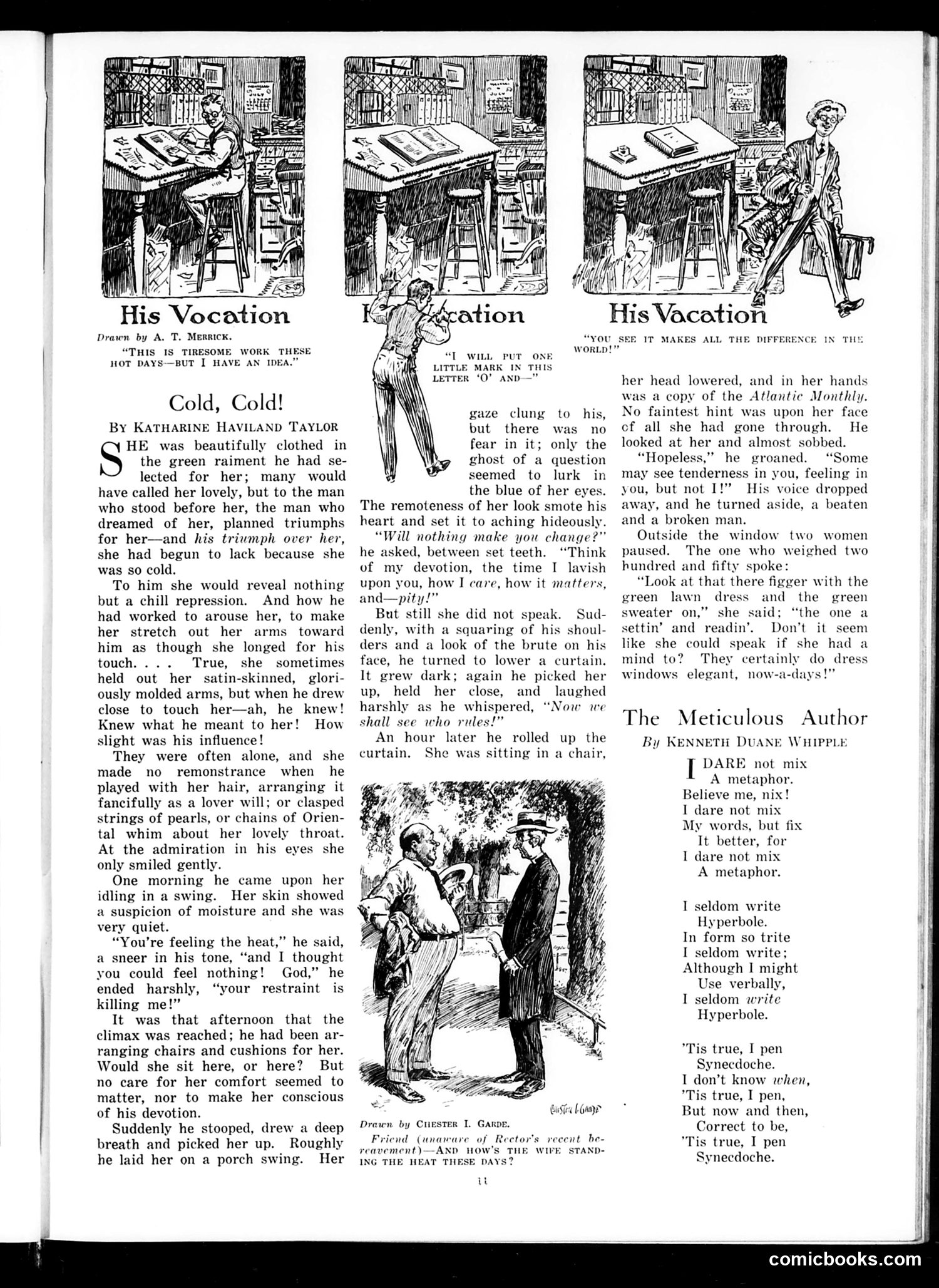
This page contains three distinct pieces of satirical content: **"His Vocation" (top comics):** A three-panel cartoon by A.T. Merrick showing a man at a drafting table working through hot weather, then abandoning his work to pursue leisure—satirizing the conflict between professional duty and personal comfort during summer. **"Cold, Cold!" (main story):** A romantic story by Katharine Haviland Taylor about an emotionally distant woman and an increasingly frustrated suitor. The satire targets male entitlement and emotional manipulation—the man expects gratitude and physical affection for his "devotion," but the woman remains unmoved. The final joke reveals her emotional coldness is unbreakable; two working-class women observing her through a store window note she seems unnaturally composed, treating her as a mannequin rather than understanding her deliberate emotional reserve. **"The Meticulous Author" (right column):** A humorous poem by Kenneth Duane Whipple satirizing overly careful, pedantic writers obsessed with technical correctness at the expense of actual writing. The page reflects early 20th-century attitudes about gender relations and literary pretension.
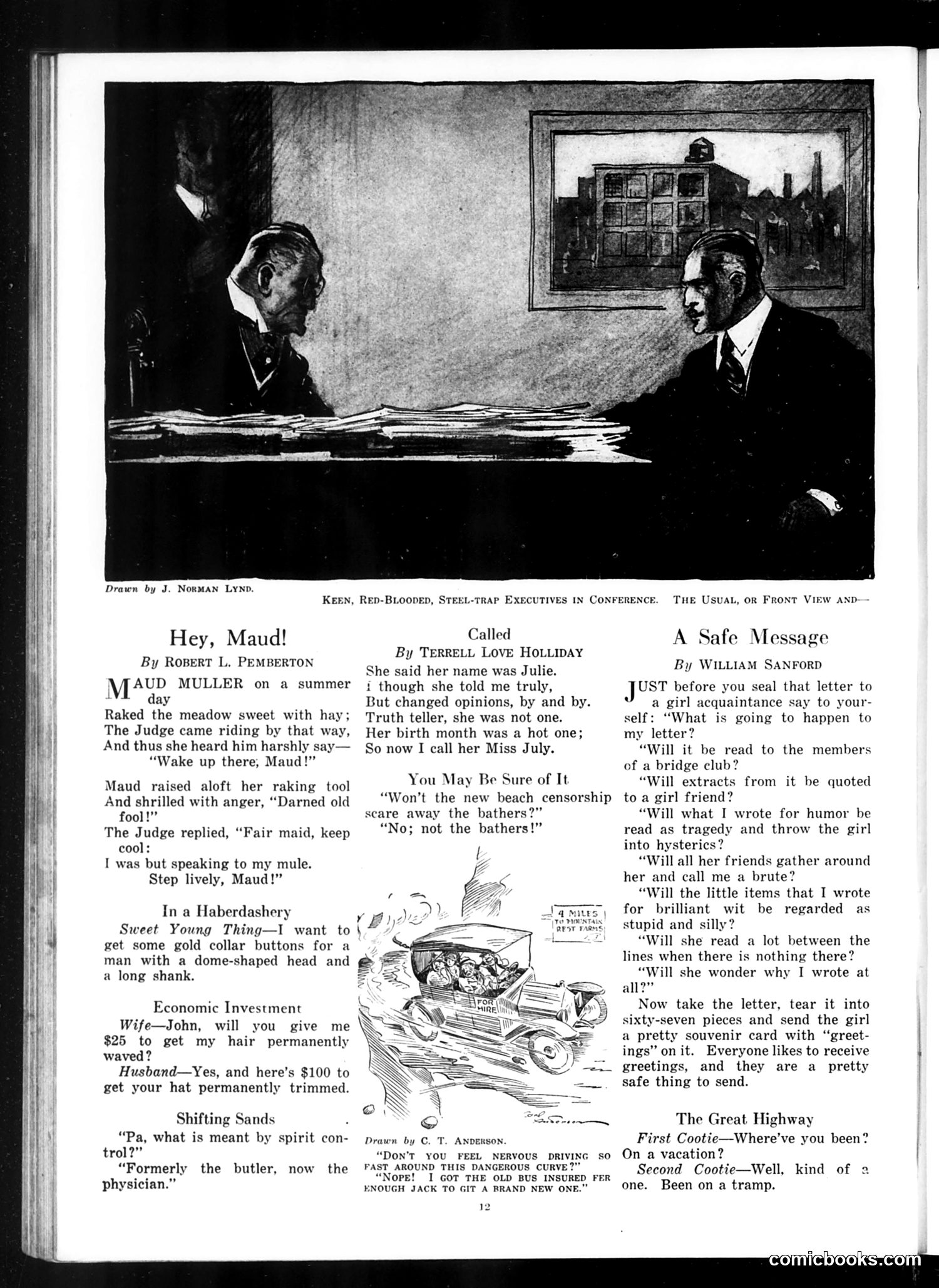
This page from *Judge* magazine contains several short humorous pieces typical of early 20th-century American satire: **"Hey, Maud!"** is a rural poem where a judge on horseback shouts at a farmworker, she angrily responds, and he clarifies he was addressing his mule—a simple misunderstanding joke. **The other pieces** are brief comedic vignettes about domestic life and social situations: a woman seeking gold collar buttons for an oddly-shaped man, a husband sarcastically offering money for his wife's beauty treatments, a child asking about "spirit control" (likely séance spiritualism), and a motorist unconcerned about dangerous driving because his car is insured. **"A Safe Message"** satirizes how women share intimate letters among friends, misinterpret humor as earnestness, and read between the lines—the advice: tear up personal letters and send generic greeting cards instead. **The bottom cartoon** features two "cooties" (lice), anthropomorphized as soldiers discussing tramp life—a WWI-era reference. The humor relies on domestic anxieties, gender stereotypes, and period-specific references rather than political commentary.
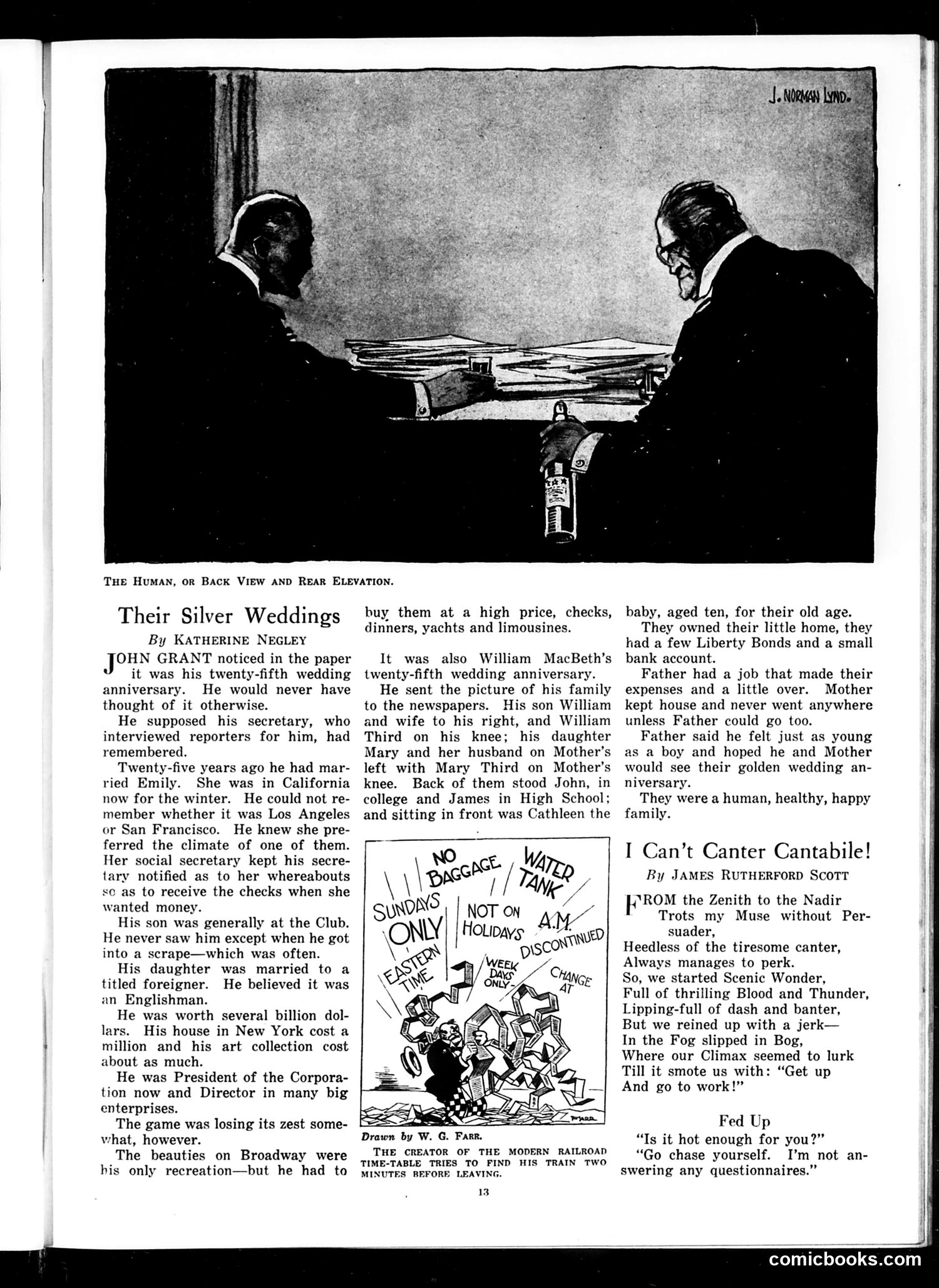
**"Their Silver Weddings"** contrasts two twenty-fifth wedding anniversaries through ironic juxtaposition. John Grant is a billionaire corporate president whose marriage is hollow—his wife lives separately in California, his son frequents clubs and gets into scrapes, his daughter married a foreigner. He buys companionship on Broadway. Yet he notices his anniversary only because his secretary remembered. William MacBeth, by contrast, is working-class with a modest home, Liberty Bonds, and a steady job. His large family—wife, multiple children—are present and genuinely bonded. He eagerly anticipates their golden anniversary. The satire critiques wealthy isolation and moral emptiness versus working-class authenticity and family love. The illustration's "back view" visual pun emphasizes how these men are defined by what's behind them (family legacy, life choices) rather than their faces. The cartoon below mocks railroad scheduling chaos—a separate satirical jab at modern transportation incompetence.
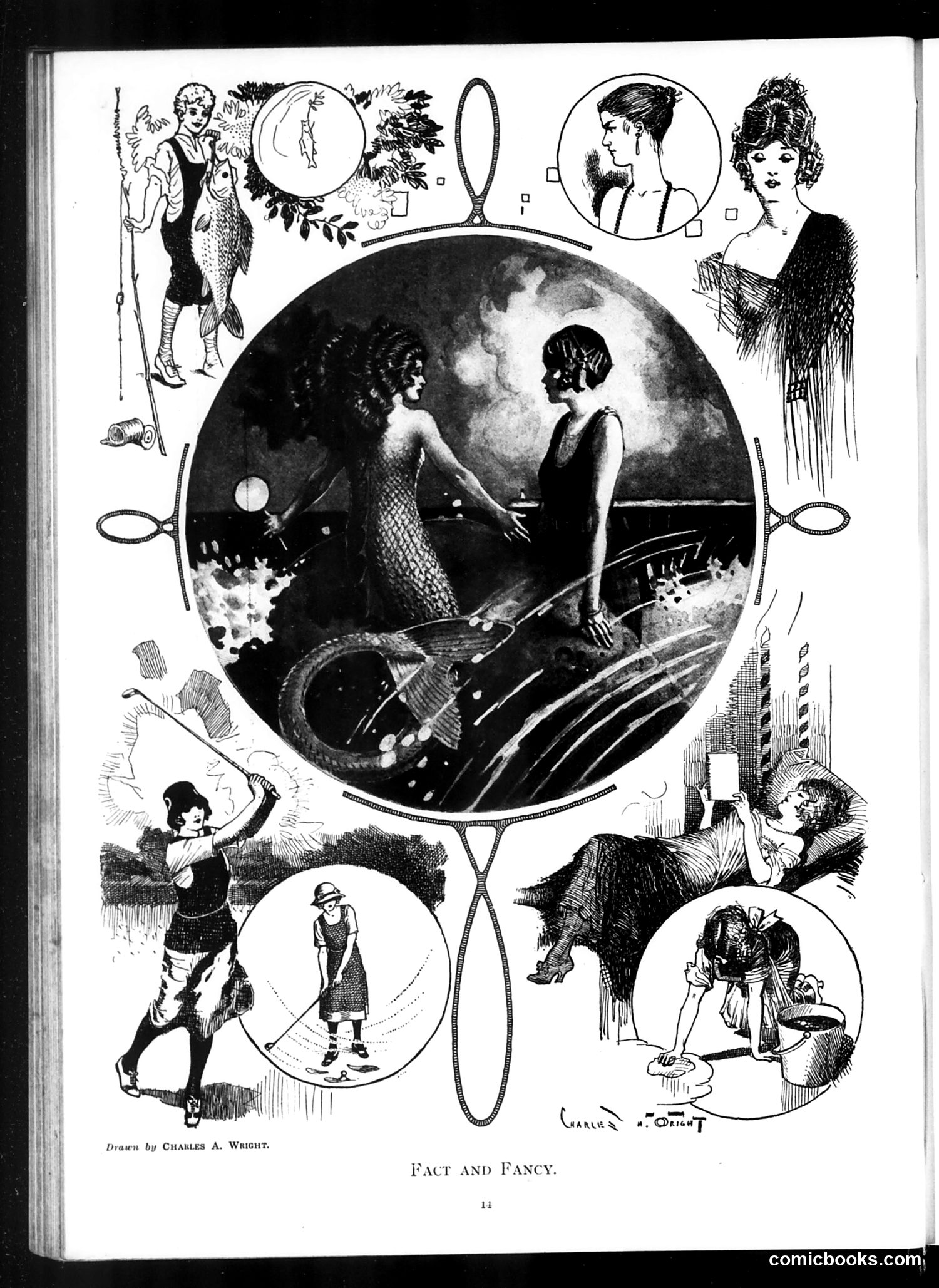
This page illustrates the contrast between reality and imagination, drawn by Charles A. Wright. The central circular scene depicts two women by water with fish, representing "fancy" or romantic idealization. Surrounding this are smaller vignettes showing "fact"—practical, everyday activities: a woman fishing, children playing, domestic work, and other mundane pursuits. The satirical point appears to critique the gap between women's romantic ideals (the dreamy central image) and their actual lives (the workaday scenes). The decorative mirrors and fashion-conscious female portraits flanking the composition suggest commentary on vanity and female aspirations versus reality. The overall layout uses the contrast between ornamental fantasy and unglamorous fact to humorously expose disconnect between expectation and lived experience, likely targeting early 20th-century gender attitudes.
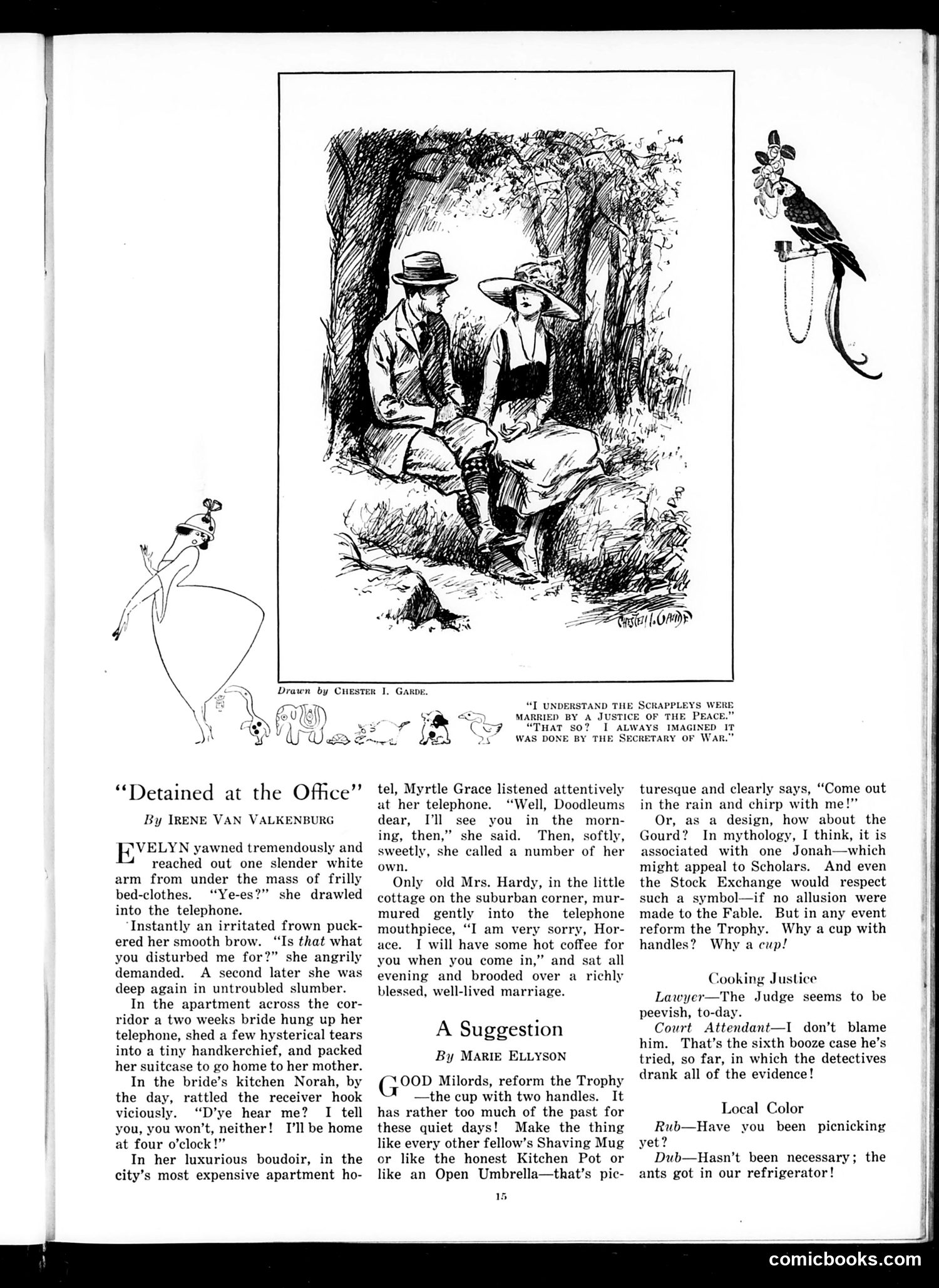
This page contains three separate satirical pieces typical of early 20th-century American humor: **"Detained at the Office"** depicts how telephone calls from work affect different women: an unmarried woman sleeps through it indifferently, a newlywed becomes upset enough to leave her husband, a servant grows angry, and only an older married woman (Mrs. Hardy) accepts it gracefully. The satire critiques modern workplace intrusions into domestic life and suggests that only women in stable, traditional marriages handle such disruptions with equanimity. **"A Suggestion"** mocks the "Trophy" (likely a specific contemporary award or cup design) as outdated, humorously proposing it be redesigned as everyday objects—a shaving mug, kitchen pot, or umbrella—rather than a formal ceremonial cup with handles. **"Cooking Justice"** and **"Local Color"** are brief joke panels: one jokes that judges become irritable because detectives drink confiscated alcohol evidence; the other quips that ants have made outdoor picnicking unnecessary by infesting home refrigerators. The Chester Gade illustration shows a courting couple in an arbor, accompanied by birds and decorative animals—typical decorative accompaniment for romantic content.
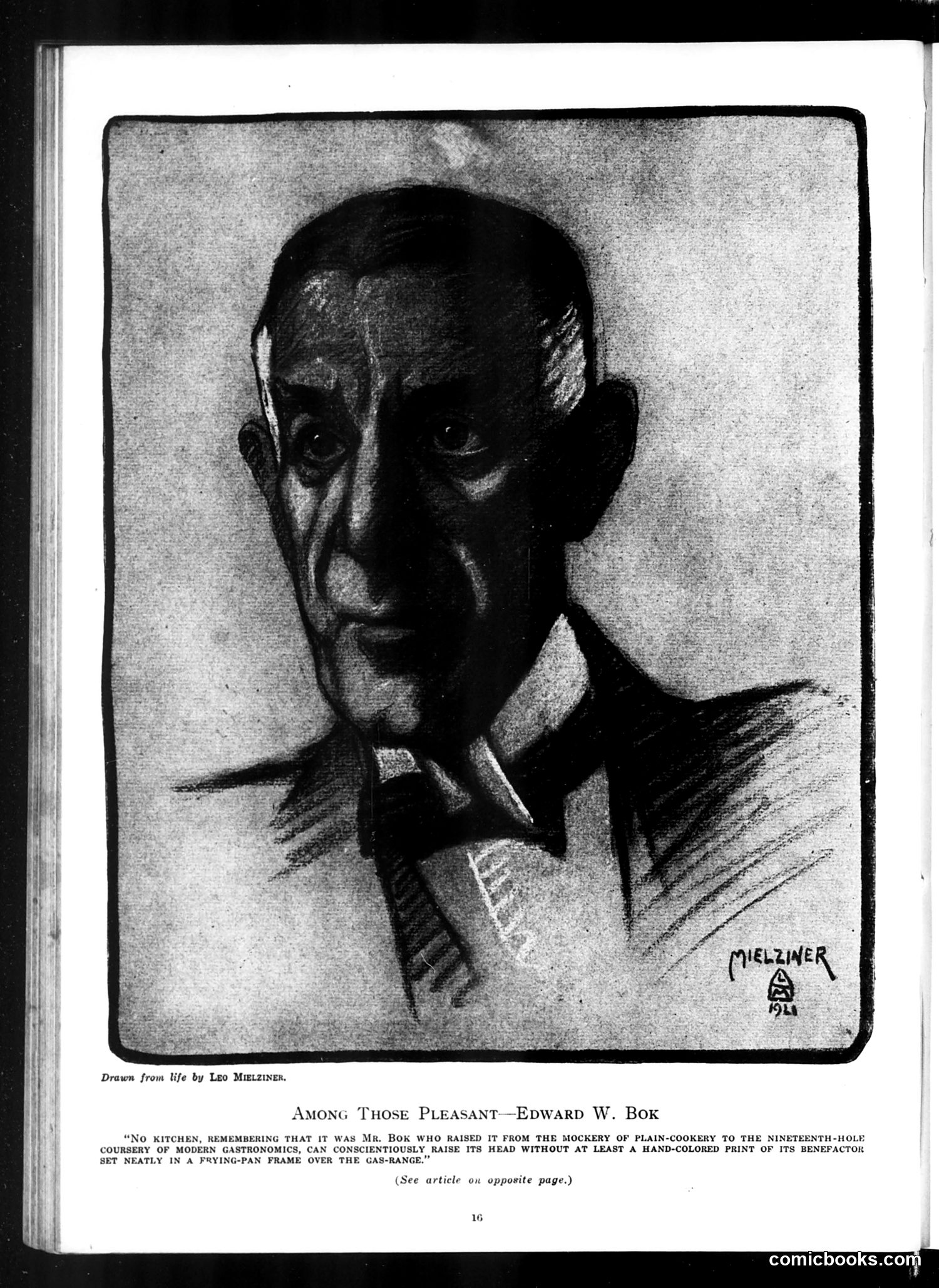
This page features a portrait drawing by Leo Mielziner (signed 1921) titled "Among Those Pleasant—Edward W. Bok." The caption quotes praise for Bok's culinary achievements, suggesting he elevated cooking from "mockery of plain-cookery" to "nineteenth-hole cookery of modern gastronomics." The reference to "nineteenth-hole" (golf course clubhouse) indicates Bok made cooking fashionable among the elite. Edward W. Bok was a prominent early-20th-century editor and philanthropist. This appears to be a complimentary portrait rather than satire—Judge is celebrating his contributions to American culinary culture and refined dining. The text directs readers to an accompanying article for fuller context. Without seeing that article, the specific satirical angle, if any, remains unclear.
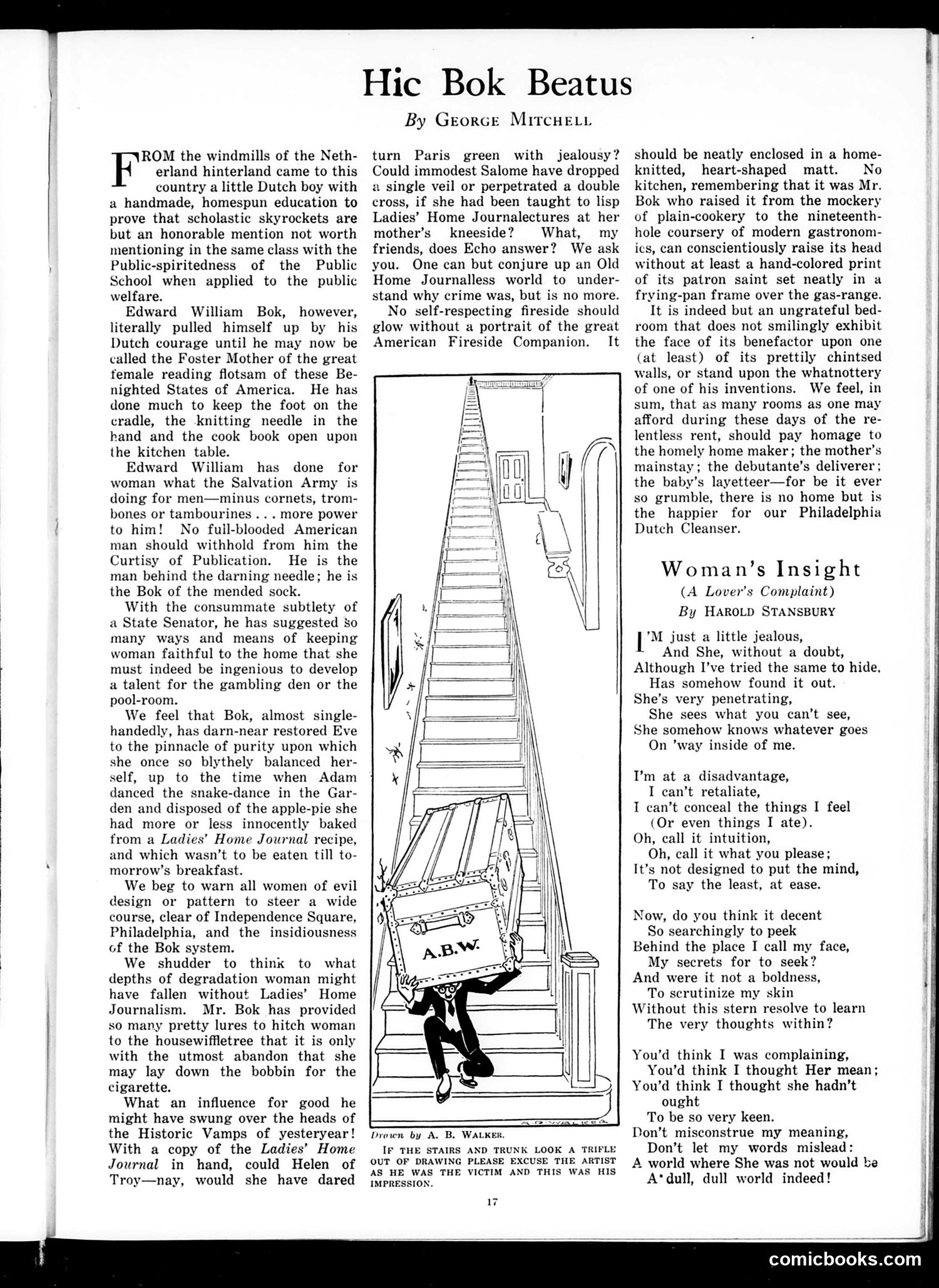
This satirical essay praises **Edward William Bok**, editor of *Ladies' Home Journal*, with heavy irony. Bok was a real Dutch-American publisher who became influential in early 20th-century American domestic life through his magazine. The satire mocks Bok's profound influence over women's domestic roles—his magazine promoted homemaking, cooking, needlework, and "keeping women faithful to the home." Mitchell sarcastically suggests Bok has almost single-handedly restored female virtue through his domestic advice, comparing him favorably to the Salvation Army for his civilizing influence. The accompanying illustration (credited to A.B. Walker) shows a woman carrying a trunk down stairs, with the artist's note humorously claiming this was his impression after being the "victim"—likely a visual pun on domestic labor. The humor lies in the exaggerated reverence for what was essentially prescriptive domestic ideology—presenting Bok's limiting influence on women's lives as heroic salvation, when modern readers recognize it as constraining.
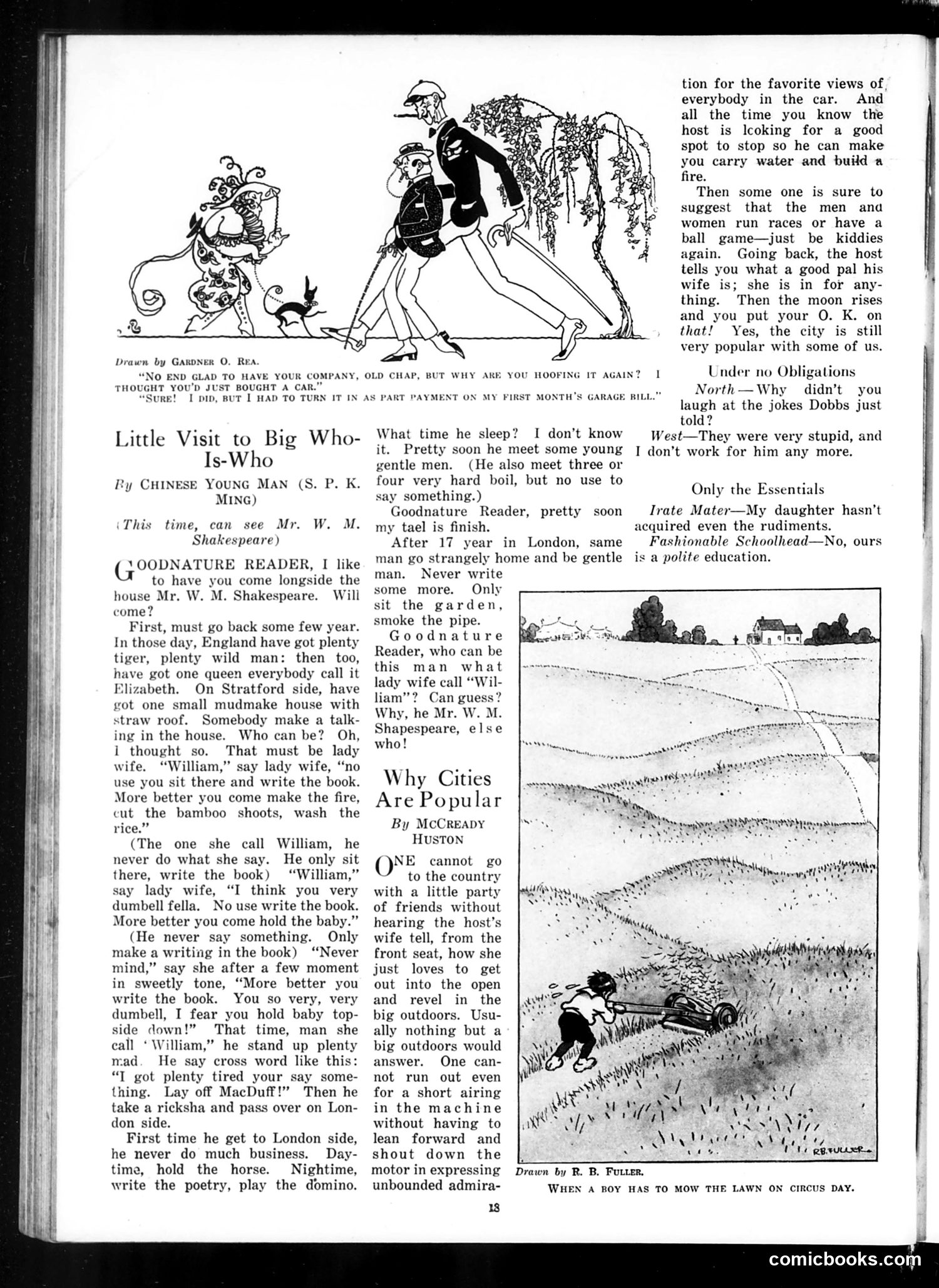
**Top Cartoon:** A couple argues with their chauffeur about a broken-down car. The wife complains they can't afford repairs; the chauffeur explains he had to surrender the vehicle as payment for his first month's garage bills. The satire targets the nouveau-riche and their struggles with automobile ownership costs—a contemporary concern as cars were still luxury items and maintenance was expensive. **"Little Visit to Big Who-Is-Who":** A Chinese immigrant narrator humorously recounts Shakespeare's life using pidgin English stereotypes ("Goodnature Reader," "dumbell fella," "topside down"). The satire mocks both pretentious literary tourism and racist caricatures of Asian immigrants. Shakespeare's wife nags him away from writing; he eventually succeeds in London. It's likely satirizing orientalist attitudes popular in early 1900s America. **"Why Cities Are Popular":** A brief commentary on suburban trips where hosts' wives bore everyone with enthusiasm for "the big outdoors"—satirizing artificial rural romanticizing and the tedium of forced country excursions. **Bottom cartoon:** A boy frustrated about missing the circus to mow the lawn—simple childhood commentary.
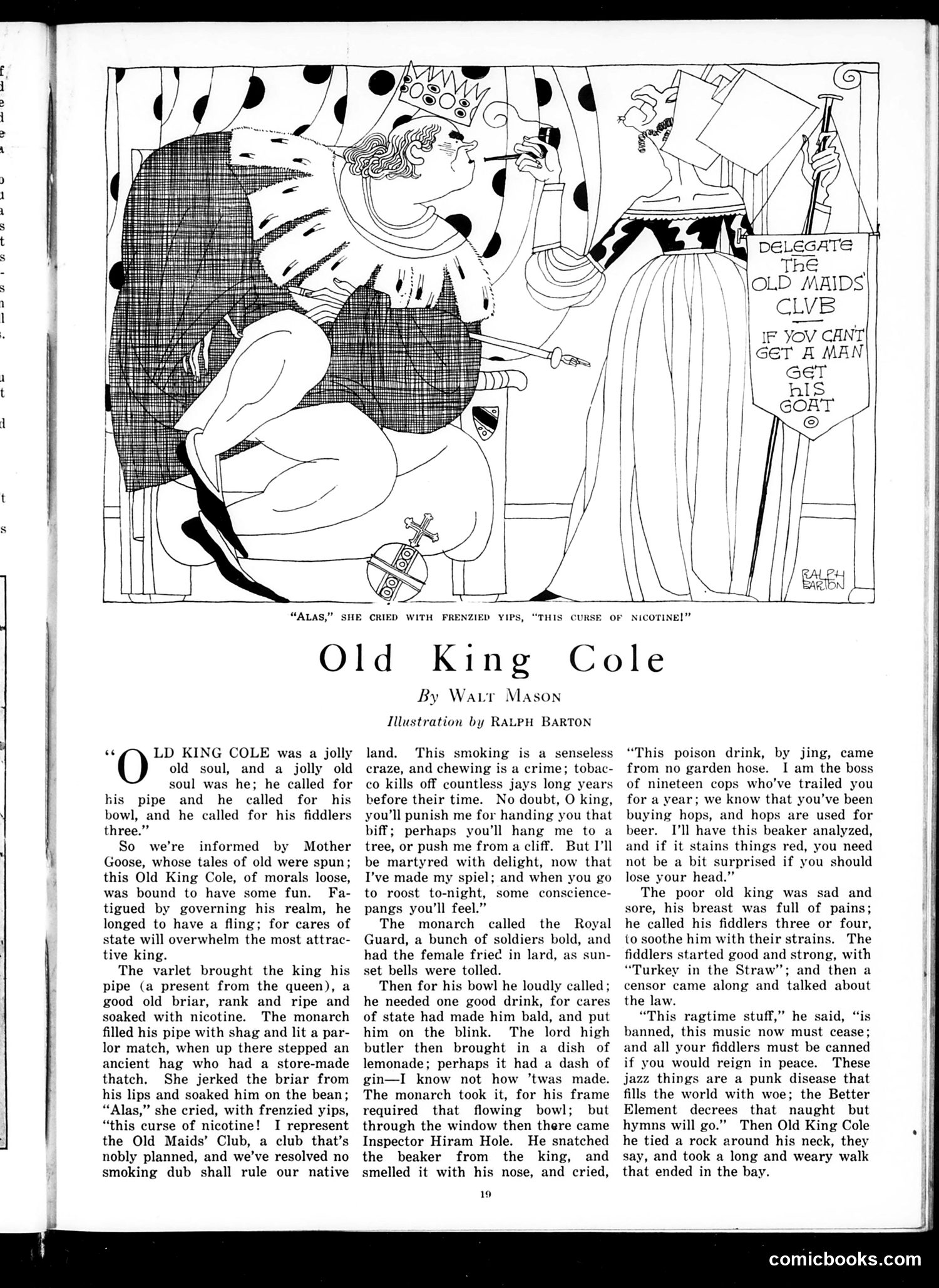
This is a satirical retelling of the nursery rhyme that mocks early 20th-century progressive reform movements. King Cole represents traditional indulgence and pleasure; various figures—an "Old Maids' Club" representative, "Inspector Hiram Hole" (a Prohibition-era alcohol enforcer), and a censor—systematically attack his vices: smoking, drinking, and ragtime music. The satire targets the era's moral crusaders who sought to ban tobacco, alcohol, and "corrupting" entertainment. Each reformer is portrayed as absurdly humorless and intrusive. The dark ending—Cole committing suicide—is darkly comic commentary on how excessive regulation destroys joy and freedom. The illustration by Barton depicts the old maid's attack on Cole's pipe-smoking, emphasizing her stern authority and his bewildered indulgence. The humor relies on readers' recognition of these contemporary moral panic campaigns.
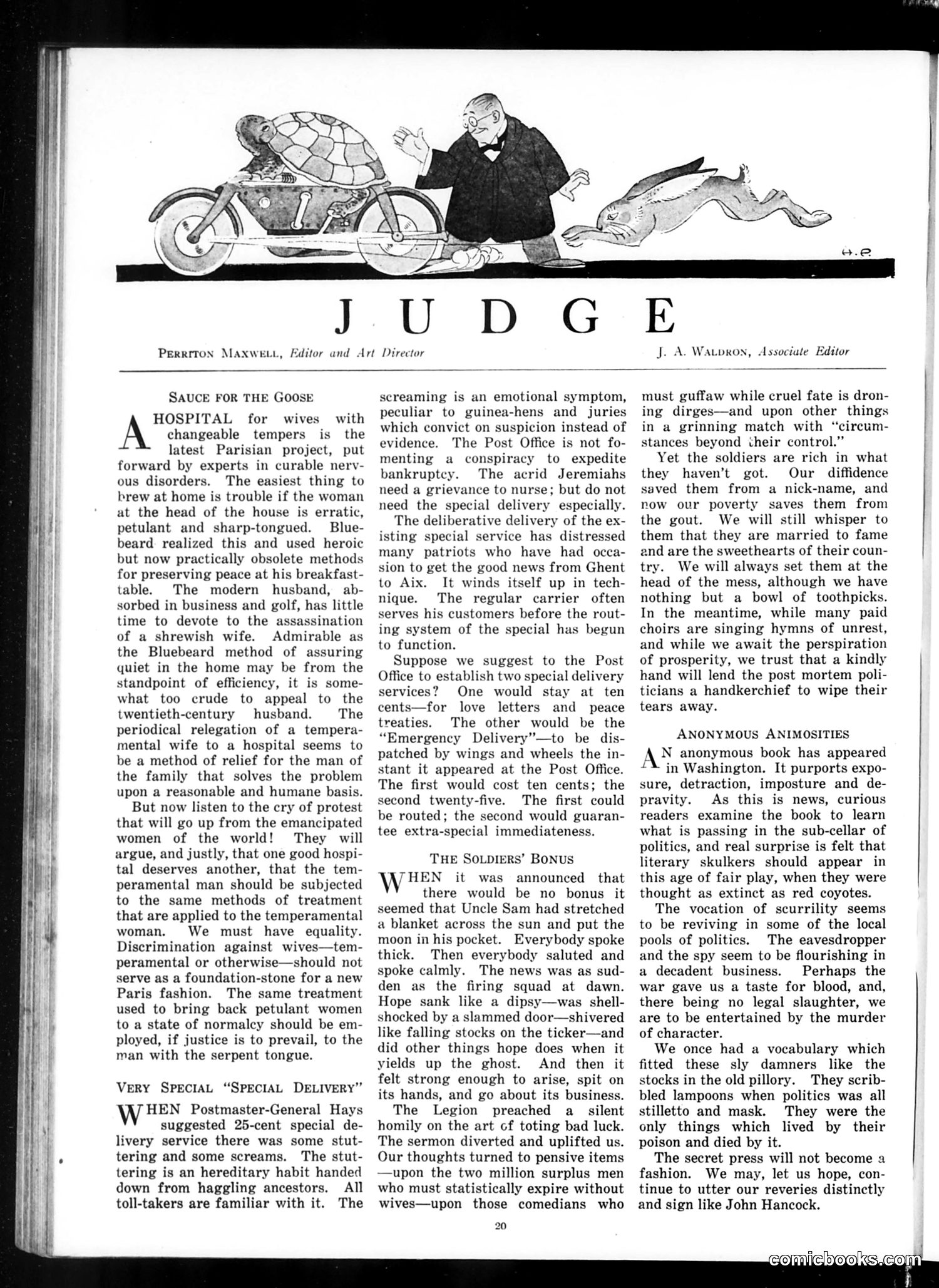
The top cartoon depicts a man in formal dress gesturing with exasperation at a motorcycle sidecar containing a turtle, while a rabbit lies on the ground. This illustrates the article "Sauce for the Goose," which satirizes a proposed Parisian hospital for wives with "changeable tempers." The joke's point: the article argues that if temperamental wives deserve hospitalization, then temperamental husbands deserve the same treatment—advocating equality in marital "discipline." The cartoon's absurd vehicles and animals likely mock this notion of managing difficult spouses. The article references the Bluebeard legend (a wife-killer) as an outdated solution to shrewish wives, positioning the modern hospital proposal as supposedly more "humane" while still treating women as problems to be solved rather than equals deserving respect. The satire targets both the Parisian idea and the underlying assumption that difficult spouses—particularly women—require institutional "correction."
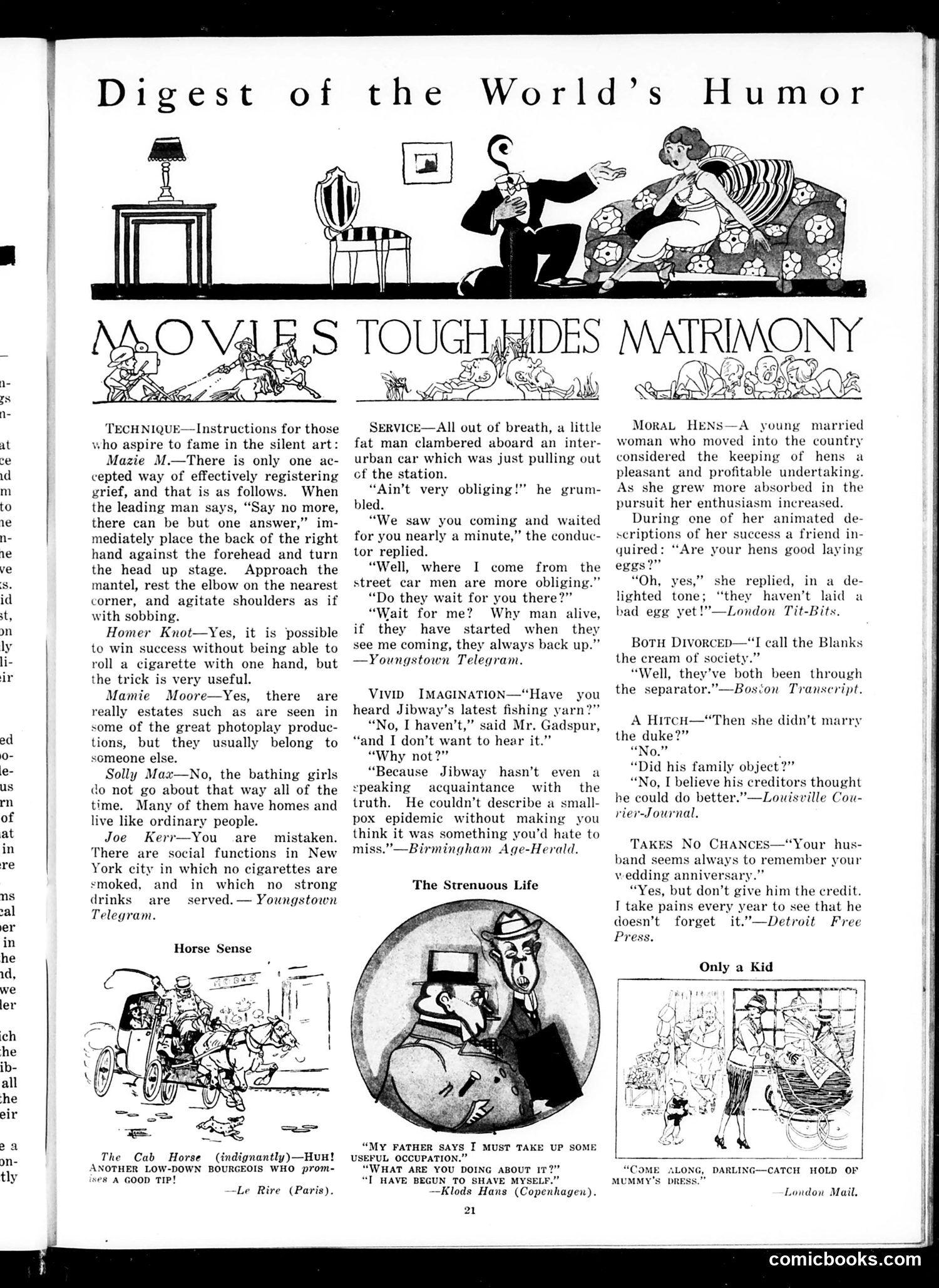
This page collects international humor pieces and cartoons from various sources, presenting jokes about social conventions and everyday life. **Key Content:** The header illustration depicts silent film acting—satirizing overly dramatic conventions of early cinema. The "Technique" section mocks specific theatrical gestures (fainting poses, cigarette rolling) that silent film actors relied upon. **Recurring Themes:** - Urban transit frustrations (impatient passengers, conductors) - Exaggeration in storytelling ("Vivid Imagination") - Gender roles and domesticity (wives keeping hens, remembering anniversaries) - Class commentary (the "cab horse" cartoon criticizing bourgeois dishonesty about tipping) **The Satire:** These pieces ridicule human pretension and social hypocrisy—people's tendency to embellish, forget obligations, or behave inconsistently. The "Both Divorced" joke plays on wealthy socialites' moral standing. The cartoons are sourced internationally (*Le Rire* from Paris, Copenhagen's *Klods Hans*), reflecting Judge's cosmopolitan audience. The humor targets middle-class manners and vanities rather than political issues.
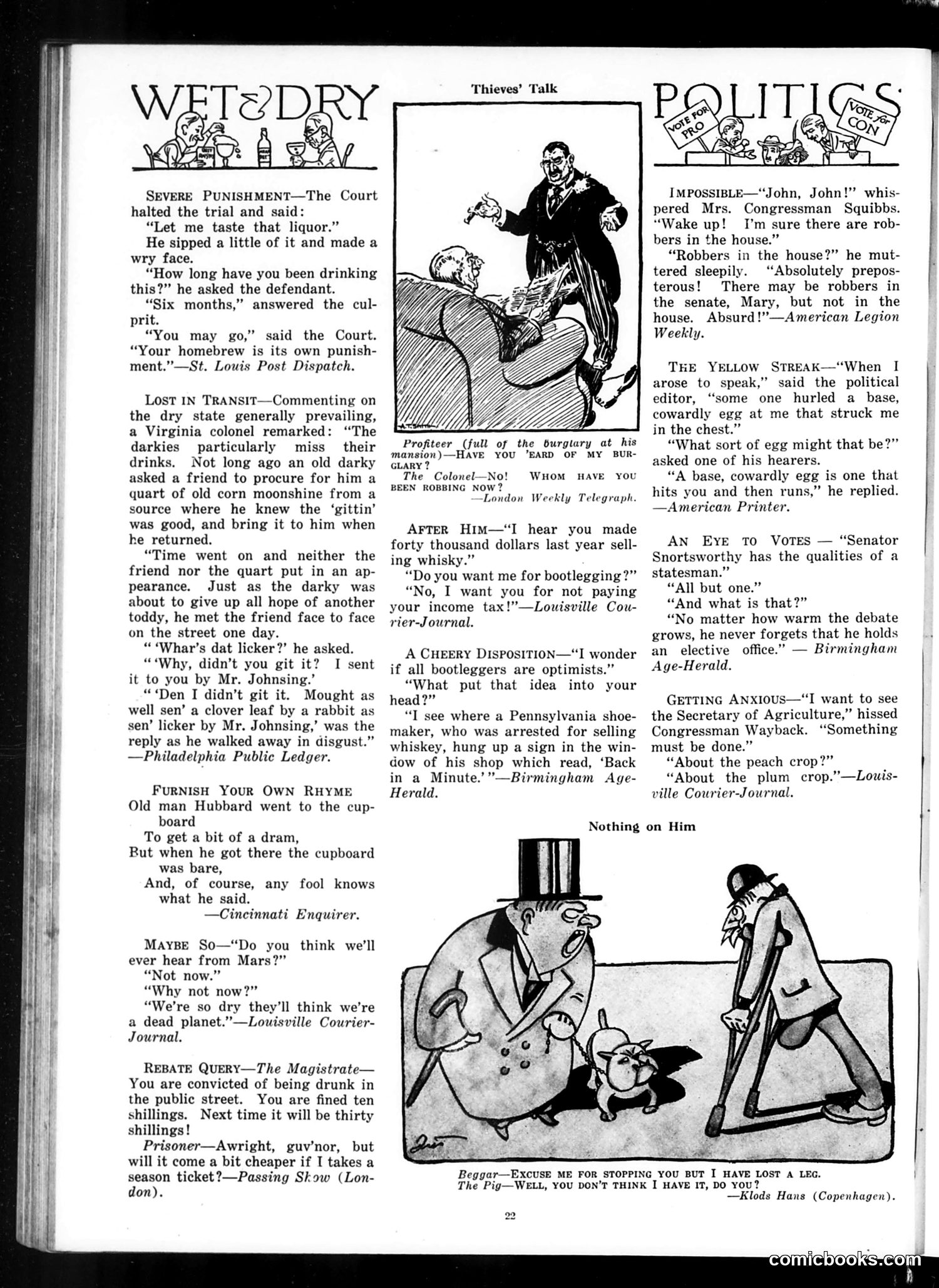
This page from *Judge* satirizes **Prohibition-era America** (alcohol was banned 1920-1933). The left column's jokes mock: - **Homemade liquor's terrible quality** ("homebrew is its own punishment") - **Bootlegging's prevalence** despite the law - **Racial stereotypes** (the "darky" anecdote reflects period prejudices) The right column shifts to **political corruption**, particularly targeting: - **Congressmen as hypocrites**: one congressman denies robbers could be in "the house" (Congress) while admitting they infest the Senate - **Bootleggers evading taxes** while selling illegal whiskey - **Politicians prioritizing re-election** over principle The cartoon "Nothing on Him" shows a beggar and wealthy man—likely satirizing how even desperate poverty couldn't extract sympathy from the indifferent wealthy. Overall, the page mocks Prohibition's failure, widespread lawbreaking across classes, and politicians' selective morality. The satire assumes readers share cynicism about government corruption and Prohibition's unpopularity.
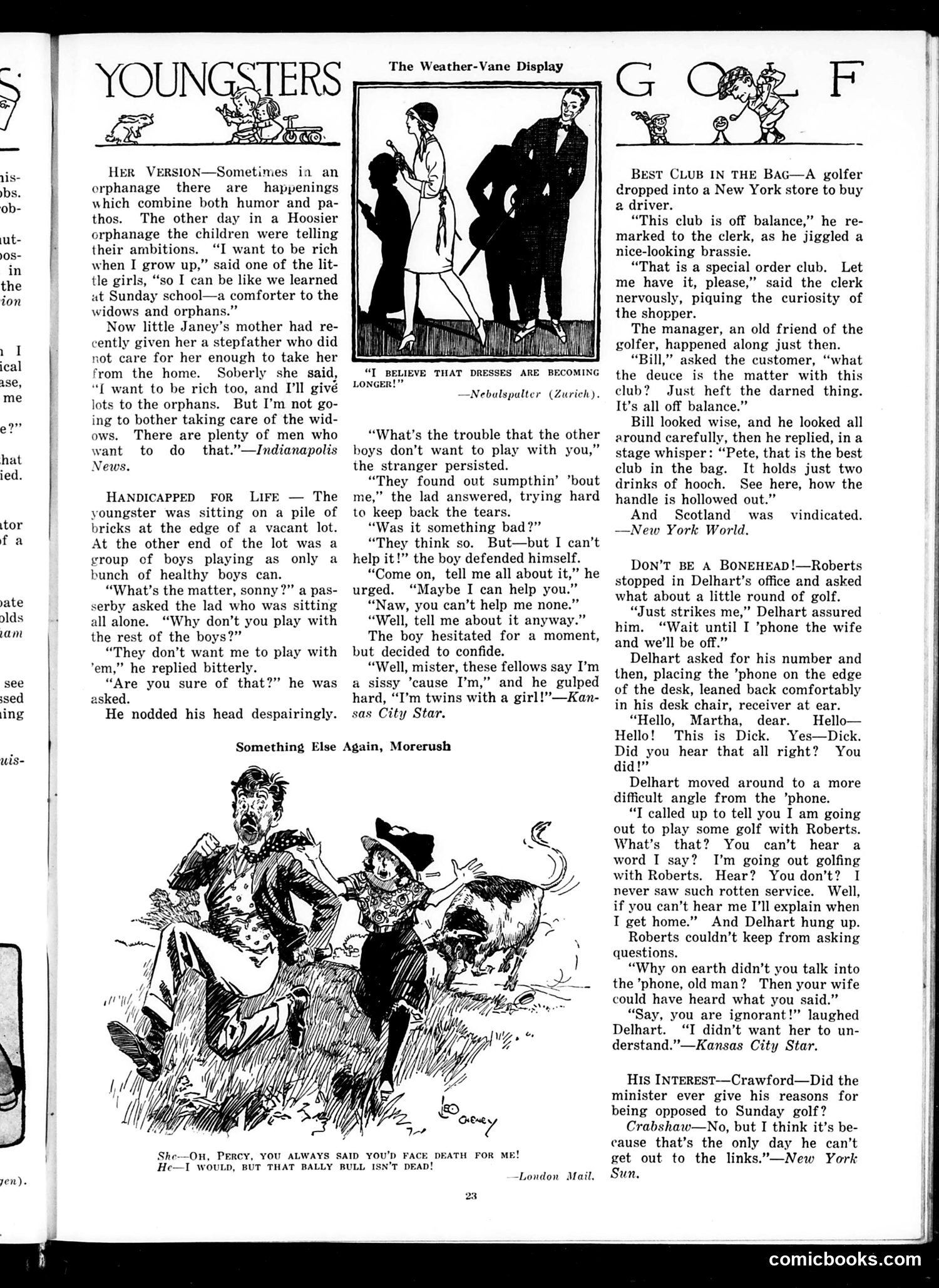
This page from Judge magazine contains several brief humorous anecdotes and cartoons satirizing early 20th-century American social life: **"Her Version"** mocks orphanage sentimentality—a girl rejects the conventional charity model of helping widows, noting practicality: men already volunteer for that. **"Handicapped for Life"** uses a boy's social exclusion to deliver a punchline: he's shunned because he's a twin with a girl—treated as somehow emasculating. **The bull cartoon** (bottom) humorously depicts cowardice: a man claims he'd face death for his girlfriend, but won't confront an actual bull. **"Best Club in the Bag"** references Prohibition-era speakeasy culture—a hollowed-out golf club secretly holds liquor. **"Don't Be a Bonehead!"** satirizes newly-available telephone technology and marital miscommunication; a man pretends his wife can't hear him on the phone to escape domestic questioning about golf plans. These pieces reflect Judge's target audience: urban, affluent readers amused by period-specific social pretensions and modern conveniences creating new comedic scenarios.
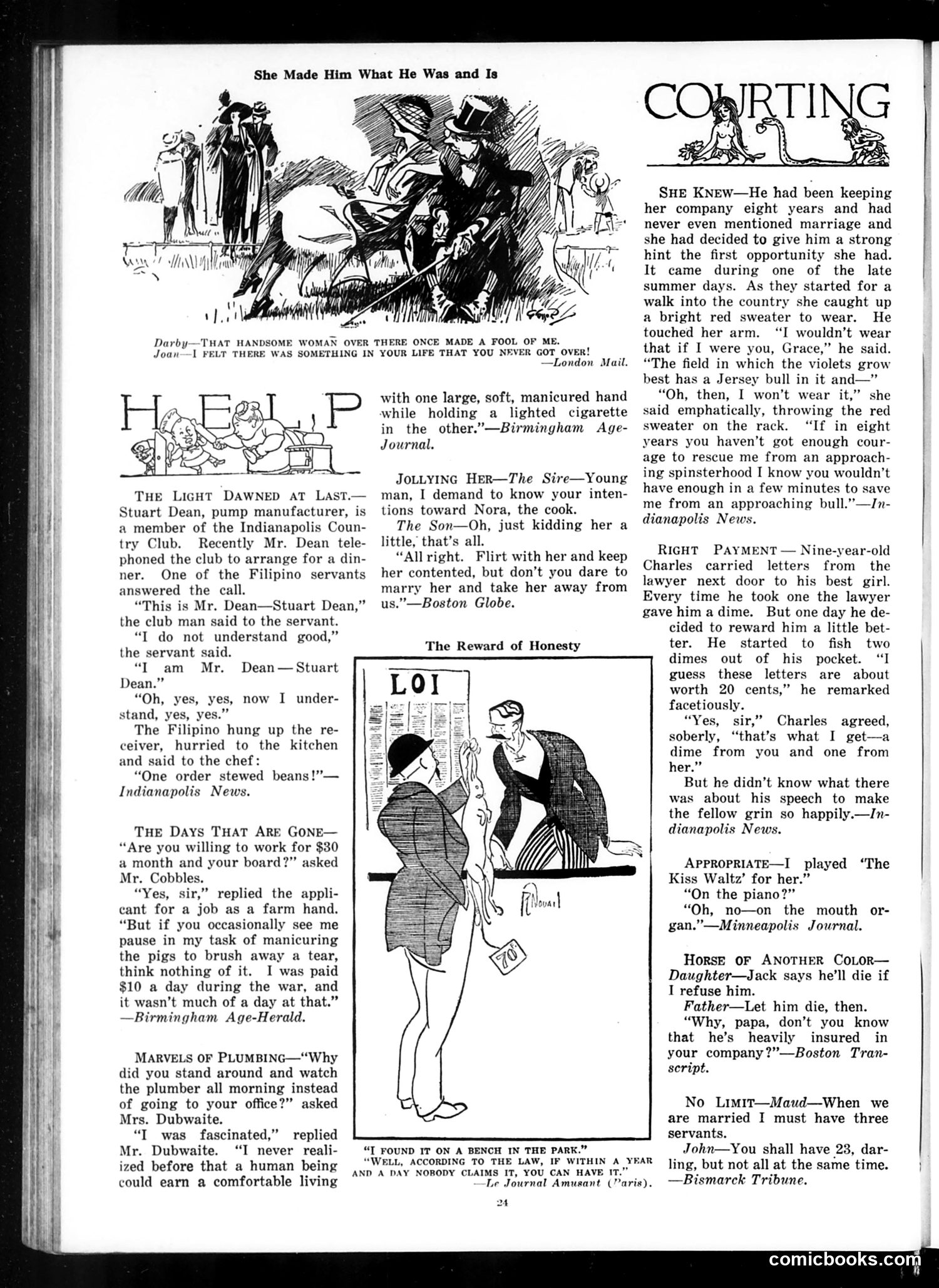
This page collects brief humorous anecdotes reflecting early 20th-century American social attitudes. The main themes involve class hierarchy, gender dynamics, and ethnic stereotypes typical of the era. The opening cartoon depicts a woman using emotional manipulation on a man during courtship—she refuses to wear a red sweater near a bull, implying her suitor lacks courage to protect her from danger (or approaching spinsterhood). The joke assumes women use such tactics to pressure men toward marriage. Other anecdotes mock: a Filipino servant's English comprehension ("stewed beans" for "Stuart Dean"); wartime wage inflation and postwar economic decline; working-class desperation; and marital negotiations. The cartoon labeled "The Reward of Honesty" shows a woman discovering lost money—the joke being that honesty provides legal rights to unclaimed property, yet she appears to be the actual owner already. Throughout, the humor assumes fixed social positions (servants, farm laborers, cooks) and stereotypes ethnic minorities as comically incompetent with English language and customs. These reflect period attitudes now recognized as offensive.
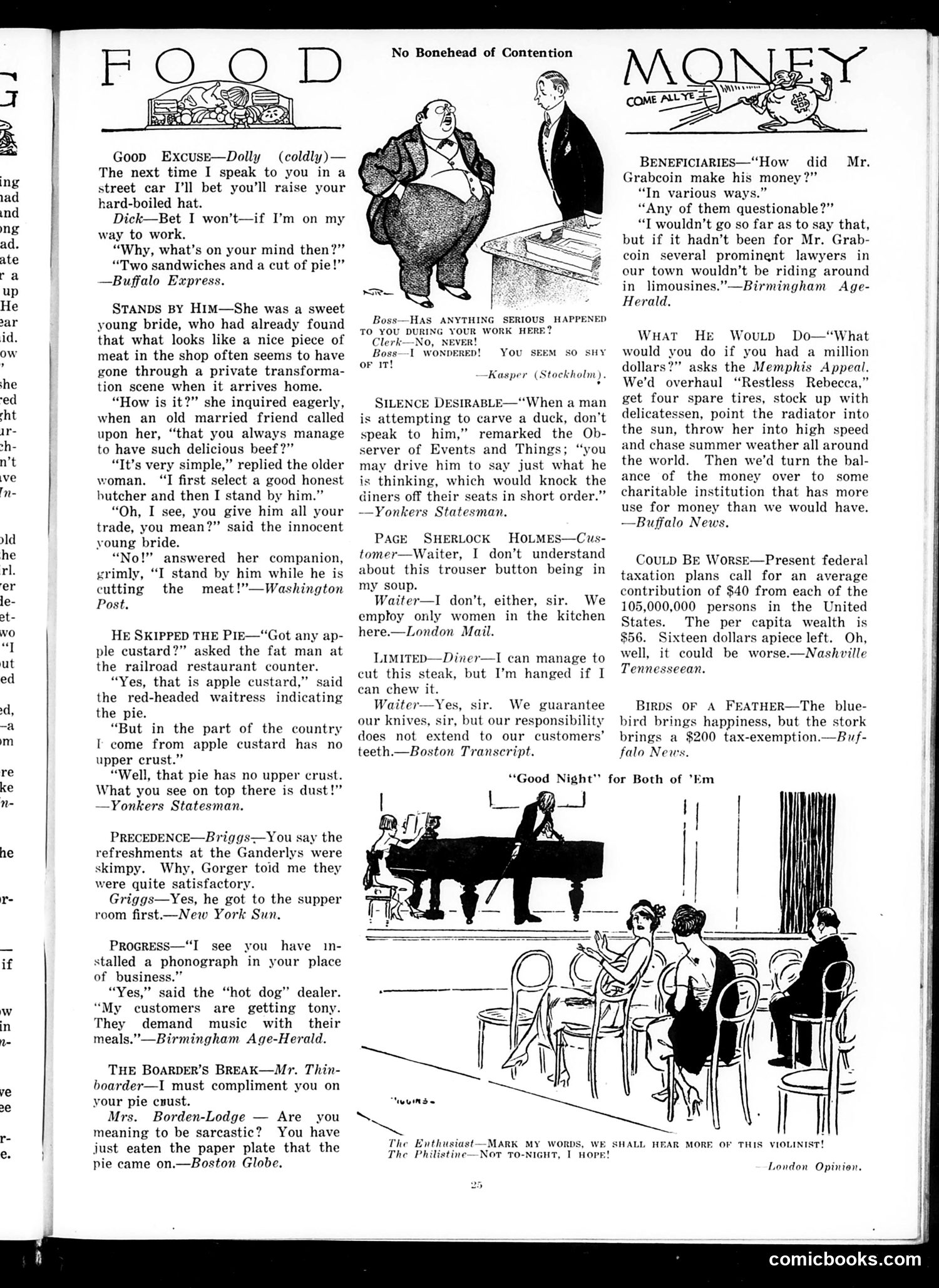
This page comprises brief humorous anecdotes rather than political cartoons. The jokes satirize early 20th-century American social life and consumer culture. Key themes include: **Working-class priorities**: A laborer mentions "sandwiches and pie" when asked what's on his mind—satirizing workers' focus on basic sustenance. **Consumer goods and wealth**: Multiple jokes mock material consumption (the "Restless Rebecca" car reference), federal taxation burdens ($40 per capita from 105 million Americans), and conspicuous consumption by the newly wealthy ("prominent lawyers...riding around in limousines"). **Service industry incompetence**: Waiters serve paper plates as pie crusts, soup contains trouser buttons, and restaurant quality is poor. **Marriage and domesticity**: Jokes about wives struggling with cooking and managing household help reflect anxieties about domestic management. The recurring target is **economic inequality and pretension**—wealthy people like "Mr. Grabcoin" acquiring money through questionable means while workers struggle with basic needs. The satire is gentle, focusing on universal frustrations rather than specific political figures.
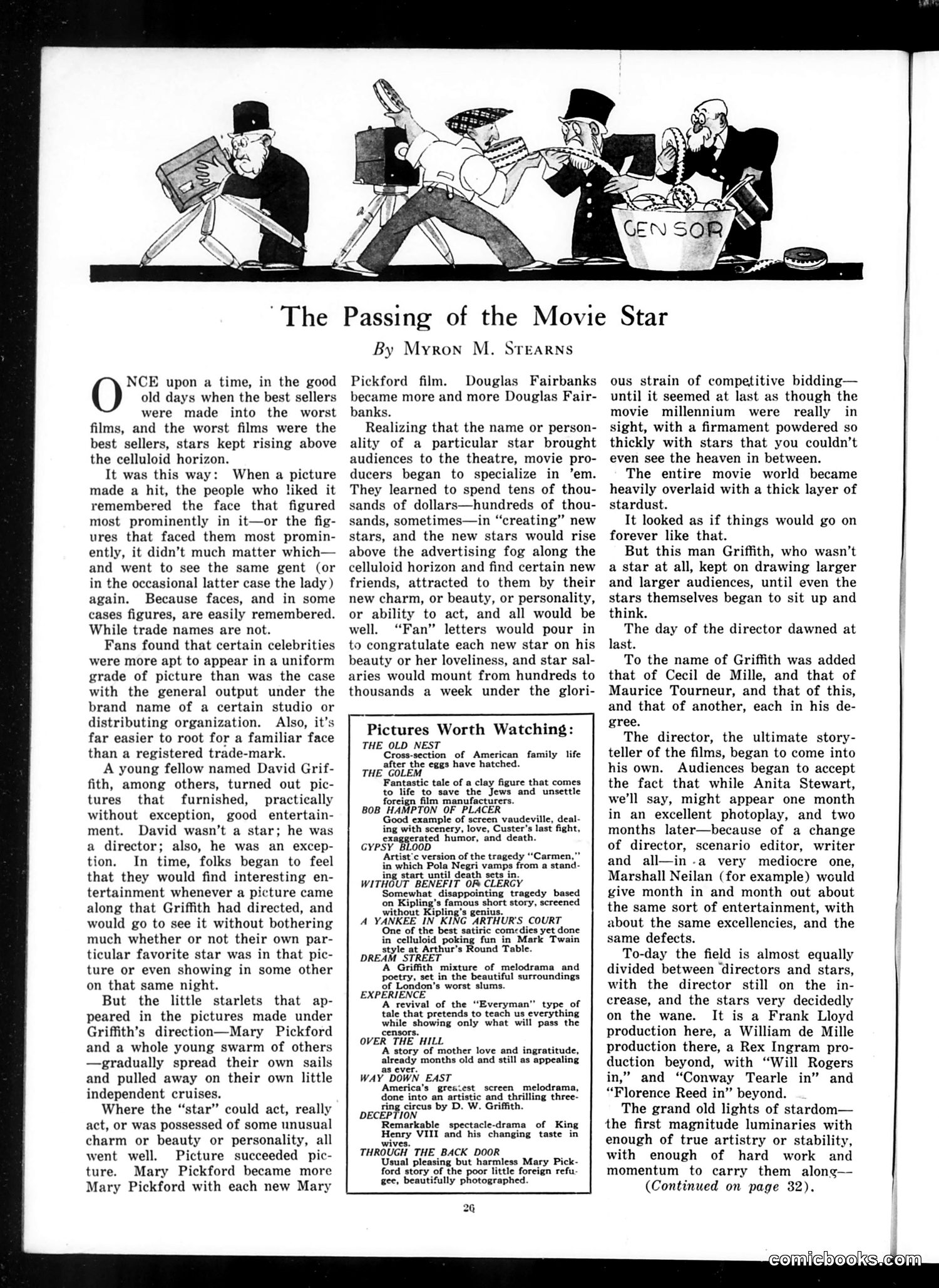
The cartoon header satirizes the film industry's machinery for creating stars. It depicts four figures on an assembly line: a director framing a shot, a cameraman filming, a censor reviewing content, and a producer in a pot—suggesting stars are manufactured products rather than discovered talents. The accompanying article by Myron M. Stearns argues that early cinema relied on recognizable *faces* rather than studio brand names to draw audiences. Director D.W. Griffith was exceptional—audiences came for *his* films specifically. However, stars like Mary Pickford and Douglas Fairbanks eventually outgrew their studios, realizing their own names held commercial value. The satire critiques how producers began "creating" stars through massive spending on publicity and marketing, treating personality and beauty as commodities. The piece suggests this industrialized star-making system represents cinema's evolution from artistic medium to pure entertainment commodity, where fan letters and salary inflation replaced genuine talent cultivation.
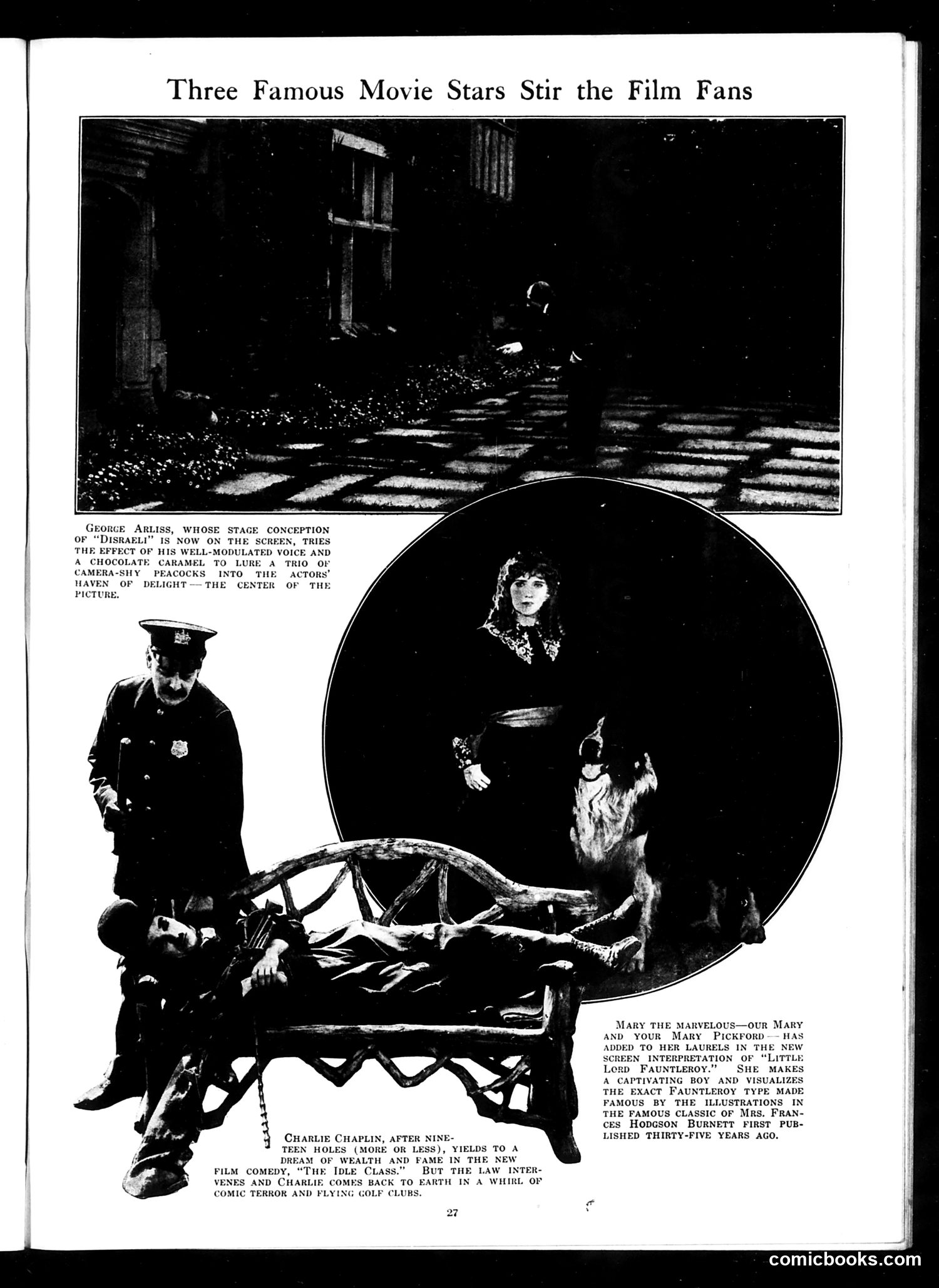
This Judge magazine page celebrates three prominent silent film stars of the era: **George Arliss** in *Disraeli*—the text humorously notes his "well-modulated voice" (ironic for silent film) and mentions using chocolate caramels to attract camera-shy peacocks as extras, poking fun at theatrical production methods. **Mary Pickford** in *Little Lord Fauntleroy*—celebrated as "Our Mary," she's praised for her boyish portrayal in this adaptation of the classic children's novel, made famous by its original illustrations. **Charlie Chaplin** in *The Idle Class*—described dreaming of wealth and fame before being comically brought back to earth by the law, referencing his trademark everyman character's social struggles. The page satirizes how these major stars captivate audiences while humorously highlighting production quirks and character types that defined early 1920s cinema.
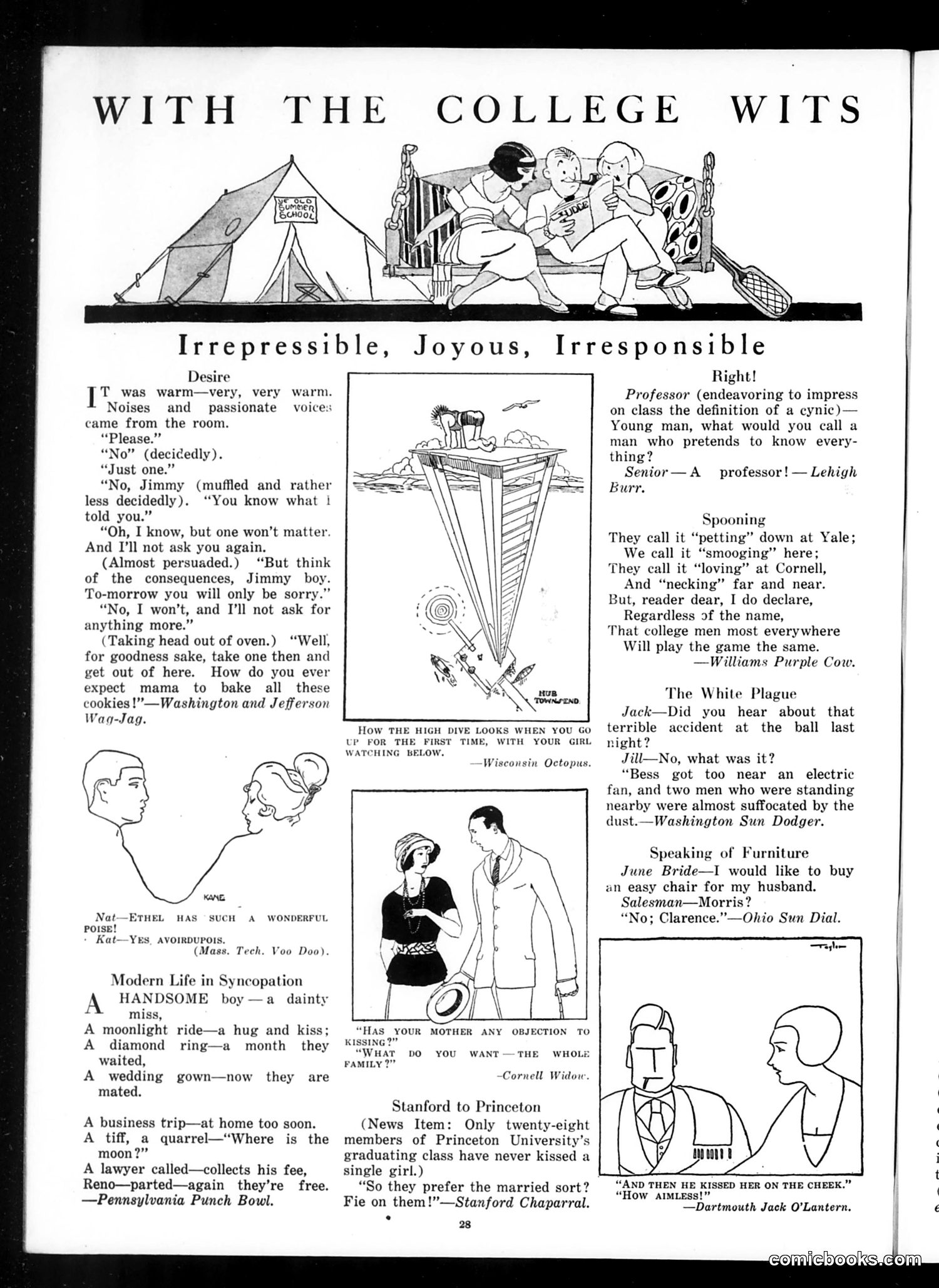
This page collects humor from various college publications, satirizing 1920s youth culture and dating customs. Key content includes: **"Desire"**: A mock-serious anecdote where a mother interrupts her son Jimmy and his girlfriend in a passionate moment—but he's actually been trying to get her permission to eat cookies she's baking. The joke relies on readers' expectation of sexual scandal. **Dating/Courtship Humor**: Multiple jokes mock college romance rituals: "spooning" (kissing/petting), the "high dive" cartoon showing vertigo during a first kiss, and Princeton students who've never kissed girls. "Modern Life in Syncopation" satirizes impulsive marriage followed by quick divorce via Reno (then the divorce capital). **Professor/Cynic Joke**: A senior student defines a cynic as "a professor"—mocking academic pretension. **The "White Plague" joke**: References tuberculosis (then common), where a woman gets too close to an electric fan and creates dust that nearly suffocates nearby men—absurdist humor. These collectively mock college social life, courtship conventions, and institutional authority circa the Jazz Age.
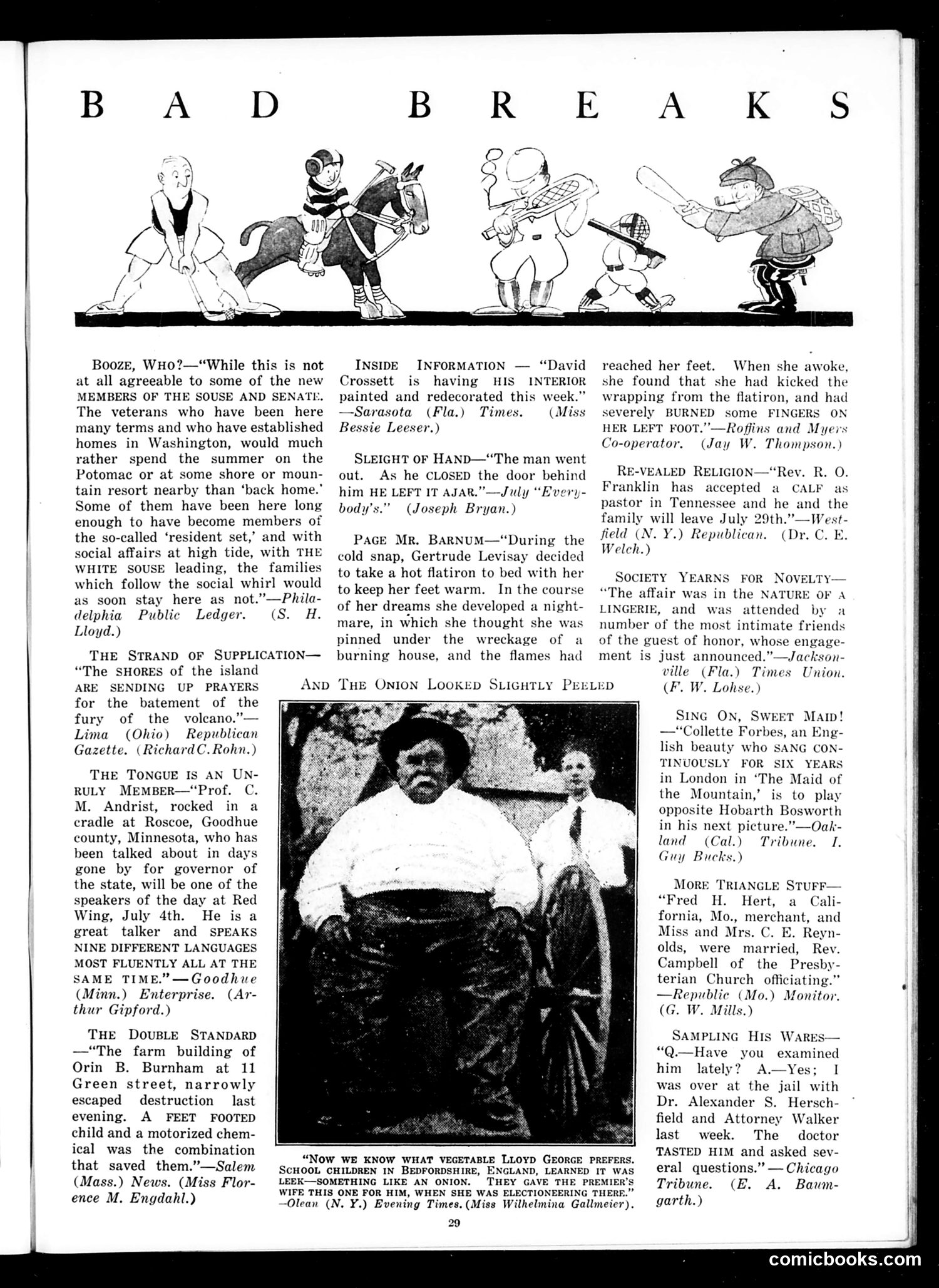
This Judge magazine page is a humor column featuring brief satirical news items, not political cartoons. The format mocks absurd or contradictory newspaper excerpts through wordplay and deliberate misreadings. **Key items:** - **"Booze, Who?"** jokes about Congressional members preferring Washington's social scene to their home districts—satirizing politicians' disconnection from constituents. - **"The Tongue is an Unruly Member"** ridicules Prof. Andrist's supposed ability to speak nine languages simultaneously—obvious hyperbole mocking newspaper exaggeration. - **The Lloyd George cartoon** (with photo) puns on British PM David Lloyd George preferring leeks, playing on "leek" sounding like "leak." - **"Page Mr. Barnum"** and other items find humor in newspapers' literal misreadings—a woman kicked off flatiron wrapping, not actual "fingers on her left foot." The page satirizes both incompetent journalism and human absurdity through careful attention to linguistic slip-ups and logical contradictions.
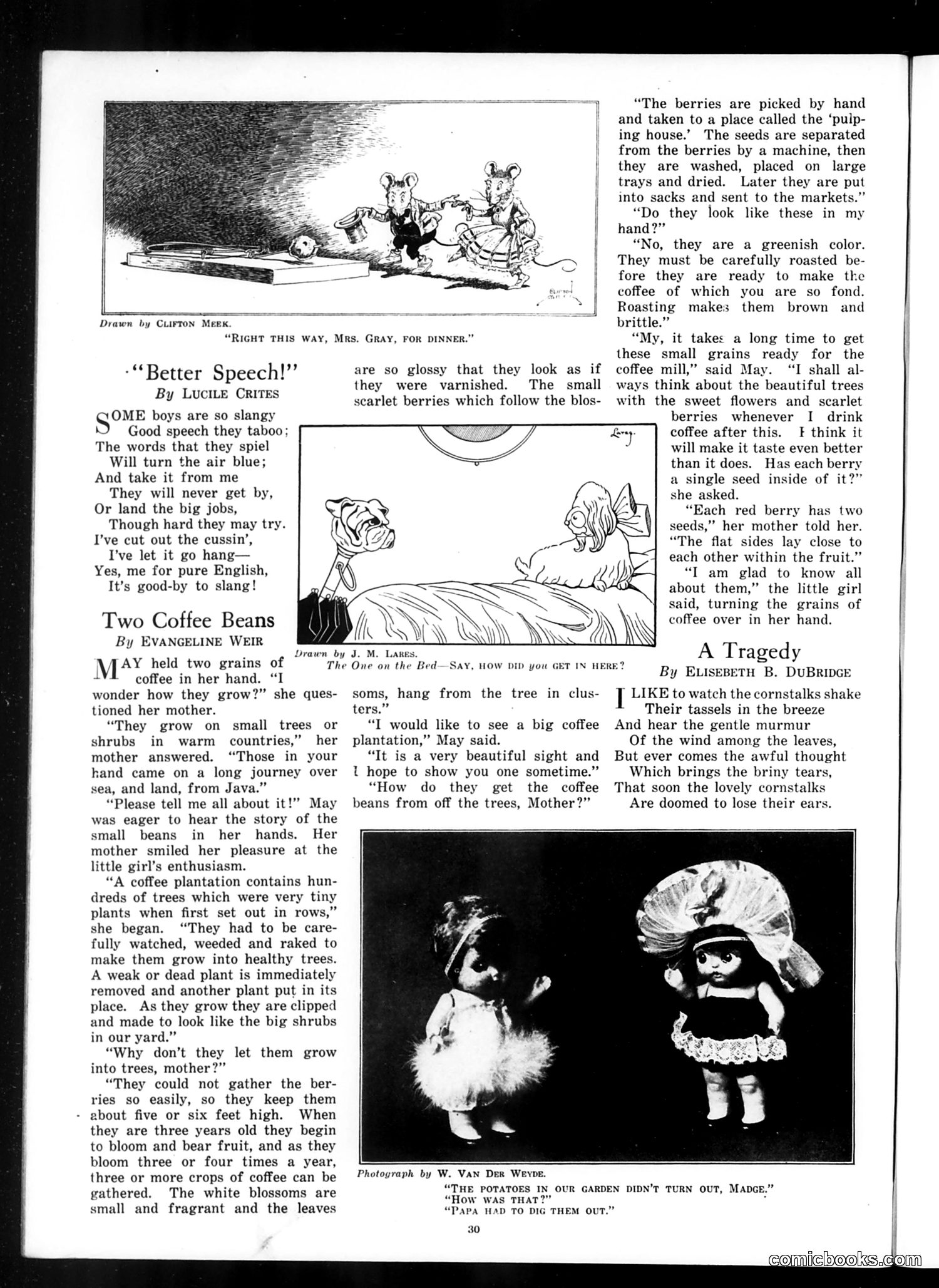
This page contains **three separate pieces of children's content**, not political satire: 1. **"Better Speech!"** — A poem encouraging boys to abandon slang and speak proper English, presented as moral instruction about social advancement ("land the big jobs"). 2. **"Two Coffee Beans"** — An educational dialogue between a mother and daughter about coffee cultivation in Java. The mother explains plantations, harvesting, processing, and roasting. This appears designed to teach children about colonial commerce and agricultural production. 3. **"A Tragedy"** — A humorous poem about corn losing its ears (a pun). The page also includes a photograph of dolls with a caption making a visual joke about potatoes requiring digging. **What's missing for modern readers**: The "Java" reference assumes familiarity with colonial coffee production. The emphasis on "proper English" reflects early 20th-century anxieties about immigrant speech and class markers. This isn't political commentary but rather **middle-class moral and educational content** typical of Judge's children's sections.
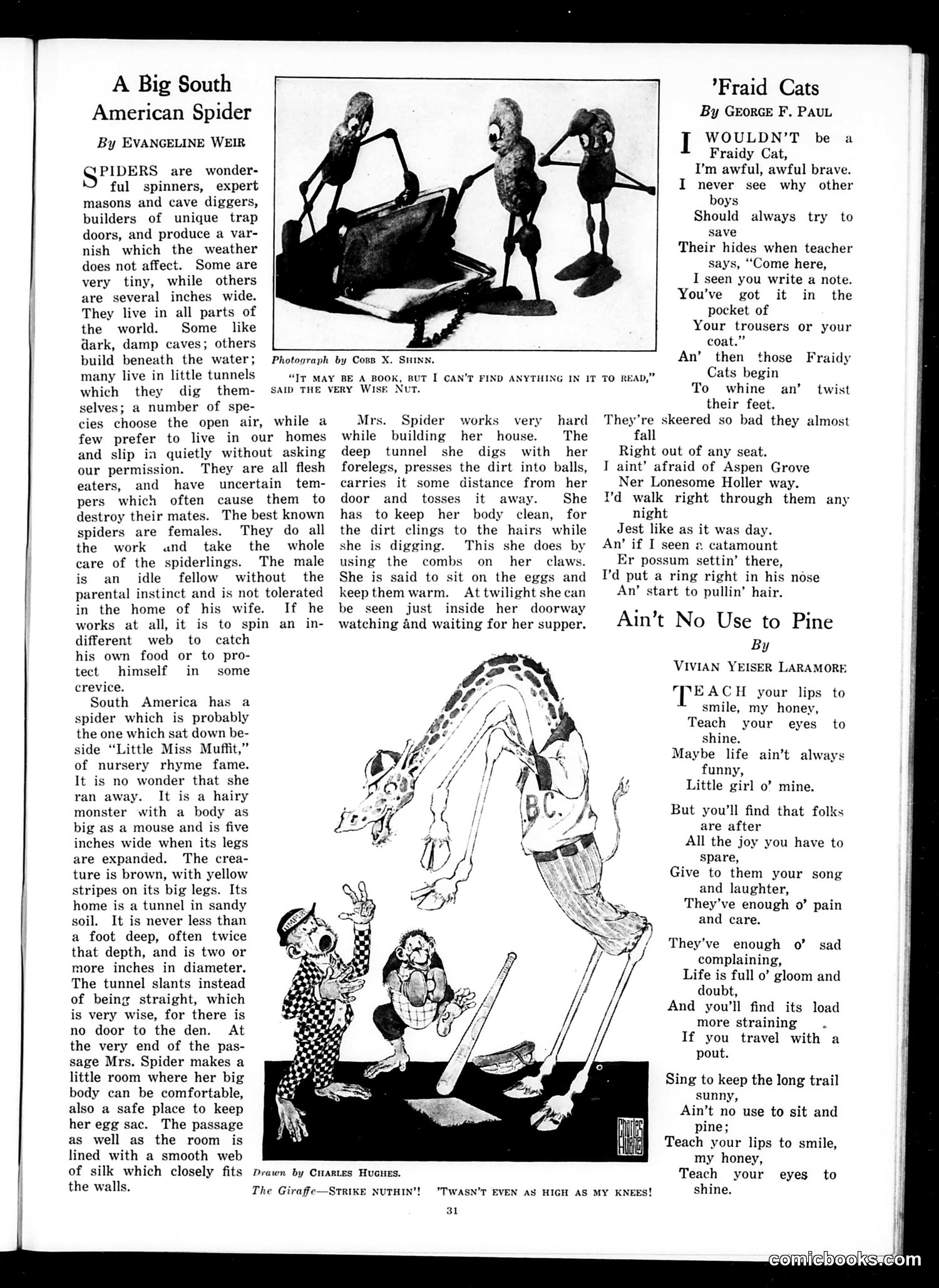
This page contains three unrelated pieces typical of Judge's mix of educational and humorous content: 1. **"A Big South American Spider"** (left): An educational article by Evangeline Weir describing spider biology and behavior, illustrated with photographs showing spiders and a "wise nut" character unable to read a book. This appears to be instructional content rather than satire. 2. **"Fraidy Cats"** (right): A humorous poem by George F. Paul mocking cowardly boys who hide notes from teachers, contrasted with a brave narrator who claims fearlessness. The humor is juvenile—typical of children's verse in the era. 3. **"Ain't No Use to Pine"** (bottom right): A sentimental poem by Vivian Yeiser Laramore encouraging a child to smile and share joy, as others need happiness. The page lacks political satire or caricature. It appears to be filler content—lighthearted verse and educational material—rather than the magazine's typical satirical commentary on public figures or social issues.
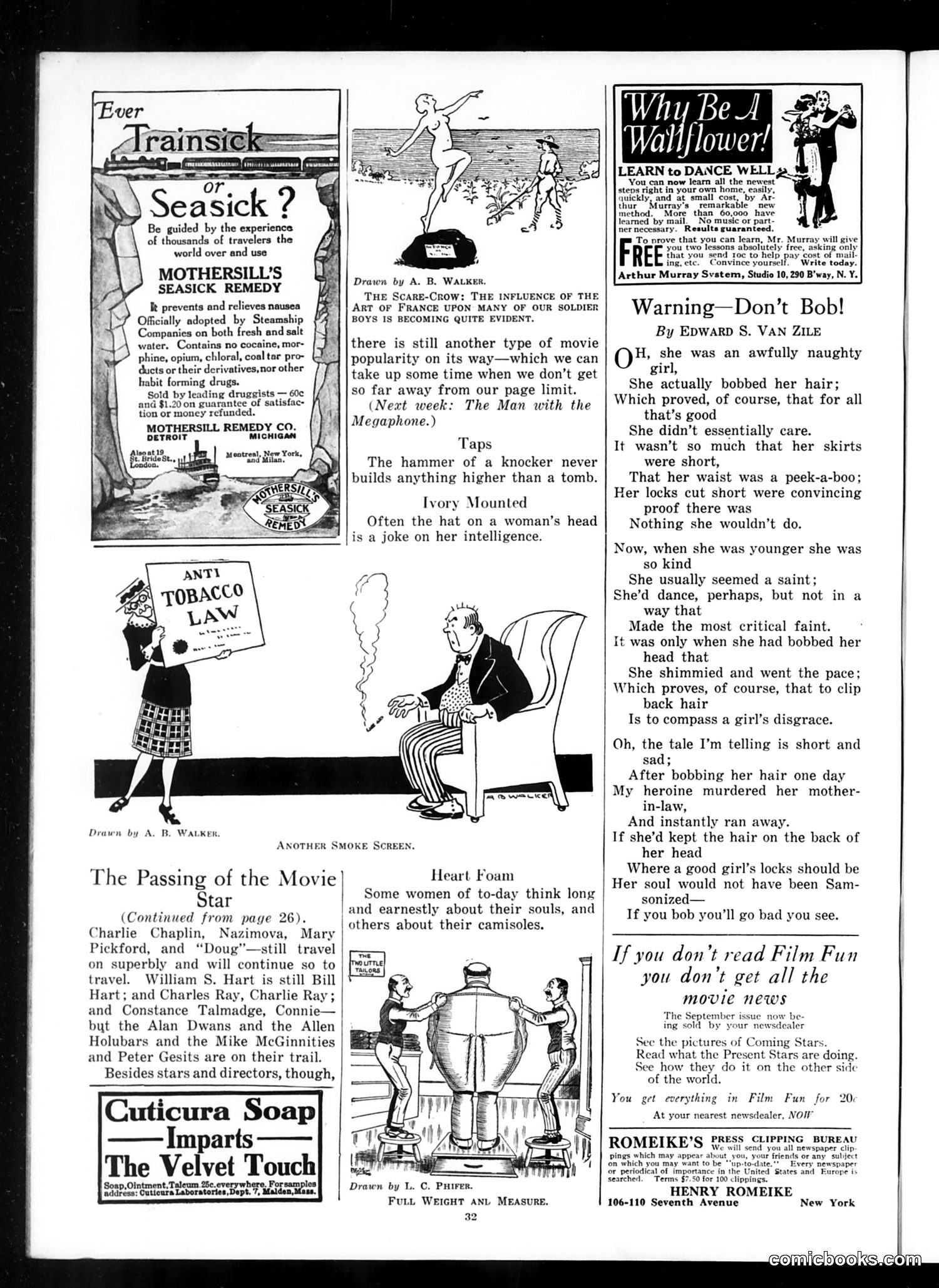
This page mixes advertisements with satirical content reflecting 1920s social anxieties about women's changing roles. **"Another Smoke Screen"** (cartoon by A.B. Walker) depicts a scarecrow-like soldier figure, captioned as commentary on French artistic influence on American servicemen returning from WWI—a satirical jab at perceived "decadence." **"Warning—Don't Bob!"** (poem by Edward S. Van Zile) is a moralistic screed against women's bobbed haircuts, a flashy symbol of 1920s modernity and female independence. The poem absurdly claims bobbing hair leads to moral corruption—the protagonist murders her mother-in-law after cutting her locks. This reflects genuine conservative backlash against the "New Woman" and her social freedoms during the Jazz Age. Other cartoons mock women's vanity and intelligence in period-typical ways. The advertisements (Mothersill's Seasick Remedy, Cuticura Soap, Arthur Murray dance lessons, anti-tobacco advocacy) were typical magazine filler, though the dance-lesson ad reflects entertainment's growing cultural importance.
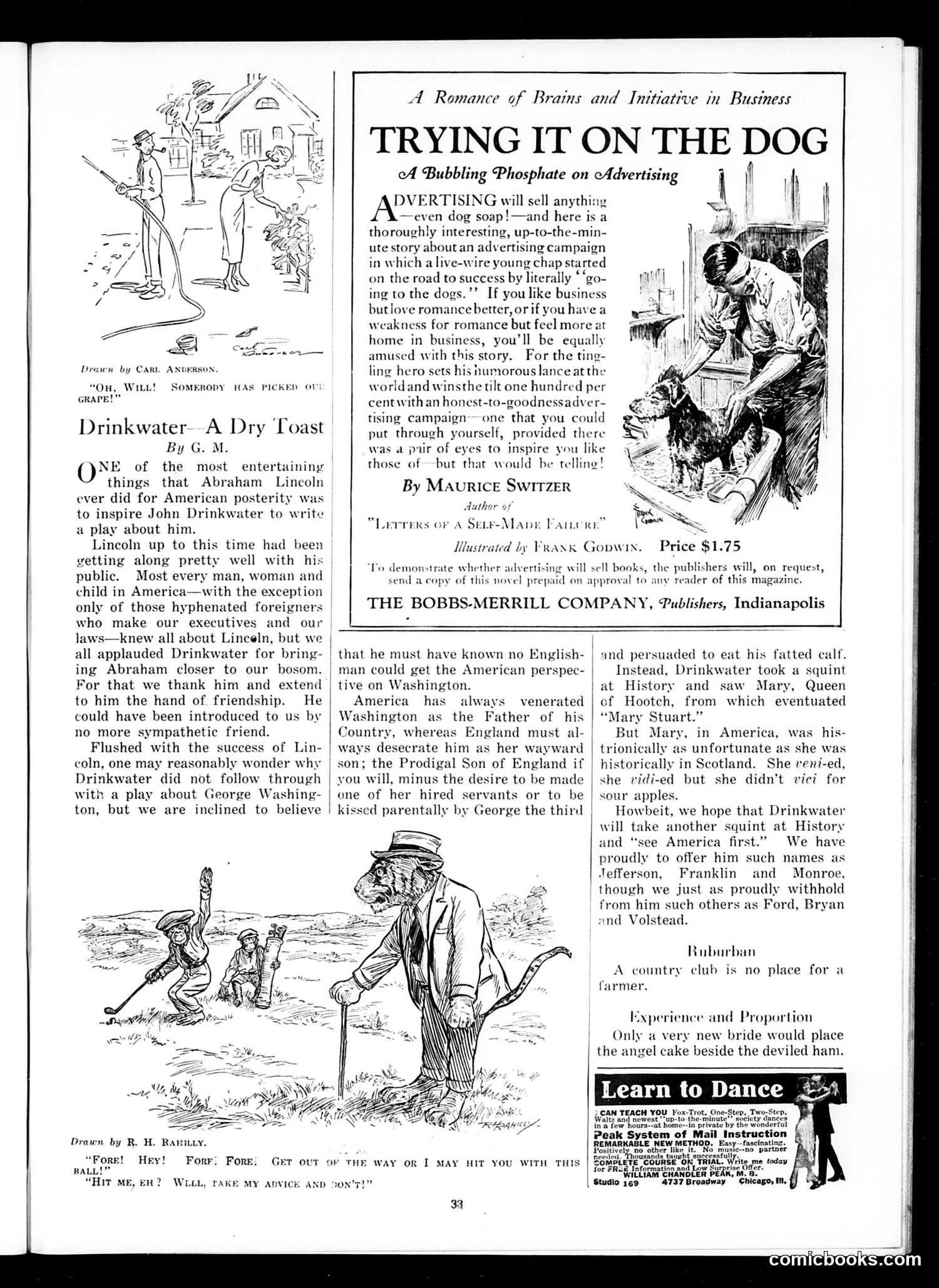
This page contains three distinct pieces: **"Drinkwater—A Dry Toast"** (left): A brief essay praising playwright John Drinkwater for writing a play about Abraham Lincoln, bringing the historical figure "closer to our bosom." The writer humorously questions why Drinkwater didn't then write about George Washington, noting that Americans revere Washington as "Father of his Country" while England views him as a "Prodigal Son." The essay suggests Drinkwater should instead celebrate American figures like Jefferson and Franklin—but pointedly *excludes* Ford, Bryan, and Volstead, likely contemporary controversial figures. **"Trying It on the Dog"** (right): An advertisement for a novel by Maurice Switzer about an advertising campaign, using the idiom "trying it on the dog" (testing something risky). The publisher offers free copies to interested readers. **Golf cartoon** (bottom): Two golfers arguing over proper etiquette—one warns the other to move or risk being hit; the other dismissively tells him to "take my advice and don't."
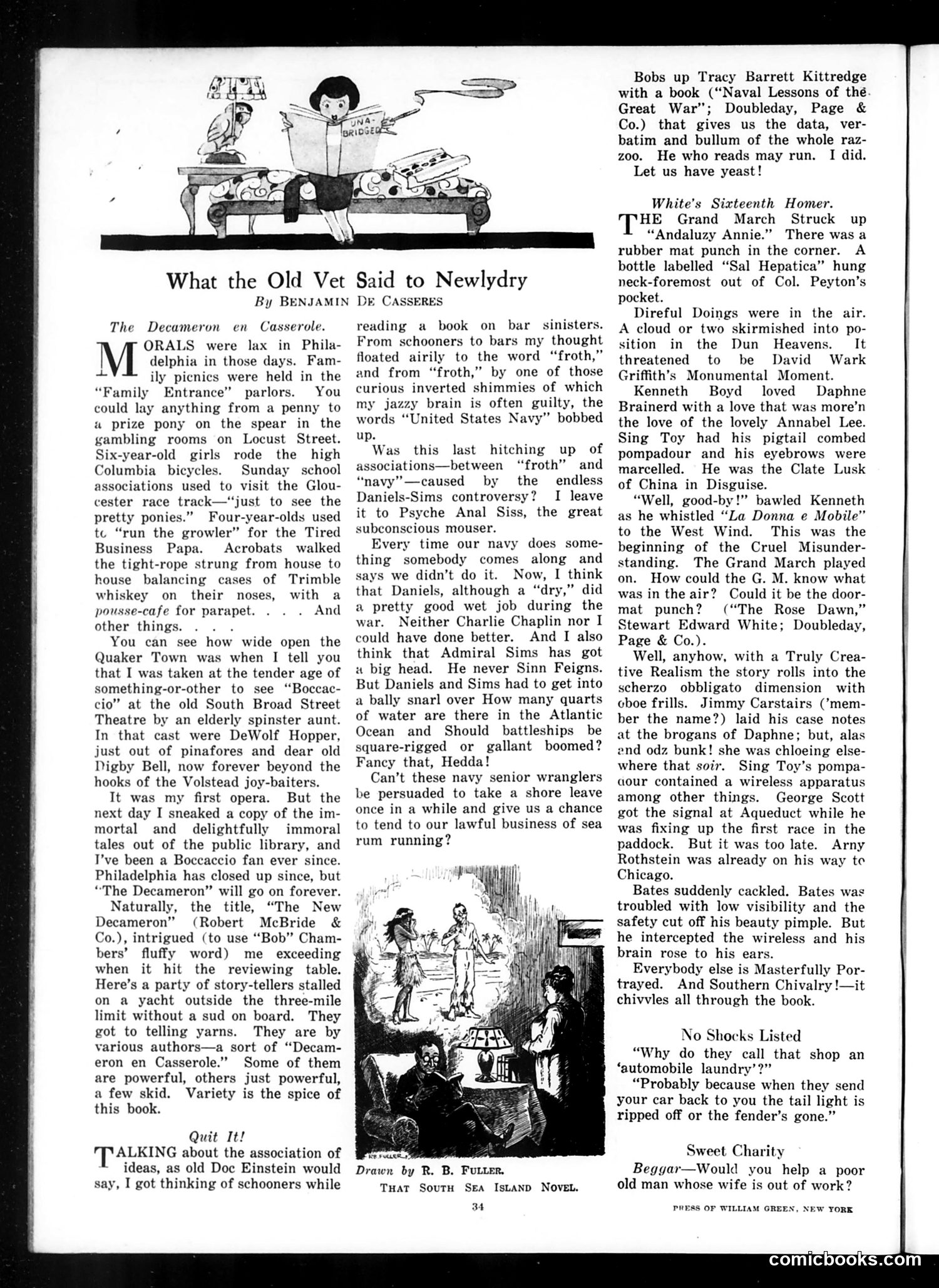
This is primarily **financial propaganda**, not satire or comedy. It's an advertisement from the Government Loan Organization promoting Treasury Savings Securities to workers. The "Wise Man Says" framing presents conventional financial advice: workers who save weekly will have security during economic hardship (referencing factory closures and unemployment). The message contrasts those who "never learn" to save against prudent savers who maintain a safety net. The page promotes establishing workplace savings associations to facilitate purchasing U.S. Treasury bonds. The appeal to "Uncle Sam's" securities and employer involvement suggests this is likely **World War I–era propaganda**, when the government encouraged citizen investment in war bonds as both patriotic duty and personal security. For modern readers: this represents early 20th-century employer-sponsored financial programs and government efforts to mobilize civilian savings for national purposes, dressed in motivational language about thrift and personal responsibility.
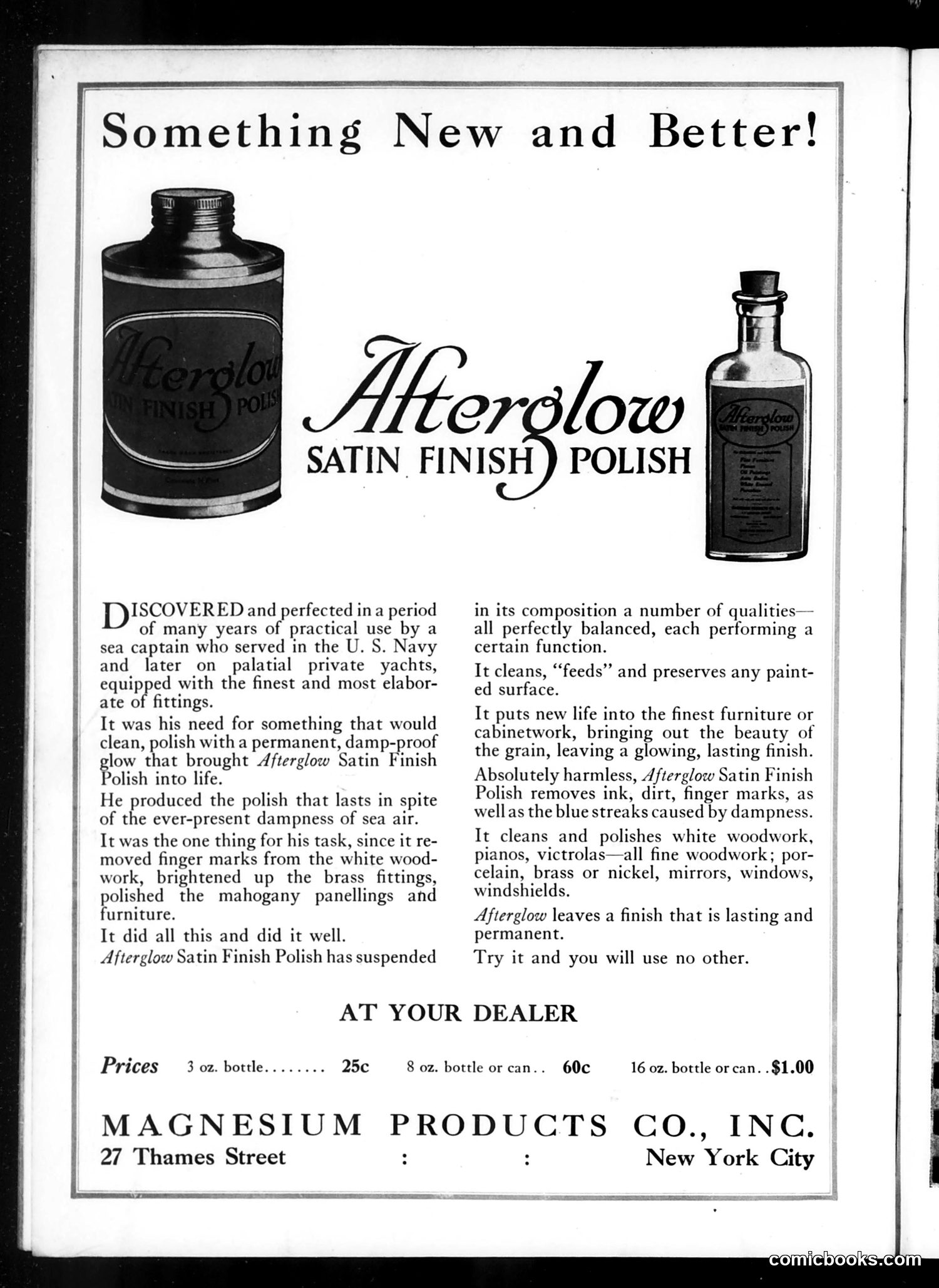
This is **not a cartoon or satirical content**—it's a straightforward product advertisement for Afterglow Satin Finish Polish, placed in Judge magazine. The ad promotes a furniture and woodwork polish supposedly developed by a U.S. Navy sea captain for use on naval vessels and private yachts. It claims the product removes fingerprints, ink stains, and dampness marks while polishing brass, mahogany, and white woodwork. The advertisement uses a common early 20th-century marketing strategy: attributing the product to expert/authority figures (naval officer) and luxury contexts (private yachts) to suggest quality and reliability. Prices range from 25¢ for 3 oz. to $1.00 for 16 oz., sold by Magnesium Products Co., Inc. in New York City. There is no satire, political commentary, or jokes visible—this is simply vintage advertising, likely from the 1920s-1930s based on typography and pricing.