
Judge, 1921-08-20 · page 30 of 36
Judge — August 20, 1921 — page 30: what you’re looking at
What you’re looking at
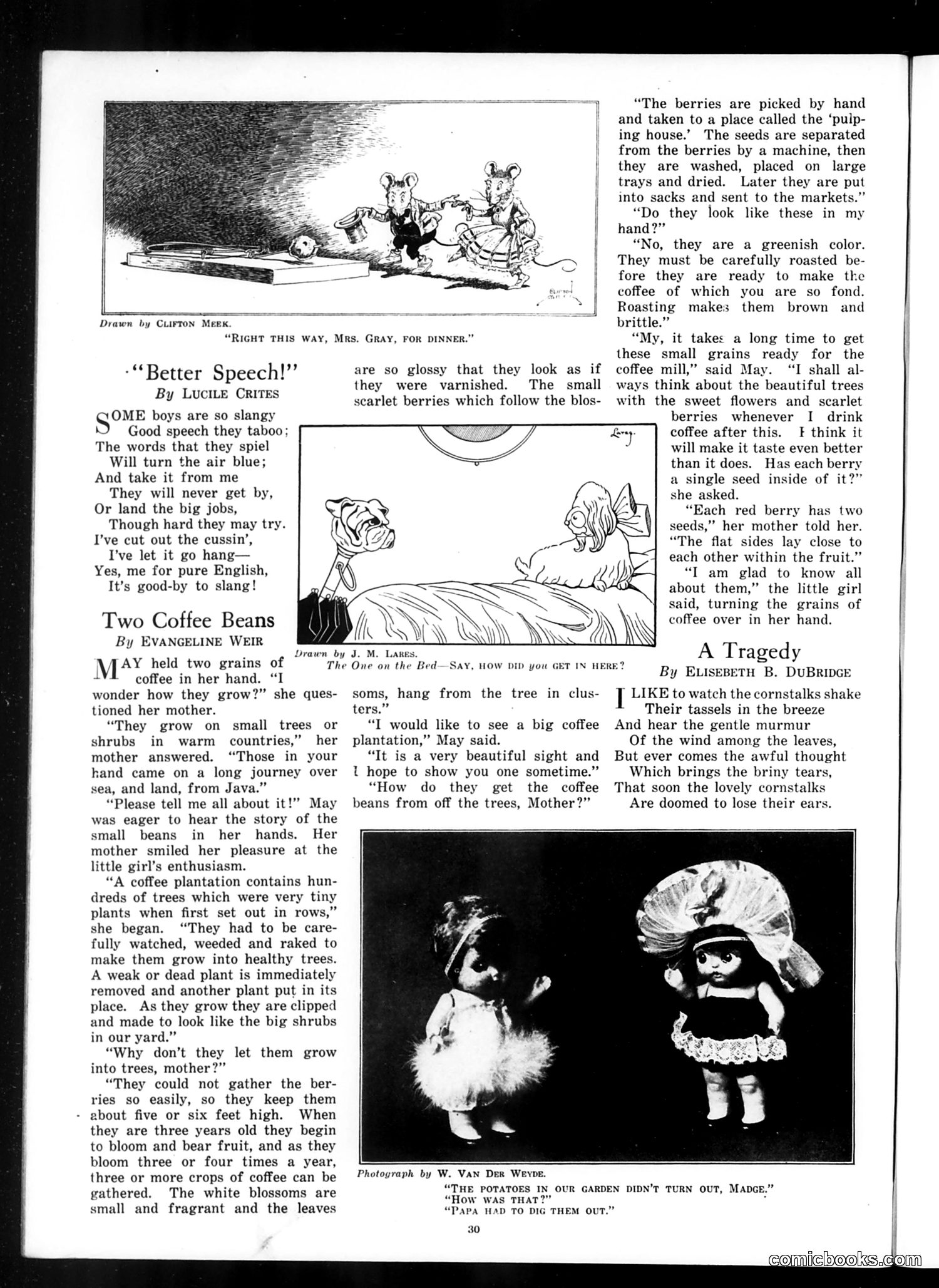
This page contains **three separate pieces of children's content**, not political satire: 1. **"Better Speech!"** — A poem encouraging boys to abandon slang and speak proper English, presented as moral instruction about social advancement ("land the big jobs"). 2. **"Two Coffee Beans"** — An educational dialogue between a mother and daughter about coffee cultivation in Java. The mother explains plantations, harvesting, processing, and roasting. This appears designed to teach children about colonial commerce and agricultural production. 3. **"A Tragedy"** — A humorous poem about corn losing its ears (a pun). The page also includes a photograph of dolls with a caption making a visual joke about potatoes requiring digging. **What's missing for modern readers**: The "Java" reference assumes familiarity with colonial coffee production. The emphasis on "proper English" reflects early 20th-century anxieties about immigrant speech and class markers. This isn't political commentary but rather **middle-class moral and educational content** typical of Judge's children's sections.
📄 Transcribed text from this page (OCR, searchable)
Machine-transcribed from the original scan — historical spelling and the odd misread are preserved.
Drawn by Cureton -“Better Speech!’’ By LUCILE CRITES SOME boys are so slangy K Good speech they taboo; The words that they spiel Will turn the air blue; And take it from me They will never get by, Or land the big jobs, Though hard they may try. I’ve cut out the cussin’, I’ve let it go hang— Yes, me for pure English, It’s good-by to slang! Two Coffee Beans By EVANGELINE WEIR “RIGHT THIS WAY, MRS. GRAY, FOR DIN are so glossy that they look as if they scarlet berries which follow the blos- were varnished. The small Drawn by J. M. Lanes. M AY held two grains of * coffee in her hand. “I wonder how they grow?” she ques- tioned her mother. “They grow on small trees or shrubs in warm countries,” her mother answered. “Those in your hand came on a long journey over sea, and land, from Java.” Please tell me all about it!” May was eager to hear the story of the small beans in her hands. Her mother smiled her pleasure at the little girl’s enthusiasm. “A coffee plantation contains hun- dreds of trees which were very tiny plants when first set out in rows,” she began. “They had to be care- fully watched, weeded and raked to make them grow into healthy trees. A weak or dead plant is immediately removed and another plant put in its place. As they grow they are clipped and made to look like the big shrubs in our yard.” “Why don’t they let them grow into trees, mother?” “They could not gather the ber- ries so easily, so they keep them - about five or six feet high. When they are three years old they begin to bloom and bear fruit, and as they bloom three or four times a year, three or more crops of coffee can be gathered. The white blossoms are small and fragrant and the leaves The One on the Bed soms, hang from the tree in clus- ters.” “I would like to see a big coffee plantation,” May said. “It is a very beautiful sight and l hope to show you one sometime.” “How do they get the coffee beans from off the trees, Mother?” SAY, HOW DID you GET IN HERE? “The berries are picked by hand and taken to a place called the ‘pulp- ing house.’ The seeds are separated from the berries by a machine, then they are washed, placed on large trays and dried. Later they are put into sacks and sent to the markets.” “Do they look like these in my hand?” “No, they are a greenish color. They must be carefully roasted be- fore they are ready to make the coffee of which you are so fond. Roasting makes them brown and brittle.” “My, it takes a long time to get these small grains ready for the coffee mill,” said May. “I shall al- ys think about the beautiful trees with the sweet flowers and scarlet berries whenever I drink coffee after this. F think it will make it taste even better than it does. Has each berry a single seed inside of it?” she asked. “Each red berry has two seeds,” her mother told her. “The flat sides lay close to each other within the fruit.” “T am glad to know all about them,” the little girl said, turning the grains of coffee over in her hand. A Tragedy By ELISEBETH B. DUBRIDGE LIKE to watch the cornstalks shake Their tassels in the breeze And hear the gentle murmur Of the wind among the leaves, But ever comes the awful thought Which brings the briny tears, That soon the lovely cornstalks Are doomed to lose their ears. Photograph by W. VAN Der Wevve. “THE POTATOES IN OUR GARDEN DIDN’T TURN OUT, MADGE.” “How was THAT?” . “PAPA HAD TO DIG THEM OUT.” 30